Sunday, April 29, 2012

Robert Avrett (1901-1975)

Né William Robert Avrett
Teacher, Poet, Author, Translator, Reader
Born December 1, 1901, Milam County, Texas
Died November 23, 1975, Milam County, Texas

William Robert Avrett, called "Billie" as a child and Robert as an adult, was born on December 1, 1901, in Milam County, Texas. The 1928 yearbook for the University of Texas in Austin gave his hometown as Cameron. Avrett graduated that year, 1928, with a master's degree and a thesis called "Philosophical and Mystical Elements in the Poetry of Enrique Gonzalez Martinez." On the strength of his degree and his knowledge of the Spanish language, Avrett taught at the College of Mines and Metallurgy in El Paso, Texas (now the University of Texas at El Paso or UTEP), and the Argentine-North American Cultural Institute in Buenos Aires. He spent the greater part of his career at the University of Tennessee, from 1947 until his retirement. Avrett also studied under a fellowship at the University of Pennsylvania.

An author of non-fiction, poetry, and even a children's book, Avrett contributed to magazines and journals as varied as Kaleidograph, Hispania, Holland's, Wings, Nature Magazine, Harper's Magazine, All-Story Love Stories, The Romantic Review, Woman's World, The Acolyte, and of course Weird Tales. He also wrote a brief biography of New Hampshire poet laureate Paul Scott Mowrer (1887-1971) and was the recipient of the Henry H. Bellaman Foundation award in 1960. Averett's books include:
  • Outline Spanish Review Grammar (non-fiction, 1940)
  • The Dream Comes First (verse, 1949)
  • Spanish in Review (non-fiction, 1959)
  • Against the Dark (verse, 1961)
  • The Timid Pup (children's book, 1964)
William Robert Avrett died on November 23, 1975, in Milam County, Texas.

Robert Avrett's Poems in Weird Tales
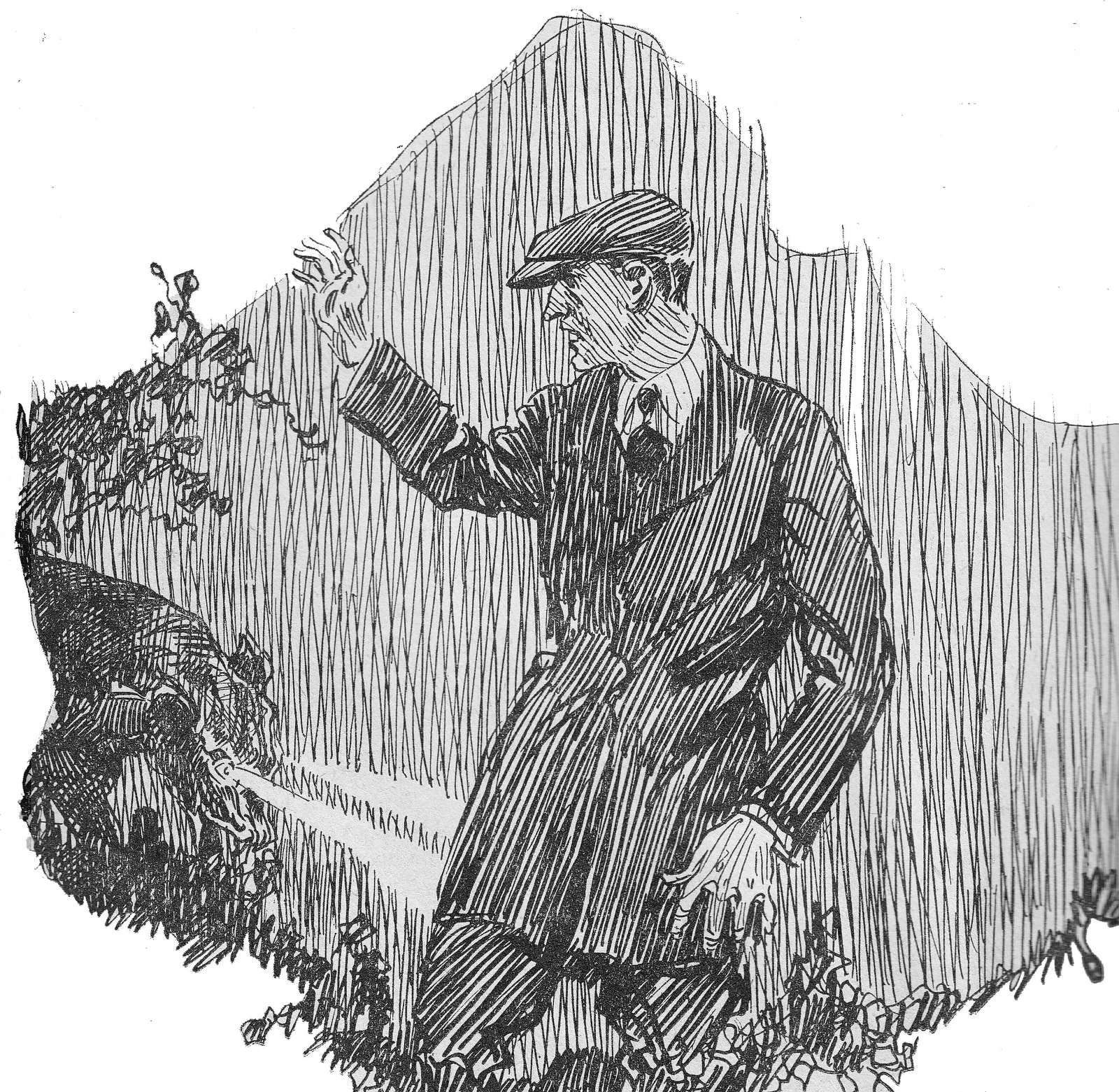
"On Hangman's Hill" (May 1935)
"The Devil's Swamp" (Mar. 1936)

Further Reading
I'm afraid I don't know of any further reading on Robert Avrett.

"Witches' Sabbath," a poem by Robert Avrett from The Acolyte #10.
And "Grecian Rhapsody" from The Acolyte #11.
In 1964, Avrett published a children's book, The Timid Pup, illustrated by Haris Petie.
Thirty-six years earlier, as a master's student at the University of Texas, Avrett had written a thesis whose title was a scholarly mouthful. I am reminded of a quote by Pablo Picasso: "It took me four years to paint like Raphael, but a lifetime to paint like a child."

Thanks to Randal A. Everts for further information.
Text and captions copyright 2012, 2023 Terence E. Hanley 

Saturday, April 28, 2012

H.S.W. Chibbett (1900-1978)

Aka Hastwa
Government Worker, Author, Paranormal Investigator, Science Fiction Fan
Born February 19, 1900, Islington, London, England
Died February 23, 1978, Greater London, England

Harold Stanley Walter Chibbett, also known as Harold S.W. Chibbett, Hal Chibbett, or Hastwa, was born on February 19, 1900, in Islington, London, England. He worked for the Inland Revenue--more or less equivalent to our Internal Revenue Service--in his home country for forty-three years, retiring in 1965. In that time, he served as secretary of the Science Fiction Association (SFA), attended British science fiction conventions (Eastercon, 1944; Whitcon, 1948), investigated paranormal and Fortean phenomena, and wrote fiction for a number of fantasy magazines. Chibbett also issued his own newsletter on his investigations. His output was otherwise sparse. Chibbett died four days after his birthday, on February 23, 1978, in Greater London. Science fiction historian Mike Ashley reported Chibbett's death to The Weird Tales Collector. An article and checklist appeared in issue number 4 in 1978. I have expanded on that list by looking for sources on the Internet. My list is by no means definitive:

Fiction by H.S.W. Chibbett
"See?" and "Bottled Spirit" in Jinn & Jitters, E.J. Carnell, editor (Pendulum, 1946 or 1948)
"Turnabout" in Fantasy Book 3 (Summer 1948)
"They Worked the Oracle" in Weird Tales (Nov. 1950)
"They That Wait" in Magazine of Horror (Feb. 1964)

Non-Fiction by H.S.W. Chibbett
"Psychic Scents" in Outlands (Winter 1946, reprinted in Fate, Dec. 1950)
"Shapes of Being" in Round Robin (July/Aug. 1954)
"UFO's and Parapsychology" in Ouranos (Aug. 1954, reprinted in Flying Saucer Review, Aug. or Sept. 1969)
"Strange Interlude" in Round Robin (Dec. 1954)
"Aboard a Flying Saucer by Hypnosis" in Mystic Magazine (Feb. 1955)
"The Poltergeist That Can Write" in Fate (Oct. 1959)

H.S.W. Chibbett's Story in Weird Tales
"They Worked the Oracle" (Nov. 1950)

Further Reading
It can be hard to find Chibbett on the Internet because of all possible combinations of his names and initials, but keep looking. You may find something of interest.

H.S.W. Chibbett's byline appeared on the cover of the British fantasy magazine Jinn & Jitters. The cover art is by Mendoza.
Almost twenty years later, it appeared again on the cover of Robert W. Lowndes' Magazine of Horror and Strange Stories. Other contributors to Weird Tales shown here: David H. Keller, Arthur J. Burks, Robert W. Chambers, Ambrose Bierce, and H.G. Wells. Note the British price stamped on the cover.
Chibbett's name wasn't on the cover of Mystic Magazine in February 1955, but his investigations into hypnosis and flying saucers could be found on the inside. Raymond A. Palmer was the force behind the magazine. No wonder that top billing on the cover went to a story about Richard S. Shaver, "America's Mystery Man." Note the title "It Happened To Me." That same title was used for a series in Weird Tales in the early 1940s.
H.S.W. Chibbett (1900-1978). Photo from the collection of Randal A. Everts.

Text and captions copyright 2012, 2023 Terence E. Hanley

Friday, April 27, 2012

Weird Tales Books

Strange Angel: The Otherworldly Life of Rocket Scientist John Whiteside Parsons by George Pendle

I just finished reading a very interesting book, one that any student of popular fiction in America might enjoy. It's called Strange Angel: The Otherworldly Life of Rocket Scientist John Whiteside Parsons, and it was written by British biographer George Pendle (Harcourt, 2005, 333 pp.). Reading this book was a revelation to me: I have heard of John Whiteside Parsons (1914-1952) only in passing and didn't know anything about the origins of the Jet Propulsion Laboratory in Pasadena, California. Parsons, a largely self-taught chemist, rocketeer, and expert on explosives, was there at the beginning, or I should say before the beginning. Strangely enough, Parsons was also involved in Aleister Crowley's version of "magick" to the point that he attempted to conjure beings from another realms into our own--and may have believed at one time that he had done so. The cast of Parsons' life story is large and varied. It includes mathematicians and magicians, physicists and occultists, straight arrows and flim-flam men, bohemians and pillars of academia and government. Fans of Weird Tales will find some of the magazine's contributing authors in the pages of this book: Robert A. Heinlein, L. Sprague de Camp, Isaac Asimov, Ray Bradbury, Forrest J Ackerman, Cleve Cartmill, Anthony Boucher, Jack Williamson, and Dr. David H. Keller. "The Unique Magazine" even earns mention itself in Strange Angel.

Strange Angel also reveals something about the intersection of science and magic and about how religious belief might grow out of the yearnings of science fiction. The related religions of flying saucers and Scientology are examples, and that brings me to another character in the life story of John Whiteside Parsons, none other than the inventor of Scientology, L. Ron Hubbard. At the end of World War II, Hubbard found himself not only in Pasadena but also in Parsons' own home. The naïve and ingenuous Parsons was a perfect mark for Hubbard. It didn't take Hubbard long to bilk Parsons of his savings and to run away to Florida with his mistress. L. Sprague de Camp had this to say in a letter to Isaac Asimov (dated August 27, 1946, and quoted directly from the book):
The more complete story of Hubbard is that he is now in Fla. living on his yacht with a man-eating tigress named Betty-alias-Sarah [Parsons' former mistress], another of the same kind . . . He will probably soon thereafter arrive in these parts with Betty-Sarah, broke, working the poor-wounded-veteran racket for all it's worth, and looking for another easy mark. Don't say you haven't been warned. Bob [Robert Heinlein] thinks Ron went to pieces morally as a result of the war. I think that's fertilizer, that he always was that way, but when he wanted to conciliate or get something from somebody he could put on a good charm act. What the war did was to wear him down to where he no longer bothers with the act.
Say what you will about L. Sprague de Camp, but he knew enough about human nature to pierce to the heart of the matter, to recognize the man behind the mask.

Finally, a piece of trivia: John Whiteside Parsons' real first name was Marvel. By reading this book, you may decide that Parsons' given name was not far from telling the truth about him.


Text copyright 2012, 2023 Terence E. Hanley

Thursday, April 26, 2012

Illustrations by Heitman


Illustrations by William F. Heitman or attributable to William F. Heitman, from Weird Tales magazine. From top to bottom: "Hypnos" by H.P. Lovecraft (May/June/July 1924); "Imprisoned with the Pharaohs" by Harry Houdini (May/June/July 1924); "The Rats in the Walls" (Mar. 1924) by H.P. Lovecraft; "The Hound" by H.P. Lovecraft (Feb. 1924); "The White Ape" by H.P. Lovecraft (Apr. 1924). The only one of these five illustrations with a signature is the last, but before the November 1924 issue--the first with Farnsworth Wright as editor--only William Heitman received credit as an interior artist. These illustrations look to be the work of one artist. I think it's safe to assume they're all by Heitman. I can comment on their quality as well, if only to say that, judging from these illustrations, Robert Weinberg may have been a little hard on Heitman. Each has its merits. The illustration for "The White Ape" (also called "Arthur Jermyn") I think is most effective and my favorite among them.

These images are courtesy of Alan Husby. I have altered them somewhat to improve their appearance (I hope) and to remove the text.

Text copyright 2012, 2023 Terence E. Hanley

Monday, April 23, 2012

Dorothy McIlwraith (1891-1976)-Part 3

More on Dorothy McIlwraith, including the first known photograph of her to appear on the Internet. The poem was published in Munsey's in 1927.

Poet and editor Dorothy Stevens McIlwraith (1891-1976)

Yesterday, April 22, 2012, was the first birthday of my blog, Tellers of Weird Tales. Today's entry is the 199th. Only a few hundred more to go, and I will have covered all the artists and writers who contributed to "The Unique Magazine." Stay with me.

Scans of the poem and the photograph are by Randal A. Everts. Original sources are from his collection.

Original text copyright 2012, 2023 Terence E. Hanley

Wednesday, April 18, 2012

William F. Heitman (1878-1945)

Artist, Illustrator, Cartoonist
Born January 31, 1878, Germany
Died January 10, 1945, Miami, Florida

Much of the very early history of Weird Tales magazine is shrouded in mystery. Launched in 1923 by Jacob Clark Henneberger, Weird Tales was based in Indianapolis and drew heavily upon writers and artists from the Midwest for its content. Wherever you read an index of the authors, artists, and stories that appeared in "The Unique Magazine," you're sure to see the name "Heitman" as artist, sometimes the sole artist on a given issue. So who was this mysterious Heitman? The answer, which may very well be revealed here for the first time in print (even if it is digital), is William F. Heitman, a rapid-fire newspaper illustrator of the early twentieth century.

William Fred Heitman, later nicknamed Bill and Heit, was born on January 31, 1878, in Germany and came to the United States as a young child with his parents, Bernard Heitman (1830-1891) and Anna (Santmann) Heitman (1838-1920). As a boy, Heitman lived in Indianapolis and Fort Wayne. He went to work for the Van Camp Company as a sign painter and decided then to become an artist. Heitman studied at the Indiana School of Art under William Forsyth, worked for the Indiana Illustrating Company, and finally landed a job as an illustrator with the Indianapolis News in about 1897. Heitman spent the rest of his career doing layouts, illustrating feature stories, and drawing cartoons and caricatures for newspapers in Indianapolis, Cleveland (the Plain Dealer), and St. Louis (the Globe-Democrat). Other artists with whom he worked included Sidney Smith (later of The Gumps), Johnny Gruelle (Raggedy Ann), and his close friend, Chic Jackson, creator of Roger Bean.

When the year 1923 rolled around, William Heitman was drawing for the Indianapolis Star. Known as one of the fastest penmen in the Midwest, he seems to have been johnny-on-the-spot for J.C. Henneberger, publisher of Weird Tales. The first two issues of the magazine--March and April 1923--lacked interior illustrations. But until Andrew Brosnatch came along in November 1924 (the first issue with Farnsworth Wright as editor), Heitman was the only credited artist on the inside of Weird Tales. He also created two covers for the magazine, the May and June issues of 1923.

Weird Tales expert Robert Weinberg was not kind to Heitman. In his Weird Tales Story (1977), Mr. Weinberg wrote:
The first issue [of Weird Tales] featured no illustrations at all. Artwork used in the next year was poor. All were small pictures with little attempt at the weird or unusual. Artwork was mainly done by Heitman, an artist notable mainly for his complete lack of imagination. Heitman's specialty was taking the one scene in a frightening story that featured nothing at all frightening or weird and illustrating that. It was Heitman who illustrated nearly all of H.P. Lovecraft's early stories in Weird Tales (1) and he succeeded in capturing none of Lovecraft's mood of brooding, building horror.
I haven't seen any of William Heitman's illustrations for the interior of Weird Tales. [Update: That has since changed, as whole issues of Weird Tales are now available on line.] I can judge him only by his covers. We can judge him partly by his covers. His first (May 1923), showing a witch or sorceress and her cauldron, is a passable drawing, although the male figure seems a little stiff. [Update: There's a reason for the difference, as the female figure is a swipe, while the male figure appears to be Heitman's own drawing. Click here to see an explanation.] I hate to say that his second (June 1923), showing an ape attacking a young woman, is practically inept. The female figure is particularly bad.

So why did an otherwise competent artist produce such work for Weird Tales? It could be that J.C. Henneberger or his editor was not particularly interested in illustration. I think it's more likely that they worked with an artist who was: a) close at hand, b) fast, c) cheap, and d) perhaps the only man available to them. I think it's safe to say Heitman was close at hand and fast. I don't have any idea whether he was cheap or not. As for being the only man available: publisher and editor may not have looked very hard. I guess we should remember that Heitman was working full time for the Indianapolis Star at the same time he was drawing pictures for Weird Tales. We might also consider that if it weren't for Heitman, there may not have been any illustrations in Weird Tales during its first year and a half in print.

In any case, Heitman was replaced when Farnsworth Wright became editor. Andrew Brosnatch became the workhorse and carried the magazine through until June 1926. Heitman's last credits were for the issue of June 1925. Heitman continued to work for the Indianapolis Star until retiring in 1943. He died in Miami, Florida, the home city of his daughter, on January 10, 1945. His body was returned to Indianapolis for burial at St. Joseph Catholic Cemetery.

Note
(1) According to Jaffery and Cook's Collector's Index to Weird Tales, the only illustration for a Lovecraft story for which Heitman received credit was "The White Ape" (Apr. 1924).

William F. Heitman's Covers and Interior Illustrations for Weird Tales
Covers
  • May 1923
  • June 1923, illustrating "The Murders in the Rue Morgue" by Edgar Allan Poe
Interior Illustrations
May 1923
  • "The Floor Above" by M.L. Humphreys
June 1923
  • "Desert Madness" by Harold Freeman Miners
  • "Jack O'Mystery" by Edwin McLaren
  • "The Blade of Vengeance" by George Warburton Lewis
July-Aug. 1923
  • "Senorita Serpente" by Earl Wayland Bowman
  • "The Room in the Tower" by D.L. Radway
Sept. 1923
  • "The People of the Comet" by Austin Hall
  • "The Cup of Blood" by Otis Adelbert Kline
Nov. 1923
  • "The Closed Room" by Maybelle McCalment
  • "The Spider" by Arthur Edwards Chapman
Jan. 1924
  • "The Hand of Fatma" by Harry Anable Kniffin
Mar. 1924
  • "The Spirit Fakers of Hermannstadt" by Harry Houdini
  • "Yellow and White" by George Fuller
Apr. 1924
  • "The Hoax of the Spirit Lover" by Harry Houdini
  • "The White Ape" by H.P. Lovecraft
  • "The Devil Bird" by Hal Halbert
  • "The Ghost-Eater" by C.M. Eddy, Jr.
May-June-July 1924
  • "The Hand" by H. Francis Caskey
  • "The Purple Death" by Edith Lytle Ragsdale
  • "An Egyptian Lotus" by Mrs. Chetwood Smith
Feb. 1925
  • "The Tomb-Dweller" by Alice I. Fuller
  • "Into the Fourth" by Adam Hull Shirk
May 1925
  • "Seignior Vanna's Jest" by Stanley S. Schnetzler
  • "The Sobbing Bell" by James C. Bardin
  • "Imprisoned for Thirty Centuries" by Romeo Poole
  • "The Lip" by Arthur Styron
June 1925
  • "Black Hill" by Frank Owen
  • "The Soul That Waited" by Louis B. Capron

Weird Tales, May 1923, the third issue of the magazine, with cover art by William F. Heitman. [Update: This is a partial swipe from the frontispiece, drawn by an unknown artist, of the book The Lock and Key Library: The Most Interesting Stories of All Nations, Old Time English, edited by Julian Hawthorne (New York: The Review of Reviews Co., 1915). Click here to read more.] 
And the cover for the fourth issue, June 1923, a step down for the artist. I'll have to study the covers of Weird Tales, but this would have to be a candidate for the worst cover of the magazine. It's not that it's poorly conceived or poorly designed, but the handling of the figures, especially that of the woman, seems to be the result either of an artist in a hurry or just plain bad draftsmanship.
Proof that William Heitman could draw: an illustration for a poem by the Indiana poet Tramp Starr (Carl Wilson) from the Indianapolis Star, January 7, 1940. 
And a drawing from the same paper illustrating a feature on the Mechanic Arts School in Evansville, Indiana, May 5, 1940. Experienced in journalistic illustration, Heitman may simply have been ill suited to fantasy art. We should remember that a lot of early fantasy art was not very well done. After all, this was a new world of illustration.

Updated on January 7, 2026, prompted by the comment below. Thank you to Jerimee for the prompt.
Thanks to a reader for corrections and further information.
Text and captions copyright 2012, 2023 by Terence E. Hanley

Isa-belle Manzer (1872 or 1873-1944)

Née Hattie Belle Sprague
Author
Born May 14, 1872 or 1873, Genesee, Michigan
Died August 11, 1944, San Fernando, California

A reader of my blog requested that I write about some authors from the early days of Weird Tales. Isa-belle Manzer will have to come first. Researching women authors is often difficult for at least two reasons. First, women usually took their husbands' names and can be hard to track in public records. Second, they were often housewives and did not list an occupation at the decennial census. In starting my research on Isa-belle Manzer, I looked for her under that name and found a candidate in Milwaukee. Then my reader pointed out that she had written a letter to Weird Tales in November 1923, signed Mrs. D.M. Manzer, Amarillo, Texas. It didn't take long for me to find what I think was the real Isa-belle.

She was born Hattie Belle Sprague in Genesee, Michigan, on May 14, 1872 (according to the 1900 census) or 1873 (according to a list of deaths in California). Her father, Cornelius F. Sprague (1830-1913), was a farmer. Her mother, Elizabeth Sprague (1836-1903), called Betty or Betsy, may have been a physician. (The 1880 census record is somewhat ambiguous. That census showed the family living in Lane County, Kansas.) The Spragues had eleven children altogether, six of whom died young. By 1900, Hattie Belle Sprague had married, borne a son, and had been widowed. Her dead husband was named Crouch and her son Raymond. At that census, Hattie was working as a hotel housekeeper in Jackson Township, Sac County, Iowa. She remarried in about 1901. Her new husband, Deward Martin Manzer (1877-1940), was a laborer and a salesman. Nineteen twenty found the Manzer family living in Antelope, Nebraska. By 1930, they had relocated to Amarillo, Texas. Together they had, I believe, four children.

As I said, Isa-Belle Manzer wrote a letter to Weird Tales, published in the November issue, 1923. In her letter (according to my reader), she told about a story that she hoped to have published in the magazine. The editor, Edwin Baird, asked his readers for their opinion. Whether they clamored for Isa-belle's tale or not, it was published as "The Transparent Ghost" in a three-part serial in February, March, and April 1924. By the time the serial came to an end, Weird Tales was in trouble as it had been and would be so many times. The next issue was a giant-sized triple issue marking the first anniversary of the magazine. Hattie Belle Manzer never again wrote a story for or letter in Weird Tales. On August 11, 1944, she died in San Fernando, California.

Isa-Belle Manzer's Letter and Story in Weird Tales
Letter to "The Eyrie" (Nov. 1923)
"The Transparent Ghost" (three-part serial, Feb., Mar., and Apr. 1924)

Further Reading
Unfortunately, I don't know of any further reading on Isa-Belle or Hattie Belle Manzer.

Isa-belle Manzer's serial, "The Transparent Ghost," appeared in three issues of Weird Tales without benefit of an illustration. I don't have any photograph of her or of any person or thing associated with her either. When all else fails, you can always post an illustration by Virgil Finlay. So here it is, an illustration from an unknown tale, showing a ghost who is more translucent than transparent and a man who looks a little like Bela Lugosi about to drive a wooden stake into the heart of an unseen corpse.

I should point out that many people of earlier times, even as recent as fifty or a hundred years ago, seem to have been obsessed with ghosts. You might think that's because they were uneducated or unscientific or superstitious. There could be another explanation, though, a better explanation. In our age, we are insulated from death. A century ago, death touched every family as a regular and too frequent occurrence. People died at home and not out of sight in a hospital or nursing home. They were often dressed for burial at home and laid to rest in a family plot close by. Death was a shock that could come at any time to any person, too often to children. It's no wonder people would hold out hope for something that might survive, for some possibility of contact with the departed. Hattie Belle Manzer came from a family in which half her siblings died young. Her first husband passed away before she was thirty. Is it any wonder that she might write a story about a ghost?
Postscript: I have heard from a reader pointing out that "The Transparent Ghost" is actually not a ghost story but "involves a mad doctor who has turned himself invisible, creating mischief [and] giggling all the while." I guess that shoots a hole in my proposed explanation of Isa-Belle Manzer's motivations. Well, what isn't true here may be true somewhere else. Thanks to my reader for the clarification.
Update (Mar. 31, 2019): John Locke discusses Isa-belle Manzer and her story at length in his book The Thing's Incredible! The Secret Origins of Weird Tales, 1923-1924 (2018). Mr. Locke considers the story to have been a prank. Not having read it, I can't say. Whatever the case, the general opinion of "The Transparent Ghost" is pretty low.

Thanks to Randal A. Everts for Hattie Manzer's obituary.
Text and caption copyright 2012, 2023 Terence E. Hanley