Showing posts with label Apes & Gorillas. Show all posts

Saturday, May 9, 2026

Reactions and Reactionaries-Part Four

From December 2017, updated to 2026.
No natural science can hold its own in the struggle against the onslaught of bourgeois ideas and the restoration of the bourgeois world outlook unless it stands on solid philosophical ground. In order to hold his own in this struggle and carry it to a victorious finish, the natural scientist must be a modern materialist, a conscious adherent of the materialism represented by Marx, i.e., he must be a dialectical materialist.
--V.I. Lenin, The Significance of Militant Materialism (1922)

In 2011, Marvin Kaye and his partnership Nth Dimension Media acquired the rights or license to publish Weird Tales magazine. The editor, Ann VanderMeer, stayed on, but not for long. She left in August 2012. I don't know what her reaction was to the whole situation, but her husband, Jeff VanderMeer, was obviously upset by it. I can sympathize. On the other hand, if he had wanted Weird Tales to be a certain thing--his thing--he should have acquired the rights or the license himself. Instead, Marvin Kaye took over. Unfortunately, he and Nth Dimension Media published only four issues of their new charge from 2012 to 2019. There weren't any issues at all in the period 2015 to 2018.

Marvin Kaye's acquisition of the Weird Tales, effectively removing it from the VanderMeers' control, can be seen as a counterrevolution, as a reactionary attempt to restore the ancien régime. The Cthulhu Mythos issue, published in Fall 2012, can be seen as a shot through the heart of the attempted revolution against H.P. Lovecraft, his work, and older forms in general, what has been called "the Old Weird." It might also be seen as a move against the dissolution of what the VanderMeers and writers in their circle had seemingly judged to be a cohesive genre, governed by tradition and convention. In the pages of Weird Tales at least, there would be no more radical attempts at remaking "the Old Weird" into the genre-crossing, genre-bending, anything-goes "New Weird." We should note that Marvin Kaye was born less than a year after Lovecraft died, and so there was a kind of continuity in the life, if there is such a thing, of weird fiction.

To her great credit, Ann VanderMeer made sure that Weird Tales was published year after year, for six years anyway, from 2007 to 2012 inclusive. During her tenure, it was an award-winning magazine. The late Mr. Kaye was less successful in those two ways. Is that evidence that a more conservative approach to genre fiction was no longer viable? Was a "New Weird" approach better in commercial or artistic terms? I don't know. But in 2023, the new, new editor of Weird Tales, Jonathan Maberry, put out a Cosmic Horror Issue, and though he used stories by "New Weird"-type authors, that issue fell back on old--even old and moldy--concepts, themes, and conventions (e.g., Vril). Remember here that cosmic horror is a synonym for Lovecraftian horror, and so Lovecraft and "the Old Weird" had come back. I wonder what Ann and Jeff VanderMeer thought of that. I wonder what relationship, if any, they have with Mr. Maberry, who relied on his friends to provide him with content, like Andy Hardy putting on a show. Mr. VanderMeer is not represented in the Cosmic Horror Issue, nor is his name in Mr. Maberry's list of authors who write or wrote cosmic horror stories. I have never read any of Jeff VanderMeer's fiction, so I can't say whether he has written in that sub-genre or not.

Charles Fort's complaint against science was that scientists had set their facts--their data--as separate and discontinuous from all other data. Those other data, then, were excluded. They were damned. Before he wrote The Book of the Damned (1919), Fort wrote science fiction stories, all of which he destroyed. Maybe he became a gadfly of science because of his own struggles with the nascent genre of science fiction. In any case, if scientists and science-minded people are correct in their worldview, and science fiction is the fiction of science, then it would follow that science fiction is discontinuous with all other genres. If science is purely materialistic, then any fiction based on science must also be purely materialistic. No fantasy, ghosts, spirits, or non-material forces of any kind, including psychic powers, allowed. And if V.I. Lenin, a thoroughgoing materialist, was right and the natural sciences must be Marxist in orientation, then from the Marxist point of view, science fiction can't be anything but Marxist.

Unfortunately for the science fiction author oriented towards Marxism, that would mean the end of his genre, for Marxism is demonstrably and has repeatedly been a failure of epic and murderous proportions. What artist--not propagandist but artist--would want any part of that? If writers of "the New Weird" or any other "new" genre or sub-genre or sub-sub-genre would hope to model their beliefs on Marxism or its offshoots, or perhaps on any codified a priori or gnostic system, then they, too, will fail in artistic or intellectual terms--and almost certainly in commercial terms. Editors, publishers, distributors, and sellers of books work for corporations. The vast majority of readers are middle class, in other words, part of the Marxist's hated bourgeoisie. Why would any of them want to read about how terrible they are or why they should be torn down and cast upon the ash heap of History? On the other hand, there are those who despise themselves and everything they have come from, including their own families, the middle class, Christianity, Western civilization, and the European-style nation-state. Maybe they like reading stories of destruction. Maybe that's why so much genre fiction is dark, depressing, violent, bloody, gory, and nihilistic. Even H.P. Lovecraft, a supposed materialist, spared humanity in "The Call of Cthulhu." He didn't hate us enough to destroy us just yet. And so people keep reading Lovecraft, despite his frequent darkness and pessimism. Meanwhile, "the New Weird" has grown old and gray. Maybe at this point it has one foot in the grave and the other on a banana peel.

Anyway, I would wager that any science fiction or other genre or sub-genre based on Marxist, materialistic, or atheistic ideas will wither and die because we as human beings have an undeniable non-material and spiritual aspect. It is a lie to say that we are merely material. Although lies can live, they are mortal, whereas the truth is eternal and imperishable--the truth will out, while lies can live only in the dark, including in the dark heart of the hateful, despairing, and vengeful Marxist.

Red Menace #47, "War-Maker," from a trading card issued by Bowman in 1951. Note the ape with a scimitar, wading in blood. This is not Poe's orangutan. If you're a Marxist, Mao Tse-tung is one of your buddies. You might as well own him. In this picture he has a green face, like Frankenstein's monster or Cthulhu or an alien from space. The unknown artist could not have anticipated the current Red-Green coalition that seeks to tear down Western civilization. Or maybe I should call it a Red-Green-Green coalition.

Text copyright 2017, 2026 Terence E. Hanley

Wednesday, February 4, 2026

Clyde Irvine (1899-1948)

John Clyde Irvine
Aka Lindsay Nisbet
Author, Playwright, Newspaper Drama Critic/Reviewer and Feature Editor
Born April 15, 1899, Glasgow, Scotland
Died June 21, 1948, Los Angeles, California

John Clyde Irvine was born on April 15, 1899, in Glasgow, Scotland. His name echoes those of geographic features in his native land: the River Clyde flows through Glasgow and into the Firth of Clyde north of Irvine. Knowing something about his life as a Scotsman transplanted to America and Canada makes me wonder whether he could have been the pseudonymous author Abrach in Weird Tales.

Clyde Irvine was the son of John Irvine, an agricultural worker and gamekeeper, and Jessie Easton Evans. Irvine attended school in Glasgow and served in the British army. In the census of 1921, he was counted in Maymyo, Burma, where he was a private in the Second Battalion of the King's Own Royal Regiment. A far more well-known writer was also at Maymyo. His name was Eric Arthur Blair, but we know him as George Orwell (1903-1950). Blair was at Maymyo in about 1923. I can't say whether these two men ever met, but crossed paths and the possibility of crossed paths are always fascinating to consider.

Eric Blair was a police officer in Burma. John C. Irvine seems to have been a police officer in Mashonaland, a region of what was at that time called Rhodesia. I base that supposition on a piece published in Short Stories magazine in its issue of October 25, 1939, credited to Clyde Irvine. Co-written with a Major Desmond"I Was a Cop in Mashonaland" was Irvine's first known credit in an American pulp magazine, and it seems to establish his connection to Rhodesia. That connection will come into play shortly.

On February 28, 1921, Irvine married Kate Doreen "Scotty" Nisbet (1900-1980) in Glasgow. She was a pianist and, after her husband's death, a musician in a nightclub in Southern California. The couple had four children, Noreen Nisbet Easton Irvine Wilson (1922-2009), Rex John Irvine (1924-1996), Mona Hay Irvine Warren (1928-2001), and Clyde Irvine, Jr. (1933-2003), three of whom lived into the current century. According to The FictionMags Index, Irvine wrote as Lindsay Nisbet in Weird Tales magazine, March 1940. Nisbet was of course his wife's maiden name. There are other Nisbets listed in the Internet Speculative Fiction Database, but I can't say whether any was related to her. Irvine had a short story under his own name in that same issue of Weird Tales.

Irvine was an author, playwright, newspaper drama critic/reviewer, and feature editor of The Daily Record, then and now based in Glasgow. Irvine's plays include "So Free We Seem" (performed at the Arran Drama Festival in 1938), "Scrap" (1938), "Yet They Endure" (1940), "The Last Cavalier," "Death Chair", and "Saltire in Crimson." He was also a member of International P.E.N.

All of that was in his first career in Scotland.

In late 1938 or early 1939, Irvine came to the United States as a representative of the Southern Rhodesia Government in its exhibit of a replica of Victoria Falls, put on display at the World's Fair in New York City. Irvine handled publicity around the exhibit and gave talks to clubs, groups, and organizations in the area of the city. He also returned dispatches to The Daily Record in Glasgow about his stay in New York.

When the enumerator of the U.S. Census came around in 1940, she found Irvine living in Queens Village, Queens, New York. He gave his occupation as freelance writer. I wonder if Irvine encountered pulp magazines for the first time when he came to the United States, for all of his credits in that type of magazine were published in 1939 and after. Here's a list from The FictionMags Index from before and after 1939:

  • "Some Kind Letters and Cross Words" (with The Duke), column, in Ziffs Magazine, Nov. 1925
  • "I Was a Cop in Mashonaland" (with Major Desmond) in Short Stories, Oct. 25 1939
  • "Bush Devil" in Jungle Stories, Spring 1940
  • "The Centurion’s Prisoner," in Weird Tales, Mar. 1940, as by Lindsay Nisbet--First installment of "It Happened To Me"
  • "The Horror in the Glen," in Weird Tales, Mar. 1940
  • "Second Chance Booter," in 12 Sports Aces, Mar. 1940
  • "Bride of the Dragon," in Mystery Tales, May 1940
  • "Idol of Death," in Jungle Stories, Fall 1940
  • "The Eye of Death," in Action Stories, Oct. 1940
  • "The Devil’s Bodyguard," in Famous Fantastic Mysteries, Dec. 1940
  • "Satan on Safari," in Jungle Stories, Winter 1940
  • "Code of the Veldt," in Jungle Stories, Summer 1941
  • "The Singing Skull, " in Jungle Stories, Fall 1941
  • "Bush Gamble," in Jungle Stories, Winter 1941
  • "The Crocodile’s Bride," in Jungle Stories, Spring 1942
  • "White Man’s Voodoo," in Jungle Stories, Summer 1942
  • "Kraal of Blood-Miracles," in Jungle Stories, Fall 1942
  • "The Juju of N'Jola," in Jungle Stories, Winter 1942
  • "Diamonds of Death," in Jungle Stories, Apr. 1943

There is also a credit for a John Irvine, a poem called "Mairi," published in The Cornhill Magazine in February 1938. There are enough stories there to make a collection. I would like to read them.

Irvine's credits in the list above ended in 1943. I think there's an easy explanation for that, for he relocated to Canada during World War II. There he appears to have served once again in the military, and he continued to write. I have as evidence one credit for him in that part of his career, a feature article called "Two-Time Winner--The Story of a Guy With Courage Plus!," by Sgt. J. Clyde Irvine, in the Canadian military newspaper Khaki, in its issue of February 16, 1944. Irvine's story is about Sgt. George Alfred Hickson (1915-1979) of Kitchener, Ontario, a Canadian war hero.

[Update (Apr. 4, 2026): Tracy Irvine Cracraft, comment below, has let us know that her father's "role in the army while in Canada was to teach soldiers jiu-jitsu." Maybe that was a skill he learned in Burma. Thank you, Tracy.]

After the war, Clyde Irvine moved with his family to Southern California. He died on June 21, 1948, in Los Angeles at age forty-nine and was buried at Inglewood Park Cemetery, Inglewood, California.

Clyde Irvine's Story in Weird Tales
"The Horror in the Glen," (Mar. 1940)

Lindsay Nisbet's Story in Weird Tales
"The Centurion’s Prisoner" (Mar. 1940)--First installment of "It Happened To Me"

The list from The FictionMags Index is the work of that website and its compilers, and I thank them for it. I also thank them for the image shown below.

Jungle Stories, Summer 1942. "White Man's Voodoo" by Clyde Irvine is inside. His name is on the cover.

Original text copyright 2026 Terence E. Hanley

Wednesday, September 20, 2023

Weird Tales, September 1923

Weird Tales for September 1923 contains 96 pages in its interior, sixteen stories in all, plus one credited essays and six uncredited nonfiction fillers, plus "The Eyrie" and "The Cauldron." (The fillers are few enough in number that I will list them below.) The cover art was by R.M. Mally again, while the interior illustrations were all by William F. Heitman. There was a new main title logo in that September issue. I think it interesting and very well done. The main title looks somewhat old-fashioned, like the Spencerian script of the nineteenth and early twentieth centuries. The subtitle, "The Unique Magazine," is in what I would call an Art Deco style, a decidedly twentieth-century style made for the machine age. The juxtaposition of old and new seems just right for Weird Tales.

The stories and essays in Weird Tales, Volume II, Number 2:

  • "The People of the Comet," part one of a two-part serial by Austin Hall (1880-1933). Was this the first interplanetary adventure in Weird Tales? I think so.
  • "The Case of Dr. Johnstone" by Burton Peter Thom (1874-1933).
  • "The Dead-Naming of Lukapehu" by P. D. Gog, pen name of Charles Edward Lauterbach (1884-1962). Gog's story is set in Hawaii. Dead-naming had a different meaning then than it does now.
  • "Black Magic" (1860) essay by Eliphas Levi aka Alphonse Louis Constant (1810-1875); translated from Historie de la Magie by C.P. Oliver. Oliver also had a story in Detective Tales, "The Body in the Cask" in September 1923, and a column, "Enigmas of Crime," in the same magazine in October 1923 and February 1924.

  • "After Reading 'The Devil's Cabin'," a letter by Rupert Hughes (1872-1956) to Vance Hoyt. Evidently, Hughes had read Hoyt's story in manuscript form. That makes me wonder, was he a literary agent? A reader of manuscripts for Weird Tales? We should look into this more. And I guess he should be added to the list of authors in Weird Tales.
  • "Sisters Prefer Death to Charity" essay (non-fiction filler) by uncredited.
  • "Female Buddha Slain" essay (non-fiction filler) by uncredited.
  • "The Gorilla" by Horatio Vernon Ellis (dates uncertain). Another gorilla story.
  • "The Autobiography of a Blue Ghost" by Don Mark Lemon (1877-1961).
  • "Rare Animals Discovered on Dipsomania Isle" essay (non-fiction filler) by uncredited.
  • "The Money Lender," a "Five-Minute Yarn" by Vincent Starrett (1886-1974).
  • "The Bloodstained Parasol" by James Ravenscroft, presumably James Ravenscroft of Florida (1873-?).

Weird Tales, September 1923, with cover art credited to R.M. Mally. 

Text copyright 2023 Terence E. Hanley

Saturday, August 26, 2023

Weird Tales, June 1923

Like the first pair of issues of Weird Tales, the second pair--the issues of May and June--go together. Both have the same main title logo and each has 120 interior pages. William F. Heitman was the cover artist on both, and he drew all of the interior art in both. There are twenty-one stories in the May issue of 1923 but only seventeen in the one for June. The staff of the magazine made up for that with thirteen non-fiction fillers (all by an uncredited author or authors), plus a non-fiction article, plus two features, "The Eyrie" and a new feature called "The Cauldron: True Adventures of Terror," conducted by Preston Langley Hickey (1900-1962).

Firsts in Weird Tales for June 1923 include:

  • The first story with a series character, Dr. Dorp in Otis Adelbert Kline's short story "The Phantom Wolfhound."
  • The first reprint of a story by Edgar Allan Poe, "The Murders in the Rue Morgue," from 1841.
  • The first photograph, a picture of an electric chair, taken by Harry Hirschfield and used as an illustration for "The Chair," a non-fiction article by Dr. Harry E. Meerness.
  • The first regular feature other than "The Eyrie," the aforementioned "The Cauldron: True Adventures of Terror," conducted by Preston Langley Hickey.

I haven't read most of the stories in that fourth issue. There may be other firsts hiding inside.

I have written before about eleven of the eighteen authors listed below. Click on their names for links.

  • Edwin MacLaren (dates unknown)
  • Adam Hull Shirk (1881-1931)
  • Julian Kilman (1878-1954)--His story "The Well" was reprinted in The Best of Weird Tales: 1923, edited by John Gregory Betancourt and Marvin Kaye.
  • Walter Noble Burns (1866-1932)--The title of his story "The Man the Law Forgot" is a variation of "The Man Who . . .".
  • Loual B. Sugarman (1894-1965)--His story "The Gray Death" was reprinted in The Eighth Green Man and Other Strange Folk, edited by Robert Weinberg (Starmont House, 1989).
  • Henry Leverage (1885-1931)
  • Hugh Thomason (dates unknown)--This may have been Captain Hugh Thomason, a friend of and correspondent with Edgar Rice Burroughs. Captain Thomason also used the pen names Jack MacLeod and Captain John Graham. Hugh Thomason the author, if he was a different person, also used the pen name Rjinn Van Veldt.
  • Herbert Hipwell (dates unknown)
  • Dr. Harry E. Mereness (dates unknown; possibly a pseudonym)

Next: "The Cauldron: True Adventures of Terror."

Weird Tales, June 1923, with cover art by William F. Heitman illustrating Edgar Allan Poe's story "The Murders in the Rue Morgue." This is the first gorilla or ape cover in Weird Tales. Unfortunately, it's terribly inept. Heitman was a better artist than this. I wonder what happened.

Text copyright 2023 Terence E. Hanley

Tuesday, June 13, 2023

J.B.M. Clarke, Jr. (1883-1959)-The First British Author and a Second Canadian

James Blyth Macalester Clark, Jr.
Journalist, Author
Born August 26, 1883, Liverpool, England
Died February 5, 1959, Rainhill Hospital, Liverpool, England

James Blyth Macalester Clark, Jr., was born on August 26, 1883, in Liverpool, England. His parents were James Blyth Macalester Clark (1847-1935), a Scottish-born optician and a man in business, and Esther Allan Nichol (1848-1885). Clark, Senior, was married twice, first to Esther Allan Nichol, on May 12, 1879, in Dumfermline, Fife, Scotland; next to Eliza Jane Dobbie (1850-1900), on June 2, 1889, in Toxteth, St. Philemon, Lancashire, England. In 1881, the Clark family was in Toxteth Park in Lancashire. In 1891, they were in Cathcart, Renfrewshire, Scotland.

A James Blyth Macalester Clark was admitted to Gartnavel Royal Asylum, an insane asylum, in 1909. Whether that was the father or the son, I can't say. But in 1911, Clark, Junior, crossed over to Quebec, Canada. His father followed in 1915 and lived in Montreal until the summer of 1935, when he returned to England. James B.M. Clark, Sr., died on July 26, 1935, in Leigh-on-Sea, Essex. His children were Esther Marie (Clark) MitchellElizabeth Grieg (Clark) Sawer, J.B.M. Clark, Jr., and Alexander D. Clark.

J.B.M. Clark, Jr., of Montreal visited in Burlington, Vermont, in 1918. His story "The Ape Man" is set in Burlington and in neighboring Winooski. (By looking for Clark in Vermont, I discovered his full name and the facts needed for this biographical sketch.) In 1921, Clark moved to Los Angeles, California. I don't know how long he stayed there. In 1935 when his father died, he was back in Montreal. Like his father before him, he returned to England. Clark died on February 5, 1959, at Rainhill Hospital, Liverpool, England. He was seventy-five years old. His wife may have been A.D. Clark (?-1964).

James B.M. Clark, Jr., wrote nonfiction and fiction. "The Ape-Man," from Weird Tales, March 1923, was his first story listed in The FictionMags Index. That list includes stories from 1923 to 1932. Clark also had brief stories syndicated in American newspapers during the 1920s and '30s. Clark's stories were in Cabaret Stories, Clues, Detective Fiction Weekly, Real Detective Tales and Mystery Stories, and a number of boys' magazines. His nonfiction seems to have been exclusively in British magazines.

J.B.M. Clarke, Jr.'s Stories in Weird Tales
"The Ape-Man" (Mar. 1923)
"Windows of Destiny" (Apr. 1927)

Further Reading
None known except for his stories.

J.B.M. Clarke, Jr.'s Story:

"The Ape-Man" is a long short story in six chapters. It takes place in Burlington and Winooski, Vermont, an unusual setting for a story in the first issue of Weird Tales. The author Clark is known to have visited in Burlington. I didn't realize until looking at a map just how close Burlington is to Clark's hometown of Montreal.

There are three main characters in "The Ape-Man," human characters, that is. There are also two simian characters. One of the men, Needham, seems to be halfway between one and the other. Another of the men, Norton, calls him "a throwback--an atavistic specimen." Needham lives a slovenly existence in a closed-up house in Burlington. His companion is a little monkey named Fifi, who wears clothing like a person. Needham has been to Africa and has observed baboons in the wild. From his observations, he has learned something about how baboons communicate. He seems to have formed a bond with one of them, a dominant male.

One night, Norton has a frightening experience while walking through Ethan Allen Park, which is close to Needham's house on North Avenue. He sees Needham gamboling in the park, more like an ape than a man. Needham follows him. He's in a tree and reaches down to grasp Norton by the throat, chuckling, "Aha! You would give me away, would you!" Fortunately Norton escapes.

There is a circus in town. Norton and his friend Meldrum go there. Naturally there are baboons among the circus animals. Needham shows up and gives his curious cry. The smaller baboons are cowed by it. The dominant one is not. Could this be the same animal with whom Needham communicated in Africa?

Norton agrees to go to Needham's house the next day. Call it an idiot-plot device. Meldrum goes later. Instinct tells him to take his pistol. From outside the door, he witnesses a strange tableau: Needham and the baboon are sitting at a table and drinking whiskey. Norton is already unconscious. It looks as though Needham commands the baboon to kill Norton. Meldrum intervenes. Shots are fired. The lights go out. (That little Fifi!) Help comes along, and Norton is saved.

"The Ape-Man" is unusual in its setting. It's also unusual in its diction. It's no surprise to learn that the author was born in England and lived in Canada. Clark's story is well developed. However, the ending isn't very satisfying. It may be that Clark didn't quite know how to bring his story to a close after having set it up pretty well. In any case, we have the last story and the last author in the first issue of Weird Tales.

Ethan Allen Park Tower, a feature mentioned in "The Ape-Man" by J.B.M Clark, Jr.

Text copyright 2023 Terence E. Hanley

Wednesday, May 31, 2023

Weird Tales-The Gorilla Connection

In 1924, a young girl of Chicago discovered science fiction in the pages of Weird Tales magazine. She had already seen a real-life fantasy land. Her mother had written about it:

     We were in a fairy forest, trees gray with lichen and green with cushioning moss, trees dripping with ferns and garlanded with vines. When the sun shone through that forest the moss gleamed with golden richness. There were trees with sharp, down-pointed leaves, a russet glow at the leaf stalk that hung like a jeweled filagree against the tropic blue of the sky. There were clouds of pink, orchid seeming flowers, that were not parasites, like orchids, but grew in silver green bushes, and everywhere were snowy reaches of wild carrot and wild parsley, and the familiar pungency of crushed catnip.

    There are no words to describe that forest. Pictures can give but faint clews. It was a magic spot. Arthur Rackham has dreamed of some of its moods, some of its wizard trees with long, curved arms, its crooked, outspread groves, like magicians in flight; but its color, its delicacy, the infinite fragility of its moods, the seduction of every line, the subtle revelation of its lights, are beyond dreams.

Joseph Faus and James Bennett Wooding wrote the first gorilla story, "The Extraordinary Experiment of Dr. Calgroni," in Weird Tales. It was published in March 1923, in the year before that little girl of Chicago first came upon the magazine. I speculated last time that gorillas made their way into popular fiction by way of the Tarzan stories of Edgar Rice Burroughs, the first of which was published in 1912. I wondered, though: could gorillas have been in the news in 1922, in the run-up to the issuing of "The Unique Magazine"? I did a search, and the answer is yes, they were. I can't say that gorillas in the news were an inspiration for Faus and Wooding. But I found something more definitive and much more interesting.

The mother of that young reader of Weird Tales was American author, traveler, and later war correspondent Mary Hastings Bradley (1882-1976). In 1921-1922, Mary traveled in Africa with her husband, Herbert Edwin Bradley (1871-1961), a big game hunter in Africa and a real estate developer in Chicago, and her uncle, the taxidermist, explorer, naturalist, and conservationist Carl E. Akeley (1864-1926). The purpose of their trip was to learn about gorillas in their natural habitat in the Virunga Mountains of East Africa and the Belgian Congo. In her travels, Mary Hastings Bradley returned dispatches for syndication in newspapers in the United States. In 1922, her book On the Gorilla Trail was published.

Mary and Herbert Bradley took their six-year-old daughter with them on their 1,000-mile trip through Africa. There are pictures of her in old newspapers, sometimes dressed as a little explorer, posing with the chief of the Kikuyu, standing next to the Congo River, seated on a reel of cable on board ship on the return of the party to the United States. There are several pictures of her in On the Gorilla Trail as well. Her name was Alice Hastings Bradley. Born on August 24, 1915, she was, like her mother, an author. She wasn't known by her unmarried name, though, nor even by her married name, Alice Bradley Sheldon, sometimes just plain Alice Sheldon. Instead the world knew her--and knows her still--as the science fiction author James Tiptree, Jr.

A snippet of a newspaper feature article, "Studying Man's Big Brother in His Jungle Home," syndicated in American newspapers in early 1922. This version is from the San Francisco Examiner, January 29, 1922, whole page number 86. Shown here are Mary Hastings Bradley, her daughter Alice Hastings Bradley, and her uncle, Carl E. Akeley. There are more pictures in this article. I have left them out, for they show gorillas that had been shot in the course of the expedition. During this expedition, Akeley is supposed to have come over to the idea that gorillas should be protected rather than hunted. He helped to persuade King Albert I of Belgium to establish the first national park in Africa for just that purpose. It is still in existence as Virunga National Park.

Original text copyright 2023 Terence E. Hanley

Tuesday, May 30, 2023

The Extraordinary Experiment of Dr. Calgroni-The First Gorilla Story

Joseph Faus & James Bennett Wooding's Story:

"The Extraordinary Experiment of Dr. Calgroni" is a short story in three chapters and told in the first person. It takes place in Belleville, a small town in a mountainous valley "something like a day's run from New York." The setup is that a mysterious Dr. Calgroni has come to town, from Vienna, and has rented the old Thornsdale place. The narrator knows Calgroni to be a surgeon. He also knows that Calgroni has made extraordinary claims regarding the transplantation of organs from primates into men. Dr. Calgroni brings in some medical equipment and an assistant. He also acquires a gorilla from a traveling circus. All indications are that he is about to perform an extraordinary experiment.

Faus and Wooding's story is the first collaborative story in Weird Tales. It's also the first gorilla story. And it's the first brain-transplant story. The setup is good, more skilled and intriguing than the setup of several other stories in that first issue. It and the story as a whole anticipate weird tales to come. The narrator isn't identified until the end, and then in an interesting twist. I like how he, in a seemingly detached way, keeps an eye on Dr. Calgroni and his activities. (He reminds me of the silent girl in the black beret in Stop That Ball! by Mike McClintock, illustrated by Fritz Siebel [1959].) You begin to think of him as just an observer, except for some reason he knows who Calgroni is and what his "unprecedented theory" is, too, for he has read about both in a "strange article" in The Surgical Monthly. As with several of the other stories I have covered so far and will cover in the last few parts of this series, there is a break in the narrative. The break in these stories is in the form of a journal entry, newspaper article, or other source transcribed into the text of the narrative. In this case, the story closes with a transcription of a note from Dr. Calgroni to the narrator in which the truth of what has happened is revealed. It looks like the inclusion in a story of documentary evidence will become a pattern in weird fiction.

"The Extraordinary Experiment of Dr. Calgroni" is a Frankenstein kind of story (or an "Ooze" kind of story), a story of a mad or hubristic scientist and of science run amuck. Call it another tale of a lab leak (as long as you don't mind being labeled a racist and a conspiracy theorist). As in "The Unknown Beast" by Howard Ellis Davis, there is also a physically powerful but mentally disabled man who wreaks havoc. As for the title, there can be no doubt that it was inspired by that of the 1920 German film The Cabinet of Dr. Caligari.

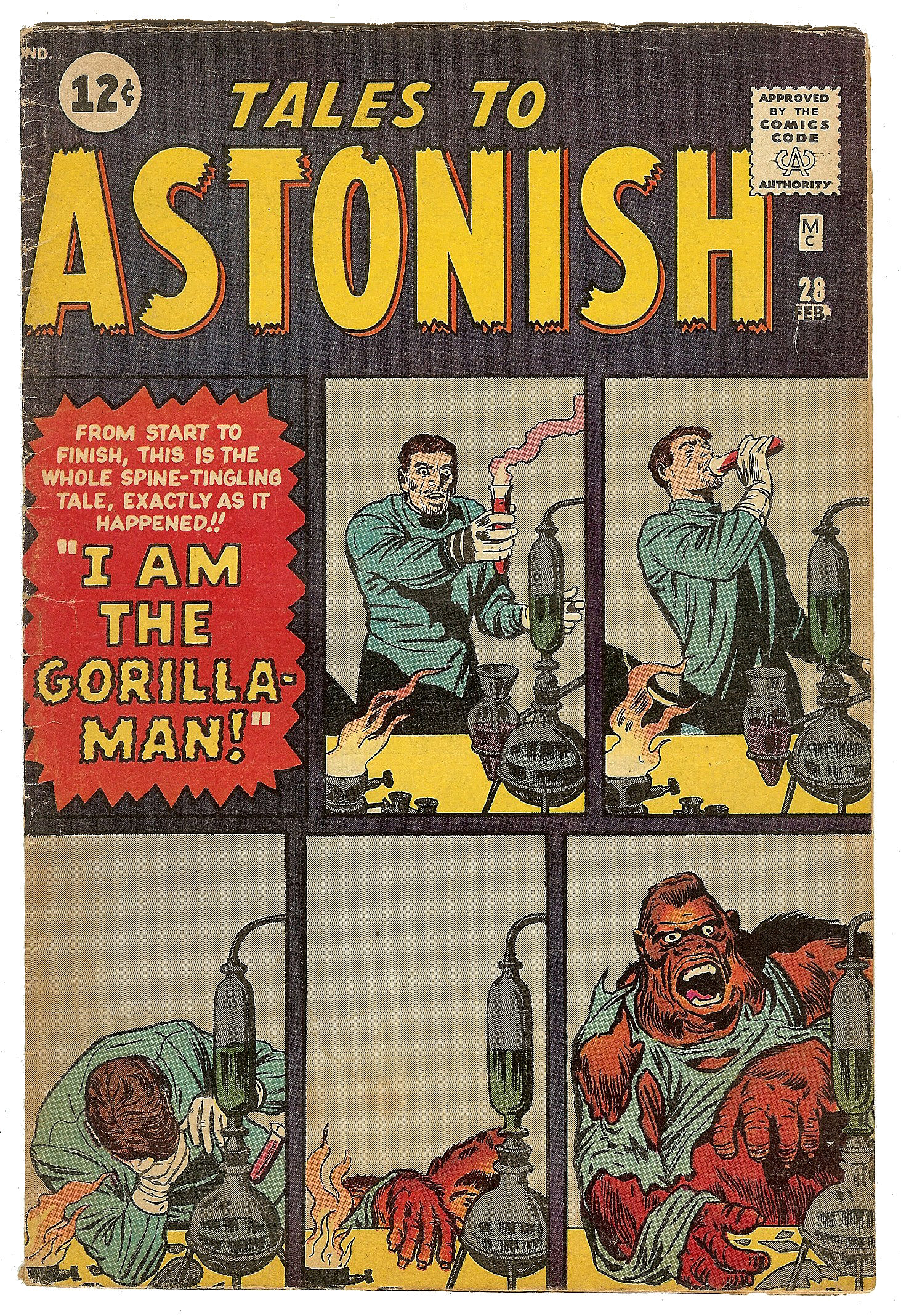
Gorilla stories and gorilla covers became a staple of comic books during the 1950s and '60s. Here's an example, Tales to Astonish #28, from February 1962, with art by Jack Kirby and Dick Ayers. I wonder when the gorilla theme began. Was it with the coming of Tarzan?

Text copyright 2023 Terence E. Hanley

Monday, April 12, 2021

Utopia & Dystopia in Weird Tales-Part Nine

Mars, Red to Blue

For simplicity's sake, Edgar Rice Burroughs (1875-1950) and his works are thrown into a big bucket called "science fiction." We like to categorize and we want our categorizing to be easy. But Burroughs began writing before there was a well-formed thing called science fiction--"Under the Moons of Mars" was in The All-Story on this day 109 years ago--and by our standards and our current categories, stories of John Carter on Barsoom are more properly called science fantasy*, planetary romance, or swords and planets. I would say that, like Star Wars, Burroughs' Mars books are not science fiction.

And now I take it all back. (But maybe not really.)

By our current categories, Burroughs' Mars books may not be science fiction, but before the Great War and even early in the interwar period, there may not have been any more popular, influential, or pertinent example of the genre, at least on this side of the pond. (On that topic, there are still things to come.) They were the state of science fiction at the time, and they were so powerful in the imagination that they endured for decades, in their pure, original, science-fantasy form, perhaps more deeply and intensely in science fiction, space opera, and space fantasy. (There are swords and sabers--airships, too--on both Barsoom and Tatooine. See the images below.) Even into the Space Age, some people imagined Mars to be the way Burroughs had imagined it. Even some scientists still thought of Mars as a dry but habitable planet (and Venus as wet but also habitable). Canals still webbed the Red Planet's surface. Ruined or dying cities might still be found at their nodes. Decadent or moribund peoples might still haunt those cities and their engulfing, pitiless deserts. Maybe there were or once had been other people in our solar system. Maybe someday we would come upon their artifacts and ruins, like a forlorn and windswept City on the Edge of Forever.

That popular image of Mars persisted even after the mid-sixties Mariner 4 mission showed the planet to be not just mostly dead but all dead--persisted, that is, in the popular imagination if nowhere else. Even in the 1970s, there were artists' images of Mars showing a patchwork of green and red, the green parts tied to each other by ligamentous canals, the two colors waxing and waning, warring with each other within the wider cycle of the Martian year. We so wanted there to be life on Mars. We wanted the green to exist and for it to be plant-life, even if it was just simple moss or lichens. You might look at the Viking missions of a decade after Mariner as acts of quiet desperation, as a kind of grasping at the straws of the idea that the Red Planet was once alive and vibrant and that life might still be found there. The views from a space-borne Mariner weren't enough. We needed a close-up view of things. We needed to touch the surface: the arm of the Viking lander would extend like the forefinger of God, but instead of bestowing life upon Mars, it would detect it. Carl Sagan (1934-1996), an ardent childhood reader of Burroughs, was instrumental in the Viking missions. Although a scientist, Dr. Sagan seems to me to have been more than anything a hopeless romantic. I think he went to his grave believing in life on other planets.

But there would be no Barsoom.

There wasn't even a bacterium.

In January 1980, a little over three years after the Viking landers set down, NBC-TV broadcast The Martian Chronicles, based on stories by Ray Bradbury (1920-2012) and with a screenplay by his friend, Richard Matheson (1926-2013). Both men had been young contributors to Weird Tales. Bradbury loved Burroughs' Mars books so much that as a child he wrote a sequel to The Warlord of Mars (1919). Even in 1980, we were holding on to romantic notions of Mars. But instead of being red, Mars in our imagination had turned blue, not only for the terrible sadness and melancholy of The Martian Chronicles, but also for the cyanotic lack of oxygen in its rarefied air. Red planet, blue mood.

By 1990, when Total Recall was released, Mars had become a kind of cyber-corporate-dystopia. In seven decades, the -topia of Red Planet had seemingly gone from Burroughs' U- to a Philip K. Dick-inspired Dys-. But in the climactic scenes of the movie, the hero Quaid reactivates the ancient Martian atmosphere factory, the vivifying plant in the original Mars books, and the blue of sadness and cyanosis gives way to a cyan sky: Mars is suddenly terraformed and Burroughs' vision is redeemed: Dystopia is banished and Utopia returned to Mars.

To be continued . . .

-----

*I still want to hold on to there being a close connection between science fantasy and Lost Worlds: I think of Burroughs' Mars novels as science fantasy/Lost Worlds set not on a closed Earth but in an open--and limitless--universe. With that being the case, it's a short step from science fantasy to science fiction, and the doors of the universe are thrown open to every kind of storytelling.

The Gods of Mars & The Warlord of Mars by Edgar Rice Burroughs in the Nelson Doubleday edition of 1971. Frank Frazetta's cover illustration is a tour de force of action and painterly technique. I suspect he finished it in a day or less. The Thark's red cloak is reminiscent of the one worn by the ape-creature on Frazetta's cover for the Lancer edition of Conan.

A rear view of this wraparound cover will show a rear view of Dejah Thoris, too. Frazetta had his proclivities. But his choice in depicting the female figure in such a way wasn't just about showing a good shot of her fanny. Or at least I don't think it was. By turning her away from us and posing her the way that he did, I think he heightened the mystery and peril of the situation in which the lovers find themselves. She is firm in the grip of the ape-creatures and is rapidly being carried away by them. John Carter had better do something, and fast, before she disappears from this tableau. (Winslow Homer did the same kind of turning away in his picture-making. I think his purpose was to depersonalize, and thus universalize, his figures.) By the way, if you look quickly enough, you will see the same kind of rear view and split, gray-toned, feminine anatomy in the climactic scenes of Total Recall.

Frank Schoonover (1877-1972) was one of the original John Carter artists. Here is his cover for The Gods of Mars, from 1919. His protagonist is a little goofy-looking. My reason for showing this image is to point out the similarity between Burroughs' desert airships and those run by Jabba the Hutt's gang in Return of the Jedi (1983): George Lucas--just like seemingly everybody else in twentieth-century American fantasy and science fiction--was almost certainly influenced, directly or indirectly, by Edgar Rice Burroughs.

Original text copyright 2021, 2023 Terence E. Hanley

Thursday, October 25, 2018

Superheroes and Supervillains

A few weeks ago I wrote a little about heroes and villains. I would like to write more now about superheroes and supervillains as a lead-in to a series involving Weird Tales.

When we were kids, we read a lot of comic books. Most were superhero comics, and even those that weren't about superheroes were often superheroized, for example, Super Goof in Walt Disney comics, Jughead Jones as Captain Hero in Archie comics, Conan the Barbarian in Marvel comics, and even Warlord in DC comics, who always wore the same outfit--and had the same split beard as Green Arrow. We drew superhero comic books, too, and if I can come up with a little time, I'd like to draw more.

Not long ago, someone told me that the word superhero is trademarked by Marvel and DC. I didn't think that could be true. After all, superhero is a word. How can you trademark a word? Especially a word that was in use before there was such a thing as a comic book? So I read a little about it, and I guess Marvel and DC, who haven't always gotten along, jointly own the trademark for a word, or at least they've got everybody scared enough not to challenge them on it. Pretty soon, I guess, you won't be able to use the word marvel without Marvel's (meaning Disney's) permission. Maybe princess will go the same way. Anyway, you would hardly know it today, but there was a time before comic book superheroes. That time was in living memory of people my dad's age and older.

Everybody likes to play the game of firsts. What was the first this, the first that. So who was the first superhero? You could say that Superman was the first superhero as we know them today. If there hadn't been Superman, there would almost certainly have been someone else--that's the way our popular culture was going in the 1930s--but Superman hit at just the right time in just the right way to bring about what is now called the Golden Age of Comic Books. Once Superman arrived, superheroes were here to stay. Some people say that there were superheroes before Superman--Popeye for instance (1929), or The Phantom (1936). I think the Scarlet Pimpernel (1903) is a good candidate for the first superhero, but there are those who would push his origins all the way back to ancient Greece or even to ancient Sumer in the person of Gilgamesh. If we follow a different line of hypostulatin' we might come up with a different answer. As it turns out, that line fits pretty well with what I have found on the origins of the word itself.

I have thought for some time that American popular culture--genre fiction, comics, movies, magazines, sports, etc.--as we know it today began in the 1890s, more or less. The technological, economic, and societal forces that brought that about aren't really the issue here. Instead, if you just look at a few dates, you might agree that there's something to this line of thought:
  • Safety bicycle invented, 1890
  • First color newspaper supplement (Chicago Inter Ocean) in America, 1892
  • First automobile manufacturing company in America, 1893
  • First Ferris wheel, 1893
  • U.S. Golf Association (USGA) formed, 1894
  • First newspaper comic strip (Hogan's Alley by Richard Outcault) published, 1895
  • First movies shown to paying customers in the United States, ca. 1895-1896
  • First all-fiction pulp magazine (The Argosy), 1896
On the other hand, firsts, origins, and beginnings are good cause for fights and debates. So instead of trying to make a case for the 1890s as being the beginning of popular culture in America, I'll just look at the origins of the word superhero and its superkin, superheroine, supervillain, and, yes, superman and superwoman. It won't take long to get back to Weird Tales.

To be continued . . .

Conan was created by Robert E. Howard and first appeared in Weird Tales. The genre inhabited by Conan is now called sword and sorcery or, more to the point, heroic fantasy. We might as well call Conan a superhero, but he wasn't really cast as a superhero until the 1960s or '70s. (Remember that all of the Conan stories published in Howard's lifetime came before the first real superhero comic book.) At the height of the sword-and-sorcery/fantasy craze of those two decades, Marvel Comics began publishing Conan the Barbarian, written by Roy Thomas and illustrated by Barry Smith. The first issue appeared in October 1970 (forty-eight years ago this month). Here is the cover for number 15, from May 1972. Already there were teamups, a feature of superhero comic books, as Conan was joined in this issue by Elric of MelnibonĂ©, created by Michael Moorcock and first in print in 1961.

Barry Smith, also called Barry Windsor-Smith, is a British artist who came to Marvel Comics with a pop-culture sensibility. I can see the influence of Jack Kirby in his work, but there's also some Jim Steranko there. But then if Mr. Steranko was influenced by Kirby, then there is only an influence once removed. This is the cover for Conan the Barbarian #16, from July 1972.

Shortly before Marvel began issuing Conan comic books, Lancer Books revived Robert E. Howard's original stories in paperback form. The covers of these books were most famously done by Frank Frazetta. I suspect that the Lancer series were the impetus for Marvel's comic book version. In any case, this pair of images from comic book and paperback versions of the same story from the same period is relatively rare. Both have their merits, but I think the Frazetta illustration makes for a tighter composition, greater action, mystery, and intrigue, and a more evocative image. Conan of Cimmeria, from 1969.

Barry Smith left Conan the Barbarian with issue number 24, in March 1973. With him went much of the otherworldly atmosphere and imagery of the series. In his place came a number of other artists, chiefly John Buscema, who had been doing superhero stories at Marvel for many years. Buscema was fast and had a knack for action, composition, and visual storytelling, but in his hands, Conan became more nearly superheroized. Here is the first cover after Barry Smith, number 25, from April 1973, drawn by Gil Kane and Ralph Reese.

Don't get me wrong. I love John Buscema's work, and I read Conan the Barbarian with real pleasure. When we were kids, we even drew our own sword-and-sorcery comic books. But Conan in Marvel's hands was essentially a superhero. Like the Incredible Hulk, he always wore the same torn clothing over his middle section. (Conan's outfit was always brown and furry rather than purple.) Like Spider-Man, he often teamed up with other superheroes, or in the case of Red Sonja, who also always wore the same outfit, a superheroine. There is even in this cover (no. 78, Sept. 1977) a skewed viewpoint, like in the old Batman TV show. Note the red-robed cultists, another throwback to Weird Tales.

Consciously or not, John Buscema evoked an image from another of the Lancer Conan paperbacks, Conan the Avenger, from 1968, again with cover art by Frank Frazetta.

More evidence of the superheroization of Conan: a Marvel Treasury Edition of Conan the Barbarian, complete with a gorilla cover. (Truth be told, gorilla covers came before superhero comic books. See my previous postings, here and here.) From 1978.

Frazetta could do a gorilla cover like nobody else. I think this is one of his most powerful covers for the Conan series, from 1967.

Text copyright 2018, 2023 Terence E. Hanley

Tuesday, November 15, 2016

Gorillas on the Cover of Weird Tales

There were gorillas in my recent posting, "Conan on the Cover of Weird Tales," and there are gorillas here, on two covers of Weird Tales. I expected more before beginning my search, but then Weird Tales didn't survive very long into what one website calls "The Gorilla Age of Comics," when images of simians proliferated on the covers of the nation's comic magazines. I'm not sure why gorillas were so popular in those days, especially in DC comics. In any case, Weird Tales beat them all to the punch with the images shown here.

Weird Tales, June 1923. Cover story: "The Murders in the Rue Morgue" by Edgar Allan Poe. Cover art by William F. Heitman. That's not actually supposed to be a gorilla but an orangutan. Oh, well, at least it's a passable drawing of a simian. The figure of the woman on the other hand is pretty poorly handled, no pun intended. The only thing I can think is that the artist was in a hurry on the day he drew this picture.

Weird Tales, September 1929. Cover story: "The White Wizard" by Sophie Wenzel Ellis. Cover art by Curtis C. Senf. Before there was King Kong, there was this cover for Weird Tales.


Here are two gorilla covers out of millions. Above, Strange Adventures #45 from June 1954 with cover art by Murphy Anderson. I wanted to show this one because the concept of civilized apes--from a place called "Gorilla World" no less--is so much like that in Planet of the Apes. Everybody remembers the movie from 1968. What is less well known is that the movie was based on a French novel, Pierre Boulle's La Planète des Singes, from 1963, nearly a decade, I might add, after this comic book came out. Below, Superman's Pal Jimmy Olsen #10 from January 1956 with cover art by Curt Swan and Ray Burnley.

You never want to pass up on a chance to show Dave Stevens' art. Here is his cover for King Kong #1 from 1991, evidence that the age of gorilla covers extended into later decades . . .

. . . even as recently as 2013 when I drew this picture for the back cover of our self-published comic book Five Star Comics. So gorillas were popular on the covers of comic books from the 1950s and '60s. Well, so were atomic bomb explosions and infinity covers. What you're seeing here is--I think--the world's first and only gorilla/A-bomb/infinity cover. (There is also an element of time travel.) It illustrates my story "A-Bombs into Infinity." The only thing it's missing is a flying saucer. Image copyright 2016 Terence E. Hanley.

Text and captions copyright 2016, 2023 Terence E. Hanley

Saturday, November 12, 2016

Conan on the Cover of Weird Tales

On November 11, 2016, Mike Tuz wrote a comment on my article "Winged Creatures on the Cover of Weird Tales." I started to write a reply but it got to be too long and involved for the comments section of this blog. I also wanted to add some images as illustrations. In addition, I had planned to write a series on recurring characters on the cover of Weird Tales. This is the perfect opportunity to begin. So I'll start with Mike's comment and continue with my reply:

Michael Tuz on November 11, 2016 at 7:40 AM

Happy Veterans Day, you happy veteran!

One of the things that I find fascinating when looking at art from days gone by is noting the changes in people's perception of what made a man or woman physically attractive. On the cover of the May '34 issue, Margaret Brundage gives us a version of Conan who looks much like Francis X. Bushman in the silent Ben-Hur; quite different from the now familiar muscleman interpretation that Frank Frazetta created three decades later (and which, in turn, helped launch Arnold Schwarzenegger to movie stardom.)

Hi, Mike,

Thanks for remembering. I served eight years and eight months in the U.S. Air Force and the Air National Guard and in two war zones. People thank me for my service, but I should thank this country and the people of this country for everything that it and they--you--have given me.

I noticed the same thing about the appearance of Conan in Margaret Brundage's illustration. Part of that might be explained by the artist. Her men tend to look civilized, even over-civilized, and somewhat feminine. Margaret was an artist (in pastel!), a woman, and a lifelong city-dweller. So maybe the facts of her sex, biography, and technique have something to do with the way she drew men.

Hugh Rankin's interior illustrations of Conan are closer to our image of the character, despite the fact that Rankin was an urbanite. He was an only child and reared by a single mother (she was an artist, too), but Rankin had a more masculine take on Conan. Over all, though, I don't think that the popular culture of the 1920s and '30s was, in the main, up to the task of adequately portraying a barbarian or savage, at least as a protagonist or a sympathetic character.

Robert E. Howard was able to imagine and identify with the barbarian because he projected himself into the historical past to a time when such people existed. He was also not very much removed from the Wild West. And he thought of himself, I think, as an atavism, as a primitive man living in the wrong century. That may have been a conceit for him, but it appears to have been the foundation of his art: that civilization is merely a veneer laid over the heart of a savage humanity. (Lovecraft thought of himself as a man living in the wrong century as well, but he imagined himself as one of the Augustan Age, a time of high civilization. Lovecraft and Howard, despite everything that separated them, were friends.)

Frank Frazetta, younger by a generation, may have been a city-dweller, but he came up in an almost savage environment in Brooklyn. Though an artist, Frazetta was also physically active (like Howard). He was hard, muscular, an excellent athlete, and good-looking enough to have been a movie star. He was heavily influenced by Hal Foster and Prince Valiant, but he wasn't constrained by those influences. Prince Valiant, though son of Norsemen, is a civilized character. He was also somewhat feminine in Foster's treatment. (Just look at those red lips!) Frazetta turned things around by depicting Conan as a savage and an outsider. Frazetta may have seen something like that in himself. More likely, he saw it in the working men of Brooklyn and maybe the men around him living on the fringes: criminals, gangsters, mafiosi, thugs. Contrast that with Boris Vallejo's posed and wooden bodybuilders with their smooth, precisely chiseled, and depilated bodies. I think that the Arnold Schwarzenegger Conan, with his big and largely useless muscles, is closer to Boris than to Frazetta.

Frazetta was also influenced by the romances of Edgar Rice Burroughs, who, like Margaret Brundage and Hugh Rankin, was a Chicagoan. (Hal Foster was a Chicagoan, too, but not by birth.) Burroughs was a man of action, but his two most well-known characters, Tarzan and John Carter, are civilized men thrust into savage worlds. They themselves are not savages. Here is the same pattern: a man who is essentially an urbanite and thoroughly civilized creates a character who reflects his world. Robert E. Howard was different, and though Frank Frazetta was not in his youth a reader or fan of Howard's stories, I don't think there was a better or more appropriate artist to depict the world he created. And maybe it took the savagery of the Second World War to lay low the Victorian or nineteenth-century idea of an inevitable progression towards a peaceful and civilized world, one without barbarians. Maybe only after the war could Conan have been shown to be what he really is.

* * *

Robert E. Howard wrote seventeen Conan stories published in Weird Tales. The first was "The Phoenix on the Sword," from December 1932. The last was "Red Nails," a three-part serial from July, August/September, and October 1936. Nine of Howard's seventeen tales of Conan were cover stories, but Conan himself was only on the cover three times. You would be right in pointing out that the title of this article isn't quite accurate.

All nine of the Conan covers for Weird Tales covers were drawn by Margaret Brundage. The 1930s were, after all, not only the golden age of Conan but also the golden age of Brundage covers. You might think she was the wrong artist to have drawn Conan. But she was an artist of the feminine, and women--small, dainty, feminine women--were throughout Howard's stories. There were things beyond that in Howard's stories as well, things I think to be in very poor taste if not indicative of psychosexual problems in the author's life and mind. Margaret Brundage depicted those things, too, in two covers, in the process softening them and making them a little less pathological.

So there are nine Conan covers. Three show Conan himself. Significantly, all three show him in peril. Two out of those three show a female character intervening between Conan and that which threatens him, and one out of those two shows her actually rescuing him. This is not our image of Conan, but it's how Margaret Brundage first depicted him, and her interpretation is worth consideration and thought. (She was probably the first artist to depict Conan in color, at least for publication.)

Five out of the nine Conan covers show women only. Women were, after all, the cover artist's specialty and main subject of interest. Two show scenes from Conan stories that can only be described as lesbian/sadomasochistic/fetishistic. (These are the kind of scenes that have often turned me off of Howard's stories.) One more is marginally in that category. Two show a woman being threatened by something other than another woman. Only one--the first--shows a woman who is not obviously threatened.

As Mike Tuz pointed out, Conan here looks like a Hollywood movie actor. He has some muscles, but he is not heavily muscled. In two out of his three covers, Conan is somewhat passive. He is also pretty well groomed and not what we think of as a barbarian. (He doesn't have a beard, as Conan doesn't have a beard. Ironically, the word barbarian refers to men with beards, i.e., men who are uncivilized. In Boris Vallejo's paintings, barbarians don't even have body hair.) But these images are part of the history of Conan the Barbarian, and they deserve a look and no careless dismissal.

Weird Tales, June 1933. Cover story: "Black Colossus" by Robert E. Howard. Cover art by Margaret Brundage. This was the fourth Conan story in Weird Tales and the first Conan cover story. I have shown this image before in "Woman and God or Idol." 

Weird Tales, September 1933. Cover story: "The Slithering Shadow" by Robert E. Howard. Cover art by Margaret Brundage. The second Conan cover story and still no sign of Conan.

Weird Tales, May 1934. Cover story: "Queen of the Black Coast" by Robert E. Howard. Cover art by Margaret Brundage. Finally, Conan, but not as we imagine him: civilized, subordinate to a woman, somewhat passive, and practically shrinking from peril.

Weird Tales, August 1934. Cover story: "The Devil in Iron" by Robert E. Howard. Cover art by Margaret Brundage. This is more like it, at least for real fans of Conan. He still looks like a movie actor, but at least he is active, combative, and superior in position to the woman.

Weird Tales, September 1934. Cover story: "The People of the Black Circle" by Robert E. Howard. Cover art by Margaret Brundage. We're back to no Conan here, but the image is effective.

Weird Tales, December 1934. Cover story: "A Witch Shall Be Born" by Robert E. Howard. Cover art by Margaret Brundage. Another cover showing a woman whipping another woman. This might as well be the same cover as in September 1933.

Weird Tales, November 1935. Cover story: "Shadows in Zamboula" by Robert E. Howard. Cover art by Margaret Brundage. Some people loved Conan. Others hated him. I think Robert Bloch (an urbanite, a Chicagoan, and an heir to one of the oldest and highest civilizations on earth) hated him. Does that explain the absence of Conan on the cover of the magazine? I doubt it. Margaret Brundage liked to draw women and that was that.

Weird Tales, December 1935. Cover story: "The Hour of the Dragon" by Robert E. Howard. Cover art by Margaret Brundage. This was the last Conan on the cover of Weird Tales, and just look at him in his abject state. Locked up, chained, pretty unhappy, and so weak or despairing that he can barely reach out to get the key to his cell from his distaff rescuer. Margaret Brundage's husband was in and out of her life and didn't always provide very well for himself and his family. Eventually the two were divorced. It doesn't surprise me that she depicted men as she did. I wonder now if she ever showed a male figure in a good light, other than the Conan cover of August 1934.

Weird Tales, July 1936. Cover story: "Red Nails" by Robert E. Howard. Cover art by Margaret Brundage. Compare this human sacrifice cover to the painting by Frank Frazetta shown below. It's almost like something out of a Busby Berkeley movie.

In strong contrast to Margaret Brundage's covers, here is an interior illustration by Hugh Rankin for "Shadows in the Moonlight" (Apr. 1934). The figure of the woman is in no way like a Frazetta woman, but the ape and the man could easily have been an influence upon the artist who created images like those that follow . . .

Cover art for Conan (Lancer, 1967), illustrating "Rogues in the House."

Cover art for Conan the Conqueror (Lancer, 1967).

Cover art for Conan the Avenger (Lancer, 1968).

Again, in strong contrast:

A painting of Conan by Boris Vallejo, technically very well done but lacking in the fury, violence, action, and mystery of Frazetta's best work.

I don't think anyone has come closer to Howard's vision than Frank Frazetta, and I don't think anyone ever will. We can be happy that there was once this artist named Frazetta yet sad that no one will ever again be able to do what he did.

Revised on Nov. 15, 2016.
Thanks to RedFury (comment below) for his correction.
Text and captions copyright 2016, 2023 Terence E. Hanley