Showing posts with label Aleister Crowley. Show all posts

Wednesday, February 6, 2013

Still More Weird Tales from France

Alphonse Louis Constant
Aka Eliphas Lévi Zahed, Eliphas Lévi
Author, Mystic, Magician
Born February 8, 1810, Paris, France
Died May 31, 1875, Paris, France

For Weird Tales
"Black Magic" (article, Sept. 1923)

Alphonse Louis Constant had been gone nearly half a century by the time Weird Tales printed his article "Black Magic" in the magazine's first year in publication (in Sept. 1923). Born on February 8, 1810, in Paris, Constant studied for the priesthood but left the seminary before being ordained. The reason? Cherchez la femme as the French say. Constant became a writer and associated himself with various names, including the socialist and feminist Flora Tristan (1803-1844), fellow mystic M. Ganneau (ca. 1805-1851), "messianic mathematician" Jozef Maria Hoëhne-Wronski (1778-1853), British novelist Edward Bulwer-Lytton (1803-1873), and French sculptress Marie-Noémi Cadiot (1832-1888), whom he married in 1846. (1) Constant was a mystic and a magician, evidently one of the most important names in that realm of endeavor. According to Wikipedia, he incorporated the Tarot into contemporary practice and was a great influence on other mystics and magicians of his time and after, including Aleister Crowley (1875-1947). (2) Constant was also the originator of a famous "Sabbatic Goat" image and of the idea that a pentagram pointing upwards represents good, while one pointing downwards (approximating the countenance of a goat) represents evil. He wrote under the pseudonyms Eliphas Lévi Zahed and Eliphas Lévi and died on May 31, 1875, in Paris.

You can read more about Constant on these websites:
Notes
(1) Flora Tristan, née Flore Celestine Thérèse Henriette Tristán y Moscoso, was the grandmother of French painter Paul Gauguin (1848-1903). Simon Ganneau, referred to as M. Ganneau, was the inventor of the religion Evadaïsme, "a compound of all the dogmas, doctrines and philosophies that have divided mankind," of which he was "the Mapah," a title combining maman and papa and a reference to our "first parents," Eve and Adam, their names combined in the name of his religion. The quotes on him are from The Living Age, Volume 29, on the occasion of Ganneau's death. Like Flora Tristan, he was a progenitor of fame, for he was the father of the archaeologist and orientalist Charles Simon Clermont-Ganneau (1846-1923).
(2) Crowley, born less than five months after Constant's death, considered himself a reincarnation of the great magician.

Villiers de l'Isle-Adam
Né Jean-Marie-Mathias-Philippe-Auguste, comte de Villiers de l'Isle-Adam
Author, Playwright, Editor/Publisher
Born November 7, 1838, Saint-Brieuc, Brittany, France
Died August 19, 1889, House of Brothers of St. Jean de Dieu, Rue Oudinot, Paris, France

Villiers de l'Isle-Adam was not in fact published in Weird Tales but in an offspring of "The Unique Magazine," Robert W. Lowndes' Magazine of Horror from the 1960s. Born on November 7, 1838, in the city of Saint-Brieuc, Villiers seems to have been a man ill-suited to life's demands. Unlucky in love, impoverished for most of his life, and not often successful as a writer, he nonetheless gave us two terms still in use today. One of them has become indispensable in science fiction and in fact.

Under the influence of Charles Baudelaire and Edgar Allan Poe, Villiers wrote tales of fantasy, mystery, horror, torture, and cruelty. (3) In his novel L'Ève future (a title translated by Wikipedia as Tomorrow's Eve, 1886), Villiers employed the term android (which had been in use since at least the 18th century) in its more modern sense, meaning a robot in human form. George Lucas and hundreds of other science fiction writers owe Villiers a debt for that.

Villiers is most well known for his collection of short stories from 1883, Contes Cruels. The conte cruel has become a subgenre or a type of fiction, a short story or tale (conte) in which characters are subjected to cruelty, torment, and torture, perhaps not because they deserve it but simply because--I suppose--life itself is full of cruel vicissitudes. I can imagine that Villiers sometimes felt himself to be such a character. Then again, essayist Arthur Symons remarked upon Villiers' "lack of sympathy," derived from his "disdain of ordinary human beings." (4)

I looked in several books on literature and fantastic fiction for a definition of the conte cruel and came up empty. Barbara, a contributor to Google Groups, admirably answers the question "What is the definition of conte cruel?" at this link. She attributes the origin of the term to Villiers' collection of the same name. She also mentions Villiers' story "The Torture by Hope," which by no coincidence appeared in Magazine of Horror #10 (Aug. 1965). Barbara also mentions Ambrose Bierce and W.C. Morrow as authors of contes cruels.

* * *
He hated every kind of mediocrity: therefore he chose to analyse [sic] exceptional souls, to construct exceptional stories, to invent splendid names, and to evoke singular landscapes. It was part of his curiosity in souls to prefer the complex to the simple, the perverse to the straightforward, the ambiguous to either. (5)
And in him there was ambiguity, too. Though born into an ancient and very distinguished aristocratic family, Villiers was nearly always poor, and though a staunch Catholic, he was also a mystic. (6) Though well loved and admired, he was lonely all of his life. A great talker and great personality, he "sometimes talked them [his stories] instead of writing them, in his too royally spendthrift way." (7) He founded a short-lived revue and one winter burned bundles of issues to keep warm. Like Poe before him, Villiers died young, in his case of cancer. He married but once, on his deathbed, to an illiterate midwife who was devoted to him in every way. Like Constant, he left a son, Victor. The last of his line, Victor--an ironic name to be sure--died in 1901 at age twenty.

Shades of Lovecraft and so many others.

The digest-sized Magazine of Horror was not Weird Tales of course, but I'm not sure there was any closer imitator between the end of the original Weird Tales in 1954 and the short-lived revival of 1973-1974. The Magazine of Horror is, though, a subject for another time.

Further Reading
"CPR Remembers: Villiers de l'Isle-Adam" by Garrick Davis on the website Contemporary Poetry Review, March 1, 2005, here.
"Villiers de l'Isle-Adam" in The Symbolist Movement in Literature by Arthur Symons (Dutton, 1958), pp. 21-32.

Notes
(3) Villiers is supposed to have been an admirer of Constant's Dogme et rituel de la haute magie (1856). Villiers' other associations: He was friends with Stéphane Mallarmé (1842-1898); he asked Théophile Gautier (1811-1872) for his daughter's hand in marriage (and was rebuffed); and his hero was Richard Wagner (1813-1883), with whom he was visiting when war broke out between their two nations in 1870. By the way, when M. Ganneau died in 1851, Gautier took his only child, Charles Simon Clermont-Ganneau, who had just turned five years old, under his wing.
(4) From "Villiers de l'Isle-Adam" in The Symbolist Movement in Literature by Arthur Symons (Dutton, 1958), p. 30.
(5) From Symons, p. 28.
(6) Another, Villiers, Philippe de Villiers de L'Isle-Adam (1464-1534), led the Knights of Rhodes in resisting the siege of Rhodes by 100,000 Turks in 1522. Forced to capitulate, he and his knights eventually ended up on the island of Malta, where he received a fiefdom from Emperor Charles V and established the Knights of Malta. In return for this grant, the knights were obliged to give to the emperor, every year on All Saints Day, a falcon, thus, among other things, the McGuffin for a detective story of the twentieth century.

Alphonse Louis Constant (1810-1875) aka Eliphas Lévi, a portrait from 1874.
Eliphas Lévi's Bephomet, an image of the Sabbatic Goat. I don't know enough about magic to say anything more. Note the name at the bottom, cut off in this image.
Villiers de L'Isle-Adam did not contribute to Weird Tales, but he was responsible for the conte cruel, a kind of story named for his collection of short stories from 1883. Here is the cover for one edition of Contes Cruels. The image is disturbing, mostly because it looks like it could have been drawn from life.
The image on this cover of a different edition is pretty tame by comparison. The man is being tortured, but he doesn't seem to be suffering much. Take away the bindings and it looks like he could be in a steam bath. (Update, Feb. 8, 2021): It occurs to me now that the image of a man working a circular machine, as in Metropolis (1927) or Modern Times (1936), may be meant to evoke the image of the breaking wheel or Catherine's wheel of medieval times.
The image on this cover of a Spanish-language edition of Conte Cruels (Cuentos crueles) is even more inviting. Are those tiger lilies?
Villiers was the author of at least fifteen books. Isis is an incomplete novel (more accurately, romance) from 1862.
In L'Ève future (1886), Villiers wrote of an android named Hadaly--invented by a fictional Thomas Alva Edison! It's from this book that we have our contemporary usage of the word android.
"The Torture of Hope," one of Villiers' contes cruels, was reprinted as the cover story in Magazine of Horror in August 1965. The cover artist was Carl Kidwell, who also contributed to Weird Tales

Revised and updated on February 8, 2021.
Text and captions copyright 2013, 2023 Terence E. Hanley

Friday, April 27, 2012

Weird Tales Books

Strange Angel: The Otherworldly Life of Rocket Scientist John Whiteside Parsons by George Pendle

I just finished reading a very interesting book, one that any student of popular fiction in America might enjoy. It's called Strange Angel: The Otherworldly Life of Rocket Scientist John Whiteside Parsons, and it was written by British biographer George Pendle (Harcourt, 2005, 333 pp.). Reading this book was a revelation to me: I have heard of John Whiteside Parsons (1914-1952) only in passing and didn't know anything about the origins of the Jet Propulsion Laboratory in Pasadena, California. Parsons, a largely self-taught chemist, rocketeer, and expert on explosives, was there at the beginning, or I should say before the beginning. Strangely enough, Parsons was also involved in Aleister Crowley's version of "magick" to the point that he attempted to conjure beings from another realms into our own--and may have believed at one time that he had done so. The cast of Parsons' life story is large and varied. It includes mathematicians and magicians, physicists and occultists, straight arrows and flim-flam men, bohemians and pillars of academia and government. Fans of Weird Tales will find some of the magazine's contributing authors in the pages of this book: Robert A. Heinlein, L. Sprague de Camp, Isaac Asimov, Ray Bradbury, Forrest J Ackerman, Cleve Cartmill, Anthony Boucher, Jack Williamson, and Dr. David H. Keller. "The Unique Magazine" even earns mention itself in Strange Angel.

Strange Angel also reveals something about the intersection of science and magic and about how religious belief might grow out of the yearnings of science fiction. The related religions of flying saucers and Scientology are examples, and that brings me to another character in the life story of John Whiteside Parsons, none other than the inventor of Scientology, L. Ron Hubbard. At the end of World War II, Hubbard found himself not only in Pasadena but also in Parsons' own home. The naïve and ingenuous Parsons was a perfect mark for Hubbard. It didn't take Hubbard long to bilk Parsons of his savings and to run away to Florida with his mistress. L. Sprague de Camp had this to say in a letter to Isaac Asimov (dated August 27, 1946, and quoted directly from the book):
The more complete story of Hubbard is that he is now in Fla. living on his yacht with a man-eating tigress named Betty-alias-Sarah [Parsons' former mistress], another of the same kind . . . He will probably soon thereafter arrive in these parts with Betty-Sarah, broke, working the poor-wounded-veteran racket for all it's worth, and looking for another easy mark. Don't say you haven't been warned. Bob [Robert Heinlein] thinks Ron went to pieces morally as a result of the war. I think that's fertilizer, that he always was that way, but when he wanted to conciliate or get something from somebody he could put on a good charm act. What the war did was to wear him down to where he no longer bothers with the act.
Say what you will about L. Sprague de Camp, but he knew enough about human nature to pierce to the heart of the matter, to recognize the man behind the mask.

Finally, a piece of trivia: John Whiteside Parsons' real first name was Marvel. By reading this book, you may decide that Parsons' given name was not far from telling the truth about him.


Text copyright 2012, 2023 Terence E. Hanley

Saturday, January 21, 2012

Weird Tales from Germany and Austria

Friedrich von Schiller
Né Johann Christoph Friedrich von Schiller
Born November 10, 1759, Marbach am Neckar, Württemberg, Germany
Died May 9, 1805, Weimar, Saxe-Weimar, Germany

For Weird Tales
"Song of the Brothers of Mercy" (Poem, translated by Francis Hard, a pseudonym of Farnsworth Wright, Dec. 1926)

Friedrich Schiller was a giant of German literature and a subject too large for a mere blog entry. His life was brief and he spent his last fourteen years as an invalid. Nonetheless, Schiller wrote some of the most acclaimed drama of any Continental playwright. Schiller also wrote poems, histories, translations, philosophy, and an unfinished novel, Der Geisterseher: Aus den Papieren des Grafen von O (The Ghost-Seer: From the Papers of the Count of O, 1789), a tale of necromancy, spiritualism, and conspiracy. Schiller's poem, "An die Freude" ("Ode to Joy," 1785), is the basis of the fourth movement of Beethoven's Symphony No. 9. Weird Tales used another Schiller poem for its own purposes, reprinting "Song of the Brothers of Mercy," translated by Francis Hard, in its December 1926 issue. 

Schiller died on May 9, 1805, and was entombed in the ducal vault in the Historical Cemetery of Weimar. Almost exactly two hundred years later, German scientists announced that the skull supposed to have been his belonged to someone else. I don't know how the switch happened. It's equally unclear to me whether the skeleton was Schiller's or not. In any case, skeleton, skull, and all have been removed. Schiller's tomb is now vacant. This is just one more bit of evidence supporting my proposition that very often, life is essentially weird. 

Wilhelm Hauff
Born November 29, 1802, Stuttgart, Germany
Died November 18, 1827

For Weird Tales
"The Severed Hand" (Oct. 1925)

Wilhelm Hauff was a German poet, novelist, and journalist known for his fairy tales and a very popular historical romance, Lichtenstein: Romantische Sage aus der wuerttembergischen Geschichte (Lichtenstein: A Romantic Saga from the History of Württemberg, 1826). His work has been the inspiration for two motion picture fantasies, the live-action Die Geschichte vom Kleinen Muck (The Story of Little Mook, 1953) and the animated Little Longnose (2003), a Russian film. Hauff died at an unbelievably young age, only a few days short of his twenty-fifth birthday. Weird Tales reprinted his story "The Severed Hand" nearly a century later, in its October 1925 issue.

Gustav Meyrink
Pseudonym of Gustav Meyer
Born January 19, 1868, Vienna, Austria-Hungary (now Austria)
Died December 4, 1932, Starnberg, Bavaria, Germany

For Weird Tales
"The Violet Death" (July 1935)
"The Man on the Bottle" (Fall, 1973, originally in The Lock and Key Library, 1912)

Although Gustav Meyrink lived into the Weird Tales era, the magazine reprinted his work only after he had died, first, "The Violet Death" in July 1935, then, "The Man on the Bottle" in Sam Moskowitz's revived version in Fall 1973. An author, playwright, translator, banker, and--paradoxically--occultist, Meyrink may have done for the golem what Bram Stoker did for the vampire by committing an ancient legend to the pages of a modern novel. After the scandal of his occult activities brought his banking career to an end, Meyrink devoted himself to writing and translating.

I have tried to assemble an accurate list of Meyrink's books with original titles in German, translated titles in English, and original years of publication. As always, information on the Internet is contradictory, inaccurate, incomplete, and of dubious value. If anyone has any additions or corrections to make, please send them my way. All or most of these works are in the genres of fantasy, horror, and weird fiction. Some have been adapted to film.
  • Der heiße Soldat und andere Geschichten (The Ardent Soldier1906)
  • Waxworks (1908)
  • Des deutschen Spießers Wunderhorn (The German Philistine's Horn, 1909)
  • Der Golem (The Golem, 1914)
  • Das grüne Gesicht (The Green Face, 1916)
  • Walpurgisnacht (Walpurgis Night, 1917)
  • The Land of the Time-Leeches (1920)
  • Der weiße Dominikaner (The White Dominican, 1921)
  • At the Threshold of the Beyond (1923)
  • Goldmachergeschichten (1925)
  • Der Engel vom westlichen Fenster (The Angel of the West Window, 1927)
The last book includes as one of its characters a fictionalized John Dee (1527-1608 or 1609), the English mathematician, astronomer, and occultist who made his entry into the Cthulhu Mythos of H.P. Lovecraft and his associates through Dee's supposed translation of the Necronomicon.

Friedrich von Schiller's life and work have been used to sell chocolates . . .  
postage stamps . . .
and meat extract. The cards are from the early 1900s, the stamp from French-occupied Germany after World War II.
Wilhelm Hauff's image has appeared on a postage stamp as well. The castle is the one described in his romance Lichtenstein (1826). The boy is Muck, from one of Hauff's fairy tales. 
Here's an illustration from an English-language version of Hauff's fairy tales from 1881. I believe this is from the story of Longnose the Dwarf. I'm afraid I don't know the artist.
In 2003, a Russian animation studio released its own version of Little Longnose, Ка́рлик Нос.
A movie poster for Die Geschichte vom Kleinen Muck, based on Hauff's fairy tale and released in East Germany in 1953.
And a still from the movie, with Thomas Schmidt as Kleiner Muck and an actress whom I don't know playing a part I don't know. That's too many "I don't knows," but I'm just beginning to explore European pop culture. The story of Muck ("Mook" in English) has indeed been popular. As evidence:
There have been books about Muck . . .
And records, and even video games.
A portrait of Gustav Meyrink in the mode of a mystic or magus, painted by Carl Alexander Wittek. Upon seeing this painting, I immediately thought of . . . 
Aleister Crowley (1875-1947), a near contemporary of Meyrink and also an occultist. Despite his sobriquet as "the wickedest man in the world," Crowley seems clownish to me, especially when he's in front of the camera. On the other hand, photographs of Meyrink convey a fire and intensity that in my mind make him more akin to someone like Rasputin or the fictional Svengali. In any case, after I thought about it a little more, it seemed to me that Meyrink's portrait reminds me of no one so much as . . .
Doctor Zin, arch enemy of Jonny Quest's father, Doctor Benton Quest.
Ming the Merciless . . . 
and Fu Manchu seem to be cut from the same cloth.
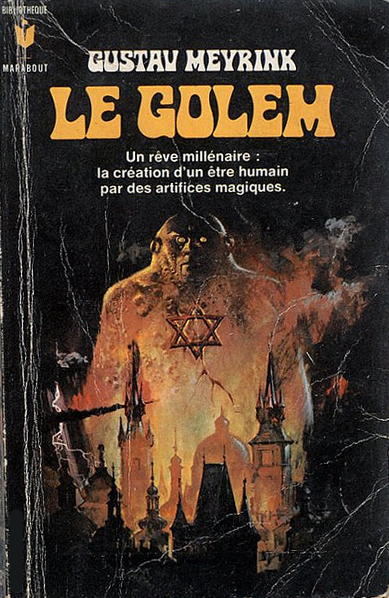
Finally, four covers for Meyrink's most well known work, The Golem, in English, French, Spanish, and French [?]. The illustrations are by Hugo Steiner-Prag (1880-1945) (top) and three unknown artists. Again, too many question marks. Can anybody fill in the blanks?

Text and captions copyright 2012, 2023 Terence E. Hanley

Monday, July 4, 2011

Wilma Dorothy Vermilyea (1915-1995)

Aka Millen Cooke, Millen Belknap, Millen le Poer Trench, Millen Trench
Poet, Author, Occultist
Born March 17, 1915, Dilley, Oregon
Died May 21, 1995, Mill Park, Victoria, Australia

Born on March 17, 1915, in Dilley, Oregon, Wilma Dorothy Millen Vermilyea lived in Multnomah and Washington counties as a child and attended Forest Grove High School outside Portland. From an early age, she was interested in theology and philosophy and later became a follower of Tibetan Buddhism.  I know nothing else about her early life except that her poem, "Fear: A Fantasy," was published in the February 1936 issue of Weird Tales under her own name. Wilma, who preferred to be called Millen, also wrote a number of letters to The American Theosophist magazine during the early 1940s. More importantly for science fiction and fantasy fans, she began submitting stories to pulp magazines.

Pen names and house names were common among writers of the pulp fiction era. Wilma Vermilyea used at least two names in her career as a science fiction writer. Her pen name, "Millen Cooke," was a combination of her preferred first name and her husband's last name. "Alexander Blade," used by a number of writers (including Millen), was a house name for Amazing Stories and Fantastic Adventures, both of which were published by Ziff-Davis and edited by Raymond A. Palmer. A blog called "Dark Worlds" by G.W. Thomas lists the men and women who shared the name "Alexander Blade." Unfortunately, Mr. Thomas' list does not indicate which of "Blade's" stories were the work of Millen Cooke. In any case, she was in good company, for Edmond Hamilton, Robert Silverberg, and John Jakes were among the many authors who masqueraded as Alexander Blade in the years 1941 to 1958.

According to the Internet Speculative Fiction Database (ISFDB), Millen Cooke's science fiction was limited to three magazines of the 1940s and '50s: Amazing Stories, Fantastic Fiction (as by Alexander Blade), and Other Worlds Science Stories. ISFDB's list of her work is short enough to repeat here. All stories and essays are as by Millen Cooke unless otherwise indicated:

Stories

  • "The Affair of Matthew Eldon" (Amazing Stories, May 1946)
  • "M-m-m-m-m-m!" (Amazing Stories, Oct. 1946, reprinted in Science Fiction Adventure Yearbook, 1970)
  • "I, John Cotter" (Amazing Stories, Apr. 1947, available as a download on the Internet)
  • "The Egg of Time" (Amazing Stories, Mar. 1948)
  • "Descent from Mera" (Other Worlds Science Stories, Jan. 1950)
  • "Edmund Latimer's Milking Machine" (Other Worlds Science Stories, May 1950)
Essays
  • "A Champion for Tibet" (Amazing Stories, May 1946)
  • "The Truth About Tibet" (Amazing Stories, Nov. 1946)
  • "Son of the Sun" as by Alexander Blade (Fantastic Adventures, Nov. 1947)
If the list is complete, then Millen Cooke's entire body of published science fiction appeared in four short years, between May 1946 and May 1950. Her first marriage, to a man deeply interested in the occult, was inclusive of those years. Also during that period, two new real-world beliefs, Dianetics and flying saucers, began to evolve out of the work of science fiction writers. Millen Cooke would be involved in both.

Millen Cooke's first husband, John Starr Cooke, was born into a wealthy and prominent family in Honolulu, Hawaii, on March 9, 1920. He became interested in the occult early in life and used a Ouija board to make important decisions, including the decision to marry. Cooke and Wilma Dorothy Vermilyea married in 1943 and divorced in 1951. In the course of their marriage, Millen Cooke had a series of visions which formed the basis of her husband's "Atlantean Tarot," one of three original Tarot decks he created. (Cooke pronounced Tarot to rhyme with carrot.) She also wrote science fiction, which remains as a large part of her legacy today. An actor and dancer, Cooke appeared on stage and in movies (as an extra) during the early 1940s and was involved in theosophy, Scientology, and the Bahai faith. He also claimed to own Aleister Crowley's own crystal ball.

Cooke lived in North Africa for many years before returning to the United States in the late 1950s. According to a blog called "Doctrine Wars" (doctrinewars.blogspot.com), he was revered by members of the Sufi sect, claimed he could activate "shakti" and "Kundalini" energies, and made an additional claim that he could induce a spinal seizure by touching people on the forehead. (Maybe he was the inspiration for the character of Professor Robert Orwell Sutwell in Beach Party (1963). Played by Bob Cummings, Professor Sutwell is a master of "The Himalayan Suspender," otherwise known as "The Finger," frequently used to render Eric Von Zipper helpless.) Cooke became involved in the counter-culture movement in the San Francisco area during the tumultuous '60s. After many years living in Mexico, John Starr Cooke died of cancer on August 21, 1976.

Millen's second husband was William Burke Belknap, Jr., a friend and associate of her first. Like Cooke, Belknap was the scion of a prominent family. Born on December 30, 1923, in Goshen, Kentucky, he graduated from Yale University and worked as a chemical engineer.  He became interested in L. Ron Hubbard's Dianetics and served as president of the Freudian Foundation of America, Inc., a Scientological organization dating from the early 1950s. He and Millen were married for a brief period during which she was also involved in Scientology. Their marriage ended in divorce, after which he remarried, in 1960. Burke Belknap lived and worked in Oceanside, California, and died on November 26, 2010.

On June 16, 1961, Millen topped off her marriages to fringe figures when she walked down the aisle with (take a deep breath) The Right Honourable William Francis Brinsley Le Poer Trench, 8th Earl of Clancarty, 7th Marquess of Heusden. Le Poer Trench (1911-1995) was an Irish peer, a member of Dutch nobility, and a member of the House of Lords. He was also a believer in ancient astronauts, a hollow earth, and flying saucers. Editor of the Flying Saucer Review from 1956 to 1959, Le Poer Trench wrote several books on the subject, including The Sky People (1960), The Flying Saucer Story (1966), Operation Earth (1969), and Secret of the Ages (1974). Millen, who had been investigating aliens and UFOs for a quarter century, provided some of the concepts and content for Le Poer Trench's first book. Unfortunately, he did not give her credit when The Sky People was published. According to an anonymous source, part of his second book, Men Among Mankind (1962), was hers as well.

Wilma Dorothy Millen Vermilyea lived in many places the world over during her long life. Her marriage to Brinsley Le Poer Trench ended in divorce in 1969, but by an almost occult coincidence, they died in 1995 within days of each other, though half the globe and many years apart separated them.

Wilma Dorothy Vermilyea's Poem in Weird Tales
"Fear: A Fantasy" (Feb. 1936)

Further Reading
Biographical information on Wilma Dorothy Vermilyea and her husbands is relatively easy to find. If you want to read more about John Starr Cooke, you might start with a website called "The Royal Maze," here.

A page from The Optimist, the yearbook of Forest Grove High School, 1929. Wilma Dorothy Vermilyea is there, second from the right in the third row from the bottom, looking very boyish.
Millen and John Starr Cooke, 1943, the year in which they were married. Photograph courtesy of an anonymous source.
John Starr Cooke (1920-1976), actor, occultist, artist, and the first husband of Wilma Dorothy Vermilyea. Photo from the website, "The Royal Maze."
In Beach Party, Bob Cummings played Professor Robert Orwell Sutwell. . .
And here he is (in the seersucker suit) as Eric Von Zipper gives himself "The Finger." Could Cummings' character (or at least his talent) have been inspired by John Starr Cooke?
The Flying Saucer Story from 1966, a peak year for popular culture in America. Written by Brinsley Le Poer Trench, the book was one of hundreds concerning visitors from outer space published during the 1950s and '60s. Le Poer Trench was Wilma Dorothy Vermilyea's third husband.
A photograph of a UFO, taken by Millen Belknap, April 10, 1958, in Vista, California.

Note: This is a revised version of the original posting. Thanks to an anonymous source for confirmation of certain information, and for corrections and clarifications.
Text and captions copyright 2011, 2023 Terence E. Hanley