Showing posts with label The King in Yellow. Show all posts

Monday, October 1, 2018

The Fungi from Yuggoth

Here are the two poems by H.P. Lovecraft (1890-1937) published in the February/March 1931 issue of Weird Tales and set to music (perhaps even performed) by Harold S. Farnese (1890-1945) (1):

XXIII. Mirage

I do not know if ever it existed--
That lost world floating dimly on Time's stream--
And yet I see it often, violet-misted,
And shimmering at the back of some vague dream.
There were strange towers and curious lapping rivers,
Labyrinths of wonder, and low vaults of light,
And bough-crossed skies of flame, like that which quivers
Wistfully just before a winter's night.

Great moors led off to sedgy shores unpeopled,
Where vast birds wheeled, while on a windswept hill
There was a village, ancient and white-steepled,
With evening chimes for which I listen still.
I do not know what land it is--or dare
Ask when or why I was, or will be, there.

XXVII. The Elder Pharos [2]

From Leng, where rocky peaks climb bleak and bare
Under cold stars obscure to human sight,
There shoots at dusk a single beam of light
Whose far blue rays make shepherds whine in prayer.
They say (though none has been there) that it comes
Out of a pharos in a tower of stone,
Where the last Elder One lives on alone,
Talking to Chaos with the beat of drums. [3]

The Thing, they whisper, wears a silken mask
Of yellow, whose queer folds appear to hide
A face not of this earth, though none dares ask
Just what those features are, which bulge inside.
Many, in man’s first youth, sought out that glow,
But what they found, no one will ever know. [4]

From the URL H.P. Lovecraft.com at this link.

Notes
(1) I'm settling on 1890 as the year of Farnese's birth, as I think it's a more likely birth year for him than 1891.
(2) The word pharos refers to a lighthouse.
(3) Note the phrase "Talking to Chaos with the beat of drums." Is that an allusion to Azathoth, whom Lovecraft described as existing "outside the ordered universe" and as an "amorphous blight of nethermost confusion," also as one who "gnaws . . . amidst . . . [the] maddening beating of vile drums"? (From The Dream-Quest of Unknown Kadath.) There are drums also backing Guy Bevier Williams' chant at the beginning of White Zombie. It seems to me that drums in Lovecraft, along with pipes and flutes, signify primitivism and/or decadence in music and, by extension, in a society or culture. Cultists in his stories invariably play these primitive or pagan instruments.
(3) Note here the reference to "The Thing [which] wears a silken mask/Of yellow . . . ." That makes me think immediately of Robert W. Chambers' King in Yellow, from a generation before. Lovecraft made reference to the same figure in "Celephaïs" (1920) and The Dream-Quest of Unknown Kadath (1926, 1943).
(4) One of the newspaper items I cited previously in this series alluded to Farnese's performance (with Jascha Gegna, in late 1932) of two "oriental" pieces composed by Farnese. Although "Mirage" seems to describe a vision of a more Western or European landscape ("steepled" village), "The Elder Pharos" has a subtle, though not unambiguous, Oriental setting: the Plateau of Leng is placed, in one Lovecraft story at least, in Central Asia, while the color yellow, though also used to connote insanity, is associated with the Orient. (It's why pencils are yellow, but think of "the yellow peril" as well.)

Original text copyright 2018, 2023 Terence E. Hanley

Wednesday, July 12, 2017

True Detective

I guess I'm catching up on my viewing from 2015, the HBO TV series True Detective included.

Few people remember it today, but in its first incarnation, Weird Tales had a companion magazine called Detective Tales, later Real Detective Tales, which began publication in 1922. The publishers of these two magazines got into financial trouble about a year into their venture. One of the publishers, Jacob Clark Henneberger, gave up his interest in Detective Tales and held onto Weird Tales, which has had an on-and-off career in the nine decades since. Detective Tales carried on under a different publisher and became Real Detective Tales, then, in May 1931, simply Real Detective. The similarly titled True Detective, part of Bernarr Macfadden's True series of titles, began publication in 1924 and lasted until 1995. The point of all this is that the makers of the TV series True Detective seem to have intended to evoke pulp fiction and pulp imagery in their show. I think they succeeded. I would add that, despite the title, True Detective has much--maybe more--in common with weird fiction than with detective fiction.

I heard a lot about True Detective in 2015 when it first aired, and I can say after having seen it that the show is compelling. The co-stars, Woody Harrelson as Marty Hart and Matthew McConaughey as Rustin Cohle are excellent. (Note the symbolism in their names.) Matthew McConaughey is, as always, like a chameleon in portraying seemingly real people. A lot of the supporting actors are also good. I'll single out Brad Carter as Charlie Lange, the peckerwood ex-husband of the murdered woman, for his performance.

There is some clunky, inauthentic, and overly literate dialogue in True Detective, but over all, the characters speak in ways that are true to life. Rust is often sophomoric in his pseudo-philosophical musings. Hart registers proper skepticism and disgust at what he says. (I'm not sure that any actor is as good at disgust as is Woody Harrelson.) The main title sequence is very good, and the theme song is perfect for it, one of the best theme songs I've heard in a long time. The settings and scenery are great, as is the cinematography. There are some anachronisms, I think, and places where the screenwriter's politics show through. For instance, he takes unnecessary swipes at private schools, especially parochial schools, and at school choice. In reading about the show, I find that the screenwriter, Nic Pizzolatto, was raised Catholic. A lot of us were, but so what? Get over whatever it is that got your underwear in a knot and move on. To that end, the Rustin Cohle character is evidently an atheist, but at the end of the show he sees the light (literally). I imagine that was a bitter disappointment for any atheists watching and enjoying the show. Significantly, his penultimate vision--the one actually shown on screen rather than the one he describes from his wheelchair--enters the otherwise flat land of Louisiana (see Flatland below) in the form of a spiral (see The King in Yellow below) and through a circular opening in the spherical roof (see The Ring and Flatland below) of a decrepit building (see almost everything below).

I have to admit, the change in tone at the end of True Detective is a little jarring, but if being gored and hatcheted by the worst serial killer in history isn't enough to change your life, I don't know what is. The show also changes in its structure and viewpoint in later episodes. I'm not sure if those were good moves or not. There are also too many convenient developments (the owner of the green house is still living, still lucid, still available for questioning, and has an impeccable memory), too many things left hanging (who called the man who subsequently killed himself in his prison cell?), and too many missed opportunities on the part of the detectives (why didn't they talk to an anthropologist, a folklorist, and a botanist very early on in the case?), but over all, True Detective is a good show, I think, and well worth the viewing.

I said that True Detective seems to want to evoke pulp fiction and pulp imagery. Here are some possible sources of inspiration, or at least examples of creative minds arriving at the same points independently of each other:

From The King in Yellow by Robert W. Chambers (1895): Carcosa (drawn from Ambrose Bierce); the King in Yellow; the viewing of the tape in True Detective vs. the reading of the play in "The Yellow Sign" as an experience that changes people's lives or damages their sanity; the secret symbol, in True Detective, a spiral, in "The Yellow Sign," the eponymous sign.

From H.P. Lovecraft (who drew from Chambers): the decadent and inbred family; the decrepit houses and other buildings; the backwoods setting; the circle or arrangement of stones in the woods at the the site of the cultist's rites; the super-secret and far-reaching cult; the secret and profane rites of the cult; the found object (in True Detective, the videotape).

From "Sticks" by Karl Edward Wagner (1974), The Blair Witch Project (1999) (both of which drew from Lovecraft), and the art of Lee Brown Coye: the found object in the videotape; sticks and stick lattices (there are sticks and lattices everywhere in True Detective; even the Cross can be seen as a stick lattice); drawings or murals on the walls of abandoned buildings; the old, decrepit, backwoods house; the murder of children; the super-secret cult.

From Twin Peaks (1990-1991): the opening sequence in which the body of a woman is found in some backwoods place; the otherwise eccentric storytelling, setting, and characters.

From The Silence of the Lambs (1991): the demented serial killer and his extensive house of horrors (if there is such a thing as the Gothic Baroque, the house and grounds of the serial killer in True Detective is it).

From The Ring (2002): the found object in the videotape; the viewing of the tape, which changes the lives of those who see it; the lone tree in the field; the repeated imagery of the circle or ring; the main title sequence in True Detective as a video montage like the contents of the tape in The Ring; the family with evil secrets; the decaying house of that family.

From Flatland: A Romance of Many Dimensions by Edwin A. Abbot (1884): talk of multiple dimensions beyond our own; flatness, circles, spheres, and other geometric or topological concepts (is a spiral merely a track made by a one-dimensional point as it moves in a certain way through a two-dimensional area, or, alternatively, the shadow in a two-dimensional area of a gyre spinning in three-dimensional space?; also, mention is made in the show of a psychosphere; also, sphere is another word for the different levels of the heavens, as in "music of the spheres"); flatness itself in the topography of Louisiana.

and

From the true-to-life Black Dahlia murder case (1947): The murder scene as a tableau for artistic, aesthetic, or personal expression; the ritualization of murder and of the preparation of the murder victim's body; the unsolved nature of the case.

As for philosophizing of Matthew McConaughey's character: I'm not sure where that comes from except from the minds of those who have given up hope or who are angry at and disillusioned by life and the world. It's not especially deep or serious-minded thinking, and though I'm no philosopher, I don't know of any formal source for the character's ideas or words. I'm with Woody Harrelson's character, though: Shut the eff up and let this vehicle we're riding in be an area of silent reflection. (But then the show would be far less interesting.)

One more thing: there is talk among writers and artists of "subverting" this or that. Trying to subvert things is an attempt at rebellion or innovation, very often a childish attempt. I would just say that when people claim that such-and-such "subverts" conventional storytelling, what they are really describing is something far simpler: it's called a twist, and genre writers and pulp writers use twists all the time. If you have never seen a twist before, or if you mistake a twist for a "subverting" of conventions, you haven't read very many stories. Next, I'll say that everyone in art, literature, politics, and society should remember the words of Ecclesiastes: there is nothing new under the sun. Nic Pizzolatto created a very fine piece of art, and he richly deserves the praise he has received, but I can't say that it subverts anything and I can't say that it's like nothing before it. (I don't know that he made those claims, only that viewers and critics tend to be carried away by hyperbole.) True Detective is just a really good piece of storytelling.

Updates, July 12, 2017
1. I see from another website that one of the books read by Rust is the collected poems of Theodore Roethke. Roethke was known for his recurring imagery of stones, bones, blood, sticks, and other natural objects. One of his most famous poems begins: "Sticks in a drowse droop over sugary loam." See "Sticks" and The Blair Witch Project above. Also, Roethke worked in greenhouses when he was young. Does green house (in True Detective) = greenhouse?
2. I see from that same website that flowers, especially in connection with sex, are part of the symbolism of True Detective. I hadn't thought much about that, but I'll add that flower parts--sepals, petals, etc.--are in whorls, a word similar in meaning to spirals.
3. Along those same lines, much of the imagery and many of the themes in True Detective have to do with sex, especially transgressive sex: pedophilia, adultery, sodomy, homosexuality, transvestism, bondage, group sex, pornography, sexting, sexual snuff films (the videotape). Even the spiral symbol can be interpreted as being related to transgressive sex. It's worth noting that all of the sex acts depicted outside of marriage are in one way or another transgressive. If I remember right, only one scene, a loving scene between Hart and his wife, shows a man and a woman in the missionary position (vs. what might be seen as pagan or pre-Christian alternatives). In contrast, the sex scene between Hart's wife and Rust shows her from behind, like the body of the murder victim at the beginning of the show. (By having sex with Hart's wife, Rust cuckolds him, i.e., places horns upon him, also like the body of the murder victim. Hart by the way is another word for an adult male deer.) I take all of that to be symbolic of a supposed moral decay that would have taken place over the years covered by True Detective, 1995 to 2012. Remember, True Detective was written by a Catholic. Remember, too, that 1995 was before cell phones and the Internet really took off.
4. In the climactic (not related to sex) scene, the main characters are on the floor of a domed building with a circular opening at the top of the dome. The building can be seen as analogous to an eyeball--i.e., a hollow sphere with a hole, aperture, or pupil in it--gazing upwards into the heavens (or spheres). (No wonder Rust sees a black hole, i.e., a kind of star but also a kind of spiral, through the aperture.) If the building is an eyeball, then maybe the stick-lattice representation of the Yellow King is at the fovea, a place also occupied for an instant, perhaps, by Rust. Significantly, fovea is Latin for pit, which is another word for abyss (for the Yellow King and his cultists) and trap (for Rust, who says early in the series that he feels like he's in a trap; the spiral symbol can also be taken as a labyrinth or maze, another kind of trap). Remember, Rust continually looks at his own eyeball in a mirror.
5. There is a lot of pagan, pre-Christian, post-Christian, and satanic imagery in True Detective, but other websites have gone into all of that, so I'll leave the analysis to them.
6. Whew!

Copyright 2017, 2023 Terence E. Hanley

Sunday, May 10, 2015

The Stories of Francis Stevens-Claimed!-Part Two

If you want to trace the origins of dark fantasy back to the early days of genre fiction, I'm not sure why you would stop at Francis Stevens and say, "Here it began." "Claimed!" is evidence that fantasy dark in mood and philosophy preceded her work, for I can see the roots of her story in The King in Yellow by Robert W. Chambers (1895), The Boats of the Glen Carig (1907) by William Hope Hodgson, and to a lesser extent The Night Land (1912), also by Hodgson. From The King in Yellow comes the artifact that by being possessed drives a person into despair or insanity. The Boats of the Glen Carig, like "Claimed!", opens with the log of a ship at sea and the approach to a strange and desolate island. Like Poe, too, Francis Stevens used epigraphs (from Psalms and "The Rime of the Ancient Mariner") to open her chapters.

Francis Stevens was an imaginative writer (though not outstanding in style or ability), and she was an innovator in some ways, but I think she worked more or less within the conventions of her field or by logical extension to what had gone before. I doubt that the influences I have mentioned here are direct. She probably read Chambers and Hodgson, probably also H.G. Wells, H. Rider Haggard, and Rudyard Kipling, and very certainly Edgar Allan Poe and Samuel Taylor Coleridge. Fans and critics look for influences of course. Everyone wants to discover the secret history of a story or book, or the facts in a writer's life, just as they wish to discover the secret history of the world and humanity. There are those who believe Francis Stevens was an influence upon A. Merritt and H.P. Lovecraft. That has become an ineradicable meme on the Internet, reproducing like the most virulent of pathogens. There isn't any forthcoming evidence that she was such an influence. But because someone said it somewhere at sometime, and it has been repeated endlessly on the Internet, it must be true. "The Call of Cthulhu" by H.P. Lovecraft has some similarities with "Claimed!"--the upthrust and desolate island with its slimy, dripping ruins; the awakened and vengeful god; the dream-states of its characters and the lingering images from those dream-states; the resulting madness among some of them; the unearthly prehistoric artifact; the climax at sea; also the uncanny mystery and even the use of log entries, newspaper articles, and letters in the story. (1) If you're looking for forerunners to "The Call of Cthulhu" (1926, 1928), you might consider "Claimed!". But was one an influence upon the other? Did Francis Stevens influence A. Merritt and H.P. Lovecraft? If your answer is "Yes," then please make your case, and don't let it be "Because I saw it on the Internet."

To be continued . . .

Note
(1) The use of clippings, letters, diaries, etc., was elsewhere in the literature of the time, in the U.S.A. trilogy by John Dos Passos (1930, 1932, 1936) and Show Girl by J.P. McEvoy (1929) for instance.

Famous Fantastic Mysteries, February 1941. Note the white horses as in the original cover  for Argosy. The cover artist was the great Virgil Finlay.

Super Science Stories, a Canadian edition from October 1944 with cover art by Leo Morey. Don't let the blurb fool you, there are no cavemen, cavewomen, or black panthers in "Claimed!".

Text and captions copyright 2015, 2023 Terence E. Hanley

Sunday, May 3, 2015

The Stories of Francis Stevens-The Elf Trap

In The Citadel of Fear (1918) and "Unseen-Unfeared" (1919), Francis Stevens made what may have been her closest approach to what is now called dark fantasy. It's probably no mere coincidence that both stories were published in late 1918 as the Great War was coming to an end and early 1919 as peace was being made. The war was of course a nightmare and a disaster. You could not have blamed a sensitive artist for reflecting horrors upon her world. But Stevens chose a different way: love over hate, goodness over corruption, light over darkness. There can be little doubt that Francis Stevens was not the creator of dark fantasy. To say that she was seems to me a twenty-first century and very academic conceit.

"The Elf Trap" is only further evidence that Francis Stevens was a teller of bright rather than dark tales. It was first published in Argosy, July 5, 1919, and reprinted in Fantastic Novels Magazine for November 1949. It's a long short story of twenty-one pages in The Nightmare and Other Tales of Dark Fantasy (2004) but one of the simplest of Stevens' stories to date. The structure of the story is somewhat complex however. In reading her work, I have come to expect that. Built like a puzzle box or assembled like a set of nesting wooden dolls, it includes a double framing device and the voices of two narrators. Relativity was in the news in 1919. Analytic cubism was a leading movement in art. It's no wonder that stories told from multiple viewpoints would make their way into modern literature. One of John Dos Passos' trilogy U.S.A., a modernist work to be sure, was in fact called 1919. That was no coincidence, either. Anyway, as you read "The Elf Trap," you wonder how this story will work itself out, where lies reality, and how a man's death can make for a happy ending. That ending is a mild surprise, and the story itself is a pleasant reading experience. I might add that it could have been written only by a woman.

"The Elf Trap" takes place mostly in the mountains of North Carolina, where the main character, Theron Tademus, has gone for some much needed rest. Francis Stevens had a way with proper nouns, and there seems to be some deeper meaning in the man's name. If there is, it remains hidden to me. Nearby Tademus' mountain cabin is an artist's colony called Carcassonne, another name that seems meaningful, maybe by association with the city Carcosa, from the works of Robert W. Chambers. (The King in Yellow was published in 1895, the year of Gertrude Barrows' golden age of twelve.) Unlike most of Francis Stevens' other stories, "The Elf Trap" is a simple fantasy. On the other hand, it involves a kind of dream-vision or altered state of consciousness or reality, and so keeps with that recurring theme in her work.

"The Elf Trap" reminds me of Brigadoon in that an ordinary man undergoes an extraordinary experience upon encountering a magical village and its magical people. The man, Tademus, is a scientist and so rational, materialist, and disengaged from living among humanity, whom he finds ugly and repellant. He has no appreciation for or understanding of art. He has never danced nor loved. Theron Tademus doesn't know what Francis Stevens has in store for him.

In "The Elf Trap," Tademus travels beyond the veil of hard reality into the deeper reality of the spirit. It is a love story in which love and art triumph over science and materialism. Love comes in the form of Elva, a young woman who wears a scarf of sky blue and adorns herself with yellow honeysuckle. For a week, Tademus escapes from his mundane life into her magic. He is called back by his love of science. (He is a microbiologist studying the local protista.) Elva responds:
"You are all alike!" she cried. "All! You talk of love, but your love is for gold, or freedom, or some pitiful, foolish nothingness like that speck of life you call by a long name--and leave me for!"
Tademus returns to his life in science. What he doesn't know is that Elva and her people have fashioned an elf trap for him. He can escape from it once, but he will be caught again, and so Theron Tademus is saved from science and for love and art.

Hardly the stuff of dark fantasy.


Text copyright 2015, 2023 Terence E. Hanley

Sunday, March 30, 2014

True Detective and Robert W. Chambers

It isn't often that an obscure collection of stories from the nineteenth century draws the attention of twenty-first century television viewers, but such a thing has happened. The collection is The King in Yellow by Robert W. Chambers, from 1895. The television viewers are the people who watched the HBO series True Detective, which premiered on January 12, 2014, and ended its first run on March 9. I say "obscure," but fans of fantasy fiction and weird fiction are and have been well acquainted with The King in Yellow for a long, long time, since H.P. Lovecraft wrote about it in his seminal study, "Supernatural Horror in Literature" (1927), if not before. I regret to say that I haven't seen the show, but I would like to have a look.

The creator of True Detective is Nic Pizzolatto, a writer and teacher from New Orleans. I'm happy to say that Mr. Pizzolatto has a connection to my home state of Indiana, for he taught at DePauw University in Greencastle, only a few blocks away from where I used to live. DePauw also gave us John Jakes, creator of Brak the Barbarian and countless other genre characters.

Nic Pizzolatto seems to be pretty familiar with genre fiction himself. His TV show is named after a pulp magazine first published by Bernarr Macfadden in 1924--ninety years ago this year. He has drawn on The King in Yellow in his plotting and writing for his show, which is set in the author's native Louisiana, the same country haunted by the cult of Cthulhu in Lovecraft's "Call of Cthulhu." One of the characters in that story is--like Mr. Pizzolatto's protagonists--a Louisiana detective, John Raymond Lagrasse. Lovecraft's fictional grimoire, The Necronomicon, doesn't make an appearance in "The Call of Cthulhu," but Lovecraft may very well have based the idea of a book that drives men mad upon reading it on Robert W. Chambers' fictional drama "The King in Yellow." In any case, I wish Mr. Pizzolatto and the makers of his show further success.

Text copyright 2014, 2023 Terence E. Hanley

Friday, October 26, 2012

Robert W. Chambers (1865-1933)

Fine Artist, Illustrator, Short Story Writer, Novelist, Playwright, Children's Book Author
Born May 26, 1865, Brooklyn, New York
Died December 16, 1933, New York, New York

Robert W. Chambers lived the kind of life any aspiring writer might envy. Talented, popular, and prolific, he wrote nearly one hundred books and used the proceeds to fund a lavish estate, a sizable art collection, an active club life, frequent trips abroad, independent wealth, and plenty of leisure time. He was an outdoorsman, a lepidopterist, a collector, an expert on certain antiquities, and in his early years, a very successful artist and illustrator, counting Charles Dana Gibson (1867-1944) and other artists and writers among his friends. Many of Chambers' stories were adapted to film in his lifetime and after. Chambers' wife, French-born Elsa Vaughn Moller, called "Elsie" and daughter of a European diplomat, bore him one son, Robert Edward Stuart Chambers. The younger Chambers, who also went by the name Robert Husted Chambers (1899-1955), followed in his father's footsteps as a writer. The Chambers family also included Chambers' brother, the New York architect Walter Boughton Chambers (1866-1945), who designed landmarks in his native city and other northeastern states.

Wealth, talent, fame, family--it all added up to a great success, yet, as far as I know, there has never been a book-length biography of Robert W. Chambers. And in the minds of many, Chambers squandered his talent on popular novels produced at a rapid pace and settling somewhere below the ken of literature. "Stuff! Literature!" Robert W. Chambers scoffed in a 1912 interview. "The word makes me sick!" His disdain for literary endeavor may have been the fox talking about the grapes. Either way, it assured that his work would become dated and seldom read in later years. In his time, he was called "the Shopgirl Scheherazade" and "the Boudoir Balzac." Today, Chambers' reputation rests almost solely on a single book, his second, entitled The King in Yellow, published in 1895.

In his survey of the genre, H.P. Lovecraft wrote--in his "Supernatural Horror in Literature" (1)--two long paragraphs on Chambers. I'll quote them in their entirety here:
     Very genuine, though not without the typical mannered extravagance of the eighteen-nineties, is the strain of horror in the early work of Robert W. Chambers, since renowned for products of a very different quality. The King in Yellow, a series of vaguely connected short stories having as a background a monstrous and suppressed book whose perusal brings fright, madness, and spectral tragedy, really achieves notable heights of cosmic fear in spite of uneven interest and a somewhat trivial and affected cultivation of the Gallic studio atmosphere made popular by Du Maurier’s Trilby. The most powerful of its tales, perhaps, is "The Yellow Sign," in which is introduced a silent and terrible churchyard watchman with a face like a puffy grave-worm's. A boy, describing a tussle he has had with this creature, shivers and sickens as he relates a certain detail. "Well, sir, it's Gawd's truth that when I 'it 'im 'e grabbed me wrists, sir, and when I twisted 'is soft, mushy fist one of 'is fingers come off in me 'and." An artist, who after seeing him has shared with another a strange dream of a nocturnal hearse, is shocked by the voice with which the watchman accosts him. The fellow emits a muttering sound that fills the head like thick oily smoke from a fat-rendering vat or an odour of noisome decay. What he mumbles is merely this: "Have you found the Yellow Sign?" 
     A weirdly hieroglyphed onyx talisman, picked up in the street by the sharer of his dream, is shortly given the artist; and after stumbling queerly upon the hellish and forbidden book of horrors the two learn, among other hideous things which no sane mortal should know, that this talisman is indeed the nameless Yellow Sign handed down from the accursed cult of Hastur—from primordial Carcosa, whereof the volume treats, and some nightmare memory of which seems to lurk latent and ominous at the back of all men's minds. Soon they hear the rumbling of the black-plumed hearse driven by the flabby and corpse-faced watchman. He enters the night-shrouded house in quest of the Yellow Sign, all bolts and bars rotting at his touch. And when the people rush in, drawn by a scream that no human throat could utter, they find three forms on the floor—two dead and one dying. One of the dead shapes is far gone in decay. It is the churchyard watchman, and the doctor exclaims, "That man must have been dead for months." It is worth observing that the author derives most of the names and allusions connected with his eldritch land of primal memory from the tales of Ambrose Bierce. Other early works of Mr. Chambers displaying the outré and macabre element are The Maker of Moons and In Search of the Unknown. One cannot help regretting that he did not further develop a vein in which he could so easily have become a recognised master.
That's a lot to digest in a single blog entry, but it's worth reading for a number of reasons. First, it's obvious that Lovecraft drew on The King in Yellow in general and on "The Yellow Sign" in particular for concepts and atmosphere for his own weird fiction. Second, it's illuminating to read of the lineage of Chambers' "names and allusions," which can be traced backward to Bierce and forward to Lovecraft and his acolyte, August Derleth. Third, it's very interesting to read Lovecraft's criticisms of the older man Chambers:
Very genuine, though not without the typical mannered extravagance of the eighteen-nineties, is the strain of horror in the early work of Robert W. Chambers . . . [emphasis added].
One cannot help regretting that he did not further develop a vein in which he could so easily have become a recognised master [again, emphasis added].
Those two criticisms, which open and close Lovecraft's discussion of Chambers, can just as easily be leveled at Lovecraft himself. In fact they sometimes have been.

* * * * *

You can read about Robert W. Chambers elsewhere on line or at the library. (The New York Times wrote of him extensively in his time. You might start by reading his obituary, dated December 17, 1933, page 36.) I'll skip the biographical details and write just a little more. First, as Lovecraft wrote, Chambers authored several works of horror, fantasy, and science fiction. (2) Second, he also wrote a book called Police!!! (1915), which may very well have contained the first cryptozoological fiction ever set to print. (3)

Cryptozoology, founded in the nineteenth century but not named until the twentieth, is the science or semi-science of unknown creatures. Its recognized founder was Antoon Cornelis Oudemans (1858-1943), a Dutch zoologist who attempted to describe and classify unknown creatures in his book The Great Sea Serpent (1892). Robert W. Chambers--Oudemans' junior by only seven years--was an enthusiastic entomologist and lepidopterist; his credentials as a science-minded author would appear firm. The point of this is that cryptozoological fiction would not have been likely before science was brought to bear on what would previously have been the stuff of legend or folklore. It's also unlikely that anyone would have written stories on a sensationalistic topic such as cryptozoology before there was a popular press on an industrial scale. I guess I should ask the question then: Can anyone offer another candidate for the first fiction in the young field of cryptozoology?

Notes
(1) Literature? "Stuff!" Chambers might say.
(2) A story called "The Repairer of Reputations" opens Chambers' 1895 collection, The King in Yellow. Set in 1920, the story alludes to recent events, including the administration of a President Winthrop and recent victory in a war with Germany. Winthrop is close enough to Wilson, and of course the United States and Germany were involved in a little tussle ending in 1918. You might say that science fiction blends into prophecy in Chambers' tale. Mostly, though, his projections are simply nonsense.
(3) There is also a hint of forensic entomology in one of the stories.

Robert W. Chambers' Stories in Weird Tales
"The Demoiselle d'Ys" (Aug. 1928)
"The Sign of Venus" (Summer 1973, originally in Harper's Magazine, Dec. 1903)
"The Splendid Apparition" (Winter 1973, originally in In Search of the Unknown, 1904)

A drawing of the King in Yellow, created by Robert W. Chambers himself, that rare combination of accomplished writer and accomplished artist.
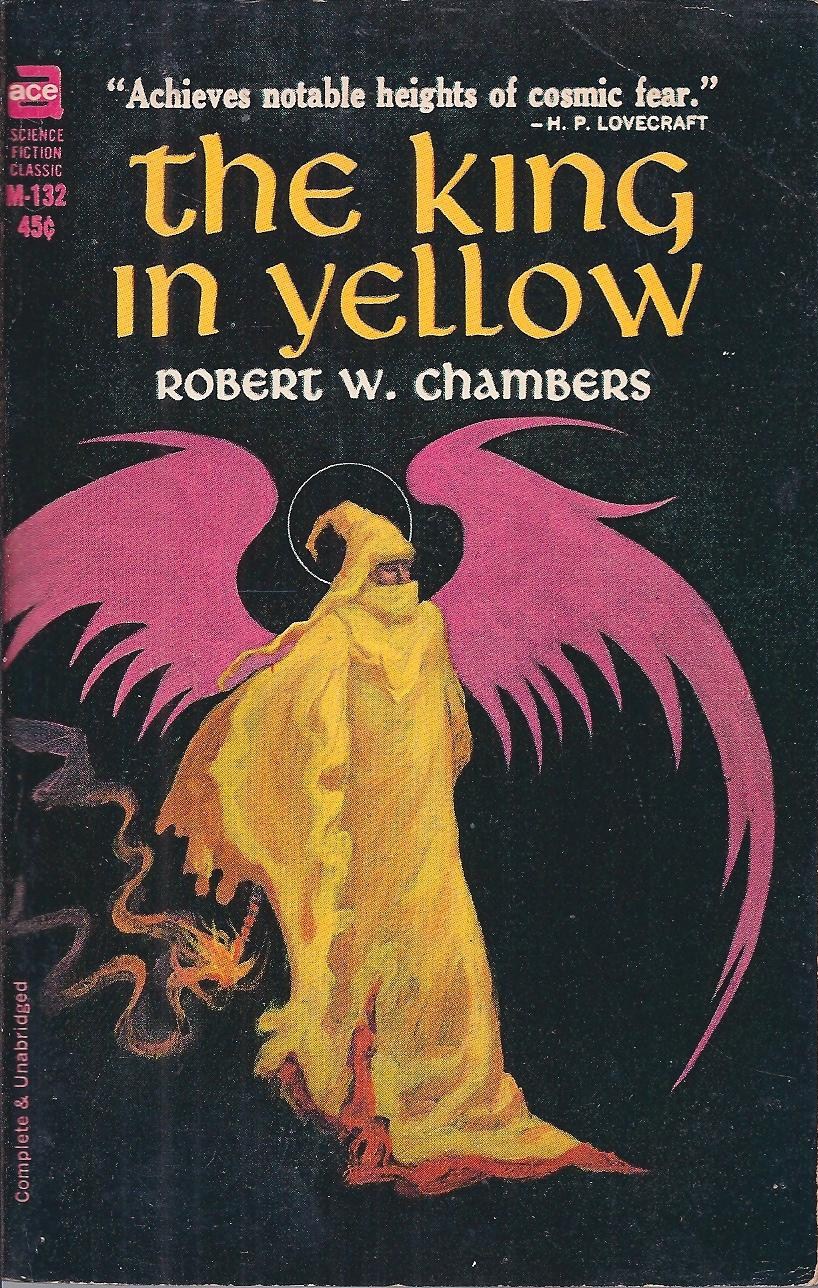
Jack Gaughan, the cover artist for the Ace Books edition of 1965, followed Chambers' model closely.
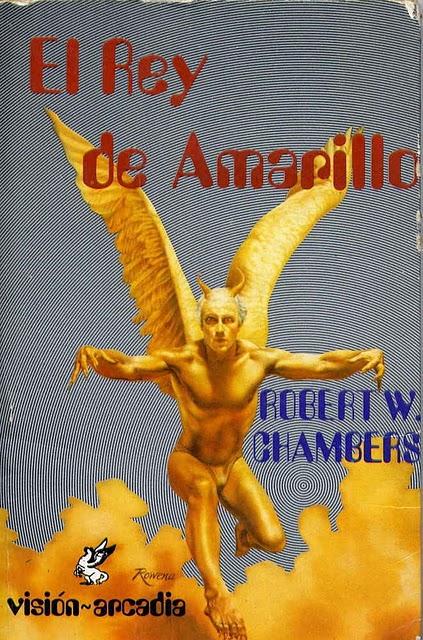
This Spanish-language version features an Op Art background to Rowena Morrill's illustration.
Unintentionally or not, the color yellow became a motif in illustration for the works of Robert W. Chambers. Here's the cover for The Maker of Moons, an edition from--I think--the 1970s and a West Coast publisher. Can anyone offer any details?
I wish I had a better and larger version of this cover illustration for The Common Law, again, in yellow, and featuring one of the blondest of blonde starlets, Constance Bennett. Filmed twice as a silent picture, Chambers' novel stepped into the era of sound in 1931. By the way, Constance Bennett was a sister to Joan Bennett of Dark Shadows fame.
Another Chambers cover in yellow. As I have suggested before, many artists see yellow as the color of madness. I offer "The Yellow Wallpaper" by Charlotte Perkins Gilman and the paintings of Vincent van Gogh as evidence.
Here's a nice wraparound cover for the novel Athalie. Chambers started off his career with a bang with The King in Yellow. Thereafter, he wrote historical novels and novels of adventure and romance. Like his friend Charles Dana Gibson, he depicted the new, independent woman of the early twentieth century. (This cover looks suspiciously like a Gibson drawing and the setting is the same as in the illustration above.) Popular with shopgirls, Chambers lost the confidence of critics as the years went by. Today he is a literary footnote except among fans of weird fiction.

Postscript (Jan. 28, 2016): Here is just such a drawing by Charles Dana Gibson, "The Greatest Game in the World," from many years before. Gibson (1867-1944) and Chambers were friends and classmates at the Art Students League in New York City. Later they lent their names to the self-confident modern woman, sometimes called "the Chambers Girl," more often "the Gibson Girl."

Text and captions copyright 2012, 2023 Terence E. Hanley

Saturday, October 20, 2012

Ambrose Bierce (1842-?)-Part 4

Ambrose Bierce was one of a kind. Author of journalistic pieces, war stories, horror stories, nascent science fiction, humor, fables, tall tales, and satire, he is an uncategorizable author. S.T. Joshi has called him "a satiric horror writer--or horrific satirist." "As such," Joshi concludes in The Weird Tale, "he simultaneously founded and closed a genre; he has no successors." I won't go into any theorizing about Bierce's work, but it seems to me that Mr. Joshi's conclusion--"he has no successors"--is true. Maybe that's why Weird Tales reprinted only one of Bierce's short stories ("The Damned Thing") and why there isn't much Bierce in the writing of authors who came after him. August Derleth wanted to be H.P. Lovecraft. Lovecraft wanted to be Lord Dunsany or Edgar Allan Poe. But has anyone ever wanted to be Ambrose Bierce?

H.P. Lovecraft obviously admired Ambrose Bierce, yet he seems to have looked elsewhere for inspiration. It's true that Lovecraft used names created by Bierce in his own fiction. However, those names seem to have come to him second hand. As far as I know, through my own limited resources, Bierce created three proper nouns that Lovecraft appropriated for his own stories.* Carcosa, a fantastic city, came from "An Inhabitant of Carcosa" (1891) by Ambrose Bierce. Hastur, the name of an entity, is from "Haïta the Shepherd" (1893) by Bierce. Finally, Hali, presumably a person, has his origins in "An Inhabitant of Carcosa." Lovecraft didn't look to the source when he wrote the words Carcosa, Hastur, and Hali into his stories. Instead, he found them in the writings of Robert W. Chambers.

Robert W. Chambers (1865-1933) came into the world about halfway between Bierce (born 1842) and Lovecraft (born 1890). Initially trained as an artist, he switched to the writing life while in his late twenties. His second book, The King in Yellow (1895), had a profound influence on Lovecraft and his circle, and for good reason. The idea of a text that--when read--drives the reader mad is a weird-fictional idea of the first order. Lovecraft would later put the idea to good use in his fictional grimoire, The Necronomicon. In any case, Chambers adapted Carcosa, Hastur, and Hali to his own purposes: Carcosa remained the name of a city, while Hastur was used ambiguously as the name of a place or an entity, and Hali was transformed into the name of a lake. Lovecraft recycled those same names, using them once or twice in his own writings. August Derleth later developed Hastur more fully.

As I have written before, H.P. Lovecraft seems to have injected verisimilitude into his stories by referring to people, things, dates, and places that either are true or sound like they could be true. If you read a Lovecraft story and come across a name like John Dee or Malleus Maleficarum or Carcosa, you might say to yourself, "I've heard of those names before--maybe they're real." In the first two cases you would be correct. The effect (and presumed intent) of all this was that Lovecraft would lend credence to his tale by referring to sources outside his own oeuvre. (It reminds me of a routine Jay Leno did on Star Trek when he appeared on David Letterman's show sometime in the Precambrian Era.)

The upshot of all this is that H.P. Lovecraft, despite knowing of Ambrose Bierce's weird fiction, borrowed three of Bierce's proper nouns not directly from Bierce, but from Robert Chambers, who happened to have borrowed them first.

*Postscript: In reading "H.P. Lovecraft: The Decline of the West" by S.T. Joshi, I have come across another of Bierce's creations borrowed by Lovecraft, courtesy of the essay's author: "Morryster's wild Marvells of Science," from Lovecraft's story "The Festival." (The essay by Mr. Joshi, by the way, is in The Weird Tale, published in 1990.) (Nov. 12, 2012)

Carcosa, Hastur, and Hali--three proper nouns that first appeared in the works of Ambrose Bierce but were made famous by other writers, first Robert W. Chambers, then H.P. Lovecraft. Here's a Spanish-language edition of An Inhabitant of Carcosa and Other Tales of Terror.
"An Inhabitant of Carcosa" also appeared in Magazine of Horror in the magazine's winter issue, 1966-1967.

Text copyright 2012, 2023 Terence E. Hanley