Showing posts with label Sam Moskowitz. Show all posts

Saturday, September 14, 2024

Weird Tales: Years without Anniversaries

Weird Tales was in print from March 1923 to September 1954. The magazine sometimes observed its own anniversary. Sometimes it was the readers who did the observing in their letters to "The Eyrie." The most prominent anniversary issues were the first, in May/June/July 1924, and the twenty-fifth, in March 1948Weird Tales was not in print from October 1954 until the summer of 1973. If there were observances of anniversaries during those years, they would have been in other places and under other banners. If there were such observances, I don't know anything about them.

I wrote the other day that Sam Moskowitz is supposed to have dissuaded Leo Margulies from bringing Weird Tales back into print. Now I have a source for that information. In Weird Tales #1, edited by Lin Carter and published in 1980, Moskowitz wrote:

     I twice talked Leo Margulies out of reviving the magazine, once in 1958 and again in the sixties, because I thought he would lose his shirt. (p. 266)

So if  Margulies had gone ahead with bringing back Weird Tales in 1958, maybe it would have been just in time for the thirty-fifth anniversary of "The Unique Magazine."

There weren't any issues and no revivals at all during the 1960s, although now I find that two of the Pyramid paperback anthologies about which I wrote the other day were intended as the start of a series. In Weird Tales #1, Sam Moskowitz revealed:

     I ghost edited for Leo Margulies the Pyramid paperbacks Weird Tales (1964) and Worlds of Weird (1965), which were intended to be a series, with covers and some interiors by Virgil Finlay. They apparently did not do well enough to justify continuing the series [. . .]. (p. 265)

Moskowitz went on to put together the fiftieth-anniversary issue of Weird Tales in Summer 1973 and three more issues in that brief four-issue revival. There wasn't any forty-fifth anniversary issue in 1968, nor a fifty-fifth anniversary issue in 1978, again, because Weird Tales was not in print during those years.

Lin Carter's four paperback issues of Weird Tales were published from 1980 to 1983. The last issue came out in 1983. I don't have a copy of it, but I assume there was at least some awareness of an anniversary, for Carter reprinted Anthony M. Rud's story "Ooze," originally in the first issue of the magazine from sixty years before.

There were two issues of Weird Tales published by Bellerophon Network in 1984-1985. These, too, were aware of the history of Weird Tales magazine, but there isn't any overt anniversary content in their pages as far as I can see. (Thanks again to Brian Forbes for providing me with the contents of those two issues.) And now we're getting close to another revival of Weird Tales and the sixty-fifth-anniversary issue of Spring 1988. A couple of things came before that issue, though, and I'll write about those next.

To be continued . . .

Weird Tales #1 (1980), edited by Lin Carter, with cover art by Tom Barber.

Original text copyright 2024 Terence E. Hanley

Sunday, September 8, 2024

Weird Tales at Fifty

I don't know what changed between the early sixties and the early seventies, but in 1973, publisher Leo Margulies put out four pulp-sized issues of Weird Tales edited by Sam Moskowitz. The first of those issues, dated Summer 1973, has cover art by Virgil Finlay. Also on the cover is a blurb inside a purple circle that reads:

50th
Anniversary
Issue,
1923-1973

Among the contents of the fiftieth-anniversary issue is an essay called "Fifty Years Young," written by Moskowitz and printed inside the front cover. The next two issues, from Fall 1973 and Winter 1973, have cover blurbs reading: "Fiftieth Anniversary Year." One more issue came along in Summer 1974, and then the fiftieth-anniversary issues of Weird Tales came to an end. In the early 1960s, Moskowitz is supposed to have warned Margulies against restarting Weird Tales as a magazine for fear he would lose his shirt. Maybe he did anyway in the 1970s.

On August 14, 2013, I wrote about the four issues of Weird Tales published in 1973-1974. You can read what I wrote by clicking here.

Born in 1900 in Brooklyn, New York, Leo Margulies died on the opposite end of the country, on the day after Christmas 1975 in Los Angeles, California. Either before he died or with the disposition of his estate, the Weird Tales property was transferred to Robert E. Weinberg (1946-2016). The late Mr. Weinberg proceeded to issue his own publication on the fiftieth anniversary of Weird Tales. That one comes next in this series.

Weird Tales, Summer 1973, with never-before-published art by Virgil Finlay, at least in full-color form and in this composition. But Finlay's illustration was a swipe, or a swipe of a swipe, or maybe some other kind of thing. You can read more about it in my article from April 28, 2017, here

Text copyright 2024 Terence E. Hanley

Friday, September 6, 2024

Weird Tales at Forty

You could say that Weird Tales magazine had its first run from March 1923 to September 1954. You could also break up that first run, the most obvious break being from August to October 1924 when the business behind the magazine was reorganizing and there weren't any issues published at all. A better way of saying it is that Weird Tales was just trying to survive that summer and fall. Survive it did. Last year at around this time, Weird Tales observed its own 100th anniversary with a new issue. This time this year, we find ourselves in the one-hundred-year anniversary of the first hiatus and the almost-disappearance of "The Unique Magazine."

You could make other breaks, too, if you wanted to. In its first run, there came a break after twelve almost-monthly issues, published from March 1923 to April 1924, all with Edwin Baird as editor. Then came the first and only quarterly issue of May/June/July 1924 with Baird, or Farnsworth Wright and Baird, or Baird, Wright, and/or Otis Adelbert Kline as editor. Then came a three-month break, during which there could have been another quarterly issue published. Then, finally, in November 1924, there was a return, with Wright as newly promoted editor, a post he would hold for the next fifteen and a little more years.

There weren't any breaks during the Wright years, even if there were changes made along the way. Weird Tales was published continuously during that time, even after Dorothy McIlwraith took over in May 1940. Call that a break if you want. Finally, in September 1953, Weird Tales went from being pulp-sized to being digest-sized, another break if you like. The magazine survived exactly a year in that format.

Leo Margulies acquired the Weird Tales property after the magazine ceased publication. He held it for about twenty years, finally to sell it to Robert Weinberg in the early to mid 1970s. The story is that Margulies wanted to revive Weird Tales as a magazine in the early 1960s. And the story is that Sam Moskowitz talked him out of it for fear Margulies would lose his shirt. Nevertheless, several paperbound anthologies came out at around the fortieth-anniversary year of Weird Tales. All have introductions, either by Margulies or Moskowitz, as well as shorter introductions to individual stories. None of these books is explicitly an anniversary issue, even if all look back with fondness and nostalgia on the Weird Tales years. I think the 1960s and '70s were an age of nostalgia for the popular culture of the 1920s through the 1940s or so. The Weird Tales anthologies came out near the beginning of that age.

I have written before about three of the four Weird Tales anthologies of the early to mid 1960s. They were:

  • The Unexpected edited by Leo Margulies (Pyramid Books, Feb. 1961, 160 pp.), with an introduction by Leo Margulies and eleven stories (Margulies called this "a usurer's dozen"), all from Weird Tales. Cover art by John Schoenherr.

Pyramid Books issued two more anthologies at around that time, both edited by L. Sprague de Camp. These are in the same format as the Weird Tales anthologies, but not all of their stories were from "The Unique Magazine." These two books were:

One of these books is called Weird Tales. Another was published in 1963. Maybe together they make a fortieth-anniversary issue. Or take all six as an observance and celebration of forty years of Weird TalesFinally, I should point out that Leo Margulies also reprinted stories from Weird Tales in his magazines of the 1960s, including The Man from U.N.C.L.E. Magazine, in print from 1966 to 1968.

The Jove edition of Weird Tales, published in 1979, is a reprinting of the Pyramid edition of 1964 except that Robert E. Howard's story "Pigeons from Hell" was removed. Also, Virgil Finlay's cover illustration--a good one to be sure--was replaced with this iconic image by Margaret Brundage, originally on the cover of the magazine in October 1933. I'm not sure that any other image is more closely associated with Weird Tales than this one.

By the way, the Pretenders' song "Back on the Chain Gang" includes the lyric "Got in the house like a pigeon from hell." That sounds an awful like a reference to Howard's story. As much as some fans and readers might want themselves and their favorite fiction to be separated and isolated from the real world--as much as they might want to escape from the world--it can't be done. If you're going to think about and write about genre fiction, you have to face the world, its people, its history, and its culture.

Text copyright 2024 Terence E. Hanley

Thursday, September 29, 2022

The Strange Case of Allison V. Harding

For decades, no one knew or cared very much about Allison V. Harding, a pseudonymous author for Weird Tales from 1943 to 1951. That has changed in recent years, not so much for her stories as for what she and they represent to readers of today. I'm not sure any of that was possible until we knew who she was. Luckily for the Allison V. Harding literary-industrial complex, somebody figured it out. I was that person by the way. I wrote about my investigations in an early entry on this blog called "Who Was Allison V. Harding?" dated May 24, 2011. You can read what I wrote by clicking here.

For years, everything that we knew about Allison V. Harding came from Sam Moskowitz, who examined the files of the original magazine then in the possession of the purchaser of the Weird Tales property, Leo Margulies. I don't know when that took place. It may have been in the early to mid 1960s. It may have been later, perhaps in the late 1960s or early 1970s. In any case, by the time Margulies sold Weird Tales to Robert E. Weinberg in the mid to late '70s, the original files were gone. They had become infested with insects while being stored in Margulies' garage. As a consequence of the infestation and possibly other kinds of damage, Margulies destroyed or disposed of the files--an invaluable resource, an incalculable loss, another Weird Tales disaster like so many others. Robert Weinberg never saw the original files. He certainly didn't know the real identity of Allison V. Harding. I base that on an exchange of email messages I had with the late Mr. Weinberg in 2011 after he had read my article.

When I say that we knew only a few things from Sam Moskowitz about Allison V. Harding, there were really only two as far as I can tell. Two other things he told us were assumptions, one strong, the other weak. The last was just plain wrong.

First, the things we knew:

1. Checks for payment for the Harding stories were sent to a woman named Jean Milligan.

2. They were addressed to her at an attorney's office in New York City.

Now the assumptions:

3. Because she received payment for the Harding stories, Jean Milligan was their author.

4. Because she received her payments at an attorney's office, she was an attorney.

Finally, the one bit of information provided by Sam Moskowitz that was incorrect:

5. Jean Milligan was no longer living when he provided his information.

So:

No. 1 and No. 2 are simple facts. We can assume that Moskowitz was telling the truth when he put them forth.

As for No. 3, I'd say that's a pretty fair assumption. Put another way, if we apply Occam's Razor to the problem, then we have the simplest answer: Jean Milligan was Allison V. Harding.

As far as I can tell, No. 4 is one assumption too far. Just because a person receives mail at an attorney's office doesn't mean that she was an attorney. It looks like other researchers have looked into this recently and haven't found any evidence that Jean Milligan was an attorney. She may not have had even a college degree.

I'm not sure why Moskowitz wrote that Jean Milligan had died. Maybe he came up with that himself. Maybe Margulies gave him that bit of information. If that's the case, I wonder whether Margulies knew her identity and was protecting her for some reason. Then again, maybe one man or the other was just plain mistaken. All of this is mere speculation.

I recently read an article called "The Elusive Allison V. Harding and How to Suppress Women’s Writing . . . Again" by Cora Buhlert. The article is posted on Ms. Buhlert's own website and is dated November 12, 2020. You can read it by clicking here. My reading of Cora Buhlert's article comes from a comment (a link) made by Jean-Yves on this blog on June 4, 2022. Thank you, Jean-Yves.

Cora Buhlert offers a defense of Jean Milligan as Allison V. Harding, as well of her work. Part of her discussion is based on a work of criticism called How to Suppress Women's Writing by Joanna Russ, from 1983. I haven't read that book, but critiques made by Ms. Russ and in turn Ms. Buhlert carry some weight, especially when you consider a review of the Harding stories made by a writer for The Paperback Warrior and quoted at length in Cora Buhlert's essay.

I have made my own speculations about the author of the Allison V. Harding stories. One is that Jean Milligan's future husband, Lamont Buchanan, associate editor of Weird Tales, was the real author of the Harding stories. Anyway, I don't find the Warrior reviewer's argument very convincing. Cora Buhlert is more convincing in refuting it. But then she makes her own arguments that are also based on assumptions and not entirely convincing. For example, she writes that "even if Lamont Buchanan wrote the stories, it makes no sense for him to use a female pen name." Well why not? How can anyone today say what he or anyone else was thinking when all of this happened more than seventy years ago, especially considering that all of the principals are now gone from this good earth? That's one of the problems with this whole strange case of Allison V. Harding: almost all of the evidence is gone. What remains is either circumstantial or solely in the form of the stories themselves. Lamont Buchanan and Jean Milligan are supposed to have been hoarders. I'd like to think that there are still manuscripts, typescripts, correspondence, and so on among their possessions. On the other hand, knowing what I know about hoarders in my own family, there may be nothing of value left. We may have to accept that the evidence is gone. And so the mystery will likely remain until the end.

Again, I have speculated that Lamont Buchanan was the real author of the Harding stories. I'm willing to consider that he and his future wife worked on at least some of the stories together, in other words that they were co-authors. And I'm willing to consider that everything is as it appears on the surface: Jean Milligan was Allison V. Harding. But that would mean dismissing my feelings and intuition in my reading of the Harding stories, especially The Damp Man stories of 1947-1949.

Again, I'm not trying to take anything away from a woman author, nor to silence her or erase her or cancel her or any other such thing. I am not trying to suppress women's writing. I like and appreciate women's writing in fact. Some of my favorite books have women as their authors: Jane Eyre by Charlotte Brontë (1847), To Kill a Mockingbird by Harper Lee (1960), Pilgrim at Tinker Creek by Annie Dillard (1974). One of my favorite science fiction/fantasy authors, C.L. Moore, was a woman. (And favorite not just because she grew up just four or five blocks away from where I grew up sixty years later.) I wrote recently about Kate Wilhelm, a wonderfully good writer who, for example, pulled off a near tour de force in her novella "The Plastic Abyss" (1973)Very often, women writers can offer things that their male counterparts seem unable to offer, or that they offer only with difficulty, for example, mood, emotion, color, genuine human feeling, depth of personality, sensitivity, perception, and so on.

Again, I base the idea that Buchanan was Harding more than anything on the stories themselves--not by trying to take anything away from Jean Milligan but by not putting things on her that don't belong. What I mean is that at least two of the Harding stories--"The Damp Man Again" and "Take the Z Train"--seem to issue from the male psyche and not at all from the female. "The Damp Man Again" in particular is a man's story. A woman may be able to approximate what a man thinks, but the author of this story seems to have had firsthand knowledge of a man's state of mind, of a sick man's cruelty, misogyny, and warped, sick, and twisted thinking in regards to women. I believe the author of that story didn't just imagine The Damp Man's state of mind--he actually lived it, even if only for moments at a time. We should remember that Buchanan had not yet married when The Damp Man stories were published. His being joined to Jean Milligan was still three years in the future when the last appeared in May 1949. Anyway, a woman doesn't think these things about other women, or at least I don't think she does. I'm not a woman, though, and never will be. I can't say for sure. What we need is for a sensitive and perceptive female literary critic to read the Allison V. Harding stories and let us know what she thinks.

Is anyone up to it?

Several years ago I contacted New Canaan High School in Connecticut looking for a yearbook in which a picture of Jean Milligan might have appeared. They didn't have anything from that long ago. I didn't think to ask about the large class pictures that used to hang on the walls of our high schools. (Do they still?) Someone else thought of it, though, and took this picture--a pretty poor one to be sure--and posted it on the Internet. So now, finally, we have a likeness of Jean Milligan, assuming this is she. She looks genuinely happy and cheerful. I hope that lasted for a very long time to come.

Thank you to the photographer.

Text copyright 2022 by Terence E. Hanley

Saturday, December 5, 2015

Leo Margulies (1900-1975)

Editor, Writer, Literary Agent, Publisher, War Correspondent
Born June 22, 1900, Brooklyn, New York
Died December 26, 1975, Los Angeles, California

Leo Margulies was born on June 22, 1900, in Brooklyn, New York. He attended Columbia University but left for work at the Frank A. Munsey chain of magazines. Starting as an office boy, Margulies learned about being an editor from Bob Davis. After leaving Munsey, Margulies worked for Fox Films and Tower Magazines and formed the first of his three literary agencies in 1929. He returned to magazine work in the early 1930s with Ned Pines' Standard Magazines, a group that at one time or other included Beacon Magazines, Better Publications, and Nedor Publishing Company. Nicknamed "the Little Giant of the Pulps," Margulies was editor or editorial director of Pines' many titles of the 1930s and '40s. He is supposed to have overseen forty-six different titles in his career. Mort Weisinger and Oscar J. Friend were among the editors who served with him or under him.

During World War II, Margulies served as a war correspondent in the Pacific Theater in 1943 and 1945. He was aboard the U.S.S. Missouri when the Japanese surrendered in September 1945. Returning to civilian life, he helped form the Popular Library line of paperback books. He also edited a number of science fiction and fantasy anthologies in hardback and paperback.

In the early 1950s, Margulies started his own publishing company, King-Size Publications. Over the years, he published The Saint Detective MagazineFantastic Universe Science FictionSatellite Science FictionThe Man from U.N.C.L.E. MagazineZane Grey's Western Magazine, and other titles. In the mid-fifties, after it had ceased publication, Margulies purchased Weird Tales magazine. In the 1960s, he collected stories from that magazine in four paperback anthologies, two of which he edited himself and two of which were ghost-edited by Sam Moskowitz. Margulies and Moskowitz teamed up again for the four-issue revival of Weird Tales magazine in 1973-1974.

Margulies and his wife lived in France in the early 1950s and moved from New York to Los Angeles in 1972. While attending a meeting of the Mystery Writers of America in London in October 1975, Leo Margulies suffered a stroke. He died on December 26, 1975, in a hospital in Los Angeles. He was seventy-five years old. Robert Weinberg acquired Weird Tales late in Margulies' life or after his death. From his hands, it passed to Viacom, the current owners.

On August 14, 2015, Leo Margulies was the subject of a talk at PulpFest in Columbus, Ohio. The talk was in observance of the 115th anniversary of Magulies' birth and was presented by his nephew, Philip Sherman. The panel also included Ed Hulse and Will Murray. Mr. Sherman is working on a biography of his uncle, whom he remembers as "a lot of fun" and "a great, great uncle." You can listen to the talk at a website called The Pulp Net, here.

Leo Margulies' Credits (An incomplete list)
Magazine Editor, Editorial Director, and/or Publisher
  • Thrilling Wonder Stories (1936-1944)
  • Thrilling Mystery (1936-1938, 1940-1941, 1944)
  • Captain Future (1940-1944)
  • Startling Stories (1939-1944)
  • Strange Stories (1939-1941)
  • The Saint Detective Magazine
  • Fantastic Universe Science Fiction (1954-1956)
  • Satellite Science Fiction (1957)
  • The Man from U.N.C.L.E. Magazine (1966-1968)
  • Weird Tales (1973-1974)
  • Charlie Chan Mystery Magazine
  • Zane Grey's Western Magazine
  • Mike Shayne's Mystery Magazine
Book Editor
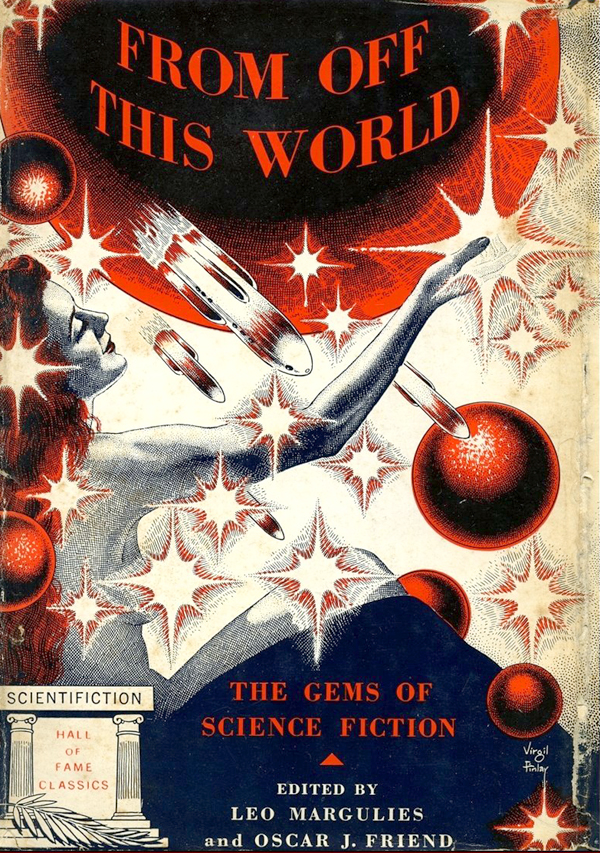
  • From Off This World (New York: Merlin Press, 1949) with Oscar J. Friend
  • My Best Science Fiction Story (New York: Merlin Press, 1949) with Oscar J. Friend
  • My Best Science Fiction Story (New York: Pocket Books, 1954) with Oscar J. Friend
  • The Giant Anthology of Science Fiction: 10 Complete Short Novels (New York: Merlin Press, 1954) with Oscar J. Friend
  • Race to the Stars (New York: Crest, 1958) with Oscar J. Friend
  • Three Times Infinity (Greenwich, Connecticut: Fawcett Gold Medal, 1958) ghost-edited by Sam Moskowitz
  • 3 from Out There (New York: Crest, 1959)
  • Get Out of My Sky (New York: Crest, 1960)
  • The Ghoul Keepers (New York: Pyramid Books, 1961)
  • The Unexpected (New York: Pyramid Books, 1961)
  • Three in One: Novels (New York: Pyramid Books, 1963) ghost-edited by Sam Moskowitz
  • Weird Tales (New York: Pyramid Books, 1964) ghost-edited by Sam Moskowitz
  • Worlds of Weird (New York: Pyramid Books, 1965) ghost-edited by Sam Moskowitz
Much of this list is from the Internet Speculative Fiction Database.

Further Reading
The Encyclopedia of Science Fiction
Internet Speculative Fiction Database

From Off This World, Leo Margulies and Oscar J. Friend's first anthology, from 1949, with dust jacket art by Virgil Finlay. Note Hugo Gernsback's old word scientifiction.

Original text and captions copyright 2015, 2023 Terence E. Hanley

Wednesday, August 14, 2013

Weird Fiction & Fantasy Magazines-Weird Tales Part 3

Sam Moskowitz may have talked Leo Margulies out of restarting Weird Tales in the 1950s and '60s, but by the early '70s, they both seemed ready to give it a try. Margulies the publisher and Moskowitz the editor put out four issues of a new Weird Tales in 1973-1974. Those four issues are roughly in the format of old pulp magazines: 6-1/2 inches by 9-1/2 inches, color covers, black-and-white interiors, ninety-six pages in length. As for content, there was a letters page ("The Eyrie"), editorial content, verse, non-fiction, illustration, and an array of short stories. Most of those short stories were reprints, though only a few came from the original Weird Tales. And thereby hangs a tale.

In an interview from 1976, C.L. Moore discussed her early short story, "Werewoman," first published in Leaves #2 in 1938:
I very foolishly . . . gave it to a fan magazine who wanted to print it. . . . The error that I made there was I didn't realize they had copyrighted it. So twenty years later, who but Sam Moskowitz . . . [ellipses original] uh, performed his usual, um, practice [emphasis hers] of jumping on things two seconds after the copyright had lapsed! So he reprinted it, of course, without paying me anything for it. Incidentally, it is simply not a thing any other publisher I know of has ever done. I have had stories of mine printed after the copyright had lapsed and I've always been paid for them. Publishers just don't do things that way, but Moskowitz is an exception to the rule and nothing can be done about that! (1)
During the 1960s, Sam Moskowitz seems to have busied himself with exhuming old and out-of-print stories from the dusty vaults where they had lain for decades. It helped that those stories were copyright-free. It helped even more when the author was in his grave. In any case, Volume 47 of Weird Tales, published between Summer 1973 and Summer 1974, relied heavily on reprints, mostly from long-dead authors who were in no position to object or to request payment. Even the cover art was mostly old: a never-published painting by Virgil Finlay, a recreation of a painting by Hannes Bok, and a swipe of a painting by Jack L. Thurston. The most conspicuously new material was the interior art, the letters in "The Eyrie," and Moskowitz's three-part critical and biographical essay on William Hope Hodgson.

In its original incarnation, Weird Tales limped along for years before meeting its end in 1954. The second and third (see the next entry) Weird Tales lasted a mere four issues each. Most imitations of Weird Tales have also met an early demise. That poses the question: Is the category of weird fiction and fantasy fiction in magazine form destined to fail? Was Sam Moskowitz right when he warned Leo Margulies against reviving Weird Tales? The latest version of Weird Tales, still breathing after twenty-five years and myriad changes in its staff, would seem to argue against that contention. More to the point, I think, is that commercial success is gravy. The genre itself is the meat. If you can make money off of it, great. Even if you can't, you keep doing it. That's why Jacob Clark Henneberger stuck with Weird Tales in 1923-1924 and why the rest of us (people like Sam Moskowitz not withstanding) still do after ninety years.

Note
(1) From Chacal, Winter 1976 (Vol. 1, No. 1), pp. 26-27.

Weird Tales
Summer 1973 to Summer 1974
4 issues (Volume 47)
Published by: Weird Tales (Leo Margulies)
Edited by: Sam Moskowitz
Format: Pulp size (6-1/2 x 9-1/2 inches)

Weird Tales, Vol. 47, No. 1, Summer 1973, with cover art by Virgil Finlay. Note the blurb: "5oth Anniversary Issue, 1923-1973."
Weird Tales, Vol. 47, No. 2, Fall 1973, with cover art by Gary van der Steur, after Hannes Bok.
Weird Tales, Vol. 47, No. 3, Winter 1973, with cover art by Bill Edwards.
Weird Tales, Vol. 47, No. 4, Summer 1974, with uncredited cover art by Jack L. Thurston, almost certainly swiped and used without his permission. Note the absence of the "fiftieth anniversary year" blurb. Note also the blurb for all-new stories, a rarity in the new Weird Tales.

So did Margulies and Moskowitz publish their new Weird Tales mostly to observe the fiftieth anniversary of the original? Did the wind go out of their sails once that year had passed? Or were they losing their shirts as Moskowitz had predicted would happen years before? Maybe Weird Tales of 1973-1974 was mostly a vehicle for stories Moskowitz had discovered in his reading of old newspapers and magazines. Publishing a magazine is one way of getting stories like that into print--and of making a little money in the process. Maybe "a little money" was actually little or no money. Whatever happened, this was the last issue of the 1970s.

Text and captions copyright 2013, 2023 Terence E. Hanley

Wednesday, August 7, 2013

Weird Fiction & Fantasy Magazines-Weird Tales Part 1

Weird Tales, the first magazine devoted exclusively to weird fiction and fantasy, arrived on the newsstand with a cover date of March 1923. This year marks the ninetieth anniversary of the magazine that fantasy fans know and love, even if it ceased publication before some of them were born. Weird Tales was never on firm footing. It faltered in its first year or two in print. The magazine's founder, Jacob Clark Henneberger, believed in his creation however and did what was necessary to keep it alive. The first incarnation of what has been called "the magazine that never dies" lasted for 279 issues, finally to give up the ghost in September 1954.

Weird Tales called itself "The Unique Magazine." That descriptor--"unique"--was I suppose used to set the magazine apart in the eyes of readers, or more importantly perhaps, potential readers. Weird Tales was unique in another way however, for it was the only magazine of its kind to have lasted for more than a few issues or more than a few years. In fact, "The Unique Magazine" is still in existence. Like a cat or an interstellar creature that lies sleeping in its submarine vault, it has many lives. Other publishers have attempted to duplicate the success of Weird Tales (which was, in the end, not financial so much as cultural). It's fair to say that no one has succeeded, despite some good efforts. Some early attempts were in competition with Weird Tales. Some later attempts were self-conscious imitations, even pastiches. Since the late '60s or early '70s, fanzines and small press magazines have probably outnumbered conventional publications. Like J.C. Henneberger, hobbyists and amateur publishers have had faith in weird fiction and in Weird Tales. They have been loath to let the thing they love die. Although the original readers of Weird Tales are dwindling in numbers, the name and spirit of the magazine live on.

This is part one of a series in which I will attempt a catalogue of weird fiction and fantasy fiction magazines from 1923 to today. I'll start with Weird Tales of course. I welcome comments, corrections, and additions.

Weird Tales
The Unique Magazine
March 1923 to September 1954
279 issues (Volumes 1 through 46)
Published byRural Publishing Corporation (Mar. 1923 to May/July 1924); Popular Fiction Company (Nov. 1924 to Oct. 1938); Short Stories, Inc. (Nov. 1938 to Sept. 1954)
Edited by: Edwin Baird (Mar. 1923 to Apr. 1924); Otis Adelbert Kline (May/July 1924); Farnsworth Wright (Nov. 1924-Dec. 1939); Dorothy McIlwraith (Jan. 1940-Sept. 1954)
Format: Small pulp size (6 x 9 inches) (Mar. to Apr. 1923); Letter size (8.5 x 11.75 inches, sometimes called large pulp or bedsheet size) (May 1923 to May/July 1924); Standard pulp size (7 x 10 inches) (Nov. 1924 to July 1953); Digest size (5 x 7.5 inches) (Sept. 1953 to Sept. 1954)

This was the original Weird Tales, perhaps more properly, the one and only, the true and original Weird Tales. Weird Tales was the home of authors H.P. Lovecraft, Robert E. Howard, and Clark Ashton Smith, as well as artists Margaret Brundage, J. Allen St. John, and Virgil Finlay. Sadly, the magazine came to its end in 1954. Leo Margulies acquired the Weird Tales property shortly after that. He wanted to revive it at least twice, but Sam Moskowitz talked him out of the idea. There are those with their grievances against Moskowitz. It's easy enough for us to say "what if" and to add his advice to Margulies to the list of grievances. In any case, Weird Tales slumbered through the 1960s except for four paperback anthologies ostensibly edited by Leo Margulies. You might call them the first reincarnation of Weird Tales. They are next in this series.

First and last covers--Weird Tales, March 1923, and September 1954. The first cover was done by Richard Ruh Epperly, the last by Virgil Finlay. These two images are not on the same scale: the first cover was six by nine inches, the last five by seven-and-a-half inches. (Please forgive the slop over into the margin. Once this posting moves down on the page, there shouldn't be any distraction.)

Text and captions copyright 2013, 2023 Terence E. Hanley

Tuesday, October 30, 2012

Albert Page Mitchell (1852-1927)

Edward Page Mitchell
Journalist, Editor, Short Story Writer
Born March 24, 1852, Bath, Maine
Died January 22, 1927, New London, Connecticut

The first thing to do here is to deal with the problem of names. "Albert Page Mitchell" is the name that appeared on the cover of two issues of the Sam Moskowitz Weird Tales of 1973-1974. That same name serves as a byline on the table of contents and in the interior of the magazine. These two issues of Weird Tales came out at about the same time as a book called The Crystal Man: Stories by Edward Page Mitchell, collected and with a biographical perspective by Moskowitz. That biographical perspective, entitled "Lost Giant of American Science Fiction," is a sixty-three page survey of American science fiction of the nineteenth century with a discussion of Mitchell's place therein. Overall, it's an admirable piece of work, but unless I'm missing something, not once is Mitchell referred to as "Albert Page Mitchell." There is mention of Mitchell's cousin, Albert G. Page, but otherwise, the Christian name "Albert" doesn't appear in relationship to the author, and he is referred to in every case either as "Mitchell" or "Edward Page Mitchell." (Moskowitz even calls him once "Edgar Page Mitchell.") So what's going on here? I can think of two possibilities: One, in rediscovering Mitchell, Moskowitz knew he had a scoop and he didn't want anybody to know about it before his book came out. Two, Moskowitz made a colossal mistake, conflating the names "Albert G. Page" and "Edward Page Mitchell" in the magazine Weird Tales. I can't see that Moskowitz would have gained anything by using a false name to protect his privy information. To me Moskowitz's use of the name "Albert" just looks like a blunder. If you do an Internet search on "Albert Page Mitchell," you'll find nothing but references to those two issues of Weird Tales (and an entry in the Internet Speculative Fiction Database). As far as I can tell, no one before or since has called Mitchell by the name "Albert Page Mitchell."

So Edward Page Mitchell it is.

Mitchell's biography is on Wikipedia. You can read it by clicking on this link. That biography seems to have been based on Moskowitz's own work in The Crystal Man. If Moskowitz is correct, then Mitchell--whom he called "'The Missing Link' in the history of American science fiction"--wrote the earliest known stories or very early stories on the topics of:
  • Faster-than-light travel ("The Tachypomp," 1874)
  • Teleportation ("The Man Without a Body," 1877)
  • Mind transfer ("Exchanging Their Souls," 1877)
  • Cybernetics ("The Ablest Man in the World," 1879)
  • Cryogenic preservation ("The Senator's Daughter," 1879)
  • Surgical alteration of personality ("The Professor's Experiment," 1880)
  • An invisible man ("The Crystal Man," 1881)
  • A time machine ("The Clock That Went Backward," 1881)
  • A friendly alien life form ("The Balloon Tree," 1883)
  • A mutated human with superior powers ("Old Squids and Little Speller," 1885)
Mitchell was a journalist; all of his known fiction was first published by his employer, the New York Sun, between 1874 and 1886. (1) Mitchell's first story, entitled "The Tachypomp," appeared in the Sun in January 1874 and again in Scribner's Monthly in April 1874. Concerned with faster-than-light travel in a decidedly non-Einsteinian way, "The Tachypomp" is also notable for its mention of an android and a tunnel through the earth. I'm not sure if Mitchell coined the term tachypomp, but its construction is simple enough: tachy, from the Greek, meaning "swift" or "rapid," and pomp, from the Latin, meaning "procession," also from the Greek, "to send." According to Wikipedia, physicist Gerald Feinberg coined the term tachyon for a hypothetical faster-than-light particle in 1967. Feinberg could not have known that an obscure nineteenth-century American writer had anticipated his construction.

Edward Page Mitchell spanned American science fiction from Edward Everett Hale (1822-1909), whom he knew as a young man, to Garrett P. Serviss (1851-1929) and Edward Bellamy (1850-1898), whom he met later in life. Mitchell also knew Frank Stockton (1834-1902), Madame Blavatsky (1831-1891), and Joshua Lawrence Chamberlain (1828-1914). Although he was interested in fantasy, science fiction, the supernatural, and the occult, Mitchell remained a solid citizen and a family man. He was on the editorial staff of the Sun in 1897 when Virginia O'Hanlon wrote her now famous letter asking if there is a Santa Claus. (2) My reason for bringing this up is not just to make a connection between Mitchell and a famous event. In 1991, Ed Asner played Edward P. Mitchell in a TV movie version of Yes, Virginia, There Is a Santa Claus. That would make Mitchell one of only a few Weird Tales authors to have been played in a movie or television show. (3)

Edward Page Mitchell died on January 22, 1927, in New London, Connecticut, at the age of seventy-four. It would take nearly half a century and the work of Sam Moskowitz--despite his mistakes--for him to be recognized as a major figure in American science fiction of the nineteenth century.

Notes
(1) Mitchell, an 1871 graduate of Bowdoin College, didn't begin working for the Sun until October 1875. He worked for newspapers in Maine and in Boston before that. Mitchell remained with the Sun the rest of his career, reaching the post of editor-in-chief in 1903 and retiring in 1922. Joshua Lawrence Chamberlain taught at Bowdoin in two stints. His teaching was interrupted by service during the Civil War. He resigned in 1883.
(2) The reply--"Yes, Virginia, There Is a Santa Claus"--was written by another editor, Francis Pharcellus Church.
(3) Two others: Robert E. Howard played by Vincent D'Onofrio in The Whole, Wide World (1996), a fine and sympathetic biopic of the creator of Conan the Cimmerian; and H.P. Lovecraft, played by Jeffrey Combs and others in various films.

Edward Page Mitchell's Stories in Weird Tales
"The Balloon Tree" (Winter 1973, originally in the New York Sun, Feb. 25, 1883)
"The Devilish Rat" (Summer 1974, originally in the New York Sun, Jan. 27, 1978)

The Crystal Man, Doubleday Science Fiction from 1973, compiled and with a historical and biographical essay by Sam Moskowitz. The artist is unknown.
I presume this is the same book in a Spanish edition.
Mitchell's work was also translated into Italian. His story, "An Uncommon Sort of Spectre," appeared in this book for youngsters.

Revised slightly and corrected on January 22, 2017; revised slightly on August 9, 2021.
Text and captions copyright 2012, 2023 Terence E. Hanley

Sunday, October 28, 2012

Authors from Sam Moskowitz's Weird Tales

As a business, Weird Tales was seldom on firm footing. It nearly died a-borning in 1923-1924. Throughout the following decades, the magazine struggled and was sold in 1938 to Short Stories, Inc. Dorothy McIlwraith came on as editor in 1940 and kept Weird Tales alive for a more than a decade, but in September 1954, "The Unique Magazine" finally gave up the ghost. In a later anthology, editor Marvin Kaye called Weird Tales "the magazine that never dies," and true to form, it has returned again and again. Leo Margulies, who purchased the Weird Tales property in the 1950s, issued several paperback anthologies in the 1960s. Then in the early '70s, editor Sam Moskowitz assembled four new issues of the magazine. Roughly the size of an old pulp magazine (or comic book), perfect bound, and amounting to 96 pages per issue, Moskowitz's Weird Tales included reprints from the original run, new stories from various authors, and some very old stories unearthed by the editor and given new life. I have written about American authors of the nineteenth century whose work was reprinted in the Weird Tales of the Farnsworth Wright era (1924-1940). Less well known are the authors from Sam Moskowitz's Weird Tales.

One of the labels I use in this blog is "Weird Tales from the Past." I have used this label for authors who died before Weird Tales began publishing in March 1923. (1) Farnsworth Wright availed himself of weird tales from the past. Dorothy McIlwraith was disinclined to do so. But when Sam Moskowitz brought back Weird Tales, he raided old story magazines for content, thereby creating a whole new category of authors for indexers and researchers like me.

It appears as though Moskowitz spent a good deal of the 1960s and '70s digging through old magazines for weird and fantastic fiction. He assembled the stories he found in a number of books and relied heavily on them for his four issues of the revived Weird TalesFollowing is a list of authors whose stories in Weird Tales appeared in the Sam Moskowitz issues. These are authors who may have lived into the first Weird Tales era, but by 1973-1974, they were gone. For most of them, their only appearance in Weird Tales was during the very brief Moskowitz era. I have already written about some of them. (Click on the links to find them.) I'll get to work on the others over the next few weeks. Think of this as a companion to my previous posting, "Nineteenth Century American Authors."
Notes
(1) There are exceptions: Robert W. Chambers, Gustav Meyrink, Giovanni Magherini Graziani, Fedor Sologub, Jean Richepin, Arthur Conan Doyle, and Gaston Leroux. Most of these authors were European and may not have known their work was being reprinted in Weird Tales.

Fifty years after Weird Tales first arrived on the newsstand and nearly twenty after it had disappeared, editor and science fiction historian Sam Moskowitz revived the title with four quarterly issues. This is the first, from the Summer of 1973. The cover art is by Virgil Finlay, and though it had been created decades before, Finlay's cover had never before been published. Created as an illustration for Pearl Norton Swet's story "The Medici Boots," this was to have been Finlay's first cover for Weird Tales. Unfortunately, the young artist didn't leave any room for title or credits. The story appeared in the September 1936 issue of the magazine, but with a cover by Margaret Brundage. Moskowitz's wife, Christine E. Haycock, photographed the original art in Finlay's studio in 1962, and the image finally saw print here. 
The second issue, from the fall of 1973, with cover art by Gary van der Steur after Hannes Bok's cover from March 1940.
Issue number 3, Winter 1973, cover art by Bill Edwards. The recent movies Willard (1971) and Ben (1972)  would have been on people's minds when this issue appeared.
The last issue of Sam Moskowitz's revival of Weird Tales, from the summer of 1974. The cover artist is unknown.
As a bonus, here's Virgil Finlay's interior illustration for "The Medici Boots" by Pearl Norton Swet.
And here's the cover that took the place of Finlay's original. The artist was Margaret Brundage.

Text and captions copyright 2012, 2023 Terence E. Hanley