Showing posts with label Henry Kuttner. Show all posts

Thursday, December 8, 2022

Husbands & Wives-Part Five

Husbands and wives wrote for Weird Tales, sometimes together, sometimes separately, sometimes before they were even married. Following is a list. It is probably incomplete.

  • Sonia H. Greene (1883-1972) & H.P. Lovecraft (1890-1937)

There were other contributors to Weird Tales who were married to writers who did not contribute. For example, Frederik Pohl (1919-2013) was married to Lesli Perri (1920-1970), Judith Merril (1923-1997), Carol Metcalf Ulf (1927-2005), and Elizabeth Ann Hull (1937-2021), all of whom were also writers.

I think I'll find more husbands and wives who wrote for "The Unique Magazine." I'll add them to this list as I do.

* * *

I have written this series to show that wives have been instrumental in the success of their husbands as authors. I was on the lookout for that kind of thing while reading Astounding: John W. Campbell, Isaac Asimov, Robert A. Heinlein, L. Ron Hubbard, and the Golden Age of Science Fiction by Alec Nevala-Lee (2018, 2019). And I found it in Robert A. Heinlein's own words regarding his second wife, Leslyn MacDonald, and in Mr. Nevala-Lee's words regarding John W. Campbell's first wife, Doña Stebbins. Campbell's second wife, Margaret "Peg" Winter, was more nearly a full and equal collaborator with him, at least in his pseudoscientific research. Heinlein's third wife, Virginia "Ginny" Gerstenfeld, was also a powerful influence on her husband. She helped him in life and she helped after his death to protect him and his reputation, to preserve his work, and to promote the study and appreciation of his work. All of these wives were personally, intellectually, and creatively formidable figures. I should add that L. Ron Hubbard also married strong and able women. But then these are things that we already knew about wives and women. I am reminded here of a quote by Alexis de Tocqueville:

And now that I come near the end of this book in which I have recorded so many considerable achievements of the Americans, if anyone asks me what I think the chief cause of the extraordinary prosperity and growing power of this nation, I should answer that it is due to the superiority of their women.

That's not to take away anything from women of other nationalities, but it gets to a truth, and it's one worth remembering and keeping close at hand.

C.L. Moore & Henry Kuttner, two married writers at work.

Text copyright 2022, 2023 Terence E. Hanley

Tuesday, July 21, 2020

Earl Peirce, Jr.-Aside No. 3

Bloch & Lovecraft

Robert Bloch (1917-1994) discovered Weird Tales in the summer of 1927 when he and his aunt were at the Chicago and North Western railroad terminal in his hometown. She told him to choose any magazine he wanted from the newsstand. "I immediately zeroed in on Weird Tales," Bloch recalled more than half a century later. His aunt wasn't very happy with the choice, but at the tender age of ten Bloch had made the discovery of a lifetime. (1)

H.P. Lovecraft (1890-1937), Bloch's soon-to-be idol and mentor, didn't have a story in Weird Tales that summer. Bloch would have had to wait until the October issue to read one instead. If that's what happened--if the October 1927 issue of Weird Tales really was Bloch's first encounter with Lovecraft--then it would have been a perfect introduction, for that's when "Pickman's Model" first appeared. I'm pretty sure "Pickman's Model"--the Night Gallery version--was my introduction to Lovecraft, too, though I didn't know it at the time.

Six years later, Bloch was living in Milwaukee and rising at 6:30 on the first of every month to dress and then rush away from his home on East Knapp Street to the cigar store on Ogden Avenue, gasping, clutching his quarter, hot to buy the first of only two or three copies of Weird Tales carried by the spinster ladies who ran the store. (One sold cigars. The other smoked them.) (2) Bloch turned sixteen that year. Only a couple of more years would pass before his own byline began appearing in Weird Tales.

Nineteen thirty-three year was a fateful year in Bloch's career. He had already had his first letter printed in "The Eyrie," the letters column of Weird Tales. That was in November 1932. (He asked that Weird Tales remain decidedly weird. His letter is also about Conan, a character Bloch is supposed to have disliked intensely.) Shortly after his sixteenth birthday, Bloch wrote a fan letter to Lovecraft. In pretty short order, he received a reply, dated April 22, 1933. Thus began a short but voluminous correspondence. "He was the man who I most admired in fantasy, next to Edgar Allan Poe," Bloch remembered. "He is the man who suggested that I write, encouraged me to write. He is the man responsible for my writing career. And I would say he is probably the strongest formative influence--outside of my own parents--on my entire life." (3)

The letters between Bloch and Lovecraft would continue until the end of Lovecraft's brief remaining years on earth. Bloch was devastated when Lovecraft died in March 1937. "At the age of twenty, the news of his fate came to me as a shattering blow," Bloch remembered. (4) In an effort to recuperate from the blow, he answered an invitation from Henry Kuttner (1915-1958), another young author who had suffered the shock, to visit him in California. Bloch made the trip in May. During his stay on the West Coast, he also met Fritz Leiber, Jr. (1910-1992) and C.L. Moore (1911-1984), fresh from her Hoosier home. Kuttner and Moore would later marry.

The Internet Speculative Fiction Database (ISFDb) lists more than four dozen published letters and cards from Lovecraft to his young correspondent. (There is no corresponding list, no pun intended, of letters from Bloch to Lovecraft.) Six of these letters were published in Lovecraft's Selected Letters, which were issued in five volumes by Arkham House. (And other publishers, too?--I'm not sure.) They are: No. 624-June 9, 1933; No. 645-Aug. 19, 1933; No. 662-Nov. 1933; No. 748-Jan. 25, 1935; No. 780-Apr. 30, 1935; No. 814-Dec. 4, 1935. Lovecraft's last letter in the ISFDb list was dated January 25, 1937, the same month in which "The Thing on the Doorstep," Lovecraft's last story published in his lifetime in Weird Tales, appeared. Two months after that he was in his grave. Bloch also wrote letters to Weird Tales. According to Thomas G.L. Cockcroft's index, there were twenty-six of them between November 1932 and July 1945. That number puts him in sixth place behind Henry Kuttner in the list of most prolific letter writers in "The Eyrie." 

I have one more piece of information from the Centipede Press book Conversations with the Weird Tales Circle (2009). In an article called "Robert Bloch on Weird Tales," the author remembered his association with the magazine and its contributors. Asked by his editor to mention his own favorites among the stories he wrote for Weird Tales, Bloch responded: "Certainly there will always be a special place in my affections for the early yarns written in the Lovecraftian style--the Egyptian cycle which gradually evolved from them," and so on. In this series, I have written about what seems to be a kind of mini-mythos invented by Robert Bloch, with Mysteries of the Worm (or De Vermis Mysteriis) by Ludvig Prinn playing a central role. Now it seems that the mythos has a name: the Egyptian Cycle. It's not in my imagination after all. In fact, Robert Price has already written about it in an article called "The Egyptian Tales of Robert Bloch" on The Lovecraft Ezine. That happened six years ago, on October 14, 2014. You can read it by clicking here. Mr. Price has also discussed the stories in the cycle, all from Weird Tales:
  • "The Faceless God" (May 1936)
  • "The Opener of the Way" (Oct., 1936)
  • "The Brood of Bubastis" (Mar. 1937)
  • "The Secret of Sebek" (Nov. 1937)
  • "The Fane of the Black Pharaoh" (Dec. 1937)
  • "The Eyes of the Mummy" (Apr. 1938)
  • "Beetles" (Dec. 1938)
Half of these were published during Lovecraft's final year on earth. "The Brood of Busbastis" appeared in the same issue in which Earl Peirce, Jr.'s story "The Last Archer" was published. Ironically, that was in March 1937, the same month in which Lovecraft died. Peirce's story seems to be connected to Bloch's Egyptian Cycle. Maybe we can add it to the list as Story Number 7-1/2. As I have already noted, Peirce's first story, "Doom of the House of Duryea," mentions Ludwig Prinn, but doesn't seem to have a connection to the Egyptian Cycle. So were there actually two connected mini-mythos creations, the Egyptian Cycle and the Mysteries of the Worm/Ludwig Prinn cycle? Or maybe a more important question is this: Does it really matter?

Notes
(1) "Time Traveling with H.P. Lovecraft: The First World Fantasy Convention," by Robert Bloch in Conversations with the Weird Tales Circle (Centipede Press, 2009), page 255.
(2) Ditto, page 256.
(3) "Robert Bloch Interviewed by Will Murray, 1975," in Conversations with the Weird Tales Circle (Centipede Press, 2009), page 269.
(4) "Time Traveling with H.P. Lovecraft: The First World Fantasy Convention," by Robert Bloch in Conversations with the Weird Tales Circle (Centipede Press, 2009), page 261.

From left to right, Henry Kuttner, Catherine L. Moore, Robert Bloch, and an unidentified woman, possibly C.L. Moore's friend Marjorie, a picture taken in Southern California in or about May 1937, possibly by Forrest J Ackerman. Bloch made the trip at Kuttner's invitation. Both were in mourning at the death of H.P. Lovecraft in March, but both seem to be having a little fun.

Kuttner had a kind of dour appearance, I think, but he was supposed to have been one of the funniest men in science fiction. He has reason for a little happiness in this picture, even if it isn't showing exactly: that's his future wife sitting next to him. The force of her gravity is even drawing him in a little.

As for C.L. Moore, she must have had the bluest of eyes, so blue that her irises often disappeared in photographs, like the eyes of Johnny Reb or Billy Yank from days of yore--like the eyes of her hero, too, Northwest Smith. Count Kuttner lucky: Catherine L. Moore was an extraordinarily charming and beautiful woman. Count me a little jealous, too.

Bloch doesn't seem to be too broken up, either. Being in the company of women can do that to a man. In fact he's clowning for the camera, pretending the kind of mayhem that one of his characters might have perpetrated. A shy or introverted man is likely to do that kind of thing, too, when women are around.

The other woman is unidentified, but Bloch later remembered a friend of C.L. Moore who accompanied her on the trip from Indiana. He even remembered her name, Marjorie. I suspect it is she, and if it is, I'm happy we have her picture and identity after these many decades.

The photograph is from Alternate Worlds: The Illustrated History of Science Fiction by James Gunn (1975), page 142.

I would like to acknowledge the Internet Speculative Fiction Database, Thomas G.L. Cockcroft, and Robert Price, and to thank Randal A. Everts for the book Conversations with the Weird Tales Circle.

Original text copyright 2020, 2023 Terence E. Hanley

Tuesday, November 12, 2013

Laurence R. D'Orsay (1887-1947)

Pseudonym of Leopold Alexander Thalmayer
Aka Laurence Thalmore
Author, Critic, Literary Agent
Born November 8, 1887, Vienna, Austria
Died November 21, 1947, Los Angeles City or County

Laurence Rex D'Orsay was the pseudonym of a man named Leopold Alexander Thalmayer, also known as Laurence Thalmore. (1) He was born on November 8, 1887 (or 1893), in Vienna, Austria. In 1911 he was living in London, England. Five years later (on March 14, 1916), he arrived in New York with a woman who was ostensibly his British-born wife, Renette. She seems to have vanished from the public record after that.

The 1920 census found Laurence A. Thalmayer living in Kearny, New Jersey, and employed with a trading company. By 1925, he was already working as a literary agent. (He wrote to Kansas columnist Jay E. House [1872-1936] that year offering to place House's writings for him.) By 1930 Laurence Thalmore was in Beverly Hills with a relatively new wife and son. She was Nordica Abbott (1902-1969), a dancer and artist named for the American opera singer Lillian Nordica, also called Madame Nordica. (2) The son was named Kenneth Thalmayer, eventually Kenneth Edward D'Orsay (1923-1972). (3) Kenneth D'Orsay would one day have a daughter named Nordica Theodora D'Orsay, or Teddy for short. In the 1970s, Teddy was or was not part of some kind of intrigue involving the CIA, the Mafia, drugs, the Shah of Iran, and other fodder for conspiracy theorists. You can try to untangle all that yourself if you'd like.

In the meantime, Laurence R. D'Orsay busied himself as a writer and a literary agent. His stories included:
  • "Phantoms," Weird Tales (Jan. 1925)
  • "The Spirit of It," Short Stories (Jan. 25, 1925)
  • "Marble," Weird Tales (June, 1925)
  • "The Stamp of Courtesy," Clues (Oct. 1926)
  • "Jewels for Two," (with F. L. Grant) Clues (Dec. 1926)
  • "The Price of Empire," Soldiers of Fortune (May, 1932)
D'Orsay also wrote a novel, Mistress of Spears: A Tale of Amazulu (Kansas City, Missouri: Burton, 1930), plus non-fiction on writing and marketing for writers. He ran Laurence D'Orsay Literary Agency in Los Angeles in the 1930s. Henry Kuttner worked for D'Orsay before making a name for himself as an author of science fiction, fantasy, and horror stories. In his work for D'Orsay, Kuttner also helped Leigh Brackett get her career started. I suspect a number of science fiction fans from southern California and their friends from the hinterlands passed through the doors of the D'Orsay agency.

Laurence D'Orsay became a naturalized citizen in 1940. He died after the war, on November 21, 1947, in Los Angeles City or County and was buried at Forest Lawn Memorial Park, in Glendale, California.

Notes
(1) Laurence D'Orsay should not be confused with the British actor of the same name.
(2) Laurence Thalmore and Nordica Abbott were married on September 15, 1922, in San Francisco. She was born on March 21, 1902, in Fresno, California.
(3) Kenneth Thalmayer was born on October 3, 1923, in San Francisco.

Laurence R. D'Orsay's Stories in Weird Tales
"Phantoms" (Jan. 1925)
"Marble" (June 1925)

Further Reading
I don't know of any further sources on Laurence D'Orsay except for his own works.

Mistress of Spears, Laurence D'Orsay's 1930 novel with a cover design by an unknown artist.
And a work by his wife, Nordica Abbott D'Orsay.

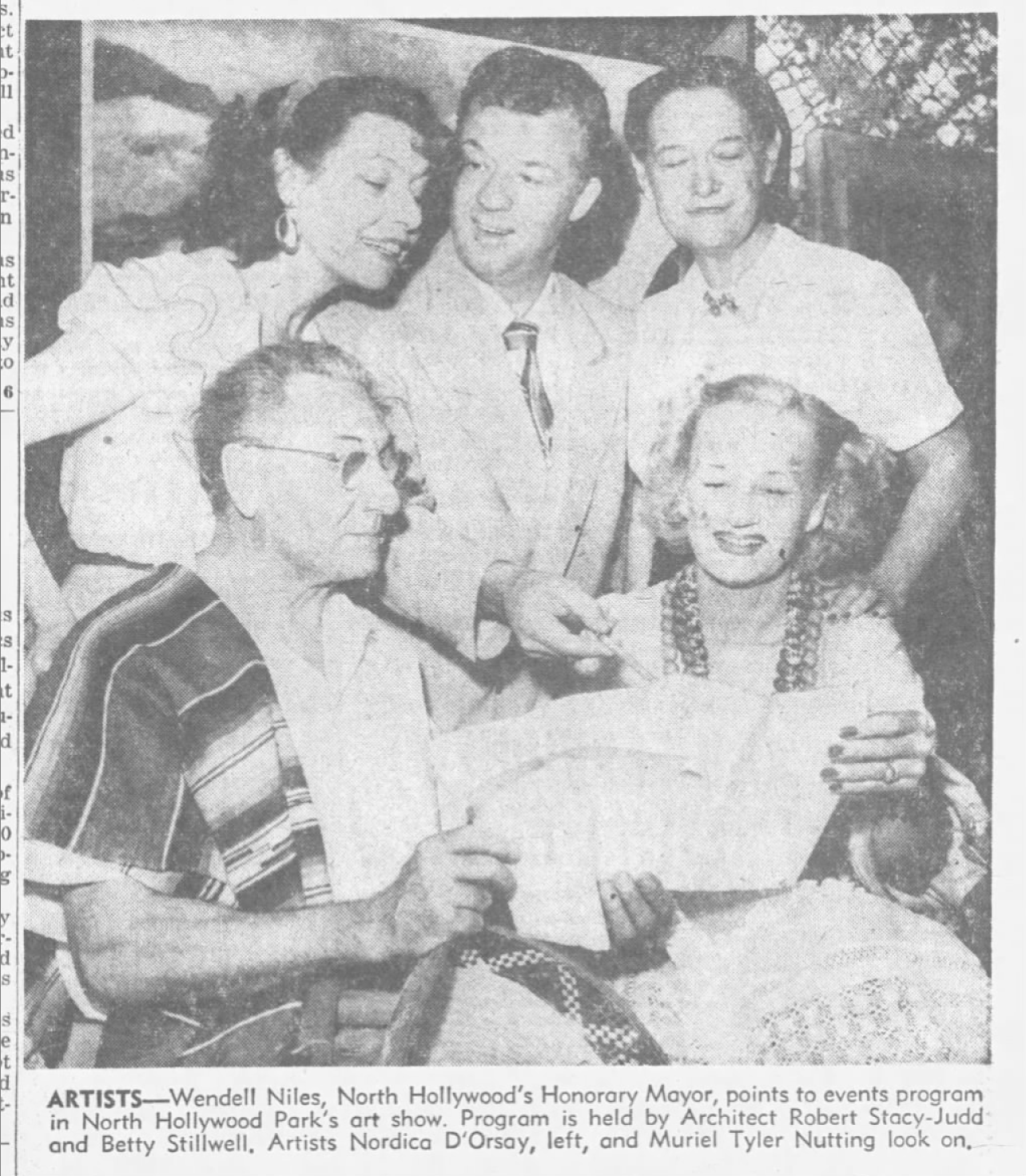
A photograph of Nordica Abbott D'Orsay (with others) from the Los Angeles Times, Ocotber 14, 1950, page 15. (Photo added Feb. 22, 2021.)

Update (June 6, 2014): I found out today that Michael C. Ruppert, the man who made the allegations about Teddy D'Orsay, killed himself on April 13, 2014. Born on February 3, 1951, in Washington, D.C., Ruppert was a police officer with the Los Angeles Police Department, an author, a conspiracy theorist, and a radio host. 

Updated: June 6, 2014; February 22, 2021.
Text and captions copyright 2013, 2023 Terence E. Hanley

Sunday, June 23, 2013

Science Fiction and Comic Books-Part 4

Comic books and superheroes drew heavily from the pulps. Comic books were replete with science fiction superheroes (Superman), detective superheroes (Batman), weird fiction superheroes (The Spectre), plus magicians, adventurers, aviators, historical heroes, and other kinds of pulp characters. Pulp writers also wrote for the comics, among them, Henry Kuttner (All-American ComicsGreen Lantern), Manly Wade Wellman (Captain MarvelBlackhawk), Fritz Leiber, Jr. (the Buck Rogers newspaper comic strip), Jack Williamson (the Beyond Mars comic strip), and Otto Binder (hundreds of stories for DC Comics, including key Superman stories). (1) Far fewer artists made the crossover, for drawing comic books would have been a step down for most pulp artists. One exception was Virgil Finlay, but then Finlay was reduced to drawing illustrations for astrological magazines in the 1960s. Far more artists went from comic books to illustration. Frank Frazetta was a perfect example of that.

In taking anything from the comics, science fiction would only have been borrowing from itself. After all, the superman (or the super-powered mutant), super-science, aliens, time travel, and so many other staples of  the comic book story originated in science fiction. Science fiction borrowed some writers from the comics however. Harry Harrison, who drew comics for EC, is the first to come to mind. I can think of one instance when comics got the scoop on science fiction, and that's when the first landing of a man on the moon was broadcast on television in the fictional confines of the comic strip Alley Oop (in 1947, twenty-two years before the real event). Up until then, no science fiction author had imagined such a thing. I'm sure there were other developments in science fiction that took place in the comics, but I don't know of any offhand. That's a question worth some study.

I'll make just one more observation. As I said, the integration of words with pictures is essential in formulating and understanding comics. The standard science fiction story is of course devoid of pictures. The words carry the story. I can think of one science fiction story that is richer for its unique visual content. I think it's one of the very finest science fiction novels, a tour de force that I can recommend to people even if they don't like science fiction. The novel is called The Stars My Destination. It was written by Alfred Bester, a former comic book scriptwriter.

I have written all this as a lead-in to one of the last writers on my list of "More Authors of the Golden Age of Science Fiction," the prolific and multitalented Gardner F. Fox. His biography is next.

Notes
(1) Incidentally, Buck Rogers also originated in the pulps, in the novelette Armageddon 2419 A.D. by Philip Francis Nowlan (Amazing StoriesAugust 1928). Less than six months later, the comic strip Buck Rogers in the 25th Century A.D. made its debut. On the same day--January 7, 1929--Tarzan also appeared in the comics for the first time. Ten days later, another now famous character made his debut in the comic strip Thimble Theatre. Comic strip historian and Weird Tales contributor Bill Blackbeard made a case that "the first genuine, unshootable, unpoisonable, door-smashing, house-lifting comic strip superham of them all [was] Elzie Segar's Popeye."

Text copyright 2013, 2023 by Terence E. Hanley

Wednesday, November 16, 2011

Who Wrote the Most Letters in Weird Tales?

"The Eyrie," the letters column and editorial department for Weird Tales, began with the first issue in March 1923 and continued through most of the magazine's run until September 1954. Hundreds of correspondents wrote to "The Eyrie," including most of the magazine's more prolific authors. H.P. Lovecraft for example was published in the letters column (in September 1923) before having his first story, "Dagon," in the main body of the magazine (in October 1923). Lovecraft wrote twelve letters published in Weird Tales. That's a bit of a surprise considering he was one of the most prolific writers of letters in human history.

The champion letter writer in Weird Tales was the so-called "Big Name Fan" Jack Darrow, a Chicagoan referred to more than once as a "letterhack." And he did hack out a few letters, 35 to Weird Tales, six to Oriental Stories, and three to The Magic Carpet Magazine. Next is the unknown B.M Reynolds with 33. If B.M. was a man, then the most prolific of women correspondents was Gertrude Hemken, nicknamed Trudy. Another Chicagoan, Gertrude Hemken wrote 32 letters published in the magazine. In his book The Weird Tales Story, Robert Weinberg described them as "disjointed patches of baby talk nonsense." Nonetheless, they and she were popular. (1) As for authors of stories, Henry Kuttner (28) and Robert Bloch (26) were on top.

Tom Cockcroft has compiled a list of letter writers to Weird Tales, published on the FictionMags website. That list is the source for my list. Once again, if my count is wrong, the fault is mine alone. If my count is correct, it's only as good as my source.

Who Wrote the Most Letters in Weird Tales?
1. Jack Darrow, 35 letters
2. B.M. Reynolds, 33
3. Gertrude Hemken, 32
4. Donald Allgeier, 29
5. Henry Kuttner, 28
6. Robert Bloch, 26
7. Julius Hopkins, 25
8. (tie) Alvin V. Pershing, 21
8. (tie) Seabury Quinn, 21
9. Clark Ashton Smith, 20
10. John V. Baltadonis, 19
11. (tie) Robert A. Madle, 17
11. (tie) E. Hoffman Price, 17
12. Manly Wade Wellman, 16
13. Caroline Ferber, 15
14. (tie) E.L. Mangshoel, 14
14. (tie) John Wasso, 14
15. Robert Leonard Russell, 13
16. (tie) H.P. Lovecraft, 12
16. (tie) J. Vernon Shea, 12
17. August Derleth, 11 letters on his own, plus 1 with another correspondent
18. Six correspondents tied with 11 letters each

Robert E. Howard by the way had nine letters published in Weird Tales.

Note
(1) In doing research for this posting, I came upon some speculation that Gertrude Hemken and Caroline Ferber were the same person. If that's true, then Gertrude would be the top writer of letters in Weird Tales.

The heading for "The Eyrie," the long-running letters column of Weird Tales, drawn by Andrew Brosnatch and used for years after he was no longer associated with the magazine.

Text copyright 2011, 2023 Terence E. Hanley

Monday, November 14, 2011

Who Wrote the Most Stories for Weird Tales?

The original Weird Tales was in print from March 1923 to September 1954, 279 issues in all. Hundreds of men and women contributed to "The Unique Magazine." As far as I know, no one has counted their number or how many stories they wrote. Some writers sold a single story to Weird Tales, while others became stars, contributing story after story during the magazine's heyday. Three authors--H.P. Lovecraft, Robert E. Howard, and Clark Ashton Smith--are closely identified with Weird Tales, yet none was more prolific than Seabury Quinn (1889-1969), a lawyer and journalist who wrote over 500 stories in his lifetime. His works for Weird Tales numbered 159, of which fourteen were non-fiction. Most of those stories starred occult detective Jules de Grandin, descended perhaps from Sherlock Holmes and Carnacki the Ghost-Finder. One of Quinn's most admired stories was "Roads," published in Weird Tales in January 1938. An unusual Christmas story, "Roads" appeared in print as the world marched towards war.

Second to Quinn was August W. Derleth (1909-1971), who wrote 101 stories under his own name, plus 13 more under the pseudonym Stephen Grendon, and another 22 stories in collaboration with others. Derleth co-founded Arkham House, a publisher of hardbound weird fiction, much of it from Weird Tales. He was largely responsible for keeping H.P. Lovecraft's name in print after Lovecraft's death in 1937.

Third in ranking is Edmond Hamilton (1904-1977) with 76 stories, followed by Robert Bloch (1917-1994) with 66. Only then do the big three show up on the list: Clark Ashton Smith (63), Robert E. Howard (54), and H.P. Lovecraft (49, not counting collaborations, revisions, and ghost-written stories).

The most prolific woman among contributors to Weird Tales was Allison V. Harding with 36 stories, followed by Mary Elizabeth Counselman with 30. There is reason to believe that Allison V. Harding was not a woman. I'll cover that possibility in a series of future postings.

In any case, following is a list, based on my count of titles in The Collector's Index to Weird Tales by Sheldon Jaffery and Fred Cook (1985). If my count is wrong, only I am to blame. If my count is correct, then it's only as good as Jaffery and Cook's list. Also, I have counted stories that appeared in the original run of Weird Tales, 1923 to 1954, and not in the revivals of 1973-1974 or 1981.

Finally, as you can see towards the bottom of the list, the order might change depending on how you count. The same is true in the case of H.P. Lovecraft, who revised and ghost-wrote several stories without being given credit in print. As always, Lovecraft is unique.

Who Wrote the Most Stories for Weird Tales?

1. Seabury Quinn, 145 stories and 14 articles, for a total of 159 works in prose
2. August W. Derleth, 101 stories under his own name, plus 13 stories under the pseudonym Stephen Grendon (114 total), plus 22 stories in collaboration with others
3. Edmond Hamilton, 76 stories
4. Robert Bloch, 66
5. Clark Ashton Smith, 63
6. Robert E. Howard, 54
7. H.P. Lovecraft, 49 stories on his own, plus 4 in collaboration with others, not counting revisions and ghost-written stories
8. Manly Wade Wellman, 39 stories on his own, plus 1 in collaboration with others
9. Paul Ernst, 37
10. Allison V. Harding, 36
11. Frank Owen, 34
12. Mary Elizabeth Counselman, 30
13. (tie) Arthur J. Burks, 29
13. (tie) Harold Lawlor, 29
14. Frank Belknap Long, 28 stories on his own, plus 1 in collaboration with others
15. (tie) Henry S. Whitehead, 26
15. (tie) Alvin F. Harlow, 26, all of which are articles
16. Ray Bradbury, 25
17. E. Hoffman Price, 24 stories on his own, plus 2 in collaboration with others
18. Arlton Eadie, 24
19. Henry Kuttner, 23 stories on his own, plus 2 in collaboration with others
20. David H. Keller, 22

Seabury Quinn (1889-1969), the most prolific author in Weird Tales.

Reformatted on December 3, 2022.
Copyright 2011, 2023 Terence E. Hanley

Friday, April 22, 2011

C.L. Moore (1911-1987)

Author, Illustrator, Teacher, Screenwriter
Born January 24, 1911, Indianapolis, Indiana
Died April 4, 1987, Los Angeles or Hollywood, California

Catherine Lucille (or Lucile) Moore was born in Indianapolis and grew up a sickly child immersed in fantasy. She attended Indiana University for two years but was forced to go to work during the early years of the Great Depression. As a secretary of a bank president, she typed during the day, but at night, after the bank had closed its doors, she wrote away, composing stories she hoped would win her a place in the pulp magazines of the day. Her dream came true with the first story she ever submitted to Weird Tales. Then and now, her "Shambleau" is a sensation.

Northwest Smith, a forerunner to interplanetary heroes all the way to Han Solo, was the hero of her first four stories for Weird Tales. Then came Jirel of Joiry, the acknowledged first heroine in the field of heroic fantasy, then dominated by Robert E. Howard's Conan. Northwest and Jirel traded back and forth as the protagonists of her fiction for "The Unique Magazine" until 1937 when they teamed up in a story that was itself a team-up between Catherine and her future husband, Henry Kuttner of Los Angeles. The story was "Quest of the Starstone," and it was illustrated by Kuttner's future best man, Virgil Finlay.

Catherine's last story for Weird Tales was a reprint, "Nymph of Darkness," co-authored by another Angeleno, Forrest J Ackerman. Fittingly enough, it was printed in the last issue of the 1930s. Six months later, Catherine was married and living on the East Coast, engaged in a writing collaboration with her husband that would last almost two decades. Weird Tales had by then already made a similar move, to offices in New York City. By the end of 1940, Weird Tales editor Farnsworth Wright would be in his grave, and the magazine's heyday would come to a close.

C.L. Moore's Stories and Letter in Weird Tales
  • "Shambleau" (Nov. 1933)-Northwest Smith
  • "Black Thirst" (Apr. 1934)-Northwest Smith
  • "Scarlet Dream" (May 1934)-Northwest Smith
  • "Dust of Gods" (Aug. 1934)-Northwest Smith
  • "The Black God's Kiss" (Oct. 1934)-Jirel of Joiry
  • "Black God's Shadow" (Dec. 1934)-Jirel of Joiry
  • "Julhi" (Mar. 1935)-Northwest Smith
  • "Jirel Meets Magic" (July 1935)-Jirel of Joiry
  • "The Cold Gray God" (Oct. 1935)-Northwest Smith
  • Letter to "The Eyrie" (as Miss Catherine Moore, Oct. 1935)
  • "The Dark Land" (Jan. 1936)-Jirel of Joiry
  • "Yvala" (Feb. 1936)-Northwest Smith
  • "Lost Paradise" (July 1936)-Northwest Smith
  • "The Tree of Life" (Oct. 1936)-Northwest Smith
  • "Quest of the Starstone" (Nov. 1937) with Henry Kuttner-Northwest Smith & Jirel of Joiry
  • "Hellsgarde" (Apr. 1939)-Jirel of Joiry
  • "Nymph of Darkness" (Dec. 1939) with Forrest J Ackerman-Northwest Smith, reprinted from Fantasy Magazine (Apr. 1935)
Further Reading
Reprints of C.L. Moore's stories are common in anthologies published since the 1960s, but if you're looking for collections of her stories alone, start with these:
  • The Best of C.L. Moore (1975), with an introduction by Lester Del Rey and an afterword by the author herself
  • Jirel of Joiry (Paperback Library, 1969)
  • Northwest Smith (Ace Books, 1981)
  • Black God's Kiss (Planet Stories, 2007)
The Jirel stories and Northwest Smith stories have been published in other collections as well, some of which are pricey. Catherine's only solo novel, Doomsday Morning (1957), is generally available, too. However, despite flashes of the color and imagination from her days writing for Weird Tales, it's not a very satisfying book.

You can also read more about C.L. Moore on my blog, Indiana Illustrators, at indianaillustrators.blogspot.com. I have also posted an article about her on my blog, Hoosier Cartoonists, at hoosiercartoonists.blogspot.com.


Catherine L. Moore (1911-1987)--The date of the photograph is unknown, but the author-to-be is quite young, perhaps still a student. Look upon this and other pictures of her, read her stories, and you'll not wonder why Forrest J Ackerman called her "Catherine the Great," why E. Hoffman Price confessed his love for her, and why Henry Kuttner proposed to her shortly after their first meeting. From the collection of Julius Schwartz and reprinted in Locus, March 1988.

Welcome to my new blog, in which I plan to tell the stories of the artists and writers who made Weird Tales a magazine made of pulp but containing gems. Please leave comments and requests. You can also contact me by email at:


Text and captions in this blog are copyright 2011, 2023 by Terence E. Hanley. All rights are reserved. Images are the property of their individual owners or creators. This blog is for informational and educational purposes only.