Showing posts with label Joseph Payne Brennan. Show all posts

Saturday, August 24, 2024

Weird Tales: The Thirtieth Anniversary

In its March issue of 1953, Weird Tales magazine printed a letter from Irving Glassman of Brooklyn, New York, in observance of the thirtieth anniversary of the magazine. Glassman had one other letter in Weird Tales. That one was printed in the May 1952 issue and reprinted in H.P. Lovecraft in "The Eyrie", edited by S.T. Joshi and Marc A. Michaud (1979). Glassman referred to H.P. Lovecraft in his first letter and made an oblique reference to Lovecraft in his second:

The Editor, WEIRD TALES
9 Rockefeller Plaza, New York 20, N. Y.

My calendar informs me that with the next issue WEIRD TALES celebrates its thirtieth anniversary. I would like to be among those who offer their congratulations to the most long-lived of all imaginative magazines.

I, myself, am too young to have read those early issues of The Unique Magazine but I have read many of those stories in later editions of WT as well as in the Arkham House books. I have in my library a copy of The Moon Terror which, I believe, was the first anthology of stories taken exclusively from your magazine. The Moon Terror is something of a rara avis today and I'm quite proud to own that book.

It would be fitting on this occasion to present a list of what I consider to be the ten best stories to have appeared in WT but such a task, I find, is impossible. At least 50 outstanding phantasies come to mind and there are more than that number which are equally good but which have, for the moment, escaped my memory. For every poorly-written tale that is printed in WT (and that only proves that the editor is human, after all) there are at least a dozen readable ones and of that dozen you will find that about half of them are potential classics. This is not merely my opinion; it is shared by all the readers of your Unique Magazine. Please keep up the good work.

Every best wish to you.

Yours by the Doom that came to Sarnath,
Irving Glassman, Brooklyn, N. Y.

There weren't very many Irving Glassmans in public records. Unfortunately, I can't say for sure who he was.

Weird Tales, March 1953, with a cover story "Slime," by Joseph Payne Brennan and cover art by Virgil Finlay. This is one of my favorite covers by Finlay for "The Unique Magazine." I think it's also one of his best. "Ooze" by Anthony M. Rud was the cover story for the first issue of Weird Tales in March 1923. "Slime" has some similarities to "Ooze." As I wrote recently, it also has some similarities to "It" by Theodore Sturgeon.

Original text copyright 2024 Terence E. Hanley

Thursday, June 6, 2024

"It" in Print & Image

"It" by Theodore Sturgeon (1918-1985) was in Unknown in August 1940. Sturgeon's contemporary, Joseph Payne Brennan (1918-1990), was working for a newspaper in New Haven, Connecticut, at about that time. Brennan had been trying for years to break into print, especially into the pages of his ideal, Weird Tales. Published by Street & Smith, Unknown was in much the same vein as "The Unique Magazine." I think "It" would have fit right into its pages. 

Brennan could easily have read Sturgeon's story the first time around in Unknown. He would have had a second chance to read "It" just a few years later, after he gone to and returned from war in Europe. In 1946, Rinehart published a collection of stories called Who Knocks? The editor of Who Knocks?August W. Derleth (1909-1971), drew from many sources for his contents, including Weird Tales. Less than halfway through the book, readers would have encountered "It." I have a feeling that they and generations of readers since have considered "It" one of their favorites, or at least a very memorable story.

"It" was reprinted again in 1948, first in a very limited paperback edition of 200 copies. A quarter of those were given away at the 6th World Science Fiction Convention, or Torcon, held in Toronto, Canada, from July 3 to July 5, 1948. The paperback version was to promote the publication of Theodore Sturgeon's first collection, Without Sorcery, published by Prime Press, Inc., of Philadelphia, also in 1948. "It" was in that collection as well. One of the men behind Prime Press was Armand E. Waldo (1924-1993), who shared a surname with Theodore Sturgeon, né Edward Hamilton Waldo. Were they related? I don't know.

Joseph Payne Brennan's story "Slime" was published in Weird Tales five years later, in March 1953. The other day, I wrote about how similar is the introduction of his story to that of Sturgeon's. As a fan of weird fiction and fantasy, Brennan would have had at least three chances to read "It" in print before sitting down to write his own story. The influence of one upon the other seems pretty clear to me. But was that a conscious influence? I can't say.


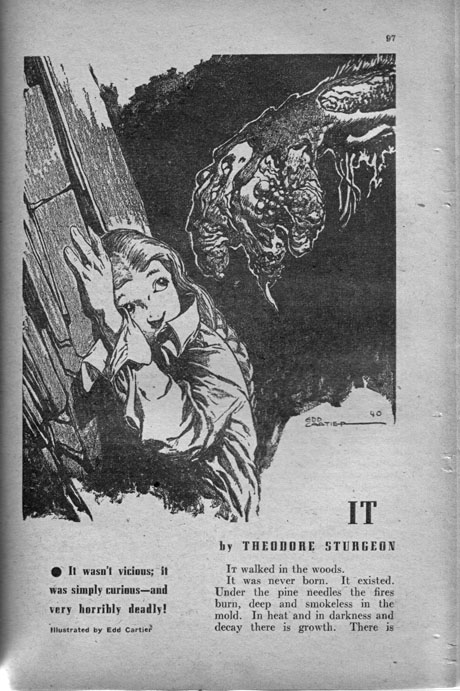
"It" by Theodore Sturgeon was in Unknown in August 1940. The author was all of twenty-two years old at its publication. "It" was illustrated by Edd Cartier (1914-2008). His two illustrations appear above. These images are from a French-language website called Collector's Showcase, accessible by clicking here.

"It" was also in Who Knocks?, a hardbound collection from 1946. The illustrator of that volume was Lee Brown Coye (1907-1981). Unfortunately I don't have any images to show of Coye's illustration or illustrations.

Original text copyright 2024 Terence E. Hanley

Sunday, June 2, 2024

Recent Reading No. 2

In our most recent weird fiction book club we read stories by Theodore Sturgeon (1918-1985). Although Sturgeon had eight stories in Weird Tales in 1947-1949, we didn't read any of those. Instead we read several that were in science fiction and fantasy magazines, beginning with "It," published in Unknown in August 1940.

On March 23 of last year, I wrote about swamp monsters in an entry called "The Internet Ooze, Blobs, Jellies, & Slime Database" (click here). Because I had never read it and didn't know anything about it, I did not include it--or "It"-- in my database. It definitely belongs there. I wonder if the monster in "It" was the first swamp monster or muck monster in literature.

Last year and the year before I wrote pretty extensively about Joseph Payne Brennan  as well as his story "Slime," published in Weird Tales in March 1953. In his writing "Slime," think that Brennan was very likely influenced by the first Weird Tales cover story, "Ooze" by Anthony M. Rud, which had preceded it in print by exactly thirty years. A couple of comic book writers and artists of the early 1950s also seem to have been influenced by "Ooze." See Beware #13 (Jan. 1953) and #15 (May 1953).

As I read the first few paragraphs of Theodore Sturgeon's "It," I was struck by the similarity between "Slime" and "It." See what you think.

Here are the first few paragraphs of "It" by Theodore Sturgeon:

     It walked in the woods.
     It was never born. It existed. Under the pine needles the fires burn, deep and smokeless in the mold. In heat and darkness and decay there is growth. There is life and there is growth. It grew, but it was not alive. It walked unbreathing through the woods, and  thought and saw and was hideous and strong and it was not born and it did not live. It grew and moved about without living.
     It crawled out of the darkness and hot damp mold into the cool of a morning. It was huge. It was lumped and crusted with its own hateful substances, and pieces of it dropped off as it went its way, dropped off and lay writhing and stilled, and sank putrescent into the forest loam.
     It had no mercy, no laughter, no beauty. It had strength and great intelligence. And--perhaps it could not be destroyed. It crawled out of its mud in the wood and lay pulsing in the sunlight for a long moment. Patches of it shone wetly in the golden glow, parts of it were nubbled and flaked. And whose dead bones had given it the form of a man?
     It scrabbled painfully with its half-formed hands, beating the ground and the bole of a tree. It rolled and lifted itself up on its crumbling elbows, and it tore up a great handful of herbs and shredded them against its chest, and it paused and gazed at the gray-green juices with intelligent calm. It wavered to its feet, and seized a young sapling and destroyed it, folding the slender trunk back on itself again and again, watching attentively the useless, fibered splinters. And it snatched up a fear-frozen field-creature, crushing it slowly, letting blood and pulpy flesh and fur ooze from between its fingers, run down and rot on the forearms.
     It began searching.

And here are the first few from "Slime" by Joseph Payne Brennan:

     It was a great gray-black hood of horror moving over the floor of the sea. It slid through the soft ooze like a monstrous mantle of slime obscenely animated with questing life. It was by turns viscid and fluid. At times it flattened out and flowed through the carpet of mud like an inky pool; occasionally it paused, seeming to shrink in upon itself, and reared up out of the ooze until it resembled an irregular cone or a kind of gigantic hood. Although it possessed no eyes, it had a marvelously developed sense of touch, and it possessed a sensitivity to minute vibrations which was almost akin to telepathy. It was plastic, essentially shapeless. It could shoot out long tentacle feelers, until it bore a resemblance to a nightmare squid or a huge starfish; it could retract itself into a round flattened disk, or squeeze into an irregular hunched shape so that it looked like a black boulder sunk on the bottom of the sea. 
     It had prowled the black waters endlessly. It had been formed when the earth and the seas were young; it was almost as old as the ocean itself It moved through a night which had no beginning and no dissolution. The black sea basin where it lurked had been dark since the world began--an environment only a little less inimical than the stupendous gulfs of interplanetary space. 
     It was animated by a single, unceasing, never-satisfied drive: a voracious, insatiable hunger. It could survive for months without food, but minutes after eating it was as ravenous as ever. Its appetite was appalling and incalculable.

By that, I think it likely that Brennan was influenced not only by "Ooze" but also by "It." Notice that both passages include the word ooze.

Here's something else to think about: modern-day squatchers believe that signs of Bigfoot in your woods include twisted trees. Here's a smaller passage from the larger passage above:

It wavered to its feet, and seized a young sapling and destroyed it, folding the slender trunk back on itself again and again, watching attentively the useless, fibered splinters.

So another connection is made between the swamp monsters or muck monsters of both fiction and comic books and the Bigfoot creatures of later pseudoscience.

Marvel Comics adapted "It" in the first issue of Supernatural Thrillers, published in December 1923. The cover artist was the essential Steranko.

Original text copyright 2024 Terence E. Hanley

Tuesday, March 21, 2023

Ooze, Blobs, Jellies, & Slime in Weird Fiction

By the late nineteenth century, then, there seems to have been an image or awareness of the ooze and slime that lay at the bottom of the world's oceans. If the 1890s were the beginnings of our current popular culture, then maybe ooze made its debut in genre fiction during that same decade. I can't say that that's true, but I have an example, Rudyard Kipling's short story "A Matter of Fact," from People magazine, 1892, and collected in Many Inventions in 1893.

"A Matter of Fact" is more than just one thing. It's a sea story, a weird tale, an early example of cryptozoological fiction, and a story about journalists and journalism. In that way, "A Matter of Fact" might be a little metafictional, just as is "Ooze" by Anthony M. Rud. Kipling's story falls into two parts. The first takes place at sea, in the kind of isolation necessary for a weird narrative to play out. The second part is set on sober land. The seagoing part of "A Matter of Fact" is exciting, suspenseful, and filled with sensations of awe and terror. You can almost believe that Kipling really did witness the death of a sea serpent caused by the eruption of an undersea volcano. The landed part consists mainly of conversations among the three journalists who were witnesses to this event. That part of the story is ironic and a little humorous. If you're an American, prepare to be poked a little.

There is both ooze and slime in "A Matter of Fact":

The gray ooze of the undermost sea lay in the monstrous wrinkles of the back, and poured away in sluices. [. . .] Then the death-struggle began, with crampings and twistings and jerkings of the white bulk to and fro, till our little steamer rolled again, and each gray wave coated her plates with the gray slime.

* * *

In July 1917, twenty-six-year-old H.P. Lovecraft wrote "Dagon," one of his first published short stories. It's the tale of a man who, having escaped in a boat from German sea-raiders, finds himself on what can only be an upthrust stretch of seabed:

When at last I awaked, it was to discover myself half sucked into a slimy expanse of hellish black mire which extended about me in monotonous undulations as far as I could see, and in which my boat lay grounded some distance away. [. . .] There was nothing within hearing, and nothing in sight save a vast reach of black slime; yet the very completeness of the stillness and the homogeneity of the landscape oppressed me with a nauseating fear.

There's a lot of namedropping in "Dagon." In the space of a couple of thousand words, Lovecraft invoked Gustave Doré, Edgar Allan Poe, and Edward Bulwer-Lytton and alluded to John Milton. There's a lot of word-dropping, too. For example:

I felt myself on the edge of the world; peering over the rim into a fathomless chaos of eternal night.

And: 

Vast, Polyphemus-like, and loathsome, it darted like a stupendous monster of nightmares to the monolith, about which it flung its gigantic scaly arms, the while it bowed its hideous head and gave vent to certain measured sounds. I think I went mad then.

And:

Perhaps I should not hope to convey in mere words the unutterable hideousness that can dwell in absolute silence and barren immensity.

My advice to young (and sometimes middle-aged) Lovecraft: try. Please just try.

Namedropping is not storytelling. (Nor is it analysis or criticism.) Word-dropping is also not storytelling. Words can sometimes act as talismans. They may have magical power in them. But certain kinds of words and phrases are not suitable substitutes for real description and real expression. What, for example, is "the fathomless chaos of eternal night"? If you compare "Dagon"--an early work to be sure--to "A Matter of Fact" you can easily see that Lovecraft could have learned a thing or two by reading Kipling.

"Dagon" was first published in The Vagrant #11 in November 1919. It was reprinted in Weird Tales in October 1923, Lovecraft's first story in "The Unique Magazine." It was reprinted again in January 1936 and November 1951. Call it a dry run--or maybe a wet, slimy run--for "The Call of Cthulhu."

* * *

"The Call of Cthulhu" by H.P. Lovecraft is from 1926 and was published in Weird Tales in February 1928. It has slime:

He talked of his dreams in a strangely poetic fashion; making me see with terrible vividness the damp Cyclopean city of slimy green stone [. . .].

There lay great Cthulhu and his hordes, hidden in green slimy vaults [. . .].

So only Briden and Johansen reached the boat, and pulled desperately for the Alert as the mountainous monstrosity flopped down the slimy stones and hesitated floundering at the edge of the water.

And ooze:

Upon retiring, he had had an unprecedented dream of great Cyclopean cities of titan blocks and sky-flung monoliths, all dripping with green ooze and sinister with latent horror.

Then, driven ahead by curiosity in their captured yacht under Johansen's command, the men sight a great stone pillar sticking out of the sea, and in S. Latitude 47° 9′, W. Longitude 126° 43′ come upon a coast-line of mingled mud, ooze, and weedy Cyclopean masonry which can be nothing less than the tangible substance of earth’s supreme terror--the nightmare corpse-city of R'lyeh, that was built in measureless aeons behind history by the vast, loathsome shapes that seeped down from the dark stars.

Something very like fright had come over all the explorers before anything more definite than rock and ooze and weed was seen.

The slime and ooze wasn't alive just yet. That would come soon enough.

* * *

Shoggoths

Lovecraft first described shoggoths in detail in his novella At the Mountains of Madness, written in 1931 and published as a serial in Astounding Stories in February-March-April 1936. Shoggoths are plastic, protoplasmic, and amoeba-like. They make me think of the giant amoeba in "Ooze":

They were normally shapeless entities composed of a viscous jelly which looked like an agglutination of bubbles; and each averaged about fifteen feet in diameter when a sphere. They had, however, a constantly shifting shape and volume; throwing out temporary developments or forming apparent organs of sight, hearing, and speech in imitation of their masters, either spontaneously or according to suggestion.

 As works of the imagination, however, shoggoths seem to go farther back than that:

It was under the sea, at first for food and later for other purposes, that they [the Old Ones] first created earth-life--using available substances according to long-known methods. The more elaborate experiments came after the annihilation of various cosmic enemies. They had done the same thing on other planets; having manufactured not only necessary foods, but certain multicellular protoplasmic masses capable of moulding their tissues into all sorts of temporary organs under hypnotic influence and thereby forming ideal slaves to perform the heavy work of the community. These viscous masses were without doubt what Abdul Alhazred whispered about as the "shoggoths" in his frightful Necronomicon [. . .]. [Emphasis added.]

More explicitly:

The steady trend down the ages [Lovecraft wrote] was from water to land; a movement encouraged by the rise of new land masses, though the ocean was never wholly deserted. Another cause of the landward movement was the new difficulty in breeding and managing the shoggoths upon which successful sea-life depended. With the march of time, as the sculptures sadly confessed, the art of creating new life from inorganic matter had been lost; so that the Old Ones had to depend on the moulding of forms already in existence. On land the great reptiles proved highly tractable; but the shoggoths of the sea, reproducing by fission and acquiring a dangerous degree of accidental intelligence, presented for a time a formidable problem. [Emphasis added.]

So, like urschleim and Bathybius, like primordial slime and primordial ooze, first of pre-science, then of pseudoscience, shoggoths were created under the sea from nonliving matter. There are lots of oozy and slimy words attached to shoggoths, also lots of colloidal words. Lovecraft's descriptions of them make me think of fruitcake batter or those Jello salads that people used to make using mini marshmallows, Maraschino cherries, and mandarin orange slices.

* * *

Ubbo-Sathla in Clark Ashton Smith's story of the same name (Weird Tales, July 1933), isn't a shoggoth, but it has shoggoth-like qualities. In a kind of body-vision, a man named Tregardis travels back through the aeons to a time before time:

Through years and ages of the ophidian era it [i.e., his de-evolving body] returned, and was a thing that crawled in the ooze, that had not yet learned to think and dream and build. And the time came when there was no longer a continent, but only a vast, chaotic marsh, a sea of slime, without limit or horizon, that seethed with a blind writhing of amorphous vapors.
     There, in the gray beginning of Earth, the formless mass that was Ubbo-Sathla reposed amid the slime and the vapors. Headless, without organs or members, it sloughed from its oozy sides, in a slow, ceaseless wave, the amebic forms that were the archetypes of earthly life. Horrible it was, if there had been aught to apprehend the horror; and loathsome, if there had been any to feel loathing. About it, prone or tilted in the mire, there lay the mighty tablets of star-quarried stone that were writ with the inconceivable wisdom of the pre-mundane gods.

The image of a limitless sea of slime recalls the upthrust seabed in "Dagon." Moreover, as "a vast, chaotic marsh, a sea of slime," an oozy place in which life is generated, beginning with "amebic forms," it is an almost perfect evocation of the primordial ooze, primordial slime, primordial soup, or warm little pool of pre-science, pseudoscience, and unsupported or evidence-free "science" that we seem to have taken for granted for a very long time now. Tregardis' regression through evolutionary time had precedent in Otis Adelbert Kline's serial "The Thing of a Thousand Shapes," which is also about a kind of ooze, slime, or plasm.

* * *

Shoggoths came back in "Notebook Found in an Deserted House" by Robert Bloch (Weird Tales, May 1951):

I looked back at the big black thing that was a shoggoth. I looked back as it kep swelling and growing. I guess I told about how it could change shape, and how big it got.

It was real tall and all inky-black, without any particular shape except a lot of black ropes with ends like hoofs on it. I mean, it had a shape but it kep changing--all bulgy and squirming into different sizes. They was a lot of mouths all over the thing like puckered up leaves on branches.

That's as close as I can come. The mouths was like leaves and the whole thing was like a tree in the wind, a black tree with lots of branches trailing the ground, and a whole lot of roots ending in hoofs. And that green slime dribbling out of the mouths and down the legs was like sap!

Lovecraft didn't mention hooves, but if you're going to live on land, you might need them. Pseudopodia are good only in a liquid medium.

* * *

In "Slime" by Joseph Payne Brennan (Weird Tales, Mar. 1953), we have the fullest, clearest, and most detailed description yet of living ooze or living slime, including its origins. It's hard to believe that Brennan did not write his story in full awareness of the history of ooze and slime, including a possible reading of "Ooze." His story begins:

     It was a great gray-black hood of horror moving over the floor of the sea. It slid through the soft ooze like a monstrous mantle of slime obscenely animated with questing life. It was by turns viscid and fluid. At times it flattened out and flowed through the carpet of mud like an inky pool; occasionally it paused, seeming to shrink in upon itself, and reared up out of the ooze until it resembled an irregular cone or a gigantic hood. Although it possessed no eyes, it had a marvelously developed sense of touch, and it possessed a sensitivity to minute vibrations which was almost akin to telepathy. It was plastic, essentially shapeless. It could shoot out long tentacles, until it bore a resemblance to a nightmare squid or a huge starfish; it could retract itself into a round flattened disk, or squeeze into an irregular hunched shape so that it looked like a black boulder sunk on the bottom of the sea.
     It had prowled the black water endlessly. It had been formed when the earth and the seas were young; it was almost as old as the ocean itself. It moved through a night which had no beginning and no dissolution. The black sea basin where it lurked had been dark since the world began--an environment only a little less inimical than the stupendous gulfs of interplanetary space. 

Everything would have been fine for us surface-dwellers . . .

     Had it not been for a vast volcanic upheaval on the bottom of the ocean basin, the black horror would have crept out its entire existence on the silent sea ooze without ever manifesting its hideous powers to mankind.
     Fate, in the form of a violent subterranean explosion, covering huge areas of the ocean's floor, hurled it out of its black slime world and sent it spinning toward the surface.

So we have come full circle, beginning with Kipling's "A Matter of Fact," then on to Lovecraft's "Dagon" and "The Call of Cthulhu," finally to "Slime," for each involves a submarine disturbance of one kind or another that raises something from the ocean floor to the surface. (The dinosaur in The Beast from 20,000 Fathoms, released in 1953, is also awakened by a disturbance at sea.) Here's another full circle: Brennan's monster arrives on land in a swamp:

     Along with scattered ash, pumice and the puffed bodies of dead fish, the black horror was hurled toward a beach. The huge waves carried it more than a mile inland, far beyond the strip of sandy shore, and deposited it in the midst of a deep brackish swamp area.

And at last we have an overt example of sea-ooze, Brennan's slime monster, becoming the swamp monster of American popular culture.

Astounding Stories, February 1936. Cover story: "At the Mountains of Madness by H.P. Lovecraft. Cover art by Howard V. Brown. This was the first installment of Lovecraft's novella and depicts, I believe for the first time, a shoggoth, a colloidal kind of creature made from inorganic matter on the ocean floor, what Kipling referred to in his poem "The Deep-Sea Cables" as "the womb of the world." Like the giant amoeba in Anthony Rud's "Ooze," they escaped from their creators and captors to wreak havoc upon the world. After their experiences in Antarctica, these polar explorers are likely to become bipolar explorers.

By the way, the swamp creature on the cover of Beware #13 (Jan. 1953), which I showed the other day, looks a lot like Brown's shoggoth shown here.

Text copyright 2023 Terence E. Hanley

Wednesday, March 15, 2023

Origins of Ooze-Part Two

The scientist in "Ooze," named John Corliss Cranmer, was drawn to the swamplands of southern Alabama because of the protozoa that live there. These were the subjects of his scientific research, the result being his unwitting development of a giant and ravenous amoeba, one that ultimately devoured him and his household. (1, 2) Anthony Rud's narrator has his opinion of the place that drew Cranmer. He refers to "the stinking depths of that sinister swamp."

There are lots of oozy and gluey words in "Ooze": viscid, gluey mire, mud, effluvium, scum, slimy, sticky, and of course ooze. There are other words, too, words related to or that might be used to describe colloids: agaramorphous, rubbery, translucent, glistening, protoplasm. The word colloid dates from the 1850s. It refers to substances that are gelatinous or sticky and glue-like. The study of colloids dates from around the same time, the 1840s to the 1860s. On a related matter, synthetic rubber and plastics are polymers. The study and development of these synthetic polymers dates from the 1800s as well. The discovery of DNA came later, but DNA is also a polymer. It's the true staff of life, twisted around itself like tentacles or a pair of snakes, and it's what Cranmer would have had to manipulate, I think, in order to make his amoeba grow. Maybe we should consider Cranmer's amoeba a genetically modified organism or GMO. Those can be bad for your health, especially when they have great, engulfing pseudopodia.

Protoplasm is colloidal. Wikipedia, that font of all knowledge, describes the stuff: "Protoplasm is physically translucent, granular[,] slimy, semifluid or viscous." Living things, then, are related to slime, or, in Rud's story, ooze. If you're a scientist, a biologist like John Corliss Cranmer, you're drawn to slime and ooze as sources of life and as the substance of life. One can become the other. One is the other. Or so some have thought.

In 1922, Alexander Oparin (1894-1980), a Soviet biochemist, began speculating on the origins of life. (3) In 1924, he proposed the prior existence of what people still call "the primordial soup," the place or conditions in which life on earth is supposed to have begun. For some reason, this idea still has credence, even though it relies essentially on a prescientific idea debunked by science, namely spontaneous generation. It's also not scientific in that it has not been and cannot be observed in nature nor replicated in the laboratory. And yet we're supposed to accept it as fact, the alternative of course being an intolerable affront to our beliefs in our own greatness and the smallness of all other things. We should remember in all of this that Oparin was a follower of Marxism, which is, among other things, a pseudoscience, as well as a supporter or associate of Trofim Lysenko (1898-1976), who peddled his own brand of pseudoscience, which had (little) to do with heredity and genetics.

Anyway, if you're looking for slime and ooze and to play games with life, swamps and bogs are places for you. You might also like Charles Darwin's "warm little pond," an expression that comes from a letter he wrote in 1871. (Lee Cranmer keeps his "pet" in a warm little pond next to his father's lodge.) Or, if you're like a nineteenth-century scientist or novelist looking for cephalopods as your subject matter, you might go to the ocean in search of ooze. But if you're a pulp-fiction writer from the 1920s, especially one who admires a certain British author of science fiction stories, how exactly might you get there? You might start by reading H.G. Wells' tome The Outline of History, published in 1920.

In Wells' vast survey, history begins with primordial ooze, with "the soft jellies and simple beginnings that flowed and crawled for hundreds of millions of years between the tidal levels and in the shallow, warm waters of the Proterozoic seas." After a while, Wells reduced these creatures to shorthand as "[t]he first jelly-like beginnings of life." I think the implication here is not jellyfish-like, but colloidal. And I think the suggestion is just what Darwin had suggested decades before and what Oparin proposed a few years later: that life arose spontaneously from non-life in the warm, shallow waters of a primordial earth, essentially acting as first cause and creating itself. Again, we should remember that Oparin was a Marxist, thus a materialist and officially an atheist; Wells was a socialist, thus also a materialist, possibly an outright atheist; and Darwin was, well, a Darwinist.

Jellies are colloids, as are Oparin's coacervates. The so-called primordial soup, the thing that both gave rise to and became life, might also be called primordial ooze, as I've done here, or primordial slime. In his Outline, Wells mentioned "that microscopic blob of living matter the Amœba." And so we have a category: slime, blobs, jellies, and ooze. (4) Oparin didn't originate the idea of the primordial ooze, however, nor did Wells or even Darwin. If you want the ur-source of slime, you have to go back, I think, to a German-Romantic philosopher of the nineteenth century.

To be continued . . .

Notes
(1) There's something missing in Rud's description of Cranmer's methods, but that's because there was something missing in our scientific knowledge at the time, namely our knowledge and understanding of DNA.
(2) You could say that Cranmer was involved in gain-of-function research and that the deaths at his lodge were the results of a lab leak, but that would make you a conspiracy theorist, a racist xenophobe, a science denier, a domestic terrorist, and possibly an insurrectionist, so don't do it.
(3) He had the perfect name for a biochemist: it sounds like the name of a protein, or a drug you see on TV: "Ask your doctor about Oparin."
(4) On the website Dark Worlds Quarterly, author G.W. Thomas has assembled a dozen comic book stories from 1940 to 1956, all involving jellies, slime, and ooze. One of these is "The Swamp Horror," from Beware #15 (May 1953). As Mr. Thomas notes, "The Swamp Horror" is very similar to "Ooze." I have seen only what he has posted, but what he has posted shows enough. It looks very much as though the story, written by Richard Kahn and drawn by Harry Harrison (later of science fiction fame), is a conscious adaptation of "Ooze."

"The Swamp Horror" was published in May 1953, just two short months after "Slime" by Joseph Payne Brennan had appeared in Weird Tales. If we back up a little to give the author time to write his script and the artist time to draw his story, also for the printer to print the book and the publisher to issue it, we might as well call the two stories contemporaneous with each other. Brennan and the Kahn/Harrison team seem to have arrived at the same idea at the same time. But were they from the same source? Did Brennan read or know of "Ooze"? Whatever the case may be, you can see what G.W. Thomas has written and the images he has assembled in his excellent article "Plant Monsters of the Golden Age: Slime Monsters!" from December 23, 2021, by clicking here.

Before "The Swamp Horror" in Beware #15 (May 1953), there was this cover of Beware #13, from January 1953. At first I thought we had our stories and issues mixed up: this looks like it could be an illustration of "The Swamp Horror" from two months later. Instead it illustrates a story called "Rebirth." More to the point, it looks like it could illustrate "Ooze," from Weird Tales, March 1923. The theme is the same and the cover, by Harry Harrison, has all of the elements of Richard R. Epperly's cover from thirty years before, although they are rearranged, like the chromosomes of a giant amoeba. (Harrison did the interior art for "Rebirth" as well.) So maybe "Ooze" was on the minds of the men who created Beware comic books. By the way, Vincent Napoli also had a story in this issue of Beware. He was also an illustrator for Weird Tales, including for the reprinting of "Ooze" in the issue of January 1952.

Text copyright 2023 Terence E. Hanley

Wednesday, March 1, 2023

Slime, Blobs, Jellies, & Ooze on the Cover of Weird Tales

I have found three covers of Weird Tales showing slime, blobs, jellies, and ooze. You have seen two of these in the past few weeks. I included the third in my catalog of Woman and Monster covers, from January 3, 2014.

One Hundred Years Ago This Month . . .

Weird Tales, March 1953. Cover story: "Ooze" by Anthony M. Rud. Cover art by Richard R. Epperly. It looks like an octopus. It's actually a giant amoeba.

     "Now it touched her. She shrieked. Ice-cold, wet, like rotting slime--it touched her--closer about her--closer!"

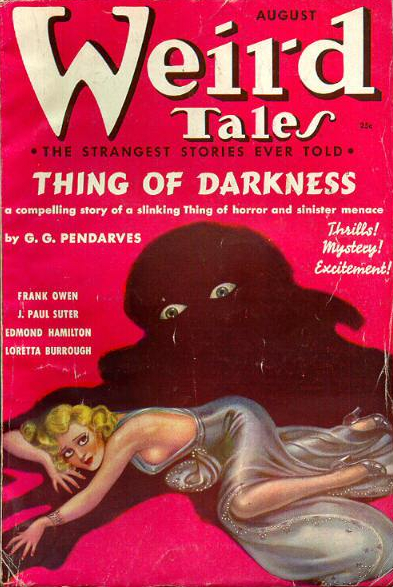
Weird Tales, August 1937. Cover story: "Thing of Darkness" by G.G. Pendarves. Cover art by Margaret Brundage. March is Women's History Month, even though we don't know what a woman is anymore and can't define her. Where's a biologist like H.G. Wells when you need him? Anyway, here's a cover with both a cover story and cover art by women.

Seventy Years Ago This Month . . .

Weird Tales, March 1953. Cover story: "Slime" by Joseph Payne Brennan. Cover art by Virgil Finlay.

Text copyright 2023 Terence E. Hanley

Friday, February 10, 2023

Bacharach, Blob, & Brennan

Today I write about a circle. The circle begins with Burt Bacharach, who died two days ago, on February 8, 2023, at age ninety-four. Everyone who grew up in the 1960s through the 1980s remembers his songs. There are so many that are so good and come so quickly to mind that as soon as you hear his name, one of them is bound to start playing in your head.

Burt Bacharach and Mack David collaborated on the theme song for the 1958 film The Blob. If you grew up during the 1950s through the 1970s, you probably saw The Blob either at the theater or on late-night television. Maybe a horror host presented it for your consideration.

The star of The Blob was Steve McQueen, about whom I wrote recently. We think of The Blob as a science-fiction monster movie or an alien invasion movie, but it's also a car movie and a teenager movie (even though Steve McQueen was already twenty-seven when it was released). Teenagers drive around in their cars and save the day in The Blob. The plot is like a cross between the first encounter with Mothman in 1966 and the movie American Graffiti.*

The plot is also like Joseph Payne Brennan's novelette "Slime," from Weird Tales, March 1953. Brennan gets short shrift when it comes to The Blob. You might think that the similarity between the two stories is just a coincidence. Maybe it's a case of convergent evolution. But if you consult the description of the Joseph Payne Brennan Papers at Brown University Library, you will find that there appears to have been legal action involving The Blob and "Slime." The word plagiarism comes up in fact. Unfortunately, we have only a description of the papers available to us on line. It would take a trip to the library, I guess, to find out what it was all about.

Click on the words below for a link:

Joseph Payne Brennan papers (Ms. 2009.011), Brown University Library, Box A, Brown University, Providence, RI 02912

"Slime" was the cover story for the March 1953 issue of Weird Tales. As it so happens, that was the thirtieth-anniversary issue of "The Unique Magazine," an anniversary that seems to have been observed only in "The Eyrie," in a letter by Irving Glassman of Brooklyn, New York, on page 70. That was the last chance for anyone to observe a nice, round-numbered anniversary issue in the original run of Weird Tales. The magazine came to an end exactly a year and a half later, in September 1954. Virgil Finlay did the cover art for both, March 1953 and September 1954.

Thirty years before "Slime," there appeared another slime-blob-jelly-ooze cover, the first in fact for Weird Tales. This was of course in the first issue of Weird Tales, March 1923. The cover story was "Ooze" by Anthony M. Rud. The monster on the cover looks more like an octopus. If you read the story, you will find that it's actually a giant amoeba. Whereas Rud told his story from the point of view of an after-the-fact human investigator, "Slime" begins with the monster.

And that leads into the next few parts of this series.

Two slime-blob-jelly-ooze covers of Weird Tales. On the left is the cover for March 1953, illustrating "Ooze" by Anthony M. Rud. The cover artist was Richard R. Epperly. On the right is the cover for March 1953, illustrating "Slime" by Joseph Payne Brennan. The cover artist was Virgil Finlay. Note that, although thirty years separated these two issues, the cover price was the same. Of course the first issue had a lot more content. As for the cover art, well, Virgil Finlay simply outshone most pulp artists. This is no exception.

*Terrence Steven McQueen (1930-1980) and I share a first name, though his has one more "r" in it. That gave him extra Vrr-oom. He was born in Beech Grove, Indiana, a town that has been swallowed like the Blob by my native city of Indianapolis. James Dean (1931-1955) was also from Indiana. I think Steve McQueen is way cooler. He was also a better driver.

Text copyright 2023 Terence E. Hanley
Friday, April 1, 2022

Joseph Payne Brennan (1918-1990)-Part Seven

"Well, I suppose there's no denying I have what you might as well call an obsession with time. I possess, you might even say, a fierce desire to go backwards in time or to be freed of the time stream. [. . .] Yet the idea of being caught on the treadmill of time without being able to get off, horrifies me. I have a terrific urge to escape from it, and since I can't personally, I suppose I do it in my stories. Part of it ties in with my desire to go backwards into another era, which would obviously mean escaping the time stream." (From Etchings & Odysseys #7, 1985, p. 60)

In his life, Joseph Payne Brennan was haunted by the passage of time, by decay and loss, pursued and finally caught by what he must have seen as the forces of doom and fate. I have written before that weird fiction is about the past, but maybe in a larger sense it's about time, just as science fiction is about time, in its case about progress and the future. But then maybe all of our obsessions and all of our art--all of our acts of creation and destruction--everything that we attempt and do--is about time, about the passage of time, about our awareness of time and its passage, about being trapped in what Brennan referred to as this inescapable stream of time. Time is a river without banks, as the saying goes. We cannot beach ourselves. We are borne ceaselessly on--or ceaselessly back if you're F. Scott Fitzgerald. For his part, Brennan hoped to escape from time, "hoped for immortality, particularly in the area of poetry," as one journalist put it. Did Brennan make it? Does anyone in this life? Not quite a dozen years before his end, Brennan said, "Perhaps after I'm dead 50 years, they'll decide I wrote two or three good verses." (1)

Brennan, again, lived a double life as a writer. He wrote weird fiction, detective fiction, Westerns, and poetry of the macabre. He was also a straight writer, all or mostly in verse. He was at a writer's festival at the Taylor Library in Milford, Connecticut, in September 1961. On January 18, 1962, he won an award from the Poetry Society of America at an event held at the Astor Hotel in New York City. He was in good company that year, for Richard Wilbur (1921-2017) won the main prize, the Melville Cane Award. Like his father, Brennan married late in life. His wife, Doris McIntyre Philbrick Brennan (1921-1995) was also a poet. She had been married previously to their tying the knot in 1970. Both worked as librarians, Joseph Payne Brennan at the Yale University libraries. His papers, on the other hand, are in the John Hay Library at Brown University, the same place that holds H.P. Lovecraft's papers.

Born at the end of autumn, Joseph Payne Brennan died in the heart of a New England winter, on January 28, 1990, in New Haven, Connecticut. He was only a month and a week past his seventy-first birthday. Except when they're feuding, Irish families tend to stick together. The Brennan family was no exception, for they nearly all lie together in a family plot in Saint Bernard Cemetery in New Haven, Brennan, his grandparents, his parents, and his wife, who followed him to the grave in 1995. These are their names and dates:
  • Joseph Payne Brennan's grandfather: Joseph Brennan (Apr. 25, 1841-Dec. 24, 1896)
  • His grandmother: Josephine Cecelia Kirk Brennan (Aug. 16, 1847-Jan. 10, 1908)
  • His father: Joseph Payne Brennan (Sept. 10, 1868-Feb. 8, 1938)
  • His mother: Nellie Wilkerson Holborn Brennan Place (Feb. 12, 1895-Jan. 12, 1992)
  • And his wife: Doris McIntyre Philbrick Brennan (July 30, 1921-Aug. 2, 1995)
Brennan's sister, Loetta Mary Brennan Sullivan (Oct. 15, 1916-Nov. 11, 2011) lies buried in another place. Brennan authored more than a few poems about the end of things. I'll leave it to you to search them out.

Joseph Payne Brennan's Stories, Poems, & Letters in Weird Tales
  • "The Green Parrot" (short story, July 1952)
  • "Slime" (novella, Mar. 1953) (Source for the 1958 film The Blob.)
  • "On the Elevator" (short story, July 1953)
  • "The Calamander Chest" (short story, Jan. 1954)
  • "Orchids from Author"--Letter to "The Eyrie" (Summer 1974)
  • "Fear" (novella; Weird Tales paperback version No. 2, Spring 1981)
  • "John Mason Sidd" (poem, Spring 1988)
  • "Because" (poem, Summer 1988)
  • "Haunted House" (poem, Summer 1988)
  • Letter to "The Eyrie" (Summer 1988)
Further Reading
The best source on Joseph Payne Brennan you're likely to find on the Internet is the guide to his papers held at the John Hay Library, Brown University, Providence, Rhode Island, here. There is also of course an article on him in Wikipedia and incomplete and overlapping lists of his works on The FictionMags Index and the Internet Speculative Fiction Database. I found an article about him called "Master of the Macabre" by Joseph F. Pisani in the Sunday magazine of the Hartford Courant, November 25, 1979, pages 163ff. There are also these sources: "Etchings & Odysseys Interview: Joseph Payne Brennan," in Etchings & Odysseys #7 (1985), pages 57-63; and a section on him in Conversations with the Weird Tales Circle (Centipede Press, 2009), pages 327-340. Finally, the best account that I have found of Brennan's life and career written in his own words is his remembrance of "The Unique Magazine" in The Weird Tales Story, edited by Robert Weinberg and published in 1977 by Fax Collector's Editions (pp. 59-61).

Note
(1) Quoted in "Master of the Macabre" by Joseph F. Pisani in the Hartford Courant Sunday magazine, Nov. 25, 1979, page 169.
A final note (Apr. 2, 2022): Joseph Payne Brennan cast himself as the sidekick of Lucius Leffing. We speak of fictional characters and events in the present tense. For example, Sherlock Holmes lives, not lived, at 221B Baker Street. By inserting himself into his own stories, Brennan also entered into the eternal present. Did he thereby make himself immortal?

Joseph Payne Brennan in the Sterling Library stacks, Yale University, 1979. Photograph by Tony Bacewicz. Look for the bat-shape above Brennan's head.

Thanks to Randal A. Everts for sources on Joseph Payne Brennan.
Original text copyright 2022 Terence E. Hanley

Wednesday, March 30, 2022

Joseph Payne Brennan (1918-1990)-Part Six

Brennan & Derleth

Joseph Payne Brennan was younger than August W. Derleth (1909-1971) by a little more than eight years. Derleth had his first story in Weird Tales in 1926 when he was just seventeen years old. Brennan waited until 1952 when he was nearly twice that age. Although both men were Roman Catholics, both were also admirers and followers of H.P. Lovecraft (1890-1937), a strict (on the surface at least) materialist. Brennan seems to have been solitary, possibly unhappy or even morose. He worked for most of his life in a library, that inner sanctum of the introvert. By all accounts, Derleth was his opposite--big and burly and outgoing, an energetic man and one full of appetites. Brennan and Derleth had some things in common. Both were not only authors and poets but also editors and publishers. And though Brennan was apparently never in touch with Lovecraft, he and Derleth corresponded. Derleth did for Brennan what he had also done for Lovecraft: under his Arkham House and other imprints, Derleth published Brennan's works.

I guess Derleth would have first approached Brennan rather than the other way around. If that's how it happened, I can imagine Derleth's reading "The Green Parrot" in the July 1952 issue of Weird Tales, Brennan's first story for the magazine. By then, Derleth had spent more than half of his life as a published author and more than a dozen years as publisher of Arkham House books. Maybe he was a leading figure in weird fiction, certainly in the publishing of weird fiction. Here in front of him, then, was a new and promising author in the field. Maybe he first wrote to Brennan. Maybe Brennan was happy to receive a letter and to write back. However it happened, I suspect that the two men began corresponding around 1952. Unfortunately, I don't have any direct sources or information on that. I hope that someone can lead the way.

In 1958, under his Arkham House imprint, Derleth issued Nine Horrors and a Dream by Joseph Payne Brennan in an edition of 1,336 copies. The cover art was by Frank Utpatel (1905-1980) (see below). Nine Horrors and a Dream collects four of Brennan's five stories for Weird Tales, plus five others. I recently came across a copy of this book in the collection of the late Margaret B. Nicholas of Bartlett and Marietta, Ohio. Mrs. Nicholas was a wallpaper hanger. She had a fine eye and good taste, not only for books and magazine fiction but also for decorative items. I thank her for what she did in her life, which lasted all of ninety-seven years.

August Derleth published Brennan's poetry as well. Brennan had fourteen poems in Fire and Sleet and Candlelight: New Poems of the Macabre, issued by Arkham House in 1961. Under his Hawk & Whippoorwill Press imprint, Derleth also published The Wind of Time (1961), a slim volume of Brennan's verse. Nightmare Need, again with cover art by Utpatel, followed in 1964, again under Arkham House. Brennan returned the favor in his own journal, entitled Macabre. For example, Derleth's poem "Revenants" was in the Summer 1959 issue of that small magazine.

Of course Brennan and Derleth were also writers of prose. Both wrote weird fiction. Both also created their own occult detectives modeled after Sherlock Holmes. Derleth's detective is Solar Pons. Brennan's goes by the more mundane appellation Lucius Leffing. (Both given names refer to light or sources of light.) Derleth cast his characters and situations into a place he had never been when he began writing. This was London. Brennan kept his detective close to home, in his own native Connecticut. Brennan himself is Leffing's sidekick and Dr. Watson. Brennan and Derleth had stories together in just one issue of Weird Tales before its demise in 1954. That was in July 1953.

August Derleth died suddenly in 1971. We can only imagine what another loss would have meant to Joseph Payne Brennan. Although both men had endured ill health in the previous few years, Brennan survived Derleth by almost two decades. Fortunately for us, Brennan and Derleth put their own works and those of so many other authors into print. Again, we can say thank you to them both.

To be concluded . . .

Further Reading

"Hawk & Whippoorwill: Derleth’s Overlooked Imprint" by Allied Authors, on the blog Allied Authors at the following URL:

https://allied-authors.org/2016/11/01/hawk-whippoorwill-derleths-overlooked-imprint/


In addition to his many other duties, August Derleth was a newspaper columnist. He wrote "Wisconsin Diary" for The Capital Times of Madison, Wisconsin. On January 31, 1963, Joseph Payne Brennan wrote to Derleth on the death of fellow poet Robert Frost (1874-1963). Derleth quoted Brennan's letter in his own column of February 11, 1963 (page 2).

Text copyright 2022 Terence E. Hanley

Tuesday, February 22, 2022

Joseph Payne Brennan (1918-1990)-Part Five

Brennan & Lovecraft

Joseph Payne Brennan (1918-1990) was old enough to have corresponded with and even to have met H.P. Lovecraft (1890-1937). Like Lovecraft's eventual literary executor, Robert H. Barlow (1918-1951), he could have, as a teenager, entered into Lovecraft's circle. But he didn't. Brennan was also old enough and probably good enough and talented enough to have been published in Weird Tales in the 1940s, possibly even in the 1930s. But he wasn't. Instead, he went his own way and seems to have worked almost in isolation for years. One thing to keep in mind here is that Brennan went to work before his twentieth birthday in order to support his family. He also lost three years of his writing life while serving in the U.S. Army in Europe during and after World War II. We can wonder about what might have been, but that doesn't do much good. Instead, we have what we have from Joseph Payne Brennan, which is no small thing at all.

Brennan was quiet and reserved. In photographs, the look on his face is the same, no matter when the photograph might have been taken: serious, unsmiling, possibly sad, maybe a little bit grim. Many of his poems are of sadness and loss. Like Lovecraft, he was filled with nostalgia, for an ideal time in the past, especially for a time before his family went into decline. He said:

I'm attracted to the Victorian period, I think, because it had at least the illusion of stability and permanence. [. . .] My grandmother here--my father's parents flourished in that time. They had a large, happy, successful family. They were relatively wealthy and successful and since I personally have known mostly poverty, I suppose I look back and wish I could have been in that prior generation. You know, they had a big house and a maid, all the amenities. I am not sure how my grandfather achieved all this but he did. And also it seems to me that since that generation, more deprivation and trouble and unhappiness has come to succeeding generations. (1)

I have written before on the idea that weird fiction is about the past and looks to the past, with loss and longing and nostalgia. Brennan's sentiments are as good as any in bearing out that idea.

Brennan was a bibliographer of H.P. Lovecraft, an essayist and poet on him, too. Here is a list of his Lovecraft-related works:

  • A Select Bibliography of H. P. Lovecraft (1952)
  • H. P. Lovecraft: A Bibliography (1952)
  • H. P. Lovecraft: An Evaluation (1955)
  • "H. P. L.: An Informal Commentary" in Howard Phillips Lovecraft Memorial Symposium (1958)
  • "Lovecraft's 'Brick Row'" in Macabre (Summer 1959)
  • "Lines to H. P. Lovecraft" (poem) in Macabre (Summer, 1959), reprinted in The Shuttered Room and Other Pieces (Arkham House, 1959) 
  • "Time and H.P.L." in Macabre (Summer 1960)
  • "Three Footnotes on H.P. Lovecraft" in Macabre (Summer 1961)
  • "A Haunter of the Night" in HPL (1972)
  • "Lovecraft on the Subway" in Macabre (1973)
  • "Lovecraft and the O'Brien Annuals" in Macabre (1976) 

This compilation is from the Internet Speculative Fiction Database (ISFDb) and includes only those works that refer to Lovecraft by name in their titles. There may be others.

Like Lovecraft, Brennan was a writer of stories, poems, and non-fiction. He was involved in amateur press and small press and was a prolific correspondent, including with August Derleth (1909-1971). Brennan had at least one story, "The Feaster from Afar," in the Cthulhu Mythos. It appeared in the collection The Disciples of Cthulhu, published by DAW Books in 1976. Like Lovecraft, he was a New Englander and had a strong sense of place. Brennan said of himself, "I'm more apt to be intrigued by a landscape than by a personality." (2) The same deemphasis on personality or characterization is also in Lovecraft.

Brennan wrote about nature in a more sympathetic way than did Lovecraft, I think. Although both men were urbanites, Brennan spent his childhood summers on his grandparents' farm in East Hartland, Connecticut. Although he wrote of the old New England devil-in-the-woods, Brennan doesn't seem to have been alienated from nature, nor to have been squeamish about the forces and ways of nature. On the other hand, threats supposedly represented by nature have become clichés in our popular culture. It seems likely to me that they were no less clichés in Lovecraft's time. And so Lovecraft and others personified--or demonized--nature, such as with the whip-poor-will, a bird, a mere bird of the gloaming and of the tangled woods. It's worth noting that Brennan had at least two works referring to Nietzsche, a poem by that title in his 1949 collection Heart of Earth, and "Zarathustra at the Gate," from the same collection. A look at Lovecraft and Nietzsche might be worth the time spent. Or has someone already done the looking?

One last thing in regards to Brennan and Lovecraft: like Lovecraft, Brennan has his papers at the John Hay Library at Brown University.

To be continued . . .

Notes

(1) From "Etchings & Odysseys Interview: Joseph Payne Brennan" in Etchings & Odysseys #7 (1985), pages 58-59.

(2) From the same source, page 59.

Original text copyright 2022 Terence E. Hanley

Sunday, February 20, 2022

Joseph Payne Brennan (1918-1990)-Part Four

Brennan Works, 1950-1990

Joseph Payne Brennan wrote mostly for pulp magazines and small magazines. Something of an anachronism, he arrived almost too late to play the pulp game. Most of his early stories were for Western titles. Brennan made his way into the pages of Weird Tales only after 1950. That magazine came to a much-lamented end not long after, in September 1954, having by then shrunken away to digest-size. The same thing had happened to other pulp titles, those that had survived anyway. Shrunken or not, most gave up the ghost by the late 1950s or early 1960s. (The last true pulp magazine is supposed to have been Ranch Romances, which rode off into the sunset in 1971.) It looks as though Brennan had just one story in a mainstream slick magazine, "I'm Murdering Mr. Massington," published in Esquire sixty-eight years ago this month, in February 1954.

Brennan started his own small magazine, entitled Macabre, in 1957, not as a replacement for Weird Tales but "to work for the revival of that unique magazine [and to] serve as a rallying place for all those devoted to horror and the supernatural." (1) The first issue was dated June 1957. Every issue after that was named for a season, Summer or Winter, twice a year until 1966, once a year--but not every year--after that until 1976. There were twenty-two issues in all. Most included at least one of Brennan's works. The author also contributed to The Arkham Collector, Weirdbook, Whispers, Nyctalops, Myrddin, Cross Plains, Fantasy Crossroads, Borderland, and others--hundreds of stories and poems in all. And yet he considered himself a failure, at least during a period--long or short, but probably long--when he engulfed himself in a cloud of typical Irish gloom, in 1985 when he was interviewed by Etchings & Odysseys. In his high school yearbook he had given his ambition: "Intend to write." Write he did, very successfully, and yet he believed that he had failed. So sad, so unnecessary--and maybe self-indulgent, too.

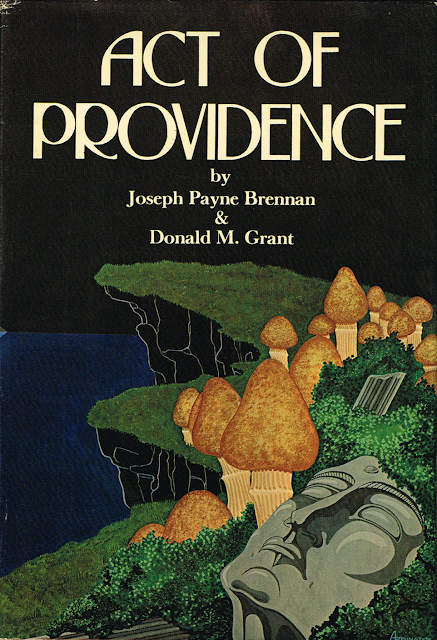
Like William Hope Hodgson and August Derleth before him, Brennan penned tales of an occult detective (although I think Brennan's detective investigated more conventional cases, too). The detective's name is Lucius Leffing. As far as I can tell, Leffing's first published adventure was "The Haunted Housewife" in Macabre #12, Winter 1962/1963. Brennan chronicled Leffing's investigations in more than three dozen stories published not only in Macabre but also in Mike Shayne Mystery Magazine and Alfred Hitchcock’s Mystery Magazine, from 1965 until 1984. These and other stories were collected in four volumes, The Casebook of Lucius Leffing (1973), The Chronicles of Lucius Leffing (1977), Act of Providence (1979) with Donald M. Grant, and The Adventures of Lucius Leffing (1990). One unusual feature of the Leffing stories is that they are set in Brennan's hometown of New Haven, Connecticut, with the author himself as narrator and sidekick, a kind of Watson to Leffing's Holmes. Brennan had other non-Leffing stories in Mike Shayne Mystery Magazine and Alfred Hitchcock’s Mystery Magazine as well. His short story "Junk," from Alfred Hitchcock’s Mystery Magazine for June 1990, may have been one of the last stories Brennan sold in his lifetime. 

To be continued . . . 

Note

(1) From "Recollections of Weird Tales: Joseph Payne Brennan," in The Weird Tales Story, edited by Robert Weinberg (West Linn, OR: Fax Collector's Editions, 1977), page 61.

Mike Shayne Mystery Magazine, July 1975, with Joseph Payne Brennan's byline on the cover for his novelet "The Apple Orchard Murder Case." Cover artist unknown.

Updated on February 22, 2022.
Text copyright 2022 Terence E. Hanley

Thursday, February 10, 2022

Joseph Payne Brennan (1918-1990)-Part Three

Brennan's Weird Fiction in Print & on Film

Joseph Payne Brennan wrote about 500 short stories and more than 2,000 poems. His earliest short story listed in the Internet Speculative Fiction Database (ISFDb) is "The Green Parrot," from 1952. That was also his first story in Weird Tales. Brennan's late arrival in the magazine is just one bit of evidence that he was something of an anachronism. He knew that about himself and admitted as much about himself. Born in 1918, Brennan was old enough to have corresponded with H.P. Lovecraft and others in Lovecraft's circle. Living in Connecticut, he could easily have made a trip by train to visit with that gentleman of Providence. Instead Brennan seems to have been alone in his youth and in his early writing and work, at least in terms of his weird fiction. (1) A contemporary or near contemporary of Henry Kuttner (1915-1958), Theodore Sturgeon (1918-1985)Ray Bradbury (1920-2012), and others, Brennan was accepted into the pages of Weird Tales only after they had gone. In his introduction to "Levitation" in Dying of Fright: Masterpieces of the Macabre (1976), Les Daniels wrote: "Joseph Payne Brennan is the last major author of supernatural stories to have been associated with Weird Tales." (p. 267). John Pelan called him "the last of the great Weird Tales authors." (2) Yes, an anachronism, and maybe great, too, and one of the last. Brennan considered himself a failure. (3)

There is a very Irish sense of doom or fate in Brennan's stories. His lack of self-esteem--that feeling that one is special, even if one is especially bad--is very Irish, too. (We have been dealing with the same kinds of feelings in our very Irish family for years.) Brennan was a nature poet. His stories are often about the encroachment of the natural--or supernatural--world or forces upon civilization, conversely about people becoming bewildered, engulfed by, or overpowered by natural or supernatural forces after going beyond the edge of town or away from the road, into swamps or hemlock woods, or even into the overgrown backyard of a suburban home. Doom or fate await them--men die not for anything they might do but because they happen to be in the wrong place at the wrong time. We should remember that Brennan was admirer of Maurice Level (1875-1926) and the conte cruel.

Brennan had at least three of his stories adapted to film, four if you count "Slime" as the original source for the 1958 theatrical release The Blob. Two of his stories were adapted to the television series Thriller, hosted by Boris Karloff and broadcast on April 16, 1962. "The Lethal Ladies" was the overall title for two stories with the same theme, "Murder on the Rocks" (originally "The Pool" in The Dark Returners, 1959) and "Goodbye, Dr. Bliss" (originally "Goodbye, Mr. Bliss" in The Dark Returners). Brennan's story "Levitation" (originally in Nine Horrors and a Dream, Arkham House, 1958) was adapted to an episode of the same name in Tales from the Dark Side in 1985.

Most of Brennan's stories were printed or reprinted in small-press collections or in small magazines, in his own Macabre (from 1957 to 1976) or in similar titles such as The Arkham Collector (from 1967 to 1971), Weirdbook (from 1968 to 1990), and Whispers (from 1973 to 1997). One prominent exception to all of that is "The Feaster from Afar," published in the paperbound anthology The Disciples of Cthulhu (DAW Books, 1976). But then tales of the Cthulhu Mythos often find their way into print without much problem. The last of his works that I have found to have been published in Brennan's own lifetime is the poem "Necrophiliac," from Grue #10, Fall 1989. What a terrible and ironic title for a final poem.

To be continued . . .

Notes
(1) Brennan was fortunate enough early on to know and work with Jack Schaefer (1907-1991), but Schaefer was a writer of Westerns, not of supernatural horror and fantasy stories.
(2) From Conversations with the Weird Tales Circle, Centipede Press, p. 329.
(3) "I'm attracted to the Victorian period [. . . ]. I also have a feeling that probably as an individual I would have been less of a failure then than I am now." From "Etchings & Odysseys Interview: Joseph Payne Brennan," Etchings & Odysseys #7 (1985), page 58. 


Original text copyright 2022 Terence E. Hanley