Monday, April 27, 2026
The New Weird Anthology-Part Four
Friday, April 24, 2026
The New Weird Anthology-Part Three
In the world of arts and ideas, an impulse to newness is usually innocuous. In fact it often reinvigorates old forms. It is in politics--or when politics crosses over into the world of arts and ideas--that the burning desire to make something new becomes so dangerous. In striving for newness, in attempting to make a new society by throwing off the old one, by starting over again at year zero, the people behind so-called progressive political systems have murdered, starved, tortured, and imprisoned countless millions of their fellow human beings. What is claimed to be new--misery, poverty, murder, oppression--is actually as old as time. In any case, it's no coincidence that the authors of what is called "the New Weird" tend towards political progressivism. So is their aim to politicize weird fiction and fantasy? I believe so, judging from Mr. VanderMeer's introduction to The New Weird. Michael Moorcock, their progenitor, is an anarchist, pragmatist, Marxist, and socialist. He makes that clear in his writings. The authors of "the New Weird," politicized or even radicalized as they may be, would seem to follow in his footsteps. The sub-genre itself seems to exist in a direct line of descent from something he helped create, the original British New Wave. So what again is new about "the New Weird"?
So, it seems to me that the inspiration and model for "the New Weird" of today (actually yesterday, as its eponymous anthology was published nearly two decades ago--more on that in a minute) is the New Wave of the 1960s and '70s. These supposedly new sub-genres or sub-sub-genres are of the same essence (1):
- Both are in reaction to older and supposedly more conservative authors, conventions, styles, forms, etc., each in its respective sub-genre, New Wave in science fiction and "the New Weird" in weird fiction. That reaction is often extremely fierce, angry, and dismissive. In fact, the fierceness, anger, and dismissiveness of current authors towards their predecessors seems to be an identifying feature of supposedly new literary movements.
- Both strive to make something new of old genres, but that impulse to newness may not be exclusively or even most importantly towards artistic, literary, or aesthetic innovation. The impulse to newness may actually be more powerfully driven by leftwing political philosophies of various stripes: Marxism, socialism, progressivism, anarchism, nihilism, the New Left (there's that word New again), critical theory, political correctness, multiculturalism, cultural Marxism, radical environmentalism, the cult of global warming, etc.
- Both strive also towards higher literary standards and towards a confounding of categorization, a crossing over, bending, or merging of genres, ultimately perhaps a convergence of genre fiction with mainstream literature.
![]() |
| New Worlds, August 1967, under the editorship of Michael Moorcock and with a cover design by Eduardo Paolozzi. Even Marxists know that sex sells. |
Wednesday, February 19, 2025
Shakespeare in "The Eyrie"
Sometimes there was verse in "The Eyrie." The authors of that verse aren't credited in bibliographies. I can understand why. But for the sake of completeness, and for the sake of not missing out on things that might prove interesting and edifying, maybe we need a list of the authors of verse who appeared in "The Eyrie."
William Shakespeare wasn't the first, but his name came up in the February issue of 1925, one hundred years ago this month. That was part of an ongoing discussion on horror and what some readers called "necrophilia" in the pages of the magazine. Following is an excerpt from "The Eyrie." Farnsworth Wright's was almost certainly the editorial voice. (Boldface is added.)
(The quote begins:)
We recently attended a performance of "Romeo and Juliet"; and as we heard Jane Cowl deliver Juliet's speech before she takes the poison, we realized that the same speech, if published in a WEIRD TALES story, would be denounced by some of our indignant readers (not many, but surely by some) as "gruesome", "shocking", "offensive". A few of our good friends would undoubtedly write letters asking us why we so offended against good taste as to draw such a "disgusting" picture of Juliet awaking at midnight in the vault,
"Where, for these many hundred years, the bonesOf all my buried ancestors are packed;Where bloody Tybalt, yet but green in earth,Lies festering in his shroud; where, as they say,At some hours of the night spirits resort: --Alack, alack! is it not like that I,So early waking--what with loathsome smells,And shrieks like mandrakes' torn out of the earth,That living mortals, hearing them, run mad --Oh, if I wake, shall I not lie distraught,Environed with all these hideous fears.And madly play with my forefathers' joints,And pluck the mangled Tybalt from his shroud?And in this rage, with some great kinsman's bone,As with a club, dash out my desperate brains?"
But there will be no indignant letters, because we have quoted this from the thousand-souled Shakespeare. And what about "Hamlet", with the stage strewn with dead bodies in the last act? And the ghost of "the blood-boltered Banquo" at Macbeth's banquet? And that gruesome scene where Macbeth washes his hands of the murdered Duncan's blood:
"What hands are these ? Ha! they pluck out mine eyes.
Will all great Neptune's ocean wash this blood
Clean from my hand? No; this my hand will rather
The multitudinous seas incarnadine,
Making the green one red."
We fear Shakespeare would fare quite badly at the hands of some of our readers. And the gentle Poe, who is still America's favorite author, and growing in popularity year by year (although the man himself died poor and neglected seventy-five years ago) -- how would Poe fare if he were writing today? Hardly better than he fared during his life. But the weird tales of that great master remain as a precious heritage to the whole world.
Considering the present unceasing popularity of the works of this great master of weird literature, we have no fear for the future of WEIRD TALES so long as the magazine remains weird.
(End of quote.)
And now here we are one hundred years later and Weird Tales (such as it is) is still being published.
(By the way, Jane Cowl played Juliet in performances in various places in Illinois in 1923-1924. In November 1924, she was at the Garrick Theatre in Chicago. Maybe that was when and where Farnsworth Wright saw her perform.)
![]() |
| Romeo and Juliet, Act V Scene III: Juliet Wakes in the Vault to Find Romeo Dead by G. Goldberg. |
Original text copyright 2025 Terence E. Hanley
Saturday, January 27, 2024
Weird Tales, May/June/July 1924-Non-Fiction & Other Fillers
Following is a list of the fillers in the May/June/July issue of Weird Tales, a list transcribed from the Internet Speculative Fiction Database. Thanks to them again. All are by uncredited authors. Most have asterisks around them. Read on to see what they mean.
- **"Juvenile Criminal," about the Hon. Grey Bennett and a boy named Leary. There really was a Grey Bennett, as remote from the first year of Weird Tales as we are from it.**
- **"Retaliation," about a British ship.**
- **"Providential Warning at Sea," about Captain Thomas Rogers and his ship Society in about 1694.**
- **"Pastime of Despots," about Czar Peter.**
- **"The Unnatural Son," about a theft in Salisbury.**
- **"Singular Discovery of a Murder in 1740," an account of events at St. Neots, England.**
- **"Giants," about very tall men known to history.**
- **"Sham Fight," about a battle between Christian and Musselman armies at Bostra [sic].**
- **"War Horses," about war in Funen, Denmark.**
- **"The Original Bluebeard," about Gilles, Marquis de Laval. Seabury Quinn had covered him before in his non-fiction series "Weird Crimes," in October 1923.**
- **"Distressing March of the Crusaders Through Phrygia."**
- **"Remarkable Accident," about Baptiste, an actor at the Comedie Francaise in 1820.**
- *"An Account of a Family Who Were All Afflicted with the Loss of Their Limbs," about John Dowling of Wattisham, England.*
- *"Hypocrisy Detected," set in Paris.*
- *"Force of Imagination," also set in Paris.*
- *"Immolation of Human Beings," about the Ashantees [sic] of Africa.*
- **"Imprisonment of Baron De Geramb."**
- *"Anecdote Concerning the Execution of King Charles the First."*
- **"Anne Boleyn."**
- **"The Heroes of Hindoostan."**
- *"Extraordinary Instance of Second Sight," about a French army officer quartered in Scotland during "the previous century."*
- **"Miracles," about a Dr. Connell and his patient, named Anne Mulligan, in 1777.**
- **"National Superstition," about two Venetians.**
- **"Death of the Duchess of Bedford."**
- **"Pardon for Forgery," a case from 1803.**
- **"Terrific Death of a Painter," about Peter Peutemann.**
- **"Deaths by Lightning," set in Ireland.**
- **"Wonderful Providence," about war in France in 1562.**
- **"Monsieur Rouelle," about the "celebrated chemist."**
- **"A Singular Experiment," about an Irish boy named Magrath who fell into the hands of a "subtile doctor," a kind of Procrustes who experimented on the boy and made of him a monstrous creation. This account goes along with my suggestion that medical doctors are very often psychopaths or sociopaths and see their fellow human beings as mere material and subjects for their bizarre and monstrous experimentation. We recently had one of those at the head of a large governmental agency. He and his fellows very likely developed and loosed upon the world a deadly virus and in response created an oppressive regime that is still lurking, still preying, including in the minds of his and their followers, supporters, and apologists. Monstrous medical doctors recently won a victory for themselves in Ohio, too. Now they have the power under the state constitution to decide who is a human being and who is not. Now we have another Moloch State.**
- **"Pentilly House, Cornwall," about a Mr. Tilly, an atheist.**
- **"Singular Combat," about England in the time of Henry IV.**
- **"Fatal Misfortune and Singular Instance of Affection in a Horse," set in England.**
- *"Punishment of the Knout in Russia."*
- **"Intrepid Conduct of Admiral Douglas," about a mutiny on board the ship Stately.**
- "Only Sound," a very brief item from the Los Angeles Times. (Below it are two jokes.)
- "Odd Facts," half a dozen brief fillers. (Below it are three anecdotes or jokes. So there are five untitled anecdotes or jokes in addition to 37 titled fillers.)
As I was about halfway through this list, I discovered the original source of most of these accounts. The source is:
The Terrific Register; or, Record of Crimes, Judgements, Providences, and Calamities, Volume I and Volume II, published in 1825 by Sherwood, Jones, and Co., of London, and Hunter of Edinburgh.
Presumably all are factual, so no fiction to add to the 37 stories in this issues. Items taken from Volume I have single asterisks around them in the list above. Those from Volume II have double asterisks. Seven of the items are from Volume I of The Terrific Register. Twenty-eight are from Volume II. That makes 35 in all, leaving only two that are from other sources.
So, if we're trying to get from 37 new stories in the interior of the anniversary number to the 50 promised on its cover, then we'll have to add 13 of the items listed above, I guess. You get to choose. A couple of them are almost as long as the shortest new stories.
It's clear that Otis Adelbert Kline was not the author of these fillers, as he had been (or probably was) in previous issues. But if he was acting as editor, or co-editor, then maybe he was the one who chose them for inclusion. And that makes me think that there must have been copies of these two volumes either in a public or university library in Chicago or in a private collection to which he had access. And now I think we had better look at the fillers in previous issues for their possible origins in the same two volumes of The Terrific Register.
I have written before about the Fortean method. I called it that after Charles Fort (1874-1932), author, gadfly of science, and collector of oddities. People who read and wrote for Weird Tales knew of Fort and his ways. Some became Forteans themselves. Others simply availed themselves of the Fortean method in creating their fictions. Like I said, I have suspected that Otis Adelbert Kline was the author of the many non-fiction fillers printed in Weird Tales in its first year, and maybe he was after all, taking after Fort in the process. But it's clear with this discovery of The Terrific Register as a source that Kline was not the sole author of the Weird Tales fillers and that Fort was not the first collector of oddities. He, along with Kline, was simply working in an older tradition. I wonder how far back that tradition goes. And I wonder: is history simply a field engaged in telling about the odd events--the crimes, judgements, providences, and calamities--of the past? Aside from that, are not these accounts simply retellings of how weird works in our lives and affairs?
Original text copyright 2024 Terence E. Hanley
Wednesday, August 23, 2023
Lady Gwendolen Cecil (1860-1945)
Lady Gwendolen Georgiana Gascoyne-Cecil
Author, Biographer
Born July 28, 1860, London, England
Died September 28, 1945, Hertfordshire, Hertford, England
Gwendolen Georgiana Gascoyne-Cecil was born on July 28, 1860, in London, England. She was the daughter of Robert Arthur Talbot Gascoyne-Cecil, 3rd Marquess of Salisbury (1830-1903), and the former Georgina Charlotte Alderson (1827-1899). Gwendolen's father, the Marquess of Salisbury, also known as Lord Robert Cecil and Lord Salisbury, was a member of Parliament, secretary of state for India, British foreign secretary, and three-time prime minister of the United Kingdom. His wife was his literary assistant and the mother of his eight children. She also wrote political articles for publication in the Saturday Review and the Quarterly Review.
Lady Gwendolen Cecil was an author and her father's biographer. She wrote a short story called "The Little Ray," published in The Pall Mall Magazine in August 1894. She was also the anonymous author of "The Closed Cabinet," which was in Blackwood's Edinburgh Magazine (Vol. CLVII, No. DCCCLI) in January 1895. Her major work was her four-volume biography of her father, entitled Life of Robert, Marquis of Salisbury (1921, 1932). "The Closed Cabinet" was her lone story in Weird Tales, and it was reprinted anonymously.
Lady Gwendolen died on September 28, 1945, in Hertfordshire, Hertford, England. She was eighty-five years old. She has a cultivar of the peony named after her, a distinction no doubt unique among contributors to "The Unique Magazine."
Lady Gwendolen Cecil's Story in Weird Tales
"The Closed Cabinet" as by _____ _____ (May 1923)
Further Reading
Not much that I have found or of note except in old newspaper articles, including a number that describe her being in an automobile accident in 1908. She was run over by her own electric vehicle after having gotten out to open a gate.
![]() |
| Gwendolen Gascoyne-Cecil (1860-1945) in a portrait drawn in 1895 by Pre-Raphaelite artist Edward Burne-Jones (1833-1898). |
Text copyright 2023 Terence E. Hanley
Sunday, August 20, 2023
"The Closed Cabinet" by _____ _____ & Sunday Swipes No. 3
"The Moon Terror" by A.G. Birch was the first story in the May 1923 issue of Weird Tales. "The Closed Cabinet" by _____ _____ was the last. _____ _____ was an anonymous author in the pages of "The Unique Magazine" and in the original. The original was Blackwood's Edinburgh Magazine (Vol. CLVII, No. DCCCLI), published in January 1895. The publication of "The Closed Cabinet" was announced in newspapers in December 1894. In its issue of January 21, 1895, the Brooklyn Daily Eagle called it "an old time Scotch story." (p. 12)
In an item called "Literary Gossip," the Bowling Green, Ohio, Daily Sentinel-Tribune (Mar. 7, 1895, p. 2) attributed authorship of the story to Lady Gwendolen Cecil, daughter of the Marquess of Salisbury. There isn't any source given for that bit of information. This was gossip after all. Her authorship was previously confirmed in The Author, Playwright and Composer, Volumes 5 and 6, page 246, also from 1895. Maybe that's the source of the item out of Bowling Green. By the way, The Collector's Index to Weird Tales by Sheldon R. Jaffery and Fred Cook, an indispensable source in my writing of this blog, was also published in Bowling Green.
I'm not the first person to track down authorship of "The Closed Cabinet" to Lady Gwendolen. Scottish editor Johnny Mains (b. 1976) did that before me for his collection A Suggestion of Ghosts: Supernatural Fiction by Women, 1854-1900 (2018). More than a hundred years before Mr. Mains published his book, Julian Hawthorne (1846-1934) included "The Closed Cabinet" in his series Library of the World's Best Mystery and Detective Stories (1907-1909?). It looks like this series was also called and/or reprinted as The Lock and Key Library. Lady Gwendolen's story is in the volume Old-Time English Stories (1909), the contents of which are as follows:
- "The Haunted House" by Charles Dickens (1859)
- "No. 1 Branch Line: The Signal-Man" by Charles Dickens (1866)
- "The Haunted and the Haunters; or, The House and the Brain" by Edward Bulwer-Lytton (1859)
- "The Incantation" by Edward Bulwer-Lytton (date unknown)
- "The Avenger" by Thomas De Quincey (1838)
- "Melmoth the Wanderer" by Charles Maturin (1821)
- "A Mystery with a Moral" by Laurence Sterne (date unknown)
- "On Being Found Out" by William Makepeace Thackeray (1861)
- "The Notch on the Ax" by William Makepeace Thackeray (1862)
- "Bourgonef" by unknown
- "The Closed Cabinet" by unknown (Lady Gwendolen Cecil)
The image shown above may seem familiar to you. Have a look at the cover illustration for the May 1923 issue of Weird Tales, made by William F. Heitman:
Now here they are side by side, with the Weird Tales cover flipped:
Text copyright 2023 Terence E. Hanley
Tuesday, June 13, 2023
J.B.M. Clarke, Jr. (1883-1959)-The First British Author and a Second Canadian
James Blyth Macalester Clark, Jr.
Journalist, Author
Born August 26, 1883, Liverpool, England
Died February 5, 1959, Rainhill Hospital, Liverpool, England
James Blyth Macalester Clark, Jr., was born on August 26, 1883, in Liverpool, England. His parents were James Blyth Macalester Clark (1847-1935), a Scottish-born optician and a man in business, and Esther Allan Nichol (1848-1885). Clark, Senior, was married twice, first to Esther Allan Nichol, on May 12, 1879, in Dumfermline, Fife, Scotland; next to Eliza Jane Dobbie (1850-1900), on June 2, 1889, in Toxteth, St. Philemon, Lancashire, England. In 1881, the Clark family was in Toxteth Park in Lancashire. In 1891, they were in Cathcart, Renfrewshire, Scotland.
A James Blyth Macalester Clark was admitted to Gartnavel Royal Asylum, an insane asylum, in 1909. Whether that was the father or the son, I can't say. But in 1911, Clark, Junior, crossed over to Quebec, Canada. His father followed in 1915 and lived in Montreal until the summer of 1935, when he returned to England. James B.M. Clark, Sr., died on July 26, 1935, in Leigh-on-Sea, Essex. His children were Esther Marie (Clark) Mitchell, Elizabeth Grieg (Clark) Sawer, J.B.M. Clark, Jr., and Alexander D. Clark.
J.B.M. Clark, Jr., of Montreal visited in Burlington, Vermont, in 1918. His story "The Ape Man" is set in Burlington and in neighboring Winooski. (By looking for Clark in Vermont, I discovered his full name and the facts needed for this biographical sketch.) In 1921, Clark moved to Los Angeles, California. I don't know how long he stayed there. In 1935 when his father died, he was back in Montreal. Like his father before him, he returned to England. Clark died on February 5, 1959, at Rainhill Hospital, Liverpool, England. He was seventy-five years old. His wife may have been A.D. Clark (?-1964).
James B.M. Clark, Jr., wrote nonfiction and fiction. "The Ape-Man," from Weird Tales, March 1923, was his first story listed in The FictionMags Index. That list includes stories from 1923 to 1932. Clark also had brief stories syndicated in American newspapers during the 1920s and '30s. Clark's stories were in Cabaret Stories, Clues, Detective Fiction Weekly, Real Detective Tales and Mystery Stories, and a number of boys' magazines. His nonfiction seems to have been exclusively in British magazines.
J.B.M. Clarke, Jr.'s Stories in Weird Tales
"The Ape-Man" (Mar. 1923)
"Windows of Destiny" (Apr. 1927)
Further Reading
None known except for his stories.
J.B.M. Clarke, Jr.'s Story:
"The Ape-Man" is a long short story in six chapters. It takes place in Burlington and Winooski, Vermont, an unusual setting for a story in the first issue of Weird Tales. The author Clark is known to have visited in Burlington. I didn't realize until looking at a map just how close Burlington is to Clark's hometown of Montreal.
There are three main characters in "The Ape-Man," human characters, that is. There are also two simian characters. One of the men, Needham, seems to be halfway between one and the other. Another of the men, Norton, calls him "a throwback--an atavistic specimen." Needham lives a slovenly existence in a closed-up house in Burlington. His companion is a little monkey named Fifi, who wears clothing like a person. Needham has been to Africa and has observed baboons in the wild. From his observations, he has learned something about how baboons communicate. He seems to have formed a bond with one of them, a dominant male.
One night, Norton has a frightening experience while walking through Ethan Allen Park, which is close to Needham's house on North Avenue. He sees Needham gamboling in the park, more like an ape than a man. Needham follows him. He's in a tree and reaches down to grasp Norton by the throat, chuckling, "Aha! You would give me away, would you!" Fortunately Norton escapes.
There is a circus in town. Norton and his friend Meldrum go there. Naturally there are baboons among the circus animals. Needham shows up and gives his curious cry. The smaller baboons are cowed by it. The dominant one is not. Could this be the same animal with whom Needham communicated in Africa?
Norton agrees to go to Needham's house the next day. Call it an idiot-plot device. Meldrum goes later. Instinct tells him to take his pistol. From outside the door, he witnesses a strange tableau: Needham and the baboon are sitting at a table and drinking whiskey. Norton is already unconscious. It looks as though Needham commands the baboon to kill Norton. Meldrum intervenes. Shots are fired. The lights go out. (That little Fifi!) Help comes along, and Norton is saved.
"The Ape-Man" is unusual in its setting. It's also unusual in its diction. It's no surprise to learn that the author was born in England and lived in Canada. Clark's story is well developed. However, the ending isn't very satisfying. It may be that Clark didn't quite know how to bring his story to a close after having set it up pretty well. In any case, we have the last story and the last author in the first issue of Weird Tales.
![]() |
| Ethan Allen Park Tower, a feature mentioned in "The Ape-Man" by J.B.M Clark, Jr. |
Text copyright 2023 Terence E. Hanley
Sunday, December 11, 2022
H.T.W. Bousfield (1891-1967)
Henry Thomas Wishart Bousfield
Professor of History, Army Officer, Author, Banker, Businessman
Born May 29, 1891, Sudbury, Derbyshire, England
Died Early 1965, Kensington, London, England
Henry Thomas Wishart Bousfield was born on May 29, 1891, in Sudbury, Derbyshire, England. He was the son of Reverend Stephen Bousfield, a rector at Shelton, Nottinghamshire, and Edith Margaret (Wishart) Bousfield, J.P., a social worker in Grantham, Lincolnshire, after her husband's death. She was the daughter of Captain G. Wishart, R.N., of London.
H.T.W. Bousfield attended Cambridge University. In 1913, at the age of twenty-two and describing himself as a professor of history, he traveled to India. Bousfield served in the British Indian Army, attaining the rank of captain. Attached to the 69th Punjabis, Captain Bousfield served on the Western Front during the Great War, including at the Battle of Loos (Sept. 25-Oct. 8, 1915), where he had a strange experience. You can read about it on line in an item entitled "A Mysterious Visitor" in The Occult Review, Vol. XXX (July-Dec. 1919), pages 64-65.
In 1922, Bousfield was affianced to Lady June Butler, a poetess. She ended up marrying another man, in 1923. Bousfield married instead Mary Adeline Guest, on November 26, 1929, at the Church of St. Margaret's, Westminster Abbey. She wore a bridal veil worn by her great-great-grandmother, Charlotte Lennox, Duchess of Richmond, who put on the renowned Duchess of Richmond's Ball the night before the Battle of Waterloo commenced. Bousfield was friends with the Hungarian artist Philip de LÔszló (1869-1937), who presented him with a portrait of his new bride as a wedding gift.
Once returned to his native land, Bousfield worked as a banker, also as chairman and managing director of Central Advertising Service, Ltd. From 1910 until at least 1944, he wrote stories and poems published in Britannia and Eve, Country Life, The Grand Magazine, Lloyd's Magazine, Nash's-Pall Mall Magazine, Pearson's Magazine, The Royal Magazine, The Sketch, The Windsor Magazine, and other British magazines. One of these stories was in "The Man Who . . ." category, "The Man Who Took Too Much Trouble" (The Windsor Magazine, Mar. 1935). "The God with Four Arms" (The Windsor Magazine, Apr. 1933) was described in contemporary newspaper items as "macabre." It became the lead story in a collection, The God with Four Arms and Other Stories, published in 1939 by Arthur Barker Ltd. A second collection, Vinegar--and Cream, was published in 1941 by John Murray. The phrase "Very Important Person" (or "Personage") made an early appearance in his story "The Only Girl Who Wasn't a Bore" (The Windsor Magazine, Feb. 1934). Bousfield had just one story in Weird Tales, "The Impossible Adventure," in the issue of November 1940. He also wrote the text for pamphlets or brochures, including RMS Queen Mary: The Ship of Beautiful Woods (Cunard-White Star, no date).
I don't have anything on H.T.W. Bousfield after 1944 except for the year and place of his death, 1965 (in the period January through March) in Kensington, London, England. He was seventy-three years old.
H.T.W. Bousfield's Story in Weird Tales
"The Impossible Adventure" (Nov. 1940)
Further Reading
Various minor sources in newspaper and on line.
![]() |
| H.T.W. Bousfield with his future bride, Mary Adeline Guest, from the Western Mail (Cardiff, Wales), November 26, 1929, page 10. |
![]() |
| A real weird tale told by Bousfield and recounted in the Liverpool Daily Post, March 30, 1936, page 9. |
Original text copyright 2022, 2023 Terence E. Hanley
Sunday, April 10, 2022
William F. Temple (1914-1989)
Born March 9, 1914, Woolwich, Royal Borough of Greenwich, England
Died July 15, 1989, Folkestone, Kent, England
William F. Temple's Story in Weird Tales
"The Triangle of Terror" (May 1950; reprinted Winter 1985)
Further Reading
There are entries on William F. Temple in:
- The Encyclopedia of Science Fiction
- The FictionMags Index
- The Internet Movie Database
- The Internet Speculative Fiction Database
- Wikipedia
![]() |
| "The 4-Sided Triangle" was originally in Amazing Stories in November 1939. The theme of the illustration is the ever-popular Woman-in-a-Test-Tube. The artist was H.W. McCauley. |
![]() |
| Temple's story/novel has been reprinted again and again, as in this Italian edition with cover art by C. Caesar. Richard Shaver might have had something to say about the tero in the title. |
Text copyright 2022 Terence E. Hanley
Sunday, October 17, 2021
Brandon Fleming (1889-1970)
Charles Brandon Raincock Fleming
Journalist, Author, Playwright, Screenwriter, Producer
Born April 27, 1889, Streatham, Surrey, England
Died October 1970, Kensington, Greater London, England
Charles Brandon Raincock Fleming, known as Brandon Fleming, was born on April 27, 1889, in Streatham, Surrey, England. In the census of 1911 he was head of his household, which included his widowed mother, and employed as a freelance journalist. He had already begun by then signing his name as Brandon Fleming.
Fleming wrote dozens of short stories published from 1910 to 1941 in The Blue Magazine, The Corner Magazine, Detective Fiction Weekly, The Novel Magazine, Pearson's Magazine, The Red Magazine, The Story-Teller, The Strand Magazine, and other titles. He had just one story in Weird Tales, "The Ruby," from January 1933. That story had previously been printed in The Grand Magazine #332, dated October 1932. "The Ruby" is the only story by Brandon Fleming listed in the Internet Speculative Fiction Database. He may have written others, but it would take a reading of many British pulp magazines and story magazines to find out. This might be a job for someone located closer to the source.
Brandon Fleming was also a playwright, screenwriter, and film producer. He wrote the source material and/or screenplays for thirteen movies, from The Eleventh Commandment (1924) to Music and Millions (1936). The Internet Movie Database has more than one Brandon Fleming in its lists of credits. A second of these Brandons wrote and produced movies that were released between 1954 and 1963, including a horror movie called The Woman Eater (1958), which might be added to the Botanical Fiction Database. I'm pretty sure these were the same Brandon because Brandon Fleming the magazine writer had a story called "The Flaw" in Detective Fiction Weekly (Mar. 19, 1932), and Brandon Fleming the screenwriter wrote the scenario for a crime film called The Flaw, released in 1955.
The fact that Brandon Fleming's credits ended in 1941 and didn't pick up again until 1954 makes me think he was engaged in the war effort, possibly afterwards in government service or journalism. In any case, Brandon Fleming lived a long life and died fifty-one years ago this month, in October 1970, in Kensington, Greater London, England. He was eighty-one years old.
Brandon Fleming's Story in Weird Tales
"The Ruby" (Jan. 1933; originally in The Grand Magazine #332, Oct. 1932)
Further Reading
None that I can find, although a search for back issues posted to the Internet might yield some of his stories. Also, Fleming's stories are listed on The FictionMags Index, an invaluable source for fans of pulp fiction.
![]() |
| The Story-Teller, a British magazine, with Brandon Fleming's name on the cover, September 1927. |
![]() |
| A poster or lobby card for The Woman Eater, released in 1958 with a screenplay by Brandon Fleming. The coconut-half claws of the tree-monster remind me of the claws of the creatures created by H.P. Lovecraft for "The Shadow Out of Time," the cover story of Astounding Stories, June 1936. You can see similar images in my blog entry called "Trees and Other Plants on the Cover of Weird Tales," dated February 11, 2014, by clicking here. |
Text copyright 2021, 2023 Terence E. Hanley
Friday, July 9, 2021
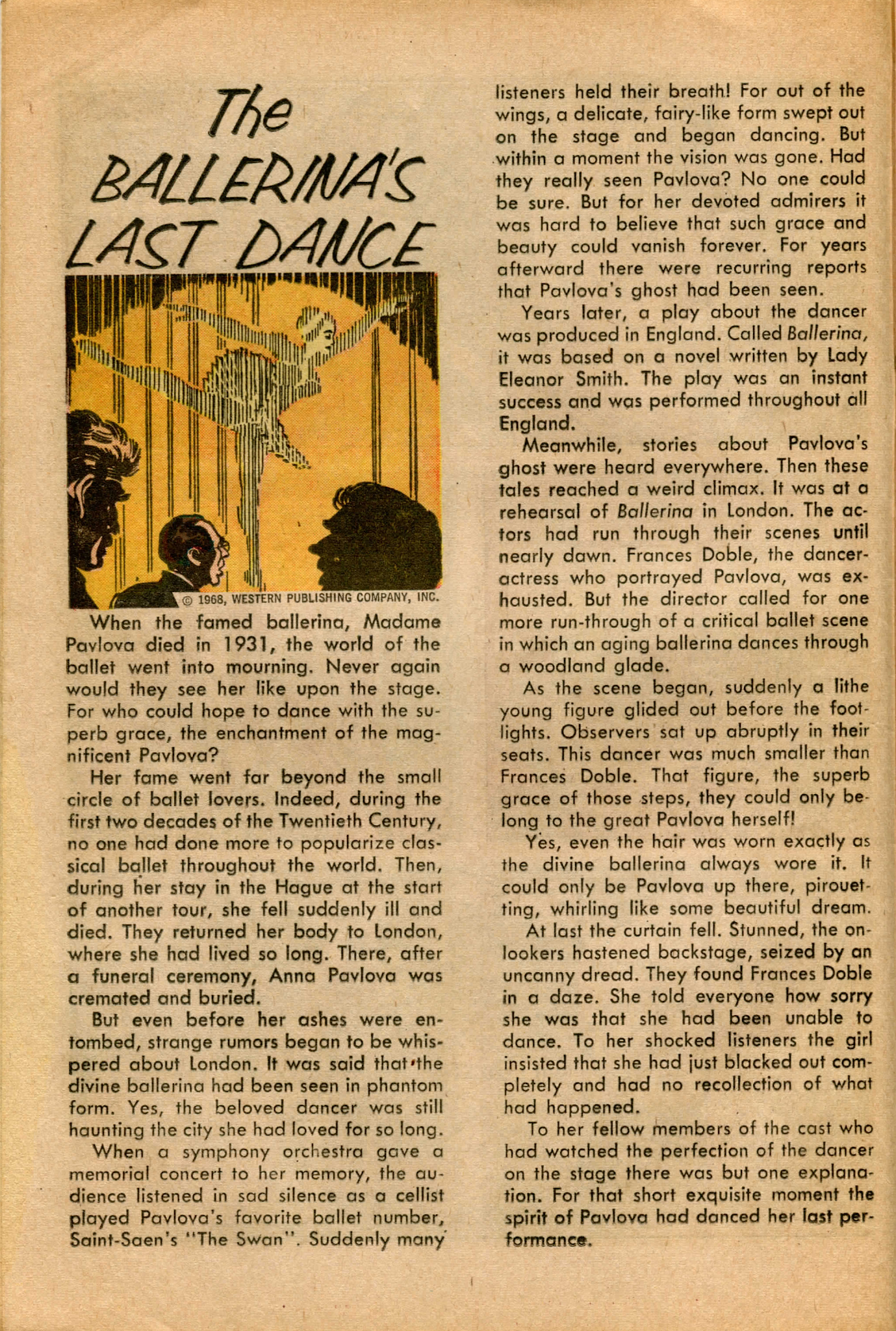
Lady Eleanor Smith & The Ballerina's Last Dance
I have written before about Lady Eleanor Smith (1902-1945), a British aristocrat of the first half of the twentieth century. She was also of course an author who had one story, "Satan's Circus," in Weird Tales (Oct. 1931). Lady Eleanor wrote more than a dozen books, mostly about dancers, circuses, and Gypsies. As with so many highborn or elite kind of people, she seems to have been attracted to the low life. I'm sure that in the opinion of some, there isn't much in culture lower than pulp magazines. If there is, comic books are probably it. So imagine coming across Lady Eleanor Smith's name in that lowly form:


-Portrait%20by%20Edward%20Burne-Jones.jpg)