Showing posts with label Fortean Authors. Show all posts

Friday, November 8, 2024

"Night Fishing" by Caitlín R. Kiernan-Part Two

The narrator in "Night Fishing" has a cosmic horror problem. We get a hint of that in the first column of the story as it appears in Weird Tales #367:

There's a hallway that seems a lot longer than it can possibly be.

Dread stretches time and space.

Time and space being the dimensions and scales in which cosmic horror operates.

Telling about night fishing with his grandfather, the narrator relates to his psychiatrist: "We'd just drift around out there on the lake, the stars wheeling overhead--I swear there were more stars in the sky when I was a kid. I look up now at night, and it's like something came along and ate most of them." Remember the image of the zero: a gaping maw. Remember the consuming, engulfing void: now an eater of stars.

Instead of using an epigraph, the author of this story, Caitlín R. Kiernan, quotes from other works within its main body. These include a traditional song called "There's a Hole in the Bottom of the Sea" and the poem "And Death Shall Have No Dominion" by Dylan Thomas, which also has imagery of the sea. (Another variation on a theme in the Cosmic Horror Issue.) There is also an allusion to a story by a long-ago teller of weird tales, paraphrased from an idea by an author before him.

Read on . . .

In Mr. Kiernan's story, there are these words in italics, which he uses to connote quotations from other works:

I think we're fished for.

Right away, I recognized that as an idea originally in The Book of the Damned (1919), the first of Charles Fort's four books on strange and anomalous phenomena. In Chapter 12 of that book, Fort concluded: "I think we're property," meaning, we are the property of races alien to Earth. This, I think, could very well have been the origin of the ancient astronauts hypothesis so popular today. And it's one of the two main themes I have identified in the Cosmic Horror Issue, or one of two main sources of these feelings of cosmic horror about which its authors write. We have this vast cosmos in which to work and yet they have come up with only two sources of horror at our apprehension of it. At least Mr. Kiernan put these things together in interesting ways, even if they are, again, meta-references.

Eleven years after The Book of the Damned was published, author Edmond Hamilton had a story called "The Space Visitors" in Air Wonder Stories. The date was March 1930. His story was reprinted in Startling Stories in September 1939, the month in which the Second World War began. Hamilton's story is a Fortean story--or a storified plot really--of a visitation made by aliens to Earth. (Storified is my new word. There were lots of storified plots in the early years of science fiction.) The aliens' purpose is unknown except that they seem to be studying us. Their study is, however, extremely destructive and heedless of human life and pain. In the story, a Dr. Jason Howard, of Gotham University no less, theorizes on the matter at hand:

Did we live at the bottom of an ocean, an atmospheric sea? Were we merely crawling things upon earth's surface, to be fished for and examined curiously by unimaginable beings and vessels far above?

Emphasis added. As in the Cosmic Horror Issue, there is imagery here of the sea. And coincidentally or not, Hamilton's second banana to Dr. Howard has the same surname, Ransome vs. Ransom, as C.S. Lewis' hero in his Space Trilogy of 1938-1945.

Soon after the allusion to an allusion to Charles Fort, there is an allusion to another, earlier figure. The narrator of "Night Fishing" has purchased a box containing some objects from an estate sale. Unfortunately, these objects--or is it just one self-transforming artifact?--have strange properties. He wonders about it. Then he writes:

     I stare at the box, and I imagine it stares back at me.

And now Friedrich Nietzsche rears his head, for in Beyond Good and Evil: Prelude to a Philosophy of the Future (1886), he wrote:

     Whoever fights monsters should see to it that in the process he does not become a monster. And when you look long into an abyss, the abyss also looks into you.

Emphasis added again. This aphorism is from Chapter 4, being all of No. 146. In my Vintage edition of 1966, it appears on page 89. Nietzsche wrote a prelude to a philosophy of the future. Remember that the protagonist in The Incredible Shrinking Man saw himself as a possible man of the future.

And so we have that word again, abyss, roughly equivalent to void, and the condition of chaos that preceded God's speaking Cosmos into existence. Abyss is also in the imagery of the sea, as in the scientific term abyssal zone, or that layer that is among the deepest in the ocean. The word abyss is also in "Dagon" by H.P. Lovecraft, one of the earliest stories--if not the earliest--in Weird Tales (Oct. 1923) that has in it cosmic scales and cosmic scope. It's also in "The Call of Cthulhu," which appeared in "The Ghost Table" Issue of Weird Tales in February 1928. Both usages are in regards to the depths of the sea. Dagon is from the sea, but Cthulhu is from the stars.

So, from Charles Fort comes the idea that there are aliens among or above us, who own us, prey upon us, or are fishing for us, and from Friedrich Nietzsche comes the image of the abyss as not just emptiness but something that is watching us, waiting for an opening through which it might gain access to our world.

To be continued . . .

Original text copyright 2024 Terence E. Hanley

Sunday, May 1, 2022

Fate Magazine and Weird Tales

Fate magazine was first published in the spring of 1948, seventy-four years ago this season. The publisher was Clark Publishing Company of Chicago, founded by Raymond A. Palmer (1910-1977) and Curtis G. Fuller (1912-1991). The first cover story was about the first sighting of flying saucers, made by Kenneth A. Arnold (1915-1984) less than a year before, on St. John's Day, June 24, 1947. Fate was preceded by Doubt, the magazine of the Fortean Society, first published in or about 1937. Whereas Doubt was a specialized title and had a small circulation, Fate was intended for the general reading public and was marketed as such. It was digest-sized from the beginning and looked for all the world like a science fiction/fantasy magazine. Palmer, after all, was a canny editor, publisher, and marketer. He had a pretty good idea of what would sell as the 1940s reached their end and the 1950s began.

Fate was also preceded by Weird Tales, which was first in print a quarter of a century prior to that first issue. If I have counted correctly, Weird Tales was in its 249th whole issue in the spring of 1948. Although it had come down in the world--that happened in general to pulp magazines during the 1940s--Weird Tales was still chugging along in the old pulp format. It finally conceded in September 1953 and switched to digest-size. Only half a dozen issues remained after that: Weird Tales finally came to an end--you could say it met its fate--in September 1954.

At first glance, Fate and Weird Tales have nothing to do with each other. That's where having a collection of early issues of Fate comes in handy. I won't claim that there is a strong connection between these two magazines, but from what I have seen, readers, writers, and even one artist seem to have migrated from Weird Tales to Fate in the 1950s. I think the two magazines must have served some of the same readership. In addition, there appears to have been a kind of continuity from weird fiction into Forteana. Or maybe it was the other way around. Or I guess it doesn't matter when you're dealing with continuities. As Charles Fort wrote, "One measures a circle, beginning anywhere." I should note that the words fate and weird--in its original sense as a noun rather than an adjective--are practically synonymous.

* * *

I'll start with the writers.

This isn't necessarily a complete list, but in the issues of Fate that I recently acquired from the collection of the late Margaret B. Nicholas and William Nicholas, I found stories and articles from the following writers who also contributed to Weird Tales:

  • Dulcie Brown (1899-1978)-Dulcie Brown made one contribution to the Weird Tales series "It Happened to Me." She was a Fortean and a writer of several letters to Fate. The magazine must have been right up her alley, and I can imagine her joy and pleasure once she discovered it, early or late. You can read more about Dulcie Brown in Joshua Blue Buhs' very interesting blog From an Oblique Angle, at the following URL: https://www.joshuablubuhs.com/blog/dulcie-brown-as-a-fortean
  • Arthur J. Burks (1898-1974)-Arthur J. Burks wrote about Voodoo and other things in Weird Tales. A former U.S. Marine (if there is such a thing), he recounted an experience from his military days in "I Have Healing Hands" in the April 1957 issue of Fate. By coincidence, Fate reprinted William B. Seabrook's account of zombies in Haiti in that same issue.
  • Mary Elizabeth Counselman (1911-1995)-Despite the fact that she wrote more stories than almost anyone for Weird Tales, Mary Elizabeth Counselman is, I think, a neglected author. In September 1962, Fate published her article "I Saw Them Take Up Serpents," about snake-handling in Southern churches. Note the confessional title.
  • L. Sprague de Camp (1907-2000)-L. Sprague de Camp isn't quite in the same category as the other writers in this list. After all, he was only a minor contributor to Weird Tales but a very successful author of science fiction and fantasy, as well as factual, historical, and biographical works. For Fate, he wrote fairly often, mostly or exclusively on archeological subjects.
  • Vincent H. Gaddis (1913-1997)-Vincent H. Gaddis contributed one brief story for Weird Tales but, over the years, many articles for Fate. An early member of the Fortean Society, he in fact specialized in Forteana, and it was Gaddis who popularized the idea of a Bermuda Triangle that gobbles up ships and planes. The earliest articles for Fate that I have for him are "America's Most Famous Ghost Story" and "Hollywood Superstitions," from Fall 1948, the third issue of the magazine. There may have been others before that.
  • Donald E. Keyhoe (1897-1988)-Like Burks, Donald E. Keyhoe was a former military man. He contributed to Weird Tales before World War II. After the war, he became interested in--if not obsessed with--flying saucers. Fate published an interview with Major Keyhoe in August 1959, a year and a half after Mike Wallace had interviewed him on TV.
  • Everil Worrell Murphy (1893-1969)-Everil Worrell was a pretty consistent contributor to Weird Tales from 1926 to 1954. In April 1957, Fate published her short article "Million-Dollar Message" as part of its regular feature "My Proof of Survival." Arthur J. Burks was in the same issue.

Stories and articles by previous contributors to Weird Tales seem to have evaporated at the end of the 1950s. There may be some significance in that. Note that most of the writers I have listed here were of the same generation, one that reached retirement age in the early 1960s. Also, pulp magazines were coming to an end as the 1950s ended, too. Even magazines that had made the switch or had started out as digest-sized titles were having a hard time by the end of the decade. As for Fate, it made a switch, too, going from painted covers to mostly text covers in 1958-1959. I think the last painted cover was in November 1959, just in time for the decade to end. Was that to cut costs? Were cover artists moving on to paperback books, men's magazines, and movie posters? Was the competition with other genre-type magazines drying up as those titles reached their end? I can't say. (1)

* * *

Fate published what is supposed to have been non-fiction. Weird Tales on the other hand was a magazine of mostly fiction, poetry, and illustration. Still, there are some connections between the two. Most obviously, Fate continued in its publication of supposed non-fictional accounts written by readers. In Weird Tales, these were called "It Happened to Me." That series lasted for eleven installments, from March 1940 to November 1941. Fate had at least two confessional-type features, "My Proof of Survival" and "Report From the Readers." Of course, confessional magazines and features had been around for a long time before that. The 1950s had their confessional genre-movie titles, such as I Was a Teenage Werewolf (1957) and I Married a Monster from Outer Space (1958). Before that there was I Walked with a Zombie (1943), which was produced by Val Lewton (1904-1951), a onetime contributor to Weird Tales.

* * *

As you might expect from the title, a big part of Fate of the 1950s and '60s had to do with real-life strokes of fate. These accounts are brief but numerous. On page after page and in issue after issue, there are stories of how the cruelest of fates befall mostly undeserving people. There are so many of these accounts--moreover they are written in such a way--that you get the idea that the editors took real pleasure at other people's pain, suffering, and cruel deaths. (2) There's a name for stories like these. They're called contes cruels and they are a staple in weird fiction. Think "The Pit and the Pendulum" by Edgar Allan Poe. The popularity of the conte cruel in weird fiction may have something to do with what Jack Williamson called the Egyptian-Hebraic roots of the anti-utopian story. My plan is to get back to my series on Utopia and Dystopia in Weird Tales and to explore that idea further.

* * *

There is something shabby and squalid in weird fiction that doesn't as often obtain in science fiction. In looking over my new collection, I have noticed that the art on the covers of science fiction magazines of the 1950s is often clean, showing the clean machine-lines and machine-curves of spacesuits and rocketships; the topological flawlessness of toroid space stations and disc-shaped spacecraft; the pristine surfaces of planets and their deep, luminous, unpolluted skies; the spotless and uncluttered depths and vastnesses of outer space, illuminated by the crystalline light of myriad stars. This is the future after all. It's bound to be better--certainly cleaner and purer--than the present, especially once we escape this earth. Very often in these scenes, people shrink away to almost nothing. Being biological in nature, people are of course impure and messy and unclean, at least in the minds of the stereotypical physical scientist, mathematician, or engineer. The human element is therefore reduced in much of science fiction art.

Some of the covers of the Raymond A. Palmer-type magazines are like this, too, but many others are lurid, sketchy, violent, chaotic. Some are exploitative, almost to the point of being in bad taste--or beyond bad taste into new territories of badness and tastelessness. The shudder pulps of the 1930s and some cheaper weird fiction/fantasy magazines of the 1940s are like that, too. Weird Tales is far less so. I think "The Unique Magazine" strived to remain in good taste in fact. Despite the nudity so often depicted, Margaret Brundage's covers are harmless confections. They look like they are made of cake frosting and spun sugar. (Her medium was mostly chalk pastel.) I should point out that a lot of science fiction art was created using an airbrush, in other words, a machine. That tool renders a machine-like perfection to textures, curves, and contours, unlike the less well-controlled and more organic paintbrush, crayon, or pencil. This is not to take anything away from airbrushed artwork: I could look at Alex Schomburg's paintings all day long and into the night and never get tired.

* * *

Anyway, if you look at the advertisements inside Weird Tales, you will see what I mean by shabbiness and squalor. Those same kinds of ads continued in Fate. Ads about numerology, "ancient wisdom," Ouija boards and planchettes, mystic this, metaphysical that. Ads about Rosicrucianism, Theosophy, "startling revelations," astrology, palmistry, graphology, the Tarot, "psychic development," and every other kind of esoterica. There are office addresses and post office boxes where you can write to get yours today, whatever it happens to be. I imagine shabby and squalid places on the other end, places housing not only run-of-the-mill charlatans and conmen but also every kind of crank, crazy, and crackpot, some or many of whom, to their credit I guess, probably believed in what they were peddling. Men wearing turbans or toupees and dyed van-dyke beards, women with piled-up hair, hard with hairspray, their faces covered in pancake makeup, all of them dressed in cheap, fake, gaudy, or threadbare costume, wearing shoes with cracked leather and worn heels and soles, hoping to gain a few bucks by trying or claiming to be able to heal the equally cracked and worn souls of their fellow human beings. Maybe these are stereotypes I have gleaned from our vast popular culture, of all the cheap, fake, grasping, squalid psychics, mediums, soothsayers, and occultists in all of those old movies and TV shows and stories, for example Raymond Chandler's 1940 detective novel Farewell, My Lovely. In seeing these advertisements, my mind went right away to another example, the Starry Wisdom Temple in Strange Eons by Robert Bloch (1979) (pp. 94ff.), with its cluttered, musty interior, hung with old drapes and smelling like a funeral home. This shabbiness and squalor has since come back into the real world, in the cult-like lifestyle and squalor of the Manson family, the squalid and terribly tragic ending of so many people at Jonestown, and the equally squalid ending of the Heaven's Gate cult just twenty-five years ago this season.

* * *

In doing research on Dianetics/Scientology a few years ago, I looked at street views of that organization's branch offices. So many of them were cheap, rundown, practically abandoned. At around that time, I was approached by a Scientologist at an event. He was on crutches, his leg in a cast or wrappings. These were my thoughts after I had talked to him: I thought you people were able to cure such things. I thought you were able to make of yourselves superior men. Anyway, I can imagine ads for Dianetical and Scientological "products" and "services" of the 1950s as looking much like those I have seen in Weird Tales and Fate.

Speaking of that, you will find ads for Mathison electropsychometers in Fate but without any mention of Dianetics or Scientology. The inventor of these gadgets, Volney G. Mathison (1897-1965), was also a contributor to Weird Tales. He was briefly associated with L. Ron Hubbard (1911-1986) but broke with him in the early to mid 1950s. (Breaking with Hubbard seems to have been a theme back then, as we'll see.) Coincidentally or not, Scientology grew out of Dianetics in 1954, the year Weird Tales reached its end. More than one writer for Weird Tales became interested or involved in Scientology. We should remember, though, that Dianetics/Scientology was the offspring of a depraved writer of science fiction and not at all of weird fiction, at least not that appeared in Weird Tales. And in case you don't remember it, I'll remind you in a future part of this series.

By the way, Heaven's Gate was a science-fictional rather than a weird-fictional cult. So is the long-enduring quasi-cult of Flying Saucers, which are actually Fortean phenomena, even if Forteana seems to be more closely connected to weird fiction than to science fiction . . . I guess I don't have all of these things puzzled out just yet.

* * *

We're all searchers, and I don't want to hit anyone too hard with the foregoing sections or take anything away from others and their searching--from their endeavoring to persevere as the old Indian in The Outlaw Josey Wales says. We all have to search and find our way if we can. We all must do our best to persevere in this life that so often seems so incomprehensible, in which there is so much pain and suffering, much of which is or seems to be needless and meaningless.

What I'm trying to get at, I guess, is that maybe people read weird fiction and Forteana for reasons far different from the reasons they read science fiction. With science fiction, maybe the reader looks to the future and the things of the future--flawless science and perfect machines--for some kind of escape or salvation. (Are escape and salvation the same thing in some people's minds?) With weird fiction and Forteana, the past and the things of the past seem to be the attraction, even if they are--or maybe because they are--musty, dusty, threadbare, squalid, shabby, or falling into ruins. Charles Fort (1874-1932) spent his working life in libraries where old, dusty, worm-eaten books, journals, and manuscripts are kept. His personal life was squalid. His professional mission was the exhumation of the past. (The past as revenant.) Weird fiction, gothic fiction, horror, and fantasy are typically about the past and the things of the past, too. Very often, the setting in these genres is an old house or castle or abbey--lonely, desolate, run-down, decaying, falling into ruins. Like Fort, the weird-fictional hero discovers in his searching a grimoire or a whole library of such dusty tomes. Within their pages are the keys to all understanding . . .

Maybe the reasons for reading weird fiction and Forteana show through in the readers themselves and the things they want and buy and look for in the back pages of their favorite magazines. And maybe weird fiction and Forteana go together in continuity. Further still, maybe science fiction is discontinuous with those two genres--maybe with all others, too--a strange thing to consider, but maybe it's true after all.

Notes

(1) I read somewhere that the last science fiction pulp magazine was published in 1958. I don't know what that magazine was or whether the year is right. Keep in mind, too, that there was talk in the late 1950s and early 1960s that science fiction as a whole was dying.

(2) The 2021-2022 version of these stories is Covid death-porn, which so many people seem to revel in.

Virgil Finlay (1914-1971) created the art for the last issue of Weird Tales, published in September 1954. A month later, his artwork was on the cover of Fate. Fate wasn't exactly a successor to Weird Tales, but it seems to me that it served some of the same readership. Finlay's cover illustration is a simple, one-stop demonstration of that idea. Unfortunately, most of the art on the cover and inside of Fate is unsigned and no credits are given. Too often this is how the world treats artists. (Note the Florida Man blurb on the cover. Go, Florida Man!)

Text copyright 2022 Terence E. Hanley

Friday, July 9, 2021

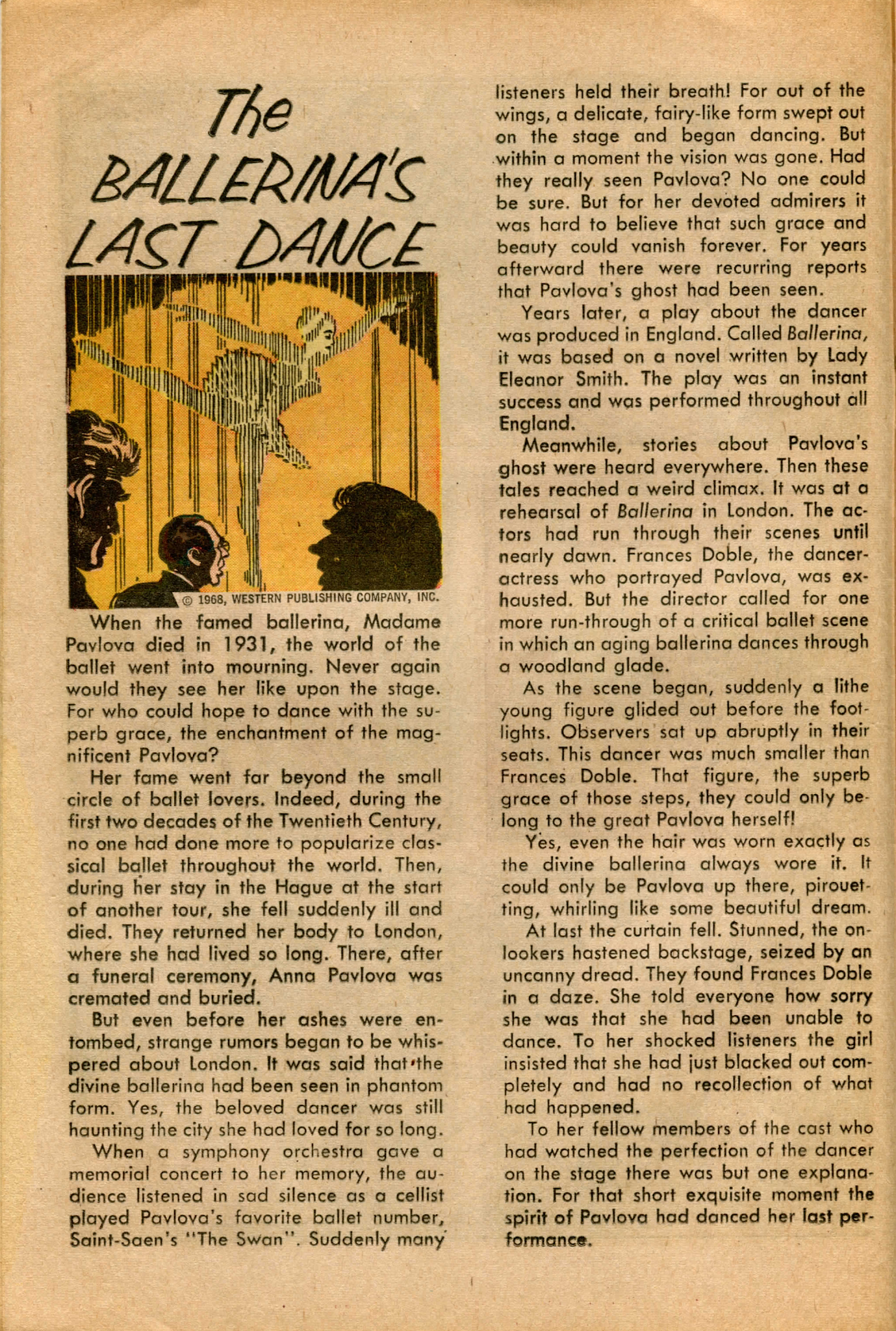
Lady Eleanor Smith & The Ballerina's Last Dance

I have written before about Lady Eleanor Smith (1902-1945), a British aristocrat of the first half of the twentieth century. She was also of course an author who had one story, "Satan's Circus," in Weird Tales (Oct. 1931). Lady Eleanor wrote more than a dozen books, mostly about dancers, circuses, and Gypsies. As with so many highborn or elite kind of people, she seems to have been attracted to the low life. I'm sure that in the opinion of some, there isn't much in culture lower than pulp magazines. If there is, comic books are probably it. So imagine coming across Lady Eleanor Smith's name in that lowly form:


The story shown above is from Ripley's Believe It or Not! True Ghost Stories #11, published by Gold Key (Western Publishing Company) in November 1968. I found my copy of this comic book at a mini-comic con in Nitro, West Virginia, in May of this year. It was the first comic con I have gone to this year. After more than a year of the not-normal, things are getting back to the way they used to be, or as much as is possible in our current situation. Here's to more comic conventions, get-togethers, parties, celebrations, and on and on, and no return at all to the coronavirus regime established the world over in 2020-2021.

Update (Feb. 1, 2022): I have found another account of the scene described by the anonymous author in Ripley's Believe It or Not! True Ghost Stories. This one is from the book Impossible Yet It Happened! by R. DeWitt Miller (Ace Books, n.d., pp. 48-49). And Miller gave an original source, Lady Eleanor Smith's own book, Life's a Circus (1939). I wonder if there could be other weird tales hiding in the pages of that book.

Original text copyright 2021, 2023 Terence E. Hanley

Friday, June 5, 2015

Percy B. Prior (?-?)

Hobbyist, Author, Poet
Born ?
Died ?

Who was Percy B. Prior? Here's a start:

Percy B. Prior is an Australian writer from Sydney who is in close contact with the splendid work Rotary is doing there. (The Rotarian, Jan. 1931)
Was he the writer for Weird Tales? Well, he was interested in weird things:
Wanted snapshots of all kinds of strange, odd, or unique things, such as happenings, freaks of nature, old and historic scenes, birds and animals, etc. For these will exchange good quality postage stamps or city and beauty snapshots in return. Percy B. Prior. 15 Philpott Street. Marrickville. N.S.W. (The World's News, Nov. 28, 1928)
Maybe he was a kind of Charles Fort or Robert Ripley of the Land Down Under. So what did he write? Here's a partial list:
  • "A Song of Thanksgiving" (1916)
  • "It Pays To Hatch Early" (article) in American Poultry Journal (Mar. 1921)
  • "A Serviceable Bench Stop" (article) in The Popular Science Monthly (Feb. 1922)
  • "Getting the Garden Soil into Condition" (article) in Garden & Home Builder (1923)
  • "To Our Flag" (poem) in The Newcastle Sun (Apr. 17, 1923)
  • "Dreams of Youth" and "My 'El Dorado'" (poems) in The Newcastle Sun (May 8, 1923)
  • "How to Photograph Moving Objects" (article) in Photo-Era (1924)
  • "And--I Ain't Dead Yet" (poem), syndicated in newspapers in 1926
  • "Why the Cake Fell" (article) in The Farmer's Wife (Sept. 1926)
  • "Strange Farms" (article) in Complete Novel Magazine (Feb. 1927)
  • "'Here Is My Heart'" (short story) in Sweetheart Stories (Feb. 28, 1928)
  • "Canberra: Will It Become the Real Capital of Australia?" (article) in The Rotarian (Oct. 1928)
  • "Useful Hints on Flashlight Photography for the Novice with a Camera" (article) in Camera Craft (1929)
  • Four-part series on Australian Aborigines in The Afro-American (beginning July 6, 1929)
  • "Concerning Ostrich Feathers" (article) in Wild West Stories and Complete Novel Magazine (Dec. 1929)
  • "The Little Things" (item), syndicated in newspapers in 1930
  • "Prison Cell Pets" (article), syndicated in newspapers in 1930
  • "School for Horses" (article), syndicated in newspapers in 1930
  • "The Wombat or Badger" (article), syndicated in newspapers in 1930
  • "An Interesting Letter from Australia" (letter) in Popular Aviation (Sept. 1930)
  • "Cat's Lifetime Spent in Church" (article), syndicated in newspapers in 1931
  • "Every One Present at Indian Wedding but Bride Herself" (article), syndicated in newspapers in 1931
  • "All About the Jellyfish" (article), syndicated in newspapers in 1932
  • "Men and Their Dogs" (article), syndicated in newspapers in 1934, 1937 
  • "Radio Around the World" (article) in The Rotarian (Apr. 1934)
  • "Christmas Again" (poem), syndicated in newspapers in 1930; also in: Anniston Star (Dec. 21, 1943); West African Advent Messenger (Dec. 1959); Australasian Record and Advent World Survey (Dec. 12, 1960)
  • "Sweetheart, You Are My Guiding Star"
Prior also had a good run in Weird Tales with three stories published in less than a year in 1927-1928. And he was a hobbyist, including being a philatelist and a photographer. And that's all I know about the man who may have been the only native Australian to contribute to Weird Tales.*

* * *

Update (Mar. 29, 2026): Some bullet points on Percy B. Prior:
  • In the period 1924-1930, Percy B. Prior was in Sydney, Australia.
  • A newspaper article from June 29, 1938, says that Prior was a past president Optimist International and lived in Los Angeles.
  • In Invisible Horizons by Vincent Gaddis (1965), Percy B. Prior is described as an American ex-sailor who settled in Australia. Thanks to Groggy Dundee, comment below, for finding the reference. My copy of Invisible Horizons is in storage, so I can't check it. Vincent Gaddis was also a teller of weird tales and a Fortean author. He and Prior had those two things in common. I wonder if they knew each other.

Percy B. Prior's Stories in Weird Tales
"The El Dorado of Death" (July 1927)
"When the Dead Return" (Dec. 1927)
"The Tree-Man Ghost" (Mar. 1928)

Further Reading

"The Tree-Man Ghost" was reprinted in 100 Ghastly Little Ghost Stories edited by Stefan Dziemianowicz, Robert Weinberg, and Martin H. Greenberg (1993). It's a fine little tale and may very well have been based on a traditional Scottish ghost story.

*Update (May 13, 2023): Prior lived in Winnipeg, Canada, so he may have been a Canadian rather than an Australian.


Copyright 2015, 2023 Terence E. Hanley

Tuesday, November 4, 2014

Robert S. Carr (1909-1994)-Part 2

I have compiled a list of Robert Spencer Carr's credits. I believe this to be as complete a record as exists on the Internet:
  • "The Composite Brain" in Weird Tales (short story, Mar. 1925)
  • "The Flying Halfback" in Weird Tales (short story, Sept. 1925)
  • "Spider-Bite" in Weird Tales (short story, June 1926)
  • "The Caves of Kooli-Kan" in Weird Tales (poem, Nov. 1926)
  • "Soul-Catcher" in Weird Tales (short story, Mar. 1927)
  • "Phantom Fingers" in Weird Tales (short story, May 1927)
  • "Fog-Faces" in Weird Tales (poem, June 1927)
  • "Beethoven" in Weird Tales (poem, Aug. 1927)
  • The Rampant Age (novel, Jan. [?] 1928; serialized in The Smart Set, 1927; adapted to film, 1930)
  • "The Chant of the Grave-Digger" in Weird Tales (poem, Jan. 1928)
  • "Whispers" in Weird Tales (short story, Apr. 1928)
  • Hot Stuff (film, screenplay co-credit by Carr from his story "Bluffers")
  • Why Leave Home? (film, adaptation by Carr from a play by Russell G. Medcraft and Norman Mitchell)
  • "Puppy Love" in College Life (short story, Summer 1928)
  • "Bright Young Laughter" in Everybody’s Combined with Romance (short story, Aug. 1929)
  • "Studio Party" in Everybody's Combined with Romance (short story, Sept. 1929)
  • "Border Incident" in The Saturday Evening Post (Nov. 20, 1943)
  • The Bells of Saint Ivan's (novel, May 8, 1944)
  • "Lie Detector" in Liberty (Mar. 4, 1944)
  • "Morning Star" in The Saturday Evening Post (novelette, Dec. 6, 1947)
  • The Room Beyond (novel, Sept. 30, 1948)
  • "Nightmare at Dawn" or "Easter Eggs" in The Saturday Evening Post (novelette, Sept. 24, 1949; also called "Those Men From Mars" and "The Invaders") 
  • "The Laughter of the Stars" in The Blue Book (August 1950; later retitled "Beyond Infinity" and reprinted in Beyond Infinity)
  • Beyond Infinity (collection of four novellas or novelettes, including the new story "Mutation," 1951; 1954)
  • "Murder in Moscow" in The Blue Book (short story, Jan. 1951)
  • "The Dictator’s Double" in The Saturday Evening Post (short story, Nov. 1, 1952)
  • "The Coming of the Little People" in The Blue Book (novelette, Nov. 1952)
  • The Invaders (novel, 1954--a British edition)
  • "The Coming of the Little People" in The Blue Book (novelette, Nov. 1952; reprinted in Fantastic Stories of Imagination, Mar. 1964)
  • "Porpoise to Starboard" in Florida Outdoors (serial, ca. 1980) 
  • "Hurricane Pass" in the Clearwater Sun (story, date unknown)
In 1952, Carr moved to Clearwater, Florida, and began teaching at the Florida Gulf Coast Art Center. After working for a time as a salesman, he accepted a position at the University of South Florida as a professor of creative writing. He called himself "Professor" or "Doctor" even though he lacked an advanced degree. Even after retiring he continued to teach at local art centers. Robert Spencer Carr died on April 28, 1994, in Dunedin, Florida. He was eighty-five years old.

Robert S. Carr's Stories and Poems in Weird Tales
See the list above.

Further Reading
In chronological order:
  • "The Ukraine Today," review of The Bells of St. Ivan's, by Nina Brown BakerNew York Times, May 7, 1944, p. BR7.
  • "Books of the Times" by Orville Prescott, New York Times, May 8, 1944, p. 17.
  • "Of Fantasy and Spirit," review of The Room Beyond, by Charles LeeNew York Times, Oct. 17, 1948, p. BR47.
  • Book of the Dead by E. Hoffman Price (2001)
  • "Robert Spencer Carr and the Pickled Aliens Hoax" by Damon C. Sasser on the blog R.E.H.: Two-Gun Raconteur, Aug. 12, 2011, here.
  • "Robert Spencer Carr as a Fortean" by Joshua B. Buhs on his blog, From an Oblique Angle, June 28-Aug. 17, 2014, here.

Beyond Infinity by Robert Spencer Carr in the hardbound edition of 1951 with cover art by Hannes Bok.
Beyond Infinity (1954), the paperback edition with cover art by Richard Powers.

Text copyright 2014, 2023 Terence E. Hanley

Monday, November 3, 2014

Robert S. Carr (1909-1994)-Part 1

Robert Spencer Carr
Né Theodore Bonifield
Novelist, Short Story Writer, Poet, Editor, Movie and Television Scriptwriter, Movie Director, UFOlogist
Born March 26, 1909, Washington, D.C.
Died April 28, 1994, Dunedin, Florida

Robert Spencer Carr was a prodigy who had magazine stories published at age ten, his first published story in Weird Tales at fifteen, and his first published novel at eighteen. Born on March 26, 1909, in Washington, D.C., he delved into fringe beliefs throughout his life. In 1932-1937, he lived in the Soviet Union, apparently as a convert to Communism. In the 1940s, he joined the Fortean Society. After the war, Carr moved to Glorieta, New Mexico, to start a lamasery. Once in New Mexico, Carr may have heard stories of flying saucers crashing to earth. Much later in life--in October 1974--he made national headlines when he claimed that alien bodies had been recovered from a crashdown near Aztec in 1948 and removed to Wright Field, later called Wright-Patterson Air Force Base in Dayton, Ohio. The story was a revival of a hoax perpetrated at the beginning of the flying saucer era but treated as fact in Behind the Flying Saucers by Frank Scully (1950). Though discounted in the 1950s and in the 1970s, the story helped fuel conspiracy theories about the supposed crashdown at Roswell in 1947. Late in life, Carr attended the Science of Mind Church in Florida, not to be confused with Scientology.

Robert Spencer Carr was born Theodore Bonifield in Washington, D.C. He was, according to his son, Timothy Spencer Carr, "the son of a pharmacist and the pretty young Mrs. Bonifield. His real father was Ceylon Spencer Carr, who was Mr. Bonifield's employer in Ashley, Ohio, where they produced naturopathic nostrums. Ceylon, who was sixty, paid for the Bonifields to move to Washington until the birth. Ceylon adopted the baby the day after his birth [so, March 27, 1909], named him Robert Spencer Carr, and they moved back to Ashley with [Dr. Carr's] wife Ida Angeline [(Smalley) Carr]. Ceylon died when Robert was five."

If Robert Spencer Carr was attracted in his life to fringe beliefs, he seems to have been an apple who hadn't fallen far from the tree. His father, Dr. Ceylon Spencer Carr, was born on January 6, 1850, in Herrickville, Pennsylvania. Carr attended schools in Towanda, Pennsylvania, and graduated from Chicago Homeopathic Medical College in 1877. He received a license in Ohio in 1896, presumably to practice medicine of some kind or other. We can hardly call homeopathy a branch of medicine, though. Dr. Carr practiced in Columbus, Ohio. He was editor of The Columbus Medical Journal in the early 1900s, but he made at least part of his living by manufacturing and selling patent medicines, including Peruna, Kubara, which continued to sell after his death, and The National, advertised as "The Only Real Bust Developer." He was a preacher and a teacher, a writer and editor on religious, philosophical, and I think we have to say pseudo-medical subjects. He was also involved in philanthropy.

Dr. Carr and his wife had four children, at least two of whom died when they were quite young. Born on June 11, 1878, in Elmira, New York, Marion Carr Schenck died of a blood clot and hemorrhage of the brain while in the Society Islands. The date was December 20, 1936. Her husband was Hollywood actor Earl Oscar Schenk (1889-1962), a man who had switched careers in mid-life and was working in the South Pacific as an explorer and ethnologist when his wife died. He was also a writer.

Next in line was Jennie Carr Sarver (1879-1960). She was married to Dr. Pearl Marvin Sarver (1883-1961). Her younger sister was Helen Carr, born in July 1888. She died suddenly on September 11, 1904, at age sixteen. Her death was rumored to have been by suicide, but the cause was instead given as uremic poisoning. "She had become somewhat melancholy," her father reported. "I am satisfied that kidney trouble was the cause of her death." He added, "Singularly, her brother died in much the same way." (Source: "Love Affair," in the Cincinnati Enquirer, Sept. 13, 1904, p. 6.) It looks like the unnamed brother will go on unnamed, for he seems to have fallen into the gap between the 1880 and 1900 censuses.

Robert Spencer Carr (1909-1994), subject of this article, was the last of Dr. Carr's children. Robert was just six years old when his father died on September 6, 1915. According to an online source, Directory of Deceased American Physicians, 1804-1929, the cause was a nervous breakdown. A contemporary newspaper article gave the same cause. An advocate of natural living and an opponent of drinking coffee and getting vaccinations, he had planned to live to one hundred. He fell short by thirty-five years.

His surviving son, Robert Spencer Carr, seems to have been a searcher and a wanderer. He lived in Ashley, Ohio, as a child and attended high school in nearby Columbus. Carr also lived in Chicago (as an associate and friend of Farnsworth Wright, E. Hoffman Price, and other Weird Tales writers); New Orleans; Hollywood; and New York. As mentioned, Carr spent half of the 1930s in the Soviet Union. He drew on his experiences there for a novel, The Bells of St. Ivan's (1944). In the same week that the book was published--on May 5, 1944--Carr enlisted in the U.S. Army at Fort MacArthur in San Pedro, California. He separated about a year later and soon after went to New Mexico, where he lived for two years with a family of his own. Carr "yearned to live in a spiritual community," writes his son, "and occasionally spent time at a Catholic monastery in nearby Pecos."

Carr was a prolific author. His first published story, "The Composite Brain," was in Weird Tales in the same month he turned sixteen. That puts him in a category with William A.P. White (Anthony Boucher) and Thomas Lanier Williams (Tennessee Williams) as authors published in "The Unique Magazine" while they were still teenagers. From 1925 to 1928, Carr had six stories and four poems in Weird TalesThe Rampant Age, a novel about young people, was published in early 1928 when Carr was only eighteen and with the editorial help of Farnsworth Wright. The book was adapted to a movie of the same name. You can watch it in its entirety on YouTube.

After World War II, slick magazines, including The Saturday Evening Post, began publishing science fiction, evidence that a pulp genre was gaining in respectability in the postwar world. Robert A. Heinlein is credited as the first postwar science fiction writer in the Post. His story "The Green Hills of Earth" from February 8, 1947, (1) beat Robert Spencer Carr's initial effort, "Morning Star," from December 6, 1947, by ten months. Carr is unusual in that--as a science fiction writer of the Golden Age--he broke into slick magazines and only later was published in pulps or digests. His three magazine novellas or novelettes--"The Laughter of the Stars," "Morning Star," and "Those Men from Mars"--plus a new story, "Mutation," were collected in book form in Beyond Infinity in 1951. In reading a synopsis of "Morning Star," I'm reminded of Abbott and Costello Go to Mars (1953) and Queen of Outer Space (1958).

Tim Carr writes: "His last publication was a serial, 'Porpoise to Starboard,' that ran in Florida Outdoors [circa 1980]." Carr's wife died in 1983. Carr continued living in "a showcase house overlooking Clearwater Bay." Carr spent the last year of his life in a nursing home in Dunedin, Florida. He died in that city on April 28, 1994, at age eighty-five.

To be continued . . .

Note
(1) The title "The Green Hills of Earth" is from a song sung in the Northwest Smith series by Weird Tales writer C.L. Moore.

The Rampant Age (1928) by Robert Spencer Carr.
An advertisement for The Room Beyond, from the New York Times (1948).
And the book itself, The Room Beyond by Robert Spencer Carr (1948).

Please note: I have corrected, revised, and updated this article on October 31-November 1, 2024, based on information provided by Timothy Spencer Carr, son of Robert Spencer Carr.

Text copyright 2014, 2023 Terence E. Hanley

Friday, October 17, 2014

Miriam Allen deFord (1888-1975)

Author, Poet, Essayist, Editor, Teacher, Reporter, Feminist, Socialist, Insurance Adjustor, Fortean Investigator
Born August 21, 1888, Philadelphia, Pennsylvania
Died March 22, 1975, Ambassador Hotel, San Francisco, California

Miriam Allen deFord was born on August 21, 1888, in Philadelphia, Pennsylvania, to Moïse deFord and Frances Allen deFord, both of whom were physicians. She grew up in Philadelphia and attended Wellesley College, Temple University, and the University of Pennsylvania. While attending Wellesley, she worked as a journalist for the Philadelphia North American. After graduating college in 1911, she wandered through Boston, San Diego, Spokane, Baltimore, Chicago, San Francisco, and other places in California. Along the way she held odd jobs, worked as a reporter, spoke out on socialist, feminist, and pacifist causes, and picked up two husbands in succession, the anarchist and mystic William Armistead Nelson Collier, Jr. (1874-1947), and the socialist, lecturer, and author Maynard Shipley (1872-1934). (1)

Even after arriving in California in 1915, Miriam's peregrinations continued. In 1920 she and her second husband moved to Sausalito. In 1922 they left the Socialist Party, and from 1924 to 1932 focused on their work with the Science League of America. Maynard Shipley died in 1934. In mourning, his widow went to Hawaii, then retreated to the East before returning to San Francisco. By the early 1940s, Miriam Allen deFord was living in the Ambassador Hotel in San Francisco, where she resided for all or most of what remained of her life. You can read more about Miriam Allen deFord on a blog called From an Oblique Angle by Joshua B. Buhs, here.

If the Golden Age of Science Fiction ended in 1950 as Isaac Asimov claimed, then Miriam Allen deFord squeezed in at the end with her story "The Last Generation" published in The Magazine of Fantasy and Science Fiction, Winter-Spring 1950. According to the Internet Speculative Fiction Database, that was her first work in the genres of science fiction and fantasy, but it came only about halfway through a career that stretched from 1920 to her death in 1975. (2) The online Encyclopedia of Science Fiction disagrees:
She began to publish work of genre interest with "The Neatness of Ann Rutledge" for The Westminster Magazine in 1924, releasing close to eighty sf and fantasy stories over the next decades, mostly in The Magazine of Fantasy and Science Fiction between 1951 and 1970, though several tales appeared later.
I think we can take the author's word as final. In the Winter issue 1973, Sam Moskowitz printed her stories "The Cats of Rome" and "Ghostly Hands" in his revived Weird Tales. According to Moskowitz, "Ghostly Hands" was originally printed in the magazine Tales of Magic and Mystery in January 1928. In the Summer issue 1974, Miriam submitted a clarification to "The Eyrie":
["Ghostly Hands"] was originally called "The Neatness of Ann Rutledge" (they chopped off the final "e"), and it appeared in a defunct magazine called Westminster sometime around 1924. Tales of Magic and Mystery apparently just swiped it without notifying them or me--or paying for it. They changed Ann's name to Jane . . . .
Miriam Allen deFord contributed most frequently to The Magazine of Fantasy and Science Fiction, co-edited by Anthony Boucher. Her first story for that magazine was the aforementioned "The Last Generation" from the magazine's second issue. Her last in her lifetime was "The Treyans Are Coming" from June 1974.

Like Boucher, Miriam was a writer in the San Francisco Bay Area. The two met in 1943 when Boucher was investigating falls of stones from out of the sky, near Oakland. He consulted with her on similar falls that she had investigated in Chico in 1922. An active Fortean, she and her husband had corresponded with Charles Fort between 1921 and Fort's death in 1932. "We never met in person," she wrote, "but we became good friends on paper." (3) In January 1954, Boucher and The Magazine of Fantasy and Science Fiction published her essay "Charles Fort: Enfant Terrible of Science."

According to The FictionMags Index, Miriam Allen deFord's first published story was "Little Bit" in Little Story Magazine for July 1920. (2) Over the next half century and more, she had scores of stories in titles that included Amazing Science FictionBeyond Fantasy FictionBrief StoriesDouble DealerEllery Queen's Mystery MagazineFantastic UniverseGalaxy Science FictionIfMike Shayne Mystery MagazineThe Overland MonthlyReal Detective Tales and Mystery StoriesThe Saint Mystery MagazineScribner'sSpace StoriesStartling StoriesTop-Notch, and Venture Science Fiction. Miriam had three stories in Weird Tales and was one of only a few authors who contributed to the original magazine and to the revival of 1973-1974. Her letter to "The Eyrie," quoted above, would have been one of her last published works during her lifetime.

Miriam's credits include not only dozens of science fiction and fantasy stories from 1950 to 1974, but also two collections of her own stories, Xenogenesis (1969) and Elsewhere, Elsewhen, Elsehow (1971); many stories anthologized in other books; a number of Little Blue Books; non-fiction books, including Bellamy's Looking Backward (1944), The Real Bonnie and Clyde (1968), and The Real Ma Barker (1970); a biography of her husband, Up-Hill All The Way: The Life of Maynard Shipley (1956); and the editorship of Space, Time and Crime (1964). A few of her stories were also adapted to television.

Miriam Allen deFord died at the Ambassador Hotel in San Francisco on March 22, 1975. She was eighty-six years old.

Miriam Allen deFord's Stories and Letter in Weird Tales
"Never Stop to Pat a Kitten" (July 1954)
"The Cats of Rome" (Winter 1973)
"The Ghostly Hands" (Winter 1973)
Letter to "The Eyrie" (Summer 1974)

Further Reading
See the websites of The Encyclopedia of Science Fiction, The FictionMags Index, The Speculative Fiction Database, and Wikipedia for more on Miriam Allen deFord. You may find more complete and accurate information on the Online Archive of California and the Suffragists Oral History Project, here.

Notes
(1) Miriam married Collier on February 14, 1915, in La Jolla and divorced him in 1920. She married Shipley on April 16, 1921, in Santa Rosa. That marriage lasted until his death on June 18, 1934.
(2) According to Sam Moskowitz in Weird Tales, Winter 1973, her writing career began in 1907.
(3) Quoted in Charles Fort: Prophet of the Unexplained by Damon Knight (1970), p. 170.

Space, Time & Crime, an anthology edited by Miriam Allen deFord, in the 1968 edition with a cover by Jack Gaughan.
Xenogensis (1969) with cover art by Richard Powers.
Update: Another edition of Space, Time & Crime, this one from 1964 with a cover by Richard Powers.

Copyright 2014, 2023 Terence E. Hanley

Thursday, October 16, 2014

Fortean Writers in Weird Tales

The Book of the Damned, the first of Charles Fort's four compilations of weird and unexplained phenomena, was published on December 1, 1919, to mixed reviews. The New York Times wrote:
[Any] conclusion . . . is so obscured in the mass of words and quagmire of pseudo-science and queer speculation that the average reader will find himself either buried alive or insane before he reaches the end. (1)
H.G. Wells, himself a believer in nonsense, called Fort "one of the most damnable bores who ever cut scraps from out-of-the-way newspapers." (2) Theodore Dreiser, Fort's champion, considered him "simply stupendous." (3) Ben Hecht, writing for the Chicago Daily News, was even more effusive:
I am the first disciple of Charles Fort. He has made a terrible onslaught upon the accumulated lunacy of fifty centuries. The onslaught will perish. The lunacy will survive, entrenching itself behind the derisive laughter of all good citizens. I, however, for one, rush to surrender my homage. Whatever the purpose of Charles Fort, he has delighted me beyond all men who have written books in this world. Mountebank or Messiah, it matters not. Henceforth I am a Fortean. (4)
Born on August 6, 1874, in Albany, New York, Charles Fort was an impoverished journalist, novelist, and writer of short stories before turning his attention to all things unexplained--at least in any satisfactory way--by science. Three compilations of these "data" as he called them followed The Book of the Damned. They were: New Lands (1923), Lo! (1931), and Wild Talents (1932). The last arrived in bookstores on May 5, 1932, just two days after Fort's death. Fort's wife survived him, as did his monumental works. Fortean has since become a word to describe the followers of Fort (thanks to Ben Hecht) as well as the phenomena themselves (collectively known as Forteana). Today there are Fortean societies all over the world.

There are also writers of Fortean fiction and have been since the beginning. Weird Tales, "The Unique Magazine," was one place where they could gather. In his remembrance of the editor Farnsworth Wright, E. Hoffman Price wrote:
Inevitably, Farnsworth was thrilled by the works of Charles Fort, the rebel who spent a lifetime trying to shatter the solemn pretenses of science, and in debunking the sacerdotal attitude of scientists. Whether he agreed or disagreed with Fort, I don't know, and it makes no difference; the essence of it was that he admired the iconoclastic approach, the startling phrases, the audacity of the wildman who juggled suns and stars and sciences. (5)
Edmond Hamilton was a young correspondent of Charles Fort and one of the first Fortean writers of fiction. His story "The Earth Owners" from Weird Tales, August 1931, was an early example in the genre (or sub-genre, or sub-sub-genre). Hamilton pointed out that he himself was preceded by George Allan England and his story "The Thing from--'Outside'" from Science and Invention, April 1923, reprinted in Amazing Stories, April 1926. (6) George Allan England (1877-1936) did not contribute to Weird Tales. Some Fortean writers who did include:
According to Robert J.M. Rickard, founder and editor of the British magazine Fortean Times: The Journal of Strange Phenomena, "John Campbell, the editor of Astounding Science Fiction . . . encouraged many authors to expand Fort's data and comments into imaginative stories." (7) And of course Raymond A. Palmer, editor of Amazing Stories, Fantastic Adventures, and Fate, modeled on the Fortean magazine Doubt, was also inclined towards Forteana. It's interesting that Campbell, the most scientifically minded of the three editors--Wright, Palmer, and himself--was also the one who fell hardest for pseudoscientific claptrap.

Fort's influence continued beyond the golden age of pulps and science fiction. The novel The Body Snatchers by Jack Finney (1954, 1955), about which I wrote recently, alludes to Fort in recounting stories of frogs falling from the sky, spontaneous human combustion, and of course the manifestation of "mysterious objects" on a farm outside Santa Mira, California. In fact the entire story is framed in Forteana with this as its closing paragraph:
But . . . showers of small frogs, tiny fish, and mysterious rains of pebbles sometimes fall from out of the skies. Here and there, with no possible explanation, men are burned to death inside their clothes. And once in a while, the orderly, immutable sequences of time itself are inexplicably shifter and altered. You read these occasional queer little stories, humorously written, tongue-in-cheek, most of the time; or you hear vague, distorted rumors of them. And this much I know. Some of them--some of them--are quite true. (8)
Charles Fort didn't think much of science or scientists, yet his "data" are now everywhere in science fiction. He inspired writers of fantasy and weird fiction, too, and even appears as a character in the recent movie adaptation of "The Whisperer in Darkness" by H.P. Lovecraft. Between the two--between science and the supernatural--lies pseudoscience, which you might say was invented by Charles Fort. As a believer in the continuity of all things, he would not have recognized a difference among science, pseudoscience, and the supernatural. He may very well have felt comfortable inhabiting those in-between spaces--or as comfortable as he felt at any time inhabiting this strange planet.

Notes
(1) Quoted in Charles Fort: The Man Who Invented the Supernatural by Jim Steinmeyer (2008), with Mr. Steinmeyer's brackets and ellipses, p. 11.
(2) Quoted in Steinmeyer, p. 11.
(3) Quoted in Steinmeyer, p. 12.
(4) Quoted in Charles Fort: Prophet of the Unexplained by Damon Knight (1970), p. 70.
(5) From "Farnsworth Wright" by E. Hoffman Price in The Weird Tales Story by Robert Weinberg (1977), p. 11.
(6) See Knight, p. 171 and notes 161 and 162 on p. 216.
(7) Quoted on Wikipedia.
(8) Ellipses and italics are in the original.

The Book of the Damned by Charles Fort in a British (?) paperback edition.

Lo! in the original hardbound edition illustrated by artist and raconteur Alexander King (1899-1965).
Charles Fort's ideas have permeated our culture, even showing up in cartoons by Charles Addams. From Creature Comforts (1981).

Text and captions copyright 2014, 2023 Terence E. Hanley