Showing posts with label Jim Causey and Bill Blackbeard. Show all posts

Thursday, February 6, 2014

John Giunta (1920-1970)-Part 3

According to the book The T.H.U.N.D.E.R. Agents Companion (2005), John Giunta began working in comic books in 1939, when, as a beginning artist, he did lettering and coloring for the Harry "A" Chesler comic book shop. He also reviewed science fiction fanzines in Amazing Mystery Funnies #12 (Dec. 1939)According to the online Comic Book Database, Giunta's earliest credited work as a comic book artist appeared in Spitfire Comics #1, from August 1941. He continued working in comic books for the rest of his life and is credited with published work in all but four years between 1941 and 1970, the year of his death. In addition to Spitfire Comics, he worked on Joker Comics, Suspense Comics, Treasure Comics, Spook Comics, The Mad Hatter, All-Star Comics, All-American Western, Boy Commandoes, Badmen of Tombstone, Strange Worlds, Man Comics, Chamber of Chills, Weird Thrillers, Big Town, Strange Adventures, Mystery in Space, Lost Worlds, Phantom Stranger, Tomb of Terror, Thrills of Tomorrow, Superboy, Journey into Mystery, Two Gun Western, World of Suspense, Strange Tales, World of Fantasy, Eerie, The Fly, Adventures of the Fly, Tales of the Unexpected, Laugh, Pep, House of Mystery, Tales to Astonish, T.H.U.N.D.E.R. Agents, Undersea Agents, Noman, Batman, and Detective Comics. That means that in his lifetime, John Giunta worked for Harvey, Timely, Continental Magazines, Prize Publications, Baily Publishing, O.W. Comics, DC, Avon, Ziff-Davis, Standard/Nedor, Atlas, I.W. Enterprises, Archie Comics, Marvel, and Tower Comics. His work has also been reprinted since his death.

According to the Internet Speculative Fiction Database, John Giunta's first published work in a professional science fiction magazine was an illustration for "Bratton's Idea" by Manly Wade Wellman in the December 1940 issue of Comet, edited by F. Orlin Tremaine. Giunta's second credited illustration was for "The Hound" by Fritz Leiber, Jr., published in Weird Tales in November 1942. For the next eight years, his illustrations in the genres of science fiction and fantasy appeared only in Weird Tales. That changed in December 1950 with his illustrations for Out of This World Adventures. From the early 1950s to the late 1960s, Giunta contributed to Fantastic Adventures, Avon Science Fiction and Fantasy Reader, Fantastic, Infinity Science Fiction, Amazing Stories, Science Fiction Adventures, Venture Science Fiction Magazine, Saturn, Fantastic Universe, If, Galaxy Magazine, and Worlds of Tomorrow. He was also art director for Original Science Fiction Stories and Saturn. And again, his work has been reprinted since his death in 1970.

Those are some long lists for a blog posting, but I have compiled them for a reason. John Giunta was both a comic book artist and a science fiction illustrator. You would hardly know that to look at sources in print or on the Internet. The science fiction sources pretty well ignore his work in comic books, and the comic book sources tell very little about his work as an illustrator. Why is that? Why should there be this unbridged gap between a genre (science fiction) and a form (comic books) that so naturally go together?

To be concluded . . . 

"The Magician from Mars," a comic book character and series created by John Giunta, Malcolm Kildale, and Michael Mirando in Amazing Man Comics (Centaur, 1940-1941). Giunta's interest in science fiction shows through pretty clearly here. If you remember my posting from the other day, Malcolm Kildale was the artist from whom Frank Frazetta seems to have borrowed an image or two.
Roly-Poly Comics #10 (Green Publishing Company, Jan. 1946). "Jay Gee," the artist, was John Giunta. 
Fantasy, a fanzine dated November 15, 1948, with cover art by John Giunta, evidence that he was involved in fandom even after having become a professional artist. 
A somewhat muddy interior illustration for "The Moonrakers," Giunta's own story from If (Jan. 1966). 
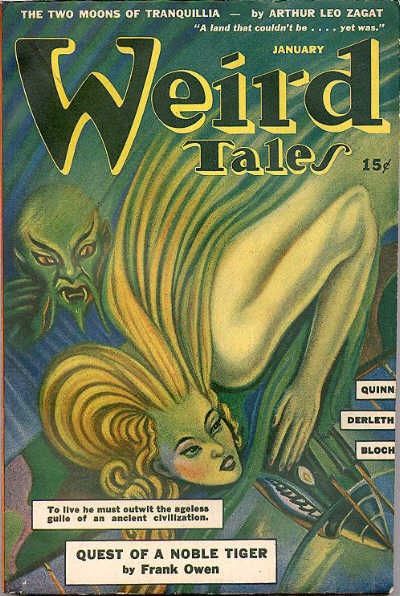
The cover of Fantasy-Times: The Science-Fiction Newspaper (Sept. 1956), with a small photograph of John Giunta in the upper right. Bill Blackbeard is in the lower center. Giunta illustrated his story (co-written with James O. Causey) "Hammer of Cain" for Weird Tales in November 1943.

Text and captions copyright 2014, 2023 Terence E. Hanley

Friday, July 22, 2011

Jim Causey and Bill Blackbeard-Part 4

Jim Causey's letter to Randal Everts concludes:

     Unfortunately, I have no old rejects from WT [Weird Tales], or from the pulps. Only a couple of stf rejects, because I sold most of my output in the fifties. Every few months I would tear up everything I had previously written, even if it had only been rejected once. I figured I'd improved. (I stopped this practice when Ray Bradbury once told me that his fine story The Swan had been rejected over 50 times before he finally sold it to the big slicks.)

     Digging through my archives, however, I found an old issue of Fantasy Times, with a picture of Bill on the cover, and also an article by him where he mentions the lamentable demise of WT and how "Dorothy McIlwraith steered the old magazine into uncharted reefs of the most unspeakable crud ever seen in print . . . ." [Causey's ellipses] I enclose copy of same for your interest.

     Sorry not to have had a more adventurous existence. Bottom line: For over 30 years have had the same wife, worked for the same company, and used the same golf putter. This should provide some clue to my massive and complex character.
All best
[Signed] Jim

Fantasy Times #254 (September 1956) with tellers of weird tales Bill Blackbeard and Forrest J Ackerman on the cover. In addition, John Giunta, pictured here, was an artist for "The Unique Magazine." Blackbeard's article, "SF and Fantasy, 1941-1956," appeared in this issue of Fantasy Times. It may be the same issue mentioned by Blackbeard's friend, Jim Causey, in Causey's letter to Randal Everts.
Thanks again to Randal A. Everts for providing the letter from his collection.

2011, 2023

Thursday, July 21, 2011

Jim Causey and Bill Blackbeard-Part 3

Jim Causey's biographical letter to Randal Everts continues:

     In the early sixties, I was fortunate enough to transfer to my company's aerospace division in Newport Beach, which permitted me to move from the Garden Grove smog belt to Laguna Beach, only a stone's throw away from work. (My wife and I both grew up in beach towns and love the ocean.) The house we bought had a little basement apartment, and Bill stayed with us for a few months. I remember him telling me what a great opportunity this was to do some serious writing.

     Bill's fiction output during this period was desultory, but his collecting mania intensified, if such a thing was possible. Soon he had the place filled floor to ceiling with moldering pulps. Tons of them. When I berated him for a magazine junkie, Bill looked bemused.

     "These are an investment," he said loftily. "These idiot booksellers don't realize the true value of their inventories."

     Alas, he marched to a different drummer. He left us a few months later, and we continued to correspond for a time, and I remember meeting him and his bride, Barbara, at a Forrie Ackerman benefit dinner a few years ago. Anyway, Bill finally established his great pulp museum and more power to him. His recent book, Sherlock Holmes in America, was a Literary Guild selection a couple of years ago and he must have gotten a rattling good price for it. There is obviously some kind of moral here about doing your own thing. [Sherlock Holmes in America was published in 1981, thus dating Causey's letter to sometime in the early to mid 1980s.]

Conclusion in the next entry.

Sherlock Holmes in America by Bill Blackbeard (1981).

2011, 2023

Wednesday, July 20, 2011

Jim Causey and Bill Blackbeard-Part 2

A continuation of Jim Causey's letter to Randal Everts, in which the author describes his return to California after a foray into New York City during the late 1940s:

     Came home to the west coast after a year, bloody but unbowed. Bounced around at odd jobs, sold a little real estate, and when I got married in 1950 decided to get a steady job. Kept writing on the side, nothing sensational, sold a few stf and mystery shorts. A TV sale to Alfred Hitchcock from one of my Manhunt stories. Three original paperback mysteries to Gold Medal, Avon & Crest in the late fifties.

     Bill and I had stayed in touch over the years and he kept telling me I should shuck the job and go to Mexico and write full-time. I couldn't see it. Had a wife and two sons who liked to eat regularly. Besides, the paperback market was getting anemic and it bothered me. Even worse, in the parlance of the trade, I was a "bleeder." Eked out first drafts in longhand, retyped, and tortuously revised. Finally typed the final draft for submission -- provided everything went well. How I envied these guys who could hammer it out first draft and sold immediately with only minor revisions! I tried this a couple of times and back came my manuscripts with dull thuds. Could simply not sell first drafts. Besides, every time I even considered writing full-time, I would get an unexpected raise and a sudden promotion. Somebody up there somewhere was trying to tell me something. . . [Causey's ellipses]

     So Bill and I each continued to follow our divergent destinies. He was still the compleat [sic] collector. Typically, he would quarter in one of those ancient, rambling frame gothics that lend a kind of updated Arkham flavor to the lees of Los Angeles. Whenever his vast collection threatened to tilt the house on its foundations, Bill would have to move, dragging tons of pulp treasure with him. An inveterate stf buff, Bill knew just about every fellow fan in the area and was a familiar sight at most of the stf/fantasy conventions. They all know him and love him. He is not, incidentally, a violent hirsute fellow as his name portends. Prematurely bald since his late teens, he is freckled, affable and articulate. Since nineteen he has looked forty. He will probably look the same at seventy.

Continued in the next entry.

Weird Tales for January 1943, the issue in which James Causey's  first story for the magazine, "The Statue," was published. The cover art is by A.R. Tilburne.

Tuesday, July 19, 2011

Jim Causey and Bill Blackbeard-Part 1

Sometime in the early 1980s, Weird Tales researcher Randal Everts wrote to the author James O. Causey requesting an account of his career. Causey's undated reply follows:

Sunday
Dear Alain [Randal Everts' middle name],

     Sorry about the lapse. Thought you had everything you needed. Thanks for sending a copy of Hammer of Cain. Very kind of you. My sketchy biography follows. Also a few data points on Bill Blackbeard.

     Born 1924, a typical depression child, omniverous [sic] devourer of pulp magazines during the thirties and early forties. Liked heroic fantasy, read every Burroughs novel I could get my hands on, also the stf and fantasy mags, particularly WT [Weird Tales], Astounding, Wonder and Amazing. Later, Unknown, Bluebook, Argosy, Adventure, etc. Met Bill when I was 18, in a second hand bookstore. He was a year younger, a dedicated stf and comics fan and already had an impressive collection which included the old Big Little comic books, vintage Batman and Superman issues and other tomes destined to be rare and costly some day. Even then, Bill was an indefatiguable [sic] collector. I recall the day he discovered an ancient volume of Flaubert's Salambo! with horrific border illustrations by Beardsley. A first edition, which would be worth a packet today. Also Clark Ashton Smith's Ebony and Crystal, which Bill calmly expropriated from the library by the simple expedient of walking out with it under his coat. He had that ruthless verve possessed by all great bibliophiles, his youth notwithstanding.

     "Tut," he waved aside my remonstrations. "Some vile book merchant will steal it eventually. Better an appreciative chap like myself who will gloat over it by lamplight."

     Anyway, he knew I had sold a couple of shorts to WT and it turned out he was working on a story for WT called Hammer of Cain. It hit me right between the eyes and I immediately outlined a plot. He didn't see it that way. We kicked it around, could not agree on the same plot line and finally decided to each write our own version. Did so, and swore a blood oath that no matter whose tale sold, the story would forever be known to the world as a collaboration job.

     When I got drafted the following year, gave Bill my entire collection of Weirds, Unknowns and Stf. Felt I was grown up and it was time to put away the things of childhood. Besides, I had just sold a novelette to Daisy Bacon's Detective Story. She paid me two cents a word on acceptance, whereas WT paid only a cent a word on publication. I had also recently read Steve Fisher's Literary Roller Coaster which appeared in the 1941 Writer's Digest Yearbook and which must have inspired every pulp writer alive. I was determined to go to NY when I got out of the Army and be a full-time free-lance pulpateer. I was young and ambitious and full of plots and stuff and couldn't wait to attack the great pulp market. The few sales I had in the army only served to whet my appetite further.

     Joined the paratroops, but did not see combat duty. Remained stateside for the duration. Got out of the army in early '47, went to New York and dug in. Found a little pad in the upper Bronx, got a typewriter and began writing my guts out. My timing couldn't have been worse. Although I sold a few mystery yarns that year, the pulps were dying. Only a few of the most talented writers made it during this period, guys like Roy Huggins and John D. MacDonald.

Continued in the next entry.

A photograph of Jim Causey, date and place unknown, but probably from the early to mid 1970s. From the collection of Randal Everts.
Thanks for Randal A. Everts for providing a copy of the letter and the photograph.

Tuesday, May 3, 2011

James O. Causey (1924-2003)

Author of Short Stories and Novels
Born July 12, 1924, Compton, California
Died April 13, 2003, Laguna Beach, California

Bill Blackbeard's collaborator on his first story for Weird Tales was another young writer, James Causey. James Oliver Causey, Jr., was born on July 12, 1924, in Compton, California, and grew up in Long Beach. The first writing credit I can find for him is his first story for Weird Tales, "The Statue," from the January 1943 issue. Half a year later, "Legacy in Crystal" appeared. Finally, in its November 1943 issue, Weird Tales printed Causey and Blackbeard's "Hammer of Cain." Causey was apparently by then serving in the military, having enlisted in March 1943 in Los Angeles. Like millions of men from his generation, his life was interrupted by World War II.

Causey's writing career picked up again after the war. At least four of his stories were published in Street and Smith's Detective Story Magazine between June 1945 and March 1947. In the early fifties, Causey tried his hand at science fiction with stories in Galaxy Science Fiction, Science Stories, and Orbit Science Fiction. One of those stories, "Felony," was selected for inclusion in The Best Science Fiction Stories and Novels: 1955, edited by T.E. Ditky (1955). Causey returned to crime fiction in the late fifties with three well regarded novels, The Baby Doll Murders (1957), Killer Take All (1957), and Frenzy (1960). One of his stories was also adapted to an episode of Alfred Hitchcock Presents. Called "Deathmate," the episode was written by Bill S. Ballinger and aired on April 18, 1961. Frenzy, by the way was not the same story as in Hitchcock's film, Frenzy (1972).

James Causey died on April 13, 2003, in Laguna Beach, where he had lived for many years. His daughter-in-law Karen Causey called him "[a] man of great wealth with regards to writing and in conversation," adding, "He is greatly missed!" You can read her comments and more on the blog Mystery Filehere.

James Causey's Stories in Weird Tales
"The Statue" (Jan. 1943)
"Legacy in Crystal" (July 1943)
"Hammer of Cain," with Bill Blackbeard (Nov. 1943)

Further Reading
Causey's three stories for Galaxy Science Fiction, "Teething Ring," "Felony," and "Competition," are apparently in the public domain and available for free on the Internet. "Teething Ring" also appeared in 50 Short Science Fiction Tales, edited by Isaac Asimov and Groff Conklin (Collier Books, 1963).

Lacking an image from Weird Tales, I offer the cover of one of James O. Causey's novels, Frenzy (1960).

Thanks to Randal A. Everts for James Causey's places of birth and death.
Text copyright 2011, 2023 Terence E. Hanley

Monday, May 2, 2011

Bill Blackbeard (1928-2011)

Writer, Editor, Anthologist, Comic Strip Historian
Born April 28, 1926, Lawrence, Indiana
Died March 10, 2011, Watsonville, California

Before he amassed what was probably the world's largest collection of newspaper comic strips, Bill Blackbeard was a writer for science fiction fanzines and pulp magazines, including Weird Tales. He was born William Elsworth Blackbeard on April 28, 1926, in Lawrence, Indiana, a town then just northeast of Indianapolis and now engulfed by the city. He started collecting comics as a twelve-year-old boy in California, where he grew up, and he never stopped. His collection eventually amounted to seventy-five tons and an estimated three million or more items. Most of that collection is now housed at Ohio State University, at the Billy Ireland Cartoon Library and Museum.

Although he never cared much for comic books (at one point he referred to them as "meretricious dreck"), Blackbeard greatly admired the two forms that gave rise to them, comic strips of course, and pulp magazines. Writing under his own name (and perhaps also under a transparent nom de plume as William Teach), Blackbeard authored stories and articles for science fiction fanzines, pulp magazines, and other publications. Only one of those stories appeared in Weird Tales. It may have been his first to see print. The story was called "Hammer of Cain," its co-author was James Causey, and it was published in the November 1943 issue of "The Unique Magazine." Blackbeard was all of seventeen years old at the time. Causey was nineteen. The story's appearance must have been quite a thrill for them (although Blackbeard's name had already seen print in Weird Tales, in a letter to "The Eyrie" from September 1942, while the magazine had published two of Causey's stories earlier in 1943). In any case, Blackbeard's budding career was soon interrupted by service with the U.S. Army in Europe during World War II. After the war, he attended Fullerton College on the G.I. Bill and embarked in earnest on a career as a writer, moreover as a collector--or savior--of American newspaper comic strips. Blackbeard died on March 10, 2011. Announcements of his death and tributes to him are all over the Internet as I write. One tribute of interest is on a blog called "Yesterday's Papers," by cartoonist and writer John Adcockhere.

Bill Blackbeard's Letter and Story in Weird Tales
Letter to "The Eyrie" (Sept. 1942)
"Hammer of Cain," with James Causey (Nov. 1943)

Further Reading
Bill Blackbeard authored or edited 200 or more books, but I have never read his fiction. For his non-fiction, you might start with:
  • The Smithsonian Collection of Newspaper Comics, edited by Bill Blackbeard and Martin Williams (Washington, DC: Smithsonian Institution Press and Harry N. Abrams, 1977)
  • Sherlock Holmes in America (New York: Harry N. Abrams, 1981)
  • The Comic Strip Century, two volumes, edited by Bill Blackbeard and Dale Crain (Englewood Cliffs, NJ: O.G. Publishing, 1995)

Bill Blackbeard in 1971. Photograph by Fitzgerald Whitney, from the Los Angeles Times.

Text copyright 2011, 2023 Terence E. Hanley