For our struggle is not against flesh and blood, but against the rulers, against the authorities, against the powers of this dark world and against the spiritual forces of evil in the heavenly realms.
Thursday, January 15, 2026
Old Gods Again
Tuesday, November 11, 2025
Lou Feck (1925-1981)
For Remembrance Sunday, November 9, and Veterans Day, November 11, 2025
Yesterday I mentioned the artist Lou Feck in regard to his illustrations for The Shepherd by Frederick Forsyth (Bantam Books, 1977). I would like to write about Lou Feck today, for he had an indirect connection to Weird Tales magazine, and I find that there isn't any biography of him on line, or at least as far as I have searched. He was a very good artist, especially good with airplanes and other machines, as well as with architecture. Like all really good artists, though, he was good at handling the human figure. He needed those skills in his work as a cover artist for science fiction and fantasy paperbacks. He did other paperback cover art as well.
Lou Feck's name can be added to the list of Conan cover artists. He also created the cover art for Kull, the Fabulous Warrior King by Robert E. Howard (Bantam Books, 1978). Feck's depictions of airplanes in flight, as well as of airfields, hangars, and other things related to aviation, are excellent. Now I find that he was acquainted with the field of aviation, as he had served in the U.S. Army Air Force during World War II. Frederick Forsyth (1938-2025), by the way, also served in the air force, in his case the Royal Air Force, or RAF. He was commissioned three days after his eighteenth birthday and became a pilot a year later. At age nineteen, he was at the time the youngest pilot in the RAF. The late Mr. Forsyth flew the de Havilland Vampire, a graceful-looking, twin-tail, single-engine jet fighter. The pilot in The Shepherd flies the same type of aircraft. Frederick Forsyth died almost exactly one hundred years after Lou Feck's birth.
Louis Edward Feck was born on July 8, 1925, in Cincinnati, Ohio, to Vela Bertyl (Edwards) Willett and Louis Fairfax Willett, Sr. The two were married on January 22, 1924, and divorced on or about March 15, 1930. Feck's name at birth was actually Louis Fairfax Willett, Jr. In the U.S. Census of 1930 (April 11), he was enumerated with his divorced mother in Norwood, Ohio. She worked then as an editor at a lithographing company. Three years later, a portrait of Vela Edwards Willett, painted by Glen Tracy (1883-1956), was included in an exhibition at the Cincinnati Art Museum. So, Lou Feck came from a family connected to the art world.
Vela Willett remarried in 1932. Her new husband was Edward A. Feck. The couple lived in Melrose, Massachusetts, in 1940 and 1950 when the census taker came around. By then they had had a daughter, Rosemary Vela Feck, later Caldwell. The former Louis Fairfax Willett, Jr., was by then going by the name Louis Edward Feck, nicknamed Lou.
Lou Feck studied at the Boston Museum of Fine Arts in 1940-1941 and graduated from Melrose High School in 1943. From July 24, 1943, to February 17, 1946, he served in the U.S. Army Air Force. In 1947, he resumed his studies at Vesper George School of Art in Boston. In 1950, he graduated from the Pratt Institute in Brooklyn, New York.
On June 18, 1950, Feck married Ruth Evangeline Cutkomp in New York City. Born on February 24, 1925, in Columbus City, Iowa, she was an artist, too. She graduated from Rock Island High School, in Rock Island, Illinois, in 1943 and attended the Chicago Art Institute in 1944-1945. From 1945 to 1946, she served in the U.S. Navy. Like her new husband, she graduated from the Pratt Institute in 1950. The young couple lived in Brooklyn and worked in advertising and illustration in New York City. I wonder if they knew John and Elaine Duillo, another husband-and-wife pair of illustrators who had also attended the Pratt Institute.
Lou Feck enjoyed a long and successful career as an artist. You have no doubt seen his work. Rather than list and show his credits here, I'll refer you first to a blog called The Paperback Palette and a long article called "The Fantastic Paperback Cover Art of Lou Feck" by Jeffersen, dated April 10, 2018, here; and second, to a blog called Poplitiko and an entry called "The Secret Work of Lou Feck, Cover Artist Supreme" by Alex Ness, dated August 25, 2025, here. You can also look at the Internet Speculative Fiction Database.
Lou Feck died suddenly and unexpectedly on November 4, 1981. He was just fifty-six years old. Ruth E. (Cutkomp) Feck died on May 11, 1990, in Broward County, Florida. Feck was buried at Huntington Rural Cemetery in Suffolk County, New York. His signature appears on his headstone. Next to his is another headstone with the signature of Anita D. Feck. Her dates are given as 1930-2016. Someone named Anita Feck wrote a letter to the science fiction magazine Locus, published in its issue of July 1982 (#258). I don't know what to make of all of that exactly. My best guess is that Anita D. Feck was Lou Feck's wife and widow and that she wrote to inform science fiction fandom of the death of her husband. I don't know anything else about her.
Sunday, August 31, 2025
Spear and Fang
100 Years of Robert E. Howard in Weird Tales
No discussion of the July 1925 issue of Weird Tales would be complete without mentioning "Spear and Fang," the first story by Robert E. Howard published in "The Unique Magazine."
Howard was nineteen and a half years old when "Spear and Fang" was published. Because my books are in storage, I will have to rely on online sources of information on Howard and his career to write this. Those sources indicate that "Spear and Fang" was not Howard's first published story but suggest that it was his first professional sale. According to one source, which is always suspect, even on the most well-documented of facts, Howard submitted "Spear and Fang" to Weird Tales in 1924, when he was just eighteen. The new editor of the magazine, Farnsworth Wright, accepted it and informed Howard as much at Thanksgiving time in 1924. I wonder if that means that Howard submitted his story while Weird Tales was still in hiatus, from about June or July to November 1924. If so, that would make for the most serendipitous of developments for Howard, Wright, and Weird Tales, all three, for the then teen-aged author would prove to be one of the most popular and prolific of those who contributed to a magazine that had almost disappeared in 1924. For his efforts, Howard was paid $16, a nice sum for a beginning pulp author of the 1920s.
"Spear and Fang" is a caveman story, though not the first to appear in Weird Tales. That honor goes to R.T.M. Scott and his "Nimba the Cave Girl" from March 1923. It's not very long, five printed pages in all, but it tells a complete story, essentially of a love triangle, if you can call it that, or the eternal triangle, and the rescuing of a damsel in distress.
"Spear and Fang" is, on its surface, a conventional story, but I noticed some things in my reading of it that I think are worth writing about. First, Howard was well known in his later writings for his identification with barbarians and what some people would call savages. That isn't the case with "Spear and Fang," for the hero is a more advanced Cro-Magnon man, while the villain is a primitive, even bestial, Neanderthal man. It's clear that the Cro-Magnon man, called Ga-Nor, is more civilized. He is, after all, an artist. (More on that in a minute.) He is the man of the future. Both he and A-aea, the woman he rescues, are referred to as "mark[s] of progress." The Neanderthal man, on the other hand, is the man of the past. His days are numbered, even if he still has the power to terrify his enemies. It seems to me that at age eighteen Howard still believed in the idea of progress. This was, after all, a progressive era, even if that era was nearing its end and even if Calvin Coolidge, a conservative, was then president. We should remember, too, that, even if weird fiction is at its heart a conservative or anti-progressive genre, Weird Tales was co-founded by a man, J.C. Henneberger, who had worked for a progressive and prohibitionist newspaper. I would guess that many of the magazine's authors held progressive views, too, including unsavory ones such as eugenics.
Second, there is a racial aspect in "Spear and Fang," though not in the way people now talk about race. The idea expressed in Howard's story seems older and broader, maybe more like an old Anglo-Saxon or even biblical view, expressed pretty well in this sentence:
Both the girl and the youth were perfect specimens of the great Cro-Magnon race which came from no man knows where and announced and enforced their supremacy over beast and beast-man.
Just as we shouldn't interpret "race" in our contemporary terms, we also shouldn't interpret "supremacy" in those terms. I wonder if Howard thought of the original Cro-Magnon men as being racially pure and that only afterwards was there some kind of degradation or descent: in our pre-civilized state, we were "perfect," or at least near perfection, and only later did decadence set in. I wonder if ideas like those were related in any way to the ideas of Friedrich Nietzsche. Maybe those of Jean-Jacques Rousseau are at work here, too.
Third, Howard probably catches a lot of flak now for his depictions of women. I don't have anything to say about that. I'll just point out that, although A-aea needs rescuing, she is not a passive character. In fact, she risks disapproval and punishment for going after what she wants, which is to draw the attention of Ga-Nor, the man she loves.
Finally, Ga-Nor, like I said, is an artist, even if he is tall and well built. (That's not a knock at artists. I'm one after all.) I take him to be a stand-in for the author of the story. He seems oblivious to A-aea at first. He's more caught up in his creation of a cave painting. But when she needs rescuing, he's there, and he succeeds where his taller and stronger rival, the reckless, cruel, and proud Ka-nanu, fails. Call it a revenge of the nerds and the fantasy of creative, gentle, or less than adept men when it comes to winning the hearts of beautiful women. This is what so much pulp fiction is about.
Although "Spear and Fang" was written by a teen-aged author (before teenager was a word), it shows some unusual depth and complexity, I think, and is more than a mere tale. It shows that there were larger things behind Howard's writing, larger than just a desire to tell a story or to earn some income. Howard seems to have begun forming a worldview and a foundation for his later writings. And he was just seven years away from "Worms of the Earth" (Weird Tales, Nov. 1932), which can be called one of his masterpieces, if there is such a thing as a masterpiece in pulp fiction.
Original text copyright 2025 Terence E. Hanley
Tuesday, January 31, 2023
What Is Weird Fiction?
Beowulf was composed in pre-Christian times but written down only after Christianity had moved into northern Europe. The result is syncretic, that is, a cross between pre-Christian and Christian beliefs. Syncretism was and is a very successful strategy in the growth and spread of Christianity. Rather than wipe out beliefs that came before it, the Church absorbed and modified them. It's why we celebrate Christmas at midwinter.
In his last words, Beowulf mentions both Weird (Wyrd) and "the Creator." The implication is that Weird works on earth, perhaps independently of the Creator. Or is she one of his agents or angels? I can't say. Beowulf seems to have lived and died in an in-between time. But what if the inclusion of Weird in Beowulf is not fully syncretic? What if Weird and God lived side by side for some time in Europe before Weird became what people now call "God's will" or "God's plan for the world"? What if only later did God subsume Weird?
For nigh on a thousand years after Beowulf, Weird was the workings of God--"God moves in mysterious ways" is the saying--and there was a syncretism, with God on top and Weird hidden away. Weird, or Fate, and her seeming random and often cruel ways retreated behind God's will, God's plan, God's mercy, God's love. God took her place; he is loving and caring, even if mysterious. He does things for his own reasons, which may be inscrutable and incomprehensible to us in our smallness, yet are ultimately wise and unassailable. Maybe the weird fiction of the nineteenth century and after chronicles a renewed schism of Weird from God, significantly beginning with the Romantic Period and the rise of the natural sciences.
We think of the Romantic Period as a reaction to the Age of Reason. But there was no simple conservatism in Romanticism. In fact, it may be seen as a search for a third way, for a middle ground between a cleaving to tradition and a radical overthrow of the past. So maybe Weird came back only after we had begun the process of dethroning God, which seems to have been part of the program of Western thought during the nineteenth century. Then, in 1883, Nietzsche wrote that God is dead. A couple of years later, publishers began putting out books with the word weird in their titles. These were no doubt the inspiration for the title, themes, and subject matter of the later magazine Weird Tales, which began one hundred years ago this spring.
So maybe the authors of weird fiction from the 1880s to the 1920s and '30s were simply returning to the Weird of the past. Except that Weird was now embodied or manifested in dark, malign, and alien beings, entities, and forces. Weird may be cruel. She may seem arbitrary. She carries us away. But more than anything, she may actually be indifferent to what we want for ourselves on this earth. Her ways may just be matters of course. These things must be done for no reason we may know. Cthulhu, on the other hand, wishes to crush us and rule over us. He has his designs upon us. He has come into this world to stay. He is bodily, though also in control of nonmaterial forces. But I sense in him an indifference, a malign indifference to be sure, but an indifference nonetheless. In the eyes of Cthulhu, we are nothing. Beyond that, in the greater Lovecraftian universe, we as human beings are insignificant, mere specks. I don't think Weird sees us that way. Weird may carry us away, but we are not nothing to her.
Based as it is on genuine human experience in a seemingly harsh, often cruel, and largely unforgiving world, the pre-Christian concept of Weird is actually profound in its grasp of our condition. It is not the simple or savage or barbaric belief of a pre-civilized people. It may actually be a kind of stoicism, a well-developed philosophy from ancient, civilized, and pre-Christian Greece and Rome. But I sense more in the concept of Weird than simply a kind of stoicism. Weird is at work in the world. No one knows her workings. Whereas Fate may be seen as acting out some kind of moral judgment or dealing some kind of punishment against transgression, Weird is or may be simply neutral. And because of that, we have acceptance. There can be no bitterness or lashing out at her. Our fists would simply fly through thin air. We are urged not to tempt Fate. But Weird is not tempted. Nor can she be avoided. She has her way no matter what we do. As Beowulf says, "Goes Weird as she must go!"
Weird is not a force. I feel certain of that. Weird is embodied in the person of an unseen and unknowable woman or goddess. And yet there is no discrete body or physical manifestation of her. And she is not a she but something else. Weird is at work everywhere at once. Weird is also not necessarily supernatural. Again, Weird may be simply part of our existence. She is in the way we live and ultimately die.
Weird fiction involves things that are weird, uncanny, eerie--all Scottish words--also, strange, fantastic, and possibly, though not necessarily, supernatural. I'll tell you the truth: I don't know what weird fiction is. But I think I know a couple of things that it is not:
First, weird fiction is not science fiction. If there are elements of weirdness in a scientific story (or pseudoscientific story, a term that predated science fiction), then it might best be described as science fantasy rather than as science fiction. To illustrate, I think it more accurate to say that H.P. Lovecraft and C.L. Moore composed stories of science fantasy rather than of science fiction. Both wrote in the weird-fiction tradition, which seems to have come from the Old World as far back as what Jack Williamson referred to as the Hebraic-Egyptian tradition. Edgar Rice Burroughs also wrote science fantasy. Although he was not a science fiction author proper, his stories may be seen as a kind of proto-science fiction. I don't think his stories are essentially weird, though, nor do they contain very many--if any--truly weird elements. I don't think Burroughs had that kind of imagination. Likewise, John Carter is not a weird-fictional hero. He is more nearly a science-fictional hero and a proximate forerunner to the Superior Man-type hero of the 1930s and after. Lovecraft's heroes, if you can call them that, and C.L. Moore's Northwest Smith in particular are clearly not science-fictional heroes in that they are not triumphant. They are in fact weak and in the end often defeated. The difference may come from differences in personality and biography. Remember that Burroughs was a man of action and vigor, whereas Lovecraft and Moore were sickly, at least in their formative years. Anyway, science fiction can have its weird elements, but, ultimately, if it's science-based rather than weird-based, then I think it has to remain within the realm of science fiction.
Likewise, weird fiction is not fantasy, or at least it's not high fantasy. The Hobbit and The Lord of the Rings Trilogy may have their weird elements, but they are fantasy. Like Robert E. Howard's stories of Conan, they also have elements of heroic fantasy. It seems to me, though, that the Conan stories lie within the realm of weird fiction because of their pervasive weird atmosphere. And let's remember that Howard saw himself as a Celt. Glenn Lord in fact assembled a book about him called The Last Celt: A Bio-Bibliography of Robert Ervin Howard (1976). We should also note that Conan is a Celtic name, and there are similarities between Conan and his countrymen with pre-Christian Celtic cultures and society. Although Weird is in Beowulf, she survived in the real-world realms of Celt-ism. Maybe that's another syncretism: Celts adapted Weird from Beowulf and his pre-Christian culture into their own and there it survived, only to be rediscovered in the nineteenth century, perhaps when it was needed again, perhaps when the Christian-pre-Christian syncretism began to break down and Weird was once again loosed from God.
I have written more than once that weird fiction involves Fate or Destiny as a limiting, corrective, or punitive force--maybe not force so much as outcome. We are permitted only certain things and no more. If we attempt more, we are put back in our place. The Greek notions of hubris and agon may come into play here. When we began our weird fiction book club several years ago, the leader of our group, my friend Nathaniel Wallace, asked us what we think makes weird fiction. My answer was and is that weird fiction involves a crossing over: either we cross over into other realms, or they cross over into or touch ours. Usually, there is a return or a retreat, but there need not be. The crossing over is the key. This, too, can be neutral: moral dimensions may be removed from weird fiction and it can still go about its business.
In reading about weird fiction, I have encountered two or three or four ideas again and again. One is that weird fiction crosses genres. I think that's true, but I think it has been true since the beginning. The claim of "the New Weird" to genre-crossing may very well be inconsequential. It's like inventing a new genre called "the New Western" and then setting all of its stories in the American West. Genre-crossing may very well be built into the definition of weird fiction. There's no need to keep commenting on it. And can we quit calling it "the New Weird"? If a thing is near two decades old, it ain't new anymore.
Second is that weird fiction subverts our expectations, or, as Wikipedia puts it, it "radically reinterprets" its subject matter. Again, I'll label that idea as puerile or sophomoric. Only the childish imagination--including the Marxist imagination--that exists within supposed adults believes in subversion or subversiveness, or in the idea that anything at this late date can be truly radical. What we should all know by now is that everything has already been tried. There is nothing new under the sun. The only reason that all of these things that have been tried don't still exist is that we found out they don't work and discarded them. It is the things that have been tried and found true that stick. You might call that the fundamental realization behind conservatism. Or if you want something truly radical, try Christianity and the idea that human beings are and by rights free and that we are made this way by our Creator. What he has done, no man may undo. Christianity and human freedom are the truly radical ideas and the real revolutions in our history. Marxism and all of its offshoots are merely reactionary, and in a pretty lunkheaded way, too.
Third is that weird fiction treats what is called the numinous. The numinous seems a philosophical or theological concept. I'm not a philosopher, nor am I a theologian, so I'll return to that fount of all knowledge, Wikipedia, which paraphrases Rudolf Otto (from 1923, the same year in which Weird Tales began) in stating that the numinous is "a mystery (Latin: mysterium) that is at once terrifying (tremendum) and fascinating (fascinans)." That works pretty well for me: weird fiction is about mysterious things that are at once terrifying and fascinating.
C.S. Lewis also commented on the numinous. In The Problem of Pain (1940), he wrote:
Suppose you were told there was a tiger in the next room: you would know that you were in danger and would probably feel fear. But if you were told "There is a ghost in the next room," and believed it, you would feel, indeed, what is often called fear, but of a different kind. It would not be based on the knowledge of danger, for no one is primarily afraid of what a ghost may do to him, but of the mere fact that it is a ghost. It is "uncanny" rather than dangerous, and the special kind of fear it excites may be called Dread. With the Uncanny one has reached the fringes of the Numinous. Now suppose that you were told simply "There is a mighty spirit in the room," and believed it. Your feelings would then be even less like the mere fear of danger: but the disturbance would be profound. You would feel wonder and a certain shrinking--a sense of inadequacy to cope with such a visitant and of prostration before it--an emotion which might be expressed in Shakespeare's words "Under it my genius is rebuked." This feeling may be described as awe, and the object which excites it as the Numinous. [Emphasis added.]
If terrifying equals dread and fascinating equals awe, then we have two prominent people in agreement as to what makes the numinous. I might add that Fate--but perhaps not Weird--acts as a rebuke. We believe ourselves to be so, so fine--We are geniuses! And we are forever rebuked.
Lovecraft had his say when it came to weird fiction. In "Supernatural Horror in Literature" (1927), he wrote:
The true weird tale has something more than secret murder, bloody bones, or a sheeted form clanking chains according to rule. A certain atmosphere of breathless and unexplainable dread of outer, unknown forces must be present; and there must be a hint, expressed with a seriousness and portentousness becoming its subject, of that most terrible conception of the human brain--a malign and particular suspension or defeat of those fixed laws of Nature which are our only safeguard against the assaults of chaos and the daemons of unplumbed space. [Emphasis added.]
I think you can read awe into Lovecraft's formulation of the weird tale. But his definition doesn't quite work for me. The chief reason might be that he wrote it in his typical overwrought and very pulpish prose ("our only safeguard against the assaults of chaos and the daemons of unplumbed space."). Another, though, is that he saw these unknown forces as being against us. I'm not sure that that's necessary. I don't think that Weird is against us. There may be cruelty in her workings, but that's only what we see on our end. She may carry us away, but for what purpose? We are merely human. We are not to know. In short, I believe the weird tale can be about weird forces, weird atmospheres, and weird events, but these need not be malign.
Again, maybe personality and biography must make their entrance. Lovecraft was not properly loved by his parents. I imagine that he extended that feeling of not being loved or cared for into the universe as a whole. In addition, he may have had a personal sense of insignificance and extended that to all of us. Lovecraft was also a materialist and an amateur astronomer. I suppose that, as such, he liked Cosmos (order) and feared Chaos (disorder). He did not believe in God. He probably resisted God, who sweeps into the heart and disorders it so that it might be put right again. God rebukes our genius. Without God, there is also Chaos, though of a different kind than exists in the physical universe. We see that in our world today, which is overfull with moral and intellectual chaos. There is also fear: we live in a world of fear. And, as we are finding now, there is also insanity. Without God and a belief in God, we--all of humanity--go utterly insane. Anyway, remember that Lovecraft fancied himself a figure from the Enlightenment and greatly admired two exemplars of that period, Joseph Addison and Richard Steele. Gothicism and Romanticism, which are in Lovecraft as well, were reactions to Reason. How do we make all of these things work with him? Maybe Lovecraft wasn't quite what he made himself out to be. In any case, fearing Chaos is not the same as discounting it. Lovecraft knew fear, terror, awe, and madness. He wrote very effectively on weird subjects and in a weird atmosphere. In fact, building atmospheres of awe and terror was one of his special talents. A writer--and a believer--like C.S. Lewis probably had less of a problem with these kinds of things, but notice that he used--and capitalized--the word Uncanny. Remember, too, that Lewis came from a Celtic culture, whereas Lovecraft was from an old Anglo-Saxon one. They all lived on the same islands, but maybe there has always been a divide between them, like Hadrian's Wall.
The quotes, again, are from Wikipedia.
Finally, there is the idea that weird fiction is about tentacles. Weird, I know. But there may be something to it. Except that I don't think a fascination with tentacles originated in weird fiction. In fact, I think it came from science fiction. And I'll have more about that when I write about the first issue of Weird Tales and its first cover story, "Ooze."
* * *
I was reading and writing about Weird earlier this month when Weird--call it Death instead--visited us again: last year at this time, we lost a sister. Now, a year and four days after losing her, we lost a brother. I do not invoke Weird lightly. I write this in all seriousness. Like I said, I don't believe Weird to be a force, nor a body, nor a spirit. Weird may not be the proper word for it. But there are workings in this world about which we may not know, and no one can explain to me that these things have happened.
My brother had a paper route when we were kids. Sometimes I helped him deliver the Indianapolis News to the people of our neighborhood. This was in Irvington, on the east side of Indianapolis. Named for Washington Irving, it's the same neighborhood in which C.L. Moore grew up fifty years before us and the same in which the Cornelius family, the printers/publishers of Weird Tales from 1924 to 1938, also lived. With his pay, my brother bought comic books, Conan the Barbarian and Kull the Conquerer among them. We read them and enjoyed them very much. We even drew our own Conan-inspired comic book called Barbarian Magazine. Later in life, my brother sought out and assembled a very good collection of Howard's works in paperback. They are still on his bookshelf.
I remember and hold on to my brother and my sister and my parents and all of the other family members and friends we have lost. Again, here are Beowulf's last words:
"Weird hath offcarried
All of my kinsmen to the Creator's glory,
Earls in their vigor: I shall after them fare."
But not now. Later. I hope later for all of us who are left. Let Death go away from our door. Let it no more carry any of us away.
* * *
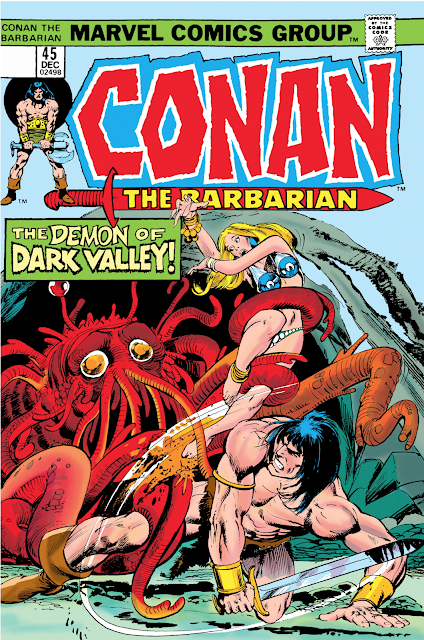
Tentacles on the Cover of
Conan the Barbarian
![]() |
| There were lots of tentacles on the cover of Conan the Barbarian. Here are just two tentacled covers. Top: Conan the Barbarian #32 (Nov. 1973), with cover art by Gil Kane and Ernie Chua. Bottom: Conan the Barbarian #45 (Dec. 1974), with cover art by Gil Kane, Neal Adams, and Crusty Bunkers. Others from the first one hundred issues include #25, #72, and #86. The images here are from Marvel Database, hence the lack of price tags and the cleaned-up images. |

![]() |
| Tentacles are in the current art world as well. Here is a photograph by Rashmi Gill showing the raising of a sculpture called "Witness," created by Shahzia Sikander, in New York City. It's meant to honor a late Supreme Court justice. That's why she's wearing a lace collar. The hair is similar to a Hopi maiden's, but it's more like a pair of goat horns. Some people have called the statue demonic or satanic. It doesn't help that her arms look like the tentacles of the Octopus Woman who is attacking Conan on the cover above. If a male sculptor had done something like this, he would have been excoriated for mutilating the female form. Instead, I guess, this is an expression of grrl power. Notice that the tentacles are connected to her body on both ends. They look like tubes or conduits or spark plug wires. Is she actually a machine? A cyborg? An AI? A transhuman? Is she feeding into herself, reaching into herself? Is she a multi-limbed female version of the worm Ouroboros? On November 17, 2022, I wrote a little about Pete Townshend's Lifehouse project. In James Harvey's illustration, there are tubes or feeds going into the heads of dehumanized masses of people. They look something like the image above. Or maybe these are manifold Fallopian tubes. Could she be fertilizing and impregnating herself? "Witness" is a well-made work. The face, head, and neck are good. But it's also bizarre and antihuman. I guess this is the state of public art in America. We must tear down images of Abraham Lincoln and put up monstrosities like this one as replacements. There will be no end to this of course. Or maybe Weird will end it. |
Original text copyright 2023 Terence E. Hanley
Sunday, June 12, 2022
The Rise of Chaos
I recently read a political opinion piece that makes reference to not one but two tellers of weird tales. It's called "The Woke Have Confused Sword and Sorcery" and it's by Richard Fernandez, a very interesting thinker and writer. Mr. Fernandez begins his essay with a paraphrasing of Robert E. Howard's famous introduction to his Conan series: "Know, O prince, that between the years . . . ", except that in Mr. Fernandez's version, the chronicle is of events that have taken place between the fall of the USSR and our current "rise of Chaos."
The future--now--was supposed to be science-fictional, not weird-fictional. Yet science has given way to superstition and we live at the beginning of a new dark age. Men now use science-fictional or quasi-science-fictional means to pursue their ends, yet superstition reigns. Socialism is one of these superstitions, of course, but in our age socialism has been eclipsed by Wokism. Wokism is a heresy against reality, but we don't yet know how long it will take to run its course, nor how many will have to suffer and die, nor how far our civilization will have to fall before it does. But reality will out. It always does, despite all of our striving against it.
Richard Fernandez writes:
This [the inevitable failure of Woke plans and ideas] is perhaps the reason why our politicians, the modern sorcerers with all the clanking machinery of the End of History at their disposal, are surprised when their confident plans to boost the economy, flatten the pandemic curve and replace nuclear plants with windmills unaccountably take off in unknown directions. The usual explanation is it's not that Woke sorcery has stopped working; it's bad luck.
And then he quotes Robert A. Heinlein:
Throughout history, poverty is the normal condition of man. Advances which permit this norm to be exceeded--here and there, now and then--are the work of an extremely small minority, frequently despised, often condemned, and almost always opposed by all right-thinking people. Whenever this tiny minority is kept from creating, or (as sometimes happens) is driven out of a society, the people then slip back into abject poverty.
This is known as "bad luck."
(The quote is from "Notebooks of Lazarus Long" in Analog Science Fiction/Science Fact, June 1973, page 77, originally in Time Enough for Love, also published in 1973. Happy June to everyone!)
Richard Fernandez writes for a website that is sometimes behind a paywall, even if all you have to pay is your consent to allow advertisements. That's a shame. His writing deserves wider reading. But if you would like to give it a try, look for "The Woke Have Confused Sword and Sorcery" by way of a link on Mr. Fernandez's website, Wretchard.com. His essay is dated May 30, 2022. Since then, he has written about zombies, as we all seemingly must do.
Original text copyright 2022 Terence E. Hanley
Saturday, April 30, 2022
Saturday, January 8, 2022
Readings Over Christmas No. 1-Mention My Name in Atlantis by John Jakes
I read a lot last year. Book No. 51 was Mention My Name in Atlantis by John Jakes (Daw Books, 1972). Mr. Jakes' book is a kind of mock epic. The lead character and narrator is a Falstaffian figure called Hoptor the Vintner. His sometimes sidekick is Conax the Chimerical, king of a land of barbarians. Mention My Name in Atlantis is also a satire and a parody, including of the typical heroic fantasy hero and pulp writing in general. Here is an illustrative passage:
"Pox on your map-makers!" screamed Conax. "Can I help it if those feeble-eyed fops are ignorant? I'd invite them to visit, but the thin-blooded villains would surely freeze their privates the minute they crossed the borders of my noble northern nation!"
"He has florid rhetoric," observed General Pytho. "Rather like the purple phrasing of the tellers of adventure tales, who swap their narratives for a tenth of a zeb a word in the scroll mart." (p. 52)
The story is set in Atlantis and explains what happened to that now sunken continent. In addition to Atlantis, there are other Fortean subjects, namely ancient astronauts, alien abductions, and flying saucers, which are initially interpreted as omens of disaster. (Disaster comes.) All are made continuous with heroic fantasy, a development that seems sure to have irritated purists of both Forteana and Howardiana (if there is such a word). That seems fine to me.
The cover of Mention My Name in Atlantis is by H.J. Bruck (1921-1995), a German-born artist. Bruck included at least two Frazetta swipes in his composition:
Here are the originals:
Look closely. You'll find them. Look closer still and you may find more.
Original text copyright 2022 Terence E. Hanley
Wednesday, December 22, 2021
Otis Adelbert Kline's Family
E. Hoffman Price described the family of his friend and co-author, Otis Adelbert Kline:
First, "Curley"--Mrs. Kline, smooth and lovely and soft-voiced and gracious, her youthful face seeming ever younger because of that prematurely gray hair; "Jimmie"--Ora Fay, the tiny dainty blond daughter; Elinor, the more robust brunette; and "Buster" Allen the son, colored very much like his father. (1)
"Curley" was Ellen H. (Grove) Kline (1890-1987), a native Illinoian born in the same month as H.P. Lovecraft, August 1890. Otis and Ellen were married sometime in the period 1910-1914. Their three children were:
- Elinor Marie Kline Reed, also called Marie, (b. Nov. 24, 1914, Ill.; d. Feb. 25, 1999, presumably in Illinois), a musician who majored in pipe organ at the Chicago Conservatory of Music.
- Allen Paul "Buster" Kline (b. Jan. 28, 1916, Sterling, Ill.; d. Sept. 26, 1999, Escondido, Calif.).
- Ora Fay "Jimmie" Kline Gunckel Rossini Rozar (b. 1918, Rock Falls, Ill.; d. May 29, 2009, Greenwood, S.C.), a U.S. Navy WAVE during World War II--and an airplane mechanic at that!--and an artist, she received an M.F.A. from the Whitney School of Art in New Haven, Connecticut. When her father died in late 1946, she took over his literary agency and helped run it for a year and a half before passing it on to Oscar Friend.
Ora Rozar is in the Internet Speculative Fiction Database (ISFDb). Here are her credits:
- "Notes" in OAK Leaves #1 (Fall 1970, p. 3), in which she discussed her father's life in Connecticut and his death.
- "Notes" in OAK Leaves #2 (Winter 1970-1971, p. 10), in which she discussed her father's literary agency.
- "Notes" in OAK Leaves #4 (Summer 1971, p. 7), in which she discussed life at home in Chicago.
- "Notes" in OAK Leaves #6 (Winter 1971-1972, p. 2), in which she discussed her father's writing, including stories syndicated in the Toronto Star Weekly.
- "Notes" in OAK Leaves #7 (Spring 1972, p. 12), the text of a letter, dated October 31, 1946, in reply to a letter sent by E. Hoffmann Price. In her reply, Ora, or "Jimmie," gave Price details on her father's death.
- "Notes" OAK Leaves #11 (1975, pp. 12-13), in which she offered photographs of her family.
Ora's "Notes" from issue number two is especially interesting:
After my father died, I took over the agency for 1 1/2 years. I had an infant daughter, born 2 months after his death and my then husband [2] was being transferred to Texas. It would have been impossible to take the agency with me. We turned over everything to Oscar Friend, including material published and unpublished, records, files, etc. I do not know what all was there, but I know there was an unpublished Mars novel. Oscar Friend ran the agency under the Otis Kline Associates name, and was to handle all material on behalf of my mother, for future sales of OAK [Otis Adelbert Kline] material. At that time, there was little demand for it. Oscar moved to another place and I suspect disposed of practically all OAK material, records, and files. Later on the space programs, TV science fiction programs, etc., renewed interest in the sf field and consumed fiction too fast. The publishers went back to the older material and published OAK hardcover and paperbacks. As this was going on, Oscar kept asking us to send him books or tear sheets for submission to the publishers on material I know we had already given to him
He kept asking me for an "unpublished novel" which he insisted I had stored away. He had never returned anything to us except contracts of signatures, royalties, and sometimes, complimentary copies.
The enclosed photo [which I used in my biography of Kline, here] was taken at the same time as the 3/4 pose used on the MAZA book jacket. I believe it was 1929; there were no more portrait pictures taken of him, only snapshots.
If Oscar Friend did indeed discard or destroy Kline's files, then we can add that to a list of literary disasters that is entirely too long, especially in regards to popular fiction.
There's something else to consider here, for by operating Otis Kline Associates for one and a half years, from 1946 to about 1948, Ora Rozar was in a line of descent of Robert E. Howard's literary agents. She may not have done much, if anything, with what she had from Howard, but there it is anyway.
One more thing: if Otis Adelbert Kline's co-author on "The Secret Kingdom" was indeed Allen S. Kline, then his co-author was his brother and not his then thirteen-year-old son, Allen P. Kline. Hopefully all of that can be corrected soon on the Internet Speculative Fiction Database.
I have one more entry on Otis Adelbert Kline. I will use that one to close out the year.
Notes
(1) From "Otis Adelbert Kline: Two Memoirs" by E. Hoffman Price in OAK Leaves #1 (Winter 1970-1971), page 3.
[2] I believe this was Ora Fay Kline's second husband, last name Rossini. Ora's daughter was born in December 1946. Ora had previously married Ray Herbert Gunckel, Jr. (1916-1980) on April 9, 1939, in Manhattan. In the 1940 census, they were counted together in Branford, Connecticut. Ray Gunckel was the head of a household that included Otis and Ellen Kline. Ray and Ora were divorced in 1944 in Escambia County, Florida. He remarried on February 23, 1945, in Jacksonville, Florida. His new wife was Blanche Pearl Jones, later Oglesby (1924-2021). She died just two months ago. Ora presumably remarried, too, in the period 1944-1946. She was married again, to Josep James Rozar (1923-2008), on June 4, 1966, in Branford, Connecticut. There are still living Kline descendants. Whatever else might be true, I would call that a happy situation.
Original text copyright 2021, 2023 Terence E. Hanley
Thursday, December 9, 2021
Otis Adelbert Kline (1891-1946)
Laborer, Compositor, Pressman, Salesman, Manufacturing Chemist, Advertising Manager, Songwriter, Music Publisher, Silent Movie Scenarist, Writer of Plots for Skits and Revues, Author, Manuscript Reader, Editor, Literary Agent, Outdoorsman, Orientalist
Born July 1, 1891, Chicago, Illinois
Died October 24, 1946, at home, Short Beach, Connecticut
Otis Adelbert Kline was there at the start. He wrote the first serial published in Weird Tales and worked as a reader of manuscripts for Edwin Baird (1886-1954), the first editor of the magazine. (1) Entitled "The Thing of a Thousand Shapes," Kline's serial appeared in the first two issues of Weird Tales, March and April 1923. It was also his first published story. Kline had three more stories in Weird Tales during that first year and two more in the second. Thereafter he was a occasional contributor from 1927 to 1943, twice with one friend, E. Hoffman Price (1898-1988), and once with another, Frank Belknap Long (1901-1994). In that time, too, Kline's writing career outside of "The Unique Magazine" took off. For a time, he was thought of as a rival of Edgar Rice Burroughs (1875-1950). There were even rumors of a feud between the two.
Otis Adelbert Kline was born on July 1, 1891, in Chicago, Illinois. His father was Louis A. Kline (1864-1938), a farmer, druggist, violin salesman, and chemical manufacturer. According to the Find A Grave website entry on him, Kline the elder was also a member of the Knights Templar and a writer "[m]ostly in favor of Prohibition." Kline's mother was Ora K. (Sides) Kline (1870-1949). The couple were married in 1888. Otis Kline grew up on his parents' farm, which was located west of Chicago, in Coloma Township, Whiteside County, Illinois, along with his younger brother Allen Sides Kline (1893-1971). Kline remembered that his father had "quite a large, well-chosen library." Louis Kline was interested in astronomy. When he was a boy, Kline and his father talked about the possibility of life on other planets. Both read H.G. Wells' War of the Worlds when it came out in 1898. "Perhaps the greatest thrill of all," Kline wrote, "was when Dad and I went together to look through the big telescope at Northwestern University. We had splendid views of Jupiter and Saturn but Mars, which we had wanted chiefly to see, was too low in the mists to be clear." Just as well. Mars should probably remain in the mists for every young and aspiring author of fantasy and science fiction. (2)
In his youth, Kline knocked about the country doing various jobs. He got his first notice in the nation's newspapers by writing songs. He started writing stories for publication after his thirtieth birthday. Weird Tales came along at just the right time. That first year, 1923-1924, was rough for the magazine. It nearly foundered. Edwin Baird left as editor at the end of the first year. Kline took over and edited the jumbo-sized first anniversary issue, dated May-June-July 1924, and wrote, anonymously, the editorial "Why Weird Tales?", which has been reprinted again and again since then. By the time the next issue was published in November 1924, Farnsworth Wright was at the helm.
In the early 1920s, Kline provided a lot of wordage to Weird Tales and other pulp magazines. His story "The Phantom Wolfhound" (Weird Tales, June 1923) introduced Dr. Dorp, an occult detective, and one of Kline's many series characters. Dr. Dorp was also in "The Malignant Entity" (Weird Tales, May/June/July 1924) and "The Radio Ghost" (Amazing Stories, Sept. 1927). Kline also wrote stories of detective Byrd Wright, nicknamed The Ferret, for Detective Tales and Flynn's Detective Weekly; Two-Gun Bart Leslie for Weird Tales, Real Detective Tales, and Young People's Weekly; and a non-fiction filler, "Curious Crimes," for Detective Tales in 1923.
The years 1925-1926 were drought years for Kline as far as Weird Tales was concerned. In its first year, the magazine had paid a penny per word. That rate dropped to 1/2 cent per word in Wright's first couple of years as editor. Once the rate returned to one cent per word, in 1926 or 1927, Kline returned, too. He soon became a star writer for the magazine and was paid 1-1/2 cents per word. In 1931, as Kline lay in the hospital, Bill Sprenger, the business manager of Weird Tales, fronted him $500 for his unfinished serial "Tam, Son of the Tiger." Kline recalled: "I never knew anyone to shoot squarer with a person, than that." (3)
In 1930, Weird Tales instituted a companion magazine, Oriental Stories. The title was changed to The Magic Carpet Magazine in 1933 and ceased publication in January 1934. Kline was there at the beginning of those two titles, too. In fact, he was the only author to have a story in each of the first issues of Weird Tales, Oriental Stories, and The Magic Carpet Magazine. Kline and Hoffman were known as Orientalists. Kline is supposed to have spoken fluent Arabic. Oriental Stories/The Magic Carpet Magazine would have been right up his alley. He contributed eight stories to those titles altogether.
Kline's series character the Dragoman was in Oriental Stories and The Magic Carpet Magazine. There were seven of these, the first being "The Man Who Limped," from the October/November 1930 issue. The last was "The Dragoman's Pilgrimage," from January 1933. Kline's eighth story for that companion magazine to Weird Tales is "The Vengeance of Sa'ik," from December/January 1931.
Otis Kline began selling stories for Robert E. Howard (1906-1936) in 1933 and continued as Howard's agent even after his death in 1936. Kline's agency, Otis Kline Associates, was sold to Oscar J. Friend (1897-1963) after Kline's death. Friend died in 1963 and the agency was dissolved. Only then did Glenn Lord (1931-2011) take over as the literary executor--and champion--of Robert E. Howard. Kline was also an agent for Carl Jacobi (1908-1997), Otto Binder (1911-1974), and Bertrand L. Shurtleff (1897-1967). Binder worked a year for Kline as an assistant in Kline's literary agency in New York City.
Again and again, those who wrote about Otis Adelbert Kline remarked on his tastes for good food, wine, spirits, and tobacco. If he was ever healthy, Kline had become, before aged forty, stricken with ailments. Nonetheless, he was, like E. Hoffman Price, a man of action. Like Price (and Robert A. Heinlein), Kline was a swordsman. He also enjoyed outdoor activities, including fishing, hunting, hiking, boating, swimming, and clamming. He worked mostly as a literary agent beginning in about 1936. In 1936, he moved from Chicago to New York City, then in 1940 to Short Beach, Connecticut. His wife and daughters helped him out in his work. They seem to have been a happy family. Tending over the years towards portliness, Kline suffered a heart attack and a stroke at home and died on October 24, 1946. He was just fifty-five years old. His friend Eric Frank Russell (1905-1978) wrote of him: "A more likeable [sic] individual it would be hard to find. Plump, jovial, generous, he seemed to have hundreds of friends and no enemies." (4)
Otis Adelbert Kline's Essay, Serials, Stories, and Poems in Weird Tales, Oriental Stories, and The Magic Carpet Magazine (All credits listed here are for short stories except where otherwise noted.)
- "The Thing of a Thousand Shapes" in Weird Tales (two-part serial, Mar.-Apr. 1923)
- "The Phantom Wolfhound" in Weird Tales (June 1923)-Dr. Dorp
- "The Corpse on the Third Slab" in Weird Tales (July/Aug. 1923)
- "The Cup of Blood" in Weird Tales (Sept. 1923; reprinted June 1935)
- "The Malignant Entity" in Weird Tales (May/June/July 1924; reprinted in Amazing Stories, June 1926)-Dr. Dorp
- "Why Weird Tales?" in Weird Tales (also attributed to Edwin Baird) (essay; May/June/July 1924)
- "The Phantom Rider" in Weird Tales (Nov. 1924)
- "The Bride of Osiris" in Weird Tales (three-part serial, Aug.-Sept.-Oct. 1927)
- "The Demon of Tlaxpam" in Weird Tales (Jan. 1929)-Two-Gun Bart Leslie
- "But Was It?" in Weird Tales (poem; Sept. 1929)
- "The Bird-People" in Weird Tales (Jan. 1930)
- "Thirsty Blades" with E. Hoffman Price in Weird Tales (Feb. 1930)-Ismeddin
- "The Man Who Limped" in Oriental Stories (Oct./Nov. 1930)-The Dragoman
- "The Vengeance of Sa'ik" in Oriental Stories (Dec. 1930/Jan. 1931)
- "The Dragoman's Revenge" in Oriental Stories (Feb./Mar. 1931)-The Dragoman
- "The Dragoman's Secret" in Oriental Stories (Apr./May/June 1931)-The Dragoman
- "The Dragoman's Slave Girl" in Oriental Stories (Summer 1931)-The Dragoman
- "Tam, Son of the Tiger" in Weird Tales (six-part serial, June/July through Dec. 1931)
- "The Dragoman's Jest" in Oriental Stories; with E. Hoffman Price (Winter 1932)-The Dragoman
- "The Dragoman's Confession" in Oriental Stories (Summer 1932)-The Dragoman
- "The Gallows Tree" in Weird Tales (poem; Feb. 1932)
- "Midnight Madness" in Weird Tales (Apr. 1932)
- "Buccaneers of Venus" in Weird Tales (six-part serial, Nov. 1932 through Apr. 1933)
- "The Dragoman's Pilgrimage" in The Magic Carpet Magazine (Jan. 1933)-The Dragoman
- "Lord of the Lamia" in Weird Tales (three-part serial, Mar.-Apr.-May 1935)
- "The Cyclops of Xoatl" with E. Hoffman Price in Weird Tales (Dec. 1936)-Two-Gun Bart Leslie
- "Spotted Satan" with E. Hoffman Price in Weird Tales (Jan. 1940)
- "Return of the Undead" with Frank Belknap Long in Weird Tales (July 1943)
Further Reading
- The Compleat OAK Leaves: The Official Journal of Otis Adelbert Kline and His Works, edited by David Anthony Kraft (Clayton, GA: Fictioneer Books, 1980).
- Book of the Dead: Friends of Yesteryear: Fictioneers & Others by E. Hoffman Price (Arkham House, 2001).
(1) Farnsworth Wright (1888-1940) was also one of Baird's readers.
(2) From "Reflections" by Otis Adelbert Kline, in OAK Leaves #11 (1975), pp. 3-4.
(3) Kline, in a letter to Dr. I.M. Howard, April 1, 1941, reprinted in OAK Leaves #1 (Fall 1970), p. 7.
(4) Quoted in "Otis A. Kline Dead," originally in The Fantasy Review, reprinted in OAK Leaves #1 (Fall 1970), p. 12.
Next: Otis Adelbert Kline-Three Questions
| Otis Adelbert Kline (1891-1946). |
Revised and omissions corrected on December 11, 2021.
Original text copyright 2021, 2023 Terence E. Hanley
Friday, January 18, 2019
Viking Adventure
![]() |
| Zebra reprinted Eric Brighteyes in 1982 with different cover art, but the artist is again unknown. |
![]() |
| There were Westerns in the pulps, but there were also Northerns, if you want to call them that, but Northerns are not about Vikings. Instead, they're about what Bob and Doug McKenzie call the Great White North. In the pulp magazine North-West Stories (later North-West Romances), these two genres lived side by side. Here is an example of the cover, from the Winter issue of 1950, showing a sort-of Betty Hutton lookalike with her parka conveniently undone and her sweater conveniently tight. This was the 1950s after all, the era of the sweater girl. Anyway, if this were a Weird Tales cover, it would fall into the category of "Woman and Wolf" (click here). The title story in fact is called "The Wolf-Woman of Chandindu," by C. Hall Thompson, who also, as chance would have it, contributed to Weird Tales. More evidence that all things form circles. |


