Showing posts with label Weird Tales in 1923. Show all posts

Sunday, July 28, 2024

R.M. Mally & the Misattributed Cover

When I started writing this blog in 2011, one of my beginning sources was The Collector's Index to Weird Tales, written and compiled by Sheldon R. Jaffery and Fred Cook and published in 1985 by Bowling Green State University Popular Press. It's an indispensable book and the result of some real yeomanlike work. If you doubt that, consider sitting in a library, before there was an Internet, and making long lists from 279 issues and thousands of pages of a magazine that may very well have crumbled a little bit more every time you touched it. Even so, there are errors in the book. One of them involves a cover created by an artist that Jaffery and Cook called "Washburn." That cover was for the November 1923 issue of Weird Tales. We now know the real artist's name to have been R.M. Mally.

In this blog, I have perpetuated Jaffery and Cook's error. I'm in the process of correcting my errors. I believe it was a reader named Jean-Yves Freyburger of l'Île-de-France who pointed out my error to me. On December 13, 2014, I posted an entry called "Ghosts on the Cover of Weird Tales" in which I misattributed the authorship of Mally's cover to the presumably nonexistent Washburn. Jean-Yves wrote two comments, the first on September 15, 2023, the second on November 21, 2023. In his second comment, Jean-Yves referenced his post on Facebook under a group heading called "Pulp Magazines Imagination." He posted his message and images on October 7, 2023, in between his two messages posted on this blog. You can see what he posted by clicking on the following URL:

https://www.facebook.com/groups/pulpsmagazines/permalink/1063225801286581/?mibextid=oMANbw

Jean-Yves was kind enough to post nine images. In his second image, a close-up of the upper righthand corner of the November 1923 cover of Weird Tales, you can clearly see the artist's last name: Mally. I believe Jean-Yves received those images from David Saunders, who writes about pulp artists on his blog Field Guide to Wild American Pulp Artists. Mr. Saunders' entry on Mally is at the following URL:

https://www.pulpartists.com/Mally.html

In that entry, David Saunders identifies R.M. Mally as George William Mally (1892-1971). Even so, there is the question of the initials and Mally's use of a seal or cartouche below his signature. Mr. Saunders has identified that seal as containing the initials of Mally's wife, Ruth Lena Mikelson Mally (1896-1977). "R.M. Mally," then, would seem to be the initials of Mally's wife, in which case, we should consider the possibility that she was the artist, or that they were collaborators. David Saunders brings up that possibility as well, but I believe I read about it somewhere before he posted his biography of Mally, which has a copyright notice of 2023. Now we should go back in time again.

On June 9, 2013, Weird Tales scholar Randal A. Everts wrote to me asking my opinion of his supposition that Mally the Weird Tales artist was George William Mally of Chicago. He had received a message from Mally's granddaughter, who had consulted her own father, Mally's son, before responding. In reference to her grandfather, she wrote: "While he did live and work in Chicago his whole life, and was an artist, we don't think he is the person you are looking for. His work was mostly watercolors of farm or landscape scenes, with some oil portraits and etching of bridges." Based on the evidence, I expressed an opinion to Mr. Everts that George William Mally was not R.M. Mally. The difference in the initials alone would have argued against the idea. However, I did point out Mally's use of a seal or cartouche below the signature (I called it a "doo-dad"), writing that, if we knew what it says, "[i]t might offer a clue." In any case, if David Saunders is correct, then Randal Everts was correct before him, ten years before him in fact. That's nothing at all against Mr. Saunders, but I believe Mr. Everts deserves every credit for being the first (apparently) to solve the mystery of who was R.M. Mally. And I regret expressing my opinion that George M. Mally probably was not R.M Mally. I also regret, though I had nothing to do with it, that Mally's family seems not to have known that George W. Mally created covers for Weird Tales.

That still leaves open the question of Ruth M. Mally's involvement in the creation of those covers of 1923-1924. If she was in fact an artist--or the artist--then she was the first woman cover artist for "The Unique Magazine" and possibly one of the first--if not the first--for any pulp magazine. And I guess if she was the artist, I was right after all. But I take no pleasure in that.

The Mallys were young at the time they created their covers, George in his early thirties, Ruth in her late twenties. As an artist myself, I recognize the signs of a young, inexperienced, or untrained artist at work. The draftsmanship in Mally's cover, shown below, isn't firm, to be sure. There's barely enough torso under the man's coat to make him a fully normal human. The skeleton in the foreground is also not very well made. "Untrained" might be the operative word here, in which case we might conclude that Ruth Mally really was the artist. Maybe she created some of their covers, maybe her husband created some, and maybe sometimes they worked together. Or maybe as a commercial artist, he received the assignment and simply passed it on to her. By the way, there was a precedent for an artist's code placed below the artist's signatures: when Fontaine Fox, creator of Toonerville Folks, signed his work, he underlined his signature, sometimes a lot, sometimes with only a few lines. The more lines that appeared under his name, the more it was his own work rather than the work of his assistant.

Before closing, I should point out that there was a writer for Weird Tales named Kirk Mashburn. I wonder if Jaffery and Cook got their notes mixed up somehow, and on top of that, turned an M into a W. Another mystery.

I would like to thank Jean-Yves Freyburger for his contribution, but I would also like to thank Randal A. Everts for his own yeomanlike work over the last several decades in uncovering and discovering the authors and artists who contributed to Weird Tales, as well as for all of his contributions to this blog and to my understanding of the magazine. If you're reading, Mr. Everts, I would like to hear from you again.

Original text copyright 2024 Terence E. Hanley

Sunday, June 30, 2024

Harry Houdini & Psychical Research

"The Thing of a Thousand Shapes," written by Otis Adelbert Kline, was the first serial to appear in Weird Tales. Part one was in the first issue, dated March 1923. Part two followed in April of that year. At the opening of part one, the narrator learns that his uncle has died. That would make "The Thing of a Thousand Shapes" the first "Uncle story" in Weird Tales. You might question whether the "Uncle story" was or is actually a thing, but I'm pretty sure that it is. I remember when we were kids watching and enjoying a movie called Let's Kill Uncle (1966), with Nigel Green in the title role. A Thousand Clowns (1965) starring Jason Robards and Barry Gordon, may also be an Uncle story. Maybe what we need is an Internet Uncle Story Database (IUSDb).

The narrator of Kline's story lets us know that his Uncle Jim was involved in researching psychic phenomena. He was a member of the London Society for Psychical Research and its American counterpart. Both were real organizations. The London society was formed in 1882, the American Society for Psychical Research in 1884. In "The Thing of a Thousand Shapes," there is a séance, some automatic writing, and a lot of ectoplasm flying, flowing, and oozing through the room. These elements of spiritualism appear in earnest in the story, although, to his credit, Kline didn't exactly fall for spiritualism. Instead he proposed a materialistic or naturalistic explanation for all of its elements. He also placed everything under God, and so nothing under God can be called supernatural. To call anything under God supernatural would of course be an oxymoron.

Kline had stories in several issues in Weird Tales over the next year. He wrote the essay "Why Weird Tales?" for the first anniversary number of May/June/July 1924. He probably also edited (or co-edited) that issue. After a little more than a year, Kline seems to have begun changing his tune when it came to spiritualism and psychic phenomena. Here is the opening text from his Dr. Dorp story "The Malignant Entity" (Weird Tales, May/June/July 1924):

     "I TELL you, Evans," said Dr. Dorp, banging his fist on the arm of his chair for emphasis, "the science of psychology is in much the same stage of development today as were the material sciences in the dark ages."

     "But surely," I objected, "the two centuries of investigation just past have yielded some fruit. It cannot be that the eminent men who have devoted the greater part of their lives to this fascinating subject have labored in vain." 

     The doctor stroked his iron-gray Van Dyke meditatively.

     "With a few--a very few exceptions, I'm afraid they have," he replied, "at least so far as their own deductions from observed phenomena are concerned."

     "Take Sir Oliver Lodge, for example--" I began. 

     "The conclusions of Sir Oliver will serve as an excellent example for my analogy," said the doctor. "No doubt you are familiar with the results of his years of painstaking psychical research as expounded in his books."

     "I believe he has become a convert to spiritism," I replied. 

     "With all due respect to Sir Oliver," said the doctor, "I should say that he has rather singled out such facts as suited his purpose and assembled them as evidence to support the spiritistic theory. It may seem paradoxical to add that I believe he has always been thoroughly conscientious in his investigations and sincere in his deductions."

     "I'm afraid I do not quite follow you."

     "There are times in the life of every man," continued the doctor, "when emotion dethrones reason. At such a crisis the most keen-witted of scientists may be blinded to truth by the overpowering influence of his own desires. Sir Oliver lost a beloved son. Only those who have suffered similar losses can appreciate the keen anguish that followed his bereavement, or sympathize with his intense longing to communicate with Raymond. Most men are creatures of their desires. They believe what they want to believe. Under the circumstances it was not difficult for a clever psychic to read the mind of the scientist and tell him the things he wanted to hear."

     "But what of the many investigators who have not been similarly influenced?" I inquired. "Surely they must have found some basis--" 

     I was interrupted by the entrance of the doctor's housekeeper who announced--"

Poor Oliver Lodge. But then nobody made him or people like him try to force their beliefs onto the world. Kline could just as easily have been writing about Arthur Conan Doyle, who also lost a son and who also, seemingly, let his feelings get in the way of his proper thinking.

So in 1923, Kline included some of the trappings of spiritualism in his first story, but by mid 1924, he seems to have become more skeptical of the whole business--if Dr. Dorp was saying what Kline wanted him to say, that is. So what happened in the interim? Maybe Kline fell under the influence of Harry Houdini, who signed his agreement with Weird Tales magazine in February 1924 and who busied himself in and out of its pages with busting psychic mediums and debunking the claims of believers in spiritualism. I have suggested that Kline, as the probable author of nonfictional fillers in Weird Tales, borrowed The Terrific Register; or, Record of Crimes, Judgements, Providences, and Calamities (two volumes, 1825) from Houdini, who is known to have had a vast library. I have also suggested that Kline was the ghostwriter behind "The Spirit Fakers of Hermannstadt," published under Houdini's byline in Weird Tales in March and April 1924. It's clear that Kline was intelligent and widely read. Maybe he saw the wisdom in Houdini's point of view. And maybe the London Society for Psychical Research saw it, too (or came to see things the same way anyway, independently of Houdini), for in 1930, there was a split in its numbers. Arthur Conan Doyle left that year. Others may have also. I can't say for sure, as I haven't looked into this business very closely. And I don't really want to, for spiritualism and its related psychic or parapsychological phenomena are so thoroughly uninteresting to me, being as they are completely ungrounded in fact or reality, and dripping, as they are, with lying, ignorance, gullibility, whining, special pleading, shabbiness, and so on. There are other, more interesting frauds and scams at work in the world. If you have only so much time to read about such things, you should choose the ones that interest you.

On November 18, 1922, Scientific American announced that it would pay $2,000 to anyone who could take a spirit photograph under test conditions and $2,500 to any medium who could produce physical effects from supposed spirits, again under test conditions or controlled conditions. (See Houdini: The Man Who Walked Through Walls by William Lindsay Gresham [McFadden, 1961], p. 201.) Houdini put up $5,000 of his own money for similar purposes. Scientific American formed its Committee for Psychical Investigations, a name similar to but not to be confused with those of the London Society for Psychical Investigations and its American counterpart. At some point, Houdini became a member of that committee. And when his tour of the vaudeville stage ended in February 1924, he went out on a new lecture tour designed to talk about and expose fraudulent mediums. I'm pretty sure he was involved with Scientific American and its investigations for several months, possibly a year or more, around that time.

Houdini's stories and his letters column in Weird Tales, "Ask Houdini," coincided with his lecture tour that spring. In May 1924, his book, A Magician Among the Spirits, written on the same subject, was published. And that summer, Houdini exposed a psychic medium known as "Margery," real name Mina Crandon, of Boston, as a fraud. Houdini's investigation of Mina Crandon forms a major episode in his many biographies.

There had been plenty of that before and there would be still more to come for Houdini. Looking back on all of this, I have the impression that spiritualism in America was in decline by the mid to late 1920s. The lesson in all of it might have been: Don't mess with Houdini. By the way, there may have been some Houdini-adjacent content in the February 1924 issue of Weird Tales in the form of a nonfiction filler entitled "Woman Fails to Win Psychic Prize." That item, on page 74, is about the Reverend Mrs. Josi K. Stewart of Cleveland, Ohio, whom Scientific American had shot down the previous October. She wanted the prize. She went home with nothing, perhaps not even a lovely parting gift. Was Otis Adelbert Kline the anonymous author of that brief article? Maybe. And here's another by-the-way: Scientific American is currently involved in another fraud and scam, in this case transgenderism. The problem this time is that the magazine is on the same side as the fraudsters and scammers, the people who are trying their best to harm children. Shame on them and everyone who believes as they do. We can only hope that Scientific American goes down the tubes as a result of this and so many other bogus and idiotic ideas that they hold and have tried to promulgate in the world.

Weird Tales in 1923-1924 is full of content about spiritualism, psychic mediums, séances, spirits, psychic phenomena, automatic writing, ectoplasm, and so on. In the first half of 1924, the Great Houdini addressed those things in his "Ask Houdini" column and in his three ghostwritten stories. The kind of research I'm doing right now on spiritualism and psychic phenomena in Weird Tales could go on and on. But I'm getting close to the end of this series on Harry Houdini. I have one more part to go. Then it will be on to other things.

Original text copyright 2024 Terence E. Hanley

Wednesday, June 26, 2024

Weird Fiction versus Spiritualism

I have written before that Weird Tales was the first magazine in America devoted to fantasy fiction. Now that I have read whole issues and many individual stories from the first year and more of the magazine, I find that not to be true. Or if it is true, it wasn't true until there was an entire issue of Weird Tales devoted exclusively to fantasy fiction. In other words, every story in a given issue would have to be a fantasy of one kind or another for Weird Tales to have been the first fantasy magazine in America. And when did that happen? I'm not sure. I would have to keep reading.

As we have seen, weird fiction is not necessarily fantastic: weird is in the real world and in our lives. It is at work in both. Nothing supernatural, nothing based in fantasy need happen for it to be weird. So maybe Amazing Stories, which made its debut in April 1926, was the first American magazine devoted to fantasy, science fiction being a sub-genre in the larger and vaguely defined genre of fantasy. But that's assuming there wasn't a whole issue of fantasy fiction in Weird Tales between March 1923 and March 1926. That seems like a tall order, but it would take a lot of reading to confirm or deny the notion. I'm not there yet.

Weird fiction is about the past. I have lumped it with the other more conservative genres of romance, supernatural horror, adventure, historical fiction, and so on. Science fiction may stand alone as the only progressive genre, although not all science fiction is progressive. There is, after all, conservative science fiction, too. In recent decades, authors have tried to make weird fiction more progressive. I'll leave it to others to decide whether that works. I can't imagine, though, rooting for or sympathizing with a protagonist who is engaged in a Marxist struggle against his hated bourgeoisie, or who wishes to silence and oppress, if not murder, Jews or Christians or women (the original kind) or anyone else who disagrees with him, or who believes that we can and must save children from harm by cutting off their breasts and genitals, or on and on through the parade of horrible, naïve, or just plain idiotic ideas that make up progressivism. Edgar Allan Poe wrote from the viewpoint of men living in pathological states of mind, but I don't think we're supposed to identify with mad Montresor or the unnamed narrator of "The Tell-Tale Heart." Besides that, those two characters and others like them have only murder on their minds. They're not trying to lay waste to the past, or impose totalitarian systems upon the earth, or bring about an end to history. There isn't any ideological motivation behind their actions.

It's hard for us to imagine now just how close to the Victorian era was Weird Tales at its inception. We picture pulp fiction as part of the fast-talking, fast-moving culture of the 1930s and '40s. And yet, in 1923, there were still vast holdovers from the previous century and the pre-war era: twentieth-century America was still living in many of its old forms and not yet aware of all of its new ones.* Spiritualism was one of those old forms, a holdover from a previous time, not yet aware that it was itself as dead as its subjects, as dead as the concept in physics of the luminiferous ether. That concept was slain by Albert Einstein as well as by anybody. Maybe its date of death was in 1919, the same year in which J.C. Henneberger (a Victorian figure in his own right) arrived in Indianapolis, soon to issue, with his business partner, first, Detective Tales, then, in March 1923, Weird Tales.

But wait, you might say, you just said that weird fiction is about the past. Wasn't the nineteenth century part of that past?

The answer is, of course, Yes. But weird and an awareness of weird are older still. Spiritualism is comparatively new. You might even call it an innovation. It was certainly an outgrowth of nineteenth-century culture, which was, truth be told, very closely interested in science and the idea of progress. Weird lives apart from technology; spiritualism is tied to it. Spirit photography is as good an example of that as anything, but how many stories based in spiritualism have you read that include some scientific or technological means for detecting, proving the existence of, or even dispelling spirits? William Hope Hodgson's stories of Carnacki the Ghost-Finder are full of gadgets. There are also ghost-finding gadgets in early stories in Weird Tales, including in Otis Adelbert Kline's adventures of Dr. Dorp. We still see that kind of thing in the instruments that contemporary ghost-hunters use. Employing material instrumentation to find something that is supposedly not material at all--they are spirits after all--hardly makes sense, but here we are.

Spiritualism and all of its trappings were in early stories in Weird Tales. The first story to appear in the magazine, "The Dead Man's Tale" by Willard Hawkins, and the first serial, "The Thing of a Thousand Shapes" by Otis Adelbert Kline, both include elements of spiritualism. Hawkins' story is in fact a transcription from the dead, made possible only by automatic writing, the same trick that Arthur Conan Doyle and his wife tried to play on Harry Houdini in 1922. But spiritualism didn't have any legs and soon grew tired. There was going to have to be something else to take its place if Weird Tales was going to go very far in its field. I think an awareness of weird--weird, which predated spiritualism by more than a millennium--would do. So would H.P. Lovecraft's brand of cosmic horror or science fantasy, a twentieth-century--or at its earliest a nineteenth-century--development. I don't know whether Houdini helped to make spiritualism go away, but he sure didn't hurt the cause.**

Houdini's stance against spiritualism, mediums, séances, and so forth also goes against the premises of so many early Weird Tales stories. Like I wrote the other day, he was not a natural fit for the magazine. Readers loved their spirits and their séances. Witness the letters published in "Ask Houdini." But maybe we should look at him and his presence in another way. In old Westerns, the new sheriff comes into town ("The new sheriff is near!") and says to the bad guys, "This town ain't big enough for the both of us." They had to ride out, either on their horses or in a hearse. Either the boondocks or Boot Hill would be their destination. So maybe Houdini was like that sheriff, saying, in effect, weird fiction can have either spiritualism or something better, but it can't and shouldn't have both. And it can't have both me and spiritualism. Not that Houdini laid down any kind of ultimatum. Not that Houdini and Weird Tales parted ways because of any conflict or difference of opinion on these things. (I think it more likely that their arrangement simply fell apart as the magazine did at about this time of year, one century past.) It's just that there were two opposing world-views, and, in competition with each other, the superior world-view won and spiritualism was shown the door. Readers and writers still hung on to spiritualism for a long time to come--there are trappings of spiritualism in Weird Tales as late as 1938 when Manly Wade Wellman's three-part serial "The Hairy Ones Shall Dance" was published in the magazine. (Published under his pseudonym Gans T. Field, "The Hairy Ones Shall Dance" was in the January through March issues of 1938.) But if spiritualism was already worn out and creaky in 1923, it was way worn out, and creakier still, fifteen years later. Wellman's including elements of spiritualism in his story actually weakens it in my mind. It also shows him as not yet having matured as a writer or a thinker. In any case, I'm not sure that any writer or reader of weird fiction today would countenance the whole business. Leave spiritualism to TV ghost-hunters and their gadgets. Let us instead have weird in our weird fiction.

-----

*In 1923, the most recent winners of the Pulitzer Prize for fiction were Edith Wharton, born in 1862, and Booth Tarkington, born in 1869.

**Another weakness of spiritualism is that it can work only in small, dark, and enclosed spaces, the natural habitat of the psychic medium, without whom none of it is possible. Weird works everywhere and all the time, even--by way of cosmic thinking not easily attained before the twentieth century--into the vast physical universe, all the way to the most distant and trackless stars. And of course it works for everyone. You might say that spiritualism, requiring a medium, is elitist, while weird is thoroughly democratic. In spiritualism there are experts.*** Weird can happen to anybody, no intermediary needed.

***And now here's a note to my note. It occurs to me now that pulp-era spiritualism and technocracy may have run on parallel tracks, even if they weren't connected at all. The proto- and early science fiction of that same era may have been more closely technocratic than was spiritualism. A return to weird and the creation of weird fiction, then, may have been a reaction to nineteenth-century science and progress, reaction being characteristic of certain brands of conservatism.
 
Technocracy has to do with gadgetry and technology-based processes, of course, but the key ingredient in technocracy is the expert, the one who knows and the one to whom we are to defer. (Maybe in that respect, technocracy is a kind of gnosticism.) In spiritualism, the expert is the medium or the psychic investigator. In technocracy (or bureaucracy), the technocrat is the expert. In either case, the expert is unassailable. In any system based on expertism (my new word), questioning the expert is verboten. Skepticism, let alone criticism, is not permitted. So: the coronavirus is naturally zoonotic. It came from a wet market in China. It did not escape from a laboratory. It certainly wasn't manufactured. Vaccines are safe and effective. They prevent disease. You must receive at least one if you are to be safe and to keep others safe. Masking, six-foot distancing, lockdowns, and wiping down your groceries and mail work. They prevent the transmission of disease. Ivermectin and hydroxychloroquine are not effective against coronavirus. They are quack treatments. Only patented medicines work. (At this point, maybe we can call them--all of those things that are called vaccines--patent medicines instead. By the way, the spellchecker in Blogger doesn't even like the word hydroxychloroquine. That might just be a coincidence, but it could also indicate that we are not even to speak its name.) You may not question the experts on any of this. If you do, you're a xenophobe, a terrorist, an insurrectionist, a science-denier.

Now, an aside, an aside inside of a note to a note to a main article from which we are so far away that I can barely see it anymore: the concept of the expert might be related to the concept of the superhero or the superior man. Taken a little further, it might be related to the leader of a cult or to the cult of personality. Science fiction during the Golden Age of the 1930s and '40s, specifically the science fiction of John W. Campbell, Jr., and Astounding Science-Fiction, was caught up in the superhero/superior man idea. Very often, the powers of the superior man are psychic rather than physical. "Slan," by A. E. van Vogt, serialized in Astounding Science-Fiction in September-December 1940, is an example of a story about the psychic-superior man in science fiction. And we should remember that Campbell, reputed to be an exemplar of hard science fiction, began his career in college as a psychic investigator. I'm not sure that he moved very far beyond that, even late in life.

To return to the original topic, if spiritualism and technocratic or bureaucratic expertism have anything in common, it's that they don't and can't stand up to scrutiny. They can't stand the light of day and can operate only in the dark. And with spiritualism, it is literally only in the dark that it can operate. Anyway, the spiritualism craze and the technocracy craze ended a long time ago, but like TV ghost-hunting, technocracy and the cult of the expert are still with us. By the way, the advent of technocracy in America is dated to--guess when--1919.

Copyright 2024 Terence E. Hanley

Tuesday, January 16, 2024

Weird Tales: The First 13 Issues

From March 1923 to May/June/July 1924, The Rural Publishing Corporation of Chicago and Indianapolis published thirteen issues of its new magazine, Weird Tales. There was one bimonthly issue during that time, July/August 1923, and one month with no issue at all, December 1923. Weird Tales was otherwise a monthly magazine until the thirteenth issue, which did triple duty, covering May through July 1924. Then came a hiatus and reorganization, which ended with the issue of November 1924 and Farnsworth Wright brought on as the new editor.

The publishers of Weird Tales in that first year and more were Jacob Clark Henneberger and John M. Lansinger. The editor of the first twelve issues was Edwin Baird. A recent exchange of comments and some research seems to have established that Baird, Wright, and Otis Adelbert Kline were involved in the editorship of the thirteenth issue. See the comments in the previous posting to learn more.

Following is a summary of Weird Tales during its first year and more.

Weird Tales, March 1923 (Vol. 1, No. 1)--Whole Number 1
Cover story: "Ooze" by Anthony M. Rud.
Cover art by Richard R. Epperly; no interior illustrations.
192 pages
26 stories, plus non-fiction fillers and "The Eyrie"
First stories by Anthony M. Rud, Otis Adelbert Kline, Farnsworth Wright.

Weird Tales, April 1923 (Vol. 1, No. 2)--Whole Number 2
Cover story: Presumably "The Whispering Thing" by Laurie McClintock & Culpeper Chunn.
Cover art by R.M. Mally; no interior illustrations.
192 pages
21 stories, plus non-fiction fillers and "The Eyrie"

Weird Tales, May 1923 (Vol. 1, No. 3)--Whole Number 3
Cover story: None. (The cover is partly a swipe from an older illustration.)
Cover art by William F. Heitman; interior illustrations by Heitman.
120 pages
21 stories, plus non-fiction fillers and "The Eyrie"
First story by Vincent Starrett; first weird fiction reprint, by Edward Bulwer-Lytton.

Weird Tales, June 1923 (Vol. 1, No. 4)--Whole Number 4
Cover story: "The Murders in the Rue Morgue" by Edgar Allan Poe.
Cover art by William F. Heitmaninterior illustrations by Heitman.
120 pages
21 stories, plus non-fiction fillers, "The Eyrie," and "The Cauldron"
First story by Edgar Allan Poe.

Weird Tales, July/August 1923 (Vol. 2, No. 1)--Whole Number 5
Cover story: Presumably "Sunfire" by Francis Stevens (Gertrude Barrows Bennett).
Cover art by R.M. Mallyinterior illustrations by Heitman.
96 pages
16 stories, 1 essay, and two poems, plus non-fiction fillers, "The Eyrie," and "The Cauldron"
First verse in Weird Tales, two poems by Clark Ashton Smith, his first works for the magazine.

Weird Tales, September 1923 (Vol. 2, No. 2)--Whole Number 6
Cover story: Presumably "People of the Comet" by Austin Hall.
Cover art by R.M. Mallyinterior illustrations by Heitman.
96 pages
16 stories and 1 essay, plus non-fiction fillers, "The Eyrie," and "The Cauldron"
First and only story by Ambrose Bierce. First letter by H.P. Lovecraft.

Weird Tales, October 1923 (Vol. 2, No. 3)--Whole Number 7
Cover story: "The Amazing Adventure of Joe Scranton" by Effie W. Fifield.
Cover art by R.M. Mallyinterior illustrations by Heitman.
96 pages
14 stories, plus non-fiction fillers, "The Eyrie," "The Cauldron," and "Weird Crimes"
First stories by H.P. Lovecraft and Frank Owen; first work, an essay, by Seabury Quinn.

Weird Tales, November 1923 (Vol. 2, No. 4)--Whole Number 8
Cover story: "The Closed Room" by Maybelle McCalment.
Cover art by R.M. Mally, misattributed to Washburninterior illustrations by Heitman.
96 pages
17 stories, plus non-fiction fillers, "The Eyrie," and "Weird Crimes"

Weird Tales, January 1924 (Vol. 3, No. 1)--Whole Number 9
Cover story: None.
Cover art by R.M. Mallyinterior illustrations by Heitman.
96 pages
14 stories, plus three poems, non-fiction fillers, "The Eyrie," and "Weird Crimes"

Weird Tales, February 1924 (Vol. 3, No. 2)--Whole Number 10
Cover story: None.
Cover art by R.M. Mallyinterior illustrations by Heitman.
96 pages
16 stories, plus one poem, non-fiction fillers, "The Eyrie," and "Weird Crimes"
First poem by a woman, Mary Sharon.

Weird Tales, March 1924 (Vol. 3, No. 3)--Whole Number 11
Cover story: "The Spirit Fakers of Hermannstadt" by Harry Houdini.
Cover art by R.M. Mallyinterior illustrations by Heitman.
96 pages
17 stories, plus one poem, non-fiction fillers, "The Eyrie," and "Weird Crimes"
First stories by Harry Houdini and C.M. Eddy, Jr.

Weird Tales, April 1924 (Vol. 3, No. 4)--Whole Number 12
Cover story: "The Hoax of the Spirit Lover" by Harry Houdini.
Cover art by R.M. Mallyinterior illustrations by Heitman.
96 pages
18 stories, plus one poem, non-fiction fillers, "The Eyrie," and "Weird Crimes"
First poem by H.P. Lovecraft within the contents of the magazine.

Weird Tales, May/June/July 1924 (Vol. 4, No. 2)--Whole Number 13
Cover story: "Imprisoned with the Pharaohs" by Harry Houdini.
Cover art by R.M. Mallyinterior illustrations by Heitman.
192 pages
37 stories, plus the essay "Why Weird Tales?", non-fiction fillers, "Ask Houdini," and "Weird Crimes"
First story by Henry S. Whitehead.

Some notes: First, the number of pages shown here is for interior pages only. Second, the count that I have here for stories, poems, and essays is my own. If you see any mistakes, let me know and I will correct them. Third, I'm not sure about some of the cover illustrations, thus the qualifier "presumably." Fourth, there wasn't any Volume 4, Number 1. Fifth, the issues in that first year and more were otherwise gathered into three volumes of four issues each.

I wanted to make this list mostly to compare these thirteen issues, particularly the number of interior pages and the number of stories in each. As you can see, the first two issues were pretty close in that regard. The next two can also be taken as a pair. Then came eight issues with 96 pages each. I have been calling the May/June/July issue of 1924 a jumbo-sized issue, but it's not really when you compare it to the first two. All three of these issues contain 192 pages. The triple-issue, though, has thirty-seven stories in all, plus an essay, non-fiction fillers, and two features. Not counting non-fiction fillers, that's about half again as many items as in the first issue.

Although it came along in May/June/July 1924, more than a year after the magazine began, the triple issue of Weird Tales was called on the cover "Anniversary Number." That was the first of many observances of anniversaries in the one hundred years plus one of Weird Tales. The most recent issue of Weird Tales also observes an anniversary on its cover. I'd like to write about that issue next.

Text copyright 2024 Terence E. Hanley

Saturday, January 6, 2024

Weird Tales in the First Year (and More)

A century ago, in January 1924, Weird Tales was still in its first year of publication. The magazine had begun in March 1923. There were issues published in almost every month following that one, from April 1923 to May/June/July 1924. There were two exceptions: one, a bimonthly issue of July/August 1923, the other, no issue at all in December 1923. That makes thirteen issues in all in the first year and more of "The Unique Magazine." Unlucky thirteen.

Those thirteen issues can be taken together because all were published by The Rural Publishing Corporation of Chicago and Indianapolis under its two founders, J.C. Henneberger (1890-1969) and John M. Lansinger (1892-1963). Twelve of the first thirteen were without a doubt edited by Edwin Baird (1886-1954). The last, the jumbo-sized triple issue of May/June/July 1924, was edited by Baird or some combination of Baird, Henneberger, Farnsworth Wright (1888-1940), and/or Otis Adelbert Kline (1891-1946). (See the comments below.)

By the end of that first year and more, Weird Tales and The Rural Publishing Corporation were in trouble. That's a story for another day. Suffice it to say, Henneberger gave up Detective Tales after its issue of April 1924 but kept his Weird Tales property. The editor Baird went with Detective Tales, which became Real Detective Tales in April 1924. From May 1924 onward, that magazine was published by Real Detective Tales, Inc., of Chicago. Baird's departure explains the now uncertain editorship of that first-anniversary issue. (Thanks to The FictionMags Index for pertinent facts on Detective Tales/Real Detective Tales.)

The first year and more of Weird Tales was also characterized by the employment of just three cover artists, Richard R. Epperly (1891-1973) for the first issue, William F. Heitman (1878-1945) for the issues of May and June 1923, and R.M. Mally (dates unknown) for all the rest. The November 1923 issue is attributed to an artist supposedly named Washburn. We now know that Mally was the cover artist for that issue, too. I plan to write about the case of the misattributed cover within the next few weeks.

After a gap of three months, from August to October 1924, Weird Tales returned in November 1924 with a new editor, Farnsworth Wright, and a new cover artist, Andrew Brosnatch (1896-1965). Both would serve for some time to come, Brosnatch until 1926, Wright until 1940. Three other changes: first, Weird Tales became (I'm pretty sure) a standard pulp-sized magazine; second, the non-fiction fillers of previous issues, probably provided by Otis Adelbert Kline, came to an end; and, third, Weird Tales was now published by the Popular Fiction Publishing Company, again of Chicago and Indianapolis.

Next: The Issues.

Weird Tales, January 1924, with cover art by R.M. Mally.

Revised on January 6, 2024, following a comment by Phil Stephensen-Payne. (See below.)
Text copyright 2024 Terence E. Hanley

Friday, November 17, 2023

Edgar Allan Poe in the First Year of Weird Tales

This is a very long essay, but as it is about Edgar Allan Poe, I think I should offer it to you all in one piece so that, if you're able, you can read it in one sitting.

* * *

In early 1809, two men were born who would change the nation, though in different realms and at different scales. The first-born of them came into the world in a great eastern city. The second was born on the American frontier. The first was born in the North but grew up in the South. The other made the opposite kind of journey. Both were orphaned in their childhood. Both were frequent failures and had great tragedy in their lives. Both men served in the military, though only for a short time. Both were known for their writing, their words, and their sense of humor.

Both of these men of 1809 died too young, the second-born by violence, the first perhaps also by violence. They died within forty miles of each other, though their deaths were separated by sixteen years and more. The second died in spring, when lilacs bloomed in the dooryard. His death was mourned by millions, and millions witnessed the passing of his funeral train to the final resting place of his earthly body. The second died in autumn. His body was placed in a simple coffin and only a few attended his funeral. The service lasted all of three minutes on a "dark and gloomy [. . . a] raw and threatening day," according to one of the attendees. The headstone of the departed lacked even his name. Only decades after his death did his grave receive proper attention. Now both men are renowned all over the world and both graves are well visited.

The first-born was conservative. In his work, he explored, among other things, the afflicted psyche of the modern man. The other was liberal. He warred against the ancient institution of slavery. The first was one of our greatest writers. There is a professional football team named after one of his poems. The second was one of our greatest presidents. You will see his visage on pennies, five-dollar bills, and the face of Mount Rushmore. It's strange to think that Abraham Lincoln and Edgar Allan Poe were born just twenty-four days apart.

Abraham Lincoln (1809-1865) was and is justly revered in America. There have probably been more books written about him than anyone else in our history. From the moment of his death, the Rail-Splitter, our Great Emancipator, has never been forgotten and is always close in our thoughts as we contemplate the history and meaning of our country. Edgar Allan Poe (1809-1849) on the other hand was slandered at his death, and though his works were still in print for many years afterwards, there were long periods during which he seems to have been almost forgotten, or at least relegated to a minor place in American letters.

That changed as the nineteenth century went on. If you look at the list of collections by Poe in the Internet Speculative Fiction Database, you will see big gaps--1856 to 1869, 1871 to 1878--begin to narrow as the turn of the century approached. And every year or almost every year from about 1888 to today, there has been a collection of Poe's works published somewhere in the world. One of those collections, a fairly early one in fact, was entitled Weird Tales (1895).

Jacob Clark Henneberger (1890-1969), cofounder of Weird Tales magazine, is a curious case. He helped bring Weird Tales to life in 1923 and helped keep it alive in 1924 and after. He seems to have been devoted to the magazine and to weird fiction in general, and yet we have almost nothing from his own hand on any subject at all. He seems to have been almost an invisible partner in the whole affair and to have essentially disappeared after the 1920s. But in a letter dated April 14, 1969, exactly seven months before his death, he wrote to Joel Frieman about his adolescent encounter with Poe:

As a lad of 16 I attended a military academy in Virginia. The English department was headed by one Capt. Stevens, a hunchback who was a rather chauvinistic chap in that he favored Southern writers. One entire semester was devoted to Poe! You can imagine how immersed I became in him. . . . (Ellipses in the original source, WT 50: A Tribute to Weird Tales, edited by Robert A. Weinberg, 1974, page 6.)

The school of which Henneberger wrote was Staunton Military Academy in Staunton, Virginia. Capt. Stevens was Captain Luke Leary Stevens (1878-1944), who, in addition to being a teacher, was a farmer, a school superintendent, and a state representative of his home county.

Note that Henneberger wrote that he became "immersed" in Poe. There is a suggestion but not quite an affirmation that he was in fact a fan of Poe. There is a general lack of information--a lack of being entirely forthcoming--in Henneberger's letter that I find frustrating. Why not tell us the name of the school? Why do we have to "imagine how immersed" in Poe he became? And how exactly did he feel about Poe? Why doesn't he say? But then Henneberger founded and stuck with a magazine based on Poe--or at least I believe that it was based on Poe--and so we should assume, I guess, that he was a fan not only of the author but also of weird, mysterious, and fantastic fiction in general.

H.P. Lovecraft (1890-1937) was much more direct. In his first letter printed in "The Eyrie" (Sept. 1923), he wrote:

"My models are invariably the older writers, especially Poe, who has been my favorite literary figure since early childhood."

This is how you do it, J.C.!

Henneberger and Lovecraft were contemporaries. They were born a little more than six months apart, Lovecraft in an old, Waspish New England city, Henneberger in rural and small-town Pennsylvania Dutch country. Both grew up in the 1890s. Both would presumably have been exposed to Poe's stories and poems by way of collections published during that mauve decade. Both, too, would have turned the golden age of twelve years old in 1902, when several collections, including a 787-page edition of Tales of the Grotesque and Arabesque, were published, all in one year. As I've written before, I think that the most likely source of the title Weird Tales is in the Poe collection Weird Tales, published in 1895 by Henry Altemus Company of Philadelphia. Henneberger was "immersed" in Poe at age sixteen. Poe was Lovecraft's "favorite literary figure since early childhood." Many of Lovecraft's early stories, including "The Outsider" (Weird Tales, Apr. 1926), are very Poesque. Weird Tales itself would seem to have been a revival of and a venue for Poesque tales of mystery and imagination. Maybe its companion title, Detective Tales, was intended to follow in the footsteps of the man who wrote the first detective story in our literature.

Other early contributors to Weird Tales were also Poe fans and Poe admirers. Poe's name was mentioned frequently in early letters to "The Eyrie," including in the very first one, submitted by Anthony M. Rud (1893-1942), author of the very first cover story as well and published in that same first issue, March 1923. Rud, then, was the first reader of Weird Tales to mention Poe in its pages. Many others followed in their letters to "The Eyrie," including:

Walter F. McCanless (1876-1965) was a Southern author. Like Captain Stevens, he hailed from North Carolina, and, like Stevens, who was two years his senior, he was a teacher. Maybe the two men knew each other. In any case, McCanless had a long letter in Weird Tales in March 1924. Part of his letter is a complaint about the short story "The Autobiography of a Blue Ghost" by Don Mark Lemon (1877-1961), which had appeared in Weird Tales in September 1923. In his letter, McCanless also urged the editor, Edwin Baird, not to print "The Transparent Ghost" by Isa-belle Manzer (1872-1944), and for about the same reason that he objected to Lemon's tale, namely, that it would make a farce of Weird Tales. (He was too late: the serialized story "The Transparent Ghost" was already in its second part by then.) McCanless moved on to his main point:

"We, of the South, believe in Edgar Allan Poe. To have it said of one that 'He writes like Poe' is, to our minds, the highest compliment that can be paid one. (By the way, 'The Crawling Death' by P.A. Connelly [sic; Weird Tales, Nov. 1923] is, in my opinion, equal, for thrills, to anything Poe ever wrote.) We, therefore, should hate to see a publication parody his best known style of writing. Poe, however, attempted humor of a sort (example, 'Why the Frenchman Wears His Arm in a Sling'), but with no very great degree of success, since he is best known for horror and mystery stories. To see these parodied by a publication would result in making such a publication taboo in the South. We turn to joke books that do not hurt our pride."

Poe may have been born in Boston, but Southerners, including Luke Leary Stevens and Walter F. McCanless, claimed him as one of their own, and I think rightly so. They were and are protective of Poe. Manly Wade Wellman, an adopted North Carolinian, wrote a story called "The Devil Is Not Mocked" (Unknown Worlds, June 1943). Well, McCanless wanted us to know that people of his region would not stand for Poe or the Poe-like story to be mocked either. By the way, we have probably all noticed that fans of fantasy, including comic book fantasy, take their subject seriously. They don't want it to be made fun of or mistreated in any way. That desire for seriousness goes back at least as far as 1924 and McCanless' letter.

The first editorial mention of Edgar Allan Poe in Weird Tales is in the blurb for "The Sequel" by Walter Scott Story (1879-1955), in the first issue of March 1923. That blurb reads:

Walter Scott Story offers a new conclusion to Edgar Allen [sic] Poe's "Cask of Amontillado"

(You'd think that a magazine based on Poe would spell his name right.)

I'll tell you right off that I think "The Sequel" was a needless effort, one that completely alters the meaning and undoes the intent of Poe's original. Story should have left well enough alone. An overly sensitive reader might even think of his tale as insulting towards Poe or even towards the art of literature in general. That's probably beside the point, which is that early tellers of weird tales were fully conscious of Poe. Some, like Walter Scott Story, wrote imitations, homages, or pastiches. Poe's influence upon certain other authors was more subtle.

Walter McCanless was getting at something when he wrote that Poe "is best known for horror and mystery stories,and it seems to me that very many of the early stories in Weird Tales were one of those two types. Both horror and mystery are broad terms. In a narrower sense, in the case of some of Poe's stories, horror can be taken as psychological horror, an account of the workings of one man's diseased mind, sometimes told from within that mind. "The Tell-Tale Heart" (1843) is an example. As for mystery, we now think of that term in a narrow sense and as the name of a literary genre. There are other kinds of mysteries to be sure. But, again, Poe is credited with having invented the mystery genre, also called the detective story, with his first tale of C. Auguste Dupin, "The Murders in the Rue Morgue" (1841). Both of these examples were reprinted in Weird Tales as "Masterpieces of Weird Fiction."

The Poesque horror story and the Poesque detective tale come at things from two opposite ends. One is a tale of passion, feeling, irrationality. The other is dispassionate, reasoning, scientific. Remember that Poe called his detective stories "tales of ratiocination." He collected several stories of certain other types in Tales of the Grotesque and Arabesque (1840), the title perhaps inspired by Sir Walter Scott's essay, On the Supernatural in Fictitious Composition (1827). I take grotesque and arabesque not as opposites but as two kinds of more or less the same thing. "William Wilson" (1840) and "The Fall of the House of Usher" (1839), two stories of what I think you can call psychological horror, are included in Poe's contents.

The protagonist of the horror story is flawed--physically, mentally, or morally weak or deficient, if not insane. Maybe he is in a long line descended from Jack Williamson's Egyptian-Hebraic hero and a progenitor of the weird-fictional hero of the twentieth century. The Poesque detective, on the other hand, possesses a level and piercing intellect. Later American detectives, being flawed antiheroes, have more in common with the weird-fictional hero. British detectives, perhaps their French counterparts, too, also some prissy Americans, are at a higher level of society. In any event, the tale of ratiocination can be seen as the beginning not only of the detective story but also as a beginning of the science fiction story with its strong, able, and triumphant hero, a man who applies science and reason to all problems, thereby solving them. The bad part about all of that is that there may be very little of the human in the problem and especially in the problem-solving. Otis Adelbert Kline's Dr. Dorp, for example, is basically nonhuman. It's worth noting here that in an essay entitled "Edgar Allan Poe," D.H. Lawrence wrote:

     But Poe is rather a scientist than and artist. He is reducing his own self as a scientist reduces a salt in a crucible. It is an almost chemical analysis of the soul and consciousness. (p. 111)

That essay was published in 1923 of all years. (It was reprinted in The Recognition of Poe, edited by Eric W. Carlson and published in 1966, which is my source for the quote above.) If you read Poe, you might be struck by a lack of moral sense. Maybe he was more a scientist than artist after all. On the other hand, if his subject was himself, then he was both the rational scientist and the tormented and passionate individual placed on the examination table or under the microscope, in other words, a human being and perhaps an artist after all.

So Poe had his horror stories or weird tales and his detective stories or tales of ratiocination. Under J.C. Henneberger and his business partner John M. Lansinger (1892-1963), Detective Tales came first, on October 1, 1922, to be precise. Weird Tales followed of course in March 1923. There was and is crossover between weird fiction and mystery or detective fiction. Batman for example is both a detective and a weird-fictional hero. And as I've written before, "The Call of Cthulhu," doubtless a piece of weird fiction, can also be considered a detective story. (As in "Ooze," see below, the murderer in Lovecraft's story is not human, or at least some of the murders are committed by the nonhuman Cthulhu.) If, in 1923 and after, you had wanted straight science and no horror or weirdness in your literature of choice, you could have read Hugo Gernsback's radio magazines. Or you could have waited until Amazing Stories came along in April 1926, the same month, by the way, in which Weird Tales printed one of Lovecraft's most Poesque stories, "The Outsider." Shortly after that, Lovecraft began writing "The Call of Cthulhu" (Weird Tales, Feb. 1928), a mostly Lovecraftian story of some length, although it now occurs to me that it bears some similarity to "The Narrative of Arthur Gordon Pym of Nantucket" (1838) by Poe.

The first story in the first issue of Weird Tales is "The Dead Man's Tale" by Willard E. Hawkins, a decidedly Poesque story of psychological horror, even if Hawkins was inspired by The Strange Case of Dr. Jekyll and Mr. Hyde by Robert Louis Stevenson (1886). The story is told in the first person by a man deranged by his love for a woman. The first detective story is "The Chain" by Hamilton Craigie, which is ten stories into that inaugural issue. Although there is a somewhat weird element in Craigie's story, it's essentially a tale of ratiocination, and its hero is very nearly without flaw or weakness.

In between those two stories is "Ooze" by Anthony M. Rud, a proto-science-fictional tale of the South but also one involving some detective work, carried out by an urban-dwelling Northerner. (In "Ooze," the Southerners are generally low characters, the Northerners high, or at least medium-high.) In this case, the murderer is a giant amoeba rather than an orangutan, as in "The Murders in the Rue Morgue." As for the first ape in Weird Tales, see "The Extraordinary Experiment of Dr. Calgroni" by Joseph Faus and James Bennett Wooding, also from March 1923 and also a story of super-science. And maybe at this point we should consider that all ape and gorilla stories are descended from "The Murders in the Rue Morgue" and that that was the real gorilla connection in Weird Tales. By the way, Poe paired "The Murders in the Rue Morgue" with another of his stories in a one-bit pamphlet published in 1843. The other is a story called "The Man That Was Used Up" (1839). If you substitute one relative pronoun for another, you get "The Man Who Was Used Up," and so maybe we have another first for Edgar Allan Poe: he wrote the first story with the title construction "The Man Who . . .". The irony is that the pronoun who is used in reference to people, while that is used in reference either to people or things. So who--or what--is the title subject of Poe's story? Is he a man or is he something else?

I'm not sure that Poe was the first literary figure to treat a narrative from the viewpoint of a diseased, depraved, insane, or dysfunctional narrator, in other words, to turn a story upside down by making the villain his protagonist and to try, at least, to make him appear sympathetic, though in a perverse way. There may have been precedent for that in Shakespeare, for example in Othello. I think Poe took a lot from Shakespeare, and I would like to read about parallels in their work. Remember that the word and concept weird may have come to us through ShakespeareThomas De Quincey (1785-1859) and his confessions were a more immediate precedent perhaps. The hero or antihero of Gothic fiction and weird fiction, Nelson Algren's man with a golden arm, the Angry Young Men of postwar British literature--on and on they go--all may very well be descended from Poe's defective protagonists. So just remember the next time you're watching a movie or TV show and find yourself rooting for the thief, the murderer, or the drug addict: you may just be the latest consumer of a Poesque brand of fiction.

The narrator of "The Cask of Amontillado" is named Montresor. Like Iago, he has a complaint against his hapless victim, poor Fortunato. (Or Unfortunato.) You could call him a killer, but killing isn't exactly his aim. Instead, it's a perverse and depraved kind of revenge--or worse. Walter Scott Story's "Sequel" picks up where Poe left off. Story's story is overtly Poesque, a kind of pastiche in fact. Other Poesque tales are more subtle. However, the discerning reader can tell one when he or she sees it. For example, in the July/August 1923 installment of "The Eyrie," H. M. of New York, New York, remarked upon the similarity of "The Devil Plant" by Lyle Wilson Holden (Weird Tales, May 1923) to "The Cask of Amontillado." I have a feeling that if you were to study the first few years of Weird Tales contents, you would find many more parallels--which might be a polite word for ripoffs. We have seen the same thing during the past century regarding Lovecraft and Robert E. Howard. (Not that I've been around for the past century.) That doesn't seem to be the case with Clark Ashton Smith, but how would you ever rip off CAS? With his language, imagery, and vast vocabulary, he seems to have made his work ripoff-proof.

The first mention of Poe in a nonfiction item in Weird Tales is in the first installment of "Weird Crimes"--its subject "Bluebeard"--by Seabury Quinn. That was in October 1923. The first mention in a story is in the March 1924 issue, in "The Fine Art of Suicide" by Howard Rockey (p. 19). Poe is also mentioned and even quoted in "Draconda" by John Martin Leahy. (p. 65; p. 70).

Rockey wrote:

"Some day," he would muse in his lighter moments, "an inspired genius will actually live or die a real story for me--with all the trimmings that even a Poe could desire--and I won"t have to fake a single detail!"

Leahy followed Rockey in his invocation of Poe, but at greater length:

     "You know," I said, "things come crowding into my mind--visions, memories, words spoken or written, some long forgotten. Among the words penned, induced no doubt by what has just been said, this haunting sentence of Poe's:

     "'No thinking being lives who, at some luminous point of his life of thought, has not felt himself lost amid the surges of futile efforts at understanding or believing, that any thing exists greater than his own soul'."

     "So you waded through Eureka. What did you get out of it?"

     "Not much; that and a few others. This, for instance:

     "'We walk about, amid the destinies of our world-existence, encompassed by dim and ever present Memories of a Destiny more vast'." (p. 65)

Then:

     Her figure was tall and slender and willowy. In her depthless eyes, and on and about her full lips, was a look the like of which I had never seen in all my life. It reminded one of sadness, and yet it was not an expression of sadness. If I were to say that it was one of deep experience, there would come, I believe, an idea of harshness or even cruelty perhaps; but there was neither harshness nor cruelty in the eyes of Draconda. It was, I fancy, an expression very like that in the orbs of Poe’s Ligeia: "I have felt it in the ocean--in the falling of a meteor." (p. 70)

I'm not sure that it really means anything, but Eureka (1848) is supposed to have been a work of ratiocination, while "Ligeia" (1838) is a horror story or weird tale.

May/June/July 1924 was past the one-year anniversary of Weird Tales. Nonetheless, I'll point out that Poe's name is mentioned ten times in Otis Adelbert Kline's manifesto-of-sorts "Why Weird Tales." Poe is the first author and "The Murders in the Rue Morgue" the first story mentioned therein. Kline called "The Murders in the Rue Morgue" "[t]he greatest weird story and one of the greatest short stories ever written."

Edgar Allan Poe had fourteen stories and four poems in Weird Tales. Five of the stories were reprinted in the first year of the magazine in the series "Masterpieces of Weird Fiction." They were:

  • "The Murders in the Rue Morgue" (the cover story of the June 1923 issue)
  • "The Pit and the Pendulum" (Oct. 1923)
  • "The Tell-Tale Heart" (Nov. 1923)
  • "The Black Cat" (Jan. 1924)
  • "Never Bet the Devil Your Head"(Mar. 1924)

Poe's next story reprinted in Weird Tales was "The Mask [sic] of the Red Death," in March 1926. The last was "The Fall of the House of Usher" in August 1939. Farnsworth Wright was editor during those years. Dorothy McIlwraith took over his post in 1940. I believe she emphasized new stories, but even she eventually turned to reprinting previously published works. But no more of Edgar Allan Poe.

One last thing regarding Poe and Weird Tales. In his lecture "House of Poe" (1959), poet Richard Wilbur remarked on Poe's repeated use of spirals and vortices in his work. These are in "MS. Found in a Bottle," "Descent into the Maelstrom," "The Fall of the House of Usher," "Metzengerstein," and "King Pest." Wilbur's speculation was that spirals and vortices "had some symbolic value for Poe." His conclusion: "What the spiral inevitably represents in any tale of Poe's is the loss of consciousness, and the descent of the mind into sleep." (The Recognition of Edgar Allan Poe, p. 257). There were circles and spirals on the cover of Weird Tales, but I think these went beyond the symbolism of Poe's stories and sleep was not at their end.
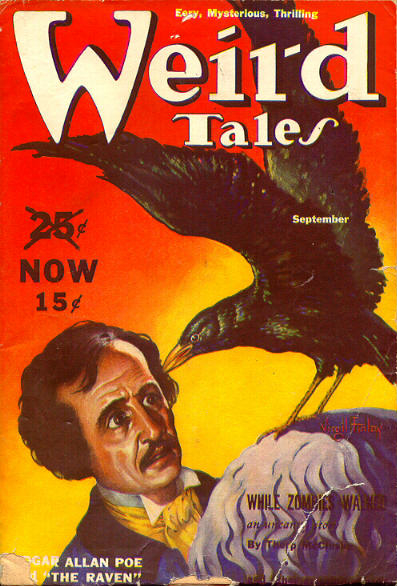
Edgar Allan Poe on the cover of Weird Tales, September 1939, with cover art by Virgil Finlay.

This will have to do until later in the month or maybe into December when I will wrap up this series on the 100-year anniversary of Weird Tales. Until then:

Happy Thanksgiving!

Original text copyright 2023 Terence E. Hanley