Showing posts with label Weird Tales from the Past. Show all posts

Wednesday, February 19, 2025

Shakespeare in "The Eyrie"

Sometimes there was verse in "The Eyrie." The authors of that verse aren't credited in bibliographies. I can understand why. But for the sake of completeness, and for the sake of not missing out on things that might prove interesting and edifying, maybe we need a list of the authors of verse who appeared in "The Eyrie."

William Shakespeare wasn't the first, but his name came up in the February issue of 1925, one hundred years ago this month. That was part of an ongoing discussion on horror and what some readers called "necrophilia" in the pages of the magazine. Following is an excerpt from "The Eyrie." Farnsworth Wright's was almost certainly the editorial voice. (Boldface is added.)

(The quote begins:)

We recently attended a performance of "Romeo and Juliet"; and as we heard Jane Cowl deliver Juliet's speech before she takes the poison, we realized that the same speech, if published in a WEIRD TALES story, would be denounced by some of our indignant readers (not many, but surely by some) as "gruesome", "shocking", "offensive". A few of our good friends would undoubtedly write letters asking us why we so offended against good taste as to draw such a "disgusting" picture of Juliet awaking at midnight in the vault,

"Where, for these many hundred years, the bones
Of all my buried ancestors are packed;
Where bloody Tybalt, yet but green in earth,
Lies festering in his shroud; where, as they say,
At some hours of the night spirits resort: --
Alack, alack! is it not like that I,
So early waking--what with loathsome smells,
And shrieks like mandrakes' torn out of the earth,
That living mortals, hearing them, run mad --
Oh, if I wake, shall I not lie distraught,
Environed with all these hideous fears.
And madly play with my forefathers' joints,
And pluck the mangled Tybalt from his shroud?
And in this rage, with some great kinsman's bone,
As with a club, dash out my desperate brains?"

But there will be no indignant letters, because we have quoted this from the thousand-souled Shakespeare. And what about "Hamlet", with the stage strewn with dead bodies in the last act? And the ghost of "the blood-boltered Banquo" at Macbeth's banquet? And that gruesome scene where Macbeth washes his hands of the murdered Duncan's blood:

"What hands are these ? Ha! they pluck out mine eyes.
Will all great Neptune's ocean wash this blood
Clean from my hand? No; this my hand will rather 
The multitudinous seas incarnadine,
Making the green one red."

We fear Shakespeare would fare quite badly at the hands of some of our readers. And the gentle Poe, who is still America's favorite author, and growing in popularity year by year (although the man himself died poor and neglected seventy-five years ago) -- how would Poe fare if he were writing today? Hardly better than he fared during his life. But the weird tales of that great master remain as a precious heritage to the whole world.

Considering the present unceasing popularity of the works of this great master of weird literature, we have no fear for the future of WEIRD TALES so long as the magazine remains weird.

(End of quote.)

And now here we are one hundred years later and Weird Tales (such as it is) is still being published.

(By the way, Jane Cowl played Juliet in performances in various places in Illinois in 1923-1924. In November 1924, she was at the Garrick Theatre in Chicago. Maybe that was when and where Farnsworth Wright saw her perform.)

Romeo and Juliet, Act V Scene III: Juliet Wakes in the Vault to Find Romeo Dead by G. Goldberg.

Original text copyright 2025 Terence E. Hanley

Saturday, January 27, 2024

Weird Tales, May/June/July 1924-Non-Fiction & Other Fillers

Following is a list of the fillers in the May/June/July issue of Weird Tales, a list transcribed from the Internet Speculative Fiction Database. Thanks to them again. All are by uncredited authors. Most have asterisks around them. Read on to see what they mean.

  • **"Juvenile Criminal," about the Hon. Grey Bennett and a boy named Leary. There really was a Grey Bennett, as remote from the first year of Weird Tales as we are from it.**
  • **"Retaliation," about a British ship.**
  • **"Providential Warning at Sea," about Captain Thomas Rogers and his ship Society in about 1694.**
  • **"Pastime of Despots," about Czar Peter.**
  • **"The Unnatural Son," about a theft in Salisbury.**
  • **"Singular Discovery of a Murder in 1740," an account of events at St. Neots, England.**
  • **"Giants," about very tall men known to history.**
  • **"Sham Fight," about a battle between Christian and Musselman armies at Bostra [sic].**
  • **"War Horses," about war in Funen, Denmark.**
  • **"The Original Bluebeard," about Gilles, Marquis de Laval. Seabury Quinn had covered him before in his non-fiction series "Weird Crimes," in October 1923.**
  • **"Distressing March of the Crusaders Through Phrygia."**
  • **"Remarkable Accident," about Baptiste, an actor at the Comedie Francaise in 1820.**
  • *"An Account of a Family Who Were All Afflicted with the Loss of Their Limbs," about John Dowling of Wattisham, England.*
  • *"Hypocrisy Detected," set in Paris.*
  • *"Force of Imagination," also set in Paris.*
  • *"Immolation of Human Beings," about the Ashantees [sic] of Africa.*
  • **"Imprisonment of Baron De Geramb."**
  • *"Anecdote Concerning the Execution of King Charles the First."*
  • **"Anne Boleyn."**
  • **"The Heroes of Hindoostan."**
  • *"Extraordinary Instance of Second Sight," about a French army officer quartered in Scotland during "the previous century."*
  • **"Miracles," about a Dr. Connell and his patient, named Anne Mulligan, in 1777.**
  • **"National Superstition," about two Venetians.**
  • **"Death of the Duchess of Bedford."**
  • **"Pardon for Forgery," a case from 1803.**
  • **"Terrific Death of a Painter," about Peter Peutemann.**
  • **"Deaths by Lightning," set in Ireland.**
  • **"Wonderful Providence," about war in France in 1562.**
  • **"Monsieur Rouelle," about the "celebrated chemist."**
  • **"A Singular Experiment," about an Irish boy named Magrath who fell into the hands of a "subtile doctor," a kind of Procrustes who experimented on the boy and made of him a monstrous creation. This account goes along with my suggestion that medical doctors are very often psychopaths or sociopaths and see their fellow human beings as mere material and subjects for their bizarre and monstrous experimentation. We recently had one of those at the head of a large governmental agency. He and his fellows very likely developed and loosed upon the world a deadly virus and in response created an oppressive regime that is still lurking, still preying, including in the minds of his and their followers, supporters, and apologists. Monstrous medical doctors recently won a victory for themselves in Ohio, too. Now they have the power under the state constitution to decide who is a human being and who is not. Now we have another Moloch State.**
  • **"Pentilly House, Cornwall," about a Mr. Tilly, an atheist.**
  • **"Singular Combat," about England in the time of Henry IV.**
  • **"Fatal Misfortune and Singular Instance of Affection in a Horse," set in England.**
  • *"Punishment of the Knout in Russia."*
  • **"Intrepid Conduct of Admiral Douglas," about a mutiny on board the ship Stately.**
  • "Only Sound," a very brief item from the Los Angeles Times. (Below it are two jokes.)
  • "Odd Facts," half a dozen brief fillers. (Below it are three anecdotes or jokes. So there are five untitled anecdotes or jokes in addition to 37 titled fillers.)

As I was about halfway through this list, I discovered the original source of most of these accounts. The source is:

The Terrific Register; or, Record of Crimes, Judgements, Providences, and Calamities, Volume I and Volume II, published in 1825 by Sherwood, Jones, and Co., of London, and Hunter of Edinburgh.

Presumably all are factual, so no fiction to add to the 37 stories in this issues. Items taken from Volume I have single asterisks around them in the list above. Those from Volume II have double asterisks. Seven of the items are from Volume I of The Terrific Register. Twenty-eight are from Volume II. That makes 35 in all, leaving only two that are from other sources.

So, if we're trying to get from 37 new stories in the interior of the anniversary number to the 50 promised on its cover, then we'll have to add 13 of the items listed above, I guess. You get to choose. A couple of them are almost as long as the shortest new stories.

It's clear that Otis Adelbert Kline was not the author of these fillers, as he had been (or probably was) in previous issues. But if he was acting as editor, or co-editor, then maybe he was the one who chose them for inclusion. And that makes me think that there must have been copies of these two volumes either in a public or university library in Chicago or in a private collection to which he had access. And now I think we had better look at the fillers in previous issues for their possible origins in the same two volumes of The Terrific Register.

I have written before about the Fortean method. I called it that after Charles Fort (1874-1932), author, gadfly of science, and collector of oddities. People who read and wrote for Weird Tales knew of Fort and his ways. Some became Forteans themselves. Others simply availed themselves of the Fortean method in creating their fictions. Like I said, I have suspected that Otis Adelbert Kline was the author of the many non-fiction fillers printed in Weird Tales in its first year, and maybe he was after all, taking after Fort in the process. But it's clear with this discovery of The Terrific Register as a source that Kline was not the sole author of the Weird Tales fillers and that Fort was not the first collector of oddities. He, along with Kline, was simply working in an older tradition. I wonder how far back that tradition goes. And I wonder: is history simply a field engaged in telling about the odd events--the crimes, judgements, providences, and calamities--of the past? Aside from that, are not these accounts simply retellings of how weird works in our lives and affairs?

Original text copyright 2024 Terence E. Hanley

Monday, November 13, 2023

Masterpieces of Weird Fiction

Weird Tales began reprinting classic tales of weird fiction in the May issue of 1923. The series is called "Masterpieces of Weird Fiction," and although the last entry is numbered six, there are actually seven entries. (The miscounting began with entry number five.) Five of the seven are by Edgar Allan Poe. We should remember that the co-founder of the magazine, Jacob C. Henneberger, was a great fan of Poe. Ambrose Bierce and Edward Bulwer-Lytton had one entry each in the series.

The first reprint was "The Haunted and the Haunters; or The House and the Brain" by Edward Bulwer-Lytton, originally in Blackwood's Edinburgh Magazine, Vol. DXXVI, August 1859. Also in the May 1923 issue was "The Closed Cabinet," ostensibly by an anonymous author but actually by Lady Gwendolen Cecil and originally in Blackwood's Edinburgh Magazine, Vol. CLVII, No. DCCCLI, January 1895. Edwin Baird, the editor of Weird Tales, probably got both stories from Old-Time English Stories (1909), a volume in the series Library of the World's Best Mystery and Detective Stories, which I think was also called and/or reprinted as The Lock and Key Library. "The Closed Cabinet" was not named as one of the series, but it might as well have been. All of the others were by male authors.

The next entry in the series was "The Murders in the Rue Morgue" by Edgar Allan Poe. It was the cover story for the June 1923 issue of Weird Tales and originally in Graham's Magazine in April 1841. Some people call it the first detective story. Poe called it a tale of ratiocination. It was the first story by Poe to appear in the magazine that was probably named after his posthumous collection from 1895. The cover illustration for that June issue was by William F. Heitman. Unfortunately, it turned out pretty poorly.

"Masterpieces of Weird Fiction" number three was "The Damned Thing" by Ambrose Bierce. Bierce's story was first in Town Topics: The Journal of Society on December 7, 1893, and reprinted in Weird Tales in September 1923. It was Bierce's only story in Weird Tales.

Edgar Allan Poe returned in the October 1923 issue with "The Pit and the Pendulum," first published in The Gift: A Christmas and New Year's Present for 1843 (1842). Although it was named as part of the series, "The Pit and the Pendulum" was not numbered. The same held true in November 1923 with the reprinting of Poe's story "The Tell-Tale Heart." It was originally in the first issue of James Russell Lowell's magazine The Pioneer in January 1843.

"Masterpieces of Weird Fiction" number five was "The Black Cat," again by Poe and originally in The Saturday Evening Post, August 19, 1843. "The Black Cat" was in Weird Tales in January 1924. Poe's "Never Bet the Devil Your Head" followed in March 1924. It was numbered as the sixth in the series but was actually number seven. The story was originally in Graham's Magazine as "Never Bet Your Head: A Moral Tale," in September 1841.

As far as I can tell, the next reprint in Weird Tales didn't come along until the issue of July 1925. A new series started then. Called "Weird Story Reprints," it ran for many years and included not just weird tales from the past but also reprints of stories that had originally appeared in Weird Tales itself.

I'm not sure that "Masterpieces of Weird Fiction" can be called a feature. I have used the word series instead. Nonetheless, I have included it in "Weird Tales Features" in the list of labels on the right.

"Masterpieces of Weird Fiction" in Weird Tales, May 1923 to March 1924:

  • No. 1--"The Haunted and the Haunters; or The House and the Brain" by Edward Bulwer-Lytton (May 1923)
  • [No. 4]--"The Pit and the Pendulum" by Edgar Allan Poe (Oct. 1923)
  • [No. 5]--"The Tell-Tale Heart" by Edgar Allan Poe (Nov. 1923)
  • No. 5 [actual No. 6]--"The Black Cat" by Edgar Allan Poe (Jan. 1924)
  • No. 6 [actual No. 7]--"Never Bet the Devil Your Head" by Edgar Allan Poe (Mar. 1924)

"The Haunted and the Haunters" by Edward Bulwer-Lytton was in The Haunters and the Haunted and Other Ghost Stories, published by Corgi books in 1963. The artwork on the cover is signed, but this image is too poor for the signature to be legible. Can someone help?

Text copyright 2023 Terence E. Hanley

Wednesday, August 23, 2023

Lady Gwendolen Cecil (1860-1945)

Lady Gwendolen Georgiana Gascoyne-Cecil
Author, Biographer
Born July 28, 1860, London, England
Died September 28, 1945, Hertfordshire, Hertford, England

Gwendolen Georgiana Gascoyne-Cecil was born on July 28, 1860, in London, England. She was the daughter of Robert Arthur Talbot Gascoyne-Cecil, 3rd Marquess of Salisbury (1830-1903), and the former Georgina Charlotte Alderson (1827-1899). Gwendolen's father, the Marquess of Salisbury, also known as Lord Robert Cecil and Lord Salisbury, was a member of Parliament, secretary of state for India, British foreign secretary, and three-time prime minister of the United Kingdom. His wife was his literary assistant and the mother of his eight children. She also wrote political articles for publication in the Saturday Review and the Quarterly Review.

Lady Gwendolen Cecil was an author and her father's biographer. She wrote a short story called "The Little Ray," published in The Pall Mall Magazine in August 1894. She was also the anonymous author of "The Closed Cabinet," which was in Blackwood's Edinburgh Magazine (Vol. CLVII, No. DCCCLI) in January 1895. Her major work was her four-volume biography of her father, entitled Life of Robert, Marquis of Salisbury (1921, 1932). "The Closed Cabinet" was her lone story in Weird Tales, and it was reprinted anonymously.

Lady Gwendolen died on September 28, 1945, in Hertfordshire, Hertford, England. She was eighty-five years old. She has a cultivar of the peony named after her, a distinction no doubt unique among contributors to "The Unique Magazine."

Lady Gwendolen Cecil's Story in Weird Tales
"The Closed Cabinet" as by _____ _____ (May 1923)

Further Reading
Not much that I have found or of note except in old newspaper articles, including a number that describe her being in an automobile accident in 1908. She was run over by her own electric vehicle after having gotten out to open a gate.

Gwendolen Gascoyne-Cecil (1860-1945) in a portrait drawn in 1895 by Pre-Raphaelite artist Edward Burne-Jones (1833-1898).

Text copyright 2023 Terence E. Hanley

Sunday, August 20, 2023

"The Closed Cabinet" by _____ _____ & Sunday Swipes No. 3

"The Moon Terror" by A.G. Birch was the first story in the May 1923 issue of Weird Tales. "The Closed Cabinet" by _____ _____ was the last. _____ _____ was an anonymous author in the pages of "The Unique Magazine" and in the original. The original was Blackwood's Edinburgh Magazine (Vol. CLVII, No. DCCCLI), published in January 1895. The publication of "The Closed Cabinet" was announced in newspapers in December 1894. In its issue of January 21, 1895, the Brooklyn Daily Eagle called it "an old time Scotch story." (p. 12)

In an item called "Literary Gossip," the Bowling Green, Ohio, Daily Sentinel-Tribune (Mar. 7, 1895, p. 2) attributed authorship of the story to Lady Gwendolen Cecil, daughter of the Marquess of Salisbury. There isn't any source given for that bit of information. This was gossip after all. Her authorship was previously confirmed in The Author, Playwright and Composer, Volumes 5 and 6, page 246, also from 1895. Maybe that's the source of the item out of Bowling Green. By the way, The Collector's Index to Weird Tales by Sheldon R. Jaffery and Fred Cook, an indispensable source in my writing of this blog, was also published in Bowling Green.

I'm not the first person to track down authorship of "The Closed Cabinet" to Lady Gwendolen. Scottish editor Johnny Mains (b. 1976) did that before me for his collection A Suggestion of Ghosts: Supernatural Fiction by Women, 1854-1900 (2018). More than a hundred years before Mr. Mains published his book, Julian Hawthorne (1846-1934) included "The Closed Cabinet" in his series Library of the World's Best Mystery and Detective Stories (1907-1909?). It looks like this series was also called and/or reprinted as The Lock and Key Library. Lady Gwendolen's story is in the volume Old-Time English Stories (1909), the contents of which are as follows:

  • "The Haunted House" by Charles Dickens (1859)
  • "No. 1 Branch Line: The Signal-Man" by Charles Dickens (1866)
  • "The Haunted and the Haunters; or, The House and the Brain" by Edward Bulwer-Lytton (1859)
  • "The Incantation" by Edward Bulwer-Lytton (date unknown)
  • "The Avenger" by Thomas De Quincey (1838)
  • "Melmoth the Wanderer" by Charles Maturin (1821)
  • "A Mystery with a Moral" by Laurence Sterne (date unknown)
  • "On Being Found Out" by William Makepeace Thackeray (1861)
  • "The Notch on the Ax" by William Makepeace Thackeray (1862)
  • "Bourgonef" by unknown
  • "The Closed Cabinet" by unknown (Lady Gwendolen Cecil)
Only some of these are considered fantasy, ghost stories, or weird fiction. Not all are included in the Internet Speculative Fiction Database.

"The Haunted and the Haunters; or, The House and the Brain" by Edward Bulwer-Lytton was the first reprint in Weird Tales, "The Closed Cabinet" now the second. It looks as though both came from the same source, namely, Julian Hawthorne's collection from earlier in the century. Charles Dickens' story "The Signal-Man" was also reprinted in Weird Tales, in the issue of April 1930. A second by-the-way: Julian Hawthorne was the son of Nathaniel Hawthorne (1804-1864) and the father of Hildegarde Hawthorne (1871-1952), both of whom also had stories in Weird Tales, though both posthumously.

Next: Lady Gwendolen Cecil (1860-1945)

"Her Countenance Grew Fierce," an illustration by an unknown artist for "The Incantation" by Edward Bulwer-Lytton and the frontispiece for The Lock and Key Library: The Most Interesting Stories of All Nations, Old Time English, edited by Julian Hawthorne (New York: The Review of Reviews Co., 1915). I have altered this image from a photograph taken of the original.

The image shown above may seem familiar to you. Have a look at the cover illustration for the May 1923 issue of Weird Tales, made by William F. Heitman:


Now here they are side by side, with the Weird Tales cover flipped:


No wonder Heitman's cover was so uncharacteristic of his regular work, and no wonder that the male figure on the right doesn't match very well the female on the left in its treatment or technique.

Text copyright 2023 Terence E. Hanley

Monday, May 2, 2016

Two Victorian British Authors

T.W. Speight
Thomas Wilkinson Speight
Railroad Man, Author
Born 1830, Liverpool, England
Died 1915

Thomas Wilkinson Speight, better known as T.W. Speight, was born in Liverpool in 1830. The Stanford Companion to Victorian Fiction (1989) states that he "was probably illegitimate," continuing, "[h]e was educated at a foundation school at Kendal in the Lake District" of northwestern England. Speight worked for the Midland Railway Company from 1847 to 1887. Even before reaching the end of the line as a railroad man, Speight had begun writing for publication. He contributed to All the Year Round, Belgravia, Cassell's Magazine, Gentleman's Annual, and other periodicals. From 1867 to 1912, he published more than four dozen short stories, serials, and novels, some of which are listed below. These were mostly thrillers, mysteries, historical romances, and sensation novels, what we might call, I think, suspense, crime, or even exploitation novels. Speight died in 1915. His only story for Weird Tales, "Mrs. Penleath's Strategem," was reprinted from Cassell's Magazine nearly forty years after his death.

T.W. Speight's Books-A Partial List
Brought to Light: A Story (1867)
Under Lock and Key (1869)
In the Dead of Night: A Novel (1874)
A Secret of the Sea: A Novel (1876)
The Mysteries of Heron Dyke: A Novel of Incident (1880)
For Himself Alone: A Tale of Reversed Identities (1884)
A Barren Title: A Novel (1885)
The Sandycroft Mystery (1890)
Burgo's Romance, complete in The Gentleman's Annual (Christmas 1893)
The Grey Monk (1895)
A Husband from the Sea (1895)
The Heart of a Mystery: A Novel (1896)
The Master of Trenance: A Mid-Century Romance (1896)
A Minion of the Moon: A Romance of the King's Highway (1896)
The Crime in the Wood (1899)
The Chains of Circumstance: A Novel (1900)
Juggling Fortune: An Everyday Romance (1900)
The Celestial Ruby (1904)
Ursula Lenorme, Lady Companion: Being a Record of Certain Experiences (1909)
A Bootless Crime
By Fortune's Whim
The Golden Hoop
A Late Repentance
A Match in the Dark
The Sport of Chance
The Web of Fate
Wife or No Wife?

T.W. Speight's Story in Weird Tales
"Mrs. Penleath's Stratagem" (Mar. 1953; reprinted in Weird Tales British edition #23, 1953; originally in Cassell's Magazine, July 1905)

* * *

Richard Marsh
Pseudonym of Richard Bernard Heldmann
Author, Editor
Born October 12, 1857, North London, England
Died August 9, 1915, Haywards Heath, Sussex, England

Richard Bernard Heldmann was born on October 12, 1857, in North London and was the son and grandson of men in the lace business. He began publishing adventure stories and boys' school stories in 1880. From October 1882 to June 1883, Heldmann was co-editor of the boys' weekly Union Jack. His employment ended abruptly. Only recently was it discovered that he passed forged checks in 1883. In April 1884, he began serving a sentence of hard labor because of it. Upon his release, Heldmann adopted the pseudonym Richard Marsh. (See the entry on John Flanders, from April 28, 2016, for a similar situation in the life of a writer in Weird Tales.) Marsh wrote prolifically in the same genres as T.W. Speight, including the sensation novel, a type pioneered by Charles Dickens and Wilkie Collins. His most well-known book is The Beetle, from 1897. (Wikipedia has a list of his books. The Internet Speculative Fiction Database has a list of his genre works.) Marsh also contributed to Belgravia, Cornhill Magazine, Household Words, and The Strand Magazine. His work appears to have been neglected by American anthologists, but it is deserving of a second look. Richard Bernard Heldmann died on August 9, 1915, at age fifty-seven. Heldmann's grandson was author Robert Aickman (1914-1981).

Richard Marsh's Story in Weird Tales
"The Adventure of the Pipe" (Sept. 1927; originally in Cornhill Magazine, Mar. 1891)

The Beetle in a British edition from 1959 with cover art by R.W. Smethurst.

Text copyright 2016, 2023 Terence E. Hanley

Saturday, April 23, 2016

More Weird Tales from the Renaissance

On October 23, 2011, I wrote about William Shakespeare (1564-1616) in an entry called "Weird Tales from the Renaissance." I had thought that Shakespeare--who died four hundred years ago today--was the only writer from the Renaissance to have been in the original Weird Tales. Now I find that there was another, Shakespeare's near contemporary, sometime collaborator, and successor, playwright John Fletcher (1579-1625).

I won't write much about John Fletcher, as his biography and credits are readily available on the Internet and in the world's libraries. He was born in Rye, England, in December 1579, orphaned in his teenage years, and educated at Corpus Christi College, Cambridge University. His first play was The Faithful Shepherdess from 1608-1609. About fifty plays followed, of which about two-thirds were collaborations, with Francis Beaumont, Philip Massinger, Thomas Middleton, William Rowley, and others, including Shakespeare himself. After Shakespeare's death, John Fletcher assumed his role as the leading playwright for the acting company The King's Men. Fletcher died in August 1625 of the plague and was interred at Southwark Cathedral.

In its May issue of 1939, Weird Tales published a poem it called "The Dead Host's Welcome." (In Jaffery and Cook's Collector's Index to Weird Tales, the title is given as "The Dead Hart's Welcome.") That poem follows.

"The Dead Host's Welcome"
by John Fletcher
from The Lovers' Progress (edition of 1647)

'TIS late and cold; stir up the fire;
Sit close, and draw the table nigher;
Be merry, and drink wine that's old,
A hearty medicine 'gainst a cold:
Your beds of wanton down the best,
Where you shall tumble to your rest;
I could wish you wenches too,
But I am dead, and cannot do.
Call for the best the house may ring,
Sack, white, and claret, let them bring,
And drink apace, while breath you have;
You'll find but cold drink in the grave:
Plover, partridge, for your dinner,
And a capon for the sinner,
You shall find ready when you're up,
And your horse shall have his sup:
Welcome, welcome, shall fly round,
And I shall smile, though under ground.

John Fletcher (1579-1625)

Original text copyright 2016, 2023 Terence E. Hanley

Friday, April 22, 2016

William Ernest Henley (1849-1903)

I began writing this blog five years ago. Today is the anniversary. I started out and have been writing more or less randomly. Not long ago, though, I looked through the remaining authors and gave them some kind of organization. Although there are still several hundred to go, I can see an end to all this, although that end might be several years out.

One of the writers I missed in my previous groupings of tellers of weird tales from the past is William Ernest Henley.* I would like to write about him today, but he really belongs with the other writers of the Victorian Age in an entry from October 27, 2011, not only because he was one of them but also because he was a friend of Robert Louis Stevenson (1850-1894), who based his character Long John Silver on Henley.

William Ernest Henley was born on August 23, 1849, in Gloucester, England, and attended The Crypt School in that city. He passed his examination in 1867 and went to work in the field of journalism. Henley edited London (1877-1878), the Magazine of Art (1882-1886), the Scots Observer/National Observer (1888-1893), and a publication called Ana Siken. Through all that, he wrote poetry and through all that he endured ill health, surgical operations, and long stays in the hospital from which he emerged minus a leg.

Henley's time was one of great prosperity and expanding horizons but also one of decadence and looking backward. Henley himself was conservative, but his poetry is forward-looking, not only in its optimism (or at least its undefeated attitude) but also in its anticipation of the verse of the coming century. According to Andrzej Diniejko, Henley and his circle (called the "Henley Regatta") "promoted realism and opposed Decadence," a viewpoint and movement then in fashion. (Quoted in Wikipedia in an entry that is disjointed at best.) If anyone might have cause to feel defeated, pessimistic, or depressed--in other words a candidate for the Decadent vogue of the fin de siècle--Henley was it. From the age of twelve, he suffered from tuberculosis in his bones. Sometime in 1868-1869, he had his left leg taken off below the knee. Henley spent a good deal of time in the hospital, including the years 1873-1875, when his right foot was also diseased. More tragically, Henley's daughter Margaret, who had inspired James Barrie in his creation of Peter Pan, died in 1894 at age five. If his poetry is any indication, Henley remained undefeated by death and disease, however. Here is his most famous work, Invictus, from 1875:

Invictus

Out of the night that covers me,
Black as the pit from pole to pole,
I thank whatever gods may be
For my unconquerable soul.

In the fell clutch of circumstance
I have not winced nor cried aloud.
Under the bludgeonings of chance
My head is bloody, but unbowed.

Beyond this place of wrath and tears
Looms but the Horror of the shade,
And yet the menace of the years
Finds, and shall find me, unafraid.

It matters not how strait the gait,
How charged with punishments the scroll,
I am the master of my fate:
I am the captain of my soul.

Here is another poem, presumably on the death of his daughter, and on his own impending end:

In Memoriam: Margaritae Sorori

A late lark twitters from the quiet skies: 
And from the west, 
Where the sun, his day's work ended, 
Lingers as in content, 
There falls on the old, gray city 
An influence luminous and serene, 
A shining peace. 

The smoke ascends 
In a rosy-and-golden haze. The spires 
Shine and are changed. In the valley 
Shadows rise. The lark sings on. The sun, 
Closing his benediction, 
Sinks, and the darkening air 
Thrills with a sense of the triumphing night-- 
Night with her train of stars 
And her great gift of sleep. 

So be my passing! 
My task accomplish'd and the long day done, 
My wages taken, and in my heart 
Some late lark singing, 
Let me be gather'd to the quiet west, 
The sundown splendid and serene, 
Death. 

I am reminded of Ralph Vaughan Williams' musical piece The Lark Ascending, from George Meredith's poem of the same name, published in 1881. To me, The Lark Ascending is both joyful and sad, music about life itself. It also represents, I think, England, about which Henley also famously wrote:

England, My England

What have I done for you,
  England, my England?
What is there I would not do,
  England, my own?
With your glorious eyes austere,         
As the Lord were walking near,
Whispering terrible things and dear
  As the Song on your bugles blown,
    England--
  Round the world on your bugles blown!         

Where shall the watchful sun,
  England, my England,
Match the master-work you’ve done,
  England, my own?
When shall he rejoice agen         
Such a breed of mighty men
As come forward, one to ten,
  To the Song on your bugles blown,
    England--
  Down the years on your bugles blown?         

Ever the faith endures,
  England, my England:--
'Take and break us: we are yours,
  England, my own!
Life is good, and joy runs high         
Between English earth and sky:
Death is death; but we shall die
  To the Song of your bugles blown,
    England--
  To the stars on your bugles blown!'         

They call you proud and hard,
  England, my England:
You with worlds to watch and ward,
  England, my own!
You whose mail’d hand keeps the keys         
Of such teeming destinies,
You could know nor dread nor ease
  Were the Song on your bugles blown,
    England--
  Round the Pit on your bugles blown!         

Mother of Ships whose might,
  England, my England,
Is the fierce old Sea's delight,
  England, my own,
Chosen daughter of the Lord,         
Spouse-in-Chief of the ancient Sword,
There's the menace of the Word
  In the Song on your bugles blown,
    England--
  Out of heaven on your bugles blown!

In our time, a poem like that would be called nationalistic, jingoistic, imperialistic, and even fascistic, the pejoratives that the politically correct so readily spew like verbal vomit. I take it as the work of a man who loved his country and all that it had accomplished, including, in an irony that is lost on them, the very freedom of thought and speech that allows the politically correct to criticize the country admired and the sentiments expressed in the poet's work.

William Ernest Henley died on July 11, 1903, in Woking, England. A little more than a quarter-century later, Weird Tales reprinted a poem by him that it called "A King in Babylon." Its author called it "To W.A.":

To W.A.

Or ever the knightly years were gone
With the old world to the grave,
I was a King in Babylon
And you were a Christian Slave.
I saw, I took, I cast you by,
I bent and broke your pride.
You loved me well, or I heard them lie,
But your longing was denied.
Surely I knew that by and by
You cursed your gods and died.
And a myriad suns have set and shone
Since then upon the grave
Decreed by the King of Babylon,
To her that had been his Slave.
The pride I trampled is now my scathe,
For it tramples me again.
The old resentment lasts like death,
For you love, yet you refrain.
I break my heart on your hard unfaith,
And I break my heart in vain.
Yet not for an hour do I wish undone
The deed beyond the grave,
When I was a King in Babylon
And you were a Virgin Slave.
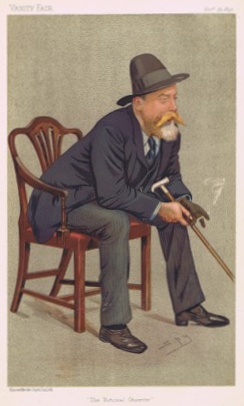
William Ernest Henley
(1849-1903)

*Revision (Apr. 23, 2016): As it turns out, I did write about him before, but only briefly, in "More Weird Tales from the Victorian Age," October 30, 2011, here.
Original text copyright 2016, 2023 Terence E. Hanley

Thursday, December 24, 2015

F.B. Ghensi (1865-1943)

Pierre-Barthélemy Gheusi
Aka Norbert Lorédan
Government Worker, Diplomat, Theatre Director, Librettist, Lyricist, Journalist, Editor, Publisher, Author 
Born November 21, 1865, Toulouse, France
Died January 30, 1943, Paris, France

In its May issue of 1940, the month in which the Sitzkrieg ended and the Nazis invaded France, Weird Tales printed a story it called "The Red Gibbet" by an author it called F.B. Ghensi. Like the Sitzkrieg, the title and the author's name were phony. His identity has been a minor mystery since then. The Internet allows a solution to the mystery.

Pierre-Barthélemy Gheusi was born on November 21, 1865, in Toulouse, France. He studied in Castres and in Toulouse. In 1887-1889, he worked on the revue Le Décadent littéraire et artistique, where he wrote under the pseudonym Norbert Lorédan, but his literary career stalled and he went into politics.

Gheusi was well connected. Among his friends, associates, and supporters were scholar François de Vesian, politician Jean Jaurès, poet and essayist Laurent Tailhade, musician Georges Pierfitte, author Émile Zola, and poet Catulle Mendès. In 1889, Gheusi joined the political campaign of Jaurès in Castres. For several years after that, he held government posts, including in Rheims. In 1894, Gheusi relocated to Paris. In that same year, he married Adrienne Willems, niece of the painter Florent Willems. In 1897, Gheusi made an inspection tour of the Christian schools in Palestine. In 1906, he held a post at le Ministère des Colonies. And in 1911, he served as a diplomat in working to restore relations between France and Venezuela.

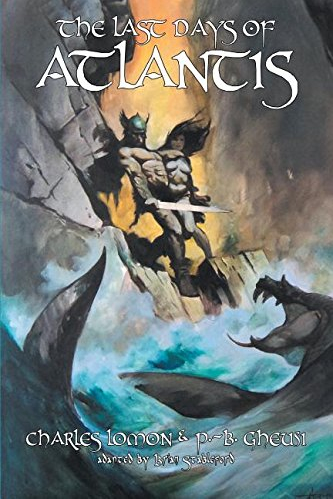
From 1888 to 1931, Gheusi wrote works for the stage, including lyrics, libretti, dramas, and comedies. He also authored histories and other works of non-fiction. His first novel was Gaucher Myrian, vie aventureuse d'un escholier féodal. Salamanque, Toulouse et Paris au XIIIe siècle, written with Paul Lavigne and published in 1893. Eleven more novels followed, the last of which, La Fille de Monte-Cristo, was published posthumously in 1948. I have not read any of his books and know nothing about them except for their titles. At least two have titles suggesting genre fiction, however, Le Serpent de mer, roman à clés (The Sea Serpent, a key novel, 1899) and Les Atlantes, aventures de temps légendaires (The Atlanteans, Adventures of Legendary Times, with Charles Lomon, 1905). As it turns out, Les Atlantes is a fantasy, and it has recently been reprinted. (See below.)

In later years, Gheusi held various positions of directorship or editorship, including of Le Gaulois du dimanche (1897), Nouvelle Revue (1899), le Paris Opéra (1906, 1914), l'Opéra Comique (to 1918), le Théâtre Lyrique du Vaudeville (1919–1920), Le Figaro (to 1932), and again l'Opéra-Comique (to 1936). During World War I, he was on the staff of General Joseph Gallieni. Gheusi also used his castle near Biarritz as a hospital for French troops.

The life of Pierre-Barthélemy Gheusi was very nearly bracketed by German invasions of his native land. The Franco-Prussian War broke out when he was only four years old and ended not long after his fifth birthday with a humiliating defeat for the French. (His distant cousin, Léon Gambetta, was a leading figure during the war.) Sixty-nine years later, Germans reentered France and again dealt it a humiliating defeat, worse than in his childhood. He would not live to see his country liberated. Gheusi died on January 30, 1943, in Paris.

Three years before, perhaps unbeknownst to him, Weird Tales had reprinted the story "The Red Gibbet," translated by H. Twitchell. Twitchell translated numerous works from numerous languages into English. Unfortunately, Twitchell seems to have left his or her Christian name unrevealed except for its initial. The translator would appear a dead end. The phrase "the red gibbet," however, leads to a solution as to the identity of the author.

I have not read the the story "The Red Gibbet" in Weird Tales, but it seems certain to me that it is merely a retitled reprinting of "The Christmas Wolves" by P.B. Gheusi, originally published in French in Figaro Illustré in February 1897, then in an English translation by H. Twitchell in The International: An Illustrated Monthly Magazine in December 1897 (Vol. 3, No. 6, pp. 546-552). You can read it by clicking here. As its title implies, the story takes place at Christmastime. It involves not only wolves but also a hanged witch. Oddly for a Christmas story, it is a tale of revenge.

So why did Weird Tales change the name of the story and its author? I don't know. The misspelling of Gheusi's name may simply be a typographical error. I doubt it, though. I think it more likely that the magazine was trying to avoid problems with copyrights or other legalistic matters. In any case, the mystery of "The Red Gibbet" is solved, and we have another French author to add to the list of those who were in Weird Tales.

F.B. Ghensi's [sic] Story in Weird Tales
"The Red Gibbet" (May 1940; originally published in the United States as "The Christmas Wolves" by P.B. Gheusi in The International: An Illustrated Monthly Magazine, Dec. 1897)

Further Reading
"Gheusi, Pierre-Barthélemy," in French, at the following URL:


"Pierre-Barthélemy Gheusi" on the French version of Wikipedia:


A portrait drawing of Pierre-Barthélemy Gheusi. Note the reference to Gallieni, "the savior of Paris."

On October 31, 2015, Hollywood Comics/Blackcoat Press published The Last Days of Atlantis by Charles Lomon and Pierre-Barthélemy Gheusi. The book was originally published in 1905 as Les Atlantes, aventures de temps légendaires. Artist Mike Hoffman created the cover illustration.

Merry Christmas from Tellers of Weird Tales!

Text and captions copyright 2015, 2023 Terence E. Hanley