Showing posts with label Conan. Show all posts

Tuesday, November 11, 2025

Lou Feck (1925-1981)

For Remembrance Sunday, November 9, and Veterans Day, November 11, 2025

Yesterday I mentioned the artist Lou Feck in regard to his illustrations for The Shepherd by Frederick Forsyth (Bantam Books, 1977). I would like to write about Lou Feck today, for he had an indirect connection to Weird Tales magazine, and I find that there isn't any biography of him on line, or at least as far as I have searched. He was a very good artist, especially good with airplanes and other machines, as well as with architecture. Like all really good artists, though, he was good at handling the human figure. He needed those skills in his work as a cover artist for science fiction and fantasy paperbacks. He did other paperback cover art as well.

Lou Feck's name can be added to the list of Conan cover artists. He also created the cover art for Kull, the Fabulous Warrior King by Robert E. Howard (Bantam Books, 1978). Feck's depictions of airplanes in flight, as well as of airfields, hangars, and other things related to aviation, are excellent. Now I find that he was acquainted with the field of aviation, as he had served in the U.S. Army Air Force during World War II. Frederick Forsyth (1938-2025), by the way, also served in the air force, in his case the Royal Air Force, or RAF. He was commissioned three days after his eighteenth birthday and became a pilot a year later. At age nineteen, he was at the time the youngest pilot in the RAF. The late Mr. Forsyth flew the de Havilland Vampire, a graceful-looking, twin-tail, single-engine jet fighter. The pilot in The Shepherd flies the same type of aircraft. Frederick Forsyth died almost exactly one hundred years after Lou Feck's birth.

Louis Edward Feck was born on July 8, 1925, in Cincinnati, Ohio, to Vela Bertyl (Edwards) Willett and Louis Fairfax Willett, Sr. The two were married on January 22, 1924, and divorced on or about March 15, 1930. Feck's name at birth was actually Louis Fairfax Willett, Jr. In the U.S. Census of 1930 (April 11), he was enumerated with his divorced mother in Norwood, Ohio. She worked then as an editor at a lithographing company. Three years later, a portrait of Vela Edwards Willett, painted by Glen Tracy (1883-1956), was included in an exhibition at the Cincinnati Art Museum. So, Lou Feck came from a family connected to the art world.

Vela Willett remarried in 1932. Her new husband was Edward A. Feck. The couple lived in Melrose, Massachusetts, in 1940 and 1950 when the census taker came around. By then they had had a daughter, Rosemary Vela Feck, later Caldwell. The former Louis Fairfax Willett, Jr., was by then going by the name Louis Edward Feck, nicknamed Lou.

Lou Feck studied at the Boston Museum of Fine Arts  in 1940-1941 and graduated from Melrose High School in 1943. From July 24, 1943, to February 17, 1946, he served in the U.S. Army Air Force. In 1947, he resumed his studies at Vesper George School of Art in Boston. In 1950, he graduated from the Pratt Institute in Brooklyn, New York.

On June 18, 1950, Feck married Ruth Evangeline Cutkomp in New York City. Born on February 24, 1925, in Columbus City, Iowa, she was an artist, too. She graduated from Rock Island High School, in Rock Island, Illinois, in 1943 and attended the Chicago Art Institute in 1944-1945. From 1945 to 1946, she served in the U.S. Navy. Like her new husband, she graduated from the Pratt Institute in 1950. The young couple lived in Brooklyn and worked in advertising and illustration in New York City. I wonder if they knew John and Elaine Duillo, another husband-and-wife pair of illustrators who had also attended the Pratt Institute.

Lou Feck enjoyed a long and successful career as an artist. You have no doubt seen his work. Rather than list and show his credits here, I'll refer you first to a blog called The Paperback Palette and a long article called "The Fantastic Paperback Cover Art of Lou Feck" by Jeffersen, dated April 10, 2018, here; and second, to a blog called Poplitiko and an entry called "The Secret Work of Lou Feck, Cover Artist Supreme" by Alex Ness, dated August 25, 2025, here. You can also look at the Internet Speculative Fiction Database.

Lou Feck died suddenly and unexpectedly on November 4, 1981. He was just fifty-six years old. Ruth E. (Cutkomp) Feck died on May 11, 1990, in Broward County, Florida. Feck was buried at Huntington Rural Cemetery in Suffolk County, New York. His signature appears on his headstone. Next to his is another headstone with the signature of Anita D. Feck. Her dates are given as 1930-2016. Someone named Anita Feck wrote a letter to the science fiction magazine Locus, published in its issue of July 1982 (#258). I don't know what to make of all of that exactly. My best guess is that Anita D. Feck was Lou Feck's wife and widow and that she wrote to inform science fiction fandom of the death of her husband. I don't know anything else about her.

Kull, The Fabulous Warrior King (Bantam Books, 1978), with cover art by Lou Feck. Created by Robert E. Howard, Kull was first in Weird Tales in August 1929 in the novelette "The Shadow Kingdom." As you can see in this and other works by the artist, Feck painted using a dark, neutral or cool palette. Maybe he borrowed the red cape from Frank Frazetta's justly famous cover for Conan (Lancer, 1967).

Conan the Rebel by Poul Anderson (Bantam Books, 1981) with cover art by Lou Feck using his pseudonym Zorin. Someone is supposed to have figured out that Feck used this pseudonym, but the links in the Internet Speculative Fiction Database don't seem to go anywhere. Conan was of course also created by Howard. The character first appeared in Weird Tales in "The Phoenix on the Sword," December 1932.

Text copyright 2025 Terence E. Hanley 

Friday, March 31, 2023

John Jakes (1932-2023)

Author, Advertising Copywriter
Born March 31, 1932, Chicago, Illinois
Died March 11, 2023, Sarasota, Florida

John Jakes has died. Known for his vastly popular historical novels, the late Mr. Jakes got his start as an author of science fiction and fantasy stories. His first published story was "The Dreaming Trees" in Fantastic Adventures, November 1950. According to Isaac Asimov, the Golden Age of Science Fiction ended in 1950. If that's the measure, then John Jakes just barely slipped in before that age came to an end.

John Jakes could have been in Weird Tales, but he wasn't. By the time "The Unique Magazine" folded, he had had nearly three dozen of his stories published, in Fantastic Adventures, Amazing Stories, Super Science Stories, Planet Stories, Imagination, The Magazine of Fantasy and Science Fiction, Space Science Fiction, Avon Science Fiction and Fantasy Reader, Rocket Stories, and Cosmos Science Fiction and Fantasy. He also wrote Westerns and crime and detective stories. Weird Tales was on its way down in the 1950s, while magazine science fiction was taking off. You could hardly have blamed John Jakes for choosing one over the other. (Or maybe he submitted stories to Weird Tales but was turned down.) He certainly wasn't above writing stories of fantasy. A later phase of his career proved as much.

In the early 1960s, Mr. Jakes began writing stories of a yellow-haired warrior loose in a world of monsters and magic. In his "Prefatory Note" to Brak the Barbarian (1968), he acknowledged writing his Brak stories in the shadow of Robert E. Howard. He did so not out of cupidity, as a letter writer to Fantastic Stories of the Imagination had suggested. "My motive for giving birth to Brak and his parallel universe on an old black Underwood was much simpler," the author explained. "There just are not enough stories of this kind to go around any more; not enough, anyway, to please me." And so he wrote.

Fantastic Stories of Imagination published the first Brak story, "Devils in the Walls," in May 1963. Eight more followed, plus several novels and collections of stories, some of which are variants of the original eight stories. I haven't done a close enough study of the Brak stories to say just how many of them there are, but it looks like there are twelve. Also, we shouldn't forget a Brak comic book story, "Spell of the Dragon," with a script by Dan Adkins and John Jakes and artwork by Adkins, Val Mayerik, and Al Milgrom, published in Marvel Comics' Chamber of Chills #2  in January 1973. That makes thirteen.

I have compiled the following lists from information in The FictionMags Index, the Internet Speculative Fiction Database, and Wikipedia, and by consulting my own collection of Brak books:

Brak Stories by John Jakes:

  • "Devils in the Walls" in Fantastic Stories of Imagination (May 1963)
  •  "Witch of the Four Winds" in Fantastic Stories of Imagination (serial, Nov.-Dec. 1963)
  •  "When the Idols Walked" in Fantastic Stories of Imagination (serial, Aug.-Sept. 1964)
  •  "The Girl in the Gem" in Fantastic Stories of Imagination (Jan. 1965)
  •  "The Pillars of Chambalor" in Fantastic Stories of Imagination (Mar. 1965)
  •  "The Silk of Shaitan" in Fantastic Stories of Imagination (Apr. 1965)
  •  "The Mirror of Wizardry" in Worlds of Fantasy, Vol. 1, No. 1, (1968)
  •  "Ghoul’s Garden" in Flashing Swords! #2, edited by Lin Carter (1973)
  •  "Storm in a Bottle" in Flashing Swords! #4, edited by Lin Carter (1977)

Brak Books by John Jakes:
  • Brak the Barbarian (1968), collecting "The Unspeakable Shrine," "Flame Face," "The Courts of the Conjurer" (variant of "The Silk of Shaitan"), "Ghosts of Stone" (variant of "The Pillars of Chambalor"), and "The Barge of Souls"  
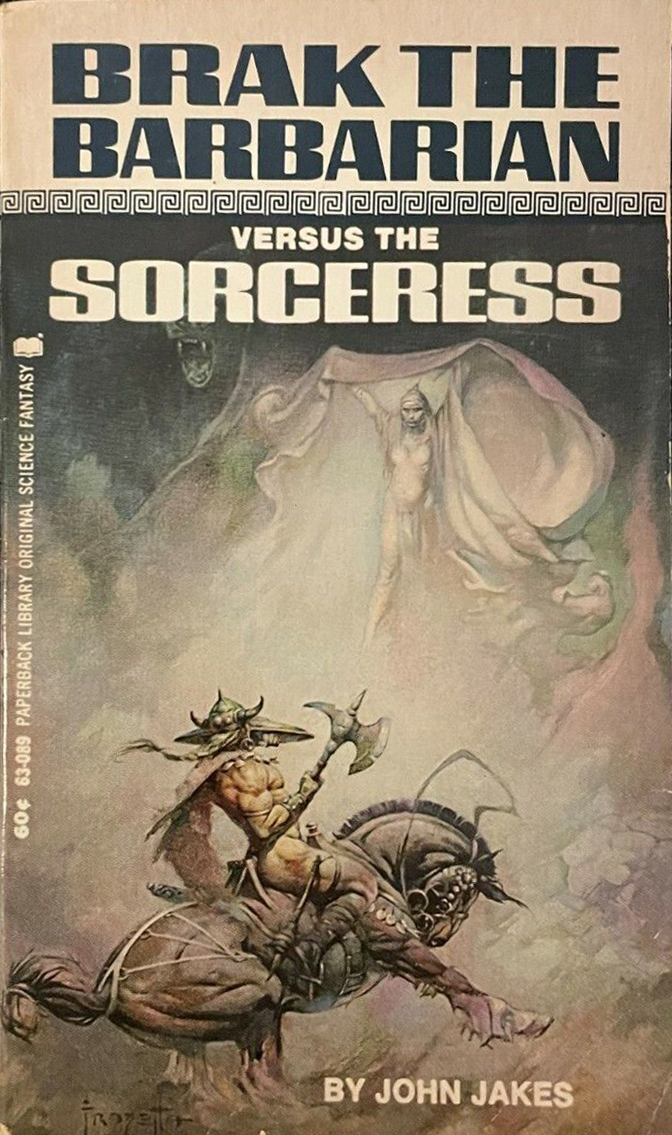
  • Brak the Barbarian Versus the Sorceress (1969), originally "Witch of the Four Winds"
  • Brak the Barbarian Versus the Mark of the Demons (1970)
  • When the Idols Walked (1978), originally "When the Idols Walked"
  • The Fortunes of Brak (1980), collecting "Devils in the Walls," "Ghoul's Garden," "The Girl in the Gem," "Brak in Chains" (variant of "Storm in a Bottle"), and "The Mirror of Wizardry"
I have stopped before the current age of non-books called "books" began.

John Jakes was born in Chicago; graduated from DePauw University in Greencastle, Indiana, in 1953; earned his masters degree at Ohio State University; and worked as an advertising copywriter in Dayton, Ohio, before setting off in 1971 to become a full-time author. (His prefaces were dispatched from Kettering, Ohio.) He sold millions of books from the 1970s to the 1990s, and several of his historical novels were adapted to TV miniseries. He lived on Bird Key in Sarasota, Florida, and died in Sarasota on March 11, 2023. Today would have been his ninety-first birthday. We send condolences to his family, wish John Jakes a happy birthday, and say thank you to him for the reading pleasure he has given the world.

* * *

I wrote about John Jakes in my essay "They Should Have Been in Weird Tales," published in The Weird Tales Story, Expanded and Enhanced, edited by Robert Weinberg and Bob McLain (2021).

Fantastic Stories of Imagination, May 1963. Cover story: "Devils in the Walls" by John Jakes. Cover art by Vernon Kramer.

Fantastic Stories of Imagination, January 1965. Cover story: "The Girl in the Gem" by John Jakes. Cover art by Ed Emshwiller. Notice the tentacles in the lower right.

Fantastic Stories of Imagination, March 1965. Cover story: "The Pillars of Chambalor" by John Jakes. Cover art by Gray Morrow.

Brak the Barbarian (1968), with cover art by Frank Frazetta.

Brak the Barbarian Versus the Sorceress (1969), with arresting cover art by Frazetta.

Brak the Barbarian Versus the Mark of the Demons (1970), with cover art by Michael Leonard.

Brak vs. the Sorceress (1977), with cover art by Charles Moll.

Brak vs. the Mark of the Demons (1977), again with cover art by Mr. Moll.

The Fantastic Swordsmen (1967) with a cover story "The Girl in the Gem" by John Jakes and cover art by his friend, Jack Gaughan. Again there are tentacles.

Flashing Swords #2 (1973), with cover art by Frazetta illustrating "Ghoul's Garden" by John Jakes.

Thanks to my correspondent for letting me know about the passing of John Jakes.
Original text copyright 2023 Terence E. Hanley

Tuesday, January 31, 2023

What Is Weird Fiction?

Beowulf was composed in pre-Christian times but written down only after Christianity had moved into northern Europe. The result is syncretic, that is, a cross between pre-Christian and Christian beliefs. Syncretism was and is a very successful strategy in the growth and spread of Christianity. Rather than wipe out beliefs that came before it, the Church absorbed and modified them. It's why we celebrate Christmas at midwinter.

In his last words, Beowulf mentions both Weird (Wyrd) and "the Creator." The implication is that Weird works on earth, perhaps independently of the Creator. Or is she one of his agents or angels? I can't say. Beowulf seems to have lived and died in an in-between time. But what if the inclusion of Weird in Beowulf is not fully syncretic? What if Weird and God lived side by side for some time in Europe before Weird became what people now call "God's will" or "God's plan for the world"? What if only later did God subsume Weird?

For nigh on a thousand years after Beowulf, Weird was the workings of God--"God moves in mysterious ways" is the saying--and there was a syncretism, with God on top and Weird hidden away. Weird, or Fate, and her seeming random and often cruel ways retreated behind God's will, God's plan, God's mercy, God's love. God took her place; he is loving and caring, even if mysterious. He does things for his own reasons, which may be inscrutable and incomprehensible to us in our smallness, yet are ultimately wise and unassailable. Maybe the weird fiction of the nineteenth century and after chronicles a renewed schism of Weird from God, significantly beginning with the Romantic Period and the rise of the natural sciences.

We think of the Romantic Period as a reaction to the Age of Reason. But there was no simple conservatism in Romanticism. In fact, it may be seen as a search for a third way, for a middle ground between a cleaving to tradition and a radical overthrow of the past. So maybe Weird came back only after we had begun the process of dethroning God, which seems to have been part of the program of Western thought during the nineteenth century. Then, in 1883, Nietzsche wrote that God is dead. A couple of years later, publishers began putting out books with the word weird in their titles. These were no doubt the inspiration for the title, themes, and subject matter of the later magazine Weird Tales, which began one hundred years ago this spring.

So maybe the authors of weird fiction from the 1880s to the 1920s and '30s were simply returning to the Weird of the past. Except that Weird was now embodied or manifested in dark, malign, and alien beings, entities, and forces. Weird may be cruel. She may seem arbitrary. She carries us away. But more than anything, she may actually be indifferent to what we want for ourselves on this earth. Her ways may just be matters of course. These things must be done for no reason we may know. Cthulhu, on the other hand, wishes to crush us and rule over us. He has his designs upon us. He has come into this world to stay. He is bodily, though also in control of nonmaterial forces. But I sense in him an indifference, a malign indifference to be sure, but an indifference nonetheless. In the eyes of Cthulhu, we are nothing. Beyond that, in the greater Lovecraftian universe, we as human beings are insignificant, mere specks. I don't think Weird sees us that way. Weird may carry us away, but we are not nothing to her.

Based as it is on genuine human experience in a seemingly harsh, often cruel, and largely unforgiving world, the pre-Christian concept of Weird is actually profound in its grasp of our condition. It is not the simple or savage or barbaric belief of a pre-civilized people. It may actually be a kind of stoicism, a well-developed philosophy from ancient, civilized, and pre-Christian Greece and Rome. But I sense more in the concept of Weird than simply a kind of stoicism. Weird is at work in the world. No one knows her workings. Whereas Fate may be seen as acting out some kind of moral judgment or dealing some kind of punishment against transgression, Weird is or may be simply neutral. And because of that, we have acceptance. There can be no bitterness or lashing out at her. Our fists would simply fly through thin air. We are urged not to tempt Fate. But Weird is not tempted. Nor can she be avoided. She has her way no matter what we do. As Beowulf says, "Goes Weird as she must go!"

Weird is not a force. I feel certain of that. Weird is embodied in the person of an unseen and unknowable woman or goddess. And yet there is no discrete body or physical manifestation of her. And she is not a she but something else. Weird is at work everywhere at once. Weird is also not necessarily supernatural. Again, Weird may be simply part of our existence. She is in the way we live and ultimately die.

Weird fiction involves things that are weird, uncanny, eerie--all Scottish words--also, strange, fantastic, and possibly, though not necessarily, supernatural. I'll tell you the truth: I don't know what weird fiction is. But I think I know a couple of things that it is not:

First, weird fiction is not science fiction. If there are elements of weirdness in a scientific story (or pseudoscientific story, a term that predated science fiction), then it might best be described as science fantasy rather than as science fiction. To illustrate, I think it more accurate to say that H.P. Lovecraft and C.L. Moore composed stories of science fantasy rather than of science fiction. Both wrote in the weird-fiction tradition, which seems to have come from the Old World as far back as what Jack Williamson referred to as the Hebraic-Egyptian tradition. Edgar Rice Burroughs also wrote science fantasy. Although he was not a science fiction author proper, his stories may be seen as a kind of proto-science fiction. I don't think his stories are essentially weird, though, nor do they contain very many--if any--truly weird elements. I don't think Burroughs had that kind of imagination. Likewise, John Carter is not a weird-fictional hero. He is more nearly a science-fictional hero and a proximate forerunner to the Superior Man-type hero of the 1930s and after. Lovecraft's heroes, if you can call them that, and C.L. Moore's Northwest Smith in particular are clearly not science-fictional heroes in that they are not triumphant. They are in fact weak and in the end often defeated. The difference may come from differences in personality and biography. Remember that Burroughs was a man of action and vigor, whereas Lovecraft and Moore were sickly, at least in their formative years. Anyway, science fiction can have its weird elements, but, ultimately, if it's science-based rather than weird-based, then I think it has to remain within the realm of science fiction.

Likewise, weird fiction is not fantasy, or at least it's not high fantasy. The Hobbit and The Lord of the Rings Trilogy may have their weird elements, but they are fantasy. Like Robert E. Howard's stories of Conan, they also have elements of heroic fantasy. It seems to me, though, that the Conan stories lie within the realm of weird fiction because of their pervasive weird atmosphere. And let's remember that Howard saw himself as a Celt. Glenn Lord in fact assembled a book about him called The Last Celt: A Bio-Bibliography of Robert Ervin Howard (1976). We should also note that Conan is a Celtic name, and there are similarities between Conan and his countrymen with pre-Christian Celtic cultures and society. Although Weird is in Beowulf, she survived in the real-world realms of Celt-ism. Maybe that's another syncretism: Celts adapted Weird from Beowulf and his pre-Christian culture into their own and there it survived, only to be rediscovered in the nineteenth century, perhaps when it was needed again, perhaps when the Christian-pre-Christian syncretism began to break down and Weird was once again loosed from God.

I have written more than once that weird fiction involves Fate or Destiny as a limiting, corrective, or punitive force--maybe not force so much as outcome. We are permitted only certain things and no more. If we attempt more, we are put back in our place. The Greek notions of hubris and agon may come into play here. When we began our weird fiction book club several years ago, the leader of our group, my friend Nathaniel Wallace, asked us what we think makes weird fiction. My answer was and is that weird fiction involves a crossing over: either we cross over into other realms, or they cross over into or touch ours. Usually, there is a return or a retreat, but there need not be. The crossing over is the key. This, too, can be neutral: moral dimensions may be removed from weird fiction and it can still go about its business.

In reading about weird fiction, I have encountered two or three or four ideas again and again. One is that weird fiction crosses genres. I think that's true, but I think it has been true since the beginning. The claim of "the New Weird" to genre-crossing may very well be inconsequential. It's like inventing a new genre called "the New Western" and then setting all of its stories in the American West. Genre-crossing may very well be built into the definition of weird fiction. There's no need to keep commenting on it. And can we quit calling it "the New Weird"? If a thing is near two decades old, it ain't new anymore.

Second is that weird fiction subverts our expectations, or, as Wikipedia puts it, it "radically reinterprets" its subject matter. Again, I'll label that idea as puerile or sophomoric. Only the childish imagination--including the Marxist imagination--that exists within supposed adults believes in subversion or subversiveness, or in the idea that anything at this late date can be truly radical. What we should all know by now is that everything has already been tried. There is nothing new under the sun. The only reason that all of these things that have been tried don't still exist is that we found out they don't work and discarded them. It is the things that have been tried and found true that stick. You might call that the fundamental realization behind conservatism. Or if you want something truly radical, try Christianity and the idea that human beings are and by rights free and that we are made this way by our Creator. What he has done, no man may undo. Christianity and human freedom are the truly radical ideas and the real revolutions in our history. Marxism and all of its offshoots are merely reactionary, and in a pretty lunkheaded way, too.

Third is that weird fiction treats what is called the numinous. The numinous seems a philosophical or theological concept. I'm not a philosopher, nor am I a theologian, so I'll return to that fount of all knowledge, Wikipedia, which paraphrases Rudolf Otto (from 1923, the same year in which Weird Tales began) in stating that the numinous is "a mystery (Latin: mysterium) that is at once terrifying (tremendum) and fascinating (fascinans)." That works pretty well for me: weird fiction is about mysterious things that are at once terrifying and fascinating.

C.S. Lewis also commented on the numinous. In The Problem of Pain (1940), he wrote:

Suppose you were told there was a tiger in the next room: you would know that you were in danger and would probably feel fear. But if you were told "There is a ghost in the next room," and believed it, you would feel, indeed, what is often called fear, but of a different kind. It would not be based on the knowledge of danger, for no one is primarily afraid of what a ghost may do to him, but of the mere fact that it is a ghost. It is "uncanny" rather than dangerous, and the special kind of fear it excites may be called Dread. With the Uncanny one has reached the fringes of the Numinous. Now suppose that you were told simply "There is a mighty spirit in the room," and believed it. Your feelings would then be even less like the mere fear of danger: but the disturbance would be profound. You would feel wonder and a certain shrinking--a sense of inadequacy to cope with such a visitant and of prostration before it--an emotion which might be expressed in Shakespeare's words "Under it my genius is rebuked." This feeling may be described as awe, and the object which excites it as the Numinous. [Emphasis added.]

If terrifying equals dread and fascinating equals awe, then we have two prominent people in agreement as to what makes the numinous. I might add that Fate--but perhaps not Weird--acts as a rebuke. We believe ourselves to be so, so fine--We are geniuses! And we are forever rebuked.

Lovecraft had his say when it came to weird fiction. In "Supernatural Horror in Literature" (1927), he wrote:

The true weird tale has something more than secret murder, bloody bones, or a sheeted form clanking chains according to rule. A certain atmosphere of breathless and unexplainable dread of outer, unknown forces must be present; and there must be a hint, expressed with a seriousness and portentousness becoming its subject, of that most terrible conception of the human brain--a malign and particular suspension or defeat of those fixed laws of Nature which are our only safeguard against the assaults of chaos and the daemons of unplumbed space. [Emphasis added.]

I think you can read awe into Lovecraft's formulation of the weird tale. But his definition doesn't quite work for me. The chief reason might be that he wrote it in his typical overwrought and very pulpish prose ("our only safeguard against the assaults of chaos and the daemons of unplumbed space."). Another, though, is that he saw these unknown forces as being against us. I'm not sure that that's necessary. I don't think that Weird is against us. There may be cruelty in her workings, but that's only what we see on our end. She may carry us away, but for what purpose? We are merely human. We are not to know. In short, I believe the weird tale can be about weird forces, weird atmospheres, and weird events, but these need not be malign.

Again, maybe personality and biography must make their entrance. Lovecraft was not properly loved by his parents. I imagine that he extended that feeling of not being loved or cared for into the universe as a whole. In addition, he may have had a personal sense of insignificance and extended that to all of us. Lovecraft was also a materialist and an amateur astronomer. I suppose that, as such, he liked Cosmos (order) and feared Chaos (disorder). He did not believe in God. He probably resisted God, who sweeps into the heart and disorders it so that it might be put right again. God rebukes our genius. Without God, there is also Chaos, though of a different kind than exists in the physical universe. We see that in our world today, which is overfull with moral and intellectual chaos. There is also fear: we live in a world of fear. And, as we are finding now, there is also insanity. Without God and a belief in God, we--all of humanity--go utterly insane. Anyway, remember that Lovecraft fancied himself a figure from the Enlightenment and greatly admired two exemplars of that period, Joseph Addison and Richard Steele. Gothicism and Romanticism, which are in Lovecraft as well, were reactions to Reason. How do we make all of these things work with him? Maybe Lovecraft wasn't quite what he made himself out to be. In any case, fearing Chaos is not the same as discounting it. Lovecraft knew fear, terror, awe, and madness. He wrote very effectively on weird subjects and in a weird atmosphere. In fact, building atmospheres of awe and terror was one of his special talents. A writer--and a believer--like C.S. Lewis probably had less of a problem with these kinds of things, but notice that he used--and capitalized--the word Uncanny. Remember, too, that Lewis came from a Celtic culture, whereas Lovecraft was from an old Anglo-Saxon one. They all lived on the same islands, but maybe there has always been a divide between them, like Hadrian's Wall.

The quotes, again, are from Wikipedia.

Finally, there is the idea that weird fiction is about tentacles. Weird, I know. But there may be something to it. Except that I don't think a fascination with tentacles originated in weird fiction. In fact, I think it came from science fiction. And I'll have more about that when I write about the first issue of Weird Tales and its first cover story, "Ooze."

* * *

I was reading and writing about Weird earlier this month when Weird--call it Death instead--visited us again: last year at this time, we lost a sister. Now, a year and four days after losing her, we lost a brother. I do not invoke Weird lightly. I write this in all seriousness. Like I said, I don't believe Weird to be a force, nor a body, nor a spirit. Weird may not be the proper word for it. But there are workings in this world about which we may not know, and no one can explain to me that these things have happened.

My brother had a paper route when we were kids. Sometimes I helped him deliver the Indianapolis News to the people of our neighborhood. This was in Irvington, on the east side of Indianapolis. Named for Washington Irving, it's the same neighborhood in which C.L. Moore grew up fifty years before us and the same in which the Cornelius family, the printers/publishers of Weird Tales from 1924 to 1938, also lived. With his pay, my brother bought comic books, Conan the Barbarian and Kull the Conquerer among them. We read them and enjoyed them very much. We even drew our own Conan-inspired comic book called Barbarian Magazine. Later in life, my brother sought out and assembled a very good collection of Howard's works in paperback. They are still on his bookshelf.

I remember and hold on to my brother and my sister and my parents and all of the other family members and friends we have lost. Again, here are Beowulf's last words:

"Weird hath offcarried
All of my kinsmen to the Creator's glory,
Earls in their vigor: I shall after them fare."

But not now. Later. I hope later for all of us who are left. Let Death go away from our door. Let it no more carry any of us away.

* * *

Tentacles on the Cover of
Conan the Barbarian
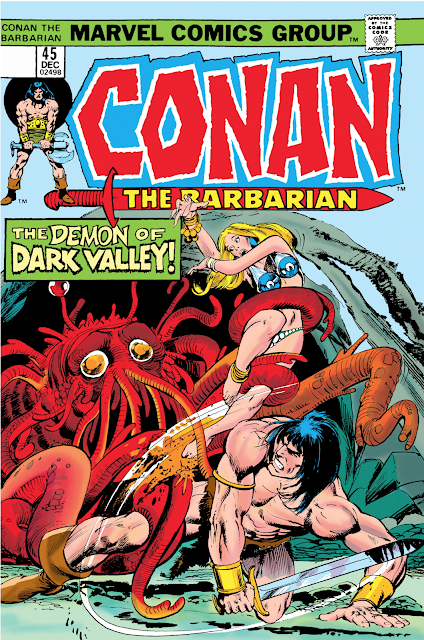

There were lots of tentacles on the cover of Conan the Barbarian. Here are just two tentacled covers. Top: Conan the Barbarian #32 (Nov. 1973), with cover art by Gil Kane and Ernie Chua. Bottom: Conan the Barbarian #45 (Dec. 1974), with cover art by Gil Kane, Neal Adams, and Crusty Bunkers. Others from the first one hundred issues include #25, #72, and #86. The images here are from Marvel Database, hence the lack of price tags and the cleaned-up images.

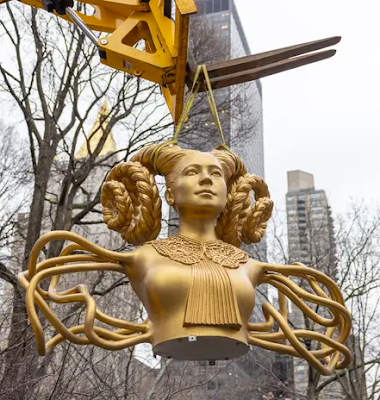
Tentacles are in the current art world as well. Here is a photograph by Rashmi Gill showing the raising of a sculpture called "Witness," created by Shahzia Sikander, in New York City. It's meant to honor a late Supreme Court justice. That's why she's wearing a lace collar. The hair is similar to a Hopi maiden's, but it's more like a pair of goat horns. Some people have called the statue demonic or satanic. It doesn't help that her arms look like the tentacles of the Octopus Woman who is attacking Conan on the cover above. If a male sculptor had done something like this, he would have been excoriated for mutilating the female form. Instead, I guess, this is an expression of grrl power.

Notice that the tentacles are connected to her body on both ends. They look like tubes or conduits or spark plug wires. Is she actually a machine? A cyborg? An AI? A transhuman? Is she feeding into herself, reaching into herself? Is she a multi-limbed female version of the worm Ouroboros? On November 17, 2022, I wrote a little about Pete Townshend's Lifehouse project. In James Harvey's illustration, there are tubes or feeds going into the heads of dehumanized masses of people. They look something like the image above. Or maybe these are manifold Fallopian tubes. Could she be fertilizing and impregnating herself? 

"Witness" is a well-made work. The face, head, and neck are good. But it's also bizarre and antihuman. I guess this is the state of public art in America. We must tear down images of Abraham Lincoln and put up monstrosities like this one as replacements. There will be no end to this of course. Or maybe Weird will end it.

Original text copyright 2023 Terence E. Hanley

Thursday, October 25, 2018

Superheroes and Supervillains

A few weeks ago I wrote a little about heroes and villains. I would like to write more now about superheroes and supervillains as a lead-in to a series involving Weird Tales.

When we were kids, we read a lot of comic books. Most were superhero comics, and even those that weren't about superheroes were often superheroized, for example, Super Goof in Walt Disney comics, Jughead Jones as Captain Hero in Archie comics, Conan the Barbarian in Marvel comics, and even Warlord in DC comics, who always wore the same outfit--and had the same split beard as Green Arrow. We drew superhero comic books, too, and if I can come up with a little time, I'd like to draw more.

Not long ago, someone told me that the word superhero is trademarked by Marvel and DC. I didn't think that could be true. After all, superhero is a word. How can you trademark a word? Especially a word that was in use before there was such a thing as a comic book? So I read a little about it, and I guess Marvel and DC, who haven't always gotten along, jointly own the trademark for a word, or at least they've got everybody scared enough not to challenge them on it. Pretty soon, I guess, you won't be able to use the word marvel without Marvel's (meaning Disney's) permission. Maybe princess will go the same way. Anyway, you would hardly know it today, but there was a time before comic book superheroes. That time was in living memory of people my dad's age and older.

Everybody likes to play the game of firsts. What was the first this, the first that. So who was the first superhero? You could say that Superman was the first superhero as we know them today. If there hadn't been Superman, there would almost certainly have been someone else--that's the way our popular culture was going in the 1930s--but Superman hit at just the right time in just the right way to bring about what is now called the Golden Age of Comic Books. Once Superman arrived, superheroes were here to stay. Some people say that there were superheroes before Superman--Popeye for instance (1929), or The Phantom (1936). I think the Scarlet Pimpernel (1903) is a good candidate for the first superhero, but there are those who would push his origins all the way back to ancient Greece or even to ancient Sumer in the person of Gilgamesh. If we follow a different line of hypostulatin' we might come up with a different answer. As it turns out, that line fits pretty well with what I have found on the origins of the word itself.

I have thought for some time that American popular culture--genre fiction, comics, movies, magazines, sports, etc.--as we know it today began in the 1890s, more or less. The technological, economic, and societal forces that brought that about aren't really the issue here. Instead, if you just look at a few dates, you might agree that there's something to this line of thought:
  • Safety bicycle invented, 1890
  • First color newspaper supplement (Chicago Inter Ocean) in America, 1892
  • First automobile manufacturing company in America, 1893
  • First Ferris wheel, 1893
  • U.S. Golf Association (USGA) formed, 1894
  • First newspaper comic strip (Hogan's Alley by Richard Outcault) published, 1895
  • First movies shown to paying customers in the United States, ca. 1895-1896
  • First all-fiction pulp magazine (The Argosy), 1896
On the other hand, firsts, origins, and beginnings are good cause for fights and debates. So instead of trying to make a case for the 1890s as being the beginning of popular culture in America, I'll just look at the origins of the word superhero and its superkin, superheroine, supervillain, and, yes, superman and superwoman. It won't take long to get back to Weird Tales.

To be continued . . .

Conan was created by Robert E. Howard and first appeared in Weird Tales. The genre inhabited by Conan is now called sword and sorcery or, more to the point, heroic fantasy. We might as well call Conan a superhero, but he wasn't really cast as a superhero until the 1960s or '70s. (Remember that all of the Conan stories published in Howard's lifetime came before the first real superhero comic book.) At the height of the sword-and-sorcery/fantasy craze of those two decades, Marvel Comics began publishing Conan the Barbarian, written by Roy Thomas and illustrated by Barry Smith. The first issue appeared in October 1970 (forty-eight years ago this month). Here is the cover for number 15, from May 1972. Already there were teamups, a feature of superhero comic books, as Conan was joined in this issue by Elric of Melniboné, created by Michael Moorcock and first in print in 1961.

Barry Smith, also called Barry Windsor-Smith, is a British artist who came to Marvel Comics with a pop-culture sensibility. I can see the influence of Jack Kirby in his work, but there's also some Jim Steranko there. But then if Mr. Steranko was influenced by Kirby, then there is only an influence once removed. This is the cover for Conan the Barbarian #16, from July 1972.

Shortly before Marvel began issuing Conan comic books, Lancer Books revived Robert E. Howard's original stories in paperback form. The covers of these books were most famously done by Frank Frazetta. I suspect that the Lancer series were the impetus for Marvel's comic book version. In any case, this pair of images from comic book and paperback versions of the same story from the same period is relatively rare. Both have their merits, but I think the Frazetta illustration makes for a tighter composition, greater action, mystery, and intrigue, and a more evocative image. Conan of Cimmeria, from 1969.

Barry Smith left Conan the Barbarian with issue number 24, in March 1973. With him went much of the otherworldly atmosphere and imagery of the series. In his place came a number of other artists, chiefly John Buscema, who had been doing superhero stories at Marvel for many years. Buscema was fast and had a knack for action, composition, and visual storytelling, but in his hands, Conan became more nearly superheroized. Here is the first cover after Barry Smith, number 25, from April 1973, drawn by Gil Kane and Ralph Reese.

Don't get me wrong. I love John Buscema's work, and I read Conan the Barbarian with real pleasure. When we were kids, we even drew our own sword-and-sorcery comic books. But Conan in Marvel's hands was essentially a superhero. Like the Incredible Hulk, he always wore the same torn clothing over his middle section. (Conan's outfit was always brown and furry rather than purple.) Like Spider-Man, he often teamed up with other superheroes, or in the case of Red Sonja, who also always wore the same outfit, a superheroine. There is even in this cover (no. 78, Sept. 1977) a skewed viewpoint, like in the old Batman TV show. Note the red-robed cultists, another throwback to Weird Tales.

Consciously or not, John Buscema evoked an image from another of the Lancer Conan paperbacks, Conan the Avenger, from 1968, again with cover art by Frank Frazetta.

More evidence of the superheroization of Conan: a Marvel Treasury Edition of Conan the Barbarian, complete with a gorilla cover. (Truth be told, gorilla covers came before superhero comic books. See my previous postings, here and here.) From 1978.

Frazetta could do a gorilla cover like nobody else. I think this is one of his most powerful covers for the Conan series, from 1967.

Text copyright 2018, 2023 Terence E. Hanley

Saturday, November 12, 2016

Conan on the Cover of Weird Tales

On November 11, 2016, Mike Tuz wrote a comment on my article "Winged Creatures on the Cover of Weird Tales." I started to write a reply but it got to be too long and involved for the comments section of this blog. I also wanted to add some images as illustrations. In addition, I had planned to write a series on recurring characters on the cover of Weird Tales. This is the perfect opportunity to begin. So I'll start with Mike's comment and continue with my reply:

Michael Tuz on November 11, 2016 at 7:40 AM

Happy Veterans Day, you happy veteran!

One of the things that I find fascinating when looking at art from days gone by is noting the changes in people's perception of what made a man or woman physically attractive. On the cover of the May '34 issue, Margaret Brundage gives us a version of Conan who looks much like Francis X. Bushman in the silent Ben-Hur; quite different from the now familiar muscleman interpretation that Frank Frazetta created three decades later (and which, in turn, helped launch Arnold Schwarzenegger to movie stardom.)

Hi, Mike,

Thanks for remembering. I served eight years and eight months in the U.S. Air Force and the Air National Guard and in two war zones. People thank me for my service, but I should thank this country and the people of this country for everything that it and they--you--have given me.

I noticed the same thing about the appearance of Conan in Margaret Brundage's illustration. Part of that might be explained by the artist. Her men tend to look civilized, even over-civilized, and somewhat feminine. Margaret was an artist (in pastel!), a woman, and a lifelong city-dweller. So maybe the facts of her sex, biography, and technique have something to do with the way she drew men.

Hugh Rankin's interior illustrations of Conan are closer to our image of the character, despite the fact that Rankin was an urbanite. He was an only child and reared by a single mother (she was an artist, too), but Rankin had a more masculine take on Conan. Over all, though, I don't think that the popular culture of the 1920s and '30s was, in the main, up to the task of adequately portraying a barbarian or savage, at least as a protagonist or a sympathetic character.

Robert E. Howard was able to imagine and identify with the barbarian because he projected himself into the historical past to a time when such people existed. He was also not very much removed from the Wild West. And he thought of himself, I think, as an atavism, as a primitive man living in the wrong century. That may have been a conceit for him, but it appears to have been the foundation of his art: that civilization is merely a veneer laid over the heart of a savage humanity. (Lovecraft thought of himself as a man living in the wrong century as well, but he imagined himself as one of the Augustan Age, a time of high civilization. Lovecraft and Howard, despite everything that separated them, were friends.)

Frank Frazetta, younger by a generation, may have been a city-dweller, but he came up in an almost savage environment in Brooklyn. Though an artist, Frazetta was also physically active (like Howard). He was hard, muscular, an excellent athlete, and good-looking enough to have been a movie star. He was heavily influenced by Hal Foster and Prince Valiant, but he wasn't constrained by those influences. Prince Valiant, though son of Norsemen, is a civilized character. He was also somewhat feminine in Foster's treatment. (Just look at those red lips!) Frazetta turned things around by depicting Conan as a savage and an outsider. Frazetta may have seen something like that in himself. More likely, he saw it in the working men of Brooklyn and maybe the men around him living on the fringes: criminals, gangsters, mafiosi, thugs. Contrast that with Boris Vallejo's posed and wooden bodybuilders with their smooth, precisely chiseled, and depilated bodies. I think that the Arnold Schwarzenegger Conan, with his big and largely useless muscles, is closer to Boris than to Frazetta.

Frazetta was also influenced by the romances of Edgar Rice Burroughs, who, like Margaret Brundage and Hugh Rankin, was a Chicagoan. (Hal Foster was a Chicagoan, too, but not by birth.) Burroughs was a man of action, but his two most well-known characters, Tarzan and John Carter, are civilized men thrust into savage worlds. They themselves are not savages. Here is the same pattern: a man who is essentially an urbanite and thoroughly civilized creates a character who reflects his world. Robert E. Howard was different, and though Frank Frazetta was not in his youth a reader or fan of Howard's stories, I don't think there was a better or more appropriate artist to depict the world he created. And maybe it took the savagery of the Second World War to lay low the Victorian or nineteenth-century idea of an inevitable progression towards a peaceful and civilized world, one without barbarians. Maybe only after the war could Conan have been shown to be what he really is.

* * *

Robert E. Howard wrote seventeen Conan stories published in Weird Tales. The first was "The Phoenix on the Sword," from December 1932. The last was "Red Nails," a three-part serial from July, August/September, and October 1936. Nine of Howard's seventeen tales of Conan were cover stories, but Conan himself was only on the cover three times. You would be right in pointing out that the title of this article isn't quite accurate.

All nine of the Conan covers for Weird Tales covers were drawn by Margaret Brundage. The 1930s were, after all, not only the golden age of Conan but also the golden age of Brundage covers. You might think she was the wrong artist to have drawn Conan. But she was an artist of the feminine, and women--small, dainty, feminine women--were throughout Howard's stories. There were things beyond that in Howard's stories as well, things I think to be in very poor taste if not indicative of psychosexual problems in the author's life and mind. Margaret Brundage depicted those things, too, in two covers, in the process softening them and making them a little less pathological.

So there are nine Conan covers. Three show Conan himself. Significantly, all three show him in peril. Two out of those three show a female character intervening between Conan and that which threatens him, and one out of those two shows her actually rescuing him. This is not our image of Conan, but it's how Margaret Brundage first depicted him, and her interpretation is worth consideration and thought. (She was probably the first artist to depict Conan in color, at least for publication.)

Five out of the nine Conan covers show women only. Women were, after all, the cover artist's specialty and main subject of interest. Two show scenes from Conan stories that can only be described as lesbian/sadomasochistic/fetishistic. (These are the kind of scenes that have often turned me off of Howard's stories.) One more is marginally in that category. Two show a woman being threatened by something other than another woman. Only one--the first--shows a woman who is not obviously threatened.

As Mike Tuz pointed out, Conan here looks like a Hollywood movie actor. He has some muscles, but he is not heavily muscled. In two out of his three covers, Conan is somewhat passive. He is also pretty well groomed and not what we think of as a barbarian. (He doesn't have a beard, as Conan doesn't have a beard. Ironically, the word barbarian refers to men with beards, i.e., men who are uncivilized. In Boris Vallejo's paintings, barbarians don't even have body hair.) But these images are part of the history of Conan the Barbarian, and they deserve a look and no careless dismissal.

Weird Tales, June 1933. Cover story: "Black Colossus" by Robert E. Howard. Cover art by Margaret Brundage. This was the fourth Conan story in Weird Tales and the first Conan cover story. I have shown this image before in "Woman and God or Idol." 

Weird Tales, September 1933. Cover story: "The Slithering Shadow" by Robert E. Howard. Cover art by Margaret Brundage. The second Conan cover story and still no sign of Conan.

Weird Tales, May 1934. Cover story: "Queen of the Black Coast" by Robert E. Howard. Cover art by Margaret Brundage. Finally, Conan, but not as we imagine him: civilized, subordinate to a woman, somewhat passive, and practically shrinking from peril.

Weird Tales, August 1934. Cover story: "The Devil in Iron" by Robert E. Howard. Cover art by Margaret Brundage. This is more like it, at least for real fans of Conan. He still looks like a movie actor, but at least he is active, combative, and superior in position to the woman.

Weird Tales, September 1934. Cover story: "The People of the Black Circle" by Robert E. Howard. Cover art by Margaret Brundage. We're back to no Conan here, but the image is effective.

Weird Tales, December 1934. Cover story: "A Witch Shall Be Born" by Robert E. Howard. Cover art by Margaret Brundage. Another cover showing a woman whipping another woman. This might as well be the same cover as in September 1933.

Weird Tales, November 1935. Cover story: "Shadows in Zamboula" by Robert E. Howard. Cover art by Margaret Brundage. Some people loved Conan. Others hated him. I think Robert Bloch (an urbanite, a Chicagoan, and an heir to one of the oldest and highest civilizations on earth) hated him. Does that explain the absence of Conan on the cover of the magazine? I doubt it. Margaret Brundage liked to draw women and that was that.

Weird Tales, December 1935. Cover story: "The Hour of the Dragon" by Robert E. Howard. Cover art by Margaret Brundage. This was the last Conan on the cover of Weird Tales, and just look at him in his abject state. Locked up, chained, pretty unhappy, and so weak or despairing that he can barely reach out to get the key to his cell from his distaff rescuer. Margaret Brundage's husband was in and out of her life and didn't always provide very well for himself and his family. Eventually the two were divorced. It doesn't surprise me that she depicted men as she did. I wonder now if she ever showed a male figure in a good light, other than the Conan cover of August 1934.

Weird Tales, July 1936. Cover story: "Red Nails" by Robert E. Howard. Cover art by Margaret Brundage. Compare this human sacrifice cover to the painting by Frank Frazetta shown below. It's almost like something out of a Busby Berkeley movie.

In strong contrast to Margaret Brundage's covers, here is an interior illustration by Hugh Rankin for "Shadows in the Moonlight" (Apr. 1934). The figure of the woman is in no way like a Frazetta woman, but the ape and the man could easily have been an influence upon the artist who created images like those that follow . . .

Cover art for Conan (Lancer, 1967), illustrating "Rogues in the House."

Cover art for Conan the Conqueror (Lancer, 1967).

Cover art for Conan the Avenger (Lancer, 1968).

Again, in strong contrast:

A painting of Conan by Boris Vallejo, technically very well done but lacking in the fury, violence, action, and mystery of Frazetta's best work.

I don't think anyone has come closer to Howard's vision than Frank Frazetta, and I don't think anyone ever will. We can be happy that there was once this artist named Frazetta yet sad that no one will ever again be able to do what he did.

Revised on Nov. 15, 2016.
Thanks to RedFury (comment below) for his correction.
Text and captions copyright 2016, 2023 Terence E. Hanley