Showing posts with label Weird Tales Covers. Show all posts

Sunday, August 3, 2025

Strange Rays & Weird Waves in Weird Tales

Weird Tales was a different kind of magazine when it came back in November 1924 than during its first year-and-a-third in print. There was a new look and a different format. Although some of the previous authors had returned, the cover artist, Andrew Brosnatch, was new. And of course there was a new editor in Farnsworth Wright. Weird fiction wasn't fully developed in the early days of "The Unique Magazine." You could say that the development of weird fiction as a genre actually happened in its pages from 1923 onward. Nevertheless, the stories published in Weird Tales between March 1923 and May/June/July 1924 tended to be weird-fictional. Things changed a little when Wright came on.

Farnsworth Wright contributed to Weird Tales in its first incarnation. His first story, "The Closing Hand" (Mar. 1923), is pretty conventional. His second to last, "An Adventure in the Fourth Dimension" (Oct. 1923), is far less so, for it treats the concept of a fourth dimension and touches on Einsteinian or relativistic physics. It's clear that Wright had an interest in stories of that type, which were called at the time pseudo-scientific stories or scientific romances. When he became editor, he set out to publish more in the pages of Weird Tales.

As I have been going through the issues published in 1925, I have noticed a recurring word: rays. I figured I had better make a search for that word and related words and concepts. Radio was big and new in the 1920s. Radium and radioactivity were in the news and in our culture, too. (Radium was discovered in 1898, X-rays in 1896.) We think of "Radium Girls" as a name for the young women of the 1920s who painted glow-in-the-dark watch dials and fell ill--and died--as a result. But in the early twentieth century, "Radium Girls" were performers on stage, their bodies literally highlighted by phosphorescent paint. Phosphorescence isn't the same as radioactivity. I can't say that Radium Girls on stage or in ballrooms were painted with radium-paint (despite the newspaper article shown below). Radium silk, of the same vintage, was not radioactive at all. But there seems to have been a fad for radium and a wider craze for radio. Maybe that's where all of the strange rays and weird waves in Weird Tales came from.

I can't say that this is a comprehensive list, but here are some ray and wave stories in Weird Tales from 1924 to 1926: 

  • "The Purple Light" by Ralph Parker Anderson (Nov. 1924) 
  • "Radio V-Rays" by Jan Dirk (Mar. 1925) 
  • "The Electronic Plague" by Edward Hades (Apr. 1925) 
  • "Under the N-Ray" by Will Smith & R.J. Robbins (May 1925)--Cover story. 
  • "The Ether Ray" by H.L. Maxson (Sept. 1925) 
  • "Red Ether" by Pettersen Marzoni (two-part serial, Feb.-Mar. 1926)--Cover story.
  • "The Devil Ray" by Joel Martin Nichols, Jr. (May 1925)--The title doesn't refer to a type of fish but to a devastating form of radioactivity.
  • "Queen of the Vortex" by F. Williams Sarles (May 1926)--This story had a sequel in "The Foe from Beyond" (Dec. 1926).
Stories of vortices lead into another category of proto-science fiction, one related to multiple dimensions of space and what we would call space warps. But that's a topic for another time.
 
Weird Tales Cover for May 1925
Weird Tales, May 1925, with a cover story, "Under the N-Ray," by Will Smith and R.J. Robbins and cover art by Andrew Brosnatch. There aren't any rays shown here, but there are waves.
 
Weird Tales Cover for February 1926
Weird Tales, February 1926. The cover story was "Red Ether" by Pettersen Marzoni. The cover artist was C. Barker Petrie, Jr. Here again, there aren't any rays and the only waves are in the distance. Maybe artists of the 1920s had trouble depicting rays, waves, and radioactivity.
 
Text copyright 2025 Terence E. Hanley
 
And because I have messed up the formatting of this article and can't figure out how to fix it, a picture after the copyright notice: 
 
"Will Dance in a Glow of Radium," from the San Francisco Examiner, May 25, 1905, page 4. "Radium Girls" were in burlesque and vaudeville shows in America and Great Britain from 1904 into the 1920s. By 1930, "Radium Girls" were the young women poisoned by their use in industry of radium-paint. If there was a fad for radium, maybe it reached its end with the well-publicized lawsuit filed by and the deaths of the "Radium Girls" in the late 1920s and early 1930s. This illustration shows two "Radium Girls" in the original sense of the phrase. (The Margaret Hamilton shown here was not the same actress who played the Wicked Witch.) It also hints at "Radium Girls" in the second sense, showing as it does a young woman with a paint brush. By the way, there was revue called "The Radium Girl" performed in Britain in the early 1900s. The girl of the title is dosed with radium by the villain Zigani and "she becomes a girl fond of a butterfly existence." (Source: "The Hippodrome Visit from 'The Radium Girl'," in The Derby Daily Telegraph, May 2, 1916, page 2.) 

Friday, April 18, 2025

Crosses on the Cover of Weird Tales

Today is Good Friday, representing the day on which Jesus Christ died upon the Cross. Weird Tales was of course a popular and secular magazine, although I would guess that most of its writers were either Christians or Jews, or nominally so.* I'm sure there were some atheists in there, too. Even so, "The Unique Magazine" published stories that have a religious background, or they contain references to religion and faith, or some of their characters are believers in God. Six years ago, I wrote about Easter stories, of which there were at least three in Weird Tales. You can read what I wrote by clicking here. If anyone finds more Easter stories, I would be happy to hear about them.

I have found crosses on six covers of Weird Tales. Most of these are incidental to the picture. Three are of crosses as headstones or parts of headstones. The first illustration below, created by Hugh Rankin, shows men who look like Crusaders, but the crosses on their surcoats appear to be upside down. And they are looking to a cross upon which a bat is hung. So even though this looks like it could be a Christian scene, it's not. It's actually an inversion and corruption of Christianity. Reading the story confirms as much. The third picture below, by C.C. Senf, is a picture of torture or punishment. It sure looks like the red-robed cultists are affixing a woman to a cross.

Regarding the second picture below, illustrating "A  Million Years After" by Katherine Metcalf Roof, I am reminded of something I noticed several years ago in the comics page. It used to be that in the comic strip Beetle Bailey, drawn by the late, great Mort Walker, any long view of Camp Swampy would show the camp church or chapel with a cross on top. That's what churches are like. But then, after Mr. Walker died, an editor must have gotten ahold of the strip--an editor who must think of crosses as being exclusive or offensive, I guess--because the cross disappeared. There was and still is a chaplain, Chaplain Stainglass, but he appears to be a preacher without portfolio, for the Cross is the symbol of his Christian faith and now it's gone from his chapel. What a ridiculous and insulting thing for the people behind Beetle Bailey to do. How stupid and petty. But we should remember that there have always been and always will be anti-Christian people, ideas, and actions--until there aren't anymore. Anyway, Happy Easter to Everyone, even if you don't believe in anything.

-----

*One of those writers was a Christian minister, Reverend Henry S. Whitehead (1882-1932).

Weird Tales, December 1928, with cover art by Hugh Rankin. Cover story: "The Chapel of Mystic Horror," a Jules de Grandin story by Seabury Quinn.

Weird Tales, November 1930, with cover art by C.C. Senf. Cover story: "A Million Years After" by Katherine Metcalf Roof.
Weird Tales, February 1932, with cover art by J. Allen St. John. Cover story: "The Devil's Bride" by Seabury Quinn.

Weird Tales, April 1939, with cover art by Virgil Finlay. Cover story: "Susette" by Seabury Quinn.

Weird Tales, May 1946, with cover art by Ronald Clyne. Cover story: "The Valley of the Gods" by Edmond Hamilton.

Weird Tales, January 1952, with cover art by Jon Arfstrom. I talked to Jon Arfstrom at PulpFest, in Columbus, Ohio, in the last year of his life. He said that this was a portfolio piece that he submitted to Weird Tales. The editor decided to run it as a cover, but the proportions were off, and so a green shape was added to the top of Mr. Arfstrom's illustration and the main title logo placed over the top of it. The cover text reads "The Black Island" by August Derleth, but I can't say that Derleth's is the cover story.

Text copyright 2025 Terence E. Hanley

Saturday, January 25, 2025

Pyramids on the Cover of Weird Tales

I wrote recently of pyramids, and this month I'm writing about the January 1925 issue of Weird Tales. Today I can write about both, for on the cover of that issue is a pyramid, a step pyramid and the only one of its kind to appear on the cover of "The Unique Magazine." There had been pyramids before, on the first-anniversary issue of May/June/July 1924. There would be one more in the original run of the magazine, in February 1929, and one more after that, in Winter 1985.

Weird Tales, May/June/July 1924, the first and only quarterly issue of "The Unique Magazine." Cover story: "Imprisoned with the Pharaohs" by Houdini (ghostwritten by H.P. Lovecraft). Cover art by R.M. Mally.

Weird Tales, January 1925. Cover story: "Invaders from the Outside" by J. Schlossel. Cover art by Andrew Brosnatch

"I heard sighs of horror from my two companions beneath me, and for a single moment we hung motionless along the chain's length, swinging along the huge pyramid's glowing side at a height of hundreds of feet above the shining streets below. Then the creature raised one of its tentacles, a metal tool in its grasp, which he brought down in a sharp blow on the chain at the window's edge. Again he repeated the blow, and again.

     "He was cutting the chain!"

Weird Tales, February 1929. Cover story: "The Star-Stealers" by Edmond HamiltonCover art by Hugh Rankin.

Weird Tales, Winter 1985. Cover art by Ro H. Kim (Hyang Ro Kim). This cover combines a pyramid with the pyramidal body and tentacles of Rankin's previous design.

Text copyright 2025 Terence E. Hanley

Tuesday, January 21, 2025

Two Poems About Two Crows

Francis Hard, aka Farnsworth Wright, had a poem called "Two Crows" in the January 1925 issue of Weird Tales. Just six years earlier, Wright had been a soldier stationed in France. In composing his poem, he must have drawn on memories of the Great War:

Two Crows
By Francis Hard (Weird Tales, Jan. 1925)

Two crows flapped over dismally
(So wearily, so drearily)
To the blackened limb of a blasted tree;
The shells flew screaming overhead,
And the field was covered thick with dead--
The earth reeked with its dead.

One crow lamented to his mate
(So wearily, so drearily):
"How long, how long must we now wait
For the taste of food that was so good
Before the shrapnel shattered the wood
And loaded the ground with dead?

"The odor sweet of dying men"
(Lamented he so drearily),
"How strangely pleasant was it when
I sensed it first with ravished breath!
But I am sated, and sick to death,
And would fain lie yon with the dead."

A shell came moaning through the air
(So drearily, so eerily)
And burst where the crows were plaining there;
It shivered the wreck of the blasted tree,
And bits of crow fell bloodily
Among the tangled dead.

* * *

A year and a month later, in February 1926, in his capacity as editor, Wright placed a traditional ballad called "The Twa Corbies" ("The Two Crows") in Weird Tales:

The Twa Corbies
(Old Ballad)
[By Anonymous]

As I was walking all alane,
I heard twa corbies making a mane.
The tane unto the tother say:
Where sail we gang and dine today?

In behint yon auld fail dike
I wot there lies a new-slain knight.
Naebody kens that he lies there
But his hawk, his hound, and his lady fair.

His hound is to the hunting gone,
His hawk to fetch the wild-fowl hame,
His lady's ta'en another mate,
So we may mak our dinner sweet.

I'll sit on his white hause-bane,
Ye'll pick out his bonny blue een,
Wi' ae lock o' his gowden hair
We’ll theek our nest when it grows bare.

Mony a one for him makes mane,
But nane sail ken where he is gane.
O'er his white banes, when they are bare,
The wind sall blaw for evermair.

* * *

"The Twa Corbies" was first in print in 1812. A century later, it was reprinted in Ballads Weird and Wonderful (1912), illustrated by Vernon Hill (1887-1972). It seems to me that Farnsworth Wright had read "The Twa Corbies" and was inspired by it in writing his own poem. The refrain, the repeated "wearily," "drearily," and "eerily," would seem to have been inspired by "The Raven" by Edgar Allan Poe and its own refrain of "evermore" and "nevermore," also from its opening line:

Once upon a midnight dreary, while I pondered, weak and weary,

I wrote about "The Twa Corbies" on December 19, 2022. You can read what I wrote by clicking here.

Two corvids on the cover of Weird Tales:

Weird Tales, July 1945, cover art by Lee Brown Coye.

Weird Tales, September 1939, cover art by Virgil Finlay.

And what might be a crow but looks more like a myna:

Weird Tales, January 1946, cover art by Albert Roanoke Tilburne.

Original text copyright 2025 Terence E. Hanley

Sunday, August 6, 2023

Sunday Swipes No. 1

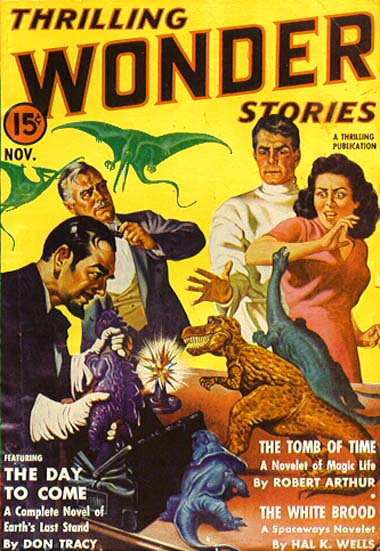
Thrilling Wonder Stories, November 1940, cover art by Earle Bergey.

Weird Tales (Canada), September 1942, cover artist unknown. 

Wednesday, March 1, 2023

Slime, Blobs, Jellies, & Ooze on the Cover of Weird Tales

I have found three covers of Weird Tales showing slime, blobs, jellies, and ooze. You have seen two of these in the past few weeks. I included the third in my catalog of Woman and Monster covers, from January 3, 2014.

One Hundred Years Ago This Month . . .

Weird Tales, March 1953. Cover story: "Ooze" by Anthony M. Rud. Cover art by Richard R. Epperly. It looks like an octopus. It's actually a giant amoeba.

     "Now it touched her. She shrieked. Ice-cold, wet, like rotting slime--it touched her--closer about her--closer!"

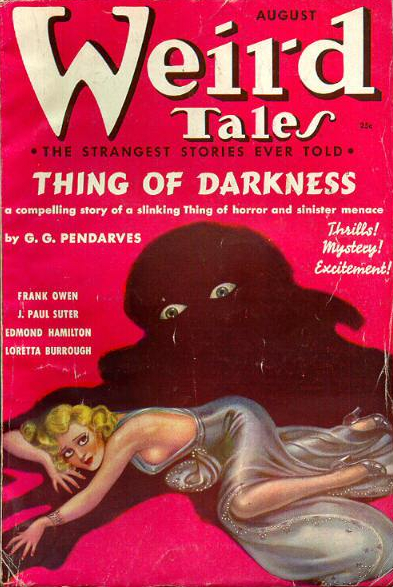
Weird Tales, August 1937. Cover story: "Thing of Darkness" by G.G. Pendarves. Cover art by Margaret Brundage. March is Women's History Month, even though we don't know what a woman is anymore and can't define her. Where's a biologist like H.G. Wells when you need him? Anyway, here's a cover with both a cover story and cover art by women.

Seventy Years Ago This Month . . .

Weird Tales, March 1953. Cover story: "Slime" by Joseph Payne Brennan. Cover art by Virgil Finlay.

Text copyright 2023 Terence E. Hanley

Saturday, February 25, 2023

Tentacles on the Cover of Weird Tales

Tentacles may or may not be the appendage of choice for tellers of weird tales, but there have been a few tentacled covers in "The Unique Magazine." I have seven to show here, but most are not quite right. Richard R. Epperly's cover for the first issue of Weird Tales shows tentacles when it should show pseudopodia. The cover illustrating "When the Green Star Waned" by Nictzin Dyalhis shows tentacle-like appendages, but they're actually arms. But then in February 1929, real tentacles arrived in Hugh Rankin's cover illustrating "The Star-Stealers" by Edmond Hamilton. And not only is the creature on the cover tentacled, it also looks likes a starfish, another of those alien-on-Earth type creatures with its slightly disconcerting radial symmetry.

There's a tentacled creature in the upper right of Hannes Bok's cover from March 1940. It's definitely not the star of the show in the way that Matt Fox's alien from November 1944 is. And then we have to skip four decades into the future for Hyang Ro Kim's take on the tentacled alien or monster. Finally, there is the current issue of Weird Tales and its cover by Bob Eggleton.

There are also covers on the themes of snakes, Medusas, and plants, some of which have reaching and entwining tendrils, but I think that tentacles, despite their similarity in appearance to these things, are distinctly different, for they are among the discoveries of science rather than subjects of myth, legends, and folklore. Authors of the nineteenth and early twentieth centuries recognized that difference, and I think that's why we have tentacled aliens in fantasy fiction.

I haven't included issues of Weird Tales after the 1980s in my writing on this blog. There are almost certainly tentacle-covers in those issues, but that's a topic for another day.

"In the yard Peggy was half engulfed in a squamous, rubbery something which at first glance he could not analyze."

Weird Tales, March 1923, the inaugural issue, with cover art by Richard R. Epperly illustrating "Ooze" by Anthony M. Rud. These are the two cover variants of which I wrote earlier this month.

"They, the Things, slowly raised each an arm, pointed at one Aerthon in the group. He, back to them as he was, quivered, shook, writhed, then, despite himself, he slowly rose in the air, moved out into space, hung above the blobs that waited, avid-mouthed. The Aerthon turned over in the air, head down, still upheld by the concentrated wills of the things that pointed . . ."

Weird Tales, April 1925. Cover art by Andrew Brosnatch. Cover story: "When the Green Star Waned" by Nictzin Dyalhis. I have included this cover here less because the arms of the aliens look tentacle-like than because Dyalhis seems to have been heavily influenced by H.G. Wells' tentacled Martians in The War of the Worlds.

"I heard sighs of horror from my two companions beneath me, and for a single moment we hung motionless along the chain's length, swinging along the huge pyramid's glowing side at a height of hundreds of feet above the shining streets below. Then the creature raised one of its tentacles, a metal tool in its grasp, which he brought down in a sharp blow on the chain at the window's edge. Again he repeated the blow, and again.

     "He was cutting the chain!"

Weird Tales, February 1929. Cover art by Hugh Rankin. Cover story: "The Star-Stealers" by Edmond Hamilton. Proof that tentacled creatures are tool-using.

Update (Feb. 26, 2023): Hugh Rankin is an overlooked artist, I think. I'm inclined to give him the award for Best Tentacled Cover for Weird Tales. His is art from another era and another kind of sensibility. Call it a cultural and historical artifact. It gives us a window onto the past. There are hints of Art Nouveau in this illustration, but Art Deco is the primary style. Note the flamingo-like birds in the background. Note also the triangular motifs that echo the shape of the creature's head, in the serifs of Rankin's hand lettering, in the dark gray side of the pyramid, and in the design containing the cover price.

Weird Tales, March 1940. Cover art by Hannes Bok. The tentacled creature in this cover is a bird-like thing in the upper right.

Weird Tales, November 1944, with cover art by Matt Fox, a master monster-maker. This cover makes me think of that golden-idol monstrosity recently erected in New York City. I included Fox's cover in an article called "Flying Saucers from Before the Great War," August 16, 2020.

Weird Tales, Winter 1985, with cover art by Hyang Ro Kim, aka Ro H. Kim. I have written about this cover before, too, on September 30, 2016.

Finally, the cover for the most recent issue of Weird Tales, what we can accept as the 100th anniversary issue, Number 366, with cover art by Bob Eggleton.

Update (Feb. 26, 2023): Regarding Hugh Rankin's starfish-with-tentacles cover of February 1929, here's another in the same vein, a far more famous cover of DC Comics' Brave and the Bold #28, featuring the Justice League of America in their battle against Starro the Conqueror, March 1960. Only thirty-one years separated those two covers. More than sixty stand between us and the first appearance of Starro.

Text copyright 2023 Terence E. Hanley

Tuesday, December 14, 2021

Tam, Son of the Tiger on the Cover of Weird Tales

Otis Adelbert Kline wrote two long serials for Weird Tales. "Tam, Son of the Tiger" came first. It was in six parts, from June/July to December 1931. Next came "Buccaneers of Venus." It was also in six parts, but the history of Kline's Venus books is a little more complicated than that of "Tam, Son of the Tiger." I'll have more in the next part of this series.

"Tam, Son of the Tiger" was the cover story of four issues of Weird Tales. To devote so many covers to a single story was unprecedented in the history of the magazine. The only thing that might compare is Harry Houdini's three consecutive cover stories in March through May/June/July 1924, and Seabury Quinn's three consecutive cover stories in March through May 1930. However, those were three different stories from each of those two authors. Otis Adelbert Kline would repeat his feat of four consecutive covers with "Buccaneers of Venus," published more than a year after "Tam, Son of the Tiger."

The title character in Kline's story is Tam Evans, a boy carried off by a white tigress into the jungles of Burma. The story of a child raised by wild animals is as old as time. Romulus and Remus were suckled by a she-wolf. Mowgli was raised by wolves, too. And of course Tarzan is of the apes. But Kline gave his story of a jungle orphan a twist, for "Tam, Son of the Tiger" is also a Lost Worlds story. In this case, the Lost World is underground. Called Irimatri, it is vast, populated by strange people, and inhabited by equally strange creatures. The people of Irimatri are bent on conquering the surface of the earth. And now all of a sudden, this sounds familiar . . .

It sounds like the Shaver Mystery of the 1940s and '50s . . .

And the setting sounds like Fred Crisman's fateful flight from Burma and his encounter with malevolent beings--Richard Shaver's dero--somewhere under the continent of Asia . . . 

So were Richard S. Shaver and Fred Crisman inspired by "Tam, Son of the Tiger"? And can we call "Tam, Son of the Tiger" a kind of Hollow Earth story? Like Edgar Rice Burroughs' Pellucidar series? Well, for a very interesting discussion of "Tam, Son of the Tiger," see "Lost Worlds and Jungle Tales of Otis Adelbert Kline," Part 2, by Den Valdron at the website ERBzine, here.

* * *

The cover artist on "Tam, Son of the Tiger" was an old standby, Curtis C. Senf (1873-1949). 


Text copyright 2021, 2023 Terence E. Hanley

Wednesday, November 24, 2021

Thursday, April 15, 2021

Ice & Icebergs on the Cover of Weird Tales

The first installment of "Under the Moons of Mars" was published in The All-Story in February 1912. By April, readers would have been halfway through Burroughs' first published work and the first of what would be eleven volumes recounting John Carter's adventures on Mars.

There was a far bigger story in April 1912, though. On April 15, after striking an iceberg in the North Atlantic Ocean, the RMS Titanic went to Davy Jones' locker. More than 1,500 people died in the disaster, including the American mystery writer Jacques Futrelle (1875-1912). Born in the same year as Edgar Rice Burroughs, Futrelle died as Burroughs was reaching the greatest success of his young life.

There are several covers of Weird Tales depicting snowy scenes and many with ships, but only two that I have found showing ice, and only the first of these also shows a ship.

Weird Tales, October 1923. Cover story: "The Amazing Adventure of Joe Scranton" by Effie W. Fifield. Cover art by R.M. Mally

Weird Tales, May 1939. Cover story: "The Hollow Moon" by Everil Worrell. Cover art by Harold S. De Lay. Note that "Almuric" (part one) by Robert E. Howard was also in this issue. Almuric, an uncharacteristic work by Howard, is more or less a pastiche of Burroughs' Mars novels.

May all who perished rest in peace.

Text copyright 2021, 2023 Terence E. Hanley

Monday, December 21, 2020

Masks & Hoods on the Cover of Weird Tales

I am out of time in this terrible year of 2020. My series on Utopia and Dystopia in Weird Tales will have to wait until after the new year arrives. In the meantime, I offer this entry in another of my series, this one on Weird Tales cover themes. I'll have to make it fast and without providing credits. I should let you know that these are covers showing masks or hoods that obscure at least part of the wearer's face. Hoods and robes that allow us to see his face are out.

My reason for making this entry and showing these pictures should be obvious to all of us living under the current and very crushing coronavirus regime. According to Funk & Wagnalls Standard Dictionary of Folklore (1950), "The function of masks varies from society to society, so that few generalizations can be made either as to their forms or uses." (p. 684) It seems to me, though, that masks can be used both to hide and to reveal, often simultaneously, and that even in the hiding there are signals. In our current situation, there can be little doubt that the wearing of masks is a signal sent out by the wearer, mostly to do with his or her political beliefs and personal psychology, far less to do with science, medicine, or public health.

Some of the masks and hoods shown below are worn by torturers and headsmen, others by cultists. There are some domino masks, which morphed in the 1920s through the 1940s into the mask worn by the uniquely American superhero. There are indeed superhero-like masks in the images shown below, none more iconic than the bat-woman mask from October 1933.

All but two of these masks and hoods are from Western culture, and only one has twentieth-century, technological origins. I think there's something to that--that Weird Tales, working within Western tradition and with its eyes mostly on the past, put the iconography of Western or European culture to good use, even if sometimes it resorted to tropes and clichés. Now here we are, nearly a hundred years after the founding of the magazine, and still we use the same iconography. Remember that the next time you see a superhero in a domino mask, a cultist or other figure wearing red robes (such as the Red Guards in the Star Wars series), and on and on.

One last note: the first image below shows not one but two masked figures, as well as a very, very long woman. The torturer or cultist may be about to sink a knife into her supine figure, but at least he's protecting her from terrible viruses and diseases by wearing a piece of really porous cloth over his face. And don't worry, what he has planned for her is a mostly peaceful human sacrifice. (He's planning to stab only one very small part of her body.) Luckily for her, she is about to be saved by a man in blue.


Love in a Time of Coronavirus

All of this mask-wearing makes me think of cartoons by the great Sam Cobean, especially the one shown here. From The Cartoons of Cobean (1952).

I wish everyone a Merry Christmas and Happy New Year, better for sure than the one now ending.

Text copyright 2020, 2023 Terence E. Hanley