Showing posts with label Dave Stevens. Show all posts

Tuesday, July 7, 2026

Music, Automobiles, & Rocketships-Part Two

Rocket 88

I don't have a very good title for this new series, but when you're going to throw in everything but the kitchen sink, you've got to settle on something. I'll begin with Rocket 88.

After World War II, weird fiction faded and science fiction and the whole culture around it began to take off. Monsters were no longer the supernatural monsters of moors and marches, nor were ghosts the haunters of castles and abbeys. Instead, the ghosts and monsters of the post-war world were those of science and technology. We encountered them in places opened up by war as well as by exploration along the frontiers of science and technology. In The Thing from Another World (1951), that frontier is in the Arctic. In It Came from Outer Space (1953) and Them! (1954), the frontier is the American West, a place dotted with World War II-era military installations, the place where atomic bombs, rockets, missiles, and jet aircraft were developed and tested. These weren't the dark, decaying, gloomy, closed-in places of weird fiction and the Gothic romance. Instead they were bright, sunny, shiny, open, futuristic.

In 1949, Oldsmobile introduced its 88 model, nicknamed Rocket 88 for its Rocket V8 engine. The Oldsmobile Rocket 88 was a popular car, so popular and recognizable in its name that it inspired a song, "Rocket 88," released in 1951, sung by Jackie Brenston, and backed by Ike Turner and his Kings of Rhythm. Like the car, the song was a hit. There were car songs before it, but this was a big one. Some people call it the first rock 'n' roll record. It's nice to think that rock 'n' roll started with a car song.

In its advertising, Oldsmobile tied its Rocket 88 to its namesake technology. For example:


Thirty-four years later, artist Dave Stevens created the following cover for Planet Comics in its issue of July 1984:

The print of this illustration is entitled "Rocket 88" after the emblem on the fuselage. Notice that the riders in each of these two pictures are two in number and in roughly the same posture and position. I wouldn't call this a swipe. Instead, it looks like the first picture inspired the second, or call it a variation or an homage. Notice that the blonde pilot in the second picture is wearing a Nazi-like hat like a British New Wave singer or musician of the same period. (As I write, New Order has come on the radio. I was thinking of Modern English, but my psychic powers aren't strong enough to make that happen.) This comic book was published in the same year as Neuromancer by William Gibson. Don't you wish we had 1980s culture back? 

By the way, Planet Comics was a revival of a comic book title in print from 1940 to 1953. The original Planet Comics was the first science fiction comic book and a spinoff of the science fiction pulp magazine Planet Stories. Ray Bradbury and Leigh Bracket were among the authors published in Planet Stories.

Here is a poster design for Rocket 88, a local band in Wisconsin from 1972 to the 1990s or after. Notice the influence of artist Jack Davis, also of underground comics:


I'm afraid I don't know the name of the artist.

Americans have tested not only rockets, missiles, and jet airplanes in the Desert West. We have also tested automobiles. In 1953, General Motors opened its new automobile proving grounds just outside of Mesa, Arizona. Those proving grounds are no longer in operation. In their place are maze-like subdivisions with science-, space-, and technology-related names: Neutron Point, Wavelength Park, Lunar Green Park. If you have ever watched American car commercials, you are familiar with all of the scenes shot in the Desert West. Automobiles go with the West like A-bombs at Trinity, the Bell XS-1 at Muroc Army Air Field, V-2 rockets at White Sands Proving Grounds, and giant ants in the tunnels under Los Angeles.*

Automobiles and rockets were tested on the salt flats and dry lake beds of the American West. In the 1950s, cars were made to look like rockets with their chrome trim and nosecones and trailing fins. I remember our neighbor, Mr. Sherman, who had a giant 1950s light blue Cadillac. (I think it was an El Dorado Seville, circa 1956.) One time he forgot to put it into park. After he went in the house, his car rolled down the driveway and with a crash speared a parked car at the bottom with its short, heavy fins. Mr. Sherman came out of the house and drove his car back up the driveway. He went back inside, and that seemed to be the end of it. His car was untouched. No such luck for the 1970s car on the receiving end of the crash. Anyway, from the 1950s to the 1970s, cars were named after spacecraft and celestial bodies: Ford Galaxie 500, Mercury Comet, Oldsmobile Rocket 88, Oldsmobile Starfire, Plymouth Satellite, Pontiac Star Chief, Studebaker Starlight, and from the advertisement in the previous entry, Chevrolet Nova and Chevrolet Vega. The Saturn line came along about a decade later. The point is that there were clear connections made between cars and rockets, and between cars and outer space. There were also connections between these things and other aspects of popular culture, including music, comic books, and science fiction. For example, in July 1979, the B-52s issued a single called "Planet Claire," which begins with these lyrics:

She came from Planet Claire
I knew she came from there
She drove a Plymouth Satellite
Oh, faster than the speed of light . . . .

So here is a science-fictional rock song played by a band named after a superfast jet airplane from the 1950s--with eight engines no less--in which the subject drives a Plymouth Satellite. The only thing missing in all of this is a comic book. But there will be another one of those in almost no time at all.

Hold onto the idea of the science-fictional automobile.

(As an aside, the U.S. Air Force rolled out the Boeing B-52 Stratofortress in March 1954. It was preceded by the Boeing 377 Stratocruiser, which had its first flight on July 8, 1947, the same day that the U.S. Army announced that it had recovered the remains of a flying disc near Roswell, New Mexico. The Fender Stratocaster electric guitar, named for one kind of airplane or another, made its debut in the same year as the B-52 Stratofortress, 1954.)

From 1960 to 1979-1980, the Oldsmobile emblem was a rocket blasting out of a cartouche. Maybe you remember it:


I wanted a simpler graphic representation. You will see why in 10, 9, 8, 7 . . .

If you're a fan of 1950s science fiction, maybe you'll recognize the rocketship emblem:


This one was on the spine of the Winston Science Fiction series of juvenile novels published from 1952 to 1960. That series was graced by the artwork of former comic book artist Alex Schomburg and included the images of many, many rocketships.

Here's another rocketship blasting off into space:


Weird still had some cachet in the late 1940s and into the 1950s. Sometimes it was paired with superheroes (Captain America's Weird Tales, 1949-1950), more often with science fiction and fantasy as in EC Comics' Weird Science (1950-1953), Weird Fantasy (1950-1953), and Weird Science-Fantasy (1954-1955). Above is the cover of Weird Science-Fantasy #24, published in June 1954, with cover art by Al Feldstein. The rocket design in the left margin was a standard feature of that title. By the way, Jack Davis, mentioned above, also worked on EC Comics. By the way again, Weird Tales magazine came to an end in September 1954, just two months after this comic book was published. Science fiction magazines lived on.

The first time I ever heard the word modockin, I was a student at a flatland high school in Indiana. A friend named Greg used it a lot. I knew what it meant by the context. It means to drive really fast or for a car to go really fast. I thought I knew its origin. For years I thought it was in reference to a place in California where jet airplanes and maybe rocket sleds were tested. But that was Muroc, not Modoc. Muroc is where Chuck Yeager broke the sound barrier in October 1947, a month after the U.S. Air Force was created and the same year in which the first flying saucers were sighted. You could say that in his flight he was really modockin.

If you look on the Internet, you will see that the word modockin is supposed to be from Modoc Brothers Trucking, which supposedly operated in Indiana and Illinois back in the old days, whenever that was. I haven't found any mention of the modockin Modoc Brothers in old newspaper accounts. I did find, though, that there was a racehorse called Modockin in the 1960s. Before that, there was a song, "Modockin" by the Silver Jets, recorded in 1962 in Frankfort, Indiana, and released by Parr Records. (I think it was actually a rock instrumental.) The Silver Jets were a local band in Frankfort. In 1962, they shared a bill with Roy Orbison at Shady Acres auditorium outside of Mulberry, Indiana. Mulberry, by the way, was the birthplace of brothers Vesto M. Slipher (1875-1969) and Earl C. Slipher (1883-1964), both of whom were astronomers. They didn't do any modockin themselves as far as I know, but they studied celestial objects that have a lot of get up and go. These two non-modockin brothers have a crater of the moon and an asteroid named after them. Anyway, the word modockin has its Indiana connection, maybe in fact has its origins in the Hoosier State. I also found that there is a school in Modoc, Indiana, called Union Junior/Senior High School. Guess what the name of their school mascot is. Believe it or not, it's the Rockets!

Watch them blast off!


*The non-science fiction equivalent of Them! might be He Walked by Night (1948), in which a man who may be a sociopath is finally tracked down in the tunnels under Los Angeles. The sociopath or psychopath--recognizable, describable, diagnosable by science--can be interpreted as a monster of science and suitable for the post-weird fiction twentieth century.

To be continued . . .

Original text copyright 2026 by Terence E. Hanley

Sunday, May 20, 2018

From Palmer and Shaver to Barker and Bender

If it weren't for Ray Palmer, we wouldn't have had a Shaver Mystery, and if it weren't for him, we probably wouldn't have flying saucers. You can curse him or praise him, but you sure can't ignore him.

Palmer didn't invent either of these belief systems, but he knew a good thing when he saw it, and he was likely unmatched among science fiction editors in bringing fringe ideas into the real world. Perhaps thwarted in his visions and ambitions while at Ziff-Davis of Chicago, Palmer founded, with Curtis Fuller (1912-1991), Clark Publishing Company sometime in 1947. Venture Press, also founded or co-founded by Palmer, may have been a forerunner to Clark Publishing Company. On the other hand, the two may have run side by side, with Fuller and Palmer at the helm of one and Palmer alone on the other. In any case, in 1948, Venture Press published in hardback I Remember Lemuria! by Richard S. Shaver, while Fuller and Palmer put out the first issue of Fate under their jointly held Clark Publishing Company. The cover story in that inaugural issue of Fate was of course Kenneth Arnold's account of his sighting of flying saucers over Mount Rainier on June 24, 1947. That was the same month--June 1947--in which Ziff-Davis put out an all-Shaver Mystery issue of Amazing Stories under the editorship of Ray Palmer. It's funny how all of these things fit together.

Palmer was out the door at Ziff-Davis at the end of 1949. The last issues of Amazing Stories and Fantastic Adventures in which he was credited as editor were those of December 1949. By then he was already working as editor of a new digest-sized magazine, Other Worlds Science Stories, first issued in November 1949. Put out by Clark Publishing Company, then by Palmer Publications, Other Worlds printed both fiction and non-fiction (plus pseudo-fiction and pseudo-non-fiction) in its eight years in print. Just before giving up the ghost in 1957, Other Worlds Science Stories became Flying Saucers from Other Worlds.

It was through the letters column of Other Worlds that Gray Barker and Albert K. Bender met in 1952-1953, and it was through their meeting that a new and bizarre chapter in the history of science (non-)fiction (or science-pseudo-non-fiction) began. It occurs to me now that in writing about the Flatwoods Monster, Men in Black (MIB), the Shaver Mystery, secret bases in Antarctica, and people who knew too much about flying saucers, Barker played the Palmer role to Bender's mad Shaver.

To be continued . . . 

Other Worlds Science Stories, November 1949, the first issue, with a cover story by Richard S. Shaver called "The Fall of Lemuria." In hindsight, the title can be seen as ironic, for the Shaver Mystery was, as we now know, in decline by the end of the 1940s. Very nearly banished from the Ziff-Davis titles, it would survive another few years under the wing of Raymond A. Palmer. The cover art is by Malcolm H. Smith.

Shaver's name next appeared on the cover of the March 1950 issue of Other Worlds. I don't know what's going on in this picture, but it looks like it involves a giant red rubber band. (The slingshot effect maybe?) The cover artist was once again Malcolm H. Smith. 

The September 1950 issue, with cover art by Smith, included a story by Shaver under his pseudonym Peter Dexter.

Shaver's name reappeared on the cover for October 1951, but only his surname and only at the bottom of the page. Far more prominent were the title and author's byline of the presumed cover story, "I Flew in a Flying Saucer." The confessional title of Captain A.V.G.'s two-part serial evokes the equally confessional "I Remember Lemuria!" from Amazing Stories from six years before. The cover artist by the way was H.W. McCauley.

This issue of Other Worlds was probably on the newsstand in September 1951, the same month in which The Day the Earth Stood Still was released. (The exact date of release was September 18.) I can't say for sure, but that film may have been the first to show an alien abduction. A more sensationalistic title could easily have been I Was Abducted by an Alien from Outer Space or I Went Aboard a Flying Saucer. Keep in mind, all of this took place several months before George Adamski first claimed to have gone aboard a flying saucer. In other words, it happened in science fiction (or science-pseudo-non-fiction) before anyone made any claims that it had happened to him or her in real life. This trend continued throughout the prime years of the flying saucer era, from 1947 to 1968 (or 1973): ordinary people imagined little if anything before it was imagined by authors and artists of science fiction. 

Other Worlds Science Stories, January 1952, with more flying saucer content, this time concerning Kenneth Arnold, the original witness. The cover art, again by McCauley, was reused, I think, for a cover of Fate magazine. Or maybe it was on the front of Fate first.

Other Worlds Science Stories, March 1952, with cover art by Malcolm H. Smith. This was the first issue of the magazine to show flying saucer-like craft on the cover, this despite Palmer's obvious enthusiasm for the subject.

Other Worlds got along for many issues with good cover art, not only by Malcolm H. Smith--the artist here--and H.W. McCauley but also by Hannes Bok and others. Smith's cover, from April 1952, is one of my favorites. This is the kind of image that made people love science fiction during the 1940s, '50s, and '60s. The interior of the ship in the foreground reminds me of the the tomb-lid at Palenque, which some people believe shows a Mayan king at the controls of a rocketship.

Shaver's byline was back on the cover of Other Worlds in July 1952. The artist was Malcolm H. Smith.

Other Worlds Science Stories, August 1952, with cover art by Smith. This was the last issue of the magazine to appear before the sighting of the Flatwoods Monster, which took place on September 12, 1952. (There was no September 1952 issue of Other Worlds.) I doubt that any of the witnesses saw this image, but the men shown here encased in their machines bear a vague resemblance to the monster, especially a later interpretation that says that what Kathleen May and the boys of Flatwoods saw was not an alien itself but an alien riding inside a kind of machine. I would refer you to the theories and artwork of Frank Feschino, Jr.

Albert K. Bender's letter to the world, informing it of the creation of the International Flying Saucer Bureau, appeared in the December issue of Other Worlds. Gray Barker down (or up) in West Virginia read that letter and sent one of his own to Bender in his Connecticut home, thereby introducing himself. For a year or more prior to writing, the two men must have read a lot of flying saucer content in Other Worlds: fiction, non-fiction, and even advertisements. Both had been interested in science fiction, flying saucers, and--significantly--the Shaver Mystery for years prior to that. Their enthusiasm must have been high at the end of 1952, and each must have felt he had found in the other a kindred spirit. This remarkable cover, by Malcolm H. Smith, shows what might be called an influencing machine at work. See the last image below for another machine of this type.

This cover of Other Worlds, from January 1953, has nothing to do with anything, but I couldn't pass it by. The artist was H.W. McCauley. You might notice an influence on Frank Frazetta. I thought of a different image by Dave Stevens . . .

. . . proof that there is nothing new under the sun (or moon).

Something happened to Other Worlds Science Stories in 1953. Although Bea Mahaffey, a science fiction fan out of Cincinnati, came on to assist Raymond Palmer, the magazine disappeared after its July issue that year and didn't reappear until May 1955. Palmer and Mahaffey were still editors then, but the magazine was now published by Palmer Publications, Inc. I suspect this was all tied up with Palmer's selling his interest in Fate (presumably also in Clark Publishing Company) to Curtis and Mary Fuller. That may have left him with Other Worlds Science Stories, but the magazine seems to have taken a step down after the deal. That's Virgil Finlay art on the cover and you can't go wrong there, but it was old art even then and reproduced here in black and white instead of the original color. The design and maybe the paper and printing were cheaper, too. After seventeen years as an editor of science fiction magazines, Palmer seems to have gone into decline. 

Other Worlds Science Stories, May 1957, with cover art by an unknown artist, colored and recycled from a previous appearance on the cover of a Shaver Mystery-related title. I have wondered about this image before. It may have been done originally by Steele Savage, but I can't say for sure, and I don't think that anyone can at this point. In any case, its use demonstrates, I think, that Other Worlds and Palmer himself were falling on hard times. 

Then, in June 1957, Palmer issued Flying Saucers from Other Worlds, an unnumbered issue that may or may not have been a continuation of Other Worlds Science Stories. The occasion was no doubt the tenth anniversary of the first sighting of flying saucers. The cover art, if you can call it that, is pretty horrendous, a collage of photographic images and blobs of ink. I suspect that the moiré effects are in the scanning rather than in the original, but you never know.

Palmer returned to the Other Worlds format in July 1957 but retitled his magazine Flying Saucers from Other Worlds. The cover art, by Malcolm Smith, was recycled from the December 1951 issue. Inside was the story "Quest of Brail" by Richard S. Shaver, also recycled, from Amazing Stories, December 1945, that golden year of the Shaver Mystery. This was the penultimate issue of Other Worlds. The magazine came to an end in October 1957.

Finally, in July 1958, Shaver and his mystery had their last gasp in an American science fiction magazine when Fantastic published a special Shaver Mystery issue. Thereafter, he and it were relegated to the pages of magazines on the fringes, magazines published by Palmer and by Shaver himself. To be fair to both men, science fiction pulps were coming to an end, too, in the late '50s. I have read that the last pulp magazine of this genre was published in 1958 and the last pulp magazine of any genre in the early 1970s. By then, the flying saucer era had reached its end, too, while Shaver and Palmer were in the last decade of their lives. In the meantime, Gray Barker and Albert K. Bender kept the memory of the Shaver Mystery alive, at least for a while.

Text copyright 2018, 2023 Terence E. Hanley

Tuesday, November 15, 2016

Gorillas on the Cover of Weird Tales

There were gorillas in my recent posting, "Conan on the Cover of Weird Tales," and there are gorillas here, on two covers of Weird Tales. I expected more before beginning my search, but then Weird Tales didn't survive very long into what one website calls "The Gorilla Age of Comics," when images of simians proliferated on the covers of the nation's comic magazines. I'm not sure why gorillas were so popular in those days, especially in DC comics. In any case, Weird Tales beat them all to the punch with the images shown here.

Weird Tales, June 1923. Cover story: "The Murders in the Rue Morgue" by Edgar Allan Poe. Cover art by William F. Heitman. That's not actually supposed to be a gorilla but an orangutan. Oh, well, at least it's a passable drawing of a simian. The figure of the woman on the other hand is pretty poorly handled, no pun intended. The only thing I can think is that the artist was in a hurry on the day he drew this picture.

Weird Tales, September 1929. Cover story: "The White Wizard" by Sophie Wenzel Ellis. Cover art by Curtis C. Senf. Before there was King Kong, there was this cover for Weird Tales.


Here are two gorilla covers out of millions. Above, Strange Adventures #45 from June 1954 with cover art by Murphy Anderson. I wanted to show this one because the concept of civilized apes--from a place called "Gorilla World" no less--is so much like that in Planet of the Apes. Everybody remembers the movie from 1968. What is less well known is that the movie was based on a French novel, Pierre Boulle's La Planète des Singes, from 1963, nearly a decade, I might add, after this comic book came out. Below, Superman's Pal Jimmy Olsen #10 from January 1956 with cover art by Curt Swan and Ray Burnley.

You never want to pass up on a chance to show Dave Stevens' art. Here is his cover for King Kong #1 from 1991, evidence that the age of gorilla covers extended into later decades . . .

. . . even as recently as 2013 when I drew this picture for the back cover of our self-published comic book Five Star Comics. So gorillas were popular on the covers of comic books from the 1950s and '60s. Well, so were atomic bomb explosions and infinity covers. What you're seeing here is--I think--the world's first and only gorilla/A-bomb/infinity cover. (There is also an element of time travel.) It illustrates my story "A-Bombs into Infinity." The only thing it's missing is a flying saucer. Image copyright 2016 Terence E. Hanley.

Text and captions copyright 2016, 2023 Terence E. Hanley

Tuesday, October 4, 2016

Dave Stevens (1955-2008)

Comic Book Artist, Comic Strip Artist, Illustrator, Storyboard Artist
Born July 29, 1955, Lynwood, California
Died March 11, 2008, Turlock, California

Dave Stevens is too big a subject for a mere blog article. I have to admit that I admire his art so much that it's still hard for me to think about his passing or to write about his life and work. I will say only that Dave Stevens was married to the former Charlene Brinkman in 1980, that their marriage lasted only six months, that she continued modeling for him after that, and that she was the model for his only illustration for Weird Tales, for her own story "The Pandora Principle" (with A.E. van Vogt), from Fall 1984.

Dave Stevens' Illustration in Weird Tales
"The Pandora Principle" by Brinke Stevens and A.E. van Vogt (serial, Fall 1984)

Further Reading
Any number of sources on line and in print.


Text copyright 2016, 2023 Terence E. Hanley

Saturday, August 17, 2013

Weird Fiction & Fantasy Magazines-Weird Tales Part 5

Lin Carter's last issue of Weird Tales came out in Summer 1983. That's also the last issue of Weird Tales listed in The Collector's Index to Weird Tales by Sheldon R. Jaffery and Fred Cook (1985). Then the troubles began.

I don't know anything at all about the two issues of Weird Tales put out by Bellerophon Network in 1984-1985 except what I have read on three sources on the Internet. I have never seen these two issues. Probably few people have, as they are reputed to be rare. In any case, Bellerophon Network of California published two issues of Weird Tales and called them Volume 49 of the magazine. According to the Internet Speculative Fiction Database and the online Encyclopedia of Science Fiction, Gordon M.D. Garb was the editor of both issues. Wikipedia tells a different and somewhat confused story, suggesting that Gil Lamont and Forrest J Ackerman were the editors of the first issue, while giving Gordon Garb sole credit for the second. The confusion over who was supposed to edit the thing is indicative of other problems, with printing, payments, scheduling, and distribution. On top of all that, the art for the second cover was a swipe from a Victoria's Secret catalogue.

The contents of Weird Tales, Volume 49, are a mixed bag of old and new stories, as well as old and new art. You can read the table of contents in detail on the website of the Internet Speculative Fiction Database.

Weird Tales
Fall 1984 to Winter 1985
2 issues (Volume 49)
Published by: Bellerophon Network (Brian Forbes)
Edited by: Gordon M.D. Garb
Format: Quarto; Fall 1984: 76 pages; Winter 1985: 96 pages

Weird Tales, Fall 1984, with cover art by Ro H. Kim.
Weird Tales, Winter 1985, with cover art credited to Hyang Ro Kim although the art is clearly signed "Ro H. Kim." Jim Stafford's girlfriend would not like these covers, as they include spiders and snakes.
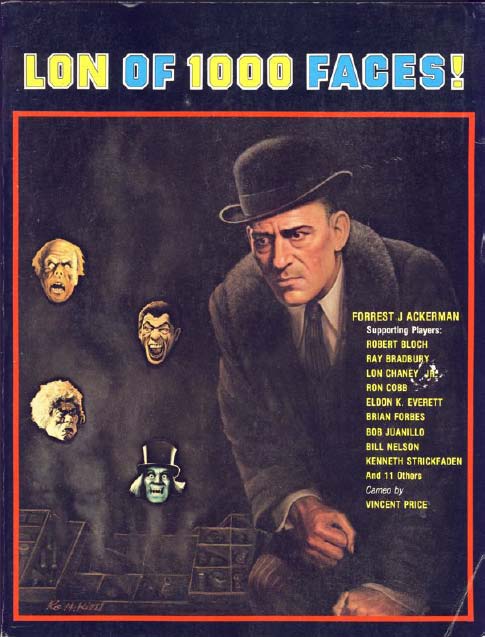
As a bonus, here's another piece of art by Ro H. Kim, the cover of Lon of 1000 Faces! by Forrest J Ackerman (1983).
P.S. (Aug. 18, 2013): Another bonus: If the 1984-1985 version of Weird Tales has done nothing else, it has at least allowed us to add Dave Stevens' name to the list of artists who contributed to the magazine. Stevens probably has his detractors. I admit that I find his more fetishistic artwork too extreme. But he was an artist who stood apart from the crowd and still does after his death. That's partly because he could draw. But it's the way that he drew, the way he composed a picture, the way he handled a brush. . . .

The illustration is for "The Pandora Principle," part one of an unfinished serial by Brinke Stevens and A.E. van Vogt, printed in the first issue. (It was also the cover story.) Brinke Stevens, the ex-wife of the illustrator, is or has been a student of Esperanto, a marine biologist, an actress and model, and a movie screenwriter. Her biography reads like the work of some fictioneer's imagination. If she were in the pulps, she could be a sidekick to Doc Savage. (Postscript [Aug. 26, 2013]: I was mistaken in assuming Brinke Stevens was not related to Dave Stevens. A reader has corrected me and I have made the correction here. See the comments below.)

Revised on Aug. 18, 2013.
Text and captions copyright 2013, 2023 Terence E. Hanley