Showing posts with label Isaac Asimov. Show all posts

Thursday, November 17, 2022

Literary Circles & Literary Cults

Robert A. Heinlein was such a good and prolific writer and such a full and interesting figure that it will be a long time before the subjects of him and his work are finally worn out. It's fitting that there is a literary society devoted to him. As an English major first time around, I would like to see literary societies devoted to just about anybody.

In reading about Heinlein, I get the sense that he is one of those figures of whom criticism may be considered impermissible, at least in certain circles and on certain topics. There are certain things we're just not allowed to say in regards to him, one of which is that the failure of his second marriage may have been equally his fault as his wife's. And who knows about his first marriage? That was so brief and so long ago that everything from it and everything about it is probably lost.

There are other figures that are similarly considered unassailable. The Islamic Prophet is one. He is believed by his followers, I think, to have been the perfect man. A long time ago, I heard a tall-haired, cigarette-voiced women say the same thing about Elvis. One question that might arise here: If those two men were in a cage match, who would win?

Anyway, Edgar Rice Burroughs is probably in the category of untouchable or unassailable authors. His fans won't permit us to say that he was a pretty lousy writer. Great imagination. Great worlds. But not fully human characters and a terrible writing style. Philip José Farmer is another author with his very devoted fan base. Every year, FarmerCon is held in conjunction with PulpFest. Yes, there is a FarmerCon. I have talked to the men at the Farmer table. Maybe it should be called FarmerTable. I have never read anything by Farmer, though, and so I have nothing to say about his writing. Even if I wanted to say something, and if it were not very favorable, his followers might very well go ballistic. Or since we're talking about Farmer here, maybe that should be ball-istic. But that's only if they could muster enough of the non-science fiction fan's masculinity and vigor to defend themselves and their opinions.

(There's a lot of crossover between science fiction and rock music. Both are led by artists, and the artists have their devoted followers. A lot of rock musicians have been keen on science fiction and have created science-fictional music and science-fictional concept albums. That's a topic for another day, though. One difference between rockers and science fiction fans is that rockers tend to be more vigorous and masculine. For example, Pete Townshend, the true inventor of the Internet by the way, might have been a beanpole when he was young, but that didn't stop him from hitting Roger Daltrey with his guitar. And Roger might be a shrimp, but he still knocked out Pete with one punch. Remember that a famous logo for The Who includes the spear-and-shield symbol of masculinity. [It's hidden in the illustration below.] One of my favorite scenes from The Who's performance at Woodstock is when Pete tells some bearded Marxist freak eff off my effing stage! and then hits him with his guitar. That's how we all ought to respond to these people. Eff off our effing stage! Wham!)

There are women writers in the category of those we're not really allowed to criticize. Virginia Woolf may be one of them. I have a friend whose son was forced to read To the Lighthouse in high school. Imagine being a boy and being tortured in such a way. Don't make them read Virginia Woolf. Let them be boys. Let them read--well, Heinlein. I have a feeling, though, that it is impermissible to say such things. After all, Heinlein and all high school boys are fully charged with toxic masculinity. They are part of a patriarchy that must be smashed. These things have to be gotten rid of. We must read women writers. We must begin with Virginia Woolf.

Margaret Atwood and J.K. Rowling have their devoted fans. There is practically a religion built around The Handmaid's Tale. But neither one of these women is considered untouchable, for both are feminists in the original sense of the word. They're both for, you know, women. And because of that, they must be cancelled, silenced, and erased, the things that, incidentally, women accuse men of doing to women. Women cancelling women. Women silencing women. Women erasing women. Who'd have thunk it? By the way, when I use the words men and women, I mean them in the sense of men and women.

The case of J.K. Rowling reminds me of that of H.P. Lovecraft. When it comes to these two writers, many fans would like to throw out the baby and keep the bathwater. They would rather that Rowling's and Lovecraft's books and stories be anonymous, like the books of the Old Testament, than tolerate the fact that someone has ideas different from their own, or, like Lovecraft, that he has flaws and is therefore human. (Or vice versa.) A reference to babies here is apt.

I don't sense that there are similar circles around writers such as Arthur C. Clarke or Ray Bradbury. (In fact, criticism of Bradbury sometimes seems fashionable.) Maybe it's because they and authors like them did not in their corpus of work create fully realized political, historical, sociological, sexual, or religious systems or worlds. And maybe that's the key: the author who may not be criticized is the same author who creates complete worlds of fantasy into which the reader and fan may fully escape, away from the real world, into the fantastic, where the reader and fan is not frustrated and his life not spoiled, where self-fulfillment, exercises of power, realization of meaning, and even spiritual salvation are possible. Remember here that fan is short for fanatic.

Isaac Asimov may have his circle of defenders or believers. If there is such a circle, some of it would seem lighthearted, as Dr. Asimov seems to have been. Some of it, though, appears more serious, in a cultish kind of way. I think that part has to do with the quasi-Marxism of his psychohistory concept. As we know from critical theory, Marx and his acolytes must never be criticized and everything they do must be tolerated. In contrast, their opponents must not be tolerated and criticism of them and their ideas must be relentless. That might be taking a discussion of Asimov and his psychohistory too far, but remember that we have a weird, scruffy, usually wrong, leftist, Nobel Prize-winning economist who has followed the good doctor in his ideas.

L. Ron Hubbard has his circles of defenders, followers, and believers, but his circles are not literary but something else entirely. They will defend his stories and his writing, but what they're really defending is a belief in their leader. He was-is after all perfect, having purged himself of engrams and raised himself to the eleventieth level of transcendence. So maybe here there are similarities between Hubbard and Heinlein. Maybe one way of looking at the problem of Leslyn MacDonald and her marriage to Robert Heinlein is to see her as a kind of suppressive person. We just don't speak of her--at least in a very favorable way--even though her husband said of her:

Mrs. Heinlein and I are in almost complete collaboration on everything. She never signs any of the stories, but I do better if she's there.

There are of course differences between Hubbard and Heinlein. Maybe you could say that the cult of Heinlein, if there is such a thing, is secular, whereas the cult of Hubbard is pseudo-religious. Also, nobody has ever died because of someone else's faith in and devotion to Heinlein.

Heinlein has his detractors to be sure. He once ran for public office as a Democrat. Now people call him a rightwing kook, a nut job, a fascist. They despise him and never fail to get worked up over him and what he wrote. Some of them seem to suffer from a kind of Heinlein Derangement Syndrome (HDS). They should realize that that's not a good look. The flaw here is that, like his circle of fiercest defenders, sufferers of HDS can't seem to manage thinking about Heinlein and his writings in a dispassionate way. Instead they let their feelings get in the way of their judgment. I guess I have two pieces of advice for people like that: First, if your eye offends you, pluck it out. Second, like Duke Ellington said about music, if it sounds good, it is good. An extension to that might be that no human being is entirely good or entirely bad and nothing that any human being has ever made is perfect. Except for Elvis, we are all imperfect. We are all flawed. That includes Robert A. Heinlein, in his personal life and in everything he ever wrote. In short, in your reading, be even, be discerning, be judicious. If it's good, it's good, and if it's not, it's not. And it doesn't matter who wrote it.
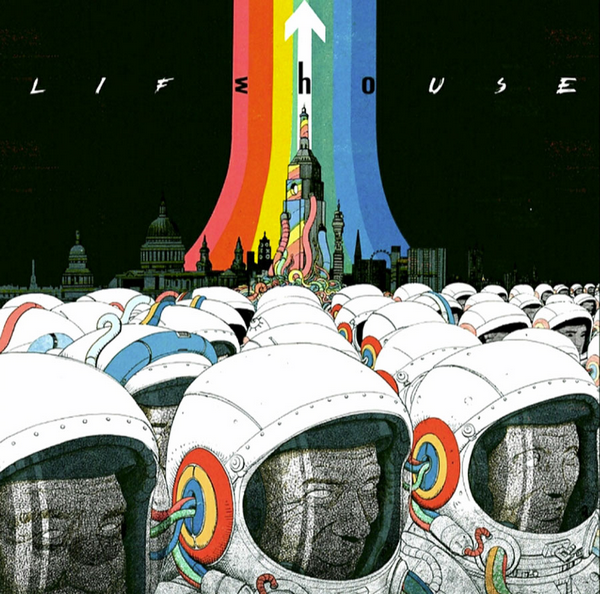
Lifehouse, a multimedia, rock-music-and-science-fiction project created by Pete Townshend inside and outside The Who. Art by James Harvey for Heavy Metal, a project announced for publication in 2020 but maybe not published after all? Note the cables and feeds coming from the lighthouse and into every head.

Pete Townshend and recording equipment, an image that echoes a photograph of James Burke that I posted the other day. Photograph by Chris Morphet / Redferns, originally in The Rolling Stone, February 15, 1969. Again, note the cables and feeds. I do not have rights to either of these images and have reproduced them here under the doctrine of fair use. I will remove them at the request of the copyright holders.

Original text copyright 2022, 2023 Terence E. Hanley

Wednesday, October 12, 2016

Authors on the Cover of Weird Tales

"Child, child--come with me--come with me to your brother's grave tonight. Come with me to the places where the young men lie whose bodies have long since been buried in the earth. Come with me where they walk and move again tonight, and you shall see your brother's face again, and hear his voice, and see again, as they march toward you from their graves, the company of young men who died, as he did, in October, speaking to you their messages of flight, of triumph, and the all-exultant darkness, telling you that all will be again as it once was."
--From "October Has Come Again" in
The Face of a Nation, Poetical Passages from the
Writings of Thomas Wolfe by Thomas Wolfe (1939)
Thomas Wolfe had a special claim on October: he was born in this most nostalgic and evocative of months in 1900, and he returned to the subject of October again and again in his writings. Wolfe's brother Ben--his closest brother--died in that same month in 1918 of the Spanish Flu, a disease that killed more people worldwide than the Great War that had waged before it. Nearly one hundred Octobers have passed since then. Now summer is gone and October has come again, as Wolfe chanted in the passage from which the quote above is taken. This is the season of cut corn and apple cider, of woodsmoke and leaves aflame, of pumpkins, apples, squash, and remembrance. The world and life will come 'round again, but for now, plants retreat into seed, root, and rosette, insects into egg, pupa, and diapause, small animals into their burrows and dens, and we into sweaters, home, memory, and hope.

Edgar Allan Poe died in October. The anniversary of his death--October 7--just passed. Harry Houdini died in October, too, fittingly on Halloween 1926, ninety years ago this month. Those two men were the only authors of whom I am aware who appeared in both name and figure on the cover of Weird Tales. The faces of two artist/authors were on Weird Tales: Virgil Finlay and Hannes Bok created self-portraits in two covers respectively. The last cover shown here from the original run of Weird Tales is less certain to fall into the category of authors on the cover of the magazine. I have included it here only as a possibility. Finally, there is the cover of the Fall 1984 issue of Weird Tales, created by Ro H. Kim with Brinke Stevens as his model. So, two named authors, two self-portraits, a modeled portrait, and an uncertainty. Those make the authors on the cover of Weird Tales from 1923 to 1985.

Weird Tales, March 1924. Cover story: "The Spirit Fakers of Hermannstadt" by Harry Houdini. Cover art by R.M. Mally.

Weird Tales, February 1937. Cover story: "The Globe of Memories" by Seabury Quinn. Cover art by Virgil Finlay. The figure of the swordsman in the center is almost certainly a self-portrait of the artist.

Weird Tales, September 1939. Cover poem: "The Raven" by Edgar Allan Poe. Cover art by Virgil Finlay.

Weird Tales, July 1941. Cover story: "The Robot God" by Ray Cummings. Cover art by Hannes Bok. Again, the male figure is probably a self-portrait of the artist.

Weird Tales, September 1950. Cover story: "Legal Rites" by Isaac Asimov and James MacCreagh (Frederik Pohl). Cover art by Bill Wayne. Asimov co-authored the cover story--that looks an awful lot like him on the right. The anatomy is odd. Note the oversized hand and the misplaced arm.

Weird Tales, Fall 1984. Cover story: "The Pandora Principal" by Brinke Stevens and A. E. van Vogt. Cover art by Ro H. Kim with Brinke as his model.

Text and captions copyright 2016, 2023 Terence E. Hanley

Friday, July 31, 2015

Science Fiction and Dystopia-Part Two

Science fiction, being a fantasy, is by definition escapist. Fans would probably prefer that real life not intrude upon their fantasies. They would rather escape. Nonetheless, reality intrudes, especially in the form of politics. Why is that?

There are two kinds of people in the world, those for whom everything is political and those for whom only political things are political. People in the second group can get along pretty well without giving much thought to politics. People in the first group on the other hand have to insert politics into everything. Their sense of outrage requires them to act, and by acting, impose their will upon everyone around them. They are the kind of people C.S. Lewis called moral busybodies, what we might as well call progressives. They simply cannot rest. They simply cannot leave things alone. The things they can't leave alone include science fiction.

As a fantasy about the future, science fiction has a built-in flaw, i.e., its tendency to become politicized. Left alone, science fiction is escapist fun, or, at the other extreme, big, ambitious, and thought-provoking. But science fiction won't be left alone for as long as there are moral busybodies at work, for they have carved out an exclusive claim to the future. The future once belonged to everyone equally, including writers and readers of science fiction. Now the future belongs only to progressives. If you don't agree with them, you are on the wrong side of history and will be banished from participation in the future. If that requires only your silence, good. If your silence comes only with your being eliminated, well, these things are sometimes necessary. It's as though the future has become simply an extension of history, and because history is known, the future can be known as well. And because history has become a science, explicable by materialist methods, the history of the future is predictable and controllable. It is a simple unwinding. (1)

The idea of history as a science seems to have come from Marx, whose philosophies have been relabeled as scientific socialism, dialectical materialism, and historical materialism. The idea that the future, as an extension of history, can be predicted by scientific means may have entered science fiction by way of Isaac Asimov, who was, incidentally, a materialist. The economist Paul Krugman, a progressive if there ever was one, was inspired by Asimov and his concept of psychohistory from the Foundation series. Here's a quote from "The Deflationist: How Paul Krugman Found Politics" by Larissa Macfarquhar from The New YorkerMarch 1, 2010
Krugman explained that he'd become an economist because of science fiction. When he was a boy, he'd read Isaac Asimov's "Foundation" trilogy and become obsessed with the central character, Hari Seldon. Seldon was a "psychohistorian"--a scientist with such a precise understanding of the mechanics of society that he could predict the course of events thousands of years into the future and save mankind from centuries of barbarism. He couldn't predict individual behavior--that was too hard--but it didn't matter, because history was determined not by individuals but by laws and hidden forces. [Emphasis added.]
Note the dismissal of the individual, the materialist and collectivist "understanding of the mechanics of society," and the belief in "laws and hidden forces." I'll call on C.S. Lewis once again:
I have great hopes [writes the demon Screwtape] that we shall learn in due time how to emotionalise and mythologise their science to such an extent that what is, in effect, a belief in us (though not under that name) will creep in while the human mind remains closed to belief in the Enemy [i.e., God]. . . . If once we can produce our perfect work--the Materialist Magician, the man, not using, but veritably worshipping, what he vaguely calls "Forces" while denying the existence of "spirits"--then the end of the war will be in sight. (Ch. VII)
Note the use of the word forces in both quotes. Same word, same meaning.

Like Isaac Asimov, C.S. Lewis wrote science fiction (or science fantasy). Unlike Asimov and Marx, he was a man of faith. Unlike Paul Krugman, he was a conservative. Here is his take on the future, all from The Screwtape Letters (1942) and all in words of advice given by the demon Screwtape to his nephew Wormwood, who is trying to win over his human "patient":
Don't waste time trying to make him think materialism is true! Make him think it is strong or stark or courageous--that it is the philosophy of the future. That's the sort of thing he cares about. (Ch. I)
[W]e want a man hagridden by the Future--haunted by visions of an imminent heaven or hell upon earth--ready to break the Enemy's [i.e., God's] commands in the present if by doing so we make him think he can attain one or avert the other. . . . (Ch. XV)
We want a whole race perpetually in pursuit of the rainbow's end, never honest, nor kind, nor happy now . . . . (Ch. XV)
Of a proposed course of action He [i.e., the Enemy, God] wants men, so far as I can see, to ask very simple questions: Is it righteous? Is it prudent? Is it possible? Now, if we can keep men asking: "Is it in accordance with the general movement of our time? Is it progressive or reactionary? Is this the way History is going?" (2) they will neglect the relevant questions. (Ch. XXV)
We have trained them [i.e., men] to think of the future as a promised land which favored heroes attain--not as something which everyone reaches at the rate of sixty minutes an hour, whatever he does, whoever he is. (Ch. XXV)
Here, then, is the Progressive, a materialist, "a man hagridden by the Future," one who believes that history is an unalterable force that merely extends into the future, one who believes that the future is attainable only by "favored heroes." His program is twofold. First, to prevent what he believes to be hell on earth by preventing people from being free and therefore some from being unhappy. (The disorder of freedom is a hated condition to the Progressive.) Second, to bring about his vision of heaven on earth, a utopia of perfect order and perfect happiness. Utopia, another word for Dystopia, requires perfect order because without perfect order, people will remain free and imperfect, thus human. In the mind of the Progressive, the future belongs only to him and shall be by his command Utopia. Because science fiction is about the future, it, too, must be utopian, belongs only to the Progressive, and must be made under his command.

To be continued . . .

Notes
(1) Our current president--Paul Krugman, too--likes to use that phrase, "on the wrong side of history," as if he and his coreligionists know the difference between right and wrong, as if they and they alone are capable of seeing how history unfolds. Here is another of the  president's claims to the future: In 2012 he issued a fatwa by pronouncing, "The future must not belong to those who slander the prophet of Islam." That one paid off earlier this year with the slaughter of the Charlie Hebdo cartoonists. Now, from Charlie Hebdo, there is silence.
(2) In other words, "Is it on the right side of history?"

Copyright 2015, 2023 Terence E. Hanley

Wednesday, December 3, 2014

Ghosts on the Cover of Weird Tales

I count a dozen ghost covers for Weird Tales. Most of these images are conventional to the point of cliché. The exception is the last, by Virgil Finlay, illustrating one of few poems to make it to the cover of "The Unique Magazine."

Weird Tales, November 1923. Cover story: "The Closed Room" by Maybelle McCalment. Cover art by Washburn, the only Weird Tales cover by an otherwise unknown artist. Cover art by R.M. Mally.

Weird Tales, January 1924. Cover story: None (?). Cover art by R.M. Mally.

Weird Tales, April 1924. Cover story: "The Spirit Lover" by Harry Houdini. Cover art by R.M. Mally. I don't want to give away too much, but he only looks like a ghost.

Weird Tales, June 1927. Cover story: "A Suitor from the Shades" by Greye La Spina. Cover art by C.C. Senf. There aren't many Weird Tales covers less scary than this one. The female figure is well done, though, as can be expected of Senf. 

Weird Tales, November 1940. Cover story: "The Last Waltz" by Seabury Quinn. Cover art by Margaret Brundage. A non-typical cover by Margaret Brundage.

Weird Tales, July 1943. Cover story: "His Last Appearance" by H. Bedford-Jones. Cover art by Edgar Franklin Wittmack. The man looks a little like Ernie Pyle.

Weird Tales, May 1945, Canadian edition. Cover story: "Bon Voyage, Michele" by Seabury Quinn. Cover art by Unknown. This image also appears in my posting "Woman and Wolf."

Weird Tales, September 1945. Cover story: "The Skull of the Marquis de Sade" by Robert Bloch. Cover art by Peter Kuhlhoff. I assume the headless figure is a ghost, although he looks pretty solid.

Weird Tales, May 1948. Cover story: None (?). Cover art by Matt Fox. How fortunate that Weird Tales discovered Matt Fox during the 1940s. If only he could have found more work in pulps and comics.

Weird Tales, September 1950. Cover story: "Legal Rites" by Isaac Asimov and James MacCreagh (Frederik Pohl). Cover art by Bill Wayne. The man on the right looks like it he could be the co-author, Isaac Asimov. And are those newspaper comics in the lower right corner?  

Weird Tales, March 1951. Cover story: "A Black Solitude" by H. Russell Wakefield. Cover art by Bill Wayne. These two covers are Bill Wayne's only covers for Weird Tales.

Weird Tales, September 1952. Cover poem: "Hallowe'en in a Suburb" by H.P. Lovecraft. Cover art by Virgil Finlay, his last original cover in the original run of Weird Tales.

Text and captions copyright 2014, 2023 Terence E. Hanley

Tuesday, December 2, 2014

Asimov on Weird Tales and Other Topics

Forty years have gone by since Doubleday published Before the Golden Age: A Science Fiction Anthology of the 1930s, edited by Isaac Asimov. Fans of Weird Tales might not care very much for what Asimov had to say about "The Unique Magazine":
During the 1930s, there were fantasy magazines of a kind on the market. One was Weird Tales, which was actually older by a couple of years than Amazing Stories itself. Its stories were reminiscent of Edgar Allan Poe and were fearfully overwritten. The author most typical of Weird Tales was H.P. Lovecraft, whose style revolted me. [p. 675]
Nevertheless, in collaboration with Frederik Pohl (writing as James MacCreigh), Isaac Asimov contributed to Weird Tales in September 1950. Their story was called "Legal Rites."

***

Asimov didn't care much for Charles Fort either. Here are his comments on Fort's work:
You see, every once in a while a science fiction magazine would run a non-fiction piece that dealt with some subject the editor conceived to be of interest to science fiction readers [. . . .] Astounding Stories, for instance, published Lo! a book by Charles Fort, in eight installments beginning with the April 1934 issue. It irritated the devil out of me, since to me it seemed to be an incoherent mass of quotations from newspapers out of which ridiculous conclusions were drawn. [p. 815]
Asimov would have been just fourteen years old when Astounding Stories ran those installments in 1934, but he was already leaning towards a career in science. Fort was of course a gadfly of science and scientists--and a favorite of Weird Tales editor Farnsworth Wright and his stable of authors.

***

Presumably, Isaac Asimov drew a line between science fiction and fantasy. August Derleth erased that line in his introduction to Portals of Tomorrow: The Best Tales of Science Fiction and Other Fantasy (Rinehart and Company, 1954) when he wrote:
The development toward more orthodox fantasy in what is called science fiction only demonstrates what every intelligent reader, whose awareness goes beyond the limited field of fantasy, has always known: that science fiction is only another form of fantasy, and not a genre in its own right. [p. x]
August Derleth was an disciple of H.P. Lovecraft and a very prolific contributor to Weird Tales. I wonder what Asimov might have said had he observed the good comte sticking his knife in with this: "science fiction is only another form of fantasy," and twisting it with this: "[science fiction] is not a genre in its own right." By the way, Asimov is not included in Derleth's anthology, though Ray Bradbury, Fredric Brown, and Murray Leinster--all contributors to Weird Tales--are.

***

Speaking of Ray Bradbury, Derleth, in his introduction, quoted from a review of a collection by Bradbury. The quote is by Graham Hough of the London Listener:
Some [of Bradbury's] stories are of magic, some are not supernatural, some of the stories are sociological parables . . . but their morals are always on the side of life and humanity. [The ellipses are as printed in Derleth's introduction, p. x.]
That's a clumsy sentence; my point here is to emphasize that last clause: "but their morals are always on the side of life and humanity." Contrast that with so much in our culture, more specifically in our science fiction, that is against life and humanity.

Portals of Tomorrow (1954) with a cover design by Fiorello and Marmaras.

Original text copyright 2014, 2023 Terence E. Hanley

Tuesday, July 30, 2013

Robert A.W. Lowndes (1916-1998)-Part 3

On September 18, 1938, Isaac Asimov wrote in his diary: "I attended the first meeting of the Futurians, and boy, did I have a good time." The meeting took place in "a sort of hall which is also a Communist Party headquarters at other times." In attendance were Asimov, Rudolph CastownJack GillespieCyril KornbluthWalter KubilisHerbert LevantmanRobert W. LowndesJohn B. MichelFrederik Pohl, Jack Rubinson, and Donald A. Wollheim. "After the meeting," Asimov wrote, "we all went down to an ice cream parlor. . . ." The young men splurged on $1.90 worth of "sodas, banana splits, and sandwiches." Every couple of weeks thereafter, the group met in various places, at Jack Gillespie's house or Dick Wilson's house. Seventeen-year-old James Blish attended the third meeting. By the end of the year, there were even women joining The Futurians in their revelry. (1)

Isaac Asimov made his first sale that fall. "On October 21, 1938," he recorded, "Amazing accepted 'Marooned Off Vesta', the third story I wrote." (2) A prodigy perhaps among prodigies, Asimov was among the first of The Futurians to become a professional. Others followed in rapid order.

Isaac Asimov (1919 or 1920-1992)--Author, editor, anthologist, chemist, teacher. First published science fiction: "Marooned Off Vesta" in Amazing Stories, Mar. 1939.

James Blish (1921-1975)--Author, critic, editor. First published science fiction: "Emergency Refueling" in Super Science Stories, Mar. 1940.

Rudolph Castown (1920-1982)--Member of The Futurians. No index entry in The Immortal Storm by Sam Moskowitz or All Our Yesterdays by Harry Warner, Jr.

Jack Gillespie (dates unknown)--Member of The Futurians and science fiction fan.

Cyril Kornbluth (1923-1958)--Author. First published science fiction: "The Rocket of 1955," in Richard Wilson's fanzine Escape (Aug. 1939).

Walter Kubilis, later Kubilius (1918-1993)--Author. First published science fiction: "Trail's End" in Stirring Science Stories, June 1941.

Herbert Levantman (dates unknown)--Member of The Futurians and science fiction fan. He is called by this name in The Futurians by Damon Knight. Sam Moskowitz called him Herman Leventman. I did not find records for a Herbert Levantman, but there was a Herman Leventmen (1920-2009), who enlisted in the U.S. Army in 1942.

Robert W. Lowndes (1916-1998)--Author, poet, editor. First published science fiction: "Letter: Report on the Plutonian Ambassador" in Wonder Stories, Sept. 1935. Editor: Future Fiction (and variant titles, 1941-1960); Science Fiction (1941); Science Fiction Quarterly (1941-1958); Dynamic Science Fiction (1952-1953); Science Fiction Stories (1953-1960); Magazine of Horror (1963-1971); Famous Science Fiction (1966-1969); Startling Mystery Stories (1966-1971); Bizarre Fantasy Tales (1970-1971). (3)

John B. Michel (1917-1968)--Author, poet, editor, publisher, artist. First published science fiction: "The Menace from Mercury" with Raymond Z. Gallun in Wonder Stories Quarterly, Summer 1932. Editor of various fan magazines, including The Fantasy Amateur.

Frederik Pohl (b. 1919)--Author, poet, editor, literary agent. First published science fiction: "Elegy to a Dead Satellite: Luna," a poem as by Elton Andrews, in Amazing Stories, Oct. 1937. Editor: Astonishing Stories (1940-1941); Super Science Stories (1940-1941); Star Science Fiction (1958); Galaxy (1961-1968); If (1962-1969); Worlds of Tomorrow (1963-1967); International Science Fiction (1967-1968).

Jack Rubinson, aka Jack Robins (dates unknown)--Member of The Futurians and science fiction fan.

Richard "Dick" Wilson (1920-1987)--Author, editor. First published science fiction: "Murder from Mars" in Astonishing Stories, Apr. 1940.

Donald A. Wollheim (1914-1990)--Author, editor. First published science fiction: "The Man from Ariel" in Wonder Stories, Jan. 1934. Editor: Cosmic Stories (1941); Stirring Science Stories (1941-1942); Avon Fantasy Reader (1947-1952); others. (4)

Note that some of the first published science fiction by these authors was printed in magazines edited by other Futurians.

That's a long list containing a lot of information. The point is that the members of The Futurians made their mark on science fiction, some primarily as authors (Asimov, Blish, Kornbluth), others primarily as editors (Wollheim), and some as both (Lowndes, Pohl). Some were published before forming The Futurians, others shortly afterwards. In any case, by 1940, they were on their way, occupying a place as up-and-coming science fictioneers.

To be concluded . . .

Notes
(1) Quotes and other details are from The Futurians by Damon Knight, pp. 16-21.
(2) The story was published in Amazing Stories in March 1939. Quoted in The Futurians p. 19.
(3) These dates are not necessarily inclusive of all years within the dates.
(4) Most of the author's and editor's credits come from the Internet Speculative Fiction Database.

Text copyright 2013, 2023 Terence E. Hanley

Thursday, May 23, 2013

Before the Golden Age-Eando Binder

Eando Binder
Pseudonym of
Earl Andrew Binder
Author, Agent
Born October 4, 1904, Harkaw, Austria-Hungary
Died October 13, 1966, Cook County, Illinois
and
Otto Oscar Binder
Chemist, Author, Editor, Comic Book Script Writer
Born August 26, 1911, Bessemer, Michigan
Died October 14, 1974, Chestertown, New York

Brothers Earl Andrew Binder and Otto Oscar Binder wrote under the pen name Eando Binder. Otto, the more active and prolific of the two, kept the name even after Earl became inactive after the mid-1930s. Otto Binder used a number of pseudonyms in addition to the name Eando Binder. Earl acted as his agent. Their last name by the way was pronounced to rhyme with "cinder."

Earl A. Binder, the older of the two, was born On October 4, 1904, in Austria-Hungary, supposedly in a city called Harkaw. The spelling of that word may or may not be correct. The Binder family emigrated to the United States in 1910 according to one source. Otto Binder was born the following year, on August 26, 1911, in Bessemer, Michigan, a small city in the iron country of the Upper Peninsula. The Binders' father, Michael Binder, was a blacksmith. That may explain the family's residence in Bessemer. By 1930, they were in Chicago. Both boys were at home, Earl working in a machine shop and Otto as a chemist. Two years later, the pair published their first science fiction story, "The First Martian," in Amazing Stories in the month of Earl's birthday, October 1932.

Otto Binder was a prolific writer in a wide range of fields, including science fiction, science fact, flying saucers, comic books, and newspaper comic strips. The Adam Link series was his. Isaac Asimov acknowledged a debt to Binder in his own series about robots. Binder began writing for comic books in 1939, including scripts for Captain Marvel, Superman, Captain America, and Blackhawk. Binder co-created Mary Marvel and many other characters and situations in the Captain Marvel universe and the Superman universe. He also scripted the comic strip Our Ever Changing World (later Our Space Age), drawn by Murphy Anderson and Carl Pfeufer between 1960 and 1969. Binder wrote what must have been one of the first novels to come out of the Marvel Comics explosion of the 1960s. The Avengers Battle the Earth-Wrecker (1967) is an exciting novel that perfectly captures the flavor of the comic book. A third Binder brother, Jack Binder (1902-1986), drew comic book stories as well as illustrations for Weird Tales magazine. His story will have to wait for another time.

Earl and Otto Binder died at a relatively young age, both in October, Earl in 1966 at age sixty-two (nine days after his birthday), Otto in 1974 at age sixty-three.

Eando Binder's Stories in Weird Tales
"Shadows of Blood" (Apr. 1935, reprinted Jan. 1954)
"In a Graveyard" (Oct. 1935)
"The Crystal Curse" (Mar. 1936)
"The Elixir of Death" (Mar. 1937)
"From the Beginning" (June 1936)
"Giants of Anarchy" (June/July 1939)

A gallery of Otto Binder book covers: Adam Link-Robot (1965) with cover art by Jack Gaughan.
The same book in a reprint in 1968, artist unknown.
Anton York, Immortal (1965), artist unknown.
Menace of the Saucers, date unknown, but the groovy getup indicates the 1970s. The resemblance of the spaceships to the Millennium Falcon and a Cylon Raider suggests that it's from about 1977-1978. Cover art by Atilla Hejja (1955-2007).
Finally, The Avengers Battle the Earth-Wrecker (1967), cover artist unknown.

Text and captions copyright 2013, 2023 Terence E. Hanley

Friday, May 3, 2013

More Authors of the Golden Age of Science Fiction-Introduction

To anyone who has lived a life that has not been utterly disastrous, there is an iridescent aura permeating its second decade. Memories of the first decade, extending back to before the age of ten, are dim, uncertain, and incomplete. Beginning with the third decade, after twenty, life becomes filled with adult responsibility and turns to lead. But that second decade, from ten to twenty, is gold; it is in those years that we remember bliss.
Isaac Asimov in his introduction to
Before the Golden Age (1974)

When I first wrote about authors of the Golden Age of Science Fiction (April 5, 2012), I noted that the golden age of science fiction is twelve. In his introduction to Before the Golden Age (1974), Isaac Asimov seconded that notion. Born in 1919 or 1920, Asimov entered his second decade at about the same time the stock market crashed and the nation began its descent into the Great Depression. In other words, Asimov's personal golden age commenced before 1938, when the Golden Age of Science Fiction is said to have begun. Asimov squeezed in his first sale of a science fiction story before turning twenty: "Marooned Off Vesta" was published in Amazing Stories in March 1939. If we take the author at his word, his life began turning to lead less than a year later. (1)

According to Asimov, the Golden Age of Science Fiction lasted from 1938, when John W. Campbell, Jr., assumed the editorship of Astounding Stories, to 1950, when the number of science fiction magazines increased and science fiction began making inroads into other media. "During the Golden Age," Asimov remembered, "to read Astounding was to know the entire field." After 1950, "the individual could no longer comprehend the field entire . . . . and the Golden Age, when all science fiction could belong to the reader, was over."

Twelve years makes for a brief golden age, but I suppose all golden ages are brief by definition. (2) But what about the periods before and after a golden age? Aren't they also worth remembering? Isaac Asimov addressed that issue in Before the Golden Age, a fat anthology that covers the period from 1920 to 1938 with an emphasis on 1930 to 1938. The idea seems to have been to pick up where Sam Moskowitz had left off in his two previous anthologies, Science Fiction by Gaslight (covering the period 1891-1911) and Under the Moons of Mars (covering 1912-1929). (3) If the Golden Age of Science Fiction lasted a dozen years, then the period immediately preceding it--from 1926, when the first science fiction magazine was published, until 1938, when the Golden Age began--lasted just as long. That leaves a lot of material open to the anthologist.

To Asimov and his peers, the distinction between the Golden Age (GA) and Before the Golden Age (BGA) must have been like the distinction historians make between BC and AD. If we consider that before Campbell and Astounding, science fiction was more likely scientific romance, or science fantasy, or space opera, then we can concede a distinction. But what about that end date, 1950? To readers of 2013, a distinction made in 1974 about a development from 1950 is less clear. Unless you're a hardcore student or fan of science fiction, you might have a vaguer notion of when the Golden Age of Science Fiction ended--and maybe of when it began as well.

With all that in mind, I would like to cover a number of authors who wrote before, during, and maybe a little after the Golden Age of Science Fiction and whose names are well known to science fiction fans today. Every one of these authors contributed to Weird Tales, mostly after 1938, when the magazine moved its offices from Chicago to New York, and especially after 1940, when Dorothy McIlwraith became editor. Dorothy seems to have been friendlier to science fiction and its authors than was her predecessor, Farnsworth Wright. We should remember that she had lost many of the magazine's big names and needed the cachet of known authors. We should also remember that the 1940s--a decade of radar, rockets, jet power, and atomic bombs--were a friendlier time for science fiction than the 1930s. Technological developments during World War II showed that we do indeed live in a science fiction world, a fact that is more in evidence now than it was then. (4)

More Authors of the Golden Age of Science Fiction
(Some a little before and some a little after, all in alphabetical order)
Notes
(1) Asimov completed his bachelor's degree in 1939, married in 1942, and didn't have children until the 1950s. However, the American entry into World War II nearly coincided with his twenty-second birthday. The war years, especially before the tide was turned, must have been leaden indeed for millions of Americans.
(2) We might say equally that a decade in a person's life is also a brief golden age. But is there anything about a person's life that is not brief?
(3) Asimov dedicated Before the Golden Age to his friend Moskowitz. By the way, comic book fans have taken to calling the period before their golden age, "The Platinum Age," a construct that to me seems of little use.
(4) Interestingly, science fiction also gave rise to technological or scientific religions, I guess to take the place of beliefs that science had attempted to destroy, or at the very least that science had brushed aside. I'm thinking here of flying saucers, Scientology, and the abortive religion of the Shaver Mystery. Fantasy and weird fiction did not give rise to new religions because both genres are wholly compatible with religion. Where nothing was destroyed, nothing had to be replaced.

To be continued . . .

Original text copyright 2013, 2023 Terence E. Hanley