Showing posts with label Abraham Lincoln. Show all posts

Sunday, November 2, 2025

Honest Abe & EAP

I had hoped to write again about Edgar Allan Poe in the anniversary month of his death, but I fell through the cracks of the world and only on Halloween night did I come out again. Things changed a little in that five weeks and a day. I'll write about a couple of them, but first I'll write about the more distant past.

* * *

Nearly two years ago, at Thanksgiving time in 2023, I wrote about Edgar Allan Poe and Abraham Lincoln. I repeated the observation that one of our greatest presidents and one of our greatest writers were born within twenty-four days of each other in 1809. In that they were contemporaries, I wondered then whether Honest Abe ever read Poe. And then I found an answer, and the answer is yes.

I found the answer in a book called Murder for Pleasure: The Life and Times of the Detective Story by Howard Haycraft (1905-1991). I have the "newly enlarged edition" published by Biblo and Tannen in 1974. The original edition was published in 1941. A scholar and historian of the crime and detective genres, Haycraft found his own answer for the question of Did Abraham Lincoln read the works of Edgar Allan Poe? in the work of an earlier author, William Dean Howells (1837-1920), whom I think of as a late 19th-century author but who was old enough to have written about Abraham Lincoln while he was campaigning for president in 1860.

In his book, Haycraft referred to Howells' "little known 'campaign biography'" as the source of his information on Lincoln and Poe. That book is, by name, Lives and Speeches of Abraham Lincoln and Hannibal Hamlin, co-authored with John L. Hayes (who wrote the biography of Hannibal Hamlin) and published in New York and Columbus, Ohio, in 1860. Howells' portion of the book was later reprinted as Life of Abraham Lincoln, including in a facsimile edition of the original, corrected by hand by Lincoln himself and published in 1938 and again in 1960.

Here is what Howells had to say about Abraham Lincoln on the subject of Edgar Allan Poe:

     The bent of his mind is mathematical and metaphysical, and he is therefore pleased with the absolute and logical method of Poe's tales and sketches, in which the problem of mystery is given, and wrought out into everyday facts by processes of cunning analysis. It is said that he suffers no year to pass without a perusal of this author. (1960, pp. 31-32)

And I think: what a wonderful development it is that Abraham Lincoln read Edgar Allan Poe!

* * * 

Howells is supposed to have had a not very high opinion of Poe, but I don't have any illustrative quotes. He seems to have shared that opinion with other prominent writers and critics. Popular culture is democratic, and so we should be careful anytime we find ourselves following the masses or the mob lest we also find our minds deadened, or worse than that, blood on our hands. But almost nobody reads Howells anymore and everyone reads Poe: we have made our judgment and our choice.

* * *

In looking for quotes by Howells on Poe, I found this quote instead:

     Yet every now and then I read a book with perfect comfort and much exhilaration, whose scenes the average Englishman would gasp in. Nothing happens; that is, nobody murders or debauches anybody else; there is no arson or pillage of any sort; there is not a ghost, or a ravening beast, or a hair-breadth escape, or a shipwreck, or a monster of self-sacrifice, or a lady five thousand years old in the whole course of the story; "no promenade, no band of music, nossing!" as Mr. Du Maurier's Frenchman said of the meet for a fox-hunt. Yet it is all alive with the keenest interest for those who enjoy the study of individual traits and general conditions as they make themselves known to American experience.

These words are supposed to have come from an essay in Harper's New Monthly Magazine, Volume 73 (1886), but I haven't found them in an online search. If they are indeed Howells' own, then he (as a realist) set himself up in opposition to the mainstream of American literature, that is if Leslie Fiedler was correct in positing in his Love and Death in the American Novel that "the American novel is pre-eminently a novel of terror," (Delta/Dell, 1966, p. 26) and that "our classic literature is a literature of horror for boys." (p. 29) Howells' brief summary of popular fiction, though, pretty well describes genre fiction, including the contents of Weird Tales.

* * *

I understand what Howells meant. It's good and I think necessary to read fiction in which "nothing happens," not in the Seinfeld sense of nothing happens but in the sense of nothing happens that is terrible or shocking or degrading to the author, his or her characters, or the reader. Readers of today, however, especially in genre fiction, seem to love and revel in violence, gore, destruction, nihilism, and so on. Stop and read instead something like a novel by Anne Tyler, or "Story of a Farm-Girl" by Guy de Maupassant (1881), or one like "Kari Aasen in Heaven" by Johan Bojer (1904; 1927), which is a fantasy to be sure but a nice one.

* * *

William Dean Howells was born in Martinsville, Ohio, now known as Martins Ferry. Like Johnny Appleseed, a fellow Ohioan, his family were Swedenborgians. Like Ambrose Bierce (1842-1914?), also a fellow Ohioan, he worked in his youth as a printer's devil.

During this past very hot summer in the Midwest, I read from The Ohio Guide, compiled by writers of the Works Progress Administration (WPA) and published in 1940, a book I had found at a secondhand store just a few days before. I was staying at a place along a road mentioned in that book, a road now called Cave Road, near Bainbridge, Ohio. It's a strange, fascinating, and mysterious world we live in when one can be carried away by a book, eighty-five years into the past, there to catch a glimpse of the very place in which one now finds himself. I have compared books to sailing ships, but here it seems apt to compare a book to an automobile, with the author as the driver and tour guide, and the reader as the backseat passenger, with eyes wide open and set upon the horizon. Every mile of road is a page in the book. We may turn its pages by traveling the miles.

Howells is in The Ohio Guide. There is mere mention therein of a figure from Ohio folklore of whom I had never heard and about whom Howells wrote in a book I soon found out was entitled The Leatherwood God (1916). As it turns out, the man called the Leatherwood God was not folkloric at all but--like Johnny Appleseed--a real person. His name was John C. Dylkes, and his career as a well-known figure in the Ohio country began in August 1828 in or near Salesville, situated along Leatherwood Creek in Guernsey County. Dylkes claimed to be a celestial being. I imagine him as another in a long line of Americans who fancied themselves important religious and theological figures. Like Ambrose Bierce, Dylkes disappeared without a trace.

* * *

By the way, Edgar Allan Poe's initials--EAP--are an anagram of the word ape, a kind of which is the perpetrator of "The Murders in the Rue Morgue." According to Howard Haycraft and many others, that was the first detective story.

* * *

Finally, I met this past month a retired schoolteacher who was also from Martins Ferry, and I have a friend who is descended from the original settlers of Guernsey County, those who came from the Isle of Guernsey in the early 1800s and who gave that county its name. I will just say that the story of our America is fascinating beyond words and with God's grace will go on and on.

Original text copyright 2025 Terence E. Hanley

Friday, November 17, 2023

Edgar Allan Poe in the First Year of Weird Tales

This is a very long essay, but as it is about Edgar Allan Poe, I think I should offer it to you all in one piece so that, if you're able, you can read it in one sitting.

* * *

In early 1809, two men were born who would change the nation, though in different realms and at different scales. The first-born of them came into the world in a great eastern city. The second was born on the American frontier. The first was born in the North but grew up in the South. The other made the opposite kind of journey. Both were orphaned in their childhood. Both were frequent failures and had great tragedy in their lives. Both men served in the military, though only for a short time. Both were known for their writing, their words, and their sense of humor.

Both of these men of 1809 died too young, the second-born by violence, the first perhaps also by violence. They died within forty miles of each other, though their deaths were separated by sixteen years and more. The second died in spring, when lilacs bloomed in the dooryard. His death was mourned by millions, and millions witnessed the passing of his funeral train to the final resting place of his earthly body. The second died in autumn. His body was placed in a simple coffin and only a few attended his funeral. The service lasted all of three minutes on a "dark and gloomy [. . . a] raw and threatening day," according to one of the attendees. The headstone of the departed lacked even his name. Only decades after his death did his grave receive proper attention. Now both men are renowned all over the world and both graves are well visited.

The first-born was conservative. In his work, he explored, among other things, the afflicted psyche of the modern man. The other was liberal. He warred against the ancient institution of slavery. The first was one of our greatest writers. There is a professional football team named after one of his poems. The second was one of our greatest presidents. You will see his visage on pennies, five-dollar bills, and the face of Mount Rushmore. It's strange to think that Abraham Lincoln and Edgar Allan Poe were born just twenty-four days apart.

Abraham Lincoln (1809-1865) was and is justly revered in America. There have probably been more books written about him than anyone else in our history. From the moment of his death, the Rail-Splitter, our Great Emancipator, has never been forgotten and is always close in our thoughts as we contemplate the history and meaning of our country. Edgar Allan Poe (1809-1849) on the other hand was slandered at his death, and though his works were still in print for many years afterwards, there were long periods during which he seems to have been almost forgotten, or at least relegated to a minor place in American letters.

That changed as the nineteenth century went on. If you look at the list of collections by Poe in the Internet Speculative Fiction Database, you will see big gaps--1856 to 1869, 1871 to 1878--begin to narrow as the turn of the century approached. And every year or almost every year from about 1888 to today, there has been a collection of Poe's works published somewhere in the world. One of those collections, a fairly early one in fact, was entitled Weird Tales (1895).

Jacob Clark Henneberger (1890-1969), cofounder of Weird Tales magazine, is a curious case. He helped bring Weird Tales to life in 1923 and helped keep it alive in 1924 and after. He seems to have been devoted to the magazine and to weird fiction in general, and yet we have almost nothing from his own hand on any subject at all. He seems to have been almost an invisible partner in the whole affair and to have essentially disappeared after the 1920s. But in a letter dated April 14, 1969, exactly seven months before his death, he wrote to Joel Frieman about his adolescent encounter with Poe:

As a lad of 16 I attended a military academy in Virginia. The English department was headed by one Capt. Stevens, a hunchback who was a rather chauvinistic chap in that he favored Southern writers. One entire semester was devoted to Poe! You can imagine how immersed I became in him. . . . (Ellipses in the original source, WT 50: A Tribute to Weird Tales, edited by Robert A. Weinberg, 1974, page 6.)

The school of which Henneberger wrote was Staunton Military Academy in Staunton, Virginia. Capt. Stevens was Captain Luke Leary Stevens (1878-1944), who, in addition to being a teacher, was a farmer, a school superintendent, and a state representative of his home county.

Note that Henneberger wrote that he became "immersed" in Poe. There is a suggestion but not quite an affirmation that he was in fact a fan of Poe. There is a general lack of information--a lack of being entirely forthcoming--in Henneberger's letter that I find frustrating. Why not tell us the name of the school? Why do we have to "imagine how immersed" in Poe he became? And how exactly did he feel about Poe? Why doesn't he say? But then Henneberger founded and stuck with a magazine based on Poe--or at least I believe that it was based on Poe--and so we should assume, I guess, that he was a fan not only of the author but also of weird, mysterious, and fantastic fiction in general.

H.P. Lovecraft (1890-1937) was much more direct. In his first letter printed in "The Eyrie" (Sept. 1923), he wrote:

"My models are invariably the older writers, especially Poe, who has been my favorite literary figure since early childhood."

This is how you do it, J.C.!

Henneberger and Lovecraft were contemporaries. They were born a little more than six months apart, Lovecraft in an old, Waspish New England city, Henneberger in rural and small-town Pennsylvania Dutch country. Both grew up in the 1890s. Both would presumably have been exposed to Poe's stories and poems by way of collections published during that mauve decade. Both, too, would have turned the golden age of twelve years old in 1902, when several collections, including a 787-page edition of Tales of the Grotesque and Arabesque, were published, all in one year. As I've written before, I think that the most likely source of the title Weird Tales is in the Poe collection Weird Tales, published in 1895 by Henry Altemus Company of Philadelphia. Henneberger was "immersed" in Poe at age sixteen. Poe was Lovecraft's "favorite literary figure since early childhood." Many of Lovecraft's early stories, including "The Outsider" (Weird Tales, Apr. 1926), are very Poesque. Weird Tales itself would seem to have been a revival of and a venue for Poesque tales of mystery and imagination. Maybe its companion title, Detective Tales, was intended to follow in the footsteps of the man who wrote the first detective story in our literature.

Other early contributors to Weird Tales were also Poe fans and Poe admirers. Poe's name was mentioned frequently in early letters to "The Eyrie," including in the very first one, submitted by Anthony M. Rud (1893-1942), author of the very first cover story as well and published in that same first issue, March 1923. Rud, then, was the first reader of Weird Tales to mention Poe in its pages. Many others followed in their letters to "The Eyrie," including:

Walter F. McCanless (1876-1965) was a Southern author. Like Captain Stevens, he hailed from North Carolina, and, like Stevens, who was two years his senior, he was a teacher. Maybe the two men knew each other. In any case, McCanless had a long letter in Weird Tales in March 1924. Part of his letter is a complaint about the short story "The Autobiography of a Blue Ghost" by Don Mark Lemon (1877-1961), which had appeared in Weird Tales in September 1923. In his letter, McCanless also urged the editor, Edwin Baird, not to print "The Transparent Ghost" by Isa-belle Manzer (1872-1944), and for about the same reason that he objected to Lemon's tale, namely, that it would make a farce of Weird Tales. (He was too late: the serialized story "The Transparent Ghost" was already in its second part by then.) McCanless moved on to his main point:

"We, of the South, believe in Edgar Allan Poe. To have it said of one that 'He writes like Poe' is, to our minds, the highest compliment that can be paid one. (By the way, 'The Crawling Death' by P.A. Connelly [sic; Weird Tales, Nov. 1923] is, in my opinion, equal, for thrills, to anything Poe ever wrote.) We, therefore, should hate to see a publication parody his best known style of writing. Poe, however, attempted humor of a sort (example, 'Why the Frenchman Wears His Arm in a Sling'), but with no very great degree of success, since he is best known for horror and mystery stories. To see these parodied by a publication would result in making such a publication taboo in the South. We turn to joke books that do not hurt our pride."

Poe may have been born in Boston, but Southerners, including Luke Leary Stevens and Walter F. McCanless, claimed him as one of their own, and I think rightly so. They were and are protective of Poe. Manly Wade Wellman, an adopted North Carolinian, wrote a story called "The Devil Is Not Mocked" (Unknown Worlds, June 1943). Well, McCanless wanted us to know that people of his region would not stand for Poe or the Poe-like story to be mocked either. By the way, we have probably all noticed that fans of fantasy, including comic book fantasy, take their subject seriously. They don't want it to be made fun of or mistreated in any way. That desire for seriousness goes back at least as far as 1924 and McCanless' letter.

The first editorial mention of Edgar Allan Poe in Weird Tales is in the blurb for "The Sequel" by Walter Scott Story (1879-1955), in the first issue of March 1923. That blurb reads:

Walter Scott Story offers a new conclusion to Edgar Allen [sic] Poe's "Cask of Amontillado"

(You'd think that a magazine based on Poe would spell his name right.)

I'll tell you right off that I think "The Sequel" was a needless effort, one that completely alters the meaning and undoes the intent of Poe's original. Story should have left well enough alone. An overly sensitive reader might even think of his tale as insulting towards Poe or even towards the art of literature in general. That's probably beside the point, which is that early tellers of weird tales were fully conscious of Poe. Some, like Walter Scott Story, wrote imitations, homages, or pastiches. Poe's influence upon certain other authors was more subtle.

Walter McCanless was getting at something when he wrote that Poe "is best known for horror and mystery stories,and it seems to me that very many of the early stories in Weird Tales were one of those two types. Both horror and mystery are broad terms. In a narrower sense, in the case of some of Poe's stories, horror can be taken as psychological horror, an account of the workings of one man's diseased mind, sometimes told from within that mind. "The Tell-Tale Heart" (1843) is an example. As for mystery, we now think of that term in a narrow sense and as the name of a literary genre. There are other kinds of mysteries to be sure. But, again, Poe is credited with having invented the mystery genre, also called the detective story, with his first tale of C. Auguste Dupin, "The Murders in the Rue Morgue" (1841). Both of these examples were reprinted in Weird Tales as "Masterpieces of Weird Fiction."

The Poesque horror story and the Poesque detective tale come at things from two opposite ends. One is a tale of passion, feeling, irrationality. The other is dispassionate, reasoning, scientific. Remember that Poe called his detective stories "tales of ratiocination." He collected several stories of certain other types in Tales of the Grotesque and Arabesque (1840), the title perhaps inspired by Sir Walter Scott's essay, On the Supernatural in Fictitious Composition (1827). I take grotesque and arabesque not as opposites but as two kinds of more or less the same thing. "William Wilson" (1840) and "The Fall of the House of Usher" (1839), two stories of what I think you can call psychological horror, are included in Poe's contents.

The protagonist of the horror story is flawed--physically, mentally, or morally weak or deficient, if not insane. Maybe he is in a long line descended from Jack Williamson's Egyptian-Hebraic hero and a progenitor of the weird-fictional hero of the twentieth century. The Poesque detective, on the other hand, possesses a level and piercing intellect. Later American detectives, being flawed antiheroes, have more in common with the weird-fictional hero. British detectives, perhaps their French counterparts, too, also some prissy Americans, are at a higher level of society. In any event, the tale of ratiocination can be seen as the beginning not only of the detective story but also as a beginning of the science fiction story with its strong, able, and triumphant hero, a man who applies science and reason to all problems, thereby solving them. The bad part about all of that is that there may be very little of the human in the problem and especially in the problem-solving. Otis Adelbert Kline's Dr. Dorp, for example, is basically nonhuman. It's worth noting here that in an essay entitled "Edgar Allan Poe," D.H. Lawrence wrote:

     But Poe is rather a scientist than and artist. He is reducing his own self as a scientist reduces a salt in a crucible. It is an almost chemical analysis of the soul and consciousness. (p. 111)

That essay was published in 1923 of all years. (It was reprinted in The Recognition of Poe, edited by Eric W. Carlson and published in 1966, which is my source for the quote above.) If you read Poe, you might be struck by a lack of moral sense. Maybe he was more a scientist than artist after all. On the other hand, if his subject was himself, then he was both the rational scientist and the tormented and passionate individual placed on the examination table or under the microscope, in other words, a human being and perhaps an artist after all.

So Poe had his horror stories or weird tales and his detective stories or tales of ratiocination. Under J.C. Henneberger and his business partner John M. Lansinger (1892-1963), Detective Tales came first, on October 1, 1922, to be precise. Weird Tales followed of course in March 1923. There was and is crossover between weird fiction and mystery or detective fiction. Batman for example is both a detective and a weird-fictional hero. And as I've written before, "The Call of Cthulhu," doubtless a piece of weird fiction, can also be considered a detective story. (As in "Ooze," see below, the murderer in Lovecraft's story is not human, or at least some of the murders are committed by the nonhuman Cthulhu.) If, in 1923 and after, you had wanted straight science and no horror or weirdness in your literature of choice, you could have read Hugo Gernsback's radio magazines. Or you could have waited until Amazing Stories came along in April 1926, the same month, by the way, in which Weird Tales printed one of Lovecraft's most Poesque stories, "The Outsider." Shortly after that, Lovecraft began writing "The Call of Cthulhu" (Weird Tales, Feb. 1928), a mostly Lovecraftian story of some length, although it now occurs to me that it bears some similarity to "The Narrative of Arthur Gordon Pym of Nantucket" (1838) by Poe.

The first story in the first issue of Weird Tales is "The Dead Man's Tale" by Willard E. Hawkins, a decidedly Poesque story of psychological horror, even if Hawkins was inspired by The Strange Case of Dr. Jekyll and Mr. Hyde by Robert Louis Stevenson (1886). The story is told in the first person by a man deranged by his love for a woman. The first detective story is "The Chain" by Hamilton Craigie, which is ten stories into that inaugural issue. Although there is a somewhat weird element in Craigie's story, it's essentially a tale of ratiocination, and its hero is very nearly without flaw or weakness.

In between those two stories is "Ooze" by Anthony M. Rud, a proto-science-fictional tale of the South but also one involving some detective work, carried out by an urban-dwelling Northerner. (In "Ooze," the Southerners are generally low characters, the Northerners high, or at least medium-high.) In this case, the murderer is a giant amoeba rather than an orangutan, as in "The Murders in the Rue Morgue." As for the first ape in Weird Tales, see "The Extraordinary Experiment of Dr. Calgroni" by Joseph Faus and James Bennett Wooding, also from March 1923 and also a story of super-science. And maybe at this point we should consider that all ape and gorilla stories are descended from "The Murders in the Rue Morgue" and that that was the real gorilla connection in Weird Tales. By the way, Poe paired "The Murders in the Rue Morgue" with another of his stories in a one-bit pamphlet published in 1843. The other is a story called "The Man That Was Used Up" (1839). If you substitute one relative pronoun for another, you get "The Man Who Was Used Up," and so maybe we have another first for Edgar Allan Poe: he wrote the first story with the title construction "The Man Who . . .". The irony is that the pronoun who is used in reference to people, while that is used in reference either to people or things. So who--or what--is the title subject of Poe's story? Is he a man or is he something else?

I'm not sure that Poe was the first literary figure to treat a narrative from the viewpoint of a diseased, depraved, insane, or dysfunctional narrator, in other words, to turn a story upside down by making the villain his protagonist and to try, at least, to make him appear sympathetic, though in a perverse way. There may have been precedent for that in Shakespeare, for example in Othello. I think Poe took a lot from Shakespeare, and I would like to read about parallels in their work. Remember that the word and concept weird may have come to us through ShakespeareThomas De Quincey (1785-1859) and his confessions were a more immediate precedent perhaps. The hero or antihero of Gothic fiction and weird fiction, Nelson Algren's man with a golden arm, the Angry Young Men of postwar British literature--on and on they go--all may very well be descended from Poe's defective protagonists. So just remember the next time you're watching a movie or TV show and find yourself rooting for the thief, the murderer, or the drug addict: you may just be the latest consumer of a Poesque brand of fiction.

The narrator of "The Cask of Amontillado" is named Montresor. Like Iago, he has a complaint against his hapless victim, poor Fortunato. (Or Unfortunato.) You could call him a killer, but killing isn't exactly his aim. Instead, it's a perverse and depraved kind of revenge--or worse. Walter Scott Story's "Sequel" picks up where Poe left off. Story's story is overtly Poesque, a kind of pastiche in fact. Other Poesque tales are more subtle. However, the discerning reader can tell one when he or she sees it. For example, in the July/August 1923 installment of "The Eyrie," H. M. of New York, New York, remarked upon the similarity of "The Devil Plant" by Lyle Wilson Holden (Weird Tales, May 1923) to "The Cask of Amontillado." I have a feeling that if you were to study the first few years of Weird Tales contents, you would find many more parallels--which might be a polite word for ripoffs. We have seen the same thing during the past century regarding Lovecraft and Robert E. Howard. (Not that I've been around for the past century.) That doesn't seem to be the case with Clark Ashton Smith, but how would you ever rip off CAS? With his language, imagery, and vast vocabulary, he seems to have made his work ripoff-proof.

The first mention of Poe in a nonfiction item in Weird Tales is in the first installment of "Weird Crimes"--its subject "Bluebeard"--by Seabury Quinn. That was in October 1923. The first mention in a story is in the March 1924 issue, in "The Fine Art of Suicide" by Howard Rockey (p. 19). Poe is also mentioned and even quoted in "Draconda" by John Martin Leahy. (p. 65; p. 70).

Rockey wrote:

"Some day," he would muse in his lighter moments, "an inspired genius will actually live or die a real story for me--with all the trimmings that even a Poe could desire--and I won"t have to fake a single detail!"

Leahy followed Rockey in his invocation of Poe, but at greater length:

     "You know," I said, "things come crowding into my mind--visions, memories, words spoken or written, some long forgotten. Among the words penned, induced no doubt by what has just been said, this haunting sentence of Poe's:

     "'No thinking being lives who, at some luminous point of his life of thought, has not felt himself lost amid the surges of futile efforts at understanding or believing, that any thing exists greater than his own soul'."

     "So you waded through Eureka. What did you get out of it?"

     "Not much; that and a few others. This, for instance:

     "'We walk about, amid the destinies of our world-existence, encompassed by dim and ever present Memories of a Destiny more vast'." (p. 65)

Then:

     Her figure was tall and slender and willowy. In her depthless eyes, and on and about her full lips, was a look the like of which I had never seen in all my life. It reminded one of sadness, and yet it was not an expression of sadness. If I were to say that it was one of deep experience, there would come, I believe, an idea of harshness or even cruelty perhaps; but there was neither harshness nor cruelty in the eyes of Draconda. It was, I fancy, an expression very like that in the orbs of Poe’s Ligeia: "I have felt it in the ocean--in the falling of a meteor." (p. 70)

I'm not sure that it really means anything, but Eureka (1848) is supposed to have been a work of ratiocination, while "Ligeia" (1838) is a horror story or weird tale.

May/June/July 1924 was past the one-year anniversary of Weird Tales. Nonetheless, I'll point out that Poe's name is mentioned ten times in Otis Adelbert Kline's manifesto-of-sorts "Why Weird Tales." Poe is the first author and "The Murders in the Rue Morgue" the first story mentioned therein. Kline called "The Murders in the Rue Morgue" "[t]he greatest weird story and one of the greatest short stories ever written."

Edgar Allan Poe had fourteen stories and four poems in Weird Tales. Five of the stories were reprinted in the first year of the magazine in the series "Masterpieces of Weird Fiction." They were:

  • "The Murders in the Rue Morgue" (the cover story of the June 1923 issue)
  • "The Pit and the Pendulum" (Oct. 1923)
  • "The Tell-Tale Heart" (Nov. 1923)
  • "The Black Cat" (Jan. 1924)
  • "Never Bet the Devil Your Head"(Mar. 1924)

Poe's next story reprinted in Weird Tales was "The Mask [sic] of the Red Death," in March 1926. The last was "The Fall of the House of Usher" in August 1939. Farnsworth Wright was editor during those years. Dorothy McIlwraith took over his post in 1940. I believe she emphasized new stories, but even she eventually turned to reprinting previously published works. But no more of Edgar Allan Poe.

One last thing regarding Poe and Weird Tales. In his lecture "House of Poe" (1959), poet Richard Wilbur remarked on Poe's repeated use of spirals and vortices in his work. These are in "MS. Found in a Bottle," "Descent into the Maelstrom," "The Fall of the House of Usher," "Metzengerstein," and "King Pest." Wilbur's speculation was that spirals and vortices "had some symbolic value for Poe." His conclusion: "What the spiral inevitably represents in any tale of Poe's is the loss of consciousness, and the descent of the mind into sleep." (The Recognition of Edgar Allan Poe, p. 257). There were circles and spirals on the cover of Weird Tales, but I think these went beyond the symbolism of Poe's stories and sleep was not at their end.
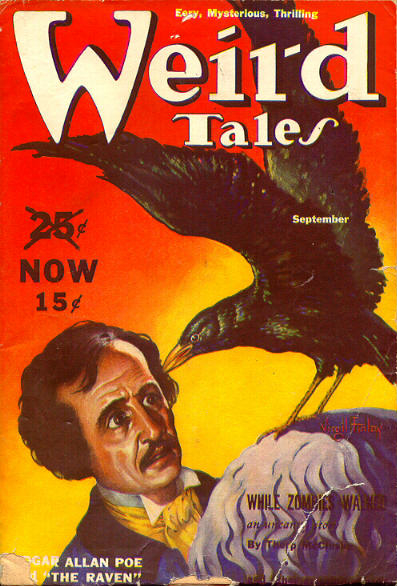
Edgar Allan Poe on the cover of Weird Tales, September 1939, with cover art by Virgil Finlay.

This will have to do until later in the month or maybe into December when I will wrap up this series on the 100-year anniversary of Weird Tales. Until then:

Happy Thanksgiving!

Original text copyright 2023 Terence E. Hanley

Friday, March 3, 2023

Richard R. Epperly (1891-1973)-The First Cover Artist

Commercial Artist, Illustrator, Fine Artist, Portraitist, Landscapist, Art Instructor
Born March 21, 1891, Tallula, Illinois
Died December 3, 1973, Oak Park, Illinois

Richard Ruh Epperly, the first cover artist for Weird Tales magazine, was born on March 21, 1891, in Tallula, Illinois. (Some sources give his birth year as 1890.) His parents were Charles Tazewell Epperly, a grocer, and May (Ruh) Epperly. Tallula is a little more than twenty miles from Springfield, Illinois. In his life as an artist, Epperly had his connections to Abraham Lincoln country. These included a portrait that he made of the Great Emancipator and an art exhibition held in the 1940s in the home of Mary Todd Lincoln's sister.

According to Find A Grave, Epperly "first became interested in art when, as a boy, he picked up a correspondence course in art discarded by his brother." He studied at the School of the Art Institute of Chicago from 1911 to 1914 and graduated with honors. Epperly served in the U.S. Army from May 28, 1918, to May 27, 1919, attaining the rank of corporal. He was stationed in Liverpool, England, and in France. While in France, he visited the Louvre Museum and became "determined to return some day to study."

From 1919 to 1928 or 1929, Epperly worked as a commercial artist in Chicago. When he filled out his draft card in 1919, he was working for Lammers-Shilling Company, a large Chicago firm. It was during this period that Epperly provided cover illustrations for the March 1923 issues of Weird Tales and Detective Tales. Those may have been his only works in the pulp fiction field.

In 1929, Epperly returned to Paris to study at the Académie Moderne under André Lhote (1885-1962) and André Marchand (1877-1951). The Académie Moderne was a free art school that had been founded in 1924 by Fernand Léger (1881-1955) and Amédée Ozenfant (1886-1966).

By 1930, Epperly was back in Chicago and working again as a commercial artist. He had married Cosona or Corona Edith Kleckner on June 2, 1920, in Cook County, Illinois, presumably in Chicago. The Epperlys had a child together, but by the time he was enumerated in the 1930 census--with his wife's family--he was a widower. He married again on April 9, 1936, also in Cook County. His new wife was Rose Verniere (1903-1987), an Italian-American. They also had a child together. An interesting tidbit from the lives of Richard and Rose Epperly: They embarked for Naples, Italy, on June 12, 1956, in New York City. Their ship was the SS Andrea Doria. On a return trip to New York on July 25, 1956, the Andrea Doria collided with the Swedish passenger liner Stockholm. It sank the next day. Fortunately, most of the passengers and crew were rescued. I don't know whether the Epperlys were on the ship when it was struck. I suspect they weren't.

In 1940, Epperly was still in Chicago, but in 1941, he relocated to Oak Park, Illinois, just outside the city. He lived in Oak Park for the rest of his life and was a well-known and active member of the art scene in the Chicago area. His work was in the All Illinois Society of the Fine Arts exhibition in Chicago in 1938, where he won an award for best watercolor by an Illinois-born veteran. He was a member and a board member of the Austin, Oak Park and River Forest Art League. He also taught art with the league and in 1973 received its President's Award.

Epperly was also a member of the Springfield Art Association and had twenty canvases in a two-man show at the home of the sister of Mary Todd Lincoln in 1946. In the 1940s, he traveled and painted in Colorado, Wyoming, California, New Mexico, and other places in the West. He exhibited at the Palette and Chisel Academy in Chicago in 1947; the Austin, Oak Park and River Forest Art League exhibition in 1960; and at the Oak Park National Bank in 1961. His work is in private collections, as well as in the collections of the Springfield Art Association, the Union League Club of Chicago, the Chicago Athletic Club, the Rotary Club of Australia, and at the National Portrait Gallery at the Smithsonian Institution. He painted portraits of Abraham Lincoln; Pope John XXIII; Carlos Romulo of the Philippines, Mrs. Romulo, and their sons; and Percy L. Julian, among others.

Richard R. Epperly died on December 3, 1973, in Oak Park and was buried at Elm Lawn Memorial Park in Elmhurst, Illinois. He was eighty-two years old.

Richard R. Epperly's Cover Illustration for Weird Tales
March 1923--The First Issue of "The Unique Magazine"

Further Reading
There are entries on Richard R. Epperly on the websites AskArtFind A Grave, and Worthpoint.

Flamenco Dancer, a nicely made portrait by Epperly. This has a classic 1920s-1930s look. It could easily have made the cover of a popular magazine. The color scheme is about the same as on the first-issue cover of Weird Tales.

Street Scene, Paris, circa 1930, probably more like 1929, if it was painted from life.

The Lammers-Shilling Company building in Chicago, presumably where Epperly worked for at least some time during 1919-1928 or 1929. I wonder if the editor or publisher of Weird Tales could have approached the Lammers-Shilling Company with a job, and that job was then assigned to Epperly, or if Epperly's covers for Weird Tales and Detective Tales were freelance work. As the old commercial says, the world may never know.

Epperly's portrait of Abraham Lincoln, after a photograph by Mathew Brady, published in the Picture Section of the Chicago Sunday Tribune on February 10, 1952. I have recolored this picture from a halftone image of the original.

Finally, Epperly's portrait of American chemist Percy Lavon Julian (1899-1975), from the National Portrait Gallery, Smithsonian Institution, a gift of Eugene V. Epperly, son of the artist. I have reproduced this image here under the doctrine of fair use. Though born in Alabama, Dr. Julian earned his degree and worked at  DePauw University in Greencastle, Indiana. I'm proud to call him a fellow Hoosier. He was the first black American to earn a doctorate in chemistry and, in 1950, the first black resident, with his family, of Oak Park, Illinois. Richard R. Epperly's portrait of his fellow townsman is a fine and sensitive one. His technique is smooth and accomplished. And to think that Epperly once drew a picture of a giant amoeba with its pseudopodia wrapped around a pulp-fiction heroine . . .

Original text copyright 2023 Terence E. Hanley

Monday, February 22, 2021

Les Baxter (1922-1996)

I wrote the other day about Gustav Holst (1874-1934) and his suite The Planets from more than a century ago. Listening to his music and looking into the covers of recordings of his music made me think of two topics related to genre fiction. Both involve Les Baxter. If you haven't listened to Les Baxter's music, I would urge you to as soon as you can. There is so much there for fans of popular culture, especially Exotica and what I think of as one of its progenitors, the genre of Lost Worlds.

Leslie Thompson Baxter, called "the Godfather of Exotica," was born on March 14, 1922, in Mexia, a small city in east-central Texas. His parents were Jesse Elliott Baxter (1890-1955) and Leta Thompson Baxter (1890-1964). Both were native Texans and the families of both originated in the Upper South. Les Baxter had one brother, James Edward "Jim" Baxter (1913-1964), an author, playwright, composer, and lyricist who worked with Les in the 1950s and '60s. Les Baxter married just once, in 1953. He and his wife, Patricia C. Baxter, had two children together. Tragically, she died at age thirty-four, after they had been together for just seven years. Les Baxter raised their children on his own after that. So, at the height of his musical career in the 1950s and '60s, Les Baxter lost his parents, his brother, and his wife. Some things are given while others are taken away.

Les Baxter's father, Jesse Baxter, worked as a stenographer, bookkeeper, and realtor, but his family included more than one prominent preacher. His brother, Batsell Baxter (1886-1956), was a preacher, writer, and college president. (More on that below.) Batsell Baxter was the father of Batsell Barrett Baxter (1916-1982), also a preacher, writer, and educator. He started Herald of Truth Bible Hour, a TV show that lasted for decades.

Jesse Baxter's sister, Anna Lee Baxter Hockaday (1892-1970), was married to a preacher, too. He was William Doniphan "Don" Hockaday (1888-1958), a second cousin, twice removed, of Abraham Lincoln (1809-1865). If you look at a picture of Don Hockaday, you might see a resemblance to the Great Emancipator. Don Hockaday's daughter-in-law died just last month. We send condolences to her family. We also find that an important idea is once again affirmed: History is alive in this moment. What we think of as being dead and in the past still lives.

Les Baxter was a musical child prodigy. He started playing piano at age five and as a six-year-old won a scholarship to the Detroit Conservatory of Music. The 1940 census indicates that in 1935 the Baxter family lived in Detroit. That would have been about the time, I think, that Jim Baxter attended Wayne University (now Wayne State University). Jim Baxter went on to write the Western novel The Circle on the Plain (1961) and the play Next Case. He also collaborated with his brother Les and songwriter Karl A. Suessdorf (1911-1982) on the songs "Rovin Gal" and "Calypso Boogie" (both from the movie Bop Girl Goes Calypso [1957]); "A Gun Is My True Love" (from the movie The Dalton Girls [1957]); and "Shooting Star" (from the album Space Escapade [1958]); as well as "Black Sheep," "Destination Honeymoon," and "Memories of Maine."

Les Baxter studied at Pepperdine University, an institution affiliated with the Churches of Christ. Baxter's uncle, Batsell Baxter, served as the first president of Pepperdine from 1937 to 1939. I suspect that Les Baxter was in attendance at about that time. In the census of 1940, Les, aged eighteen, did not have an occupation listed, but in 1942, when he filled out his draft card, he was employed by Central Casting in Hollywood. By age twenty, then, he had begun working in show business. 

Baxter worked as a concert pianist and joined Mel Tormé's vocal group, the Mel-Tones, in or about 1944. The other singers in that group were Betty Beveridge, Ginny O'Connor, and Bernie Parke. Some combination of them appeared in two motion pictures, Pardon My Rhythm (1944) and I'll Remember April (1945). (Baxter played a singing sailor.) Ginny O'Connor soon after married Henry Mancini (1924-1994), another sometime composer of Exotica. (Be sure to listen to his "Lujon.") Les Baxter also played saxophone in Freddy Slack's big band.

Les Baxter was not only a singer and musician but also, of course, a composer, arranger, conductor, and producer of music. He wrote more than 250 scores for radio, television, and movies, including music for the Bob Hope and Abbott and Costello radio shows. I won't go into his list of credits except in the bullet points and record covers shown below. You can easily find his credits on your own on other websites, including on the Internet Movie Database (here). But I wanted to tell you a little more on the life of this extraordinary composer of so much exotic, evocative, and atmospheric music of the postwar era. I also wanted to tell about his influence upon and connections to the old pulp genres of science fiction, fantasy, and weird fiction:

First, as a maker of Exotica, Les Baxter helped to carry some of the moods and forms of more nearly classical music into popular realms of the 1950s through the 1970s. He did this chiefly, I think, by his use of African-influenced percussion, impressionistic woodwinds and strings, and soaring, wordless voices, these first with the Peruvian coloratura singer Yma Sumac (1922-2008), later in other albums of his own. (He produced and composed the music for her first studio album, Voice of the Xtabay, in 1950.)

If you listen to Gustav Holst's Planets (1914-1916, 1918), specifically "Neptune, The Mystic," you will hear wordless voices, but they are in other early twentieth-century compositions, too, such as in Maurice Ravel's Daphnis et Chloé (1912). You can hear the influence of Ravel--Debussy, too--on Les Baxter, but then these two French composers had a large effect on American popular music, especially film scores, in which seemingly every ocean-going movie for decades quoted from Debussy's La Mer. (Be sure to listen, too, to the angelic wordless singing of Edda dell'Orso [b. 1935], who worked extensively with Ennio Morricone [1928-2020] on his own film scores. Addition, March 4, 2021: One more piece of wordless singing: "Madrigals of the Rose Angel" from Harold Budd's album The Pavilion of Dreams [1978].)

The wordless singing and rapid-fire percussion of Exotica found their way into the main title theme of Star Trek, especially in the first season opening. The music was by Alexander Courage (1919-2008) and I think very much influenced by Les Baxter's Exotica. All of these voices remind me of the high, sweet, otherworldly, vocal group- or choral group-type singing in The Wizard of Oz (1939). Remember that Les Baxter started out in a vocal group, singing with a man nicknamed "the Velvet Fog." Talk about atmosphere.

Second, Les Baxter also used the theremin early on, an instrument that is kind of a science fiction instrument anyway but also became one of the essential elements of the science fiction movie soundtrack of the 1950s, such as in Rocketship X-M (1950), The Day the Earth Stood Still (1951), and The Thing from Another World (1951). Here's a chicken-and-egg question: Did science fiction movies use the theremin because of Les Baxter, or was it the other way around? Or maybe both discovered the instrument at the same time.

Third, Baxter composed music drawing from or meant to evoke the genres of Lost Worlds and science fiction (see the record covers below), but he also wrote scores for every kind of genre movie, including: The Invisible Boy (science fiction, 1957); The Lone Ranger and the Lost City of Gold (Western and Lost Worlds, 1958); Goliath and the Barbarians (sword and sandal or heroic fantasy, 1959); Master of the World (scientific romance or Vernian science fiction, 1961); Reptilicus (monster movie, 1961); Tales of Terror (weird fiction, 1962); Panic in the Year Zero! (post-apocalypse, 1962); and many others, plus plenty of beach-party and motorcycle exploitation movies.

Fourth, he also wrote the score for The Dunwich Horror (1970), the first movie based on a work by H.P. Lovecraft (1890-1937) that also shares its title with the original source. (I think.) So if a movie score is a kind of program music or a kind of adaptation, then Les Baxter might get credit for the first musical adaptation of Lovecraft's work on film. However, the first film adaptation of a work by Lovecraft was actually The Haunted Palace (1963), a film based on "The Case of Charles Dexter Ward" (1927, 1941, 1943). The author of that score was Ronald Stein (1930-1988), whose list of credits might be indistinguishable from Les Baxter's, for these two men wrote music for all of the same kinds of movies. Anyway, Ronald Stein should probably get credit for the first recorded musical adaptation of H.P. Lovecraft's work, assuming, like I said, that a movie score is a kind of program music and therefore an adaptation. (See my article "The Other Forms of Lovecraft," dated October 2, 2018, by clicking here.)

Well, this article has gone on pretty long and it might be time to wrap things up. I'll close by letting you know that Les Baxter died on January 15, 1996, in Newport Beach, California. He was seventy-three years old, but in departing he left behind music that I hope we can listen to forever.

Further Reading

  • "Les Baxter" on the website Space Age Music Maker, here.
  • A website called Les Baxter at this URL: Lesbaxter.com.
  • The Exotic World of Les Baxter, a website accessible by clicking here.

The "banned" record cover of The Planets by Gustav Holst, which I showed the other day, reminded me of this one, for Space Escapade by Les Baxter (1958). The rocketship in the background might be a little phallic, but it also reminds me of the Flatwoods Monster.

Here's the reverse side of that album. I don't know who the artist is, but he or she knew something about science fiction imagery. And talk about a phallic rocketship.

In Music Out of the Moon (1947), Les Baxter collaborated with composer Henry Revel (1905-1958) and theremin player Samuel J. Hoffman (1903-1967). New things with this album included not only music of the theremin but also the full-color cover and the scantily clad model (actress Virginia Clark). One old-fashioned thing about it: it was released on three 78 rpm records. One real-world application: Neil Armstrong played Music Out of the Moon--on the moon!

To me, Exotica is related to the Lost Worlds genre of literature but perhaps filtered through the overseas experiences of servicemen and -women during World War II. Think of South Pacific with its "own special island." Whatever its origins, Exotica was very popular during the 1950s and '60s. Here is an early recording in that genre, Le Sacre du Savage or Ritual of the Savage by Les Baxter and his orchestra, from 1951.

The cover artist was William Chapman George, Jr. (Aug. 10, 1926-May 25, 2017), who for some reason is not very well identified on the Internet despite his having been a very accomplished illustrator over the course of a very long career. As an example of his talent, the late Mr. George painted this picture when he was just twenty-five years old. He went on to paint interior illustrations and covers for men's magazines, paperback books, especially Westerns, and packaging for He-Man toys of all things. There is an interview with him in Illustration #8, from 2003. On the other hand, there is very little of him on the Internet Speculative Fiction Database. I hope someone will correct that oversight soon.

A few years ago, I was at a Bigfoot conference in Ohio and stopped at the table of the Explorers Club. One of their promotional items, a flyer or postcard, showed William George's cover for Ritual of the Savage but missing all identifying information. In other words, I think they swiped his artwork and violated somebody or other's copyright. But these are the things people do to the work of the artist. Anyway, I'll have more to say about the Explorers Club in a future article.

Speaking of swipes, here's a movie poster for House of Usher (1960), for which Richard Matheson (1926-2013) wrote the screenplay and Les Baxter wrote the music. The swipe is from Harry Clarke's illustration for "The Premature Burial" by Edgar Allan Poe (1809-1849). (Click on the previous sentence to see it.)

It's strange to think that Edgar Allan Poe and Abraham Lincoln were born less than a month apart.

By 1970, when The Dunwich Horror was released, H.P. Lovecraft had name recognition. Moviemakers didn't have to hide his story behind Poe's byline as they had done just seven years before in The Haunted Palace. I wish I had the name of the cover artist here: he or she deserves some credit for this full-color illustration of a story that had seldom--or maybe never--gotten this kind of treatment before.

Original text copyright 2021, 2023 Terence E. Hanley

Monday, November 21, 2016

Vampires and Corpuscles

I finished reading Abraham Lincoln, Vampire Hunter by Seth Grahame-Smith (2010) last night (Nov. 19, 2016). If I were to start writing book reviews here there would be no end to it, but I would like to make some observations and then move on.

Mr. Grahame-Smith's novel is a weird tale and so descended from Weird Tales and from the gothic and romantic stories of the 18th and 19th centuries. It's called a "mashup," a word that contemporary readers find cute but is really just revolting. (Whatever else it might be, "mashup" is way overused.) In addition to being a "mashup" between real historical figures (including Edgar Allan Poe) and those that exist only in fantasy, Abraham Lincoln, Vampire Hunter is a combination of realism and romanticism or gothicism. There is even a navel-gazing writer at the beginning of the book, and, as we know, contemporary fiction in America is mostly fiction by, about, and for navel-gazing writers, preferably writers living and working and agonizing and suffering through their existential crises somewhere on the East Coast. I was waiting for that writer to reappear in the book, as his appearance at the beginning seemed to be the first part of a framing device, but there is no finished frame.

Abraham Lincoln, Vampire Hunter received good reviews, and I can say that it's not a bad book. I have to admit, though, that it's a pretty dreary chronicle of violence and gore. Although the book deals with the problem of evil in the world, it doesn't carry any great moral force or reach any great depth. In fact it trivializes the anguish and suffering of millions of people in general--slaves, Civil War soldiers, and their loved ones--and of Abraham Lincoln and his family in particular. It also offers a hatch through which we can escape from our culpability for the evil that exists in this world by laying blame on vampires. Perhaps its worst offenses are that it makes American history less interesting by introducing vampires into the story, and ultimately remakes Abraham Lincoln into a force for evil rather than for good.

Some miscellaneous thoughts: first, Abraham Lincoln, Vampire Hunter, ostensibly a story of good and evil, is reduced to a mere adventure story--and pretty colorless at that--by what I sense to be a prevailing twenty-first century style of writing. A story of this kind demands treatment by a stylist like William Faulkner or Cormac McCarthy. Instead we get what is essentially a screenplay in book form. Second, in terms of classification, Abraham Lincoln, Vampire Hunter might fall into the category of alternate history, more specifically, of secret history, in other words, a kind of conspiracy theory, alternatively, a cult history, like Theosophy or Scientology. Third, in the book, Abraham Lincoln is used and manipulated by a vampire. Rather than being a self-actuated agent of radical change, he is more nearly a pawn of a greater personality, that of his vampire handler. Fourth, in that way, Abraham Lincoln, Vampire Hunter isn't very much different from Mission: Impossible or Charlie's Angels. It's Abraham Lincoln as Sabrina, Jill, or Kelly.

* * *

We went to see Arrival last night (Nov. 19, 2016), and we saw it in a movie theater full of deplorables. Yes, they can read and write and do simple math problems like this: (538 x 0.5) + 1 = the presidency. It's a beautifully made movie--intelligent, sensitive, well written, adult. At first I wondered about the cruelty of moviemakers: this is the second science fiction movie I have seen in recent years in which a child is killed off. (The other was Gravity [2013], ultimately a spiritually empty film.) Here, though, the death of the child proves to be a different matter. The arrival in Arrival is, at first glance, the arrival on Earth of aliens from space. They come here in great asphalt-black ships shaped like giant red corpuscles. (When they turn on their sides, they look like flying saucers.) There are minor offenses in the movie against two of Hollywood's favorite villains, but those are beside the point. This is more the point: last year, I wrote about circles and spirals on the cover of Weird Tales. Circles and cycles are a theme and a motif in this movie. The alien ships are circular. The aliens themselves have radial symmetry. Their writing, which looks like a cross between a Rorschach blot and a coffee cup stain, is circular. Their closest connection is to a woman, a representative of that half of our species which lives more by cycles than by linearity. (Enforcing that theme is an image of birth and of an after-death experience--or rebirth--in the walk through a long, dark tunnel into a place full of light.) I won't give too much away here, but an escape from the linear into the cyclic is how the death of the child is ameliorated and how Arrival attains a spiritual dimension, something so lacking in the art and popular culture of today.

Copyright 2016, 2023 Terence E. Hanley

Thursday, December 10, 2015

Theodore Roscoe (1906-1992)

Author, Illustrator, Biographer, Historian
Born February 20, 1906, Rochester, New York
Died May 29, 1992, Florida

Theodore Roscoe was born on February 20, 1906, in Rochester, New York, and grew up in a house filled with artifacts from Asia. His parents, married in India in 1895, were missionaries, his father a teacher, his mother a novelist and speaker of Hindi. Roscoe's grandfather knew languages and was a published author as well. The Roscoes returned to the United States in time for Theodore, the youngest of their four children, to come into the world. At age eight, Theodore, a shy and sickly boy, made his first book, The Devul [sic] and the Knight. He sold a copy for a single red cent, which he used to buy a piece of candy. From that moment on, he linked eating to writing.

As a student at East High School in Rochester, Roscoe played chess and in the school band. He was also assistant editor of and short story writer for his school magazine, The Clarion. After graduating from high school in 1925, Roscoe went to work in local stock company as a grip and a prop man. Among the actors and actresses he encountered were Louis Calhern, Miriam Hopkins, and Sylvia Sidney. Roscoe himself was uninterested in acting. Instead he hoped to learn the business of writing plays. He studied at Columbia University from 1927 to 1929 but by then he was a published author and had found his life's work.

According to The FictionMags Index, Theodore Roscoe's first published story was "The Duel," and it was in the second semi-monthly issue of North-West Stories of September 1926. He had more than four dozen stories published in the years he was at Columbia (or to December 1929). These included the first of his two stories for Weird Tales, "The Dancing Death," from October 1928. The Great Depression did not slow his output. From 1926 to 1946, the nation's pulps published scores of his stories. These appeared in Action Stories, Adventure, Air Adventures, The All Story Braille MagazineArgosy, Complete Stories, Detective Fiction Weekly, Far East Adventure Stories, Fight StoriesFlying Stories, Flynn's Detective Fiction, High Spot Magazine, Jungle StoriesShort Stories, Soldier Stories, The Underworld Magazine, Wide World Adventures, and WingsIn all, Roscoe is supposed to have written 400 short stories. His most well-known creation was probably Foreign Legionnaire Thibaut Corday from Argosy magazine.

Like his parents, Roscoe was a world traveler. He visited France and North Africa in 1929, England in 1930, Cuba and Dutch Guiana in 1931, Burma and Somaliland in 1932, and Latin America in 1934 and 1936. Asthma prevented his service in the military during World War II. Instead, Roscoe wrote histories of the U.S. Navy for which he won a Distinguished Service Medal. He wrote other non-fiction as well, and he penned scripts for radio, movies, and television. A partial list of his twenty-one books:
  • United States Submarine Operations in World War II (1949)
  • United States Destroyer Operations in World War II (1953)
  • This Is Your Navy: An Informal History (1950)
  • Picture History of the U.S. Navy from Old Navy to New, 1776-1897 (1956)
  • Only in New England: The Story of a Gaslight Crime (1959)
  • Tin Cans (1960)
  • The Web of Conspiracy: The Dramatic Story of the Men Who Murdered Abraham Lincoln (1960)
  • True Tales of Bold Escapes (1965)
  • Pig Boats: The True Story of the Fighting Submariners of World War II (1967, 1982)
  • On the Seas and in the Skies: A History of the U.S. Navy's Air Power (1970)
  • The Trent Affair, November, 1861: U.S. Detainment of a British Ship Nearly Brings War with England (1972)
"The Lincoln Murder Case," an episode of The Dupont Show of the Month broadcast on CBS television on February 18, 1961, was based on Roscoe's Web of Conspiracy. That book was also adapted to a Reader's Digest book as "The Abraham Lincoln Murder Mystery." The Internet Movie Database also lists an episode of Hawaiian Eye, "Made in Japan" (Jan. 4, 1961), as being based on his story. Navy History and Tradition, a comic book series from 1959, was by Roscoe or based on his work as well.

Theodore Roscoe died on May 29, 1992, in Florida. He was eighty-six years old.

Theodore Roscoe's Stories in Weird Tales
"The Dancing Death" (Oct. 1928)
"The Curse Kiss" (Feb. 1930)

Further Reading
Much of what I have written here has come from the following two sources: 1) "Theodore Roscoe-Traveller, Historian, Pulp Writer" on the blog PulpFlakes (Aug. 24, 2012), and 2) an audio version of the book Pulpmaster by Audrey Parente. Any errors are my own. (I have written about Theodore Roscoe as part of my continuing series on "Notes from PulpFest," the reason being that I won the audio version of Pulpmaster at that event simply for knowing a very trivial bit of trivia: I knew that Farnsworth Wright served as a translator during World War I. Sometimes it pays to have these things stuck in your head.) By the way, Theodore Roscoe's papers are at Columbia University and the Syracuse University Libraries.

Pulpmaster: The Theodore Roscoe Story by Audrey Parente was originally published in Starmont Popular Culture Studies #13 (1992). It has recently been reprinted in book form and recorded as a digital audio book.

Text copyright 2015, 2023 Terence E. Hanley