Showing posts with label William F. Heitman. Show all posts

Thursday, October 26, 2023

Weird Tales, October 1923

The October 1923 issue of Weird Tales has fourteen stories, three features, and five uncredited non-fiction fillers. The features are "The Eyrie," "The Cauldron," and "Weird Crimes." The cover story is the first part of a two-part serial called "The Amazing Adventure of Joe Scranton" by Effie W. Fifield. The cover art was by R.M. Mally and all of the interior illustrations by William F. Heitman. Firsts include the first stories in Weird Tales by Seabury Quinn, H.P. Lovecraft, and Frank Owen, also the first installment of the feature "Weird Crimes" by Quinn.

  • "The Amazing Adventure of Joe Scranton," part one of a two-part serial by Effie W. Fifield (1857-1937).
  • "Aged Man Kills Wife, Self and 'Other Woman'," uncredited non-fiction filler.
  • "World Ice to Wipe Out Continents," uncredited non-fiction filler.
  • "Sight Without Eyes," uncredited non-fiction filler.
  • "Genoese Riviera Damaged by Waterspout," uncredited non-fiction filler.
  • "The Man Who Owned the World" by Frank Owen (1893-1968). This was Frank Owen's first story for Weird Tales. The title is of course in the now familiar form of "The Man Who . . .".
  • "Grey Sleep" by Charles Horn (dates unknown).
  • "The Sign from Heaven" by A. Havdal (dates unknown).
  • "The Inn of Dread" by Arthur Edwards Chapman (1898-?).
  • "The Hairy Monster" by Neil C. Miller (1898-1975) of Sioux City, Iowa.
  • "Devil Manor" by E. B. Jordan (dates unknown).
  • "The Case of the Golden Lily" by an Irish-Welsh-English author, Francis D. Grierson (1888-1972). Known for his mystery, crime, and detective stories, Grierson wrote in "The Case of the Golden Lily" of his series character Paul Pry.
  • "Bluebeard" by Seabury Quinn, the first in a non-fiction series called "Weird Crimes."
  • "Weird Snake Dance of Hopis May Be Tabooed," uncredited non-fiction filler.
  • "An Adventure in the Fourth Dimension" by Farnsworth Wright (1888-1940). "An Adventure in the Fourth Dimesnion" is an alien invasion story. It appears to have been influenced by Flatland: A Romance of Many Dimensions by Edwin Abbott (1884), also by recent developments in Einsteinian physics. Wright's aliens are depicted (see below) as small and with pointed ears, not very much different from the so-called gray aliens of today. That makes me think that gray aliens are really just an iteration of the elves, brownies, and other little people of European folklore. Of course I'm not the first person to think that way. Reprinted in The Moon Terror in 1927.
  • "After the Storm" by Sarah Harbine Weaver (1880-1965), a writer of Ohio, New York, and California.
  • "The Eyrie."

Weird Tales, October 1923, with a cover story, "The Amazing Adventure of Joe Scranton" by Effie W. Fifield and cover art by R.M. Mally.


Text copyright 2023 Terence E. Hanley

Tuesday, September 26, 2023

The First of Lovecraft

No author is identified more with Weird Tales than is Howard Phillips Lovecraft (1890-1937) of Providence, Rhode Island, and--for a short time--Brooklyn and Brooklyn Heights, New York. Lovecraft was thirty-two years old when the first issue of Weird Tales was published in March 1923. I imagine that he had waited all of his life for such a title to appear.

I don't know when or where Lovecraft first came upon Weird Tales, although it's clear by reading the first letter below that he did not see the March issue right away. According to his biographer, L. Sprague de Camp, Lovecraft was "urged by his friends to submit stories to this new market." Lovecraft resisted. (His amateurism and dilettantism are maddening even to this day.) "About April," de Camp wrote, "Lovecraft let himself be persuaded to send [Edwin] Baird five manuscripts." (From Lovecraft: A Biography, Ballantine Books, 1976, pp. 190-191.) Lovecraft sent a kind of cover letter with his submissions. It reads like a résumé by a person who doesn't want the job. It's clear to me that Lovecraft lacked self-esteem or feelings of self-worth. He almost demanded rejection. But that's what a person often does who has experienced rejection from those closest to him, especially, or perhaps exclusively, from his parents.

The long excerpt below begins with Edwin Baird's introduction and continues with the full text of Lovecraft's first letter in Weird Tales, September 1923. After that, Baird had his one-sentence closing. I have made the names of several authors boldface.

     Equally interesting is the letter from H. P. Lovecraft, another master of the weird tale, from whom we have accepted some stories for your entertainment. Mr. Lovecraft's letter, unlike Mr. Triem's, doesn’t exactly flatter WEIRD TALES, but we are nevertheless glad to pass it on to you:

     "My Dear Sir: Having a habit of writing weird, macabre, and fantastic stories for my own amusement, I have lately been simultaneously hounded by nearly a dozen well-meaning friends into deciding to submit a few of these Gothic horrors to your newly-founded periodical. The decision is herewith carried out. Enclosed are five tales written between 1917 and 1923.

     "Of these the first two are probably the best. If they be unsatisfactory, the rest need not be read . . . 'The Statement of Randolph Carter' is, in the main, an actual dream experienced on the night of December 21-22, 1919; the characters being myself (Randolph Carter) and my friend, Samuel Loveman, the poet and editor of 'Twenty-one Letters of Ambrose Bierce.'

     "I have no idea that these things will be found suitable, for I pay no attention to the demands of commercial writing. My object is such pleasure as I can obtain from the creation of certain bizarre pictures, situations, or atmospheric effects; and the only reader I hold in mind is myself.

     "My models are invariably the older writers, especially Poe, who has been my favorite literary figure since early childhood. Should any miracle impel you to consider the publication of my tales, I have but one condition to offer; and that is that no excisions be made. If the tale can not be printed as written, down to the very last semicolon and comma, it must gracefully accept rejection. Excision by editors is probably one reason why no living American author has a real prose style . . . But I am probably safe, for my MSS. are not likely to win your consideration. 'Dagon' has been rejected by _____ _____, to which I sent it under external impulsion--much as I am sending you the enclosed. This magazine sent me a beautifully tinted and commendably impersonal rejection slip . . .

     "I like WEIRD TALES very much, though I have seen only the April number. Most of the stories, of course, are more or less commercial--or should I say conventional?--in technique, but they all have an enjoyable angle. 'Beyond the Door,' by Paul Suter, seems to me the most truly touched with the elusive quality of original genius--though 'A Square of Canvas,' by Anthony M. Rud, would be a close second if not so reminiscent in denouement of Balzac's 'Le Chef d’Ouvre inconnu'--as I recall it across a lapse of years, without a copy at hand. However, one doesn't expect a very deep thrill in this sophisticated and tradesman-minded age. Arthur Machen is the only living man I know of who can stir truly profound and spiritual horror."

     Despite the foregoing, or because of it, we are using some of Mr. Lovecraft's unusual stories, and you will find his "Dagon" in the next issue of WEIRD TALES.

L. Sprague de Camp had this reaction:

Lovecraft had done everything [in his letter] to assure rejection of his stories: the haughty tone, the art-for-art's-sake pose, the deprecation of his own work, and the mention of a previous rejection.

It strikes me as the work not of a man in his thirties but of a boy in his teens.

* * *

As promised, Weird Tales published Lovecraft's story "Dagon" in its issue of October 1923. William F. Heitman's illustration (below) is a good and understated one. Heitman was not especially good at depicting weird, fantasy, horror, or the supernatural. The real heart of "Dagon" was probably outside his range as an illustrator, but a picture of a man in a boat works. I wonder if this was the first published illustration of a work by Lovecraft, or at the very least in a mainstream publication.

"Dagon" is from 1917 or 1919. Nineteen nineteen was also the year in which Lovecraft's contemporary J.C. Henneberger (1890-1969) arrived in Indianapolis and in which The Thrill Book was in publication. I haven't read every story published in Weird Tales to that date, October 1923, but I'm not sure that any one of them is like "Dagon" in its implications, which are of vast expanses of time and the insignificance of man or men lost in an indifferent or even hostile cosmos. (Lovecraft's narrator is essentially a human-like device used to tell a cosmic story.) Edwin Baird called it "a radically different sort of story." There are problems with "Dagon" to be sure. One is Lovecraft's patented overwrought prose. Another is the closing, which became a cliché not only in his work but in myriads more stories in and out of Weird Tales. Only seven short years separated its composition from that of "The Call of Cthulhu." Call "Dagon" a practice run for Lovecraft's later story. But we can also see in these two stories how much Lovecraft matured as a builder of sustained works of fiction between 1919 and 1926.

* * *

"Dagon" takes up less than two and a half pages in Weird Tales. Lovecraft's second published letter, which appeared on page 82, isn't quite that long, but it's long enough. A full paragraph of it has to do with "Dagon."

Once again, Edwin Baird introduced Lovecraft, after which his correspondent launched into another long missive. Included are excerpts from two poems by Lovecraft, his first lines of verse to be published in the magazine. Baird stepped in twice before writing a closing to "The Eyrie" for the month of October. Again, I have made the names of authors boldface.

You may recall the letter from H. P. Lovecraft, published here last month. A bit caustic, that letter; and today we have pleasure in offering another, which, if less stinging, is none-the-less enjoyable. Our friend Lovecraft always has something to say when he writes. Thus:

     "Dear Mr. Baird: I should apologize if my former letter seemed to tax WEIRD TALES with seeking conventional material. Such was not my intention in any way. I only meant that I presumed you would not wish too subtle or cryptical material for presentation to the general public. There is a difference between mere originality and delicate symbolism, or hideously nebulous adumbration. How many American readers outside the frankly 'highbrow' class, for example, would find any pleasure or coherent impression in Arthur Machen's 'The White People,' or in the fantastic passages of the same author's 'Hill of Dreams'? In a word, I take it that WEIRD TALES wants definite stories, with a maximum of plot, tension of situation, explosive climax, and statement rather than too elusive suggestion--this rather than, the Baudelairian prose-poem of spiritual Satanism, where chiseled phrase, lyrical tone, color, and an opiate luxuriance of exotic imagery form the chief sources of the macabre impression . . . .

     "I lately read the May WEIRD TALES, and congratulate yon on Mr. Humphrey's 'The Floor Above,' [for a moment I had a shiver which the author didn't intend--I thought he was going to use an idea which I am planning to use myself!! But it wasn't so, after all], which is a close second to my favorite, 'Beyond the Door.' Evidently my taste runs to the architectural! 'Penelope' is clever--but Holy Pete! If the illustrious Starrett's ignorance of astronomy is an artfully conceived attribute of his character's whimsical narrative, I'll say he's right there with the verisimilitude! I wrote monthly astronomical articles for the daily press between 1906 and 1918, and have a vast affection for the celestial spheres.

     "Some day I may send you a possible filler, beginning:

’’Through the ghoul-guarded gateways of slumber, 
Past the wan-moon'd abysses of night,
I have lived o'er my lives without number,
I have sounded ail things with my sight--
And I struggle and shriek ere the daybreak, being
driven to madness and fright."

[The lines are from Lovecraft's poem "Nemesis," which was printed in the April 1924 issue of Weird Tales.]

     Mr. Lovecraft, you will observe, is quite as deft at poetry as he is with prose; and as further evidence of this, we submit the prologue to a 300-line heroic poem of his that we may print some day:

"I am he who howls in the night;
I am he who moans in the snow;
I am he who hath never seen light;
I am he who mounts from below.
My car is the car of death;
My wings are the wings of dread;
My breath is the north wind's breath;
My prey are the cold and dead."

     As you know, we are publishing a series of Mr. Lovecraft’s prose pieces, beginning with “Dagon;” and of this story he wrote us, in part:

     "I shall venture 'Dagon' as a sort of test of my stuff in general. If you don't care for this, you won't care for anything of mine. . . . It is not that 'Dagon' is the best of my tales, but that it is perhaps the most direct and least subtle in its 'punch'; so that for popular publication it is most likely to please most. In copying it I have touched up one or two crude spots--it having been written in 1917, directly after a lull of nine years in my fiction-writing. Naturally I was a bit rusty in the management of the prose. A friend of mine--Clark Ashton Smith, the California poet of horror, madness and morbid beauty--showed this yam to George Sterling, who declared he liked it very much, though suggesting (absurdly enough, as I view it!) that I have the monolith topple over and kill the 'thing' . . . a piece of advice which makes me feel that poets should stick to their sonneteering . . .

     "My love of the weird makes me eager to do anything I can to put good material in the path of a magazine which so gratifyingly cultivates that favorite element. I shall await with interest the next issues, with the tales you mention, and am meanwhile trying to get the opening number through a newsdealer. I am sure the venture will elicit some notable contributions as its fame spreads--and the extent of that fame may be judged from the fact that people in Massachusetts, New York, Ohio and California have been equally prompt in calling my attention to it and urging me to try my luck!"

     In a way, "Dagon" is a radically different sort of story, even for WEIRD TALES, and those that will follow it are even more so. For this reason, we shall be particularly interested in hearing what our readers think of the Lovecraft tales. THE EDITOR.

Lovecraft's next letter and next story on his own--"The Picture in the House"--would appear in the issue of January 1924. (Collaborating with his future wife, Sonia H. Greene, he co-wrote, ghost-wrote, or revised "The Invisible Monster" in the November 1923 issue. His contribution was anonymous.) Lovecraft also had stories in the issues of February, March, April, and May/June/July 1924. That's a nice run in the first year and more of "The Unique Magazine."

Original text copyright 2023 Terence E. Hanley

Friday, September 1, 2023

"The Eyrie," June 1923

In "The Eyrie" for June 1923, the editor, presumably Edwin M. Baird, once again lamented the sameness of the stories being submitted for publication in Weird Tales:

THE TIME has come to talk of cats and Chinamen, and rattlesnakes and skulls--and why it is these things abound in yarns for WEIRD TALES. Particularly cats and Chinamen. Believe it or not, every second manuscript we open, (and that's placing the average rather low) is concerned with one or the other, or both, of these.

Why is this? Is it because a cat and a Chinaman suggest the mysticism of the Orient, and thus seem excellent "props" for weird fiction? Or is it merely because both mind their own business, imperturbably pursue their destinies, and thereby create the impression that there's some deep-laid mystery here? We ask you that.

Whatever the reason, it's an odd and curious fact that when an author sets out to tell a weird tale his mind turns, as if instinctively, to cats and Chinamen. And then, for good measure, he not infrequently throws in a few rattlesnakes and a skull or two.

Sometimes the result is interesting. And sometimes it is awful! And again, sometimes, it is a ludicrous thing, unconsciously funny.

Letters came from the following readers (and one author): 

  • R.E. Lambert , secretary of the Washington Square College of New York University, New York, New York; and
  • Rev. Andrew Wallace MacNeill (1885-1937), minister of the Bethlehem Congregational Church, International Falls, Minnesota;
both of whom enjoyed "Beyond the Door" by J. Paul Suter, which had appeared in the April issue of Weird TalesJoseph Paul Suter (1884-1970), the author, responded in a letter of his own.

  • Conrad A. Brandt (1879-1947) of New York City, later a book and film reviewer for Amazing Stories, who observed: "The stories you have printed so far can be grouped under three general headings: Ghost Stories, Snake Stories, Insanity Stories. In your first issue you printed a story called 'Ooze' which approached the type of semi-scientific stories that are liked intensely by all those who are fond of the unusual, and if you would publish at least one story of this type in each issue of your magazine I am sure that your efforts would register larger sales."
  • Adeline Jugol of Covina Apartments, Los Angeles, California.
  • O.R. Hamilton of Austin, Texas.
  • Witch Hazel of St. Louis, Missouri.
  • A.M. Oliver of Akron, Ohio.
  • P.W. Burrows of Kearney, Nebraska.
  • J.C. Wolquist of Des Moines, Iowa.
  • Miss Marguerite Nicholson (1907-1987) of Philadelphia, Pennsylvania.
  • M. Nawrocki, probably Michael Nawrocki (1904-1978), of Milwaukee, Wisconsin.

The lead story in Weird Tales for June 1923 is "The Evening Wolves" by Paul Ellsworth Triem. Nevertheless, William F. Heitman's illustration shows a snake. And already in the first paragraph is mention of a Chinese boy. The story itself is set partly in Chinatown.

This might be as good a place as any to bring up a point. Weird Tales is supposed to have been the first American magazine devoted to fantasy fiction. I have written that myself in this blog. As we have seen, though, it wasn't so devoted, at least in the first four issues. Instead there were lots of crime stories plus stories with weird elements but no fantasy or supernatural content. The arrival of Amazing Stories--in April 1926--was still nearly two years away, but unless we come upon an issue of Weird Tales in which every story has some kind of fantastical element, then maybe credit as the first American magazine devoted to fantasy should go to the former rather than to the latter.

Original text copyright 2023 Terence E. Hanley

Saturday, August 26, 2023

Weird Tales, June 1923

Like the first pair of issues of Weird Tales, the second pair--the issues of May and June--go together. Both have the same main title logo and each has 120 interior pages. William F. Heitman was the cover artist on both, and he drew all of the interior art in both. There are twenty-one stories in the May issue of 1923 but only seventeen in the one for June. The staff of the magazine made up for that with thirteen non-fiction fillers (all by an uncredited author or authors), plus a non-fiction article, plus two features, "The Eyrie" and a new feature called "The Cauldron: True Adventures of Terror," conducted by Preston Langley Hickey (1900-1962).

Firsts in Weird Tales for June 1923 include:

  • The first story with a series character, Dr. Dorp in Otis Adelbert Kline's short story "The Phantom Wolfhound."
  • The first reprint of a story by Edgar Allan Poe, "The Murders in the Rue Morgue," from 1841.
  • The first photograph, a picture of an electric chair, taken by Harry Hirschfield and used as an illustration for "The Chair," a non-fiction article by Dr. Harry E. Meerness.
  • The first regular feature other than "The Eyrie," the aforementioned "The Cauldron: True Adventures of Terror," conducted by Preston Langley Hickey.

I haven't read most of the stories in that fourth issue. There may be other firsts hiding inside.

I have written before about eleven of the eighteen authors listed below. Click on their names for links.

  • Edwin MacLaren (dates unknown)
  • Adam Hull Shirk (1881-1931)
  • Julian Kilman (1878-1954)--His story "The Well" was reprinted in The Best of Weird Tales: 1923, edited by John Gregory Betancourt and Marvin Kaye.
  • Walter Noble Burns (1866-1932)--The title of his story "The Man the Law Forgot" is a variation of "The Man Who . . .".
  • Loual B. Sugarman (1894-1965)--His story "The Gray Death" was reprinted in The Eighth Green Man and Other Strange Folk, edited by Robert Weinberg (Starmont House, 1989).
  • Henry Leverage (1885-1931)
  • Hugh Thomason (dates unknown)--This may have been Captain Hugh Thomason, a friend of and correspondent with Edgar Rice Burroughs. Captain Thomason also used the pen names Jack MacLeod and Captain John Graham. Hugh Thomason the author, if he was a different person, also used the pen name Rjinn Van Veldt.
  • Herbert Hipwell (dates unknown)
  • Dr. Harry E. Mereness (dates unknown; possibly a pseudonym)

Next: "The Cauldron: True Adventures of Terror."

Weird Tales, June 1923, with cover art by William F. Heitman illustrating Edgar Allan Poe's story "The Murders in the Rue Morgue." This is the first gorilla or ape cover in Weird Tales. Unfortunately, it's terribly inept. Heitman was a better artist than this. I wonder what happened.

Text copyright 2023 Terence E. Hanley

Sunday, August 20, 2023

"The Closed Cabinet" by _____ _____ & Sunday Swipes No. 3

"The Moon Terror" by A.G. Birch was the first story in the May 1923 issue of Weird Tales. "The Closed Cabinet" by _____ _____ was the last. _____ _____ was an anonymous author in the pages of "The Unique Magazine" and in the original. The original was Blackwood's Edinburgh Magazine (Vol. CLVII, No. DCCCLI), published in January 1895. The publication of "The Closed Cabinet" was announced in newspapers in December 1894. In its issue of January 21, 1895, the Brooklyn Daily Eagle called it "an old time Scotch story." (p. 12)

In an item called "Literary Gossip," the Bowling Green, Ohio, Daily Sentinel-Tribune (Mar. 7, 1895, p. 2) attributed authorship of the story to Lady Gwendolen Cecil, daughter of the Marquess of Salisbury. There isn't any source given for that bit of information. This was gossip after all. Her authorship was previously confirmed in The Author, Playwright and Composer, Volumes 5 and 6, page 246, also from 1895. Maybe that's the source of the item out of Bowling Green. By the way, The Collector's Index to Weird Tales by Sheldon R. Jaffery and Fred Cook, an indispensable source in my writing of this blog, was also published in Bowling Green.

I'm not the first person to track down authorship of "The Closed Cabinet" to Lady Gwendolen. Scottish editor Johnny Mains (b. 1976) did that before me for his collection A Suggestion of Ghosts: Supernatural Fiction by Women, 1854-1900 (2018). More than a hundred years before Mr. Mains published his book, Julian Hawthorne (1846-1934) included "The Closed Cabinet" in his series Library of the World's Best Mystery and Detective Stories (1907-1909?). It looks like this series was also called and/or reprinted as The Lock and Key Library. Lady Gwendolen's story is in the volume Old-Time English Stories (1909), the contents of which are as follows:

  • "The Haunted House" by Charles Dickens (1859)
  • "No. 1 Branch Line: The Signal-Man" by Charles Dickens (1866)
  • "The Haunted and the Haunters; or, The House and the Brain" by Edward Bulwer-Lytton (1859)
  • "The Incantation" by Edward Bulwer-Lytton (date unknown)
  • "The Avenger" by Thomas De Quincey (1838)
  • "Melmoth the Wanderer" by Charles Maturin (1821)
  • "A Mystery with a Moral" by Laurence Sterne (date unknown)
  • "On Being Found Out" by William Makepeace Thackeray (1861)
  • "The Notch on the Ax" by William Makepeace Thackeray (1862)
  • "Bourgonef" by unknown
  • "The Closed Cabinet" by unknown (Lady Gwendolen Cecil)
Only some of these are considered fantasy, ghost stories, or weird fiction. Not all are included in the Internet Speculative Fiction Database.

"The Haunted and the Haunters; or, The House and the Brain" by Edward Bulwer-Lytton was the first reprint in Weird Tales, "The Closed Cabinet" now the second. It looks as though both came from the same source, namely, Julian Hawthorne's collection from earlier in the century. Charles Dickens' story "The Signal-Man" was also reprinted in Weird Tales, in the issue of April 1930. A second by-the-way: Julian Hawthorne was the son of Nathaniel Hawthorne (1804-1864) and the father of Hildegarde Hawthorne (1871-1952), both of whom also had stories in Weird Tales, though both posthumously.

Next: Lady Gwendolen Cecil (1860-1945)

"Her Countenance Grew Fierce," an illustration by an unknown artist for "The Incantation" by Edward Bulwer-Lytton and the frontispiece for The Lock and Key Library: The Most Interesting Stories of All Nations, Old Time English, edited by Julian Hawthorne (New York: The Review of Reviews Co., 1915). I have altered this image from a photograph taken of the original.

The image shown above may seem familiar to you. Have a look at the cover illustration for the May 1923 issue of Weird Tales, made by William F. Heitman:


Now here they are side by side, with the Weird Tales cover flipped:


No wonder Heitman's cover was so uncharacteristic of his regular work, and no wonder that the male figure on the right doesn't match very well the female on the left in its treatment or technique.

Text copyright 2023 Terence E. Hanley

Friday, July 28, 2023

Weird Tales, May 1923-Part Two

By my count, there were a dozen authors who were new in Weird Tales in the issue of May 1923. Half are known. The other half are not, at least to me. First are the six known authors.

A.G. Birch (1883-1972)--A.G. Birch was Albert G. "Al" Birch, a reporter, photographer, editor, and publicity manager at the Denver Post. He was also in publicity with Famous Players-Lasky and Paramount. His story was "The Moon Terror," a two-part serial and the lead story in that May issue. And because it was the lead story, it was also the first illustrated story to appear in Weird Tales. The illustration was of course by William F. Heitman (1878-1945).

I'll have more on Birch and "The Moon Terror" later in this series. You can also read about both at the following URL:

https://archive.org/details/BirchA.G.TheMoonTerrorAndOtherStories1927/page/n191/mode/2up

Kenneth Duane Whipple (1894-1974)--Kenneth Duane Whipple was a reporter for the Claremont Eagle in Claremont, New Hampshire. There were scads of Whipples in New England during the Colonial and Early National periods, subsequently in other parts of the country. H.P. Lovecraft's maternal grandfather bore the name Whipple as his Christian name. He was Whipple Van Buren Phillips (1833-1904), and he was named, presumably, after his paternal grandmother, Esther Whipple Phillips (1767-1842). Her father was Captain Benedict Whipple (1739-1819). The point of all this is that Kenneth Duane Whipple and H.P. Lovecraft may very well have been related, though distantly. In our family, we have Whipples, too. I wonder if we could be related to Lovecraft as well.

Whipple's story, "The Secret Fear," is described in the blurb as "A 'Creepy' Detective Story." The narrator is a newspaper reporter, just like the author. There is talk of an escaped gorilla. (Another gorilla.) There are also Irishmen, including a beat cop named Corcoran, the dead man Terence McFadden, and police captain Dolan. (The police commissioner in The Spirit comic strip is also named Dolan.) The victim's Irishness pertains because he was superstitious: it was his secret fear that killed him.

Vincent Starrett (1886-1974)--Charles Vincent Emerson Starrett was born above a bookshop in Toronto, Canada. Like Saul Bellow (1915-2005), Starrett moved with his family from Canada to Chicago when he was a child. Starrett was a bookman, author, poet, critic, newspaper reporter, columnist, Sherlock Holmes aficionado, and biographer of Ambrose Bierce (1842-1914?). "Penelope," a comic short story about a man's upside-down day, was his first for Weird Tales. If you have ever loved a woman, you understand the pull of gravity Penelope exerts on the main character.

Bruce Grant (1893-1977)--Barely more than a page long, Bruce Grant's story, entitled "Feline," was the first "storiette" in Weird Tales. Grant was born in Wichita Falls, Texas, and worked on a cattle ranch before becoming a newspaper reporter. He was also the author of novels and nonfiction books about the American West. There is a very informative article about him entitled "Native Wichitan Compiles Reference Work on Indians" in the Wichita Falls Times, March 22, 1959, page 69. Like Ernest Hemingway, Grant killed himself with a shotgun, this in the basement of his home in Winnetka, Illinois.

Lyle Wilson Holden (1885-1960)--Lyle Wilson Holden was a poet, school teacher, and school principal in Rochester, New York. His short story "The Devil Plant" should go in the Botanical Fiction Database. For those interested in tentacles in genre fiction, the plant of the title is also known as "the octopus plant."

Mollie Frank Ellis (1880-1948)--Author, lecturer, and clubwoman Mollie Garfield Frank Ellis was born in Greencastle, Indiana, and attended DePauw University in her native city. Her story, "Case No. 27," is set in an insane asylum. Mollie lived in Indianapolis late in life and died in a sanitorium in that city.

Next: The Unknown Authors

William F. Heitman's illustration for "The Moon Terror" by A.G. Birch, the first illustration to appear in Weird Tales. In the story, the woman is described as nearly nude. That wouldn't have worked, I guess, in the popular press, and so here her nudity is concealed by a cloth. Human sacrifice and execution were common themes in Weird Tales and in other genre fiction or pulp fiction from the 1920s onward. This is the first instance in "The Unique Magazine."

Text copyright 2023 Terence E. Hanley

Friday, December 31, 2021

Why Weird Tales?

Weird Tales was in trouble during that first year. The magazine that never dies almost did in 1924. Otis Adelbert Kline (1891-1946) stepped in to edit the triple-sized, first anniversary issue, May/June/July 1924. It would be the last issue of the magazine until November 1924, when Farnsworth Wright (1890-1940) took over. Coincidentally, that first-anniversary issue was whole number 13.

The first feature in Weird Tales for May/June/July 1924 was a kind of manifesto entitled "Why Weird Tales?" It was written, anonymously, by Kline. In it, he explained the purposes of publishing the magazine, first, to offer readers stories they wanted but were unlikely to find in other places; second, "to find and publish those stories that will make their writers immortal." H.P. Lovecraft (1890-1937) was not yet known when Kline wrote. Robert E. Howard (1906-1936) was only eighteen and just getting started as a writer. Dozens of now well-known authors had not yet been published in Weird Tales. Hundreds of still nearly unknown writers, the beginning subject of this blog, still awaited discovery.

According to the current Weird Tales website, the first issue of the magazine appeared on newsstands on February 18, 1923. In other words, in about seven weeks Weird Tales will enter its 100th year. "The Unique Magazine" hasn't been continuously in print for these one hundred years. But it still exists and is still known and read. There may be another issue coming in the not very distant future. Otis Adelbert Kline's vision still holds.

* * *

I have posted the complete text of "Why Weird Tales?" on a new page for this blog. See the list of pages at the right. I have transcribed this text from the original, which I found on the website Internet Archive at the following URL:

https://archive.org/details/WeirdTales1924050607ATLPM/page/n1/mode/2up

Any transcription errors are my own.

* * *

Otis Adelbert Kline mentioned many authors in his essay. Following is a list. Names in bold are of those whose work was published in Weird Tales in the period 1923-1974. Click on their names to see my biographies of these authors.

Kline devoted a good deal of his 2,100-word essay to Poe and Hawthorne, also a full paragraph to Charles Brockden Brown. Brown may have been more well known in the 1920s than he is today. He has been and may even still be a neglected author.

I almost overlooked H.G. Wells' name in "Why Weird Tales?" and was almost ready to make something of that. Even though his name is there, I might still make something of Kline's bare mention of it: Weird Tales does not seem to have followed in Wells' path, for his work was an innovation. Weird Tales came from older things. Even though the magazine published science fiction, especially in the 1940s and '50s under the supervision of Dorothy McIlwraith (1891-1976), its mainstay was the weird tale, a type of fiction that matured into its own subgenre, weird fiction, in the pages of "The Unique Magazine." That's my opinion.

* * *

There are many good points in "Why Weird Tales?" One passage jumped out at me, considering what I have written over the past year about Utopia and Dystopia in Weird Tales. That passage:

The ancient Hebrews used the element of fear in their writings to spur their heroes to superhuman power or to instill a moral truth. The sun stands still in the heavens that Joshua may prevail over his enemies.

I refer here to Jack Williamson's idea that Utopia is in the Greek tradition, while Dystopia is in an older Egyptian-Hebraic tradition. (See "Utopia & Dystopia in Weird Tales-Part Three: Dystopia Before Utopia," here.) I'll have more on that topic and wrap up that series after the new year arrives.

Until then, Happy New Year to everyone everywhere. If 2022 is going to be better than the previous two years, we will all have to make it better. It won't happen on its own.

The cover story of Weird Tales May/June/July 1924 was "Imprisoned with the Pharaohs" by Harry Houdini. I don't see a signature here, but this is almost certainly the work of William F. Heitman of Indianapolis. I wanted to show Heitman's work here because it reminds me of the scene in Raiders of the Lost Ark when Indiana Jones and Marion Ravenwood are thrown into the pit. The more things change, the more they remain the same.

Original text copyright 2021, 2023 Terence E. Hanley

Thursday, April 26, 2012

Illustrations by Heitman


Illustrations by William F. Heitman or attributable to William F. Heitman, from Weird Tales magazine. From top to bottom: "Hypnos" by H.P. Lovecraft (May/June/July 1924); "Imprisoned with the Pharaohs" by Harry Houdini (May/June/July 1924); "The Rats in the Walls" (Mar. 1924) by H.P. Lovecraft; "The Hound" by H.P. Lovecraft (Feb. 1924); "The White Ape" by H.P. Lovecraft (Apr. 1924). The only one of these five illustrations with a signature is the last, but before the November 1924 issue--the first with Farnsworth Wright as editor--only William Heitman received credit as an interior artist. These illustrations look to be the work of one artist. I think it's safe to assume they're all by Heitman. I can comment on their quality as well, if only to say that, judging from these illustrations, Robert Weinberg may have been a little hard on Heitman. Each has its merits. The illustration for "The White Ape" (also called "Arthur Jermyn") I think is most effective and my favorite among them.

These images are courtesy of Alan Husby. I have altered them somewhat to improve their appearance (I hope) and to remove the text.

Text copyright 2012, 2023 Terence E. Hanley

Wednesday, April 18, 2012

William F. Heitman (1878-1945)

Artist, Illustrator, Cartoonist
Born January 31, 1878, Germany
Died January 10, 1945, Miami, Florida

Much of the very early history of Weird Tales magazine is shrouded in mystery. Launched in 1923 by Jacob Clark Henneberger, Weird Tales was based in Indianapolis and drew heavily upon writers and artists from the Midwest for its content. Wherever you read an index of the authors, artists, and stories that appeared in "The Unique Magazine," you're sure to see the name "Heitman" as artist, sometimes the sole artist on a given issue. So who was this mysterious Heitman? The answer, which may very well be revealed here for the first time in print (even if it is digital), is William F. Heitman, a rapid-fire newspaper illustrator of the early twentieth century.

William Fred Heitman, later nicknamed Bill and Heit, was born on January 31, 1878, in Germany and came to the United States as a young child with his parents, Bernard Heitman (1830-1891) and Anna (Santmann) Heitman (1838-1920). As a boy, Heitman lived in Indianapolis and Fort Wayne. He went to work for the Van Camp Company as a sign painter and decided then to become an artist. Heitman studied at the Indiana School of Art under William Forsyth, worked for the Indiana Illustrating Company, and finally landed a job as an illustrator with the Indianapolis News in about 1897. Heitman spent the rest of his career doing layouts, illustrating feature stories, and drawing cartoons and caricatures for newspapers in Indianapolis, Cleveland (the Plain Dealer), and St. Louis (the Globe-Democrat). Other artists with whom he worked included Sidney Smith (later of The Gumps), Johnny Gruelle (Raggedy Ann), and his close friend, Chic Jackson, creator of Roger Bean.

When the year 1923 rolled around, William Heitman was drawing for the Indianapolis Star. Known as one of the fastest penmen in the Midwest, he seems to have been johnny-on-the-spot for J.C. Henneberger, publisher of Weird Tales. The first two issues of the magazine--March and April 1923--lacked interior illustrations. But until Andrew Brosnatch came along in November 1924 (the first issue with Farnsworth Wright as editor), Heitman was the only credited artist on the inside of Weird Tales. He also created two covers for the magazine, the May and June issues of 1923.

Weird Tales expert Robert Weinberg was not kind to Heitman. In his Weird Tales Story (1977), Mr. Weinberg wrote:
The first issue [of Weird Tales] featured no illustrations at all. Artwork used in the next year was poor. All were small pictures with little attempt at the weird or unusual. Artwork was mainly done by Heitman, an artist notable mainly for his complete lack of imagination. Heitman's specialty was taking the one scene in a frightening story that featured nothing at all frightening or weird and illustrating that. It was Heitman who illustrated nearly all of H.P. Lovecraft's early stories in Weird Tales (1) and he succeeded in capturing none of Lovecraft's mood of brooding, building horror.
I haven't seen any of William Heitman's illustrations for the interior of Weird Tales. [Update: That has since changed, as whole issues of Weird Tales are now available on line.] I can judge him only by his covers. We can judge him partly by his covers. His first (May 1923), showing a witch or sorceress and her cauldron, is a passable drawing, although the male figure seems a little stiff. [Update: There's a reason for the difference, as the female figure is a swipe, while the male figure appears to be Heitman's own drawing. Click here to see an explanation.] I hate to say that his second (June 1923), showing an ape attacking a young woman, is practically inept. The female figure is particularly bad.

So why did an otherwise competent artist produce such work for Weird Tales? It could be that J.C. Henneberger or his editor was not particularly interested in illustration. I think it's more likely that they worked with an artist who was: a) close at hand, b) fast, c) cheap, and d) perhaps the only man available to them. I think it's safe to say Heitman was close at hand and fast. I don't have any idea whether he was cheap or not. As for being the only man available: publisher and editor may not have looked very hard. I guess we should remember that Heitman was working full time for the Indianapolis Star at the same time he was drawing pictures for Weird Tales. We might also consider that if it weren't for Heitman, there may not have been any illustrations in Weird Tales during its first year and a half in print.

In any case, Heitman was replaced when Farnsworth Wright became editor. Andrew Brosnatch became the workhorse and carried the magazine through until June 1926. Heitman's last credits were for the issue of June 1925. Heitman continued to work for the Indianapolis Star until retiring in 1943. He died in Miami, Florida, the home city of his daughter, on January 10, 1945. His body was returned to Indianapolis for burial at St. Joseph Catholic Cemetery.

Note
(1) According to Jaffery and Cook's Collector's Index to Weird Tales, the only illustration for a Lovecraft story for which Heitman received credit was "The White Ape" (Apr. 1924).

William F. Heitman's Covers and Interior Illustrations for Weird Tales
Covers
  • May 1923
  • June 1923, illustrating "The Murders in the Rue Morgue" by Edgar Allan Poe
Interior Illustrations
May 1923
  • "The Floor Above" by M.L. Humphreys
June 1923
  • "Desert Madness" by Harold Freeman Miners
  • "Jack O'Mystery" by Edwin McLaren
  • "The Blade of Vengeance" by George Warburton Lewis
July-Aug. 1923
  • "Senorita Serpente" by Earl Wayland Bowman
  • "The Room in the Tower" by D.L. Radway
Sept. 1923
  • "The People of the Comet" by Austin Hall
  • "The Cup of Blood" by Otis Adelbert Kline
Nov. 1923
  • "The Closed Room" by Maybelle McCalment
  • "The Spider" by Arthur Edwards Chapman
Jan. 1924
  • "The Hand of Fatma" by Harry Anable Kniffin
Mar. 1924
  • "The Spirit Fakers of Hermannstadt" by Harry Houdini
  • "Yellow and White" by George Fuller
Apr. 1924
  • "The Hoax of the Spirit Lover" by Harry Houdini
  • "The White Ape" by H.P. Lovecraft
  • "The Devil Bird" by Hal Halbert
  • "The Ghost-Eater" by C.M. Eddy, Jr.
May-June-July 1924
  • "The Hand" by H. Francis Caskey
  • "The Purple Death" by Edith Lytle Ragsdale
  • "An Egyptian Lotus" by Mrs. Chetwood Smith
Feb. 1925
  • "The Tomb-Dweller" by Alice I. Fuller
  • "Into the Fourth" by Adam Hull Shirk
May 1925
  • "Seignior Vanna's Jest" by Stanley S. Schnetzler
  • "The Sobbing Bell" by James C. Bardin
  • "Imprisoned for Thirty Centuries" by Romeo Poole
  • "The Lip" by Arthur Styron
June 1925
  • "Black Hill" by Frank Owen
  • "The Soul That Waited" by Louis B. Capron

Weird Tales, May 1923, the third issue of the magazine, with cover art by William F. Heitman. [Update: This is a partial swipe from the frontispiece, drawn by an unknown artist, of the book The Lock and Key Library: The Most Interesting Stories of All Nations, Old Time English, edited by Julian Hawthorne (New York: The Review of Reviews Co., 1915). Click here to read more.] 
And the cover for the fourth issue, June 1923, a step down for the artist. I'll have to study the covers of Weird Tales, but this would have to be a candidate for the worst cover of the magazine. It's not that it's poorly conceived or poorly designed, but the handling of the figures, especially that of the woman, seems to be the result either of an artist in a hurry or just plain bad draftsmanship.
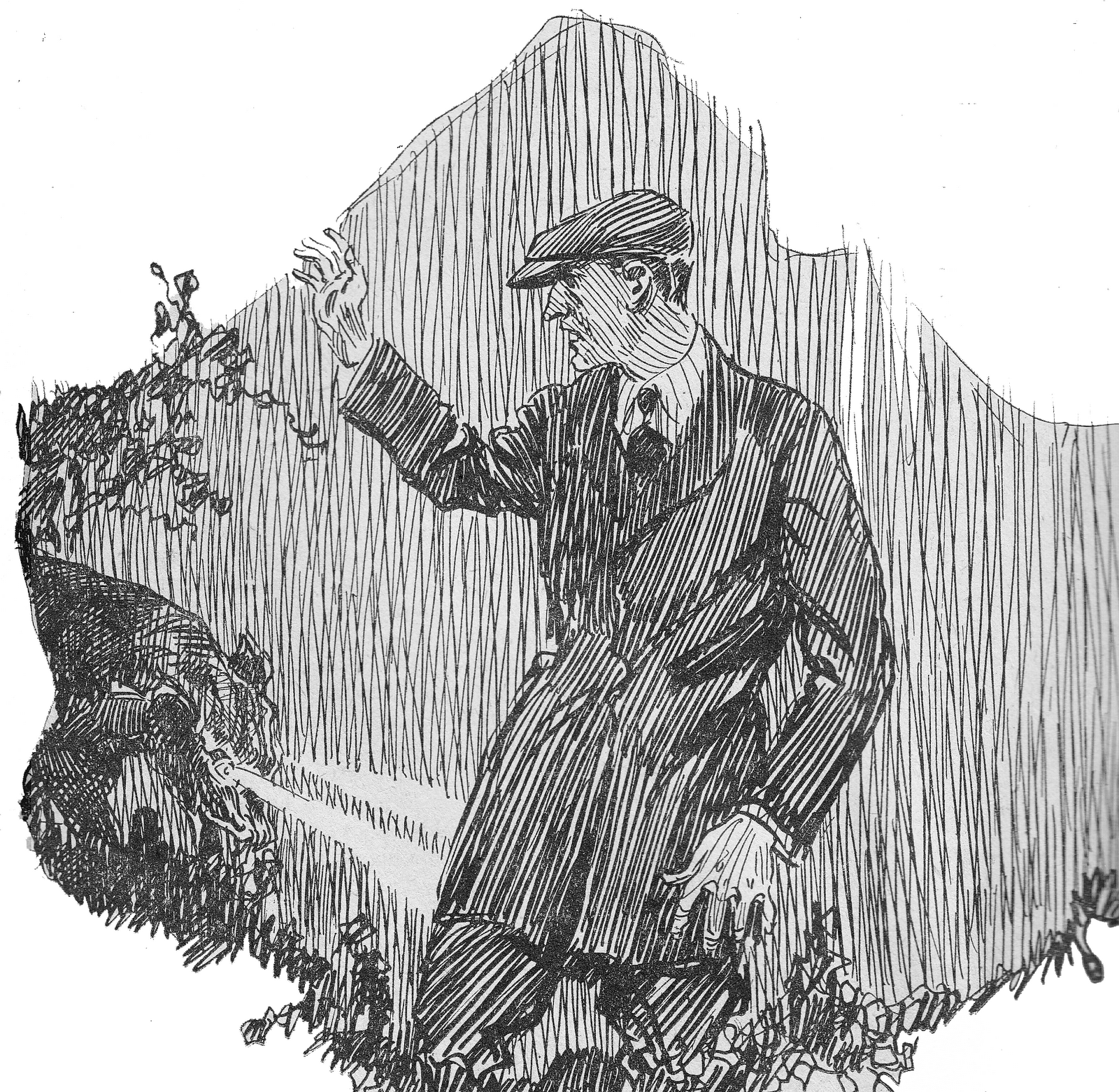
Proof that William Heitman could draw: an illustration for a poem by the Indiana poet Tramp Starr (Carl Wilson) from the Indianapolis Star, January 7, 1940. 
And a drawing from the same paper illustrating a feature on the Mechanic Arts School in Evansville, Indiana, May 5, 1940. Experienced in journalistic illustration, Heitman may simply have been ill suited to fantasy art. We should remember that a lot of early fantasy art was not very well done. After all, this was a new world of illustration.

Updated on January 7, 2026, prompted by the comment below. Thank you to Jerimee for the prompt.
Thanks to a reader for corrections and further information.
Text and captions copyright 2012, 2023 by Terence E. Hanley