Showing posts with label Mummies & Egypt. Show all posts

Wednesday, July 16, 2025

The Curse of Tut-Ankh-Amen

The first story by Donald Edward Keyhoe in Weird Tales was "The Grim Passenger," published in April 1925, one hundred years before I began writing this series. My move and other events have intervened. That one-hundred year anniversary isn't so timely now. But I'll complete this series today.

"The Grim Passenger" is a story of Egypt and mummies. It begins with a reference to "the opening of the tomb of King Tut-Ankh-Amen," which took place in February 1923 but was still pretty fresh in the minds of the reading public two years later. Weird Tales had had plenty of content related to Egypt, pyramids, pharaohs, mummies, and King Tut-Ankh-Amen, most notably in its first-anniversary issue of May-June-July 1924. There would be more.

Keyhoe's story is one of a curse. Its author was clever enough to connect the idea of an ancient Egyptian curse to a more recent historical event. I won't give away his twist ending. There are those who believe in what they call the Curse of King Tut. Still there are those who believe these things. Even as late as the one-hundred-year anniversary issue of Weird Tales, published in 2023, there seems to have been belief, this expressed in Tim Lebbon's story "Laid to Rest." I will quote a newspaper article from one hundred years before: "It is really remarkable that otherwise intelligent persons should give credence to stories of this character [. . .] ." And yet they do. (Source: "Spirits and Lord Carnarvon," in The (San Francisco) Recorder, April 7, 1923, page 6.)

The concept of an ancient Egyptian curse visited upon those who disturb ancient tombs and graves is an old one. Like so much in our popular culture, it appears to date from the nineteenth century. The originators of the living mummy and a mummy's curse appear to have been three women, plus an anonymous author. They were Jane C. Loudon, Jane G. Austin, Louisa May Alcott, and, of course, Anonymous. You can read more about that on Wikipedia, the website that knows everything, including many things the rest of us know as lies.

There is a pharaonic curse in the work of another author. He was H. Rider Haggard. In Cleopatra: Being an Account of the Fall and Vengeance of Harmarchis (1889), Haggard wrote of how Harmarchis robs the tomb of the pharaoh Men-kau-ra and how "the 'Ka,' or the spirit of the dead Pharaoh, brought about the degradation and death of both Harmarchis and Cleopatra for their impious deed." (Same source as the above quote.) In February 1923, Haggard in fact protested against "desecrating the tombs at Luxor," asking, "'What would England think if the great dead in Westminster Abbey were exhumed and treated this way?'" (Source: "H. Rider Haggard Flays Desecration," in the Minneapolis Star Tribune, February 20, 1923, page 2.) Haggard is about to come up again.

The idea that there is a Curse of King Tut seems to have originated with the sickness and death of Lord Carnarvon, who had financed the explorations at the tomb of Tutankhamen. The first use of that phrase--"the Curse of King Tut"--that I have found in an American newspaper is from March 20, 1923. Lord Carnarvon had fallen ill the previous day from an infected mosquito bite. He died on April 5, 1923, in Cairo, and his body was returned to his native land for burial. I feel certain it has remained undisturbed since then. In any case, "the Curse of King Tut" and Weird Tales magazine are, as you can see, of the same vintage, for both got their start in March 1923. I don't know who came up with the idea of the curse. The newspaper article, shown below, is unsigned. But its anonymous author wrote it as if Haggard were in his place, and I find that noteworthy. It's also fascinating to realize that the writing lives of the early Weird Tales authors overlapped with that of H. Rider Haggard.

"The Curse of King Tut! Egyptians Insist Avenger Has Struck Invader of Tomb." From The Cleveland Press, March 20, 1923, page 1. The author is anonymous, but the art is signed. Unfortunately, I can't read the artist's last name, only his first--Paul. The account reads like a weird tale, and the illustration of a man in a pith helmet and jodhpurs, fleeing from a giant insect, could easily have appeared in "The Unique Magazine" of the 1920s.

Original text copyright 2025 Terence E. Hanley

Monday, May 19, 2025

Donald Keyhoe in National Geographic-Part Two

As I was paging through Donald E. Keyhoe's article "Seeing America with Lindbergh," published in The National Geographic Magazine in January 1928, I was struck by an oblique aerial photograph, and its caption, of the new airport at Oakland, California:

The caption reads:

A GLIMPSE OF THE CROWD AT OAKLAND (SEE, ALSO, PAGE 39)

     This modern airport when completed will cover 825 acres and will be one of the largest in the world. At present it has one runway 7,000 feet long and 250 feet wide. There is also a square area, part of which is here shown, now ready for use. This is 1,700 by 2,500 feet. The white circle and the name "Oakland" are made permanent by the use of crushed stone. These markings are a very great help to the airman who is flying cross-country over strange territory. Hangars, night lighting equipment, and other apparatus are being installed.

- - -

Pay special attention to the word "Oakland," the white circle with its stem, and the white square with its longer stem to the left. These features, along with the words of the caption--"These markings are a very great help to the airman who is flying cross-country over strange territory"--reminded me of other images and other ideas . . .

The idea pointed out by Keyhoe in his picture and caption is that large symbols made on the ground can be used to communicate with viewers in the air. If you read works of Forteana, you have probably encountered this idea before. I know I have, and I might have a date for my first such encounter: January 5, 1973, when the documentary In Search of Ancient Astronauts was first broadcast on NBC-TV. Or maybe it was on September 6, 1973, when "one of the most talked-about television specials of the past season" was repeated. The source of the quote is a syndicated feature article from various American newspapers published in September 1973. I suspect the documentary was repeated at later dates, too.

In Search of Ancient Astronauts is based on the book Chariots of the Gods? by Erich von Däniken, published in 1968 and adapted to film in 1970. One segment of In Search of Ancient Astronauts is about the lines graven into the plains of Nazca in southern Peru. The "conclusion reached by von Däniken," says the narrator Rod Serling, using his best Twilight Zone/Night Gallery voice, is that these lines "represent a landing field: the Plain of Nazca is a gigantic abandoned airport."

Here are two images, with captions, from a double-page spread in Mr. von Däniken's book (Bantam Books, 1971):


The captions read:

(Above:)
Another of the strange markings on the Plain of Nazca. This is very reminiscent of the aircraft parking areas in a modern airport.

(It's also reminiscent of the circle and stem at the Oakland airport in 1927.)

(Below:)
This huge 820-foot figure above the Bay of Pisco points to the Plain of Nazca. Could this be an aerial direction indicator rather than a symbol of religious significance?

(In other words, could this figure have been put into place to help "the airman who is flying cross-country over strange territory"?)
- - -

The idea of communicating with people in the air from signals on the ground predated In Search of Ancient Astronauts, Chariots of the Gods?, and Donald Keyhoe's article from 1928, for in its issue of April 1920, Popular Mechanics published an article by Paul H. Woodruff called "Perhaps Mars Is Signaling Earth." The article begins with a recounting of events from January 1920, when "Marconi commercial-wireless stations at New York and London reported the receipt of certain strange and undecipherable signals." (p. 495) The author of the article quoted several prominent astronomers and physicists, including Albert Einstein, regarding these signals. An idea bandied about was that they were from people on another planet. A further idea was how we of Earth might signal them back.

There were different ways of doing that according to the men quoted in the article. Here is an illustration of one to go along with today's theme:


The caption reads:

Sir Oliver Lodge's Simple Suggestion Is to Form a Gigantic Geometrical Figure on the Surface of the Sahara Desert, Which Would Be Visible to a Martian Observer through a Telescope as Powerful as Those Used on Earth. It would be Understood as a Sign Because Geometry Is a Science of the Universe.
- - - 

We have encountered Sir Oliver Lodge (1851-1940) before. Although he was a physicist, he was also the opposite of a physicist, that is, a spiritualist. I first wrote about him in an article called "Dr. Dorp by Otis Adelbert Kline," posted on September 4, 2023. You can read what I wrote by clicking here. Although Lodge, as a physicist, would have been interested in other planets and possible signals from outer space, I sense that his interest here had more to do with his beliefs in the paranormal and other things outside the realm of science. His geometric shape here might be a triangle, but it's also the shape of a pyramid in profile. (So now we have three basic shapes, circle, square, and triangle.) And look at that, there are four pyramids in the foreground. These are no doubt for scale, but they also introduce a connection to these ancient, mysterious, and some would say occult structures. Remember that proponents of the ancient astronauts hypothesis believe that the pyramids of Egypt were constructed with the help of extraterrestrial knowledge and technology. In the 1920s, there were paranormal and weird-fictional connections, for example in "Imprisoned with the Pharaohs" by Houdini, ghostwritten by H.P. Lovecraft and published in the May/June/July issue of Weird Tales magazine. I'll have more on Egypt before too much longer.

The idea that people on other planets are watching those of Earth was older still. Here is the opening of The War of the Worlds by H.G. Wells (1897; 1898):

     No one would have believed in the last years of the nineteenth century that this world was being watched keenly and closely by intelligences greater than man’s and yet as mortal as his own; that as men busied themselves about their various concerns they were scrutinised and studied, perhaps almost as narrowly as a man with a microscope might scrutinise the transient creatures that swarm and multiply in a drop of water.
- - -

If Sir Oliver Lodge felt like Martians were watching us, maybe he had that idea from H.G. Wells in his work of less than a quarter-century before that April 1920 issue of Popular Mechanics.

But if Martians were watching us, we were watching them, too, and we believed we could see shapes and lines on the surface of their planet as well. In the 1880s and 1890s, American astronomers reported seeing canals and other strange and mysterious features on the surface of Mars. Among them was William H. Pickering (1858-1938), part of whose work was carried out at Arequipa, Peru, which is not very close at all to Nazca. By the way, there are pyramids near Nazca, too. These are called the Cahuachi pyramids.

The so-called Canals of Mars are most closely associated with Percival Lowell (1855-1916), though, who watched Mars for years and wrote three books about his observations. I can only assume that his first, Mars (1895), excited the imaginations of people all over the world and was an influence upon Wells in the composition of his novel of interplanetary invasion. Lowell no doubt inspired other authors of science fiction, too. From Wikipedia:

     Lowell's influence on science fiction remains strong. The canals figure prominently in Red Planet by Robert A. Heinlein (1949) and The Martian Chronicles by Ray Bradbury (1950). The canals, and even Lowell's mausoleum, heavily influence[d] The Gods of Mars (1918) by Edgar Rice Burroughs as well as all other books in the Barsoom series.
- - -

Like the circle at the Oakland airport, we come back to beginnings, namely Donald E. Keyhoe. In his last book, Aliens from Space . . . The Real Story of Unidentified Flying Objects, published in 1973, Major Keyhoe devoted a whole chapter to what he called Operation Lure. Originally developed by--but not really, as we have seen--Robert Spencer Carr (1909-1994), Operation Lure would have been designed to lure space aliens to land as if they were ducks landing on a pond stocked with decoys. Here is Keyhoe's one-sentence summary of Operation Lure:

     The Lure will be an isolated base with unusual structures and novel displays, designed to attract the UFO aliens' attention. (p. 291)
- - -

The main observation post for Earthmen would have been called Control, like in Get Smart. A communications station twenty-five miles distance from Control would have been called "Relay," like in Pete Townshend's never-completed project, Lifehouse. If you have never heard The Who song "Relay," you might want to give it a listen. In it, Mr. Townshend invented the Internet. Listen for the lyric, "The word is getting out about control."

The circle is getting tighter still: in Aliens from Space, Keyhoe wrote about ancient aliens, mentioning the Piri Reis map, the Theosophical Book of Dzyan, the plains at Nazca, the pyramids of Egypt, and even Carl Sagan!

Next: Miscellany about Keyhoe, Lindbergh, Heinlein, and other things.

Original text copyright 2025 Terence E. Hanley

Saturday, January 25, 2025

Pyramids on the Cover of Weird Tales

I wrote recently of pyramids, and this month I'm writing about the January 1925 issue of Weird Tales. Today I can write about both, for on the cover of that issue is a pyramid, a step pyramid and the only one of its kind to appear on the cover of "The Unique Magazine." There had been pyramids before, on the first-anniversary issue of May/June/July 1924. There would be one more in the original run of the magazine, in February 1929, and one more after that, in Winter 1985.

Weird Tales, May/June/July 1924, the first and only quarterly issue of "The Unique Magazine." Cover story: "Imprisoned with the Pharaohs" by Houdini (ghostwritten by H.P. Lovecraft). Cover art by R.M. Mally.

Weird Tales, January 1925. Cover story: "Invaders from the Outside" by J. Schlossel. Cover art by Andrew Brosnatch

"I heard sighs of horror from my two companions beneath me, and for a single moment we hung motionless along the chain's length, swinging along the huge pyramid's glowing side at a height of hundreds of feet above the shining streets below. Then the creature raised one of its tentacles, a metal tool in its grasp, which he brought down in a sharp blow on the chain at the window's edge. Again he repeated the blow, and again.

     "He was cutting the chain!"

Weird Tales, February 1929. Cover story: "The Star-Stealers" by Edmond HamiltonCover art by Hugh Rankin.

Weird Tales, Winter 1985. Cover art by Ro H. Kim (Hyang Ro Kim). This cover combines a pyramid with the pyramidal body and tentacles of Rankin's previous design.

Text copyright 2025 Terence E. Hanley

Monday, February 5, 2024

Weird Tales: The Houdini Issues-Part Three

"Imprisoned with the Pharaohs"

In January and February of 1924, Weird Tales magazine played cowboys and Indians on its covers. In the first illustration, a hatless cowboy wearing thick, furry chaps is seen fleeing on horseback from a ghostly rider twirling a ghostly lariat. In the second, an Indian seems to be summoning lightning from the night sky. With his straight arms raised and his hands open before him, he looks like the symbol of the Lone Scouts. With his flashing red cloak, he looks like the ape in Frank Frazetta's illustration for the Conan story "Rogues in the House." Both covers were by R.M. Mally.

Then the Houdini issues began.

There were three in all, in March, April, and May/June/July 1924. Although Houdini signed his agreement with Weird Tales in February 1924, the issue with the Indian cover was already on the nation's newsstands by then. The March issue was the earliest in which his byline could appear. 

R.M. Mally was again the creator of the three Houdini covers. Houdini was supposed to have been the author of all three cover stories. They were:

  • March 1924: "The Spirit Fakers of Hermannstadt"
  • April 1924: "The Hoax of the Spirit Lover"
  • May/June/July 1924: "Imprisoned with the Pharaohs"

So there were three stories published under Houdini's byline in Weird Tales. But does that mean that Houdini was actually their author? The answer is obviously no in the case of "Imprisoned with the Pharaohs," as H.P. Lovecraft is known to have ghostwritten that story. There was some drama attached to that, for Lovecraft wrote it in a hurry, lost his first version in an even quicker hurry, then rewrote it on his honeymoon, again in a hurry. (Most people are in a hurry on their honeymoons, though not to retype lost manuscripts.) Maybe the briefcase or satchel containing his typescript is in the same place as Hemingway's stolen suitcase. Maybe they're both at the dead letter office where Bartleby the Scrivener used to work. Wherever it went, Lovecraft was well compensated for his work, Houdini liked the result, and his story is still admired by fans of weird fiction. It also became the cover story of the only quarterly issue of Weird Tales, May/June/July 1924. (1, 2)

To be continued . . .

Notes
(1) According to Wikipedia, "Imprisoned with the Pharaohs" is supposed to have been an influence upon a young Robert Bloch. Wikipedia of course doesn't say how. Robert Price, though, has identified an Egyptian Cycle of stories written by Bloch. These were published in Weird Tales in 1936-1938. Bloch's Milwaukee friend Earl Peirce, Jr., wrote a story, "The Archer" (Weird Tales, Mar. 1937), that seems to be connected to the Egyptian Cycle as well. Bloch didn't encounter Weird Tales until 1927. If "Imprisoned with the Pharaohs" was an influence upon him, that happened after the initial publication of Lovecraft's story.
(2) Houdini's fictional guide in "Imprisoned with the Pharaohs" is Abdul Reis el Drogman. I assume that the Reis part of his name is from Piri Reis. El Drogman would seem to refer to Abdul Reis' service as a guide. Otis Adelbert Kline would later write stories about a man employed in the same way. These were in his Dragoman series for Oriental Stories and The Magic Carpet Magazine of 1930-1933.

William F. Heitman's illustration for "Imprisoned with the Pharaohs," in Weird Tales, May/June/July 1924. The byline was Houdini's, but the story was written by H.P. Lovecraft. The scene here reminds me of one from Raiders of the Lost Ark in which Indiana Jones descends into a pit full of snakes. Indy's friend Sallah is there. Played by John Rhys-Davies (Rhys, not Reis), Sallah would appear to be a drogman- or dragoman-type character. Every Western adventurer in the Middle East or Near East needs one.

Original text copyright 2024 Terence E. Hanley

Friday, February 2, 2024

Weird Tales: The Houdini Issues-Part Two

Spirits & Sphinxes

Weird Tales magazine was apparently already in trouble when Harry Houdini (1874-1926) met J.C. Henneberger (1890-1969) in his Chicago office in February 1924. Henneberger must have seen a chance to capitalize on Houdini's name and fame by having him and it associated with his magazine. Maybe that would increase sales. And maybe Houdini saw an agreement between them as a chance to publicize his upcoming lecture tour of America. He wanted to talk about spiritualism, séances, and mediums. He wanted people to know that these things were (and still are) a scam, a hoax, and a great fraud.

What followed were three cover stories for Weird Tales written under Houdini's byline. Houdini also conducted a letters column called "Ask Houdini," which took the place of "The Eyrie" and ran in two installments, April and May/June/July 1924. I haven't checked this, but I believe "The Eyrie" was in every other issue of Weird Tales from March 1923 to September 1954. Only those two issues had something different. In any case, things didn't work out so well for Henneberger. Weird Tales foundered in mid-1924, and although he officially retained ownership of the magazine, he became indebted to others, including the men at the head of Cornelius Printing Company of Indianapolis. (I always like to point out that Weird Tales originated in my native city.) The quarterly issue of May/June/July was the last to appear until November 1924. By then, Edwin Baird, the first editor, had left, being replaced by Farnsworth Wright. Meanwhile, Houdini seemingly vanished, having moved on to another--apparently very successful--phase of his career.

* * *

The FictionMags Index provides a list of Harry Houdini's magazine credits. I have adapted it as follows:

  • Letter in The Sphinx: The Official Organ of the Society of American Magicians, Sept. 15, 1916.
  • "The Thrills in the Life of a Magician" in The American Magazine, Sept. 1918.
  • "The Spirit Fakers of Hermannstadt," a two-part serial in Weird Tales, Mar.-Apr. 1924.
  • "The Hoax of the Spirit Lover" in Weird Tales, Apr. 1924.
  • "Imprisoned with the Pharaohs" in Weird Tales, May/June/July 1924, ghostwritten by H.P. Lovecraft. Reprinted in Weird Tales in June/July 1939 as part of a series entitled "Weird Story Reprint." Houdini still got the byline, but an introduction to the story identifies Lovecraft as its true author. It's ironic that a man who exposed ghosts also had a ghost behind his story.
  • "When Magic Didn’t Work" in Collier's, Apr. 18, 1925.
  • "Tricks of Fake Mediums" in Liberty, Nov. 28, 1925.
Thanks to The FictionMags Index for compiling these credits and making this and so much more information available for the rest of us. (Houdini had other credits in The Sphinx. There is a website with indices to The Sphinx, but it's a commercial website, so I won't provide a link. You can find it on your own easily enough.)

Here are two more magazine credits, from Wikipedia:
  • "How I Unmask the Spirit Fakers" in Popular Science, Nov. 1925.
  • "How I Do My 'Spirit Tricks'" in Popular Science, Dec. 1925.
If you detect an air of skepticism and debunkery in these titles, you could be on to something.

Houdini had a famous difference of opinion with Arthur Conan Doyle (1859-1930), who, like the Cowardly Lion, believed in spooks, and yet, like Edgar Allan Poe, wrote great tales of ratiocination. Houdini and Doyle had first corresponded in 1920 while Houdini was touring in Great Britain. (It isn't clear to me when they actually met, although there is an extant photograph of them standing together like a Mutt-and-Jeff pair.) They became friendly, but that turned sour as Houdini continued in his work investigating and exposing frauds, mediums, hoaxers, and fakers. Doyle was well known for his belief in ghosts and fairies. You could call him gullible, perhaps in the extreme, while Houdini resided at the opposite end of the spectrum, for he was in fact powerfully skeptical of the whole business of spiritualism. Doyle saw Houdini's film The Man from Beyond (1921), though, liked it, praised it, and was mollified by it, for Houdini apparently had attempted an onscreen reconciliation of a sorts through his second-to-last picture. Good for Houdini.

To be continued . . .

In 1924, Houdini went on a twenty-four-date lecture tour of America booked by Coit-Albee Lyceum. His subjects were spiritualism, mediums, and séances. He also investigated mediums as a member of the Committee for Psychical Investigations organized by Scientific American. The poster or lobby card shown here is from 1924. It advertised something or other but I haven't found out what. But it was 1924, Houdini's name was still in the news and in American popular culture, and it shows the Great Sphinx of Egypt . . .

The Sphinx was "The Official Organ of the Society of American Magicians." Here is the cover for the March 15, 1924, issue, showing Houdini's picture flanked by hieroglyphics and the volume (XXIII) and number (One) enclosed in what you might call cartouches. By mid-March, Houdini was already on tour. (He had lectured in Birmingham, Alabama, on March 7 and 8, 1924.) Also by then, the first of three Houdini issues of Weird Tales had come out. His story, or article, "The Spirit Fakers of Hermannstadt," first of a two-part serial, was the cover story that month.

The Society of American Magicians held its 20th annual dinner at the Hotel McAlpin in New York City on June 6, 1924. Houdini was on the cover of the program along with the Great Sphinx of Egypt. The cover artist was Grant Wright. At about that same time, Houdini's book A Magician Among the Spirits (Harper & Brothers, 1924) came out. The subject was the same as in his lecture tour, that is, spirit fakers. According to Wikipedia, the uncredited co-author of A Magician Among the Spirits was C.M. Eddy, Jr., of Weird Tales fame. Like Houdini, Eddy had stories in the March, April, and May/June/July issues. Eddy's story for the triple-issue (cover shown below) was "The Loved Dead."

The theme and motif of the Sphinx returned in the May/June/July issue of Weird Tales and in Houdini's cover story, "Imprisoned with the Pharaohs," actually by H.P. Lovecraft, a friend and sometime collaborator of Eddy. The cover art was by R.M. Mally, his or her last for "The Unique Magazine." (In fact, all three of the Houdini covers were by Mally.) After reading about Houdini's activities in 1924 and seeing all of these images, I think it pretty likely that Weird Tales was still seeking to capitalize on its association with Houdini, thus the Sphinx on the cover. Ancient Egypt and the pharaohs of Egypt were still in the public consciousness, too, after the discovery of the tomb of Tutankhamen in November 1922. In looking over the first thirteen issues of Weird Tales, I see that there were several stories and non-fiction fillers on those subjects. In this space, those will have to be subjects for another day.

Original text copyright 2024 Terence E. Hanley

Friday, December 31, 2021

Why Weird Tales?

Weird Tales was in trouble during that first year. The magazine that never dies almost did in 1924. Otis Adelbert Kline (1891-1946) stepped in to edit the triple-sized, first anniversary issue, May/June/July 1924. It would be the last issue of the magazine until November 1924, when Farnsworth Wright (1890-1940) took over. Coincidentally, that first-anniversary issue was whole number 13.

The first feature in Weird Tales for May/June/July 1924 was a kind of manifesto entitled "Why Weird Tales?" It was written, anonymously, by Kline. In it, he explained the purposes of publishing the magazine, first, to offer readers stories they wanted but were unlikely to find in other places; second, "to find and publish those stories that will make their writers immortal." H.P. Lovecraft (1890-1937) was not yet known when Kline wrote. Robert E. Howard (1906-1936) was only eighteen and just getting started as a writer. Dozens of now well-known authors had not yet been published in Weird Tales. Hundreds of still nearly unknown writers, the beginning subject of this blog, still awaited discovery.

According to the current Weird Tales website, the first issue of the magazine appeared on newsstands on February 18, 1923. In other words, in about seven weeks Weird Tales will enter its 100th year. "The Unique Magazine" hasn't been continuously in print for these one hundred years. But it still exists and is still known and read. There may be another issue coming in the not very distant future. Otis Adelbert Kline's vision still holds.

* * *

I have posted the complete text of "Why Weird Tales?" on a new page for this blog. See the list of pages at the right. I have transcribed this text from the original, which I found on the website Internet Archive at the following URL:

https://archive.org/details/WeirdTales1924050607ATLPM/page/n1/mode/2up

Any transcription errors are my own.

* * *

Otis Adelbert Kline mentioned many authors in his essay. Following is a list. Names in bold are of those whose work was published in Weird Tales in the period 1923-1974. Click on their names to see my biographies of these authors.

Kline devoted a good deal of his 2,100-word essay to Poe and Hawthorne, also a full paragraph to Charles Brockden Brown. Brown may have been more well known in the 1920s than he is today. He has been and may even still be a neglected author.

I almost overlooked H.G. Wells' name in "Why Weird Tales?" and was almost ready to make something of that. Even though his name is there, I might still make something of Kline's bare mention of it: Weird Tales does not seem to have followed in Wells' path, for his work was an innovation. Weird Tales came from older things. Even though the magazine published science fiction, especially in the 1940s and '50s under the supervision of Dorothy McIlwraith (1891-1976), its mainstay was the weird tale, a type of fiction that matured into its own subgenre, weird fiction, in the pages of "The Unique Magazine." That's my opinion.

* * *

There are many good points in "Why Weird Tales?" One passage jumped out at me, considering what I have written over the past year about Utopia and Dystopia in Weird Tales. That passage:

The ancient Hebrews used the element of fear in their writings to spur their heroes to superhuman power or to instill a moral truth. The sun stands still in the heavens that Joshua may prevail over his enemies.

I refer here to Jack Williamson's idea that Utopia is in the Greek tradition, while Dystopia is in an older Egyptian-Hebraic tradition. (See "Utopia & Dystopia in Weird Tales-Part Three: Dystopia Before Utopia," here.) I'll have more on that topic and wrap up that series after the new year arrives.

Until then, Happy New Year to everyone everywhere. If 2022 is going to be better than the previous two years, we will all have to make it better. It won't happen on its own.

The cover story of Weird Tales May/June/July 1924 was "Imprisoned with the Pharaohs" by Harry Houdini. I don't see a signature here, but this is almost certainly the work of William F. Heitman of Indianapolis. I wanted to show Heitman's work here because it reminds me of the scene in Raiders of the Lost Ark when Indiana Jones and Marion Ravenwood are thrown into the pit. The more things change, the more they remain the same.

Original text copyright 2021, 2023 Terence E. Hanley
Monday, August 30, 2021

The Two Ozymandiases (and Then Some)

I quoted Percy Shelley's "Ozymandias" when I wrote in July. What I found in my research is that there are actually two Ozymandiases. First is Shelley's version:

Ozymandias (1818)
by Percy Bysshe Shelley (1792-1822)

I met a traveller from an antique land,
Who said--"Two vast and trunkless legs of stone
Stand in the desert. . . . Near them, on the sand,
Half sunk a shattered visage lies, whose frown,
And wrinkled lip, and sneer of cold command,
Tell that its sculptor well those passions read
Which yet survive, stamped on these lifeless things,
The hand that mocked them, and the heart that fed;
And on the pedestal, these words appear:
My name is Ozymandias, King of Kings;
Look on my Works, ye Mighty, and despair!
Nothing beside remains. Round the decay
Of that colossal Wreck, boundless and bare
The lone and level sands stretch far away."

* * *

Shelley wrote his "Ozymandias" in competition with his friend, Horace Smith (1779-1849). Smith's version was published two months after Shelley's:

Ozymandias (1818)
by Horace Smith

In Egypt's sandy silence, all alone,
Stands a gigantic Leg, which far off throws
The only shadow that the Desert knows:--
"I am great OZYMANDIAS," saith the stone,
"The King of Kings; this mighty City shows
"The wonders of my hand."-- The City's gone,--
Nought but the Leg remaining to disclose
The site of this forgotten Babylon.

We wonder,-- and some Hunter may express
Wonder like ours, when thro' the wilderness
Where London stood, holding the Wolf in chace,
He meets some fragment huge, and stops to guess
What powerful but unrecorded race
Once dwelt in that annihilated place.

* * *

Shelley's sonnet is justifiably famous. Horace Smith's is, I suppose, obscure. But it brings into these tales of two Ozymandiases something missing from the first: the poet's vision is cast into the future as well as into the past. And as a vision of the future and a post-apocalypse, Horace Smith's poem approaches science fiction.

* * *

All of that led me to some other lines of verse. These were written by the British poet and author Anna Lætitia Barbauld (1743-1825). They predated Shelley's and Smith's poems by six years. An excerpt from Eighteen Hundred and Eleven: A Poem (1812), by Anna Lætitia Barbauld, lines 39-49:

And think'st thou, Britain, still to sit at ease,
An island Queen amidst thy subject seas,
While the vext billows, in their distant roar,
But soothe thy slumbers, and but kiss thy shore?
To sport in wars, while danger keeps aloof,
Thy grassy turf unbruised by hostile hoof?
So sing thy flatterers; but, Britain, know,
Thou who hast shared the guilt must share the woe.
Nor distant is the hour; low murmurs spread,
And whispered fears, creating what they dread;
Ruin, as with an earthquake shock, is here, [. . . .]

* * *

Mrs. Barbauld wrote of the Napoleonic Wars, but in her vision of the near future, she saw ruin.

The future may hold Utopia, but it may also hold Apocalypse.

* * *

By the way, Anna Lætitia Barbauld is in the Internet Speculative Fiction Database.

"The Questioner of the Sphinx" (1863), by the American artist Elihu Vedder (1836-1923).

Original text copyright 2021, 2023 Terence E. Hanley

Tuesday, October 11, 2016

Mummies & Egypt on the Cover of Weird Tales

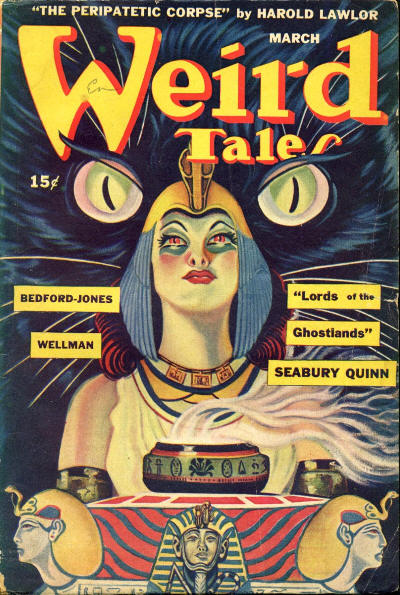
Mummies, Egypt, and subjects related to Egypt have been on the cover of Weird Tales seven times by my count. The first was the triple-issue first anniversary number of May/June/July 1924 and shows a generic Egyptian scene of Sphinx and pyramids. The next three show women being menaced by one thing or another. The last three are a little more complicated and not easily categorized.

There were Orientalists among the first generation of writers for Weird TalesOtis Adelbert Kline and E. Hoffman Price chief among them. Farnsworth Wright must have been one of them, too, as he eventually saw a pet project, Oriental Stories/The Magic Carpet Magazine, into print. In any case, the mysterious East held the imagination of writers, artists, and readers alike for decades before Weird Tales came along, but an event of the 1920s brought Egypt to the fore, namely, the opening, on February 16, 1923, of King Tut's tomb. The first issue of Weird Tales, dated March 1923, was probably on the newsstand by then. A year later, as investigations at the tomb continued, Weird Tales capitalized on the interest in Egypt, pyramids, tombs, and mummies with its cover, by R.M. Mally, for Harry Houdini's story "Imprisoned with the Pharaohs." Universal Pictures got in on the action eight years later with what I think was the first mummy movie, called, appropriately enough, The Mummy. Like the covers of Weird Tales from the 1920s, that movie also featured a woman menaced by a villain, in this case, the mummy himself, come to life. And like the last two Weird Tales covers on the subject of Egypt, it had that woman in ancient Egyptian dress.

Finally, as a friend calls it, some hypostulatin': I wrote last time about World War II and noted that the last Weird Tales cover on that subject came only midway through the war. It seems to me that after the war, American popular culture had some new things to deal with and responded accordingly with some new or rapidly evolving genres: film noire, science fiction, the Cold War thriller. But it also retrenched (to use a military metaphor) into horror, fantasy, and monster movies, stories, and comic books. As we have seen, stories of monsters, being stories of the supernatural, have had a hard time surviving in a world in which all things are scientified (my neologism, not my friend's). Almost every monster movie made these days is actually a science fiction movie, as all the monsters have a science-fictional explanation. Even the recent Mummy series, overloaded as it is with computerized effects, has the look of a science fiction extravaganza. Anyway, it's strange to see an Egypt cover on the Weird Tales issue of March 1945, the month in which the Allies broke into Germany on the Western Front, while the war in the Pacific was finally nearing the Japanese homeland. What was in people's minds at the time? Did they think that we would just go back to the way things were before the war? Was there a kind of nostalgia for the prewar world? Even if there was such a thing, the people of the time must have known that the world had changed beyond measure and that there would be no going back.

Weird Tales, May/June/July 1924. Cover story: "Imprisoned with the Pharaohs" by Harry Houdini. Cover art by R. M. Mally.

Weird Tales,  August 1927. Cover story: "The Bride of Osiris" by Otis Adelbert Kline. Cover art by the underrated Hugh Rankin.

Weird Tales, April 1928. Cover story: "The Jewel of Seven Stones" by Seabury Quinn. Cover art by C.C. Senf.

Weird Tales, June 1929. Cover story: "The House of Golden Masks" by Seabury Quinn. Cover art by Hugh Rankin.

Weird Tales, April 1930. Cover story: "The Dust of Egypt" by Seabury Quinn. Cover art by Hugh Rankin.

Weird Tales, November 1938. Cover story: "I Found Cleopatra" by Thomas P. Kelley. Cover art A.R. Tilburne.

Weird Tales, March 1945. Cover story: "Lords of the Ghostlands" by Seabury Quinn. Cover art by A.R. Tilburne.

Text copyright 2016, 2023 Terence E. Hanley

Sunday, April 19, 2015

The Stories of Francis Stevens-Behind the Curtain

"Behind the Curtain" is a short story originally published in All-Story Weekly, September 21, 1918, and reprinted in Famous Fantastic Mysteries, January 1940. In The Nightmare and Other Tales of Dark Fantasy (2004), it takes up a mere seven pages.

"Behind the Curtain" is short, also simple, a tale of revenge in the manner of Edgar Allan Poe. The author even mentions Poe in her story, and her two characters, Santallos the narrator, and Quentin, his guest, drink of Amontillado. Santallos is a collector of Egyptian antiquities, including mummies and mummy cases. You might say he's wrapped up in his hobby, so much so that he neglects his wife. Naturally she falls into the arms of the younger man, Quentin. Santallos concocts a fiendish kind of revenge. Poe might have twisted the story one way. Francis Stevens chose to twist it another. A more conventional author would have left it untwisted. There is, I think, a feminine sensibility in the twist, despite the fact that the narrator is a man and the story was written by a woman who signed her stories with a masculine pseudonym.

* * *

As the saying goes, the golden age of science fiction is twelve. Born on September 18, 1883, Gertrude Barrows turned twelve in 1895. During the year in which she lived that golden age (and perhaps in the few months before and after--I don't know the exact dates of publication), Henry Altemus of Philadelphia issued a collection of Edgar Allan Poe's stories entitled Weird Tales (1), and out of England came The Time Machine and The Island of Doctor Moreau by H.G. Wells and The Well at the World's End by William Morris. Francis Stevens was clearly inspired and influenced by Poe--as in "Behind the Curtain"--and Wells--as in the Doctor Moreau-like character Archer Kennedy in The Citadel of Fear. (2) I can also see the influence of nineteenth- and early twentieth-century detective stories and tales of Lost Worlds after H. Rider Haggard and Edgar Rice Burroughs, again in The Citadel of Fear. We might ask how Gertrude Barrows left such a mark in her very brief career writing fantasy. Maybe it all goes back to a golden age during which she read Poe and Wells, as so many of us have done in our adolescence.

Notes
(1) There is reason to believe the later magazine (1923) was named for Poe's Weird Tales of 1895.
(2) The influence of H.G. Wells is even more pronounced in The Heads of Cerberus (1919). Stay tuned.

Virgil Finlay's illustration for "Behind the Curtain" by Francis Stevens, from Famous Fantastic Mysteries, January 1940. Note how the wrappings are strategically placed to cover up certain parts of the female anatomy. That happened a lot in pulp art.

Text and captions copyright 2015, 2023 Terence E. Hanley

Friday, January 3, 2014

Woman and Monster

Sometimes the eternal triangle of man, woman, and monster is reduced by one to simply woman and monster. In yesterday's posting, I showed thirteen Weird Tales covers in the first category. Today I will show eighteen in the second. If you're looking for patterns in the illustrations shown below, you will probably first notice that many of these women are scantily clad or in tightly fitting dresses. (Three of those dresses are red.) Second, look for seven green or greenish monsters, plus a green snake. As for classifying monsters by type, note that most are humanoid. Note also that two are amorphous. Third, there seems to be a lot of looking in these pictures: at least seven show the monster mostly just looking at the woman, perhaps in the same way that a male reader might look at women and pictures of women. So if an illustration of a monster looking at a woman satisfies the male viewer's desire to look, does it also satisfy the female viewer's fear of being looked at?

 * * *

Update (Jan. 5, 2014): I have been thinking a little more about these images of the woman and the monster. Maybe we can go a little further in this system of classifying covers of Weird Tales magazine. It seems to me that there are three stages of a process illustrated here: 1) Watching or looking. 2) Approaching, attacking, or chasing. 3) Capturing or carrying away. It also seems to me that there are more than just two players in each of these little dramas. The woman and the monster are evident. The artist and the viewer are much less so. But each plays his part. So is the monster representative of a man, either of the artist or of the viewer, or is he representative of man in general? I'm not sure that we as men can escape that implication. As for classification:
  1. Watching or looking (seven in all): the hairy giant, the mummy (if he's not approaching or attacking), the three-eyed alien, the gargoyle, the black blot, the bat-eared demon, the green alien.
  2. Approaching, attacking, or chasing (eight in all): Drome, the green gnome, the white-eyed zombies, the leopard-demon, the skeleton, the blue slime, and two pictures with reaching hands. (You might say that the green alien is both looking and attacking: the spoon is clearly a sexual symbol, essentially an extension of the hand that holds it.)
  3. Capturing or carrying away (three in all): the green bat-men; the red-robed, fanged monster; the winged, horned creature. The red-robed, fanged monster has gone the next step and is just about ready to kill the woman he is attacking. 
Note that almost half of these covers are in the category of looking. A statistician might call that significant.

 * * *

Weird Tales was known for its women writers, artists, readers, and letter-writers. During its middle period (the 1930s), the magazine competed with weird menace magazines, yet few if any of the images presented below would have fit with that rival sub-genre. (The cover showing the red-robed, fanged monster is an exception.) Weird Tales had its weird menace-like covers to be sure, but "The Unique Magazine" may have lived up to its subtitle by not being overtly cruel or misogynistic as so many pulp magazines were at that time. I don't think that the magazine could have been without driving away a good deal of its female readership. Farnsworth Wright seems to have been a man of taste. He was succeeded as editor by a woman, Dorothy McIlwraith. Both may have thrilled their readers with pictures of women in peril, but I don't detect any extreme cruelty or misogyny in most of the following images of woman and monster (except for perhaps in the last). Remember, too, that for much of the 1930s, the covers of Weird Tales were drawn by a woman, Margaret Brundage. She could hardly have been expected to create cruel or misogynistic covers, especially considering the way she was treated by her husband.

Weird Tales, January 1927. Cover story: "Drome" by John Martin Leahy. Cover art by C. Barker Petrie, Jr. This is one of my favorites of the early covers of Weird Tales. Petrie's illustration is well composed and simple to the point of being almost poster-like. The woman's green outfit contrasts nicely with the monster's reddish-brown fur. The monster by the way looks like an overdeveloped flying minion of the Wicked Witch of the West.

Weird Tales, March 1927. Cover story: "The City of Glass" by Joel Martin Nichols, Jr. Cover art by Curtis C. Senf. The monster is now humanoid and the illustration looks like something from a fairy tale--with a little female flesh thrown in to attract the male reader. I'm not sure what that thing is on the monster's foot. In any case, the woman doesn't seem to be overly frightened of him. Senf was German or German-American. (I'll know more when I write his biography.) His approach and technique seem to me to be distinctly Old-World. (Update [Dec. 3, 2018]: That thing on the monster's foot is not on his foot at all. I simply misread the image. It's actually a stool that the woman has upset in her flight from her attacker. And, yes, C.C. Senf was born in Europe and was in middle age when he was creating covers for Weird Tales. I like his work, but it is decidedly old-fashioned and very European.)

Weird Tales, April 1927. Cover story: "Explorers into Infinity" by Ray Cummings. Cover art by Curtis C. Senf. Only a month passed between these two similar scenes of March and April 1927. The monster is once again humanoid and the woman of his dreams is once again clad in pink, though just barely. Senf did a smart thing here: If the artist had put a different look on the monster's face, we might have thought he (the monster) was trying to crush the woman with the tree he's holding. Instead, any implication of cruelty or violence is relieved by the monster's pleased and surprised countenance.

Weird Tales, April 1928. Cover story: "The Jewel of Seven Stones" by Seabury Quinn. Cover art by Curtis C. Senf. If a mummy is a monster, then this cover falls into the category of woman and monster. It also falls into a category of covers with Egyptian themes. There's not much going on here, but I like the mummy's luminous eyes.

Weird Tales, May 1928. Cover story: "The Bat-Men of Thorium" by Bertram Russell. Cover art by Curtis C. Senf. Only a month separated this cover from the previous one, yet Senf looked like a different artist. The mummy cover is pretty conventional. The green bat-men cover on the other hand is frightening and nightmarish. The creatures here remind me of Ray Harryhausen's creepy animated models. The color scheme is the reverse of Petrie's "Drome" cover from the year before: the monsters are green and now the woman is in red. As soon as I saw this image, I thought of another:
"The Rape of the Daughters of Leucippus" by Peter Paul Rubens from 1617-1618. That image makes me think of this one:
A drawing called "Rape of the Sabines" by one of the great cartoonists of the 1930s-1950s, R. Taylor (1902-1970). As you can see, there isn't any "sobbin', sobbin', sobbin'" going on in this picture. Instead, the women seem to have tricked the men into doing what they want. In any case, once a great work of art has been skewered, it's hard to un-skewer it in your head. For me, Rubens and Taylor will always go together. 
We might as well go full circle: Richard Taylor also drew the covers for five volumes of weird tales issued by Arkham House between 1958 and 1963. Here is his illustration for The Trail of Cthulhu by August Derleth (1962). Note the artist's initials inside the cartouche on the stone in the foreground. Note also that the poached-egg eyes--a Taylor trademark--are missing.

Weird Tales, May 1929. Cover story: "The Scourge of B'Moth" by Bertram Russell. Cover art by Curtis C. Senf. I'm not sure that the creature in the red robes is actually a monster, but he looks like a monster and that will do.

Weird Tales, November 1931. Cover story: "Placide's Wife" by Kirk Mashburn. Cover art by Curtis C. Senf. This cover could go into one of several categories. The hands are those of a monster however, so despite the presence of the cat and despite the vampire theme, I will put it here and in a forthcoming category called "Reaching Hands."

Weird Tales, January 1932. Cover story: "The Monster Prophecy" by Clark Ashton Smith. Cover art by Curtis C. Senf. As an artist, Senf may have been a little too fussy a little too often, but all that went out the window with this fine illustration from 1932. The woman and the alien that is eyeing and eyeing and eyeing her are well delineated and the star field stays nicely in the background. The technique on the woman's face almost looks like airbrush. Senf had six months left as a cover artist when this issue appeared. In June 1932, J. Allen St. John created his first cover for Weird Tales. Then, in September, Margaret Brundage came along, and for nearly half a decade, only she and St. John drew covers for "The Unique Magazine."

Weird Tales, July 1932. Cover story: "The Phantom Hand" by Victor Rousseau. Cover art by Curtis C. Senf. This cover has one of everything: a woman, another woman (perhaps a witch), a snake, a reaching hand, and--if the hand is that of a phantom--a ghost or monster. You'll see why I have made a separate category for each of those elements.

Weird Tales, March 1934. Cover story: "The Black Gargoyle" by Hugh B. Cave. Cover art by Margaret Brundage. As in Senf's illustration, the monster here glares at the woman, though perhaps with more pleasure and anticipation. If we're going to classify cover images more finely, we should place monsters in one of at least three categories: 1) The kind that just wants to kill or eat its prey. 2) The monster that covets the woman. That's the kind that is the greatest threat to the hero. 3) The monster that wants to torture, imprison, or otherwise torment the woman. This black gargoyle looks like he falls into the second category. Thankfully, Margaret Brundage avoided racial stereotyping in her illustration, for just as she was not misogynistic, she was also not a racist or racialist.

Weird Tales, August 1937. Cover story: "Thing of Darkness" by G.G. Pendarves. Cover art by Margaret Brundage. The cover blurb refers to the monster here as "a slinking Thing of horror and sinister menace." The artist managed to make him kind of cute, a blot of black pastel on a Barbie-pink background.

Weird Tales, October 1937. Cover story: "Tiger Cat" by David H. Keller. Cover art by Margaret Brundage. This cover is unique among those shown here in that the woman seems to have the upper hand. Those look like monsters to me--zombies or something like them--but she seems to have things pretty well under control. I was surprised in doing my research at how many covers there are with someone flailing around with a cat-o'-nine-tails. This was the weird menace era of course. Fetishism was on full display in the pulps. But there may have been something about this kind of whip that appealed to artists, especially to Margaret Brundage. If nothing else, it gave her a chance to make her female subjects physically powerful. I guess we shouldn't overlook that the author, David H. Keller, was a sexologist. He probably had these things just lying around the house. (Update [Dec. 3, 2018]: Since writing this entry, I have read the story "Tiger Cat." As it turns out, the woman here is more nearly a monster and the men her almost helpless victims: they are eyeless because she has kept them in a darkened dungeon against their will.)

Weird Tales, January 1940. Cover story: "Spotted Satan" by two old standbys, Otis Adelbert Kline and E. Hoffman Price. Cover art by Virgil Finlay. This may not be Virgil Finlay's finest pulp magazine cover, but it's a striking image. In some ways it's very similar to C. Barker Petrie's illustration from thirteen years before.

Weird Tales, July 1942. Cover story: "Coven" by Manly Wade Wellman. Cover art by Margaret Brundage. An artist can't help but change as time goes by. You would hardly know to look at it that this illustration was by Margaret Brundage. Again, a striking image and one with real power. Many of her drawings are like confections--this one has come out of a nightmare, though perhaps a little stiffly. It reminds me of this image:
Frank Frazetta's much more dynamic original cover for The Moon Maid by Edgar Rice Burroughs. In both images, the woman is carried aloft by a monster. She is warm in contrast to the cool colors of the creature and of the background. That contrast between warm and cool may explain why so many monsters are green, but then there may be something else at work as I wrote in my comments from yesterday's posting. In any case, I think the mood of Margaret Brundage's drawing is what has reminds me of Frazetta.

Weird Tales, September 1942, Canadian edition. I'm not sure of the cover story and don't know the cover artist. In any case, if a skeleton is a monster, then this is a woman-and-monster cover. I'm not sure whether the woman is defending herself or commanding the skeleton. If she is defending herself, then she is one of just two women in this category to do so. (Both are using whips.) If she is in command, then she is in a category by herself.

Weird Tales, Canadian edition, January 1945. Cover story: "The Shadow Folk" by Edmond Hamilton (?). Cover artist unknown. (I hope someone can help out.) The green snake is back. There are a lot of those on the cover of Weird Tales. The main monster, though, is a bat-eared, gorilla-faced demon in need of a napkin.

Weird Tales, March 1953. Cover story: "Slime" by Joseph Payne Brennan. Cover art by Virgil Finlay. Contrast Virgil Finlay's version of the amorphous monster with Margaret Brundage's from 1937. Note also the menacing trees.
The movie The Blob came out five years later. I wonder if the makers of that movie saw either of these covers of Weird Tales. (Update [Dec. 3, 2018]: The Blob was in fact based on Joseph Payne Brennan's story, so it's no wonder that these two monsters look alike.)
If we're cataloguing blob-like and slime-like monsters in literature, we shouldn't forget the Oobleck from Bartholomew and the Oobleck by Dr. Seuss (1949).

Weird Tales, July 1953. Cover story: None. Cover art by W.H. Silvey. Again, a green alien looks on as the woman reacts in fear. As in my first posting, The Eternal Triangle, this one ends with a science-fictional image. Weird Tales was nearing its end as most pulp magazines were in 1953, but this was an era of science fiction. A magazine of purely weird fiction would have had a hard time keeping up. If it was going to hang on, Weird Tales probably had to make concessions to science fiction. Even so, "The Unique Magazine" lasted only another year after this image appeared. Of all the images I have shown in this entry, Silvey's illustration is the most problematic for me. The placement of the spoon between the woman's legs is very nearly obscene and suggestive of molestation or rape.

Next: Man and Monster

Updated on January 23, 2014, and again on December 3, 2018.
Text and captions copyright 2014, 2023 Terence E. Hanley