Showing posts with label Weird Tales in the 1970s. Show all posts

Saturday, September 14, 2024

Weird Tales: Years without Anniversaries

Weird Tales was in print from March 1923 to September 1954. The magazine sometimes observed its own anniversary. Sometimes it was the readers who did the observing in their letters to "The Eyrie." The most prominent anniversary issues were the first, in May/June/July 1924, and the twenty-fifth, in March 1948. Weird Tales was not in print from October 1954 until the summer of 1973. If there were observances of anniversaries during those years, they would have been in other places and under other banners. If there were such observances, I don't know anything about them.

I wrote the other day that Sam Moskowitz is supposed to have dissuaded Leo Margulies from bringing Weird Tales back into print. Now I have a source for that information. In Weird Tales #1, edited by Lin Carter and published in 1980, Moskowitz wrote:

     I twice talked Leo Margulies out of reviving the magazine, once in 1958 and again in the sixties, because I thought he would lose his shirt. (p. 266)

So if  Margulies had gone ahead with bringing back Weird Tales in 1958, maybe it would have been just in time for the thirty-fifth anniversary of "The Unique Magazine."

There weren't any issues and no revivals at all during the 1960s, although now I find that two of the Pyramid paperback anthologies about which I wrote the other day were intended as the start of a series. In Weird Tales #1, Sam Moskowitz revealed:

     I ghost edited for Leo Margulies the Pyramid paperbacks Weird Tales (1964) and Worlds of Weird (1965), which were intended to be a series, with covers and some interiors by Virgil Finlay. They apparently did not do well enough to justify continuing the series [. . .]. (p. 265)

Moskowitz went on to put together the fiftieth-anniversary issue of Weird Tales in Summer 1973 and three more issues in that brief four-issue revival. There wasn't any forty-fifth anniversary issue in 1968, nor a fifty-fifth anniversary issue in 1978, again, because Weird Tales was not in print during those years.

Lin Carter's four paperback issues of Weird Tales were published from 1980 to 1983. The last issue came out in 1983. I don't have a copy of it, but I assume there was at least some awareness of an anniversary, for Carter reprinted Anthony M. Rud's story "Ooze," originally in the first issue of the magazine from sixty years before.

There were two issues of Weird Tales published by Bellerophon Network in 1984-1985. These, too, were aware of the history of Weird Tales magazine, but there isn't any overt anniversary content in their pages as far as I can see. (Thanks again to Brian Forbes for providing me with the contents of those two issues.) And now we're getting close to another revival of Weird Tales and the sixty-fifth-anniversary issue of Spring 1988. A couple of things came before that issue, though, and I'll write about those next.

To be continued . . .

Weird Tales #1 (1980), edited by Lin Carter, with cover art by Tom Barber.

Original text copyright 2024 Terence E. Hanley

Tuesday, September 10, 2024

WT 50: A Tribute to Weird Tales (1974)

Leo Margulies published and Sam Moskowitz edited the fiftieth-anniversary issue of Weird Tales in the summer of 1973. Two more issues followed before the end of the year. The last of the four Margulies/Moskowitz issues was dated Summer 1974. Margulies was still credited as publisher. I wonder whether that issue was laid out and planned for publication in Spring 1974 before some kind of delay set in. Maybe that delay was for financial reasons, or maybe it was for legal reasons. (See the following paragraph for a possible explanation.) Maybe Weird Tales was reliving its difficulties of exactly fifty years before when there was so much uncertainty as to its future. Whatever might have happened, there would be no more "Unique Magazine" for the rest of the 1970s.

Also in 1974, Robert Weinberg edited and published WT50: A Tribute to Weird Tales. If you have never it, WT50 is a perfect-bound book of about 5-1/2 x 8-3/8 inches and 135 numbered pages. Inside are essays, five short stories, and artwork, all in black and white. Robert Weinberg introduced his book with an essay entitled "Why WT50?" And although it came along in the fifty-first year of Weird Tales, I think we can accept the title as accurate and expressive of Mr. Weinberg's intent. And the fact that he was publisher and holder of the copyright for this small book suggests pretty strongly that he took possession of the Weird Tales property either in late 1973 or during 1974. I should point out that he reused and adapted some of his material for The Weird Tales Story, published in 1977.

I haven't been writing at quite the pace I had hoped for during 2024. Merely by coincidence, this short article about the fiftieth anniversary of Weird Tales is my fiftieth of the year. I have another of my patented super-long articles coming up next, so be on the lookout for that and be sure to set aside some time for it.

WT50: A Tribute to Weird Tales, edited by Robert Weinberg and published in 1974, with cover art by John Mayer.

Text copyright 2024 Terence E. Hanley

Sunday, September 8, 2024

Weird Tales at Fifty

I don't know what changed between the early sixties and the early seventies, but in 1973, publisher Leo Margulies put out four pulp-sized issues of Weird Tales edited by Sam Moskowitz. The first of those issues, dated Summer 1973, has cover art by Virgil Finlay. Also on the cover is a blurb inside a purple circle that reads:

50th
Anniversary
Issue,
1923-1973

Among the contents of the fiftieth-anniversary issue is an essay called "Fifty Years Young," written by Moskowitz and printed inside the front cover. The next two issues, from Fall 1973 and Winter 1973, have cover blurbs reading: "Fiftieth Anniversary Year." One more issue came along in Summer 1974, and then the fiftieth-anniversary issues of Weird Tales came to an end. In the early 1960s, Moskowitz is supposed to have warned Margulies against restarting Weird Tales as a magazine for fear he would lose his shirt. Maybe he did anyway in the 1970s.

On August 14, 2013, I wrote about the four issues of Weird Tales published in 1973-1974. You can read what I wrote by clicking here.

Born in 1900 in Brooklyn, New York, Leo Margulies died on the opposite end of the country, on the day after Christmas 1975 in Los Angeles, California. Either before he died or with the disposition of his estate, the Weird Tales property was transferred to Robert E. Weinberg (1946-2016). The late Mr. Weinberg proceeded to issue his own publication on the fiftieth anniversary of Weird Tales. That one comes next in this series.

Weird Tales, Summer 1973, with never-before-published art by Virgil Finlay, at least in full-color form and in this composition. But Finlay's illustration was a swipe, or a swipe of a swipe, or maybe some other kind of thing. You can read more about it in my article from April 28, 2017, here. 

Text copyright 2024 Terence E. Hanley

Wednesday, November 30, 2016

Hannes Bok's Uncategorizable Cover, Then Politics on the Cover of Weird Tales

Hannes Bok is known for his strange and fantastic people, monsters, aliens, and other creatures. In March 1940, this design by Bok appeared on the front of Weird Tales:


The image above could go in other places in my categories of covers for Weird Tales: with woman and monster (maybe); with devils and demons (maybe); with vampires and bats (maybe); or with winged creatures (maybe). That's a lot of maybes, and that's because this cover isn't easily categorizable, for the woman isn't a woman, the demon isn't a demon, and the bat isn't exactly a bat. Heck, even the sloth is part bird. That's why I have put this cover alone . . .

Except that it isn't alone, because thirty-three years after "The Unique Magazine" printed that cover, it printed this one (albeit under different ownership and editorship):


The artist was Gary Van Der Steur, and his illustration was clearly meant as an homage to Bok's cover from so many years before. The bat is now a bird (it could be a dove). The demon now looks like a demon and carries a knife with a bloody point. The fetal cyclops remains. So does the face in the lower part of the picture, only instead of a fantasy animal, it looks like (and is) a depiction of Richard Nixon. Times had changed.

By personal correspondence, Mr. Van Der Steur let me know that he had included Richard Nixon in his illustration. As I write this (on Nov. 10, 2016), election week is ending and we now have a president-elect. It seems safe to say that this has been the weirdest election year in American history. I'll close the month in which the election occurred with the only political cover (as far as I can tell) for Weird Tales.

Text copyright 2016, 2023 Terence E. Hanley

Saturday, December 5, 2015

Leo Margulies (1900-1975)

Editor, Writer, Literary Agent, Publisher, War Correspondent
Born June 22, 1900, Brooklyn, New York
Died December 26, 1975, Los Angeles, California

Leo Margulies was born on June 22, 1900, in Brooklyn, New York. He attended Columbia University but left for work at the Frank A. Munsey chain of magazines. Starting as an office boy, Margulies learned about being an editor from Bob Davis. After leaving Munsey, Margulies worked for Fox Films and Tower Magazines and formed the first of his three literary agencies in 1929. He returned to magazine work in the early 1930s with Ned Pines' Standard Magazines, a group that at one time or other included Beacon Magazines, Better Publications, and Nedor Publishing Company. Nicknamed "the Little Giant of the Pulps," Margulies was editor or editorial director of Pines' many titles of the 1930s and '40s. He is supposed to have overseen forty-six different titles in his career. Mort Weisinger and Oscar J. Friend were among the editors who served with him or under him.

During World War II, Margulies served as a war correspondent in the Pacific Theater in 1943 and 1945. He was aboard the U.S.S. Missouri when the Japanese surrendered in September 1945. Returning to civilian life, he helped form the Popular Library line of paperback books. He also edited a number of science fiction and fantasy anthologies in hardback and paperback.

In the early 1950s, Margulies started his own publishing company, King-Size Publications. Over the years, he published The Saint Detective Magazine, Fantastic Universe Science Fiction, Satellite Science Fiction, The Man from U.N.C.L.E. Magazine, Zane Grey's Western Magazine, and other titles. In the mid-fifties, after it had ceased publication, Margulies purchased Weird Tales magazine. In the 1960s, he collected stories from that magazine in four paperback anthologies, two of which he edited himself and two of which were ghost-edited by Sam Moskowitz. Margulies and Moskowitz teamed up again for the four-issue revival of Weird Tales magazine in 1973-1974.

Margulies and his wife lived in France in the early 1950s and moved from New York to Los Angeles in 1972. While attending a meeting of the Mystery Writers of America in London in October 1975, Leo Margulies suffered a stroke. He died on December 26, 1975, in a hospital in Los Angeles. He was seventy-five years old. Robert Weinberg acquired Weird Tales late in Margulies' life or after his death. From his hands, it passed to Viacom, the current owners.

On August 14, 2015, Leo Margulies was the subject of a talk at PulpFest in Columbus, Ohio. The talk was in observance of the 115th anniversary of Magulies' birth and was presented by his nephew, Philip Sherman. The panel also included Ed Hulse and Will Murray. Mr. Sherman is working on a biography of his uncle, whom he remembers as "a lot of fun" and "a great, great uncle." You can listen to the talk at a website called The Pulp Net, here.

Leo Margulies' Credits (An incomplete list)
Magazine Editor, Editorial Director, and/or Publisher
  • Thrilling Wonder Stories (1936-1944)
  • Thrilling Mystery (1936-1938, 1940-1941, 1944)
  • Captain Future (1940-1944)
  • Startling Stories (1939-1944)
  • Strange Stories (1939-1941)
  • The Saint Detective Magazine
  • Fantastic Universe Science Fiction (1954-1956)
  • Satellite Science Fiction (1957)
  • The Man from U.N.C.L.E. Magazine (1966-1968)
  • Weird Tales (1973-1974)
  • Charlie Chan Mystery Magazine
  • Zane Grey's Western Magazine
  • Mike Shayne's Mystery Magazine
Book Editor
  • From Off This World (New York: Merlin Press, 1949) with Oscar J. Friend
  • My Best Science Fiction Story (New York: Merlin Press, 1949) with Oscar J. Friend
  • My Best Science Fiction Story (New York: Pocket Books, 1954) with Oscar J. Friend
  • The Giant Anthology of Science Fiction: 10 Complete Short Novels (New York: Merlin Press, 1954) with Oscar J. Friend
  • Race to the Stars (New York: Crest, 1958) with Oscar J. Friend
  • Three Times Infinity (Greenwich, Connecticut: Fawcett Gold Medal, 1958) ghost-edited by Sam Moskowitz
  • 3 from Out There (New York: Crest, 1959)
  • Get Out of My Sky (New York: Crest, 1960)
  • The Ghoul Keepers (New York: Pyramid Books, 1961)
  • The Unexpected (New York: Pyramid Books, 1961)
  • Three in One: Novels (New York: Pyramid Books, 1963) ghost-edited by Sam Moskowitz
  • Weird Tales (New York: Pyramid Books, 1964) ghost-edited by Sam Moskowitz
  • Worlds of Weird (New York: Pyramid Books, 1965) ghost-edited by Sam Moskowitz
Much of this list is from the Internet Speculative Fiction Database.

Further Reading
The Encyclopedia of Science Fiction
Internet Speculative Fiction Database

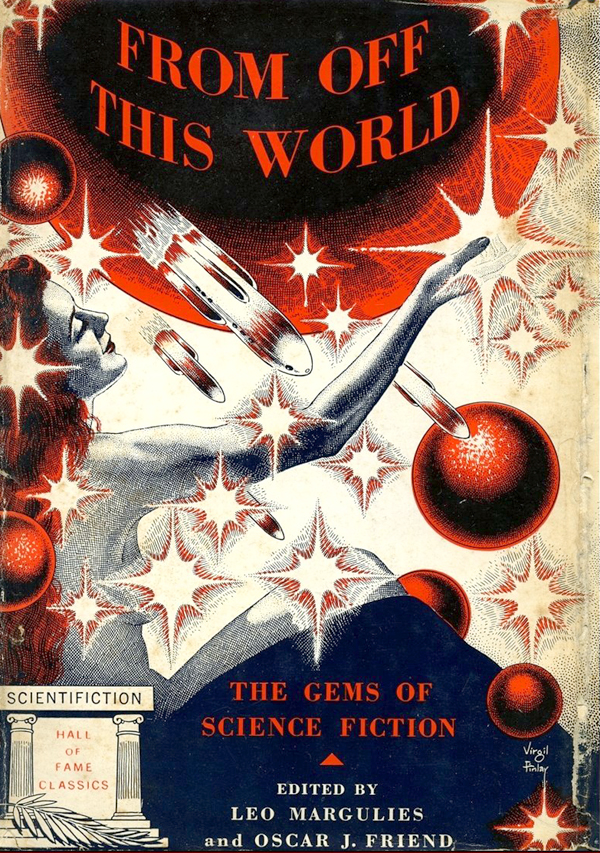
From Off This World, Leo Margulies and Oscar J. Friend's first anthology, from 1949, with dust jacket art by Virgil Finlay. Note Hugo Gernsback's old word scientifiction.

Original text and captions copyright 2015, 2023 Terence E. Hanley

Sunday, October 6, 2013

Edward D. Hoch (1930-2008)

Author
Born February 22, 1930, Rochester, New York
Died January 17, 2008, Rochester, New York

Edward Dentinger Hoch was born on February 22, 1930, in Rochester, New York. He began writing as a teenager and published his first story, "Village of the Dead," in the December 1955 issue of Famous Detective Stories. Over the next half-century, Hoch added 950 more stories to his credits for an average of one story every three weeks. Ellery Queen's Mystery Magazine published one of his tales every month from May 1973 to May 2007. Edward Hoch's stories also appeared in Adventure, Alfred Hitchcock's Mystery Magazine, Double-Action Detective, Isaac Asimov's Science Fiction Magazine, Mike Shayne Mystery Magazine, The Magazine of Horror, The Saint Mystery Magazine, and Web Detective Stories. His series characters numbered more than a dozen and included an occult detective named Simon Ark. Ark is the investigator in Hoch's lone story for Weird Tales, "Funeral in the Fog," from Summer 1973. Hoch died on January 17, 2008, in the city of his birth.

Edward D. Hoch's Story in Weird Tales
"Funeral in the Fog" (Summer 1973)

Further Reading
Edward D. Hoch in Wikipedia

Ellery Queen's Mystery Magazine, May 1980, with Edward D. Hoch's picture on the cover. In would be inadequate to call Hoch a regular contributor: he didn't miss an issue in thirty-four years.
Hoch was also a writer of science fiction and other fantasy. Here's a science fiction novel from nearly forty years ago, The Frankenstein Factory (1975). 

Text and captions copyright 2013, 2023 Terence E. Hanley

Wednesday, August 14, 2013

Weird Fiction & Fantasy Magazines-Weird Tales Part 3

Sam Moskowitz may have talked Leo Margulies out of restarting Weird Tales in the 1950s and '60s, but by the early '70s, they both seemed ready to give it a try. Margulies the publisher and Moskowitz the editor put out four issues of a new Weird Tales in 1973-1974. Those four issues are roughly in the format of old pulp magazines: 6-1/2 inches by 9-1/2 inches, color covers, black-and-white interiors, ninety-six pages in length. As for content, there was a letters page ("The Eyrie"), editorial content, verse, non-fiction, illustration, and an array of short stories. Most of those short stories were reprints, though only a few came from the original Weird Tales. And thereby hangs a tale.

In an interview from 1976, C.L. Moore discussed her early short story, "Werewoman," first published in Leaves #2 in 1938:
I very foolishly . . . gave it to a fan magazine who wanted to print it. . . . The error that I made there was I didn't realize they had copyrighted it. So twenty years later, who but Sam Moskowitz . . . [ellipses original] uh, performed his usual, um, practice [emphasis hers] of jumping on things two seconds after the copyright had lapsed! So he reprinted it, of course, without paying me anything for it. Incidentally, it is simply not a thing any other publisher I know of has ever done. I have had stories of mine printed after the copyright had lapsed and I've always been paid for them. Publishers just don't do things that way, but Moskowitz is an exception to the rule and nothing can be done about that! (1)
During the 1960s, Sam Moskowitz seems to have busied himself with exhuming old and out-of-print stories from the dusty vaults where they had lain for decades. It helped that those stories were copyright-free. It helped even more when the author was in his grave. In any case, Volume 47 of Weird Tales, published between Summer 1973 and Summer 1974, relied heavily on reprints, mostly from long-dead authors who were in no position to object or to request payment. Even the cover art was mostly old: a never-published painting by Virgil Finlay, a recreation of a painting by Hannes Bok, and a swipe of a painting by Jack L. Thurston. The most conspicuously new material was the interior art, the letters in "The Eyrie," and Moskowitz's three-part critical and biographical essay on William Hope Hodgson.

In its original incarnation, Weird Tales limped along for years before meeting its end in 1954. The second and third (see the next entry) Weird Tales lasted a mere four issues each. Most imitations of Weird Tales have also met an early demise. That poses the question: Is the category of weird fiction and fantasy fiction in magazine form destined to fail? Was Sam Moskowitz right when he warned Leo Margulies against reviving Weird Tales? The latest version of Weird Tales, still breathing after twenty-five years and myriad changes in its staff, would seem to argue against that contention. More to the point, I think, is that commercial success is gravy. The genre itself is the meat. If you can make money off of it, great. Even if you can't, you keep doing it. That's why Jacob Clark Henneberger stuck with Weird Tales in 1923-1924 and why the rest of us (people like Sam Moskowitz not withstanding) still do after ninety years.

Note
(1) From Chacal, Winter 1976 (Vol. 1, No. 1), pp. 26-27.

Weird Tales
Summer 1973 to Summer 1974
4 issues (Volume 47)
Published by: Weird Tales (Leo Margulies)
Edited by: Sam Moskowitz
Format: Pulp size (6-1/2 x 9-1/2 inches)

Weird Tales, Vol. 47, No. 1, Summer 1973, with cover art by Virgil Finlay. Note the blurb: "5oth Anniversary Issue, 1923-1973."
Weird Tales, Vol. 47, No. 2, Fall 1973, with cover art by Gary van der Steur, after Hannes Bok.
Weird Tales, Vol. 47, No. 3, Winter 1973, with cover art by Bill Edwards.
Weird Tales, Vol. 47, No. 4, Summer 1974, with uncredited cover art by Jack L. Thurston, almost certainly swiped and used without his permission. Note the absence of the "fiftieth anniversary year" blurb. Note also the blurb for all-new stories, a rarity in the new Weird Tales.

So did Margulies and Moskowitz publish their new Weird Tales mostly to observe the fiftieth anniversary of the original? Did the wind go out of their sails once that year had passed? Or were they losing their shirts as Moskowitz had predicted would happen years before? Maybe Weird Tales of 1973-1974 was mostly a vehicle for stories Moskowitz had discovered in his reading of old newspapers and magazines. Publishing a magazine is one way of getting stories like that into print--and of making a little money in the process. Maybe "a little money" was actually little or no money. Whatever happened, this was the last issue of the 1970s.

Text and captions copyright 2013, 2023 Terence E. Hanley

Tuesday, December 18, 2012

Weird Tales Artists of the 1970s

I'm just about finished with the artists who contributed to Weird Tales in the early 1970s. There were just four issues in that incarnation of the magazine that never dies. The artists who signed their work or who were given credit for their work included these few:
In addition, there was one uncredited artist who has now been identified:
By the time that four-issue revival of Weird Tales had been published in 1973-1974, two of its artists--Andrew Brosnatch and Virgil Finlay--were gone. Jack L. Thurston's art was almost certainly used without his knowledge or permission. Bill Edwards and Don Rico were both well-established, professional artists. Their art seems to have been created specifically for the 1970s Weird Tales. Both were based in southern California, which is where Weird Tales was published, and while Edwards was busy with acting and other activities, Don Rico had begun a teaching career at UCLA. He began with courses in the history of comic books. By 1976, he was making plans to teach young students how to draw them.

The reason I bring all this up is that it leads to a line of conjecture. I have been unable to find anything on the artist Geoffrey Sickler except for a reference to a man by that name who graduated from Edison High School in Huntington Beach, California, in 1971. Gary van der Steur, who created the cover of the second issue of Weird Tales, graduated from the California Institute of the Arts in 1971. (The school absorbed the Chouinard Art Institute in 1969; Mr. van der Steur would have matriculated at one school and finished with another.) Much of the unsigned art in Weird Tales from 1973-1974 looks like student work. So my question is, did Sam Moskowitz or his representative approach students or recent graduates of the California Institute of the Arts or other local art schools and ask them to illustrate Weird Tales? Was Don Rico, who was just beginning his teaching career, somehow involved?

Copyright 2012, 2023 Terence E. Hanley

Friday, December 14, 2012

Edison Marshall (1894-1967)

Author, Adventurer
Born August 28, 1894, Rensselaer, Indiana (1)
Died October 29, 1967, Augusta, Georgia

I have been writing about authors whose stories were reprinted in Weird Tales of the 1970s, after they had died. Edison Marshall is chronologically the last, as he was born on August 28, 1894, in Rensselaer, Indiana. If you're drawing up a list of writers who were also adventurers, you can include Edison Marshall along with E. Hoffman Price, Gordon MacCreagh, and George Griffith. In any case, Edison Tesla Marshall, named for the two combatants in the "War of Currents," came from a family of adventurers, at least in their own small ways. His father studied law but settled in Rensselaer, bought the local newspaper, and married the schoolmarm, who bore the singular name of Lilly Bartoo. Lilly was an artist and a poet. Her sister Jessie was one of the first women in Indiana to operate a photographic studio. Marshall's Aunt Minnie gave up teaching at age sixty to become the operator of a linotype machine.

As a boy, Marshall hunted and fished around his northern Indiana home. In 1907, he moved to Medford, Oregon, when his father retired from the newspaper business to become a orchardist. Marshall attended the University of Oregon from 1913 to 1915 or 1916 and began writing fiction as a student. He sold his first story, "When the Fire Dies," (2) to The Argosy when he was a freshman and another to The Saturday Evening Post at age twenty-one. Adventure stories, historical novels, and pulp fiction poured out of his typewriter after that. Except for one year in the U.S. Army during World War I, Marshall made his living solely as a writer.

By his early twenties, Edison Marshall had lost his left thumb, but that didn't stop him from becoming a hunter and adventurer the world over. After the war, with literary success in hand (or four-fifths of a hand), Marshall set off on trips to the Arctic, Africa, French Indo-China, and Burma, where he hunted grizzly bears, leopards, tigers, and the great sladang, the wild ox of Malaya. His hunting trophies couldn't match his accomplishments as a writer however. Marshall twice had stories placed in the annual O. Henry collection. These included "The Heart of Little Shikara," selected the best American short story of 1921. He followed that with scores of stories and articles for The Saturday Evening Post, Cosmopolitan, Field and Stream, Good Housekeeping, Liberty, and many other magazines. In 1939, Marshall turned to writing novels of history and adventure. Nine of his books were adapted to the movies. Strength of the Pines (published in 1921, filmed for release in 1922) was the first. Others included Benjamin Blake (1941), which became Son of Fury (1942) starring Tyrone Power; Yankee Pasha: The Adventures of Jason Starbuck (1947), which had its title shortened to Yankee Pasha (1954); and The Viking (1951), the title of which was pluralized for the 1958 classic starring Kirk Douglas. Also worth noting are Marshall's lost worlds romance, Dian of the Lost Land (1935), and The Lost Colony (1964), a historical novel of the Roanoke settlement and Virginia Dare.

Married to a Southerner during his year in the army, Edison Marshall returned to Georgia (where he had been stationed) in 1926. Over the course of his long career, he wrote from a home he called Breetholm, a place name he used in his novel Benjamin Blake. Author of forty-nine novels in all, Marshall became one of the most successful of popular writers. Like so many in that category, however, he saw his popularity and sales go into decline in later years. The New York Times observed his passing, which took place on October 29, 1967, at his Georgia home, with a photograph and a very brief obituary. The man who had written millions of words in his lifetime received only a few with the notice of his death.

Edison Marshall's Stories in Weird Tales
"The Serpent City" (Summer 1973, originally in The Blue Book Magazine, Nov. 1919)
"The Son of the Wild Things" (Summer 1974, originally in The Blue Book Magazine)

Notes
(1) I have seen birth dates of August 28 and August 29, each apparently asserted with confidence. Edison Marshall's World War I draft card, however, gives the date as August 28. Unless someone can come up with a better source, I'll stick with that.
(2) Sam Moskowitz gave the title as "The Sacred Fire."

Edison Marshall wrote historical novels of every era, but here is one set in a place close to home for him: South Carolina. This cover for an abridged version of Castle in the Swamp (1951) is one of Dell's renowned map backs. The front cover artist was George Mayers. Coincidentally, I wrote about Perley Poore Sheehan the other day. His story "Monsieur De Guise" is also set in a large house in a swamp.
You should never pass up an opportunity to show covers like this one for Gypsy Sixpence. The original edition was from 1949. Here's a later paperback edition with a cover from an unknown artist. 
Another historical period, another map back, this time for The Upstart (1950).
It's only fitting that a man named Marshall would write Westerns. The cover artist's signature is in the lower left, but I can't read it.
Here's a fuzzy scan of the cover of Earth Giant, a novel from the early 1960s when Biblical epics and sword-and-sandal movies were all the rage. The artist's signature is as fuzzy as the rest of the image.
I like to show foreign-language editions of American novels and stories. The cover artist on this Spanish edition was Armengol Terre.
The figures on this Spanish-language edition look very Nordic. The artist's name begins with a "P" I think, but that's all I can read.
Here's a French edition with a sketchy cover drawing.
In addition to writing adventure stories and historical novels, Edison Marshall wrote fantasy and science fiction. Dian of the Lost Land, from 1935, was one of his more sustained works in those genres. It has been reprinted repeatedly, including in this issue of Famous Fantastic Mysteries from April 1949. The cover artist was Lawrence Sterne Stevens, aka Lawrence (1884-1960).
Here's the cover of the first edition, published in 1935. The artist's signature is in the lower right, but it's too small and illegible for me to read. 
Here's a Spanish-language edition of the same book. The artist was Juan Pablo Bocquet (1904-1966), a native of Barcelona. Thanks to "A Spaniard" for the information.
Chilton reprinted Dian of the Lost Land in 1966. Curtis Books reissued it with a new title, The Lost Land, in 1972. The book concerns an air expedition to Antarctica and a search for a secret valley. According to the blurb on the back cover, two explorers discover "a lost world ruled by a race of creatures from the darkest depths of time." That same description might also be applied to "At the Mountains of Madness" by H.P. Lovecraft, which was written in 1931 but not published until 1936, when it was serialized in Astounding Stories. Without a doubt, Marshall's novel owes something to stories of lost worlds from the past. (She by H. Rider Haggard comes to mind.) In any case, we can add Dian of the Lost Land to the list of Arctic and Antarctic fantasy and science fiction. The cover art doesn't appear to be signed and there is no credit on the inside of the book, but this looks like the work of the Spanish artist Gervasio Gallardo, who was very active in creating fantasy book covers during the early 1970s.
The Viking, published in 1951, was one of Edison Marshall's most popular books . . .
In 1958, it was made into a movie called The Vikings, starring Kirk Douglas, Tony Curtis, and Janet Leigh. (Tony Curtis and Janet Leigh were married at the time.) That looks like Ernest Borgnine bringing up the rear in this poster. Borgnine, a navy veteran of World War II, died earlier this year. After sailing around on a longboat in The Vikings, he hopped onto a PT boat for his starring role in McHale's Navy. That show made its debut fifty years ago in October and ran for four seasons on ABC-TV. Unlike so many stage and movie actors who acted in television, he didn't become typecast and went on to play serious roles--and not-so-serious roles, such as the voice of Mermaid Man on SpongeBob SquarePants. In any case, we have lost another irreplaceable actor.
Finally, a publicity photo from The Vikings with Kirk Douglas and Janet Leigh, a woman of unquestionable beauty and extraordinary pulchritude. She made two of the very best American movies within two years of each other, Psycho in 1960 and The Manchurian Candidate in 1962.

Now, four "by the ways": First, Psycho was of course based on the book by Robert Bloch, a contributor to Weird Tales. Second: Janet Leigh appeared in The Manchurian Candidate and Three on a Couch with the actress Leslie Parrish. I call that an odd combination, not of actresses but of movies. Third, in Psycho, Janet Leigh was the woman killed by the creepy male lead. In The Manchurian Candidate, Leslie Parrish suffered that fate. Finally, have the children of Kirk Douglas and Janet Leigh ever acted together?

Text and captions copyright 2012, 2023 Terence E. Hanley 

Thursday, December 13, 2012

Muriel Campbell Dyar (1875-1963)

Author
Born December 31, 1875, Marietta, Ohio
Died November 21, 1963, San Diego City, California

Muriel Campbell Dyar was born on the day before the nation's centennial year began, on December 31, 1875, in Marietta, Ohio. Granddaughter of a professor and daughter of an oilman, she graduated from her hometown Marietta College in 1897. A 1905 directory of alumni listed her as engaged in "Literary Work" in Beverly, Ohio, a Muskingum River town north of Marietta. The 1910 census found her across the river in Waterford and living with her sister-in-law. Muriel's occupation was listed as "Writer for Magazine." That situation repeated itself ten years later when Muriel was counted this time with her brother-in-law in Downers Grove, Illinois. He was a banker, while she continued to write for magazines. By 1930, she had arrived on the West Coast and was residing with her cousin. Muriel Campbell Dyar had by then moved up to being an "authoress" of novels and stories.

The Fiction Mags Index has listed Muriel C. Dyar's stories, but that list (below) is incomplete, including as it does credits only from the period 1899 to 1912. She was also the author of a book, Davie and Elizabeth, Wonderful Adventures (1908).
  • "The Woman in Red" The Black Cat (Nov. 1899)
  • "Unmasked" The Black Cat (Mar. 1900)
  • "Benje's Eulogy" Harper’s Monthly (Aug. 1903)
  • "Elizabeth and David" Harper's Monthly (Sept. 1904)
  • "The Story of a Great Week" Harper’s Monthly (Mar. 1905)
  • "The Beau" Harper's Monthly (Feb. 1906)
  • "The Valedictory" Harper's Monthly (Mar. 1907)
  • "The Last Visit to a Scholar" Harper's Monthly (Apr. 1907)
  • "Old 'Lijah Bale's Escape" Harper's Monthly (June 1907)
  • "Johnny Hall" Harper's Monthly (July 1907)
  • "The Tea-Party" Harper's Monthly (Jan. 1908)
  • "The Mother Bird" Harper's Monthly (Apr. 1908)
  • "The Oversight" Harper's Monthly (June 1908)
  • "The Man of Destiny" Harper's Monthly (Nov. 1908)
  • "In the Other Room" Harper's Monthly (Mar. 1909)
  • "Resignation" Harper's Monthly (July 1909)
  • "Sleepyhead" Harper's Monthly (Sept. 1909)
  • "On the Bird-Cage Road" Harper's Monthly (June 1910)
  • "The Crime in Jedidiah Peeble's House" Harper's (Mar. 1912)
As you can guess, Muriel must have submitted her story "The Woman in Red" to The Black Cat not long after graduating college. In his introduction from Weird Tales (Summer 1973), Sam Moskowitz described the reaction to "The Woman in Red":
So tantalizing was the ending of this provocatively imaginative story that hundreds of letters poured in [to The Black Cat] asking for a sequel and big red letters across the top of the March, 1900 number presented it reading: "The Woman in Red--Unmasked!"
Weird Tales reprinted the story and its sequel in the first issue of its revived version in the summer of 1973. By then, Muriel Campbell Dyar had been gone a decade, having died the day before John F. Kennedy was assassinated. Her place of death was San Diego, California. Before that she had lived in El Cajon.

Muriel Campbell Dyar's Stories in Weird Tales
"The Woman in Red" (Summer 1973, originally in The Black Cat, Nov. 1899)
"Unmasked" (Summer 1973, originally in The Black Cat, Mar. 1900)

Further Reading
Muriel Campbell Dyar is briefly listed in Ohio Authors and Their Books, 1796-1950 (1962), edited by William Coyle.

Muriel Campbell Dyar was a prolific and popular author, yet I could find only one image relating to her life and work. It's this illustration by W.H.D. Koerner (1878-1938) for her story "Ann Eliza Weatherby's Trip to Town" from Harper's Monthly Magazine (1916). 

Text and captions copyright 2012, 2023 Terence E. Hanley

Wednesday, December 12, 2012

Perley Poore Sheehan (1875-1943)

Reporter, Editor, Novelist, Short Story Writer, Playwright, Screenwriter, Movie Director
Born June 11, 1875, Cincinnati, Ohio
Died September 30, 1943, Sierra Madre, California

Perley Poore Sheehan was born on June 11, 1875, in Cincinnati, Ohio. As a young man, he worked as a newspaper reporter in Hamilton, Ohio, before setting off for Union College in Schenectady, New York, with fifty dollars in his pocket. When he graduated in 1898 with a degree in philosophy, he still had his fifty dollars. As the New York Times said of him, "Mr. Sheehan considered faith a substitute for cash."

After his graduation, Sheehan worked on newspapers in New York. Having saved a little money, he decided to see a bit of the world. Starting with Cuba, he made his way to Spain, then to France. Sheehan arrived in Paris without knowing the language and with only ten dollars to his name. Nonetheless, within five years he had become editor of the Paris Herald, the Paris edition of the New York Herald. Sheehan held that post from 1905 to 1907. He was also a correspondent in Paris and London. While in France, Sheehan padded his bankroll, added to his knowledge of the French language, and found himself a Gallic wife. Her name was Virginia (or Virginie) Pont and they were married on May 18, 1902, in France.

Perley Poore Sheehan returned to the land of his birth in 1908. It didn't take him long to begin placing stories in American magazines. The Fiction Mags Index lists his many credits between 1909 and 1933, but I'm not sure that list is complete. His specialty was adventure, and he contributed to The Argosy, The All-Story Weekly, Thrilling Adventures, and other titles. Sheehan's continuing characters included Captain Trouble and Kwa, a Tarzan-like jungle hero. It should come as no surprise that Sheehan also contributed to Munsey's Magazine, for he served as associate editor of that publication for some time beginning in 1908. He also edited The Scrap Book under his sometime co-author, Robert H. Davis. The Internet Speculative Fiction Database also lists some of Sheehan's tales, evidence that he wrote in genres other than just plain adventure. I have combined a couple of different lists to come up with the following one. These are short stories and serials only. Sheehan's other titles follow.

Short Stories and Serials by Perley Poore Sheehan:
  • "Monsieur De Guise" The Scrap Book (Jan. 1911)
  • "The Copper Princess" The All-Story (Sept. 1913)
  • "The Woman of the Pyramid" The All-Story (Mar. 1914)
  • "The Ghost Mill" All-Story Weekly (Apr. 4, 1914)
  • "The Queen of Sheba" All-Story Weekly (Apr. 18, 1914)
  • "Judith of Babylon" All-Story Cavalier Weekly (serial beginning Feb. 6, 1915)
  • "Abu the Dawn-Maker" All-Story Cavalier Weekly (serial beginning May 8, 1915)
  • "The Abyss of Wonders" The Argosy (Jan. 1915)
  • "The Belated Tears of Louis Marcel" Munsey's Magazine (July 1915)
  • "The Superscoundrel" All-Story Weekly (June 16, 1917)
  • "The One Gift" (1920)
From Munsey's Magazine:
  • "The Black Abbott"
  • "The Fighting Fool"
  • "The Green Shiver"
  • "Kwa and the Ape People"
  • "The Red Road to Shamballah"
  • "Spider Tong"
  • "Where Terror Lurked"
In addition to writing short stories and serials, Sheehan wrote plays:
  • "Efficiency: A Play in One Act" (with Robert H. Davis) (1917)
  • "Blood and Iron: A Play in One Act" The Strand Magazine (Oct. 1917)
and books:
  • The Seer (1912)
  • The Prophet (1912)
  • "We Are French!" (with Robert H. Davis) (1914)
  • The Abyss of Wonders (1915)
  • Those Who Walk in Darkness (1917)
  • The Passport Invisible (1918)
  • The One Gift (1920)
  • The House with a Bad Name (1920)
  • The Ten-Foot Chain: or, Can Love Survive the Shackles? (1920; Sheehan's contribution to this "symposium" is entitled "Princess or Percheron")
  • The Whispering Chorus (1928)
  • King Arthur (1936)
  • Heidi (1936)
  • Lola Montez, Her Pagan Majesty, or, Queen Errant (1936)
  • Blennerhassett (1937)
  • The Abyss of Wonders (1953) illustrated by John T. Brooks
In 1919, Sheehan made the move from straight prose to scenarios for the silver screen. In 1920, he was still based in Manhattan, but by 1940, Sheehan was living in California and his movie career was winding down. In the meantime, his stories were adapted to film and Sheehan himself wrote scenarios for a number of silent pictures:
  • The Dragon (1916)
  • The Bugler of Algiers (1916)
  • The Whispering Chorus (1918)
  • Brave and Bold (1918)
  • A Society Sensation (1918)
  • Upstairs (1919)
  • Three Sevens (1921)
  • For Those We Love (1921)
  • If You Believe It, It's So (1922)
  • Always the Woman (1922)
  • The Old Homestead (1922)
  • The Man Who Saw Tomorrow (1922)
  • The Hunchback of Notre Dame (1923)
  • The Night Message (1924)
  • Love and Glory (1924)
  • The Way of All Flesh (1927)
And talkies:
  • The Lost City (serial, 1935)
  • King Arthur (1936)
  • The Victim of Lust (1940)
  • Ihtiras kurbanlari (a posthumous credit from Turkey, 1953)
Sheehan checked off another box by directing the movie The Night Message, released in 1924. By that same year, according to a poorly designed website,
a Hollywood mythos was clearly emerging. Perley Poore Sheehan, a popular screenwriter, issued a bizarre tract called Hollywood as a World Center, which combined elements of small-town boosterism, industry braggadocio, and occult transcendentalism (known locally as "new thought"). For Sheehan, "The rise of Hollywood and its parent city, Los Angeles, has world-wide significance. It is a new and striking development in the history of civilization. . . . This flooding of population to the Southwest has its origins in the dim past. It is the culmination of ages of preparatory struggle, physical, mental and spiritual. In brief, we are witnessing the last great migration of the Aryan race." Going beyond traditional American disdain for the eastern cities, Sheehan saw the birth of Hollywood as the dawn of the Aquarian age and described a New Jerusalem that would reveal to all mankind the "Universal Subconscious."
If all that's true, then the web of crackpot ideas becomes a little more tangled. If you pull on a thread, you never know what might fall out.

According to the Internet Movie Database, Sheehan's last movie credit while he was living was The Victim of Lust, released in 1940. By that time, the writer was residing in Sierra Madre, California, amongst a garden of castoff plants, marked by a homemade stone lych-gate. He had also returned to newspaper work, writing a column for the Sierra Madre News. The Los Angeles Times noted that he had forsaken the high collars and spats of his days in Paris for an open collar and no tie.

Perley Poore Sheehan died on September 30, 1943, in Sierra Madre, California. Thirty years later, Sam Moskowitz included Sheehan's short story, "Monsieur De Guise," in his four-issue revival of Weird Tales. Moskowitz opened his introduction with these words:
Perley Poore Sheehan wrote in an era of the great scientific romancers--Edgar Rice Burroughs, George Allan England, A. Merritt, Francis Stevens--and his work compares favorably with the best of them. Yet, as occasionally happens to fine writers, it is rare to find his stories reprinted.
and closed it thus:
["Monsieur De Guise"] will go down on your mental list of all-time favorites.
Perley Poore Sheehan's Story in Weird Tales
"Monsieur De Guise" (Summer 1974, originally in The Scrap Book, Jan. 1911)

A philosophy major who made his living as a newspaper reporter and editor, Perley Poore Sheehan turned to writing fiction after ten years abroad. Here's a cover with his byline from June 27, 1914. 
Sheehan specialized in adventure stories as in "Abu the Dawn-Maker" from All-Story Cavalier Weekly, May 8, 1915.
Next came books. Here's an eerie cover from 1928, artist unknown.
Sheehan's biggest hit as a scenarist was probably The Hunchback of Notre Dame, a star vehicle for Lon Chaney in 1923.
That movie was the inspiration for an Aurora model manufactured four decades later.
Sheehan had dealt in lost worlds earlier in his career. He got back into the act with his screenplay (co-written with two others) for the 1935 serial The Lost City. Kane Richmond, who received second billing here, also played during his career: The Shadow, Spy Smasher, and Brick Bradford.

I have written a lot on Perley Poore Sheehan and have barely covered his credits or much on his career. I welcome corrections and additions. I hope someone can pick up the baton from here and complete a biography and bibliography.

Revised slightly on October 20, 2019
Text and captions copyright 2012, 2023 Terence E. Hanley