Showing posts with label Hugh Rankin. Show all posts

Saturday, November 15, 2025

Ichabod Lovecraft-Part One

In late September, near the beginning of my five-weeks-and-a-day, I re-read "The Legend of Sleepy Hollow" by Washington Irving (1820) for the first time in a very long time. Irving's story begins with a long passage meant to introduce setting and to establish a sense of place, more specifically, the sense of a marvelous place where strange, magical, and supernatural events might occur:

     In the bosom of one of those spacious coves which indent the eastern shore of the Hudson, at that broad expansion of the river denominated by the ancient Dutch navigators the Tappan Zee, and where they always prudently shortened sail and implored the protection of St. Nicholas when they crossed, there lies a small market town or rural port, which by some is called Greensburgh, but which is more generally and properly known by the name of Tarry Town. This name was given, we are told, in former days, by the good housewives of the adjacent country, from the inveterate propensity of their husbands to linger about the village tavern on market days. Be that as it may, I do not vouch for the fact, but merely advert to it, for the sake of being precise and authentic. Not far from this village, perhaps about two miles, there is a little valley or rather lap of land among high hills, which is one of the quietest places in the whole world. A small brook glides through it, with just murmur enough to lull one to repose; and the occasional whistle of a quail or tapping of a woodpecker is almost the only sound that ever breaks in upon the uniform tranquillity.

     I recollect that, when a stripling, my first exploit in squirrel-shooting was in a grove of tall walnut-trees that shades one side of the valley. I had wandered into it at noontime, when all nature is peculiarly quiet, and was startled by the roar of my own gun, as it broke the Sabbath stillness around and was prolonged and reverberated by the angry echoes. If ever I should wish for a retreat whither I might steal from the world and its distractions, and dream quietly away the remnant of a troubled life, I know of none more promising than this little valley.

     From the listless repose of the place, and the peculiar character of its inhabitants, who are descendants from the original Dutch settlers, this sequestered glen has long been known by the name of SLEEPY HOLLOW, and its rustic lads are called the Sleepy Hollow Boys throughout all the neighboring country. A drowsy, dreamy influence seems to hang over the land, and to pervade the very atmosphere. Some say that the place was bewitched by a High German doctor, during the early days of the settlement; others, that an old Indian chief, the prophet or wizard of his tribe, held his powwows there before the country was discovered by Master Hendrick Hudson. Certain it is, the place still continues under the sway of some witching power, that holds a spell over the minds of the good people, causing them to walk in a continual reverie. They are given to all kinds of marvellous beliefs, are subject to trances and visions, and frequently see strange sights, and hear music and voices in the air. The whole neighborhood abounds with local tales, haunted spots, and twilight superstitions; stars shoot and meteors glare oftener across the valley than in any other part of the country, and the nightmare, with her whole ninefold, seems to make it the favorite scene of her gambols.

Readers of weird fiction might be struck by the similarity of that passage to the following later one:

     When a traveller in north central Massachusetts takes the wrong fork at the junction of the Aylesbury pike just beyond Dean's Corners he comes upon a lonely and curious country. The ground gets higher, and the brier-bordered stone walls press closer and closer against the ruts of the dusty, curving road. The trees of the frequent forest belts seem too large, and the wild weeds, brambles, and grasses attain a luxuriance not often found in settled regions. At the same time the planted fields appear singularly few and barren; while the sparsely scattered houses wear a surprisingly uniform aspect of age, squalor, and dilapidation. Without knowing why, one hesitates to ask directions from the gnarled, solitary figures spied now and then on crumbling doorsteps or on the sloping, rock-strown meadows. Those figures are so silent and furtive that one feels somehow confronted by forbidden things, with which it would be better to have nothing to do. When a rise in the road brings the mountains in view above the deep woods, the feeling of strange uneasiness is increased. The summits are too rounded and symmetrical to give a sense of comfort and naturalness, and sometimes the sky silhouettes with especial clearness the queer circles of tall stone pillars with which most of them are crowned.

     Gorges and ravines of problematical depth intersect the way, and the crude wooden bridges always seem of dubious safety. When the road dips again there are stretches of marshland that one instinctively dislikes, and indeed almost fears at evening when unseen whippoorwills chatter and the fireflies come out in abnormal profusion to dance to the raucous, creepily insistent rhythms of stridently piping bull-frogs. The thin, shining line of the Miskatonic's upper reaches has an oddly serpent-like suggestion as it winds close to the feet of the domed hills among which it rises.

     As the hills draw nearer, one heeds their wooded sides more than their stone-crowned tops. Those sides loom up so darkly and precipitously that one wishes they would keep their distance, but there is no road by which to escape them. Across a covered bridge one sees a small village huddled between the stream and the vertical slope of Round Mountain, and wonders at the cluster of rotting gambrel roofs bespeaking an earlier architectural period than that of the neighbouring region. It is not reassuring to see, on a closer glance, that most of the houses are deserted and falling to ruin, and that the broken-steepled church now harbours the one slovenly mercantile establishment of the hamlet. One dreads to trust the tenebrous tunnel of the bridge, yet there is no way to avoid it. Once across, it is hard to prevent the impression of a faint, malign odour about the village street, as of the massed mould and decay of centuries. It is always a relief to get clear of the place, and to follow the narrow road around the base of the hills and across the level country beyond till it rejoins the Aylesbury pike. Afterward one sometimes learns that one has been through Dunwich.

Those are of course the opening paragraphs of "The Dunwich Horror" by H.P. Lovecraft, first published in the April 1929 issue of Weird Tales.

The mood evoked and the atmosphere described in these two passages are very different from each other, essentially the opposite of each other. A person might like to tarry in Sleepy Hollow, near Tarry Town. That same person probably can't wait to get away from Dunwich. As the author's voice says, "It is always a relief to get clear of the place."

Irving's introduction speaks of "marvellous beliefs," "trances and visions," "strange sights," and "music and voices in the air." Indeed, "[t]he whole neighborhood abounds with local tales, haunted spots, and twilight superstitions." There are also references to "a High German doctor" and "an old Indian chief, the prophet or wizard of his tribe." These things seem to be about local flavor and the charm of the place. The country in and around Dunwich is entirely different. There isn't any charm there. No decent person would want to sample its flavors.

Like his predecessor, Lovecraft wrote about the marvelous and perhaps supernatural atmosphere of his setting, as well as of things of the past: "Two centuries ago, when talk of witch-blood, Satan-worship, and strange forest presences was not laughed at, it was the custom to give reasons for avoiding the locality." More recently, there are horrors in Dunwich, these drawn out of the historic and even remoter past. Call this the Nathaniel Hawthorne version of the tale of place. Washington Irving seems to have been a happier person and his a happier story. It is, at least, a somewhat lighthearted story. "The Dunwich Horror" is something else entirely.

To be continued . . .

Hugh Rankin's interior illustration for "The Dunwich Horror" in Weird Tales, April 1929. By the way, "The Legend of Sleepy Hollow" was in Weird Tales, too, in November 1928, or ninety-seven years ago this month.

Original text copyright 2025 Terence E. Hanley

Saturday, February 25, 2023

Tentacles on the Cover of Weird Tales

Tentacles may or may not be the appendage of choice for tellers of weird tales, but there have been a few tentacled covers in "The Unique Magazine." I have seven to show here, but most are not quite right. Richard R. Epperly's cover for the first issue of Weird Tales shows tentacles when it should show pseudopodia. The cover illustrating "When the Green Star Waned" by Nictzin Dyalhis shows tentacle-like appendages, but they're actually arms. But then in February 1929, real tentacles arrived in Hugh Rankin's cover illustrating "The Star-Stealers" by Edmond Hamilton. And not only is the creature on the cover tentacled, it also looks likes a starfish, another of those alien-on-Earth type creatures with its slightly disconcerting radial symmetry.

There's a tentacled creature in the upper right of Hannes Bok's cover from March 1940. It's definitely not the star of the show in the way that Matt Fox's alien from November 1944 is. And then we have to skip four decades into the future for Hyang Ro Kim's take on the tentacled alien or monster. Finally, there is the current issue of Weird Tales and its cover by Bob Eggleton.

There are also covers on the themes of snakes, Medusas, and plants, some of which have reaching and entwining tendrils, but I think that tentacles, despite their similarity in appearance to these things, are distinctly different, for they are among the discoveries of science rather than subjects of myth, legends, and folklore. Authors of the nineteenth and early twentieth centuries recognized that difference, and I think that's why we have tentacled aliens in fantasy fiction.

I haven't included issues of Weird Tales after the 1980s in my writing on this blog. There are almost certainly tentacle-covers in those issues, but that's a topic for another day.

"In the yard Peggy was half engulfed in a squamous, rubbery something which at first glance he could not analyze."

Weird Tales, March 1923, the inaugural issue, with cover art by Richard R. Epperly illustrating "Ooze" by Anthony M. Rud. These are the two cover variants of which I wrote earlier this month.

"They, the Things, slowly raised each an arm, pointed at one Aerthon in the group. He, back to them as he was, quivered, shook, writhed, then, despite himself, he slowly rose in the air, moved out into space, hung above the blobs that waited, avid-mouthed. The Aerthon turned over in the air, head down, still upheld by the concentrated wills of the things that pointed . . ."

Weird Tales, April 1925. Cover art by Andrew Brosnatch. Cover story: "When the Green Star Waned" by Nictzin Dyalhis. I have included this cover here less because the arms of the aliens look tentacle-like than because Dyalhis seems to have been heavily influenced by H.G. Wells' tentacled Martians in The War of the Worlds.

"I heard sighs of horror from my two companions beneath me, and for a single moment we hung motionless along the chain's length, swinging along the huge pyramid's glowing side at a height of hundreds of feet above the shining streets below. Then the creature raised one of its tentacles, a metal tool in its grasp, which he brought down in a sharp blow on the chain at the window's edge. Again he repeated the blow, and again.

     "He was cutting the chain!"

Weird Tales, February 1929. Cover art by Hugh Rankin. Cover story: "The Star-Stealers" by Edmond Hamilton. Proof that tentacled creatures are tool-using.

Update (Feb. 26, 2023): Hugh Rankin is an overlooked artist, I think. I'm inclined to give him the award for Best Tentacled Cover for Weird Tales. His is art from another era and another kind of sensibility. Call it a cultural and historical artifact. It gives us a window onto the past. There are hints of Art Nouveau in this illustration, but Art Deco is the primary style. Note the flamingo-like birds in the background. Note also the triangular motifs that echo the shape of the creature's head, in the serifs of Rankin's hand lettering, in the dark gray side of the pyramid, and in the design containing the cover price.

Weird Tales, March 1940. Cover art by Hannes Bok. The tentacled creature in this cover is a bird-like thing in the upper right.

Weird Tales, November 1944, with cover art by Matt Fox, a master monster-maker. This cover makes me think of that golden-idol monstrosity recently erected in New York City. I included Fox's cover in an article called "Flying Saucers from Before the Great War," August 16, 2020.

Weird Tales, Winter 1985, with cover art by Hyang Ro Kim, aka Ro H. Kim. I have written about this cover before, too, on September 30, 2016.

Finally, the cover for the most recent issue of Weird Tales, what we can accept as the 100th anniversary issue, Number 366, with cover art by Bob Eggleton.

Update (Feb. 26, 2023): Regarding Hugh Rankin's starfish-with-tentacles cover of February 1929, here's another in the same vein, a far more famous cover of DC Comics' Brave and the Bold #28, featuring the Justice League of America in their battle against Starro the Conqueror, March 1960. Only thirty-one years separated those two covers. More than sixty stand between us and the first appearance of Starro.

Text copyright 2023 Terence E. Hanley

Wednesday, December 12, 2018

Vikings and Medieval Subjects on the Cover of Weird Tales

When I was in college the first time around, I took a class in medieval history. Then as now, I liked cartoons and comic strips, so I pointed out to my professor, Dr. James Divita, that there were at the time at least three popular newspaper comics about the Middle Ages, Hägar the Horrible by Dik Browne, The Wizard of Id by Brant Parker and Johnny Hart, and Prince Valiant by John Cullen Murphy (originally by Hal Foster). There have been others. I would hazard a guess, though, that there may not be anymore new ones in the future, at least as we know newspaper comics. Anyway, I have found four covers of Weird Tales in which there are Vikings or other medieval subjects. Note that almost everybody has red hair. Red garments, too.

Weird Tales, January 1925. Cover story: "Invaders from Outside: A Tale of the Twelve Worlds" by J. Schlossel. Cover art by Andrew Brosnatch. I don't think this story is set in the Middle Ages, but it sure looks that way, judging from the costumes. However, there are three dead, pointy-eared, three-legged aliens on the ground between the two main characters, so probably not. Anyway, I don't know about you, but pictures of people pointing at things are generally not very interesting to me.

Weird Tales, December 1928, ninety years ago this month. Cover story: "The Chapel of Mystic Horror" by Seabury Quinn. Cover art by Hugh Rankin. I'll have to check, but this might be the only cover of "The Unique Magazine" to include any kind of Christian imagery, in this case, the crosses on the shields and surcoats of the knights on the left. However, the crosses seem to be inverted, signifying what exactly?

Weird Tales, January 1941. Cover story: "Dragon Moon" by Henry Kuttner. Cover art by Harold S. De Lay. This is a "novelette of drowned Atlantis," not of the Middle Ages, but the artist has depicted the setting and characters in a conventional medieval sort of way. So here it goes.

Weird Tales, March 1943. Cover story: "Flight into Destiny" by Verne Chute. Cover art by Edgar Franklin Wittmack. There weren't any airplanes or aviators in the Middle Ages, but there were big, strong, spear-toting guys and beautiful women wearing breastplates, at least in our imaginations. We'll probably see this cover again.

I guess in summary that there is something wrong and not quite medieval in every one of these images. For whatever reason, though, more than one teller of weird tales drew on the Middle Ages for inspiration and imagery.

Text and captions copyright 2018, 2023 Terence E. Hanley

Saturday, February 18, 2017

Zombies, Liches, Corpses, and the Undead

So far, February has been Zombie Month at Tellers of Weird Tales. I guess I'll keep it up for a while, beginning with all of the covers of Weird Tales showing zombies, liches, corpses, and the undead, plus a couple of creatures that look like they could be from among the undead. I count more than a dozen of these covers. One thing I noticed in pulling them together is that many of the undead seem to have lost their pupils, like Little Orphan Annie. If the eyes are a window upon the soul, I guess that makes sense. Anyway, the first cover is for a story by Arthur J. Burks, who may be the forgotten father of the zombie in America. I don't know for a fact that the taller of the two figures is a zombie, but once I learned a little something about Burks, the cover made sense: in front appears to be a bokor, houngan, or mambo, and in the rear, a zombie? I plan to read this story soon. When I do, I'll let you know for sure.

Weird Tales, August 1925. Cover story: "Black Medicine" by Arthur J. Burks. Cover art by Andrew Brosnatch.

Weird Tales, April 1930. Cover story: "The Dust of Egypt" by Seabury Quinn. Cover art by Hugh Rankin. The creature in the middle looks like one of the undead, plus he doesn't have any pupils. You have seen this cover before in the categories of Egypt and of the reaching hand, but I think it has a place here, too.

Weird Tales, January 1931. Cover story "The Lost Lady" by Seabury Quinn. Cover art by C.C. Senf. Another reaching hand, and in the rear, a zomboid creature. Or maybe he's a ghoul.

Weird Tales, August 1932. Cover story: "Bride of the Peacock" by E. Hoffman Price. Cover art by T. Wyatt Nelson. More than a skeleton, less than alive. In my book, that makes for one of the undead.

Weird Tales, October 1936. Cover story: "Isle of the Undead" by Lloyd Arthur Eshbach. Cover art by J. Allen St. John. There's no doubt about this cover.

Weird Tales, February 1937. Cover story: "The Globe of Memories" by Seabury Quinn. Cover art by Virgil Finlay.

Weird Tales, October 1937. Cover story: "Tiger Cat" by David H. Keller. Cover art by Margaret Brundage. I don't know that the men in the picture are of the undead, but their eyes are blunked out, as MAD magazine put it in its parody of Pogo, so here they are. Update (Feb. 18, 2017): I have just read this story. You can read it, too, by going to this issue of Weird Tales at the website pulpmags.org, here. As it turns out, the men in the story are not undead, and though the woman is defending herself from them, the whole situation is not what you might think. Just read for yourself. I think you'll like the story.

Weird Tales, July 1938. Cover story: "Spawn of Dagon" by Henry Kuttner. Cover art by Virgil Finlay. More missing pupils, plus the short guy in front is pretty green and seems to be past his expiration date.

How did Virgil Finlay see the future so well?

Weird Tales, November 1939. Cover story: "Towers of Death" by Henry Kuttner. Cover art by Virgil Finlay. This is a rare cover and one we haven't seen before (if I remember right).

Weird Tales, July 1940. Cover story: "An Adventure of a Professional Corpse" by H. Bedford-Jones. Cover art by Margaret Brundage. This guy wins the prize for the spiffiest corpse so far.

Weird Tales, Canadian edition, November 1943. Cover story: Uncertain. Cover art by an unknown artist. The Canadian edition of Weird Tales had its own look. You would barely know that it was the same magazine as the American edition. And some of the Canadian covers were superior to their American counterparts.

Weird Tales, Canadian edition, March 1944. Cover story: "The Valley of the Assassins" by Edmond Hamilton [?]. Cover art by an unknown artist. More blunked-out eyes. Are these men undead?

Weird Tales, July 1947. Cover story: "Weirdisms: The Vampire" by E. Crosby Michel. Cover art by Lee Brown Coye. This is actually a vampire cover, but Coye's vampire looks more like what we think of as a zombie. Coye tended to draw and paint decrepit people, but I think that with his artist's keen vision, he saw and depicted the true nature of the vampire as an evil and depraved being. People who think of vampires as cute and sexy have forgotten or overlooked that. Why do they have to be reminded that vampires are here to kill us all?

Weird Tales, November 1949. Cover story: "The Underbody" by Allison V. Harding. Cover art by Matt Fox.

Text and captions copyright 2017, 2023 Terence E. Hanley

Saturday, January 21, 2017

Whips, Chains, Bondage, and Torture-1924-1931

Very often, Weird Tales was a magazine of terror, violence, torment, and cruelty. Cover after cover--about twenty in all in the magazine's original run--show scenes of whipping, bondage, torture, and other kinds of sadism. Much of the violence and cruelty is sexual. The cat-o'-nine-tails, with its connotations of sexual and homosexual flagellation, is especially common, especially in covers from the 1930s. Why all the cruelty? Part of it, I think, can be explained by the origins of the weird tale in the work of Edgar Allan Poe, who wrote several of what are now called contes cruel, or stories of cruelty, "gruesome physical horrors" (a quote from H.P. Lovecraft), and savage and ironic twists of fate. Some of these covers are in poor taste. Others are carried out pretty well, I think, like Hugh Rankin's moody illustration for "The Inn of Terror" by Gaston Leroux (Aug. 1929). At least one, the last shown here, is a nightmare of theme and composition. Like I said, there are about twenty of these covers. I'll show them in three parts beginning with the period 1924 to 1931.

Weird Tales, March 1924. Cover story: "The Spirit Fakers of Hermannstadt" by Harry Houdini. Cover art by R.M. Mally. This is one of few images of a naked man on the cover of Weird Tales. It's also one of the few in this three-part series that does not depict some kind of torture or cruelty.

Weird Tales, October 1928. Cover story: "The Werewolf's Daughter" by H. Warner Munn. Cover art by C.C. Senf. This cover almost makes it into the category of human sacrifice and execution, but there doesn't seem to be any executing going on, despite the presence of the headsman. There's also an odd detail: a dead cat on the lower left.

Weird Tales, November 1928. Cover story: "The Mystery of Acatlan" by Rachael Marshall and Maverick Terrell. Cover art by C. C. Senf. The whipping begins.

Weird Tales, August 1929. Cover story: "The Inn of Terror" by Gaston Leroux. Cover art by Hugh Rankin.

Weird Tales, January 1930. Cover story: "The Curse of the House of Phipps" by Seabury Quinn. Cover art by C.C. Senf. There were lots of redheads on the cover of Weird Tales. Curtis Senf seems to have had a special liking for them.

Weird Tales, February 1930. Cover story: "Thirsty Blades" by Otis Adelbert Kline and E. Hoffman Price. Cover art by Hugh Rankin.

Weird Tales, January 1931. Cover story: "The Lost Lady" by Seabury Quinn. Cover art by C.C. Senf. This one has a reaching hand, a pistol, a green ghoul, a young, bound, and scantily clad woman, and a bald sadist with a cat-o'-nine-tails. The only thing missing is the kitchen sink.

To be continued . . .

Text and captions copyright 2017, 2023 Terence E. Hanley

Tuesday, January 17, 2017

Human Sacrifice and Execution in the 1930s and Beyond

There was more human sacrifice and execution in the 1930s in Weird Tales. The pattern was pretty well the same as before: a helpless woman, usually bound and recumbent, is about to be knifed, usually by a man. The pattern is a little different in two pictures here. One shows a man as the victim. The other shows a woman as the perpetrator. Once again, there is only one scene of execution, this one with a rope. In the last picture, there is no weapon at all, but I assume this is an image of human sacrifice.

Weird Tales, February 1930. Cover story: "Thirsty Blades" by Otis Adelbert Kline and E. Hoffman Price. Cover art by Hugh Rankin.

Weird Tales, October 1930. Cover story: "The Druid's Shadow" by Seabury Quinn. Cover art by Hugh Rankin. A nicely done cover by Hugh Rankin in complementary blue and orange.

Weird Tales, March 1932. Cover story: "The Vengeance of Ixmal" by Kirk Mashburn. Cover art by C. C. Senf.

Weird Tales, July 1933. Cover story: "The Hand of Glory" by Seabury Quinn. Cover art by Margaret Brundage.

Weird Tales, July 1936. Cover story: "Red Nails" by Robert E. Howard. Cover art by Margaret Brundage.

Weird Tales, September 1938. Cover story: "As 'Twas Told to Me" by Seabury Quinn. Cover art by Margaret Brundage.

Weird Tales, Summer 1974. Cover story: None. Cover art by Jack L. Thurston, a reworked version of an earlier paperback cover by the artist.

Next: Scientific Experimentation.

Text and captions copyright 2017, 2023 Terence E. Hanley

Sunday, January 15, 2017

Human Sacrifice and Execution in the 1920s

There is more fiendishness and murderousness in this series on human sacrifice and execution in Weird Tales. In the previous series, the fiend or murderer attacked a woman who might somehow resist. Here, she is helpless. You can interpret this situation sexually, just as in the previous series. There is even a name for the desire to have sex with a sleeping or helpless person. It's called somnophilia. Bill Cosby, whom we loved so much when we were kids, has been accused of raping women after having drugged them. Some people think that he is a somnophiliac. Not long ago, I watched Mother, Jugs & Speed from 1976. There are scenes of drug use and of somnophilia in that movie, and you just can't watch it in the same way now as you might have then. I suppose this desire to put women into situations where they are helpless has to do with the viewer's (or participant's) feelings of inferiority or a lack of confidence, sexual ability, or sexual experience, or his attempts to avoid rejection or humiliation. Anyway, here they are, the covers of the 1920s showing human sacrifice and execution. In this first installment, all of the victims are women.

Weird Tales, September 1925. Cover story: "The Gargoyle" by Greye La Spina. Cover art by Andrew Brosnatch.

Weird Tales, November 1926. Cover story: "The Peacock's Shadow" by E. Hoffman Price. Cover art by E. M. Stevenson.

Weird Tales, February 1927. Cover story: "The Man Who Cast No Shadow" by Seabury Quinn. Cover art by C. Barker Petrie, Jr. I assume this is an image of sacrifice: the woman is helpless and is tied down, while the man holds a knife. That makes three knives in a row.

Weird Tales, Ocober 1929. Cover story: The Woman with the Velvet Collar" by Gaston Leroux. Cover art by Hugh Rankin. Here the weapon of choice is not a knife but a guillotine blade. I remember in the movie The Da Vinci Code that the blade is supposed to be a masculine symbol and the cup a feminine symbol. So far in this series (and in the previous one), that seems to be true, at least for the male symbol.

To be concluded . . . 

Text and captions copyright 2017, 2023 Terence E. Hanley

Monday, January 9, 2017

Fiends and Murderers of the 1920s

I have started this year writing about the undead and the dead. The dark tone will continue for a while, beginning today with the first of a three-part series on fiends and murderers on the cover of Weird Tales. I'll try to find a way to brighten things up in the next few weeks, although I still want to find out and write about the origins of zombies in American popular culture.

When I was in South Korea, I was a member of the 36th Tactical Fighter Squadron. We were called the Flying Fiends. Our unit patch showed a creature wearing an old-fashioned aviator's helmet. Some of the guys called him "the slobberin' dog." I thought then that a fiend is simply a monster of some kind. Then my friend Joe told me that he looked it up and that a fiend is a sexual deviant. I just looked it up again. My dictionary says that a fiend is "a diabolically cruel or wicked person" or "an evil spirit." That doesn't get away from the depiction of fiends on the cover of pulp magazines, including the seven covers on display here. Each shows a man attacking, threatening, or abducting a woman. The sexual connotations are unavoidable. I tend to think that my friend Joe was right and that a fiend is sexual deviant or a sexual predator on women.


Showing or telling about women in peril is as old as storytelling, of course. It gives men and boys a chance to imagine themselves as rescuers of women. Pulp magazines, however, emphasized the sexual aspect of women in peril. (Maybe that gave men and boys a bit of a thrill or even a chance to imagine themselves as the tormenters of women.) They also emphasized sexual deviancy and sexual violence, including bondage, sadism, torture, and sexual mutilation. That was the hallmark of the weird menace pulps of the 1930s. But as the covers below show, there was fiendishness and murderousness in pulps before that. I count seven such covers of Weird Tales from the 1920s. Four are obviously in this category. Three are less certain. Unfortunately, I haven't read any of these cover stories, so I can't say for sure.

Weird Tales, April 1926. Cover story: "Wolfshead" by Robert E. Howard. Cover art by E.M. Stevenson. You have seen this cover before--pretty recently in fact. Here it is again. Robert E. Howard was all of twenty years old when this cover was new.

Weird Tales, May 1926. Cover story: "The Ghosts of Steamboat Coulee" by Arthur J. Burke. Cover art by Andrew Bensen. Here the tables are turned and the fiend or murderer has the knife.

Weird Tales, September 1926. Cover story: "The Bird of Space" by Everil Worrell. Cover art by E.M. Stevenson. I included this cover with vampires and bats, but I don't know that the fiend here is a vampire. Maybe he just looks like one.

Weird Tales, July 1927. Cover story: "The Return of the Master" by H. Warner Munn. Cover art by C.C. Senf. I think that's a man scaring the woman. I'm not sure. And he may or may not be a fiend. I have included this cover here just to be sure.

Weird Tales, January 1929. Cover story: "The Black Master" by Seabury Quinn. Cover art by C.C. Senf. Here again, I'm not sure that the man is an actual threat to the woman. He may be rescuing her. Here it is, though, just to be on the safe side.

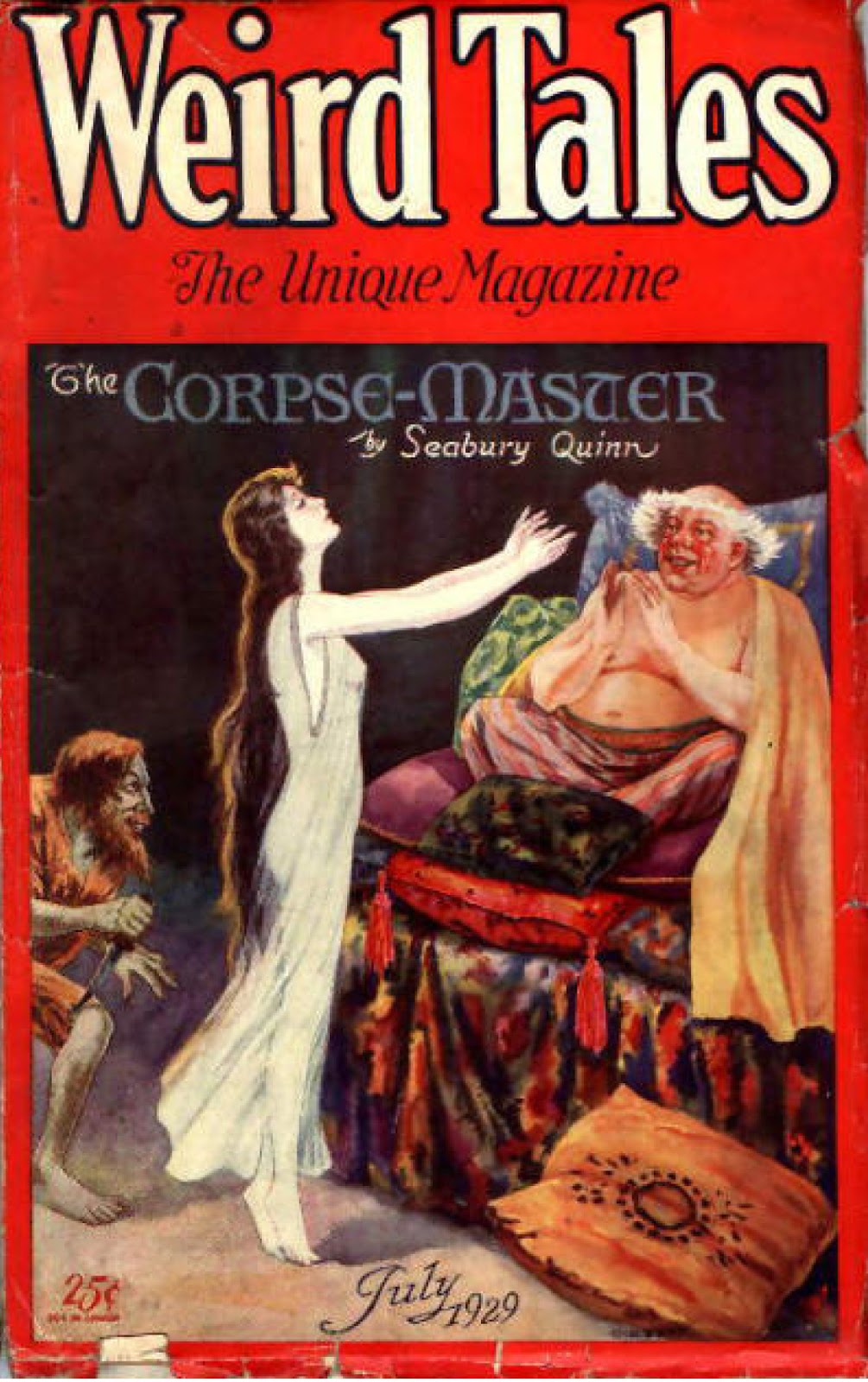
Weird Tales, July 1929. Cover story: "The Corpse-Master" by Seabury Quinn. Cover art by C.C. Senf. Where is the fiend? Sneaking into the picture on the left. I'll have to add this cover to my list of dwarf covers. And he's green. Note that there are three "masters" in a row.

Weird Tales, December 1929. Cover story: "The Mystery of the Four Husbands" by Gaston Leroux. Cover art by Hugh Rankin. This is the third ambiguous cover. I'm not sure that the man is a bad guy. The woman may just think that he is. Of course his bringing a knife to her bed might have something to do with it. Anyway, I just want to say that Hugh Rankin could really draw women. In their stature and allure, they remind me of Roy Crane's women in Wash Tubbs and Captain Easy.

To be continued . . . 

Text and captions copyright 2017, 2023 Terence E. Hanley