Showing posts with label Weird Tales in the 1960s. Show all posts

Saturday, September 14, 2024

Weird Tales: Years without Anniversaries

Weird Tales was in print from March 1923 to September 1954. The magazine sometimes observed its own anniversary. Sometimes it was the readers who did the observing in their letters to "The Eyrie." The most prominent anniversary issues were the first, in May/June/July 1924, and the twenty-fifth, in March 1948Weird Tales was not in print from October 1954 until the summer of 1973. If there were observances of anniversaries during those years, they would have been in other places and under other banners. If there were such observances, I don't know anything about them.

I wrote the other day that Sam Moskowitz is supposed to have dissuaded Leo Margulies from bringing Weird Tales back into print. Now I have a source for that information. In Weird Tales #1, edited by Lin Carter and published in 1980, Moskowitz wrote:

     I twice talked Leo Margulies out of reviving the magazine, once in 1958 and again in the sixties, because I thought he would lose his shirt. (p. 266)

So if  Margulies had gone ahead with bringing back Weird Tales in 1958, maybe it would have been just in time for the thirty-fifth anniversary of "The Unique Magazine."

There weren't any issues and no revivals at all during the 1960s, although now I find that two of the Pyramid paperback anthologies about which I wrote the other day were intended as the start of a series. In Weird Tales #1, Sam Moskowitz revealed:

     I ghost edited for Leo Margulies the Pyramid paperbacks Weird Tales (1964) and Worlds of Weird (1965), which were intended to be a series, with covers and some interiors by Virgil Finlay. They apparently did not do well enough to justify continuing the series [. . .]. (p. 265)

Moskowitz went on to put together the fiftieth-anniversary issue of Weird Tales in Summer 1973 and three more issues in that brief four-issue revival. There wasn't any forty-fifth anniversary issue in 1968, nor a fifty-fifth anniversary issue in 1978, again, because Weird Tales was not in print during those years.

Lin Carter's four paperback issues of Weird Tales were published from 1980 to 1983. The last issue came out in 1983. I don't have a copy of it, but I assume there was at least some awareness of an anniversary, for Carter reprinted Anthony M. Rud's story "Ooze," originally in the first issue of the magazine from sixty years before.

There were two issues of Weird Tales published by Bellerophon Network in 1984-1985. These, too, were aware of the history of Weird Tales magazine, but there isn't any overt anniversary content in their pages as far as I can see. (Thanks again to Brian Forbes for providing me with the contents of those two issues.) And now we're getting close to another revival of Weird Tales and the sixty-fifth-anniversary issue of Spring 1988. A couple of things came before that issue, though, and I'll write about those next.

To be continued . . .

Weird Tales #1 (1980), edited by Lin Carter, with cover art by Tom Barber.

Original text copyright 2024 Terence E. Hanley

Friday, September 6, 2024

Weird Tales at Forty

You could say that Weird Tales magazine had its first run from March 1923 to September 1954. You could also break up that first run, the most obvious break being from August to October 1924 when the business behind the magazine was reorganizing and there weren't any issues published at all. A better way of saying it is that Weird Tales was just trying to survive that summer and fall. Survive it did. Last year at around this time, Weird Tales observed its own 100th anniversary with a new issue. This time this year, we find ourselves in the one-hundred-year anniversary of the first hiatus and the almost-disappearance of "The Unique Magazine."

You could make other breaks, too, if you wanted to. In its first run, there came a break after twelve almost-monthly issues, published from March 1923 to April 1924, all with Edwin Baird as editor. Then came the first and only quarterly issue of May/June/July 1924 with Baird, or Farnsworth Wright and Baird, or Baird, Wright, and/or Otis Adelbert Kline as editor. Then came a three-month break, during which there could have been another quarterly issue published. Then, finally, in November 1924, there was a return, with Wright as newly promoted editor, a post he would hold for the next fifteen and a little more years.

There weren't any breaks during the Wright years, even if there were changes made along the way. Weird Tales was published continuously during that time, even after Dorothy McIlwraith took over in May 1940. Call that a break if you want. Finally, in September 1953, Weird Tales went from being pulp-sized to being digest-sized, another break if you like. The magazine survived exactly a year in that format.

Leo Margulies acquired the Weird Tales property after the magazine ceased publication. He held it for about twenty years, finally to sell it to Robert Weinberg in the early to mid 1970s. The story is that Margulies wanted to revive Weird Tales as a magazine in the early 1960s. And the story is that Sam Moskowitz talked him out of it for fear Margulies would lose his shirt. Nevertheless, several paperbound anthologies came out at around the fortieth-anniversary year of Weird Tales. All have introductions, either by Margulies or Moskowitz, as well as shorter introductions to individual stories. None of these books is explicitly an anniversary issue, even if all look back with fondness and nostalgia on the Weird Tales years. I think the 1960s and '70s were an age of nostalgia for the popular culture of the 1920s through the 1940s or so. The Weird Tales anthologies came out near the beginning of that age.

I have written before about three of the four Weird Tales anthologies of the early to mid 1960s. They were:

  • The Unexpected edited by Leo Margulies (Pyramid Books, Feb. 1961, 160 pp.), with an introduction by Leo Margulies and eleven stories (Margulies called this "a usurer's dozen"), all from Weird Tales. Cover art by John Schoenherr.

Pyramid Books issued two more anthologies at around that time, both edited by L. Sprague de Camp. These are in the same format as the Weird Tales anthologies, but not all of their stories were from "The Unique Magazine." These two books were:

One of these books is called Weird Tales. Another was published in 1963. Maybe together they make a fortieth-anniversary issue. Or take all six as an observance and celebration of forty years of Weird TalesFinally, I should point out that Leo Margulies also reprinted stories from Weird Tales in his magazines of the 1960s, including The Man from U.N.C.L.E. Magazine, in print from 1966 to 1968.

The Jove edition of Weird Tales, published in 1979, is a reprinting of the Pyramid edition of 1964 except that Robert E. Howard's story "Pigeons from Hell" was removed. Also, Virgil Finlay's cover illustration--a good one to be sure--was replaced with this iconic image by Margaret Brundage, originally on the cover of the magazine in October 1933. I'm not sure that any other image is more closely associated with Weird Tales than this one.

By the way, the Pretenders' song "Back on the Chain Gang" includes the lyric "Got in the house like a pigeon from hell." That sounds an awful like a reference to Howard's story. As much as some fans and readers might want themselves and their favorite fiction to be separated and isolated from the real world--as much as they might want to escape from the world--it can't be done. If you're going to think about and write about genre fiction, you have to face the world, its people, its history, and its culture.

Text copyright 2024 Terence E. Hanley

Saturday, December 5, 2015

Leo Margulies (1900-1975)

Editor, Writer, Literary Agent, Publisher, War Correspondent
Born June 22, 1900, Brooklyn, New York
Died December 26, 1975, Los Angeles, California

Leo Margulies was born on June 22, 1900, in Brooklyn, New York. He attended Columbia University but left for work at the Frank A. Munsey chain of magazines. Starting as an office boy, Margulies learned about being an editor from Bob Davis. After leaving Munsey, Margulies worked for Fox Films and Tower Magazines and formed the first of his three literary agencies in 1929. He returned to magazine work in the early 1930s with Ned Pines' Standard Magazines, a group that at one time or other included Beacon Magazines, Better Publications, and Nedor Publishing Company. Nicknamed "the Little Giant of the Pulps," Margulies was editor or editorial director of Pines' many titles of the 1930s and '40s. He is supposed to have overseen forty-six different titles in his career. Mort Weisinger and Oscar J. Friend were among the editors who served with him or under him.

During World War II, Margulies served as a war correspondent in the Pacific Theater in 1943 and 1945. He was aboard the U.S.S. Missouri when the Japanese surrendered in September 1945. Returning to civilian life, he helped form the Popular Library line of paperback books. He also edited a number of science fiction and fantasy anthologies in hardback and paperback.

In the early 1950s, Margulies started his own publishing company, King-Size Publications. Over the years, he published The Saint Detective MagazineFantastic Universe Science FictionSatellite Science FictionThe Man from U.N.C.L.E. MagazineZane Grey's Western Magazine, and other titles. In the mid-fifties, after it had ceased publication, Margulies purchased Weird Tales magazine. In the 1960s, he collected stories from that magazine in four paperback anthologies, two of which he edited himself and two of which were ghost-edited by Sam Moskowitz. Margulies and Moskowitz teamed up again for the four-issue revival of Weird Tales magazine in 1973-1974.

Margulies and his wife lived in France in the early 1950s and moved from New York to Los Angeles in 1972. While attending a meeting of the Mystery Writers of America in London in October 1975, Leo Margulies suffered a stroke. He died on December 26, 1975, in a hospital in Los Angeles. He was seventy-five years old. Robert Weinberg acquired Weird Tales late in Margulies' life or after his death. From his hands, it passed to Viacom, the current owners.

On August 14, 2015, Leo Margulies was the subject of a talk at PulpFest in Columbus, Ohio. The talk was in observance of the 115th anniversary of Magulies' birth and was presented by his nephew, Philip Sherman. The panel also included Ed Hulse and Will Murray. Mr. Sherman is working on a biography of his uncle, whom he remembers as "a lot of fun" and "a great, great uncle." You can listen to the talk at a website called The Pulp Net, here.

Leo Margulies' Credits (An incomplete list)
Magazine Editor, Editorial Director, and/or Publisher
  • Thrilling Wonder Stories (1936-1944)
  • Thrilling Mystery (1936-1938, 1940-1941, 1944)
  • Captain Future (1940-1944)
  • Startling Stories (1939-1944)
  • Strange Stories (1939-1941)
  • The Saint Detective Magazine
  • Fantastic Universe Science Fiction (1954-1956)
  • Satellite Science Fiction (1957)
  • The Man from U.N.C.L.E. Magazine (1966-1968)
  • Weird Tales (1973-1974)
  • Charlie Chan Mystery Magazine
  • Zane Grey's Western Magazine
  • Mike Shayne's Mystery Magazine
Book Editor
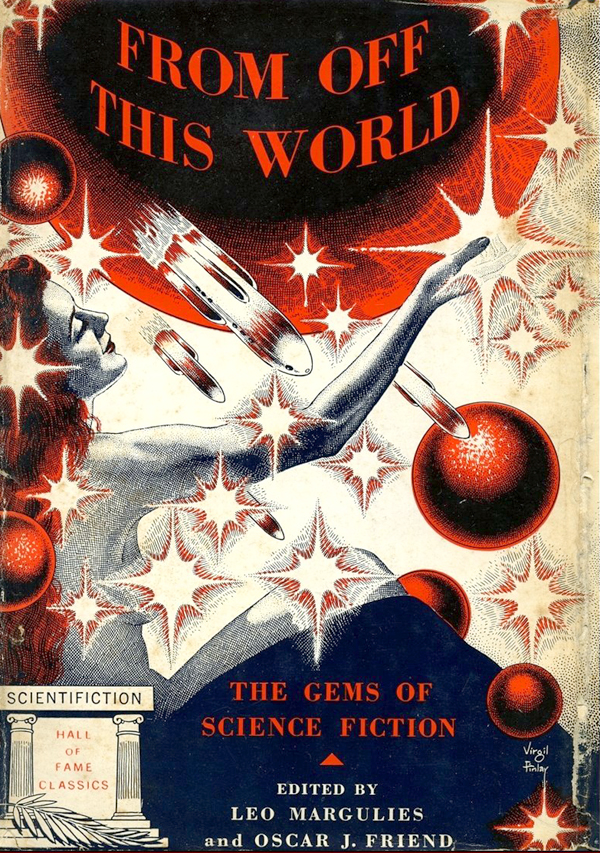
  • From Off This World (New York: Merlin Press, 1949) with Oscar J. Friend
  • My Best Science Fiction Story (New York: Merlin Press, 1949) with Oscar J. Friend
  • My Best Science Fiction Story (New York: Pocket Books, 1954) with Oscar J. Friend
  • The Giant Anthology of Science Fiction: 10 Complete Short Novels (New York: Merlin Press, 1954) with Oscar J. Friend
  • Race to the Stars (New York: Crest, 1958) with Oscar J. Friend
  • Three Times Infinity (Greenwich, Connecticut: Fawcett Gold Medal, 1958) ghost-edited by Sam Moskowitz
  • 3 from Out There (New York: Crest, 1959)
  • Get Out of My Sky (New York: Crest, 1960)
  • The Ghoul Keepers (New York: Pyramid Books, 1961)
  • The Unexpected (New York: Pyramid Books, 1961)
  • Three in One: Novels (New York: Pyramid Books, 1963) ghost-edited by Sam Moskowitz
  • Weird Tales (New York: Pyramid Books, 1964) ghost-edited by Sam Moskowitz
  • Worlds of Weird (New York: Pyramid Books, 1965) ghost-edited by Sam Moskowitz
Much of this list is from the Internet Speculative Fiction Database.

Further Reading
The Encyclopedia of Science Fiction
Internet Speculative Fiction Database

From Off This World, Leo Margulies and Oscar J. Friend's first anthology, from 1949, with dust jacket art by Virgil Finlay. Note Hugo Gernsback's old word scientifiction.

Original text and captions copyright 2015, 2023 Terence E. Hanley

Thursday, August 8, 2013

Weird Fiction & Fantasy Magazines-Weird Tales Part 2

Editor and publisher Leo Margulies acquired the Weird Tales property in the 1950s after the original run of the magazine had come to an end. Rather than sit on it and guard it like the fabled dog in the manger, Margulies wanted to do something with his new title and the stories that went with it. Sam Moskowitz, an associate of Margulies, was in a position to advise him. "I twice talked Leo Margulies out of reviving the magazine," Moskowitz remembered, "once in 1958 and again in the sixties, because I thought he would lose his shirt." (1) I can't say that I like Moskowitz's advice, but I wasn't there and I don't know the circumstances. It's worth noting that Robert A.W. Lowndes' Magazine of Horror, one of the longest running magazines in the Weird Tales mold, was in print from 1963 to 1971. If he did it, I'm not sure why Leo Margulies couldn't have done it as well. Hindsight is always 20-20 of course. In any case, instead of publishing a magazine, Leo Margulies issued four paperback collections of stories from Weird Tales between 1961 and 1965. (Sam Moskowitz was ghost editor on at least two of them.) If you wanted Weird Tales in the 1960s, those four books were the place to start. (2) Of course interest in pulp fiction picked up as the decade went on. By its end, Robert E. Howard and H.P. Lovecraft were household names, at least among fantasy fans.

Mass market paperbacks are obviously not periodicals. They don't really belong in a series of blog postings about weird fiction and fantasy magazines. Here I have included these four books not just for completists but also because they may have been a model of sorts to a later incarnation of Weird Tales, Lin Carter's four-issue paperback series. Before posting something on that series, I'll write about Sam Moskowitz's 1970s version of Weird Tales.

Notes
(1) From Weird Tales #1, edited by Lin Carter and published in 1981, p. 266.
(2) Leo Margulies also published The Man from U.N.C.L.E. Magazine, a digest-sized journal in which he recycled stories from Weird Tales. For example, "Hellsgarde" by C.L. Moore (Weird Tales, Apr. 1939) appeared in the November 1967 issue. "Hell on Earth" by Robert Bloch (Weird Tales, Mar. 1942) was reprinted in The Man from U.N.C.L.E. Magazine in November 1966.

The Unexpected, published in February 1961, edited by Leo Margulies, and containing eleven stories, all from Weird Tales. The only original content was an introduction by the editor. The cover art was by John Schoenherr. I believe I have seen this book in red as well. P.S. (Aug. 11, 2013): I was mistaken when I wrote that The Unexpected was printed with a red cover as well. Actually it was The Ghoul Keepers. See below.
Schoenherr returned to create the cover illustration for The Ghoul Keepers from October 1961. Once again, all the stories in the book were originally published in Weird Tales.
Weird Tales (the book) followed in May 1964 with eight stories and an introduction, which may have been written by Sam Moskowitz. The cover was by Virgil Finlay and all of the stories inside are from the original Weird Tales.
Finally, Worlds of Weird from January 1965. (This is a reprint from 1977.) Sam Moskowitz finally received credit for his input. The seven stories inside are from Weird Tales. That's Virgil Finlay's art on the cover.
P.S. (Aug. 11, 2013): The Ghoul Keepers in the original edition with a red cover. Note that the art was cropped and reversed for the later edition with the yellow cover (above). Could Sam Moskowitz have had that process in mind when he reworked Jack L. Thurston's art for the cover of the Summer 1974 issue of Weird Tales? Thanks to Chap O'Keefe for the image.

Text and captions copyright 2013, 2023 Terence E. Hanley

Wednesday, February 6, 2013

Still More Weird Tales from France

Alphonse Louis Constant
Aka Eliphas Lévi Zahed, Eliphas Lévi
Author, Mystic, Magician
Born February 8, 1810, Paris, France
Died May 31, 1875, Paris, France

For Weird Tales
"Black Magic" (article, Sept. 1923)

Alphonse Louis Constant had been gone nearly half a century by the time Weird Tales printed his article "Black Magic" in the magazine's first year in publication (in Sept. 1923). Born on February 8, 1810, in Paris, Constant studied for the priesthood but left the seminary before being ordained. The reason? Cherchez la femme as the French say. Constant became a writer and associated himself with various names, including the socialist and feminist Flora Tristan (1803-1844), fellow mystic M. Ganneau (ca. 1805-1851), "messianic mathematician" Jozef Maria Hoëhne-Wronski (1778-1853), British novelist Edward Bulwer-Lytton (1803-1873), and French sculptress Marie-Noémi Cadiot (1832-1888), whom he married in 1846. (1) Constant was a mystic and a magician, evidently one of the most important names in that realm of endeavor. According to Wikipedia, he incorporated the Tarot into contemporary practice and was a great influence on other mystics and magicians of his time and after, including Aleister Crowley (1875-1947). (2) Constant was also the originator of a famous "Sabbatic Goat" image and of the idea that a pentagram pointing upwards represents good, while one pointing downwards (approximating the countenance of a goat) represents evil. He wrote under the pseudonyms Eliphas Lévi Zahed and Eliphas Lévi and died on May 31, 1875, in Paris.

You can read more about Constant on these websites:
Notes
(1) Flora Tristan, née Flore Celestine Thérèse Henriette Tristán y Moscoso, was the grandmother of French painter Paul Gauguin (1848-1903). Simon Ganneau, referred to as M. Ganneau, was the inventor of the religion Evadaïsme, "a compound of all the dogmas, doctrines and philosophies that have divided mankind," of which he was "the Mapah," a title combining maman and papa and a reference to our "first parents," Eve and Adam, their names combined in the name of his religion. The quotes on him are from The Living Age, Volume 29, on the occasion of Ganneau's death. Like Flora Tristan, he was a progenitor of fame, for he was the father of the archaeologist and orientalist Charles Simon Clermont-Ganneau (1846-1923).
(2) Crowley, born less than five months after Constant's death, considered himself a reincarnation of the great magician.

Villiers de l'Isle-Adam
Né Jean-Marie-Mathias-Philippe-Auguste, comte de Villiers de l'Isle-Adam
Author, Playwright, Editor/Publisher
Born November 7, 1838, Saint-Brieuc, Brittany, France
Died August 19, 1889, House of Brothers of St. Jean de Dieu, Rue Oudinot, Paris, France

Villiers de l'Isle-Adam was not in fact published in Weird Tales but in an offspring of "The Unique Magazine," Robert W. Lowndes' Magazine of Horror from the 1960s. Born on November 7, 1838, in the city of Saint-Brieuc, Villiers seems to have been a man ill-suited to life's demands. Unlucky in love, impoverished for most of his life, and not often successful as a writer, he nonetheless gave us two terms still in use today. One of them has become indispensable in science fiction and in fact.

Under the influence of Charles Baudelaire and Edgar Allan Poe, Villiers wrote tales of fantasy, mystery, horror, torture, and cruelty. (3) In his novel L'Ève future (a title translated by Wikipedia as Tomorrow's Eve, 1886), Villiers employed the term android (which had been in use since at least the 18th century) in its more modern sense, meaning a robot in human form. George Lucas and hundreds of other science fiction writers owe Villiers a debt for that.

Villiers is most well known for his collection of short stories from 1883, Contes Cruels. The conte cruel has become a subgenre or a type of fiction, a short story or tale (conte) in which characters are subjected to cruelty, torment, and torture, perhaps not because they deserve it but simply because--I suppose--life itself is full of cruel vicissitudes. I can imagine that Villiers sometimes felt himself to be such a character. Then again, essayist Arthur Symons remarked upon Villiers' "lack of sympathy," derived from his "disdain of ordinary human beings." (4)

I looked in several books on literature and fantastic fiction for a definition of the conte cruel and came up empty. Barbara, a contributor to Google Groups, admirably answers the question "What is the definition of conte cruel?" at this link. She attributes the origin of the term to Villiers' collection of the same name. She also mentions Villiers' story "The Torture by Hope," which by no coincidence appeared in Magazine of Horror #10 (Aug. 1965). Barbara also mentions Ambrose Bierce and W.C. Morrow as authors of contes cruels.

* * *
He hated every kind of mediocrity: therefore he chose to analyse [sic] exceptional souls, to construct exceptional stories, to invent splendid names, and to evoke singular landscapes. It was part of his curiosity in souls to prefer the complex to the simple, the perverse to the straightforward, the ambiguous to either. (5)
And in him there was ambiguity, too. Though born into an ancient and very distinguished aristocratic family, Villiers was nearly always poor, and though a staunch Catholic, he was also a mystic. (6) Though well loved and admired, he was lonely all of his life. A great talker and great personality, he "sometimes talked them [his stories] instead of writing them, in his too royally spendthrift way." (7) He founded a short-lived revue and one winter burned bundles of issues to keep warm. Like Poe before him, Villiers died young, in his case of cancer. He married but once, on his deathbed, to an illiterate midwife who was devoted to him in every way. Like Constant, he left a son, Victor. The last of his line, Victor--an ironic name to be sure--died in 1901 at age twenty.

Shades of Lovecraft and so many others.

The digest-sized Magazine of Horror was not Weird Tales of course, but I'm not sure there was any closer imitator between the end of the original Weird Tales in 1954 and the short-lived revival of 1973-1974. The Magazine of Horror is, though, a subject for another time.

Further Reading
"CPR Remembers: Villiers de l'Isle-Adam" by Garrick Davis on the website Contemporary Poetry Review, March 1, 2005, here.
"Villiers de l'Isle-Adam" in The Symbolist Movement in Literature by Arthur Symons (Dutton, 1958), pp. 21-32.

Notes
(3) Villiers is supposed to have been an admirer of Constant's Dogme et rituel de la haute magie (1856). Villiers' other associations: He was friends with Stéphane Mallarmé (1842-1898); he asked Théophile Gautier (1811-1872) for his daughter's hand in marriage (and was rebuffed); and his hero was Richard Wagner (1813-1883), with whom he was visiting when war broke out between their two nations in 1870. By the way, when M. Ganneau died in 1851, Gautier took his only child, Charles Simon Clermont-Ganneau, who had just turned five years old, under his wing.
(4) From "Villiers de l'Isle-Adam" in The Symbolist Movement in Literature by Arthur Symons (Dutton, 1958), p. 30.
(5) From Symons, p. 28.
(6) Another, Villiers, Philippe de Villiers de L'Isle-Adam (1464-1534), led the Knights of Rhodes in resisting the siege of Rhodes by 100,000 Turks in 1522. Forced to capitulate, he and his knights eventually ended up on the island of Malta, where he received a fiefdom from Emperor Charles V and established the Knights of Malta. In return for this grant, the knights were obliged to give to the emperor, every year on All Saints Day, a falcon, thus, among other things, the McGuffin for a detective story of the twentieth century.

Alphonse Louis Constant (1810-1875) aka Eliphas Lévi, a portrait from 1874.
Eliphas Lévi's Bephomet, an image of the Sabbatic Goat. I don't know enough about magic to say anything more. Note the name at the bottom, cut off in this image.
Villiers de L'Isle-Adam did not contribute to Weird Tales, but he was responsible for the conte cruel, a kind of story named for his collection of short stories from 1883. Here is the cover for one edition of Contes Cruels. The image is disturbing, mostly because it looks like it could have been drawn from life.
The image on this cover of a different edition is pretty tame by comparison. The man is being tortured, but he doesn't seem to be suffering much. Take away the bindings and it looks like he could be in a steam bath. (Update, Feb. 8, 2021): It occurs to me now that the image of a man working a circular machine, as in Metropolis (1927) or Modern Times (1936), may be meant to evoke the image of the breaking wheel or Catherine's wheel of medieval times.
The image on this cover of a Spanish-language edition of Conte Cruels (Cuentos crueles) is even more inviting. Are those tiger lilies?
Villiers was the author of at least fifteen books. Isis is an incomplete novel (more accurately, romance) from 1862.
In L'Ève future (1886), Villiers wrote of an android named Hadaly--invented by a fictional Thomas Alva Edison! It's from this book that we have our contemporary usage of the word android.
"The Torture of Hope," one of Villiers' contes cruels, was reprinted as the cover story in Magazine of Horror in August 1965. The cover artist was Carl Kidwell, who also contributed to Weird Tales

Revised and updated on February 8, 2021.
Text and captions copyright 2013, 2023 Terence E. Hanley

Monday, August 27, 2012

Weird Tales Books-The Spell of Seven

The Spell of Seven edited by L. Sprague de Camp

SEVEN
  • heroes in hot water
  • malicious magicians
  • trials by terror
  • superb stories of swords and sorcery
That's the blurb inside the front cover of The Spell of Seven, L. Sprague de Camp's 1965 companion volume to Swords & Sorcery. The format was the same as before: cover art and interior art by Virgil Finlay, introductions to the book and to each story by de Camp, and a collection of tales from Weird Tales and other magazines, all in the genre of heroic fantasy. Dunsany, Howard, Smith, and Leiber are here, but so are then-younger writers Jack Vance and Michael Moorcock. There are seven stories in all, only two of which originally appeared in Weird Tales.

The Spell of Seven edited by L. Sprague de Camp
(Pyramid Books, 1965, 192 pp.)
"Introduction: Wizards and Warriors" by L. Sprague de Camp
"Bazaar of the Bizarre" by Fritz Leiber (Fantastic Stories of the Imagination, Aug. 1963)
"The Dark Eidolon" by Clark Ashton Smith (Weird Tales, Jan. 1935)
"The Hoard of the Gibbelins" by Lord Dunsany (The Sketch, date unknown; The Book of Wonder, 1912)
"The Hungry Hercynian" by L. Sprague de Camp (Universe Science Fiction, Dec. 1953)
"Kings in Darkness" by Michael Moorcock (Science Fantasy No. 54, 1962)
"Mazirian the Magician" by Jack Vance (The Dying Earth, 1950)
"Shadows in Zamboula" by Robert E. Howard (Weird Tales, Nov. 1935)

The Spell of Seven (Pyramid Books R-1192). Cover art by Virgil Finlay.

Text copyright 2012, 2023 Terence E. Hanley

Sunday, August 26, 2012

Weird Tales Books-Swords & Sorcery

Swords & Sorcery edited by L. Sprague de Camp

Weird Tales was a pioneer in the sub-genre of fantasy known as heroic fiction, or as in the title of a 1963 collection from Pyramid Books, sword and sorcery. The magazine's chief practitioner of heroic fiction--and arguably the inventor of the sub-genre as most know it today--was Robert E. Howard. His principal character was of course Conan the Cimmerian, that "dark-haired, sullen-eyed" swordsman from before the last glaciation. Other authors of heroic fiction include Clark Ashton Smith and C.L. Moore, creator of the first heroic female protagonist, Jirel of Joiry. The editor of Swords & Sorcery was that bur-under-the-blanket of all Howard and Lovecraft fans, L. Sprague de Camp. De Camp was known to have written a few sword and sorcery tales in his own time. He also authored a study of figures in the field, entitled--what else--Literary Swordsmen and Sorcerers: The Makers of Heroic Fantasy (Arkham House, 1976).

Swords & Sorcery collects eight stories, half of which are from Weird Tales. Those four weird tales are from the 1930s, what you might call the golden age (or perhaps the only age) of heroic fiction in the magazine of the same name. By 1940, Howard and Lovecraft were in their graves, while C.L. Moore had moved on to other markets. Only Clark Ashtom Smith remained, though he wrote considerably less for Weird Tales than he had in the '30s. I think I read that Dorothy McIlwraith didn't care for heroic fiction, hence Fritz Leiber was forced to look elsewhere for a publisher of his Fafhrd and the Gray Mouser stories. Henry Kuttner, who had taken up the mantle after Howard's death (and infused a little Lovecraft into his stories) sold stories to Dorothy McIlwraith's Weird Tales, but like his new wife--that same C.L. Moore--found other markets during the 1940s.

De Camp wrote an introduction to Swords & Sorcery as a whole and to each story. Virgil Finlay's illustrations appear on the cover and in the interior.

Swords & Sorcery edited by L. Sprague de Camp
(Pyramid, 1963, 186 pp.)
"Introduction: Heroic Fantasy" by L. Sprague de Camp
"The Valor of Cappen Varra" by Poul Anderson (Fantastic Universe Science Fiction, Jan. 1957)
"Distressing Tale of Thangobrind the Jeweler" by Lord Dunsany (The Sketch, date unknown; The Book of Wonder, 1912)
"Shadows in the Moonlight" by Robert E. Howard (Weird Tales, Apr. 1934)
"The Citadel of Darkness" by Henry Kuttner (Strange Stories, Aug. 1939)
"When the Sea King's Away" by Fritz Leiber, Jr. (Fantastic Science Fiction Stories, May 1960)
"The Doom That Came to Sarnath" by H.P. Lovecraft (Marvel Tales, Mar.-Apr. 1935; reprinted in Weird Tales, June 1938)
"Hellesgarde" by C.L. Moore (Weird Tales, Apr. 1939)
"The Testament of Athammaus" by Clark Ashton Smith (Weird Tales, Oct. 1932)

Swords & Sorcery (Pyramid Books R-950, 1963), with cover art and interior illustrations by Virgil Finlay.

Text copyright 2012, 2023 Terence E. Hanley

Saturday, August 25, 2012

Weird Tales Books-Worlds of Weird

Worlds of Weird edited by Leo Margulies

In Worlds of Weird from 1965, Leo Margulies added an introduction from science fiction historian Sam Moskowitz and interior illustrations by Virgil Finlay. As with Weird Tales (1964), the cover was also by Virgil Finlay. In his introduction, Moskowitz related the story of Jacob Clark Henneberger, founder and publisher of Weird Tales. There are seven stories in the book beginning with Seabury Quinn's well-known and much admired tale of Christmas, "Roads." Other writers include Nictzin Dyalhis, Robert E. Howard, Edmond Hamilton, Clark Ashton Smith, David H. Keller, and Frank Belknap Long. The women are still absent, as is H.P. Lovecraft. Three stories in this collection repeat the standard Weird Tales construction for titles: "The _____ in the _____," or "The _____ of the _____." Lovers of pulp fiction wonder why their favorite genres are not taken very seriously by literary critics. Reliance on clichés is one of the reasons.

Worlds of Weird edited by Leo Margulies
(Pyramid Books, 1965, 158 pp.)
"The Forgotten Creator of Weird Tales, An Introduction . . ." by Sam Moskowitz
"Roads" by Seabury Quinn (Weird Tales, Jan. 1938)
"The Sapphire Goddess" by Nictzin Dyalhis (Feb. 1934)
"The Valley of the Worm" by Robert E. Howard (Feb. 1934)
"He That Hath Wings" by Edmond Hamilton (July 1938)
"Mother of Toads" by Clark Ashton Smith (July 1938)
"The Thing in the Cellar" by David H. Keller, M.D. (Mar. 1932)
"Giants in the Sky" by Frank Belknap Long (Aug. 1939)

Worlds of Weird (Pyramid Books V4471, 1965, second printing, 1977), with cover art by Virgil Finlay.

Text copyright 2012, 2023 Terence E. Hanley

Thursday, August 23, 2012

Weird Tales Books-Weird Tales

Weird Tales edited by Leo Margulies

Pulp magazines spawned paperbacks and comic books, thereby spelling their own doom. From the early 1940s onward, pulp magazines slowly sank as readers turned to paperback books and comics for entertainment, mostly in the same genres of science fiction, fantasy, horror, and so on. When Leo Margulies acquired the Weird Tales property in the 1950s, he also acquired the rights to (or at least direct access to) a large body of material. Rather than let those old stories molder away in brittle and yellowing magazines, Margulies compiled and edited a number of paperback collections in the 1960s featuring stories from the original Weird Tales. Those collections were more or less smaller versions of the magazine, but without the ads, the letters, and the run-of-the-mill stories. I'll show four paperback collections over the next few days, beginning with a book drawn entirely from "The Unique Magazine," right down to its title.

Issued by Pyramid Books, Weird Tales features cover art by Virgil Finlay and eight stories from some of the magazine's most admired authors. Margulies introduced each story, beginning with Edmond Hamilton's darkly comic "The Man Who Returned" and ending with one of the scariest tales you're likely to read, Robert E. Howard's "Pigeons from Hell." Also in the mix: Leiber, Bloch, Dyalhis, Lovecraft, Derleth, and Long. Missing are C.L. Moore and Clark Ashton Smith, but Margulies corrected that oversight in later collections. I should mention that Nictzin Dyalhis' story "The Sea Witch" (also spelled "Sea-Witch") is justly included in this collection, as it is probably his finest story and one of the most admired of all stories published in the original Weird Tales

Weird Tales edited by Leo Margulies
(Pyramid Books, 1964, 155 pp.)
Introduction by Leo Margulies
"The Man Who Returned" by Edmond Hamilton (Weird Tales, Feb. 1934)
"Spider Mansion" by Fritz Leiber, Jr. (Sept. 1942)
"A Question of Etiquette" by Robert Bloch (Sept. 1942)
"The Sea Witch" by Nictzin Dyalhis (Dec. 1937)
"The Strange High House in the Mist" by H.P. Lovecraft (Oct. 1931)
"The Drifting Snow" by August W. Derleth (Feb. 1939)
"The Body-Masters" by Frank Belknap Long (Feb. 1935)
"Pigeons from Hell" by Robert E. Howard (May 1938)

Weird Tales (Pyramid Books R-1029) with a cover by Virgil Finlay.

Text copyright 2012, 2023 Terence E. Hanley

Sunday, September 4, 2011

Weird Tales Books-The Ghoul Keepers

The Ghoul Keepers edited by Leo Margulies

For many years after the magazine's demise, editor Leo Margulies owned the Weird Tales property and drew a number of anthologies and reprints from its yellowing pages. The Ghoul Keepers was one. Originally published in 1961, the book was reprinted in 1965 in the version shown here. Margulies introduced the book, but not with the scholarly approach used by Sam Moskowitz in other collections of weird tales. The cover blurb promises a panoply of supernatural creatures: "Monster, Vampire, Demon, Sorcerer, Ghost, Witch." For the more discriminating reader, it also offers a partial list of authors. Every one of the stories in The Ghoul Keepers was originally printed in Weird Tales. Six out of nine are from the Dorothy McIlwraith years (1940-1954). Some trivia: Seabury Quinn, author of "Claire de Lune," was the most prolific of all contributors to Weird Tales. Between 1923 and 1952, "The Unique Magazine" published over 150 of his tales. Weird Tales writer Helen W. Kasson was the sister of pioneering science fictioneer Stanley G. Weinbaum. "Spawn of Dagon," starring Elak of Atlantis, is Henry Kuttner's hybrid of heroic fantasy in the mode of Robert E. Howard and H.P. Lovecraft's "Cthulhu Mythos." The story was published in 1938 shortly after the deaths of those two giants of Weird Tales.

The Ghoul Keepers edited by Leo Margulies
(Pyramid Books, 1965, 157 pp.)
"Introduction" by Leo Margulies
"The Sorcerer's Apprentice" by Robert Bloch (Weird Tales, Jan. 1949)
"The Martian and the Moron" by Theodore Sturgeon (Weird Tales, Mar. 1949)
"The Isle of the Sleeper" by Edmond Hamilton (Weird Tales, May 1938, reprinted May 1951)
"Please Go 'Way and Let Me Sleep" by Helen W. Kasson (Weird Tales, Mar. 1945)
"The Lake" by Ray Bradbury (Weird Tales, May 1944)
"The Witch in the Fog" by Harry Altshuler (Weird Tales, Sept. 1938, as by Alexander Faust)
"When the Night Wind Howls" by L. Sprague de Camp and Fletcher Pratt (Weird Tales, Nov. 1951)
"Clair de Lune" by Seabury Quinn (Weird Tales, Nov. 1947)
"Spawn of Dagon" by Henry Kuttner (Weird Tales, July 1938)

The Ghoul Keepers, edited by Leo Margulies and featuring nine stories from the pages of Weird Tales. The cover art is by the renowned science fiction illustrator John Schoenherr (1935-2010).

Text copyright 2011, 2023 Terence E. Hanley