Showing posts with label Cryptozoology. Show all posts

Sunday, June 2, 2024

Recent Reading No. 2

In our most recent weird fiction book club we read stories by Theodore Sturgeon (1918-1985). Although Sturgeon had eight stories in Weird Tales in 1947-1949, we didn't read any of those. Instead we read several that were in science fiction and fantasy magazines, beginning with "It," published in Unknown in August 1940.

On March 23 of last year, I wrote about swamp monsters in an entry called "The Internet Ooze, Blobs, Jellies, & Slime Database" (click here). Because I had never read it and didn't know anything about it, I did not include it--or "It"-- in my database. It definitely belongs there. I wonder if the monster in "It" was the first swamp monster or muck monster in literature.

Last year and the year before I wrote pretty extensively about Joseph Payne Brennan  as well as his story "Slime," published in Weird Tales in March 1953. In his writing "Slime," think that Brennan was very likely influenced by the first Weird Tales cover story, "Ooze" by Anthony M. Rud, which had preceded it in print by exactly thirty years. A couple of comic book writers and artists of the early 1950s also seem to have been influenced by "Ooze." See Beware #13 (Jan. 1953) and #15 (May 1953).

As I read the first few paragraphs of Theodore Sturgeon's "It," I was struck by the similarity between "Slime" and "It." See what you think.

Here are the first few paragraphs of "It" by Theodore Sturgeon:

     It walked in the woods.
     It was never born. It existed. Under the pine needles the fires burn, deep and smokeless in the mold. In heat and darkness and decay there is growth. There is life and there is growth. It grew, but it was not alive. It walked unbreathing through the woods, and  thought and saw and was hideous and strong and it was not born and it did not live. It grew and moved about without living.
     It crawled out of the darkness and hot damp mold into the cool of a morning. It was huge. It was lumped and crusted with its own hateful substances, and pieces of it dropped off as it went its way, dropped off and lay writhing and stilled, and sank putrescent into the forest loam.
     It had no mercy, no laughter, no beauty. It had strength and great intelligence. And--perhaps it could not be destroyed. It crawled out of its mud in the wood and lay pulsing in the sunlight for a long moment. Patches of it shone wetly in the golden glow, parts of it were nubbled and flaked. And whose dead bones had given it the form of a man?
     It scrabbled painfully with its half-formed hands, beating the ground and the bole of a tree. It rolled and lifted itself up on its crumbling elbows, and it tore up a great handful of herbs and shredded them against its chest, and it paused and gazed at the gray-green juices with intelligent calm. It wavered to its feet, and seized a young sapling and destroyed it, folding the slender trunk back on itself again and again, watching attentively the useless, fibered splinters. And it snatched up a fear-frozen field-creature, crushing it slowly, letting blood and pulpy flesh and fur ooze from between its fingers, run down and rot on the forearms.
     It began searching.

And here are the first few from "Slime" by Joseph Payne Brennan:

     It was a great gray-black hood of horror moving over the floor of the sea. It slid through the soft ooze like a monstrous mantle of slime obscenely animated with questing life. It was by turns viscid and fluid. At times it flattened out and flowed through the carpet of mud like an inky pool; occasionally it paused, seeming to shrink in upon itself, and reared up out of the ooze until it resembled an irregular cone or a kind of gigantic hood. Although it possessed no eyes, it had a marvelously developed sense of touch, and it possessed a sensitivity to minute vibrations which was almost akin to telepathy. It was plastic, essentially shapeless. It could shoot out long tentacle feelers, until it bore a resemblance to a nightmare squid or a huge starfish; it could retract itself into a round flattened disk, or squeeze into an irregular hunched shape so that it looked like a black boulder sunk on the bottom of the sea. 
     It had prowled the black waters endlessly. It had been formed when the earth and the seas were young; it was almost as old as the ocean itself It moved through a night which had no beginning and no dissolution. The black sea basin where it lurked had been dark since the world began--an environment only a little less inimical than the stupendous gulfs of interplanetary space. 
     It was animated by a single, unceasing, never-satisfied drive: a voracious, insatiable hunger. It could survive for months without food, but minutes after eating it was as ravenous as ever. Its appetite was appalling and incalculable.

By that, I think it likely that Brennan was influenced not only by "Ooze" but also by "It." Notice that both passages include the word ooze.

Here's something else to think about: modern-day squatchers believe that signs of Bigfoot in your woods include twisted trees. Here's a smaller passage from the larger passage above:

It wavered to its feet, and seized a young sapling and destroyed it, folding the slender trunk back on itself again and again, watching attentively the useless, fibered splinters.

So another connection is made between the swamp monsters or muck monsters of both fiction and comic books and the Bigfoot creatures of later pseudoscience.

Marvel Comics adapted "It" in the first issue of Supernatural Thrillers, published in December 1923. The cover artist was the essential Steranko.

Original text copyright 2024 Terence E. Hanley

Wednesday, July 12, 2023

"Historic and Unprecedented Vermont Floods"

As I write, there is flooding in Vermont. I don't want to take anything away from real-life peril and loss, but there is flooding in Vermont in weird fiction as well. In August 1931, Weird Tales published "The Whisperer in Darkness" by H.P. Lovecraft. Once you get past Lovecraft's first introduction, there is this second:

     The whole matter began, so far as I am concerned, with the historic and unprecedented Vermont floods of November 3, 1927. [. . .]. Shortly after the flood, amidst the varied reports of hardship, suffering, and organised [sic] relief which filled the press, there appeared certain odd stories of things found floating in some of the swollen rivers [. . . ].

     The tales thus brought to my notice came mostly through newspaper cuttings; though one yarn had an oral source and was repeated to a friend of mine in a letter from his mother in Hardwick, Vermont. The type of thing described was essentially the same in all cases, though there seemed to be three separate instances involved--one connected with the Winooski River near Montpelier, another attached to the West River in Windham County beyond Newfane, and a third centring [sic] in the Passumpsic in Caledonia County above Lyndonville. Of course many of the stray items mentioned other instances, but on analysis they all seemed to boil down to these three. In each case country folk reported seeing one or more very bizarre and disturbing objects in the surging waters that poured down from the unfrequented hills [. . .].

We recently saw the place name Winooski in "The Ape-Man" by J.B.M. Clark, Jr. (Weird Tales, Mar. 1923). There is also mention in "The Whisperer in Darkness" of newspaper clippings à la Charles Fort. (Fort is a character in the movie adaptation of Lovecraft's story.) And there is mention of the Mi-Go:

No use, either, to point out the even more startlingly similar belief of the Nepalese hill tribes in the dreaded Mi-Go or "Abominable Snow-Men" who lurk hideously amidst the ice and rock pinnacles of the Himalayan summits.

I'm not sure how anything can "lurk hideously." Remind me again of how Lovecraft belongs in any canon of American literature or how he might be the equal of Edgar Allan Poe.

The Mi-Go or Abominable Snowman was also mentioned in a letter printed in the September 1945 issue of Weird Tales. The writer of that letter gave a pretty good account of evidence and supposed sightings of the creature. He referred to "The Whisperer in Darkness" in his letter and asked that others who knew about the things about which Lovecraft wrote, including the Mi-Go, write to him, and he provided his address in Sharon, Pennsylvania. His name was Paul Doerr (1927-2007). Last year (in 2022), one or more investigators publicly made a case that Doerr was the infamous Zodiac Killer. There appears to be some good circumstantial evidence that he was in fact the killer. Among Doerr's habits were clipping items from newspapers and making collages. I have written about both of those things recently as well.

I have heard about the flooding in New York and New England. I have also heard that a woman drowned while trying to flee her flooded home. Let's pray for everyone to be protected from harm, for comfort for those who have suffered losses, and for strength and courage for everyone who goes to the rescue. There has been more than enough tragic death recently. We don't need any more.

C.C. Senf's illustration for "The Whisperer in Darkness," in Weird Tales, August 1931, page 33. The story starts on page 32, and already Senf is giving away the game. Lovecraft's story got short shrift, too, because this is the only illustration in his very long work of fiction. By the way, that's a reaching hand on the right. Senf specialized in that device.

Original text copyright 2023 Terence E. Hanley

Thursday, April 13, 2023

G.A. Wells (?-?)-The First Story of the Far North

Author, Traveler
Born ?, Ohio
Died ?

As far as I know, nobody has identified the author G.A. Wells, although The FictionMags Index lets us know that he or she was from Ohio and was also a traveler. Wells had several dozen stories published from 1917 until 1938. Titles include Ace-High Magazine, Adventure, The Black Cat, Detective Story Magazine, The Frontier, North•West Stories, People's Favorite Magazine, Short Stories, Telling Tales, Thrilling Stories, Top-Notch Magazine, and Western Story Magazine. Wells had one story in Weird Tales, "The Ghoul and the Corpse," from March 1923. The dates of Wells' stories suggest that he or she was of the same generation of several other authors from that first issue, perhaps born in the 1880s or 1890s. A lot of authors in Weird Tales used only their initials, but I wonder if G.A. Wells got something out of the similarity between his or her name and that of H.G. Wells.

G.A. Wells' Story in Weird Tales
"The Ghoul and the Corpse" (Mar. 1923)

Further Reading
None known.

G.A. Wells' Story:

"The Ghoul and the Corpse" is misnamed and that diminishes the story, making it sound like a conventional horror story rather than what it is, for "The Ghoul and the Corpse" is set not in some dark and musty graveyard but in the far north of Alaska. There is a framing device in the story. One man, McNeal, recounts a tale told him by another, named Chris Bonner. I'm not sure why authors of the nineteenth and early twentieth centuries felt compelled to distance themselves from their own stories. Could there have been some kind of stigma attached to the writing of fiction? Did people--authors and their readers alike--consider fiction to be a kind of lie? I'm not sure. I remember the secretary at the first forestry office where I worked said that she didn't read novels "because they're not true." I liked her and got along with her, but that didn't stop me from wanting to slap her down. Her feeling gets to a lack of understanding in so many people as to the difference between truth and fact. Fiction is not factual. We can all agree on that. That doesn't stop the best of it from containing real truth.

McNeal, a fur trapper, is settling in for the winter in a place called Aurora Bay, on the Arctic Sea, when into his igloo comes Chris Bonner. Bonner has been alone in the boondocks and has a story to tell now that he's back among his fellow men. He begins by recalling the theory that, long ago, the earth turned sideways, with the tropics becoming polar regions and vice versa. Why would he talk about such a thing? Because he's trying to explain how he found a prehistoric apeman frozen in an Alaskan glacier.

"The Ghoul and the Corpse" is a tale told around a fire in a remote place. As a tale--a very old type to be sure--it's fairly short, not well developed, and concerns itself only with a single episode in the experience of a single character. It could have been so much more, as the concept at its core has such great potential. But we have to give the author Wells some slack. This was only 1923 and only the first issue of Weird Tales. It would fall on later authors to carry the concept along of the creature frozen in ice and to develop it further.

So in "The Ghoul and The Corpse" there is talk of suspended animation (as in "The Thing of a Thousand Shapes" by Otis Adelbert Kline); what Wikipedia calls "the Cataclysmic Pole Shift Hypothesis"; and prehistory, apemen, and Darwinian evolution. (There is a recapitulation of evolution in Kline's story, too.) Also in "The Ghoul and the Corpse" there is an early example (I think early) of a creature frozen in ice and then revived. Ice doesn't kill. It only preserves. (1)

In reading Wells' story, I couldn't help but think of Sasquatch or Bigfoot. I also couldn't help but think of the Minnesota Iceman. Again, before these things can be seen (or made), they must be imagined, and it is artists and writers who very often do the imagining.

Note
(1) When it comes to monsters, ice is good for two things: one, preserving creatures such as Frankenstein's monster and the Thing from Another World so that they can be revived and used to tell a scary story; and two, immobilizing creatures such as the Damp Man and the T-1000 so that the main characters can make their escape. Then, of course, the creature is revived so that another scary story can be told, and the cycle repeats itself.

Argosy, May 1969, with a cover story "The Missing Link" by Ivan T. Sanderson. The cover blurb says that he was found in Wisconsin. That may or may not be true. Now, though, he's called "the Minnesota Iceman," and I believe he's living in suspended animation in Texas. Anyway, could Frank Hansen, the huckster behind the monster, have read "The Ghoul and the Corpse"? Or did he get his idea from Frankenstein Meets the Wolfman (1943), better yet, from The Thing from Another World (1951)?

Text and caption copyright 2023 Terence E. Hanley

Monday, February 20, 2023

Weird Tales, March 1923: Tentacles-Part One

The first cover story in Weird Tales is called "Ooze." It was written by Anthony M. Rud. The monster in the story is a giant amoeba. In Richard R. Epperly's cover drawing, it looks more like an octopus with long, reaching tentacles. I don't know why Epperly drew his monster that way. Maybe he or the editor or publisher thought that people would know at a glance what an octopus is. An amorphous blob of protoplasm isn't so easy to recognize.

There are lots of tentacles in weird fiction. I have read a reference to tentacles as being in fact representative of the genre. Unfortunately, I don't have access to the original source, China Miéville's article "Weird Fiction" in The Routledge Companion to Science Fiction, edited by Mark Bould, et al. (2009). I can offer two examples of tentacles and tentacled creatures as a subject of weird fiction. One is a critical or analytical work, "'Comrades in Tentacles': H. P. Lovecraft and China Miéville" by Martyn Colebrook in New Critical Essays on H.P. Lovecraft (2013). The other is Mr. Miéville's own novel Kraken, from 2010. In case you didn't know it, things from 2010 are considered new, as in the phrase "the New Weird."

The idea that tentacles are representative of weird fiction may be mostly China Miéville's. There appears to be some theorizing behind it and the theorizing appears to be his. I haven't read Mr. Miéville's writing on the subject, but I believe he's correct in tracing tentacles in fiction to the late nineteenth century. However, my own research leads me to believe that tentacles didn't come from weird fiction so much as from science, pseudoscience--especially cryptozoology--science fiction, and the precursors of science fiction, including pseudo-scientific fiction, science fantasy, and scientific romances.

Cryptozoologists trace the beginning of their field (I won't call it a discipline--it takes discipline to be a discipline) to the late nineteenth century, but the study of unknown animals actually goes back centuries. In order for any pursuit to become a science, though, there first has to be science. Science didn't have a start date, although it seems to have recently developed an expiration date, which was yesterday or the day before. I guess we should just say that science evolved from the seventeenth to the early nineteenth centuries. And that's when Pierre Dénys de Montfort (1766-1820) lived, that is, at the end of that period. Montfort studied mollusks, a group of animals that seem almost alien to us, one that includes octopuses, squids, nautiluses, and cuttlefish. You know Montfort's work, even if only by one image, that of the kraken, a legendary creature he believed to be a giant octopus. Montfort's theorizing began after he had read about the discovery of a great tentacle in the mouth of a whale. In other words, Weird Tales began with tentacles and so did cryptozoology. Anyway, Montfort believed in the giant octopus, so much so that he attributed the loss of a British flotilla to the kraken's depredations. He was wrong and died in poverty and shame. In other words, there was a time when people who were wrong about things were punished rather than rewarded. Now it's the other way around.

Alfred, Lord Tennyson immortalized the kraken in his poem of the same name, from 1830:

The Kraken
by Alfred, Lord Tennyson

Below the thunders of the upper deep,
Far, far beneath the abysmal sea,
His ancient, dreamless, uninvaded sleep
The Kraken sleepeth: faintest sunlights flee
About his shadowy sides; above him swell
Huge sponges of millennial growth and height;
And far away into the sickly light,
From many a wondrous grot and secret cell
Unnumbered and enormous polypi
Winnow with giant arms the slumbering green.
There hath he lain for ages, and will lie
Battening upon huge sea worms in his sleep,
Until the latter fire shall heat the deep;
Then once by man and angels to be seen,
In roaring he shall rise and on the surface die. 

It's a strange and vivid, a frightening and apocalyptic poem. There is a faint or not so faint awareness of the natural sciences in its lines, most detectable in Tennyson's use of the Greek word polypi. Polypi is plural, of course, and refers to an archaic word for octopus or cuttlefish, polypus, meaning, more or less "many-footed." The French word for octopus is poulpe. Despite the similarity, there is apparently no relationship between the words poulpe and pulp. So, no, pulp fiction is not poulpe fiction and not the literature of octopuses, or of the tentacle. But wouldn't it have been a nice way to draw a circle?

Anyway, it seems clear that the Kraken in Tennyson's poem is a greater creature than the "[u]nnumbered and enormous polypi" that seem to attend it. But we don't have a description: the Kraken remains a mysterious creature, a great natural or perhaps supernatural force. If you detect Cthulhu in Tennyson's versifying, you're probably on to something. Author Robert Price was apparently the first to draw a connection between "The Kraken" and H.P. Lovecraft's story "The Call of Cthulhu" from nigh on a hundred years later. I think the similarities of the latter to the former are unavoidable. Good work, Mr. Price.

(Update, Feb. 22, 2023): In Moby Dick (1851), there is a sighting of but no battle with a giant squid. The author Herman Melville described the creature in Chapter 59, called "Squid":

A vast pulpy mass, furlongs in length and breadth, of a glancing cream-colour, lay floating on the water, innumerable long arms radiating from its centre, and curling and twisting like a nest of anacondas, as if blindly to clutch at any hapless object within reach. No perceptible face or front did it have; no conceivable token of either sensation or instinct; but undulated there on the billows, an unearthly, formless, chance-like apparition of life. 

Note the references to the squid as a "vast pulpy mass" and as "unearthly" and "formless." There will be more descriptions like these in the next part of this series.

There's a battle with an octopus in The Toilers of the Sea by Victor Hugo (1866). Three years later, a giant squid appeared in Twenty Thousand Leagues Under the Sea by Jules Verne (published 1869-1870). Verne wrote before there was such a named thing as science fiction. His works were something new or almost new in the world, though, and so there had to be some kind of name for stories of their type. In a discussion of literary items published on November 28, 1884 (p. 6), the Boston Evening Transcript referred to "Jules Verne's stories, with their magic machinery of pseudo-science." That's the earliest example I have found of Verne's name coupled with the term "pseudo-science." "[M]agic machinery" refers to what some people might call super-science or superscience, like in the James Bond movies or Marvel Comics. There was also a pulp magazine called Super Science Stories. You can see one of its tentacle covers below.

My purpose isn't to trace the history of the terms "pseudo-science" or "pseudo-scientific," but now that I'm on it, I might as well keep going for a while. And--holy cow!--I found the phrases "weird tale" and "pseudo-scientific stories" in the same article--and it's from 1896, the decade during which pop culture began in America!

     The leading story of the Argonaut of July 6 is "The Mines of Mars." It was written by Maria Roberts, who, some time ago, had a very striking story in the Argonaut entitled "The Mystery of Asenath."

     The present story is a weird tale of a clairvoyant's two trip [sic] through space to the distant planet that many now suppose to be inhabited, and is one of those pseudo-scientific stories for which the Argonaut has long been celebrated. (Los Gatos Mail, July 7, 1896, p. 5).

(The phrase "pseudoscientific tale" didn't come until later, in the Pittsburgh Daily Post, December 5, 1908, page 5, in regards to Campbell MacCullough's story "The Fourth Dimension.")

Maria Roberts' story, in the San Francisco Argonaut, from January 11, 1892, was actually entitled "The Sorcery of Asenath." It's about Voodoo and it's set in the American South. A brief newspaper review called it "weird and uncanny in the extreme," so there are those two words again. "The Sorcery of Asenath" was reprinted in Argonaut Stories, edited by Jerome Hart and published in 1906. It was also reprinted in the New Orleans Crescent. You will remember that I wrote recently about another story in the Crescent, this one called "A Christmas Reminiscence," from Christmastime, 1868. It was written by a pseudonymous author calling herself Hagar. Her subject was also Voodoo or Voudou.

By the way, no one knows anything about Maria Roberts. She may have been a teacher in California. She is in the Internet Speculative Fiction Database only by name and for her authorship of "The Sorcery of Asenath." We should add "The Mines of Mars: A Weird Tale of a Clairvoyant's Two Trips Through Space" to her credits. That story was in The Argonaut for July 6, 1896. The Argonaut should not be confused with Argosy, the American magazine that ushered in the pulp era in its issue of December 1896. It won't, of course, be confused with the short story "The Chronic Argonauts" (1888) by an author whose name is going to come up really, really soon, like if you were traveling in a time machine to the end of this article.

Proto-science fiction or science fantasy stories were sometimes called "pseudo-scientific." The term "pseudoscience" was and is also used to describe fields of endeavor that make out like they're scientific but really aren't. Phrenology is a good example. The Hollow Earth theory is another. Cryptozoology is kind of split. Looking for, discovering, and describing previously unknown animals is a legitimate scientific endeavor. The okapi, finally described by Europeans in 1901, is kind of the spirit animal of cryptozoologists. On the other side of the coin are people who go out on weekends looking for Bigfoot at the local state park. Cryptozoology as a quasi-scientific, semi-scientific, or pseudoscientific field got its start in 1892--when else?--and the publication of crypto- and just plain zoologist Antoon Cornelis Oudemans' book The Great Sea Serpent, and so we're back to monsters of the sea, except that Oudemans theorized that sea serpents are actually some unknown species of giant seal. So no tentacles.

The point of all this is that tentacles in weird fiction are probably not from folklore, myths, legends, fairy tales, weird tales, or any other old or traditional form but instead from science, pseudoscience, and pseudo-scientific fiction from the nineteenth century. That's what the evidence seems to show. In order to make the leap--or crawl the creep, I guess--into science fiction, tentacles needed treatment from a biologically trained author. Anthony M. Rud, whose parents were medical doctors and who studied to be a doctor, too, was one of them. But he was preceded by another and far more well-known author with a background in biology. His name was H.G. Wells.

To be continued . . .

First and Last Tentacles
The first issue of Weird Tales has tentacles on the cover. So does the most recent issue, Number 366, the Sword & Sorcery Issue, from 2023. Number 366 also has a side-by-side kind of cover: On the left is a Cthulhoid monster--you might as well call him Cthulhu--while on the right is the swordsman of heroic fantasy. On the left: A Lovecraftian monster. On the right: A Howardian hero.

Pierre Dénys de Montfort's "Le Poulpe Colossal 1801," the Giant Octopus or Kraken of cryptozoology.

Classics Illustrated #56, illustrating The Toilers of the Sea by Victor Hugo, from February 1949. Cover artist unknown. 

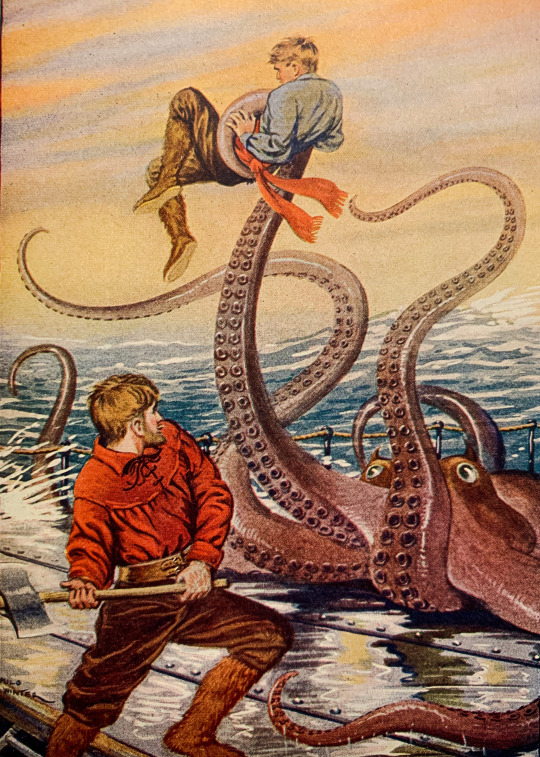
An illustration for Twenty Thousand Leagues Under the Sea by Jules Verne, from a 1922 edition, illustrated by Milo Winter (1888-1956). That's a nice picture.

A record cover for Jonny Quest in 20,000 Leagues Under the Sea, presented by Hanna-Barbera Records in 1965. Even under water, Race Bannon's hair stays in place.

The works of Jules Verne and many writers after him were characterized by super-science, what a reviewer from 1884 called "[m]agic machinery." Super-science isn't usually real science but a magical kind of science or technology that requires a suspension of disbelief in order for it to work. In 1940, Popular Publications (not to be confused with the Popular Fiction Company that published Weird Tales) began publishing Super Science Stories. Here is the cover for the second issue, May 1940, with art by Gabriel Mayorga (1911-1988). That looks like airbrushed art. Maybe Mayorga knew Alex Schomburg, who was a master of that tool.

Here's a bonus, the cover of Peril, The All Man's Magazine, from October 1956: another first issue, another tentacled creature on the attack.

Original text copyright 2023 Terence E. Hanley

Sunday, August 31, 2014

A Survey of Monsters-Part Ten

The End of the Cryptid

I'm looking for the monster of the twenty-first century. By using the Cat in the Hat's process of calculatus eliminatus, I hope to strike one type of monster off the list.

The Gill-man from Creature from the Black Lagoon is a cryptozoological monster and one of the first new Universal monsters of the 1950s. By the time the movie was released in 1954, supernatural monsters were being displaced by scientific monsters. There are probably several reasons for that. I would chalk it up to the scientific and technological advances of World War II, the coming of the flying saucers, and the postwar popularity of science fiction, among other things. In any case, the Gill-man wasn't the first of his type. King Kong is also a cryptozoological monster, as is Godzilla. Like so many monsters of the 1950s, Godzilla's origins are tied up with the use of atomic weapons and atomic power. More on that in the future.

Originally, monsters were from the outside. They lived in the wilderness, in dark forests, deep caves, dank jungles, dusty ruins. They inhabited all the darkened, outer places and came no closer than the edge of the firelight or lamplight. Like the monsters of old, the cryptozoological monster is a monster from the outside. The problem for him is that civilization is pressing in upon him, and he has very little power to resist. There is very little left of the outer edge. There is no outside anymore. Some monsters have adapted by entering the city gates and by passing among us. The cryptozoological monster, by his very nature, can't do that. Like the dodo and the passenger pigeon, his days are numbered.

Cryptozoological monsters had a good run for awhile. Before the 1950s, Bigfoot was kind of just a foot. Only later did he became Big. Roger Patterson shot his famous footage (or should that be Bigfootage?) in 1967. Nine years later, Bigfoot appeared in The Six Million Dollar Man (featuring a character who, like Bob Heironimus, the guy in the ape suit in Patterson's film, had an artificial eye). In 1987, Bigfoot starred in his own movie, Harry and the Hendersons. Like E.T. (1982), he had become a child's friend rather than a menacing monster. By then we were beginning to recognize the limits of the monster's powers and to lament the loss of something vital or necessary in our lives. Lost Worlds are called that because they are hidden, secret, lost from the outside world. We might also call them lost because they are disappearing, a thing of the past, a subject for nostalgia.

There were other cryptid monsters in the 1970s. The outsized great white shark from Jaws (1975) is an obvious example. There were two sequels to Jaws, plus lots of other movies trying to cash in on its success. They included, from 1976: Eaten Alive (crocodile), Grizzly (an 18-foot-tall bear), Rattlers (rattlesnakes), and Squirm (worms); from 1977: Day of the Animals, Empire of the Ants, Kingdom of the Spiders, Orca: The Killer Whale, The Pack (feral dogs), and Tentacles (octopus); and, from 1978: Piranha, and, in a sign that the trend was coming to its end, Attack of the Killer Tomatoes. You might say the animal-attack movies of the 1970s were related to environmentalism and a new ecological consciousness (again, a feeling that something was lost), but the fan of cryptozoology can claim them as well.

In the 1920s and '30s, Aldo Leopold began developing the concept of wilderness. Today we have areas designated as wildernesses in our national parks and forests. I like the idea of wilderness, but it seems strange to me that a wilderness has become a geographic unit rather than an actuality. After all, doesn't a true wilderness draw a line around you rather than the other way around? To put it another way, we exist at the pleasure of a true wilderness, not vice versa. If the cryptozoological monster is a creature of the wilderness, then it, too, has been circumscribed. Like Harry from Harry and the Hendersons, it can no longer be a threat and is no candidate for the monster of our times.

Copyright 2014, 2023 Terence E. Hanley
Saturday, August 30, 2014

A Survey of Monsters-Part Nine

The Creature, The Cryptozoologist, and Lost Worlds

In 1954, Universal Pictures released Creature from the Black Lagoon and a new monster was born. Filmed in 3-D (a response to the vast popularity of television), the movie was so successful as to spawn two sequels, Revenge of the Creature (1955) and The Creature Walks Among Us (1956). Creature from the Black Lagoon was also novelized by John Russell Fearn no less, under his pseudonym Vargo Statten. By the time Aurora Plastics issued its line of monster models in the 1960s, The Creature, also called the Gill-man in the movies, had reached a status equal to that of the classic Universal monsters. Today he is the only Universal monster of the 1950s to be part of that same pantheon. Or should that be panmonstrum . . . ?

***

The Mummy is one of the undead and embodies undying fears, that the dead will live again, that they will walk among us, prey upon us, and perhaps take their revenge upon us. Ghosts, vampires, and zombies are of course also among the undead. Dracula and The Wolfman (i.e., the werewolf) are supernatural in origin and date from at least the Middle Ages. A relative latecomer, Frankenstein's Monster is a monster of science and at the same time a monster of the Gothic romance (as well as one of the undead.) Dr. Jekyll and Mr. Hyde came later still. Mr. Hyde is a monster of science or of the semi-science of psychology. He also falls into the category of the degenerate human or beast-man. The Phantom of the Opera is a kind of madman and might also be explained by science. Finally, The Hunchback of Notre Dame is a monster in the original sense of the word, that is, a deformed person, thus no monster at all. The Creature from the Black Lagoon is altogether different. He is without a doubt a monster of science, but that science was a new one for the twentieth century.

Cryptozoology is the science--more accurately pseudoscience--of unknown animals. Unknown animals range from the quite real--for example, the okapi, which was not known to science until 1901--to the ridiculous, such as the chupacabra. There is a wide range in the type of people who look for unknown animals as well. Some are scientists. Others are crackpots. The field of cryptozoology was in fact founded by men of science. Antoon Cornelis Oudemans (1858-1943) is considered the father of cryptozoology, a judgment based on the primacy of his book The Great Sea Serpent (1892). Bernard Heuvelmans (1916-2001) and Ivan T. Sanderson (1911-1973) were among the prominent cryptozoologists of the twentieth century. In fact, the term cryptozoology was coined by one or the other of them. All three men were trained as zoologists and distinguished in their work.

There have always been unknown animals. In the Age of Exploration, cartographers would mark unknown lands with the words "Here Be Monsters." Even into the twentieth century, parts of the earth remained unexplored. As late as 1920s or '30s, there was still a chance that unexplored regions would hold large fauna, or--in the popular imagination--even relict dinosaurs or prehistoric mammals. In the literature of fantasy, those unexplored places of earth became known as Lost Worlds. In hidden and unreachable valleys or plateaus, beyond high and impassable mountains, at the earth's poles, and even beneath the earth's surface, Lost Worlds awaited discovery. I don't think it's any coincidence that cryptozoology and the Lost Worlds genre date from about the same period, that is, to the end of the Age of Exploration and to the beginnings of the Age of Science. (1, 2)

The Age of Exploration continued into the twentieth century as Roald Amundsen, Richard E. Byrd, and other men penetrated into the heart of the last unknown places on earth. On a more popular level, Frank Buck made a name for himself as a collector of animals from exotic places. Like the Universal monsters, he even teamed up with Abbott and Costello in Africa Screams (1949). The Lost Worlds genre and the related genres of safari, jungle, and South Seas adventure thrived during the 1930s, '40s, and '50s, even as the world was shrinking. During World War II, American servicemen and merchant sailors were stationed in the South Pacific, New Guinea, the Philippines, Africa, and Latin America. They brought back with them indelible memories of the tropics. James Michener wrote of those places. His book Tales of the South Pacific, published in 1947 and winner of a Pulitzer Prize in 1948, opens with an unforgettable passage:
I wish I could tell you about the South Pacific. The way it actually was. The endless ocean. The infinite specks of coral we called islands. Coconut palms nodding gracefully toward the ocean. Reefs upon which waves broke into spray, and inner lagoons, lovely beyond description.
In the postwar, Tiki culture, a kind of kitsch, but still popular today, spread across the land. Les Baxter, Arthur Lyman, and Martin Denny set the exotic to music (and if you have never listened to Exotica, you should--you won't regret it). Under the title South Pacific, Michener's book was adapted to Broadway, then to the silver screen. (3) Other entertainment set in lower latitudes included King Solomon's Mines (1950), The African Queen (1951), Beat the Devil (1953), Mogambo (1953), The Naked Jungle (1954), Watusi (1959), Hatari! (1962), The Naked Prey (1965), Born Free (1966), and The Pink Jungle (1968). On television, there was Tarzan (1966-1968) and of course Gilligan's Island (1964-1967). (4)

That's a long way to go to get to The Creature from the Black Lagoon, but it seems to me that the movie was drawn from a stew of ingredients and not just from Universal monsters and the post-war ascendancy of science fiction. The Creature from the Black Lagoon inhabits a Lost World in miniature. The people searching for him are scientists, more specifically, cryptozoologists. The Gill-man himself is a cryptozoological creature (or cryptid) and a relic from an earlier age. Like Bigfoot, he is bipedal and has a level of intelligence that approaches the human. Also like Bigfoot, he lives on the edges of human habitation. The implication is that his world will become smaller and smaller, finally to disappear before the advance of civilization. In the end the Gill-man is a tragic creature. Like King Kong (who also comes from a Lost World), he is drawn to and ultimately killed by his attraction to a beautiful woman. (5)

I have made a list of ingredients that went toward the making of Creature from the Black Lagoon. Take what you like from it. In addition to Universal monsters, postwar science fiction, and the effects of television on moviemaking of the 1950s, it includes: jungle adventure, safari adventure, South Seas adventure, pulp fiction or a general pulp sensibility, the genre of Lost Worlds, science and pseudoscience, the Age of Exploration, animal collecting à la  Frank Buck and Ivan T. Sanderson, men's adventure out of the pulps and out of World War II, Tiki, Exotica, and even Abbott and Costello (6). Few who saw the movie at the time would have known anything about cryptozoology, but that's part of the mix, too.

To be continued . . .

Notes
(1) In its entry on "Lost Worlds," the online Encyclopedia of Science Fiction lists some works in that genre. Some of the earliest: Journey to the Center of the Earth by Jules Verne (1863); The Coming Race by Edward Bulwer-Lytton (1871); Atlantis, The Antediluvian World by Ignatius Donnelly (1882); King Solomon's Mines by H. Rider Haggard (1885); The Phantom City: A Volcanic Romance (1886) and A Queer Race: The Story of a Strange People (1887) by William Westall; A Strange Manuscript Found in a Copper Cylinder by James de Mille (1888); The Aztec Treasure House: A Romance of Contemporaneous Antiquity by Thomas Janvier (1890); and of course The Lost World by Arthur Conan Doyle (1912), which lent its name to the genre. I would add Herland by Charlotte Perkins Gilman, from 1915.
(2) It might be more accurate to say the Age of Pseudoscience or the Age of Scientism.
(3) There is even a lost world of sorts in South Pacific. Bali Ha'i calls to you.
(4) Maybe you can include McHale's Navy (1962-1966) and Hawaii Five-O (1968-1980) in that category as well. As for literature, it seems like there was less to read than to watch. Ernest Hemingway (1899-1961) wrote of Africa of course. So did Robert Ruark (1915-1965). I'm not sure who else to put on that list.
(5) One of the highlights of Creature from the Black Lagoon is the underwater photography of the female stand-in, Ginger Stanley, a swimmer of extraordinary power, beauty, and grace.
(6) To promote the film, the Creature appeared with Abbott and Costello on live television on The Colgate Comedy Hour in 1954. I guess you could call that another team-up.

Copyright 2014, 2023 Terence E. Hanley

Saturday, May 31, 2014

A Survey of Monsters-Part One

Introduction

I have asked the question, "What is the monster of the twenty-first century?" Now here it is five weeks and eight parts of an article later and I still haven't proposed an answer. I hope to get to one soon. Before proceeding, I should offer a survey of monsters.

Fritz Leiber called it "the era of cottage and castle." That era stretched unbroken from the early Middle Ages into the Age of Reason and the Industrial Revolution. The monsters of those many centuries were supernatural in origin and in character: vampire, werewolf, ghost, demon, and so on. (1) I suppose that in an Age of Reason, any culture would become more self-conscious. That's what happened when men and women of the mid-eighteenth century looked back upon their history with some nostalgia. The result was a Gothic revival. (They even created artificial "ruins" to go with their interests.) It probably wasn't the first retro movement in history. After all, the Renaissance was a revival of Classical learning. But Gothicism is still with us and still a powerful cultural force. You won't meet many true Renaissance men in your lifetime, but chances are you have seen a member of the Goth subculture some time in the recent past. Or maybe you are part of that subculture.

So the Gothic revival of the eighteenth and nineteenth centuries reconnected us to stories of ghosts, demons, vampires, and werewolves. Curiously, it also gave us a science-fictional monster, one of the earliest of its type: Frankenstein's monster. In Mary Shelley's Gothic romance of 1818, the monster is one of the undead, but he is reanimated not by a supernatural force but by purely natural--that is, scientific, or what passed for scientific--galvanism. In America, Edgar Allan Poe followed Mary Shelley's example, marrying the settings, trappings, and themes of Gothic romance to nascent science fiction. "The Facts in the Case of M. Valdemar" (1845), in which the title character is kept alive after his death through the power of mesmerism, is an example. Other writers of the nineteenth century followed suit. Their monsters--Varney the Vampire, Carmilla, Wagner the Were-Wolf, Spring-Heeled Jack--were in the Gothic tradition, sometimes with a little science thrown in.

At the end of the nineteenth century, in Bram Stoker's Dracula, the vampire--like the psychopathic killer before him--moved to the city. In Dracula's case, it was from rural Ruritanian Europe to the bustling metropolis of London, where he could so easily go about his business. Not many people today remember Varney or Carmilla, but the whole world knows of Dracula. He and his vampiric kin have been with us continuously since 1897, when Dracula first appeared in print. Two other monsters arrived in that same decade. (2) Also in 1897, space aliens, in the form of H.G. Wells' Martian invaders, arrived on Earth and in our imaginations. They have never left us, either. Half a decade before, Antoon Cornelis Oudemans published The Great Sea Serpent (1892), a scientific study of the phenomenon. Bernard Heuvelmans, the father of twentieth century cryptozoology, considered that book to be the first work in its field.

I have already written about two real-life monsters, the psychopathic killer and the totalitarian. If Jack the Ripper was the model for the psychopathic killer, then he predates the previously described monsters by only a few years, having done his work in 1888. The origin of the twentieth century totalitarian monster is harder to pin down. Part psychopath, part devil, and part god, he has probably been around since the beginning of time. As for his first occurrence in literature, I can offer two examples, "The New Utopia" by Jerome K. Jerome (1891) and Pictures of the Socialistic Future by Eugen Richter (1891). I haven't read either of those stories, but I don't believe the totalitarian monster was personified in either one of them. Maybe the example of the real-world totalitarian was necessary before he could cross over into literature. If anyone can propose the first totalitarian in literature, I would like to hear about it.

That leaves a few other types of monsters that I haven't talked about yet. Fitz-James O'Brien wrote about the invisible monster in "What Was It? A Mystery" (1859). Guy de Maupassant's story "The Horla" (1887) and Ambrose Bierce's story "The Damned Thing" (1893) are more well known. They also conveniently fall within the last decade or so of the nineteenth century, as does "The Invisible Man" by H.G. Wells (1897). The machine-monster has its origins in real-life automata of ancient times. If you were drawing a Venn diagram of machine-monsters, Frankenstein's monster might fall partially within your circle. The android would also, of course. The French writer Villiers de l'Isle-Adam, in L'Ève future (1886), was responsible for the first usage of that word as we understand it, that is, a robot in human form. Ambrose Bierce turned the game-playing automaton into a monster in "Moxon's Master" (1893). The word robot itself comes from the play R.U.R by Karel Čapek (1920). The computer-monster is just a later variation on the same type.

I don't know when the concept of the interdimensional being or monster came about, but ghosts, demons, and other supernatural monsters would have served that purpose in olden times. Cryptids, space aliens, and invisible monsters fill the bill today. The degenerate human is a kind of monster as well. I'm not sure you can point to his first appearance, although The Time Machine (1895) or The Island of Doctor Moreau (1896), both by H.G. Wells (1896), are good candidates. My list isn't complete, but I'll close this part one with another type, the soulless monster, which can take various forms. For example, does Frankenstein's monster possess a soul? Does a vampire? More to my point, does the machine-monster have a soul? Or the space alien of the pod-person type? Or what about the monster du jour, the zombie?

To be continued . . .

Notes
(1) Once the Age of Exploration began, there would have been born a new kind of monster and one of the first monsters of science: the previously unknown creature out of terra icognita. Today we would call that creature a cryptid.
(2) The decade in which our current popular culture can be said to have begun.

Copyright 2014, 2023 Terence E. Hanley

Tuesday, April 22, 2014

Johanson and the Monster

The old saying is that life imitates art. In 1926, H.P. Lovecraft composed "The Call of Cthulhu," a story that would become a classic of twentieth century horror and fantasy. Published in Weird Tales in February 1928, "The Call of Cthulhu" is a kind of mystery in which a scientific investigator attempts to reconstruct the events of a time only recently past. The key piece of evidence in his reconstruction is the diary of a Norwegian sailor, Gustaf Johansen, who was there when Cthulhu awoke from his slumbers on the island city of R'lyeh. Johansen was the lone survivor of that encounter, but even he has succumbed to the influence of Cthulhu before the story ends.

The fainting narrator is a cliché in the writings of H.P. Lovecraft. Alternatively, the narrator is driven insane by his experience, sometimes temporarily, often permanently. Even if his insanity is only temporary, the narrator must lie abed before recovering himself. Gustaf Johansen is not the narrator of "The Call of Cthulhu," but of all the characters in the story, he comes in closest contact with its horrors. Made of sturdier stuff than the typical Lovecraftian narrator, Johansen nonetheless falls into a state of depression or despair after encountering Cthulhu. In the end, he dies mysteriously, almost certainly at the hands of cultists.

Four years after the publication of "The Call of Cthulhu," the Swedish overseer of a rubber plantation in the Belgian Congo reported an experience like that of Gustaf Johansen, though admittedly not by degree. His name was J.C. Johanson, and on a hunting trip in the Kasai Valley, he and his bearer encountered a monster out of the past. Described as a lizard sixteen yards long, the creature was devouring a rhinoceros when the two men came upon it. Johanson is supposed to have taken pictures of the creature. The two images circulating on the Internet have been shown to be fakes. In any event, Johanson's reaction is familiar to anyone who has read a story by H.P. Lovecraft:
The experience was too much for my nervous system. Completely exhausted, I sank down behind the bush that had given me shelter. Blackness reigned before my eyes. . . . I must have looked like one demented when at last I regained camp. . . . For eight days I lay in a fever, unconscious nearly all the time. (1)
Even Johanson's expressions--"Blackness reigned before my eyes"--echo writing from the pulps.

I have never seen a Tyrannosaurus rex eating a rhinoceros or for that matter a ham sandwich. I can't say what my reaction would be to such a thing. But pulp writers and moviemakers don't seem to have a lot of faith in the psychological strength and stability of their fellow human beings. If Johanson was laid low by the sighting of a dinosaur in the African jungle, I don't think he should have been in Africa in the first place, so far as it is from a fainting couch. In other words, Johanson's story sounds like a story. I wonder if the man himself ever existed. And if it was just a story, I wonder if the person who thought it up had read "The Call of Cthulhu" not long before.

Note
(1) Quoted in Monsters and Mythic Beasts by Angus Hall (1975), p. 87.

Copyright 2014, 2023 Terence E. Hanley

Wednesday, December 5, 2012

Wardon Allan Curtis (1867-1940)

Aka Warden Allan Curtis
Journalist, Author
Born February 1, 1867, New Mexico Territory
Died January 20, 1940, Plymouth, New Hampshire

Wardon Allan Curtis was born in the New Mexico Territory on the first day of February, 1867. He was the son of Captain Charles Albert Curtis, U.S.A., and Harriet Louise Hughes Curtis. I suspect that he was born on or near a military installation. He may have moved from place to place as a child as military children do. In 1889, Curtis received his bachelor's degree from the University of Wisconsin. He worked as a journalist after that and was with the Chicago Daily News in 1910-1913, the Boston Herald in 1913-1916, and the Manchester Union in 1924-1928. Curtis also served as secretary of the Publicity Commission of New Hampshire in 1921-1925. From at least 1899 onward, Wardon Allan Curtis wrote science fiction and fantasy stories. The Encyclopedia of Science Fiction (1995) writes:
His most important sf [i.e., science fiction] is a short story about a brain transplant, "The Monster of Lake LaMetrie" (1899 The Windsor Magazine), in which the brain is human and the recipient body that of a prehistoric survival from a bottomless lake that may lead into a hollow earth.
If that description doesn't make you want to read the story, I don't know what will.

The Black Cat published his story "The Fate of the 'Senegambian Queen'" in 1900. Weird Tales reprinted the story in its Fall 1973 issue. An Arabian Nights kind of story, "The Seal of Solomon the Great," appeared in The Argosy in February 1901. Almost two decades later, All-Story Weekly printed his tale "The Mahoosalem Boys" (May 15, 1920). All other credits for Curtis as listed in the Internet Speculative Fiction Database are from his 1903 collection The Strange Adventures of Mr. Middleton, "a mixture of Oriental fantasy and bizarre mystery," according to The Encyclopedia of Science Fiction.

Wardon Allan Curtis lived in New Hampshire late in life and died in Plymouth twelve days before his seventy-third birthday. He was buried in Green Grove Cemetery in Ashland, New Hampshire.

Wardon Allan Curtis' Story in Weird Tales
"The Fate of the 'Senegambian Queen'" (Fall 1973, originally in The Black Cat, Nov. 1900)

An illustration by Stanley L. Wood (1866-1928) for Wardon Allan Curtis' story "The Monster of Lake LaMetrie" from 1899, demonstrating the connection between science fiction and cryptozoology. A story like this one would later have been included in that hybrid genre known as weird western. The Valley of Gwangi (1969) was a later entry in that selfsame genre.
Curtis wrote a series of interrelated tales in The Strange Adventures of Mr. Middleton (1903). My first question upon seeing this cover illustration: "Just what are they smoking?"

Text and captions copyright 2012, 2023 Terence E. Hanley

Friday, October 26, 2012

Robert W. Chambers (1865-1933)

Fine Artist, Illustrator, Short Story Writer, Novelist, Playwright, Children's Book Author
Born May 26, 1865, Brooklyn, New York
Died December 16, 1933, New York, New York

Robert W. Chambers lived the kind of life any aspiring writer might envy. Talented, popular, and prolific, he wrote nearly one hundred books and used the proceeds to fund a lavish estate, a sizable art collection, an active club life, frequent trips abroad, independent wealth, and plenty of leisure time. He was an outdoorsman, a lepidopterist, a collector, an expert on certain antiquities, and in his early years, a very successful artist and illustrator, counting Charles Dana Gibson (1867-1944) and other artists and writers among his friends. Many of Chambers' stories were adapted to film in his lifetime and after. Chambers' wife, French-born Elsa Vaughn Moller, called "Elsie" and daughter of a European diplomat, bore him one son, Robert Edward Stuart Chambers. The younger Chambers, who also went by the name Robert Husted Chambers (1899-1955), followed in his father's footsteps as a writer. The Chambers family also included Chambers' brother, the New York architect Walter Boughton Chambers (1866-1945), who designed landmarks in his native city and other northeastern states.

Wealth, talent, fame, family--it all added up to a great success, yet, as far as I know, there has never been a book-length biography of Robert W. Chambers. And in the minds of many, Chambers squandered his talent on popular novels produced at a rapid pace and settling somewhere below the ken of literature. "Stuff! Literature!" Robert W. Chambers scoffed in a 1912 interview. "The word makes me sick!" His disdain for literary endeavor may have been the fox talking about the grapes. Either way, it assured that his work would become dated and seldom read in later years. In his time, he was called "the Shopgirl Scheherazade" and "the Boudoir Balzac." Today, Chambers' reputation rests almost solely on a single book, his second, entitled The King in Yellow, published in 1895.

In his survey of the genre, H.P. Lovecraft wrote--in his "Supernatural Horror in Literature" (1)--two long paragraphs on Chambers. I'll quote them in their entirety here:
     Very genuine, though not without the typical mannered extravagance of the eighteen-nineties, is the strain of horror in the early work of Robert W. Chambers, since renowned for products of a very different quality. The King in Yellow, a series of vaguely connected short stories having as a background a monstrous and suppressed book whose perusal brings fright, madness, and spectral tragedy, really achieves notable heights of cosmic fear in spite of uneven interest and a somewhat trivial and affected cultivation of the Gallic studio atmosphere made popular by Du Maurier’s Trilby. The most powerful of its tales, perhaps, is "The Yellow Sign," in which is introduced a silent and terrible churchyard watchman with a face like a puffy grave-worm's. A boy, describing a tussle he has had with this creature, shivers and sickens as he relates a certain detail. "Well, sir, it's Gawd's truth that when I 'it 'im 'e grabbed me wrists, sir, and when I twisted 'is soft, mushy fist one of 'is fingers come off in me 'and." An artist, who after seeing him has shared with another a strange dream of a nocturnal hearse, is shocked by the voice with which the watchman accosts him. The fellow emits a muttering sound that fills the head like thick oily smoke from a fat-rendering vat or an odour of noisome decay. What he mumbles is merely this: "Have you found the Yellow Sign?" 
     A weirdly hieroglyphed onyx talisman, picked up in the street by the sharer of his dream, is shortly given the artist; and after stumbling queerly upon the hellish and forbidden book of horrors the two learn, among other hideous things which no sane mortal should know, that this talisman is indeed the nameless Yellow Sign handed down from the accursed cult of Hastur—from primordial Carcosa, whereof the volume treats, and some nightmare memory of which seems to lurk latent and ominous at the back of all men's minds. Soon they hear the rumbling of the black-plumed hearse driven by the flabby and corpse-faced watchman. He enters the night-shrouded house in quest of the Yellow Sign, all bolts and bars rotting at his touch. And when the people rush in, drawn by a scream that no human throat could utter, they find three forms on the floor—two dead and one dying. One of the dead shapes is far gone in decay. It is the churchyard watchman, and the doctor exclaims, "That man must have been dead for months." It is worth observing that the author derives most of the names and allusions connected with his eldritch land of primal memory from the tales of Ambrose Bierce. Other early works of Mr. Chambers displaying the outré and macabre element are The Maker of Moons and In Search of the Unknown. One cannot help regretting that he did not further develop a vein in which he could so easily have become a recognised master.
That's a lot to digest in a single blog entry, but it's worth reading for a number of reasons. First, it's obvious that Lovecraft drew on The King in Yellow in general and on "The Yellow Sign" in particular for concepts and atmosphere for his own weird fiction. Second, it's illuminating to read of the lineage of Chambers' "names and allusions," which can be traced backward to Bierce and forward to Lovecraft and his acolyte, August Derleth. Third, it's very interesting to read Lovecraft's criticisms of the older man Chambers:
Very genuine, though not without the typical mannered extravagance of the eighteen-nineties, is the strain of horror in the early work of Robert W. Chambers . . . [emphasis added].
One cannot help regretting that he did not further develop a vein in which he could so easily have become a recognised master [again, emphasis added].
Those two criticisms, which open and close Lovecraft's discussion of Chambers, can just as easily be leveled at Lovecraft himself. In fact they sometimes have been.

* * * * *

You can read about Robert W. Chambers elsewhere on line or at the library. (The New York Times wrote of him extensively in his time. You might start by reading his obituary, dated December 17, 1933, page 36.) I'll skip the biographical details and write just a little more. First, as Lovecraft wrote, Chambers authored several works of horror, fantasy, and science fiction. (2) Second, he also wrote a book called Police!!! (1915), which may very well have contained the first cryptozoological fiction ever set to print. (3)

Cryptozoology, founded in the nineteenth century but not named until the twentieth, is the science or semi-science of unknown creatures. Its recognized founder was Antoon Cornelis Oudemans (1858-1943), a Dutch zoologist who attempted to describe and classify unknown creatures in his book The Great Sea Serpent (1892). Robert W. Chambers--Oudemans' junior by only seven years--was an enthusiastic entomologist and lepidopterist; his credentials as a science-minded author would appear firm. The point of this is that cryptozoological fiction would not have been likely before science was brought to bear on what would previously have been the stuff of legend or folklore. It's also unlikely that anyone would have written stories on a sensationalistic topic such as cryptozoology before there was a popular press on an industrial scale. I guess I should ask the question then: Can anyone offer another candidate for the first fiction in the young field of cryptozoology?

Notes
(1) Literature? "Stuff!" Chambers might say.
(2) A story called "The Repairer of Reputations" opens Chambers' 1895 collection, The King in Yellow. Set in 1920, the story alludes to recent events, including the administration of a President Winthrop and recent victory in a war with Germany. Winthrop is close enough to Wilson, and of course the United States and Germany were involved in a little tussle ending in 1918. You might say that science fiction blends into prophecy in Chambers' tale. Mostly, though, his projections are simply nonsense.
(3) There is also a hint of forensic entomology in one of the stories.

Robert W. Chambers' Stories in Weird Tales
"The Demoiselle d'Ys" (Aug. 1928)
"The Sign of Venus" (Summer 1973, originally in Harper's Magazine, Dec. 1903)
"The Splendid Apparition" (Winter 1973, originally in In Search of the Unknown, 1904)

A drawing of the King in Yellow, created by Robert W. Chambers himself, that rare combination of accomplished writer and accomplished artist.
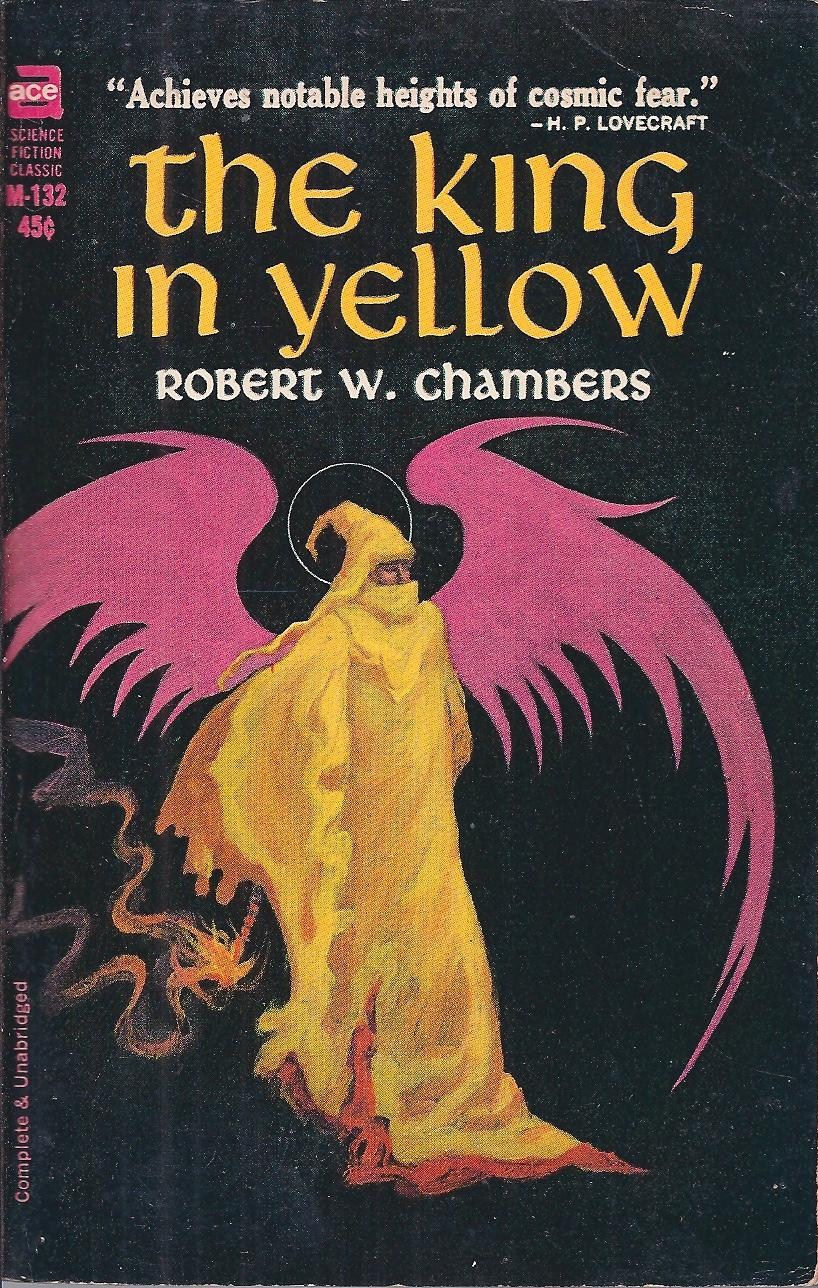
Jack Gaughan, the cover artist for the Ace Books edition of 1965, followed Chambers' model closely.
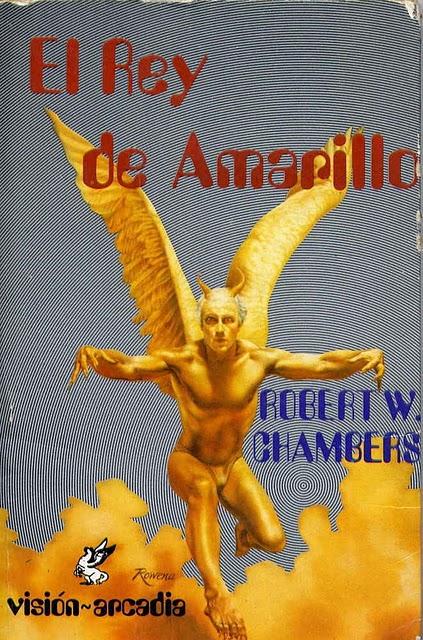
This Spanish-language version features an Op Art background to Rowena Morrill's illustration.
Unintentionally or not, the color yellow became a motif in illustration for the works of Robert W. Chambers. Here's the cover for The Maker of Moons, an edition from--I think--the 1970s and a West Coast publisher. Can anyone offer any details?
I wish I had a better and larger version of this cover illustration for The Common Law, again, in yellow, and featuring one of the blondest of blonde starlets, Constance Bennett. Filmed twice as a silent picture, Chambers' novel stepped into the era of sound in 1931. By the way, Constance Bennett was a sister to Joan Bennett of Dark Shadows fame.
Another Chambers cover in yellow. As I have suggested before, many artists see yellow as the color of madness. I offer "The Yellow Wallpaper" by Charlotte Perkins Gilman and the paintings of Vincent van Gogh as evidence.
Here's a nice wraparound cover for the novel Athalie. Chambers started off his career with a bang with The King in Yellow. Thereafter, he wrote historical novels and novels of adventure and romance. Like his friend Charles Dana Gibson, he depicted the new, independent woman of the early twentieth century. (This cover looks suspiciously like a Gibson drawing and the setting is the same as in the illustration above.) Popular with shopgirls, Chambers lost the confidence of critics as the years went by. Today he is a literary footnote except among fans of weird fiction.

Postscript (Jan. 28, 2016): Here is just such a drawing by Charles Dana Gibson, "The Greatest Game in the World," from many years before. Gibson (1867-1944) and Chambers were friends and classmates at the Art Students League in New York City. Later they lent their names to the self-confident modern woman, sometimes called "the Chambers Girl," more often "the Gibson Girl."

Text and captions copyright 2012, 2023 Terence E. Hanley