Showing posts with label Nictzin Dyalhis. Show all posts

Saturday, May 3, 2025

Nictzin Dyalhis & Donald Edward Keyhoe

Nictzin Dyalhis (1873?-1942) had his first story in Weird Tales in April 1925. So did Donald Edward Keyhoe (1897-1988). Dyalhis' story was of course "When the Green Star Waned," a science-fantasy set in the solar system of the future. Keyhoe's story was "The Grim Passenger," a tale of Egyptian archaeology and a pharaoh's curse. "The Grim Passenger" is, then, about the past. As it turns out, it is also set in the past, the past, that is, of 1925. You'll have to read the story to find out the year. I don't want to give away Keyhoe's twist ending.

"When the Green Star Waned" is in the prose style of the pulps. Dyalhis seems to have been influenced by H.G. Wells, but it looks like the greater influence came from Edgar Rice Burroughs and his Martian tales. In contrast, "The Grim Passenger" is almost journalistic or documentary in its tone and style. It could almost be an article rather than a story. In fact, it's barely a story as we understand and enjoy works of fiction. It seems to exist mainly for its twist ending and the occult connection made between one event and another. It's a somewhat Fortean construction, or like an expanded vignette from Ripley's Believe It or Not! If it had been true or mostly true, it would have found a place in later books by Frank Edwards or Vincent Gaddis.

Nictzin Dyalhis had eight stories in Weird Tales from 1925 to 1940 and five more in other magazines during those same decades. These proved very popular with readers. It's a shame there weren't more, even if, as I suspect, they were revised or even rewritten by authors within Farnsworth Wright's stable. (Maybe Dyalhis was the Richard Shaver of Weird Tales.) Despite the popularity and success of his stories and the powers of imagination behind them, Dyalhis worked as a common laborer and a hardscrabble farmer. He lived in poverty and died in almost complete obscurity. He was survived by his wife and daughter. The daughter died not long ago. She had children of her own, and so the enigmatic Nictzin Dyalhis still has living descendants. I doubt that anyone knows his real name. The facts of his life are extremely scanty. At least one of the supposed facts in his obituary is wrong. 

Donald E. Keyhoe moved in different circles. He graduated from the U.S. Naval Academy in 1919 and served as a pilot in the U.S. Marine Corps, eventually attaining the rank of major (with his service during World War II). Although he wrote scads of stories for the lowly pulps, he was also an employee of the U.S. Department of Commerce and an associate of the most famous aviator of his time, Charles Lindbergh, for whom he managed a 22,000-mile aerial tour of the United States in 1927. I'll have more on that next time.

Keyhoe was born on June 20, 1897. Four days after his fiftieth birthday, on June 24, 1947, Kenneth Arnold, another airplane pilot, saw a flight of unidentified flying objects over Mount Rainier in Washington State. These and other such objects of course became known as flying saucers, named for Arnold's description of the way they flew. (The original description was of crescent-shaped or flying wing-type aircraft. They were decidedly not discs.) Keyhoe became deeply interested in--eventually obsessed with--the flying saucer phenomena. In January 1950, True magazine published his article "The Flying Saucers Are Real." It proved a sensation, and Keyhoe expanded it into a book of the same name, published shortly thereafter.

Several more flying saucer books flew from his typewriter. The last came in 1973, which can be considered the last year of the flying saucer era. In 1957, he took over as director of the National Investigations Committee on Aerial Phenomena (NICAP), founded the previous year. Also in 1956, the film Earth vs. the Flying Saucers, based on Keyhoe's Flying Saucers from Outer Space (1953), was released. In this one, Hugh Marlowe played the hero instead of a louse, as he did in The Day the Earth Stood Still (1951). Earth vs. the Flying Saucers is still a very watchable and enjoyable movie. Look for an alien abduction scene as a precursor to later, supposedly real-life abductions, such as in the case of Betty and Barney Hill.

Donald Keyhoe was a conspiracy theorist, though probably not the original conspiracy theorist when it came to flying saucers. On March 8, 1958, he appeared on ABC-TV on The Mike Wallace Interview, starring Mike Wallace and a Parliament cigarette. Keyhoe did pretty well in the interview, I think. Mike Wallace was not the savage interviewer of later years. Listen for the word "misinformation." The point of this is that Keyhoe and his subject, flying saucers, were taken seriously enough to have appeared on national television, where he was interviewed at length by a prominent and well-respected journalist. There has been recent media coverage of flying saucers, but this doesn't seem to be going anywhere. Recent witnesses might long for the 1950s.

In his last book, Aliens from Space . . . The Real Story of Unidentified Flying Objects (1973), Keyhoe covered the whole phenomenon and its various (human) actors. He speculated on the physical appearance of aliens from space. He also suggested that aliens might be up to no good. It's interesting that his first story in Weird Tales appeared in an issue in which a tale of an alien invasion of Earth was so prominent. In his own story of April 1925, Keyhoe looked to the past. In Nictzin Dyalhis' story, maybe Keyhoe saw the future.

I think Donald Keyhoe went to his grave believing in what he saw as the truth behind flying saucers. He died at age ninety-one on November 29, 1988. His obituary appeared in the Washington Post. Major Keyhoe was survived by his wife and three children. I don't know whether he has any living descendants.

In looking through Aliens from Space, I came upon the name of another teller of weird tales. He was Robert Spencer Carr (1909-1994). By a strange coincidence, Carr also had his first story in Weird Tales in 1925. Entitled "The Composite Brain," it was published in the March issue. As it turned out, Carr became special advisor to NICAP, and so his path crossed that of Major Keyhoe three decades or more after they had had their stories in Weird Tales. Carr had lots of ideas, one of which was called Operation Lure. But this idea wasn't new at all. It had first been proposed in that decade of origins, the 1920s, in the pages of Popular Mechanics. It, too, seems to have been influenced by H.G. Wells in that Martians have been watching us and we have in turn observed phenomena on the surface of their Red Planet. It seems there is always watching and listening going on . . .

Next: Donald E. Keyhoe in National Geographic.

Text copyright 2025 Terence E. Hanley

Tuesday, April 29, 2025

The Falling Man

The illustration on the cover of Weird Tales for April 1925 is for "When the Green Star Waned" by Nictzin Dyalhis. The artist was Andrew Brosnatch. It shows a man who appears to be falling into a mass of aliens that have invaded Earth. In actuality, the aliens have levitated him the way a Roman might hold a grape over his open mouth. The intent is the same: the aliens mean to eat him. In a moment, they will let go with their powers of levitation and he will plunge into their mass, where they await with their "triangular, gaping, hideous orifices." The man is spared his fate by the merciful actions of the Venus-Men.

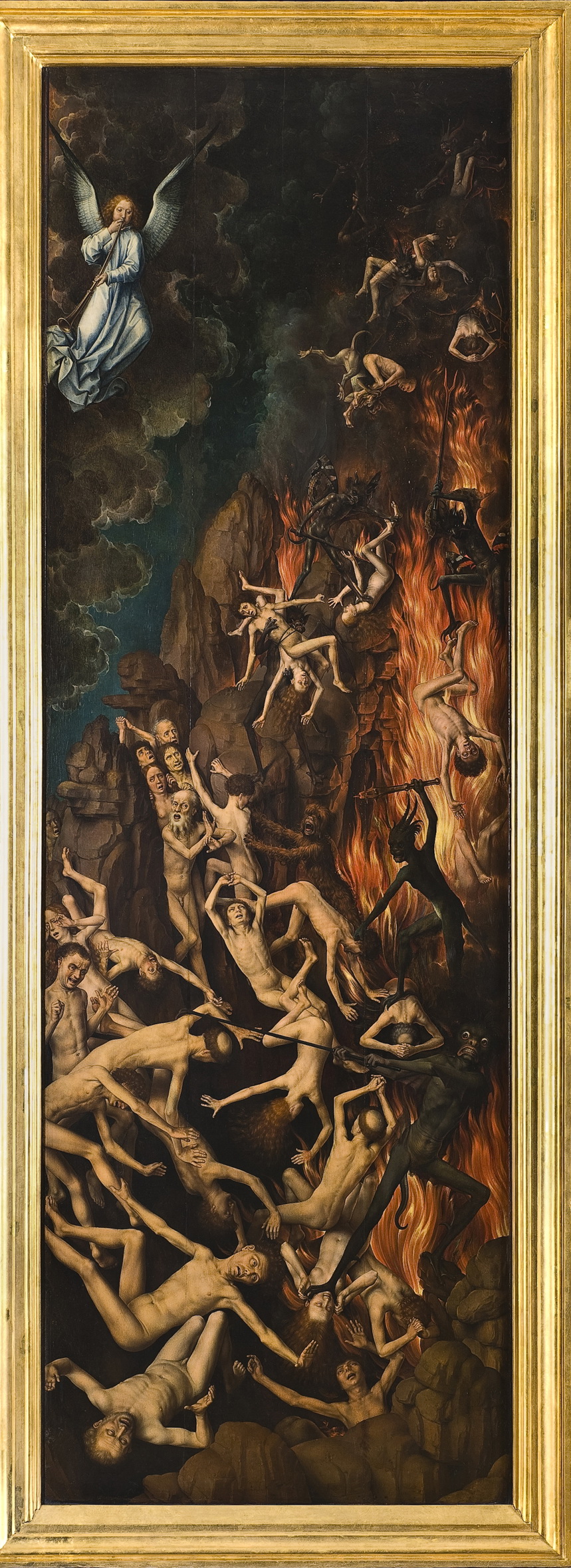
Andrew Brosnatch's cover illustration makes me think of Christian art, especially depictions of Hell and the casting into Hell of sinners. His garb is also redolent of ancient or biblical dress. First is Brosnatch's cover, then an example of the falling man from Christian art:


"Casting the Damned into Hell," the right wing of a triptych entitled The Last Judgment, by German-Flemish artist Hans Memling (ca. 1430-1494). See in particular the figure on the middle right.

There are many more examples of the falling man, cast into Hell, in Christian art. If you go looking for such imagery, be ready for some nightmarish, yet fascinating, depictions of Hell, some of which remind me of William Hope Hodgson's description of our nightmarish future in The Night Land (1912).

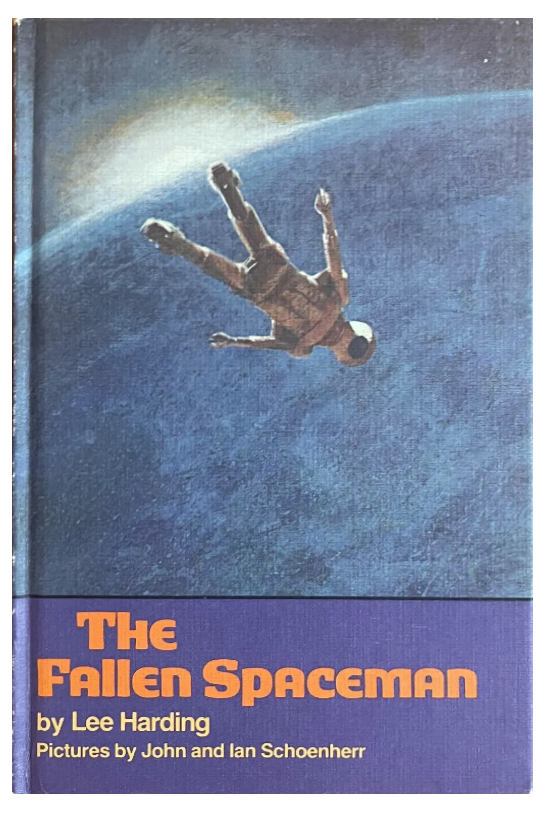
Depictions of Icarus by European artists show a similar falling man from pre-Christian and pagan times. The image of the falling spaceman is common in science fiction art, the art of the future. (I guess apocalyptic art is art of the future, too.) Here's an example of that:

The Fallen Spaceman by Lee Harding (1973), with art by John and Ian Schoenherr. Be aware that I have adjusted this image from an online photograph of the cover. This is not a true representation of the original.

I don't know whether Andrew Brosnatch intended to evoke thoughts of the fall of man from the Book of Genesis, of the sinner and the damned cast into Hell, or of the general image of man falling from grace or from great heights into opposing depths. Those of us with religious upbringing and education can't avoid seeing such things, though.

I have just one more thing. My nephew and I noticed a long time ago that all of the major characters in Star Wars sooner or later fall into a pit. The same thing happens to Indiana Jones and Marion Ravenwood, also to characters in The Lord of the Rings saga. That fear, dread, and terror at falling or plunging, or being cast into pits and depths, must be deep in us, no pun intended, and always ready to come forth. 

Text copyright 2025 Terence E. Hanley

Sunday, April 27, 2025

April Aliens & April Invasions

The cover story and lead story in the April 1925 issue of Weird Tales is "When the Green Star Waned" by Nictzin Dyalhis. The "Green Star" of the title is Earth as seen from the planet Venus. The men of Venus have noticed that the green light of Earth has faded and that their neighboring planet has gone silent. These two developments have raised the alarm on Venus. The great men of that planet decide to travel to Earth to find out what has happened. (1, 2)

"When the Green Star Waned" is about an alien invasion of Earth. The aliens of the story have enslaved Earthmen and it is we who prove weak, helpless, and powerless to save ourselves. The heroes and rescuers in "When the Green Star Waned" are in fact Venus-Men rather than Earthmen. That alone makes for an unusual story. There are other ways in which "When the Green Star Waned" is unusual or innovative.

Nictzin Dyalhis' story is an early example of weird fantasy, science fantasy, space fantasy, or the weird-science type of story. Later science fiction would treat the same kind of situation--going up against alien invaders of other planets--except that it is Earthmen who are the heroes and rescuers. It is we who free the oppressed, enslaved, or exploited peoples of those planets. The same kind of plot became a staple of the television show Star Trek, broadcast four decades after "When the Green Star Waned" was published. The episode "Operation--Annihilate!", first broadcast in April 1967, is an example. The plot of that episode has similarities to The Puppet Masters by Robert A. Heinlein before it (1951) and the movie Alien afterwards (1979).

There was a contrary development during the Flying Saucer Era of 1947 to 1968 or 1973. During that era, aliens from outer space were often represented as good and caring and benevolent. They were our space brothers, or like angels from on high. Their purpose in coming to Earth was to save us from ourselves. This is what much of the Contactee phenomenon of the 1950s was about. The space brother/space angel/space savior idea was captured pretty well in the movie The Day the Earth Stood Still, released in 1951.

A description of the alien invaders in "When the Green Star Waned" must have sounded familiar to readers of what was then called the pseudo-scientific story (see "Ooze" by Anthony M. Rud in Weird Tales, Mar. 1923), scientifiction (Hugo Gernsback's name for stories of this type), or the scientific romance (a term more commonly used in Great Britain, I think). A passage from "When the Green Star Waned":
     And here we found life, such as it was. I found it, and a wondrous start the ugly thing gave me! It was in semblance but a huge pulpy blob of a loathly blue color, in diameter over twice Hul Jok's height, with a gaping, triangular-shaped orifice for mouth, in which were set scarlet fangs; and that maw was in the center of the bloated body. At each corner of this mouth there glared malignant an oval, opaque, silvery eye.
     Well it was for me that, in obedience to Hul Jok's imperative command, I was holding my Blastor pointing ahead of me; for as I blundered full upon the monstrosity it upheaved its ugly bulk--how, I do not know, for I saw no legs nor did it have wings--to one edge and would have flopped down upon me, but instinctively I slid forward the catch on the tiny Blastor, and the foul thing vanished--save for a few fragments of its edges--smitten into nothingness by the vibrations hurled forth from that powerful little disintegrator.

Here is a similar passage, of the narrator's first encounter with an alien, in The War of the Worlds by H.G. Wells, first published in Pearson's Magazine from April to December 1897:

    A big greyish rounded bulk, the size, perhaps, of a bear, was rising slowly and painfully out of the cylinder. As it bulged up and caught the light, it glistened like wet leather.

    Two large dark-coloured eyes were regarding me steadfastly. The mass that framed them, the head of the thing, was rounded, and had, one might say, a face. There was a mouth under the eyes, the lipless brim of which quivered and panted, and dropped saliva. The whole creature heaved and pulsated convulsively. A lank tentacular appendage gripped the edge of the cylinder, another swayed in the air.

    Those who have never seen a living Martian can scarcely imagine the strange horror of its appearance. The peculiar V-shaped mouth with its pointed upper lip, the absence of brow ridges, the absence of a chin beneath the wedgelike lower lip, the incessant quivering of this mouth, the Gorgon groups of tentacles, the tumultuous breathing of the lungs in a strange atmosphere, the evident heaviness and painfulness of movement due to the greater gravitational energy of the earth--above all, the extraordinary intensity of the immense eyes--were at once vital, intense, inhuman, crippled and monstrous. There was something fungoid in the oily brown skin, something in the clumsy deliberation of the tedious movements unspeakably nasty. Even at this first encounter, this first glimpse, I was overcome with disgust and dread.

Dyalhis' aliens aren't quite the same as Wells', but his description of them is close enough that I sense the influence of the latter upon the former. Wells' prose here found echoes in that of H.P. Lovecraft, too, I think. Maybe there was an influence there as well.

By the way, Nictzin Dayalhis was the originator of the term Blastor, later blaster, a weapon that will forever be indispensable in our fight against alien invasions.

Next: Andrew Brosnatch's Cover.

Note
(1) Light as an indication of life has been in the news as I write, for a spectrographic analysis of the atmosphere of a planet called K2-18b shows signs of what some scientists believe could be life on that planet. (A skepto-graphic analysis might show something different.) The indicating compounds are sulfurous. Sulfur has of course been associated with Hell, the Devil, and a general wickedness or evil. Hold onto that thought for next time.

(2) The silence of the planet Earth in "When the Green Star Waned" makes me think of Out of the Silent Planet by C.S. Lewis. In Lewis' version, Earth is "silent" because we are under a kind of cosmic quarantine, the reason being that human beings are "bent," another way of saying, I guess, that we are fallen in our nature. Hold onto the idea of a fallen man for next time as well.

Original text copyright 2025 Terence E. Hanley

Tuesday, April 15, 2025

Weird Tales, April 1925

One hundred years ago this month, the enigmatic Nictzin Dyalhis made his debut in the pages of Weird Tales magazine. His story, "When the Green Star Waned," was both the cover story and the lead story. The cover art was by Andrew Brosnatch.

"When the Green Star Waned" is an unusual story. Set in the far future, it tells of men of Venus--or Venhez--who save the men of Earth--or Aerth by their spelling of it--from slavery and oppression at the hands--or tentacles--of alien invaders. This isn't really science fiction but science fantasy, or maybe it should be called weird science. It wasn't the first story of its type: in January 1925, Weird Tales published J. Schlossel's science fantasy or outer space fantasy "Invaders from Outside." But "When the Green Star Waned" struck a nerve in readers. It became the most popular story of 1925 in Weird Tales and the fifth most popular of the period November 1924 to January 1940, with 63 votes in total. As an example of the readers' positive responses, James Godfrey Osgood, Jr., of Fitchburg, Massachusetts, wrote: 

I do not think you have overstated the case one bit when you say that When the Green Star Waned, by Nictzin Dyalhis, is one of the most remarkable stories of its kind which have yet appeared. Indeed, of its peculiar genre it is the best, I have no doubt, and, needless to say, is my choice for the best story in the April number. (From "The Eyrie," June 1925)

Other authors who had their first stories for Weird Tales in the April issue were: Joel Martin Nichols, Jr., James W. Bennett, Donald E. Keyhoe, H. Thompson Rich, Robert E. Ulmer, and Walter G. Detrick. Several other authors had their one and only story in that same issue.

* * *

There are two items from "The Eyrie" that I would like to point out. First is a long quote in the form of a screen shot of the scanned page. I hope you can read it.


For emphasis: "WEIRD TALES plays no favorites." But that was 1925. Things were different ninety-eight years later when the Cosmic Horror Issue, Number 367, was published, for the authors in that issue are friends of the editor. I'll just say, publishing a magazine is not like an Andy Hardy movie. You don't get your friends together to put on a show. It's something more serious than that, and you owe your readers--and the 100-year reputation of your magazine--more than what amounts to just an APAzine.

* * *

The second item was a preview of the May 1925 issue of Weird Tales. The editor wrote: "In addition to Burks, Owen and Quinn, you will have stories by the four big L's--La Spina, Leahy, Long and Lovecraft." We have all heard of the big three in Weird Tales--H.P. Lovecraft, Robert E. Howard, and Clark Ashton Smith. This is the first I have heard of the four big L's.

To be continued . . .

Original text copyright 2025 Terence E. Hanley

Thursday, February 23, 2023

Weird Tales, March 1923: Tentacles-Part Two

Before becoming the originator of so much of our science fiction, H.G. Wells trained as a zoologist and biologist. His first book was a textbook of biology called--what else?--Text-Book of Biology, published in 1893. Being in the public domain, every other book published in the nineteenth century is available to us on line. Text-Book of Biology seems to be an exception. Good luck in your search for its full text and illustrations, if there are any.

We recognize the strangeness or alienness of certain types of organisms. Viruses (if they are indeed alive), fungi, and cephalopods confound us. There are some who believe them to be from outer space. As a zoologist or biologist, Wells may have had similar apprehensions, although he may not have been aware of the existence of viruses, which weren't discovered, or at least indicated, until the 1890s. In any case, Wells got in on the nineteenth-century literary habit of writing about giant cephalopods in "The Sea Raiders," a short story from 1896. I'm more interested in his tentacled Martians from The War of the Worlds, serialized in Pearson's Magazine and Cosmopolitan in 1897 and published in hardback the following year.

From Book One, Chapter IV: The Cylinder Opens:

     Those who have never seen a living Martian can scarcely imagine the strange horror of its appearance. The peculiar V-shaped mouth with its pointed upper lip, the absence of brow ridges, the absence of a chin beneath the wedgelike lower lip, the incessant quivering of this mouth, the Gorgon groups of tentacles, the tumultuous breathing of the lungs in a strange atmosphere, the evident heaviness and painfulness of movement due to the greater gravitational energy of the earth--above all, the extraordinary intensity of the immense eyes--were at once vital, intense, inhuman, crippled and monstrous. There was something fungoid in the oily brown skin, something in the clumsy deliberation of the tedious movements unspeakably nasty. Even at this first encounter, this first glimpse, I was overcome with disgust and dread.

The Martians' machines also have tentacles:

Seen nearer, the Thing was incredibly strange, for it was no mere insensate machine driving on its way. Machine it was, with a ringing metallic pace, and long, flexible, glittering tentacles (one of which gripped a young pine tree) swinging and rattling about its strange body. It picked its road as it went striding along, and the brazen hood that surmounted it moved to and fro with the inevitable suggestion of a head looking about. Behind the main body was a huge mass of white metal like a gigantic fisherman’s basket, and puffs of green smoke squirted out from the joints of the limbs as the monster swept by me. And in an instant it was gone.

A more thorough description of Martian anatomy and physiology--like that written by a biologist or zoologist, of which H.G. Wells was one--is in Book Two, Chapter II of The War of the Worlds.

* * *

I'll cut to the chase: I think that H.G. Wells' Martians from The War of the Worlds were the prototype of the tentacled or octopoid alien in science fiction, then called pseudo-scientific fiction or scientific romance. From there, tentacles wormed their way into other genres, including science fantasy and weird fiction. I think it was Wells' training as a zoologist and biologist that inspired his leap of imagination. I think he recognized and articulated the alienness of tentacled creatures, more broadly creatures with radial symmetry, and that's why we have such things in our fantasy fiction. It seems unlikely to me that the authors of weird fiction were alone responsible for that development or for initiating that development. I'm not sure that weird fiction as tentacled fiction really works as an idea.

* * *

Anthony M. Rud was the son of two medical doctors. He studied medicine, too, before settling on the writing life. In other words, he, like Wells, received an education in biology, anatomy, physiology, and so on. Writing a story about a giant amoeba would presumably have been within his area of expertise. In "Ooze," he even employed terms such as karyokinesis, protoplasm, nucleolous, and contractile vacuole.

"Ooze," the first cover story in Weird Tales (Mar. 1923), is a proto-science-fictional or science fantasy story. Rud used an older term in his own story. He wrote:

     As readers of popular fiction know well, Lee Cranmer's forte was the writing of what is called--among fellows in the craft--the pseudo-scientific story. In plain words, this means a yarn, based upon solid fact in the field of astronomy, chemistry, anthropology or whatnot, which carries to logical conclusion unproved theories of men who devote their lives to searching out further nadirs of fact.

     In certain fashion these men are allies of science. Often they visualize something which has not been imagined even by the best of men from whom they secure data, thus opening new horizons of possibility. In a large way Jules Verne was one of these men in his day; Lee Cranmer bade fair to carry on the work in worthy fashion--work taken up for a period by an Englishman named Wells, but abandoned for stories of a different--and, in my humble opinion, less absorbing--type. [Emphasis added.]

Here, then, is direct evidence for the influence of Jules Verne and H.G. Wells on Anthony Rud, and perhaps partly through him, on weird fiction. By the way, Rud used the exact phrase "weird tales" early on in "Ooze," making him the first author in "The Unique Magazine" to include those words together in his or her story.

Despite its octopoid appearance on the cover of Weird Tales, Rud's monster is in fact a giant amoeba. Here's a brief description of the creature:

     Rori failed to explain in full, but something, a slimy, amorphous something, which glistened in the sunlight, already had engulfed the man to his shoulders! Breath was cut off. Joe's contorted face writhed with horror and beginning suffocation. One hand--all that was free of the rest of him!--beat feebly upon the rubbery, translucent thing that was engulfing his body!

Another description, from early on in the creature's development:

This amoeba, a rubbery, amorphous mass of protoplasm, was of the size then of a large beef liver.

Then, the scene apparently illustrated on that famous first cover arrives:

     Of a sudden her screams cut the still air! Without her knowledge, ten-foot pseudopods--those flowing tentacles of protoplasm sent forth by the sinister occupant of the pool--slid out and around her putteed ankles.

     For a moment she did not understand. Then, at first suspicion of the horrid truth, her cries rent the air. Lee, at that time struggling to lace a pair of high shoes, straightened, paled, and grabbed a revolver as he dashed out.

     In another room a scientist, absorbed in his notetaking, glanced up, frowned, and then--recognizing the voice--shed his white gown and came out. He was too late to do aught but gasp with horror.

     In the yard Peggy was half engulfed in a squamous, rubbery something which at first glance he could not analyze.

     Lee, his boy, was fighting with the sticky folds, and slowly, surely, losing his own grip upon the earth! 

* * *

Alien invaders came into Weird Tales in April 1925 with Nictzin Dyalhis' novelette "When the Green Star Waned." The author's description of his aliens owes a little to Wells' Martians, I think:

And here we found life, such as it was. I found it, and a wondrous start the ugly thing gave me! It was in semblance but a huge pulpy blob of a loathly blue color, in diameter over twice Hul Jok's height, with a gaping, triangular-shaped orifice for mouth, in which were set scarlet fangs; and that maw was in the center of the bloated body. At each corner of this mouth there glared malignant an oval, opaque, silvery eye.

Note the triangular mouth and the emphasis on the eyes. Note also that the alien is described as "a huge pulpy blob." Later in the story, the things are referred to as "blob-things." So maybe they have similarities not only to Wells' Martians but also to Rud's giant amoeba--and Joseph Payne Brennan's later great slime, inspiration for the Blob of movie fame.

Dyalhis' aliens don't have tentacles, even if the cover illustration shows tentacle-like appendages pointing upward. (That illustration appears to be based on the following passage.) Instead, they have arms:

They, the Things, slowly raised each an arm, pointed at one Aerthon in the group. He, back to them as he was, quivered, shook, writhed, then, despite himself, he slowly rose in the air, moved out into space, hung above the blobs that waited, avid-mouthed. The Aerthon turned over in the air, head down, still upheld by the concentrated wills of the things that pointed . . .

* * *

Science fiction still hadn't been adequately named when Dyalhis wrote "When the Green Star Waned." I'm not sure that the term "science fantasy" had appeared yet, either. Nonetheless, I think "When the Green Star Waned" might better be described as science fantasy than as science fiction. The same is true, I think, of "The Call of Cthulhu," from Weird Tales, February 1928. There are science-fictional elements in H.P. Lovecraft's seminal mythos story to be sure, but his purpose was more nearly weird-fictional. The what-ifs of science fiction don't really enter into his storytelling, and the emphasis is on the past, not on the future: "The Call of Cthulhu" is a story of decadence, not of scientific progress.

From "The Call of Cthulhu":

Above these apparent hieroglyphics was a figure of evidently pictorial intent, though its impressionistic execution forbade a very clear idea of its nature. It seemed to be a sort of monster, or symbol representing a monster, of a form which only a diseased fancy could conceive. If I say that my somewhat extravagant imagination yielded simultaneous pictures of an octopus, a dragon, and a human caricature, I shall not be unfaithful to the spirit of the thing. A pulpy, tentacled head surmounted a grotesque and scaly body with rudimentary wings; but it was the general outline of the whole which made it most shockingly frightful. Behind the figure was a vague suggestion of a Cyclopean architectural background.

Later, in the encounter with the monster himself:

There was a mighty eddying and foaming in the noisome brine, and as the steam mounted higher and higher the brave Norwegian drove his vessel head on against the pursuing jelly which rose above the unclean froth like the stern of a daemon galleon. The awful squid-head with writhing feelers came nearly up to the bowsprit of the sturdy yacht, but Johansen drove on relentlessly. There was a bursting as of an exploding bladder, a slushy nastiness as of a cloven sunfish, a stench as of a thousand opened graves, and a sound that the chronicler would not put on paper. For an instant the ship was befouled by an acrid and blinding green cloud, and then there was only a venomous seething astern; where--God in heaven!--the scattered plasticity of that nameless sky-spawn was nebulously recombining in its hateful original form, whilst its distance widened every second as the Alert gained impetus from its mounting steam.

If you have read "Ooze," you will remember that there are fish smells and nastiness in that story, too.

* * *

Tentacles (and radial symmetry) are in lots of stories by H.P. Lovecraft. I count them in "The Dunwich Horror" (Weird Tales, Apr. 1929), At the Mountains of Madness (Astounding Stories, Feb.-Apr. 1931), and The Shadow Out of Time (Astounding Stories, June 1936). All involve scientists and scientific investigations of one kind or another, just as in "Ooze." There are tentacles in other stories written by Lovecraft alone and in collaboration with others, too.

* * *

"Shambleau" by C.L. Moore (Weird Tales, Nov. 1933) is a story of science fantasy. Set on Mars, it involves the title character, an alien creature with vampire appetites. She afflicts poor Northwest Smith of Earth with an awful and irresistible desire:

     The red folds loosened, and--he knew then that he had not dreamed--again a scarlet lock swung down against her cheek . . . a hair, was it? a lock of hair? . . . thick as a thick worm it fell, plumply, against that smooth cheek . . . more scarlet than blood and thick as a crawling worm . . . and like a worm it crawled. 

     Smith rose on an elbow, not realizing the motion, and fixed an unwinking stare, with a sort of sick, fascinated incredulity, on that--that lock of hair. He had not dreamed. Until now he had taken it for granted that it was the segir which had made it seem to move on that evening before. But now . . . it was lengthening, stretching, moving of itself. It must be hair, but it crawled; with a sickening life of its own it squirmed down against her cheek, caressingly, revoltingly, impossibly. . . . Wet, it was, and round and thick and shining . . . .

     She unfastened the last fold and whipped the turban off. From what he saw then Smith would have turned his eyes away--and he had looked on dreadful things before, without flinching--but he could not stir. He could only lie there on his elbow staring at the mass of scarlet, squirming--worms, hairs, what?--that writhed over her head in a dreadful mockery of ringlets. 

     And it was lengthening, falling, somehow growing before his eyes, down over her shoulders in a spilling cascade, a mass that even at the beginning could never have been hidden under the skull-tight turban she had worn. He was beyond wondering, but he realized that. And still it squirmed and lengthened and fell, and she shook it out in a horrible travesty of a woman shaking out her unbound hair--until the unspeakable tangle of it--twisting, writhing, obscenely scarlet--hung to her waist and beyond, and still lengthened, an endless mass of crawling horror that until now, somehow, impossibly, had been hidden under the tight-bound turban. It was like a nest of blind, restless red worms it was--it was like naked entrails endowed with an unnatural aliveness, terrible beyond words.

Some readers might find that passage repetitive. I don't see it that way. Instead, I see a building of effect, a characteristic of weird fiction. I think it's an extraordinary piece of writing for a woman in her early twenties.

Towards the end of "Shambleau," Smith tells his sidekick Yarol what he has experienced:

"I only know that when I felt--when those tentacles closed around my legs--I didn't want to pull loose, I felt sensations that--that--oh, I'm fouled and filthy to the very deepest part of me by that--pleasure--and yet . . . . "

By the way, Martians are the threat in The War of the Worlds and "Shambleau." Bacteria save us in The War of the Worlds. Venerians come to the rescue in "When the Green Star Waned" and again in "Shambleau."

* * *

From all of this, I think we can take a few things about tentacles in fantasy fiction:

First, tentacles seem to have come into fantasy fiction by way of science and the pseudoscience, semi-science, or quasi-science of cryptozoology, then by way of the pseudo-scientific fiction, science fantasy, scientific romances, and finally science fiction of the late nineteenth and early twentieth centuries. It seems to me that an interest in tentacles is scientific and progressive, not folkloric or traditional.

Second, H.G. Wells' War of the Worlds, clearly a science fiction story, seems a very likely entry point for tentacles into fantasy fiction of all types, including weird fiction. There are tentacles in Twenty Thousand Leagues Under the Sea, too, but they are the appendages of an earthly animal, not of a creature or being from the other side. Wells was a prototype of the scientist who becomes an author of science fiction, and when he became an author, he brought tentacles along with him.

Third, tentacles probably represent something that we don't easily apprehend, something strange, alien, otherworldly, terrifying, and dreadful, also, nasty, disgusting, nauseating, inhuman, and monstrous, and of course enfolding, enclosing, and engulfing. Tentacled aliens drink blood or energy or life-force in The War of the Worlds and "Shambleau." They are of course the threat in those two stories, plus in "The Call of Cthulhu." The aliens in "When the Green Star Waned" are not tentacled, but they are alien and a threat nonetheless. Only in "Ooze" is the threat something of this earth, even if it has been altered by Frankensteinian (my new word) science. Although it looks to be tentacled on the cover, Rud's giant amoeba sends out seeking and engulfing pseudopodia instead.

Fourth, tentacles don't stand alone--or creep and crawl alone. They are part of an organism that may also be gelatinous, amorphous, rubbery, pulpy, bloated, blobby, twisting, crawling, writhing, and so on, in short, not like us in any way. Significantly, tentacled creatures very often have radial rather than bilateral symmetry. That alone sets them apart from us and most of our fellow-creatures as something bizarre, alien, and otherworldly (Herman Melville's word from Moby Dick).

If weird fiction is about a crossing over of some kind, then the alienness of the creature with tentacles might be a perfect fit into the genre. Maybe that's why it was on the cover of the first issue of Weird Tales and why it appeared again and again in weird fiction and science fiction.

Original text copyright 2023 Terence E. Hanley

Buon compleanno, F.M.E.

Saturday, November 14, 2015

Before Star Trek and Star Wars . . .

. . . there was Weird Tales.

Star Trek and Star Wars are in the news. Earlier this month, CBS Television Studios announced that a new Star Trek television show will begin in January 2017, missing the fiftieth-anniversary year by only a month. That's news enough for Star Trek fans. I'm not sure they care when the show is set or in what universe. (1) Having a new Star Trek television show is probably enough.

I say Star Wars is in the news, but that may not be entirely accurate. Star Wars: The Force Awakens is more like the context in which all other news takes place. Everything on the Internet, on YouTube, on television, and in the stores is Star Wars. I even saw Star Wars Cover Girl makeup on display. I suspect that Star Wars: The Force Awakens will have the biggest opening of any movie ever and that it may very well be the highest grossing movie ever. (We can hope for that if only to knock that excremental film Avatar out of first place.) I needn't remind anyone that Star Wars: The Force Awakens opens on December 18, 2015, thirty-three days from now.

There is nothing new under the sun of course. That is as true of science fiction and fantasy as anything. And so, before there was Star Trek or Star Wars, there was Weird Tales. In April 1925, "The Unique Magazine" published an early entry in the sub-genre of interplanetary adventure, "When the Green Star Waned" by Nictzin Dyalhis. The story concerns a crew of spacefarers who go to the rescue of a planet that has been invaded by creatures from another world. That sounds like a plot from Star Trek, but in this case, the spacefarers are from Venus, the people they rescue are earthlings, and the creatures are from the far side of the moon.

Opinions differ on the quality of "When the Green Star Waned." Readers of Weird Tales loved it, voting it the most popular story of April 1925 and of the year 1925, and the fifth most popular published in the years 1923 to 1940. Everett Bleiler, on the other hand, called it "[d]istasteful and negligible as fiction" while recognizing it as "a seminal work in the history of pulp [science fiction]." (2) The similarities between Dyalhis' story and other genre works are manifest. First, it's a variation on the theme of H.G. Wells' novel The War of the Worlds (1897), though instead of being saved by bacteria, the people of earth are saved by Venerians. Second, according to an always anonymous contributor to Wikipedia, "When the Green Star Waned" was an influence upon Jerry Siegel and his co-creation of Superman. There isn't any substantiation of or citation for that claim. Third, the similarity of the story to the whole concept of Star Trek is unmistakable. Whether Gene Roddenberry read "When the Green Star Waned" is another matter. I doubt that he did. It seems more likely that he worked in the context of 1950s and '60s science fiction in which Dyalhis' ideas had become subsumed and, consequently, anonymous. By the way, Nictzin Dyalhis is credited with coining the word blastor, in Star Trek parlance, phaser.

Or in Star Wars parlance, blaster. Han Solo carried one. He used it to shoot Greedo. And he shot first. (3) The reason Han Solo shot first and did so many other of the things he did is that he is a rogue and an outlaw, a cynical and morally ambiguous anti-hero. In the end, he saves himself and his friends by shucking off some of his cynicism and moral ambiguity. He becomes a straight hero, in the process winning glory, honor, and the heart of the beautiful princess. Star Wars (1977) might be his story as much as it is anyone's. Anyway, there is precedent in science fiction and fantasy for a character like Han Solo. If you're looking for origins, you should probably begin with a character who first appeared in Weird Tales, C.L. Moore's Northwest Smith.

Northwest Smith, like Han Solo, is a spaceship pilot and a smuggler. Also like Han Solo, he has an alien sidekick, in his case, the Venerian Yarol. He gets in and out of scrapes over the course of his career. In his debut appearance, in the short story "Shambleau" in Weird Tales for November 1933, he nearly perishes, wrapped in the tresses of the beautiful, irresistible, and addictive title character. What a way to go. In all, Northwest Smith was in thirteen stories, mostly in Weird Tales. He also got into the imaginations of other writers, including C.L. Moore's friend Leigh Brackett, who created her own interplanetary adventurer in Eric John Stark. Leigh Brackett is also credited as co-screenwriter for The Empire Strikes Back (1980), and so we come full circle, as any traveler of the universe eventually must do.

* * *

Speaking of Star Trek, Star Wars, and precedents: before the Death Star, there was the planet-destroying machine in the Star Trek episode "The Doomsday Machine." Science fiction author Norman Spinrad wrote the episode.

* * *

I like Star Trek. I also like Brazilian music, so I was happy to learn of a connection: the great Brazilian guitarist Laurindo Almeida played guitar on the song "Beyond Antares," sung by Nichelle Nichols on the episode "The Conscience of the King." Almeida's performance was uncredited. The lyrics are by Gene L. Coon:

Beyond Antares
The skies are green and glowing

Where my heart is!

Where my heart is,

Where the scented lunar flower is blooming:

Somewhere, beyond the stars,

Beyond Antares.


I'll be back, though it takes forever:

Forever is just a day!

Forever is just another journey,

Tomorrow a stop along the way.


And let the years go fading


Where my heart is,

Where my heart is!

Where my love eternally is waiting:

Somewhere, beyond the stars,

Beyond Antares . . .


Those words were written of course when men and women still loved each other.

* * *

Here are partial lyrics to another science fiction song:

My heart turns home in longing
Across the voids between,
To know beyond the spaceways
The hills of Earth are green.

They come from the song "The Green Hills of Earth," hummed by Northwest Smith in "Shambleau." C.L. Moore and Henry Kuttner put words to the song in their story "Quest of the Starstone" (Weird Tales, Nov. 1937). Robert A. Heinlein later used the title and composed his own lyrics for use in his own stories.

* * *

Finally, in an unrelated matter, mass man--alternatively, the member of a mass movement or the adherent to a mass belief--that potent monster of our times, struck again in Paris last night. Our thoughts are with the people of Paris and of France. In a larger sense, though, we should think of our entire civilization and the threats posed to it, perhaps less by those on the outside than by those on the inside. We should remember two figures from French history, Charles Martel and Marshal Pétain, and choose which we would prefer to emulate.

Notes
(1) Now that J.J. Abrams has spun off a new universe in which stories no longer have to be thoughtful, original, make sense, or cover up planet-sized holes in their plots.
(2) Science-Fiction, The Early Years: A Full Description of More Than 3,000 Science-Fiction Stories from Earliest Times to the Appearance of the Genre Magazines in 1930, with Author, Title, and Motif Indexes (1990), p. 214.
(3) At the Mothman Festival in September, I talked to a couple of men about Splinter of the Mind's Eye by Alan Dean Foster (1978). One had read the book, and though he enjoyed it, he said it isn't "canon." Star Trek fans talk like that, too. I am of the opinion that people who use the word canon in reference to Star Trek or Star Wars ought to be slapped at the very least. Or maybe they ought to be shot out of--or by--a cannon. Jar Jar Binks and Lwaxana Troi, two of the worst characters in the history of literature, are part of the "canon" of their respective universes. According to the "canon" of Star Wars, Greedo shot first. Only George Lucas, who seems to have smoked too much weed in his life, believes that.

https://blogger.googleusercontent.com/img/b/R29vZ2xl/AVvXsEja1ZA9NgDuIcCCDGKjv0foYBHrMR_JFLXuhGSnFqfode7YUI5_VlGu2At8eM0yTJ1fn7rRq0KbHglgPIMSjDMA8vU9mrH0xbwU3z0-VSAEsuKzgOCfGLceQXJDkkTYbr53GosFHwCg0H3U/s1600/Weird+Tales+Cover-1925-04.png
Weird Tales, April 1925, with a cover story, "When the Green Star Waned," by Nictzin Dyalhis and cover art by Andrew Brosnatch.

https://blogger.googleusercontent.com/img/b/R29vZ2xl/AVvXsEhd6hfIVtfx5XbNK1Qm2DWWE99_R2BEqmRubgxT7cOAKvDOzF2TJr7inE0GCCvPNKy6TmvHuVPdA29b_tcZV3ZGa1GE8I-IniEORs7GvAbFwZQ_7DsUYJqkv-FQo7chbpFCmYmr3BXvj-1v/s1600/Northwest+of+Earth+(1954).jpg
C.L. Moore's Northwest Smith, in a sanitized version on the cover of Northwest of Earth (1954). The cover art is by Ric Binkley.

Text copyright 2015, 2023 Terence E. Hanley

Tuesday, June 4, 2013

Happy Birthday to Nictzin Dyalhis

Today is Nictzin Dyalhis' birthday, that is, if he told the truth about the day he was born. I suspect that he did. Today is also the 140th anniversary of his birth, again, if he told the truth about the year of that event. He may or may not have. I think 1873 is the best of the dates offered as his year of birth, but there isn't much evidence to support it. In any case, Happy Birthday to an enigma, a curiosity, a character who could not have been invented but who could only have invented himself. Happy Birthday to Nictzin Dyalhis.

Copyright 2013, 2023 Terence E. Hanley

Saturday, September 8, 2012

Weird Tales and Star Trek

Today is the anniversary of the first broadcast of the first episode of the classic television series Star Trek. That first episode was called "The Man Trap" and it aired forty-six years ago, on September 8, 1966. (1) Seventy-eight more episodes followed, the last--"Turnabout Intruder"--on June 3, 1969. Interestingly, a woman was the bad guy in both the first and the last episodes. William Shatner got to pull out the stops in both episodes as well, playing his role in "The Man Trap" as what some people have called "the male Fay Wray." Two more items of trivia before I move on:

Item No. 1: The last episode of Star Trek to be broadcast in its original run was a repeat of "Requiem for Methuselah." (The date was September 2, 1969.) The last word uttered in that last episode? Spock tells Captain Kirk, "Forget." Could that have been a message to fans of the show at the end of its run? After all, they were in as much pain as Captain Kirk at the loss of the woman he loved. Anyway, in a parallel scene from The Wrath of Khan (1982), Spock tells McCoy, "Remember," thereby setting up the next two movies.

Item No. 2: Six days after the broadcast of "Requiem for Methuselah," Star Trek made its debut in syndication. The date? Forty-three years ago today, on September 8, 1969. So today is actually a double anniversary.

I have called this posting "Weird Tales and Star Trek," but the connection between the two is actually pretty tenuous. Although it wasn't the first pulp magazine, Weird Tales was the first American magazine devoted exclusively to fantasy fiction. Subtitled "The Unique Magazine," Weird Tales made its debut in March 1923. The first science fiction magazine--Hugo Gernsback's Amazing Stories--didn't come along until April 1926, by which time "The Unique Magazine" had already printed its first science fiction story, before the term had even been invented. I can't say what that story would have been, but "Ooze," the cover story for the first issue, is a good candidate. In any case, in April 1925, Weird Tales published a story in which the crew of a spacecraft, using sensors to detect a potential problem on a nearby planet, flies to that planet and rescues its helpless natives by destroying a race of monstrous invaders. (The weapons used by the crew of that spacecraft are some sort ray gun. In the story, they are called "blastors.") That sounds an awful lot like the plot for an episode of Star Trek. Instead, it describes the main action in Nictzin Dyalhis' story "When the Green Star Waned."

Despite its originality (especially for TV science fiction), Star Trek relied on developments in science fiction going back decades for its basic setup: interstellar travel, empires, warfare, and organizations of planets; tractor beams, transporters, phasers, and computers; robots, androids, aliens, and monsters--the list could go on and on. Even tribbles had previously appeared in science fiction, though under a different name. (2) To its credit, the show also relied on the work of well known science fiction authors, including Harlan Ellison, Jerome Bixby, and Norman Spinrad. (3) Three writers for Star Trek are worth noting here because they also contributed to Weird Tales: Theodore Sturgeon ("Shore Leave" and "Amok Time"), Fredric Brown ("Arena"), and Robert Bloch ("What Are Little Girls Made Of?", "Catspaw," and "Wolf in the Fold"). Finally, Star Trek derived a great deal from The Outer Limits, an anthology series, which--like The Twilight Zone--owed something in turn to pulp magazines such as Weird Tales. (You can read more about the connection between Star Trek and The Outer Limits in an article called "Star Trek Myths, Part 2: The Outer Limits Connection" by Don Hardenhere.)

One last very tenuous connection between Star Trek and Weird Tales: "The City on the Edge of Forever," written by (or credited to) Harlan Ellison is one of Star Trek's best episodes. It's also the only episode set on Earth during the pulp fiction era. (4) We can imagine an extra in that episode, somewhere in the background, reading a copy of Weird Tales. (5)

Notes
(1) Nineteen sixty-six was a peak year for pop culture in America. In addition to Star Trek, Batman, Dark Shadows, The Newlywed Game, The Green Hornet, The Monkees, The Girl from U.N.C.L.E., Mission: Impossible, and The Hollywood Squares also made their debut. The Beatles released what is arguably their best album, Revolver, while Simon and Garfunkel, Bob Dylan, The Beach Boys, The Byrds, and other groups also released key albums. That was also the year of a UFO flap and of the first sightings of Mothman. By the way, one of the songs on The Byrds' Fifth Dimension (1966) is called "Mr. Spaceman," about space aliens.
(2) They were probably based on a very earthly animal, the guinea pig.
(3) Jerome Bixby wrote "Requiem for Methuselah" as well as three other episodes of Star Trek.
(4) "A Piece of the Action"--the gangster episode--is actually set on another planet.
(5) "The City on the Edge of Forever" is a kind of bridge between the science fiction of the past and of the future in that the Guardian of Forever is a forerunner to Stargate. I have mentioned guinea pigs and Stargate. The person who pointed out that today is an anniversary will be happy.

Weird Tales, April 1925, with a cover story, "When the Green Star Waned" by Nictzin Dyalhis. It was one of the first tales of interplanetary travel or of science-fantasy to appear in "The Unique Magazine."
Star Trek followed in the tradition of science fiction, science-fantasy, and weird fiction pioneered in pulp magazines.
"Remember."
"Forget."

It's ironic that "forget" was the last word spoken in the original run of the television series Star Trek.

Text copyright 2012, 2023 Terence E. Hanley

Monday, June 4, 2012

Nictzin Dyalhis (1873?-1942)

Author, Workman
Born June 4, 1873?, Massachusetts?
Died May 8, 1942, Salisbury, Maryland

Today is the 139th anniversary of the birth of one of the most enigmatic authors to contribute to Weird Tales, if not in all of American popular fiction. I say today is the anniversary, yet even that is in doubt, for almost nothing the man known as Nictzin Dyalhis ever said or wrote about himself was true. Despite claims made by Sam Moskowitz and others, even the name "Nictzin Dyalhis" was almost certainly a pseudonym. And despite decades of inquiry, the identity of its author remains unknown.

According to information he provided himself, Nictzin Wilstone Dyalhis was born on June 4, 1873, in Massachusetts. There isn't any corroborating evidence of those claims. The first known record of Nictzin Dyalhis dates from his marriage--presumably his first--in 1910. At the time he completed his World War I draft card, Dyalhis was living in Pennsylvania and working as a box nailer at a nearby company in New York State. Interestingly, he had "one eye gone." Shortly thereafter, he began selling stories to pulp magazines. His lifetime output of published works is so small that I can list his credits here in their entirety. A blogger named Steve on his blog, Bear Alley, compiled this list. I have not seen a couple of these stories listed before in Dyalhis' credits.
  • "Who Keep the Desert Law" (Adventure, Oct. 20, 1922)
  • "For Wounding--Retaliation" (Adventure, Nov. 20, 1922)
  • "When the Green Star Waned" (Weird Tales, Apr. 1925; reprinted in Weird Tales, Jan. 1929)
  • "The Eternal Conflict" (Weird Tales, Oct. 1925)
  • "He Refused to Stay Dead," with Eric Marston (Ghost Stories, Apr. 1927)
  • "The Dark Lore" (Weird Tales, Oct. 1927)
  • "The Oath of Hul Jok" (Weird Tales, Sept. 1928)
  • "The Red Witch" (Weird Tales, Apr. 1932; reprinted in Magazine of Horror, Jan. 1968)
  • "The Whirling Machete" (Underworld Magazine, Dec. 1933)
  • "The Sapphire Goddess" (Weird Tales, Feb 1934; reprinted as "The Sapphire Siren" in Avon Fantasy Reader, 1951; Weird Tales, Spring 1981)
  • "Gangland’s Judas" (Complete Underworld Novelettes, Aug. 1934)
  • "The Sea-Witch" (Weird Tales, Dec. 1937; reprinted in Weird Tales, July 1953)
  • "Heart of Atlantan" (Weird Tales, Sept. 1940)
Most of Dyalhis' work was published in Weird Tales magazine. His first story, "When the Green Star Waned," proved especially popular and was an early salvo in the battle between weird fiction and science fiction in the pages of "The Unique Magazine." In all, he authored eight stories for Weird Tales. Their popularity was disproportionate to their number. Readers voted "When the Green Star Waned" (Apr. 1925) the most popular story in the issue in which in appeared, the most popular story of 1925, and the fifth most popular of all stories printed between November 1924 and January 1940. "The Eternal Conflict" (October 1925), "The Sapphire Goddess" (Feb. 1932), and "The Sea-Witch" (Dec. 1937) were also most popular for the month in which they appeared, while "The Red Witch" was second in popularity only to "In the Vault" by H.P. Lovecraft in April 1932. "When the Green Star Waned," "The Eternal Conflict," and "The Sea-Witch" all landed in the top twenty-five most popular stories of the period 1924-1940, placing Nicztin Dyalhis in the company of Lovecraft, C.L. Moore, Seabury Quinn, and Edmond Hamilton.

Nictzin Dyalhis was married at least twice and had perhaps just one child, a daughter. He lived in various places in Pennsylvania and Maryland in ever-increasing poverty. Late in life, Dyalhis received a young Willis Conover, Jr. (1920-1996) in his backwoods home. (1) Conover, a student in Maryland and a fan of science fiction, later wrote about their conversations and correspondence. His account is one of few we have from those who knew Nictzin Dyalhis personally. Dyalhis died on May 8, 1942, in Salisbury, Maryland. True to form, he was not buried in the cemetery in which his obituary claimed he would be buried. Even in death, Dyalhis confounded fact.

I am planning to write more on Nicztin Dyalhis and hope to offer as complete an account of his life and work as has been printed anywhere. If anyone has information to contribute, please send it my way. You can reach me in the comments section at the bottom of this blog entry or by email at:

info@hoosiercartoonists.com (No longer active as of March 21, 2023.)

Note
(1) Conover himself was a contributor to Weird Tales with his poem, "Awakening" (May 1940). 

In "When the Green Star Waned," his first story for Weird Tales, Nictzin Dyalhis authored the cover story, the most popular story of the issue, the most popular story of the year, and an early entry in the field of science fantasy. He was also the originator of the term blaster (spelled blastor). The two-color cover art was by Andrew Brosnatch.
Dyalhis made an outsized contribution in terms of popular stories in Weird Tales. His cover stories were also out of of proportion to his total number of stories. Here is the second of his five cover stories, "The Dark Lore" from October 1927, with cover art by Curtis C. Senf.
Senf also did the cover for Dyalhis' third cover story, "The Red Witch," from April 1932. 
Margaret Brundage's art graced the cover of Weird Tales in February 1934 when "The Sapphire Goddess" was published.
Virgil Finlay provided the cover illustration for "The Sea-Witch," Nictzin Dyalhis' last cover story for "The Unique Magazine," and the work of a more mature author. A few short years after this story was printed (in December 1937), Dyalhis went to his grave, not far from the ocean that may have inspired him.

Text and captions copyright 2012, 2023 Terence E. Hanley