Showing posts with label Medical Doctors. Show all posts

Tuesday, July 22, 2025

James C. Bardin (1887-1959)-Part Two

Following are some of the writing credits of James C. Bardin, first from The FictionMags Index:

  • "Blue Shade," poem in Harper's Monthly Magazine (Mar. 1911)
  • "The Watcher," poem in Harper's Monthly Magazine (Aug. 1911)
  • "In the Magnolia Gardens," poem in The Smart Set (Sept. 1912)
  • "The Strange Philanthropy of Juan Del Coronado," short story in Snappy Stories (1st, Jan. 1916)
  • "Tiger-Lily," poem in Snappy Stories (2nd, Aug. 1916)
  • "The Construction Gang," poem in Railroad Man's Magazine (Nov. 1916)
  • "The Philanthropist," short story in People's (Nov. 1916)
  • "Barren Sands," short story in Sea Stories Magazine (Feb. 1925)
  • "Death," article in Weird Tales (Feb. 1925)
  • "The Sobbing Bell," short story in Weird Tales (May 1925)
  • "The Golden Fleece," short story in The Golden West Magazine (Jan. 1928)

Bardin's contributions to Virginia Quarterly Review, from the website of that journal:

  • "The Last Available 'Place in the Sun'" (Autumn 1926)
  • "The Hate of Those Ye Guard" (Spring 1927)
  • "Lawrence" (Summer 1927)
  • "Before Columbus" (Spring 1928)
  • "Black Valley and the Tree of Life" (Autumn 1928) 
  • "Gongorism? -- What of It?" (Summer 1929)
  • "Mexico--And Indianismo" (Spring 1932)
  • "The Mexican Revolution" (Winter 1934)
  • "Thunder Over Latin America" (Winter 1939)

In Scientific American:

  • "The Amazingly Accurate Calendar System of the Maya Indians" (Nov. 1925)

In The Bulletin of the Pan American Union:

  • "A Song from Sor Juana" (1942) 

I have also found that Bardin wrote at least two stage plays:

  • Penningtons, Too: A Play in One Act
  • Second Samuel

I'm sure he had other writing credits, too.

James C. Bardin's Article & Short Story in Weird Tales
"Death" (Feb. 1925)
"The Sobbing Bell" (May 1925)

Further Reading

"Dr. James C. Bardin A Distiguished Scholar Passes," in The Coastland Times, etc., Manteo, NC, Oct. 16, 1959, page 1.

Numerous other newspaper articles and, if you can find them, Bardin's own works.

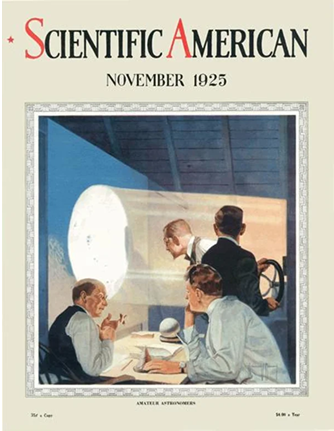
Scientific American, November 1925, in which James C. Bardin's article on the Mayan calendar appeared. I don't know the name of the artist, but change the dress of the men in this illustration to something futuristic and it could easily have been on the cover of a science fiction magazine of the 1920s and '30s. This was when science was done in buildings that looked like barns by men and women who were true scientists. Now supposed "science" is carried out in multi-million-dollar facilities by people who believe in pseudoscience, anti-science, non-science, or simple nonsense. I can't tell what the two objects on the table are supposed to be, but they remind me of the Trylon and Perisphere at the New York World's Fair of 1939.

Acknowledgments to The FictionMags Index and the websites of Virginia Quarterly Review and Scientific American.

Updated on July 14, 2026.
Original text copyright 2025 Terence E. Hanley

Saturday, July 19, 2025

James C. Bardin (1887-1959)-Part One

Author, Poet, Playwright, Book Reviewer, Editor, Translator, Military Officer, Explorer, Medical Doctor, University Professor, Public Speaker
Born September 25, 1887, Augusta, Georgia
Died October 13, 1959, Veterans Administration Hospital, Salisbury, North Carolina

James Cook Bardin had one essay and one short story in Weird Tales, both in 1925. He was born on September 25, 1887, in Augusta, Georgia, the son of Henry Clay Bardin and Mary Ella (Cook) Bardin. He appears to have attended Harvard University, graduating in 1908, and he attended the University of Virginia, there receiving his medical degree in 1909. Young Dr. Bardin was on the staff of Central State Hospital in Petersburg, Virginia, for one year before beginning as a teacher at the University of Virginia in Charlottesville. Central State Hospital was a hospital for mentally ill black people, the first of its kind in the United States.

James C. Bardin taught Romance languages and history at the University of Virginia for forty-four years, from 1910 until his retirement in 1954. He had an admirable career not only as a university professor but also as a writer of both fiction and non-fiction, as well as verse, stage plays, and book reviews. Dr. Bardin had short stories in the lowly pulps as well as non-fiction articles in Scientific AmericanVirginia Quarterly Review, and other journals. He was a member of Phi Beta Kappa and the Raven Club, as well as societies in Latin America, where he often traveled. Dr. Bardin's grandson, comment below, has let us know that:

Dr. Bardin was so enthralled with South America and its history that he started Inter America, with a partner in 1917, and was supported by a Carnegie endowment. It was a monthly magazine that alternated English and Spanish versions each month. The idea was to nurture exchanges between cultures. [Reformatted slightly to match the format of this blog.]

The Raven Club, which I think was also called the Raven Society, was a scholastic society at the University of Virginia. A newspaper article from 1909 explained that it was a "society made up of students who [had] distinguished themselves in literary work." That article, "Paying Tribute to Poe's Genius" (The Portsmouth [Virginia] Star, Jan. 18, 1909, page 1) makes it pretty clear that the "Raven" in Raven Club refers to the poem of the same name by Edgar Allan Poe. The article also gives details on the celebration of the centenary of Poe's birth at the university. Poe of course attended the University of Virginia, as did Captain Luke Leary Stevens (1878-1944), teacher of J.C. Henneberger, later co-founder of Weird Tales magazine.

On June 19, 1915, Dr. Bardin married Sally Norvell Nelson (1891-1969) in Charlottesville. She was a watercolorist and a volunteer librarian, among other things. They had a son, Captain James Nelson Bardin (1926-2008) of the U.S. Marine Corps. He was also a writer, of non-fiction on aviation and handguns. See the comment below for more information on Captain Bardin.

James C. Bardin entered the U.S. Army in 1918 as a first lieutenant and eventually attained the rank of lieutenant colonel. He served in the medical corps at Camp Wadsworth, South Carolina, and Camp Cody, New Mexico, in late 1918. Later he was a reserve officer in the geographic division of the Military Intelligence Service. And he served again during World War II. Bardin had been in Paris at the outbreak of the Great War, but he made it back stateside in one way or another. He traveled often and to many different countries. He was a student of the Mayan civilization and its languages. In 1929, he criticized Charles A. Lindbergh's flights over Mayan ruins, a photographic expedition, as being "worthless to science," according to a contemporaneous newspaper article. The current website of the Smithsonian National Air and Space Museum has a different opinion.

Dr. Bardin retired to the coastal counties of North Carolina (as Captain Stevens had before him). James C. Bardin, M.D., Ph.D., died on October 13, 1959, at the Veterans Administration Hospital in Salisbury, North Carolina, after a very long stay. He was seventy-two years old. His death came in the same month of the year as Poe's and just six days after that anniversary, which was the 110th. Bardin was buried at Manteo Cemetery, Dare County, North Carolina.

To be concluded . . .

Dr. James Cook Bardin (1887-1959), from the Waynesboro [Virginia] News-Virginian, December 6, 1938, page 5, on the occasion of a talk Bardin gave on the Spanish Civil War.

Updated on July 14, 2026. Thanks to Mark Holt, the grandson of James C. Bardin, for more information.
Original text copyright 2025 Terence E. Hanley

Friday, February 7, 2025

Ooze & Abysses

I have been writing for a long time now about Weird Tales in its first year and in its 100th. Weird Tales began in March 1923 with a story called "Ooze" by Anthony M. Rud. In its current incarnation, the magazine observed its 100th anniversary in 2023. In a series called "Origins of Ooze," from March 2023, I wrote about the concepts of primordial ooze, primordial slime, and primordial soup. These are supposed to be scientific concepts, but they're actually closer to pseudoscience, hoaxes, and frauds. Like overpopulation, though, ooze and slime escaped from the confines of genre literature and got into the general consciousness. And like overpopulation, people in the general public accepted it and internalized it.

Not long ago, I reread Bright Lights, Big City by Jay McInerney (1984; Vintage Books, 1987). One of the interesting things about this book is that it was written in the second person. The only other fictional work I can think of written in the second person is Ralph Milne Farley's short story "The House of Ecstasy," originally in Weird Tales in April 1938. Bright Lights, Big City is also written in the present tense, so it's close to unique in two ways. (Two-nique?) Getting back to ooze and slime, here's a brief quote: "The woman looks at you as if you were something that had just crawled out of the ocean trailing ooze and slime." (p. 13) It doesn't seem to me that that was a random choice of words: writers seem to have heard of ooze and slime and it has stuck in their brains.

The imagery in the 100th anniversary issue of Weird Tales has to do with voids and abysses. I have tried to bring into my discussion of that issue, its authors, and its lead characters the image of the worm that swallows its own tail. The other evening I finished reading The Doomsters by Ross Macdonald (1958; Knopf, 1979). That book doesn't start off very well, but it finishes with some power. Here is a passage regarding a human inner darkness or void:

     His eyes were still burning with fierce and unquenched light. I thought it was a light that burned from darkness, a blind arrogance masking fear and despair. Behind his shifting masks, I caught a glimpse of the unknown dispossessed, the hungry operator who sat in Grantland's central darkness and manipulated the shadow play of his life. I struck at the shape in the darkness. (p. 163)

I guess you could say that Dr. Grantland has a heart of darkness. (And again we have a medical doctor who is dark or empty inside.) On its last page, the image of the worm ouroboros shows up: "The circuit of guilty time was too much like a snake with its tale in its mouth, consuming itself." (p. 200) The title, by the way, is from Thomas Hardy's poem "To an Unborn Pauper Child" and these lines:

Sleep the long sleep:
The Doomsters heap
Travails and teens around us here . . . ,

Original text copyright 2025 Terence E. Hanley

Monday, May 27, 2024

Recent Reading

I'm behind in everything as always and still want to complete my series on the Houdini issues of Weird Tales. Before doing that, I thought I would write something quick on some of my recent reading.

First, in March, I read Revolt on Alpha C, a Scholastic Book (TX137) by Robert Silverberg (1955, 1959, 1965). It's a pretty conventional book, a space cadet/space patrol-type story so common in the 1950s and meant for boys. One really interesting thing about it is that Mr. Silverberg included the name of a fellow science fiction author and one of his contemporaries in his dramatis personae, none other than Harlan Ellison. The protagonist in Revolt on Alpha C is Larry Stark, but the next character to make his appearance is Harl Ellison, "like Larry a newly graduated cadet of the Space Patrol Academy" (p. 2). Robert Silverberg was not in Weird Tales, but Harlan Ellison was, in the Bellerophon issue of Fall 1984.

A few days before finishing that book, I read The Yellow Wallpaper by Charlotte Perkins Gilman (1860-1935). Originally published in 1892, "The Yellow Wallpaper" is a standard in high school and college literature courses. The version I read was published by The Feminist Press in 1973 with an afterword by Elaine R. Hedges (1927-1997). Charlotte Perkins Gilman lived into the Weird Tales era but was not published in the magazine. "The Yellow Wallpaper" can be interpreted as or included in the genre of weird fiction. It's more potent, however, as a study of madness and as a feminist work. I found two gothic or weird-fictional conventions in "The Yellow Wallpaper." First is the setting in an old house, "[a] colonial mansion, a hereditary estate," described as "queer" (in the original and best sense of the word). "[W]hy should it be let so cheaply? And why [should it] have stood so long untenanted?" (p. 9) Those are always the questions in these haunted house stories, for example in more than one written by Mary E. Wilkins Freeman (1852-1930), whom we read recently in our weird fiction book club. Like the first-person narrator in "The Yellow Wallpaper," Freeman was married to a medical doctor.

There is something wrong with the house in "The Yellow Wallpaper." Or is there something wrong with the unnamed narrator? It seems clear to me, and I believe to generations of readers, especially women readers, that there isn't something wrong with her so much as with the way she is looked upon and treated, not only by her husband but also by her society. Her husband is named John. He is "practical in the extreme." She continues: "He has no patience with faith, an intense horror of superstition, and he scoffs openly at any talk of things not to be felt and seen and put down in figures." (p. 9) (When she says "felt," she obviously means "touched," and not anything to do with feelings. By the way, there are "figures" in Mary E. Wilkins' story "The Hall Bedroom," too, published in 1903 and 1905. Those figures, inscribed on the walls of a secret room, have seemingly been used to open a doorway into another dimension.) John is, in short, a materialist. As such, he lacks imagination. And like so many medical doctors in fiction, he is or may be something of a psychopath, or at least a controlling personality, a know-it-all, just-trust-me kind of person. I have written about such men before. (And they're always men.) Maybe they began with Dr. Frankenstein. Dr. Fell of the child's nursery rhyme could easily be of this type, though we don't know why the narrator does not like Dr. Fell. A recently retired governmental doctor and one of the chief architects of the coronavirus regime also falls into that category. We can only hope that he will go to prison some day.

If such a thing is possible, there are worse men--and now women, too--at work in the world. Like Dr. Mengele and his cohort, they are performing experiments on their fellow human beings, cutting off their breasts and genitals, trying to reshape or simply eliminate the genitalia of their torture-subjects, fashioning Frankenstein's pseudo-penises out of the flesh of their forearms and attaching them where no such thing should be. I have a feeling that Charlotte Perkins Gilman and feminists after her, including Elaine R. Hedges, would have something to say about all of this, if they had lived into our current age of madness and lies. You would think that authors, librarians, booksellers, and others engaged in the world of books and literature would want to keep out political activism on behalf of those who perpetrate and support such atrocities. Not so, at least in Scotland. Recently, Literary Alliance Scotland (LAS) posted a fatwa against what they call Terfs, or trans-exclusionary radical feminists, in other words, real feminists who advocate for real women. Their fatwa is for booksellers. I'll quote just one sentence because one is all we need:

"Don't sell Terf books/platform Terf authors."

Have you got that? If you're a bookseller in Scotland, you are forbidden to sell or platform things with which LAS disagrees. If they could do it, I'm sure they would forbid such things the world over. There are people and institutions in this same world who support transgenderism and do not yet recognize it as a totalitarian belief system. Your local library is probably one of them. I know mine is. I'm not sure how much more evidence they will need to see it. And I wonder how long it will take--how much more gas-lighting will there be--before they wake up. Or will they go mad, like the wife locked in her room in "The Yellow Wallpaper," because of the irreconcilable differences between what they are required to believe and what they know in their hearts to be true? No, probably not. They probably won't go mad, nor will they turn. They will in all likelihood go on believing in lies, even while being led ultimately to the prison camp or before the firing squad. Anyway, there are still, thankfully, people who know truth when they see it and are willing to stand up for it and against the lies and tyranny of transgenderism. Luckily one of them is probably the most powerful literary figure in the world, J.K. Rowling, who also happens to live in Scotland. You could say that she recently brought down the Scottish prime minister. (Thank God.) A few pissant (excuse my French) transgenderists should be no problem for her, should she decide to join in the battle against LAS and its fellow travelers.

Again, I'll say: past generations of feminists did not do all that they did, suffer what they did, fight for what they did, so that insane, delusional, perverted, violent, aggressive, lying, oppressive, and tyrannical men could take everything from women that rightfully belongs to women.

To read more about LAS and its diktat, see "Literary society tells bookshops not to sell 'Terf' books" by Frederick Attenborough on the website Free Speech Union (FSU), dated May 25, 2024, here.

Revolt on Alpha C by Robert Silverberg, a Scholastic book with cover art by William Meyerriecks.

Text copyright 2024 Terence E. Hanley

Saturday, January 27, 2024

Weird Tales, May/June/July 1924-Non-Fiction & Other Fillers

Following is a list of the fillers in the May/June/July issue of Weird Tales, a list transcribed from the Internet Speculative Fiction Database. Thanks to them again. All are by uncredited authors. Most have asterisks around them. Read on to see what they mean.

  • **"Juvenile Criminal," about the Hon. Grey Bennett and a boy named Leary. There really was a Grey Bennett, as remote from the first year of Weird Tales as we are from it.**
  • **"Retaliation," about a British ship.**
  • **"Providential Warning at Sea," about Captain Thomas Rogers and his ship Society in about 1694.**
  • **"Pastime of Despots," about Czar Peter.**
  • **"The Unnatural Son," about a theft in Salisbury.**
  • **"Singular Discovery of a Murder in 1740," an account of events at St. Neots, England.**
  • **"Giants," about very tall men known to history.**
  • **"Sham Fight," about a battle between Christian and Musselman armies at Bostra [sic].**
  • **"War Horses," about war in Funen, Denmark.**
  • **"The Original Bluebeard," about Gilles, Marquis de Laval. Seabury Quinn had covered him before in his non-fiction series "Weird Crimes," in October 1923.**
  • **"Distressing March of the Crusaders Through Phrygia."**
  • **"Remarkable Accident," about Baptiste, an actor at the Comedie Francaise in 1820.**
  • *"An Account of a Family Who Were All Afflicted with the Loss of Their Limbs," about John Dowling of Wattisham, England.*
  • *"Hypocrisy Detected," set in Paris.*
  • *"Force of Imagination," also set in Paris.*
  • *"Immolation of Human Beings," about the Ashantees [sic] of Africa.*
  • **"Imprisonment of Baron De Geramb."**
  • *"Anecdote Concerning the Execution of King Charles the First."*
  • **"Anne Boleyn."**
  • **"The Heroes of Hindoostan."**
  • *"Extraordinary Instance of Second Sight," about a French army officer quartered in Scotland during "the previous century."*
  • **"Miracles," about a Dr. Connell and his patient, named Anne Mulligan, in 1777.**
  • **"National Superstition," about two Venetians.**
  • **"Death of the Duchess of Bedford."**
  • **"Pardon for Forgery," a case from 1803.**
  • **"Terrific Death of a Painter," about Peter Peutemann.**
  • **"Deaths by Lightning," set in Ireland.**
  • **"Wonderful Providence," about war in France in 1562.**
  • **"Monsieur Rouelle," about the "celebrated chemist."**
  • **"A Singular Experiment," about an Irish boy named Magrath who fell into the hands of a "subtile doctor," a kind of Procrustes who experimented on the boy and made of him a monstrous creation. This account goes along with my suggestion that medical doctors are very often psychopaths or sociopaths and see their fellow human beings as mere material and subjects for their bizarre and monstrous experimentation. We recently had one of those at the head of a large governmental agency. He and his fellows very likely developed and loosed upon the world a deadly virus and in response created an oppressive regime that is still lurking, still preying, including in the minds of his and their followers, supporters, and apologists. Monstrous medical doctors recently won a victory for themselves in Ohio, too. Now they have the power under the state constitution to decide who is a human being and who is not. Now we have another Moloch State.**
  • **"Pentilly House, Cornwall," about a Mr. Tilly, an atheist.**
  • **"Singular Combat," about England in the time of Henry IV.**
  • **"Fatal Misfortune and Singular Instance of Affection in a Horse," set in England.**
  • *"Punishment of the Knout in Russia."*
  • **"Intrepid Conduct of Admiral Douglas," about a mutiny on board the ship Stately.**
  • "Only Sound," a very brief item from the Los Angeles Times. (Below it are two jokes.)
  • "Odd Facts," half a dozen brief fillers. (Below it are three anecdotes or jokes. So there are five untitled anecdotes or jokes in addition to 37 titled fillers.)

As I was about halfway through this list, I discovered the original source of most of these accounts. The source is:

The Terrific Register; or, Record of Crimes, Judgements, Providences, and Calamities, Volume I and Volume II, published in 1825 by Sherwood, Jones, and Co., of London, and Hunter of Edinburgh.

Presumably all are factual, so no fiction to add to the 37 stories in this issues. Items taken from Volume I have single asterisks around them in the list above. Those from Volume II have double asterisks. Seven of the items are from Volume I of The Terrific RegisterTwenty-eight are from Volume II. That makes 35 in all, leaving only two that are from other sources.

So, if we're trying to get from 37 new stories in the interior of the anniversary number to the 50 promised on its cover, then we'll have to add 13 of the items listed above, I guess. You get to choose. A couple of them are almost as long as the shortest new stories.

It's clear that Otis Adelbert Kline was not the author of these fillers, as he had been (or probably was) in previous issues. But if he was acting as editor, or co-editor, then maybe he was the one who chose them for inclusion. And that makes me think that there must have been copies of these two volumes either in a public or university library in Chicago or in a private collection to which he had access. And now I think we had better look at the fillers in previous issues for their possible origins in the same two volumes of The Terrific Register.

I have written before about the Fortean method. I called it that after Charles Fort (1874-1932), author, gadfly of science, and collector of oddities. People who read and wrote for Weird Tales knew of Fort and his ways. Some became Forteans themselves. Others simply availed themselves of the Fortean method in creating their fictions. Like I said, I have suspected that Otis Adelbert Kline was the author of the many non-fiction fillers printed in Weird Tales in its first year, and maybe he was after all, taking after Fort in the process. But it's clear with this discovery of The Terrific Register as a source that Kline was not the sole author of the Weird Tales fillers and that Fort was not the first collector of oddities. He, along with Kline, was simply working in an older tradition. I wonder how far back that tradition goes. And I wonder: is history simply a field engaged in telling about the odd events--the crimes, judgements, providences, and calamities--of the past? Aside from that, are not these accounts simply retellings of how weird works in our lives and affairs?

Original text copyright 2024 Terence E. Hanley

Sunday, October 29, 2023

"The Eyrie," October 1923

There are only a few letters in the October 1923 issue of Weird Tales, but some are long. H.P. Lovecraft (1890-1937) wrote again for the second time in two months. There are three excerpts from his long letter in this issue, including his first verse published in Weird Tales. Letter writers were:
  • An Old Fashioned Woman of Hayward, California, a discerning reader with a good memory who noticed the similarity of:

"The Invisible Terror" by Hugh Thomason (dates unknown) in Weird Tales, June 1923, to "The Damned Thing" by Ambrose Bierce (1842-1914?), which was reprinted in Weird Tales in September 1923;

"The Gray Death" by Loual B. Sugarman (1894-1965) in Weird Tales, June 1923, to "The Silver Menace" by Murray Leinster (1896-1975) in The Thrill Book, September 1 and September 15, 1919; and

"Penelope" by Vincent Starrett (1886-1974) in Weird Tales, May 1923, to "Phoebe" by O. Henry (1862-1910) in Everybody's Magazine, November 1907.

  • J. L. of Jersey City, New Jersey.
  • Joel Shoemaker (1862-1937) of Seattle, Washington. Called "Reverend," he was an Indian fighter, newspaperman, politician, public speaker, and conservationist. A month after his letter was published, Shoemaker got into a tussle with Morris S. Brown, Seattle's "tallest policeman," who was trying to kidnap Shoemaker's three-year-old grandson, Billings Brown. Shoemaker's daughter, Mrs. Nannie S. Brown, fired a pistol at her ex-husband, while Joel Shoemaker "belabored his victim with an old hickory cane he has carried for 30 or 40 years." Brown should have known better than to mess with an old Kentuckian carrying a hickory cane, or with that old Kentuckian's wife, Luella Billings Shoemaker, who "rushed" the pistol to her daughter, ready for the firing. You can read all about it in "Brown Facing Prison Term" in the Seattle Star, November 28, 1923, page 3.
  • Lee Torpie of San Francisco, California.
  • Dr. Henry C. Murphy (1862-1932) of Brooklyn, New York. He was a long-practicing medical doctor whose father was also a medical doctor. In response to his letter, editor Edwin M. Baird wrote:

The foregoing was written by Dr. Henry C. Murphy of Brooklyn; and, before we comment upon it, we rise to remark that WEIRD TALES seems to offer a special appeal to physicians and surgeons. They like to read our sort of stories, and they like to write 'em. There is scarcely a day that we don't get at least one weird story written by a doctor. Doctors, it seems, encounter some weird adventures.

I have written before about medical doctors. Very often, my writing about doctors has gone along with my writing about psychopaths and serial killers. Click on the menu items on the right to read more.


H.P. Lovecraft started out the year 1923 with the publication of his serialized novelette "The Lurking Fear" in the magazine Home Brew. The Internet Speculative Fiction Database lists nine issues of Home Brew, five published in 1922 and four in 1923. "The Lurking Fear" ran in all four of the issues for 1923, from January through April.

I wondered the other day whether "Dagon" was Lovecraft's first illustrated story in
 a national magazine. I guess it depends on what you think of as a national magazine, but "The Lurking Fear" in Home Brew was also illustrated, by Clark Ashton Smith of all people.

Home Brew was edited and published in New York by George Julian Houtain (1884-1945) and his second wife, Elsie Dorothy (Grant) McLaughlin Houtain (1889-?). They were members of the National Amateur Press Association (NAPA), and she served as the second female president of the organization. I have always thought of Home Brew as an amateur publication and, as such, not a national magazine. On the other hand, "America's Zippiest Pocket Magazine" was available as far west as Cincinnati.


I have read a reference to Home Brew that it was discontinued in 1924. Lovecraft was published in its pages in 1922-1923. Weird Tales must have come along at just the right time for him. "The Lurking Fear," by the way, was reprinted in Weird Tales in June 1928.

Note the blurb on the cover regarding CAS: "the Artist Who Illustrated Edgar Allan Poe."

Original text copyright 2023 Terence E. Hanley

Monday, July 31, 2023

Weird Tales, May 1923-Part Three

Six authors about whom I know little or nothing at all, all of whom had stories in Weird Tales in May 1923:

William P. Barron (Dates unknown)--I found a newspaper item that mentions a Dr. William P. Barron who was president of the Free Lance Club of writers in Washington, D.C., in 1930 and 1931. If he's our man, then I believe he was the same William P. Barron (1877-1946) who hailed from Bonham, Texas, and served in the U.S. Army Medical Corps during World War I. His story, called "Jungle Beasts," is another example of a found manuscript as the basis for a story. One of the readers of the manuscript is a medical doctor working in an insane asylum.

M. Humphreys (Dates unknown)-"The Floor Above" by M. Humphreys is a diary story, a story that begins with a summons from a friend, and a rooming-house story. H.P. Lovecraft liked "The Floor Above," but good luck finding any evidence of that on this vaunted Internet. The status of Humphreys' tale as one of Lovecraft's favorites seems to be based entirely on a single sentence in Lovecraft's letter to "The Eyrie," printed in October 1923:

"I lately read the May WEIRD TALES, and congratulate you on Mr. Humphrey's 'The Floor Above.' [for a moment I had a shiver which the author didn’t intend—I thought he was going to use an idea which I am planning to use myself!! But it wasn't so, after all], which is a close second to my favorite, 'Beyond the Door'."

(The brackets are in the original. "Beyond the Door," by J. Paul Suter, was in the April 1923 issue of Weird Tales.) As for the identity of M. Humphreys, it would be hard to discover one without having a first name.

Herman Sisk (Dates unknown)--There was a Herman Sisk who lived in Los Angeles, California, and wrote plays and other works. I suspect he was the same Herman Sisk who wrote "The Purple Heart," a short short story about a haunted cabin.

F.K. Moss (Dates unknown)--F.K. Moss' story is called "The Death Cell." There is a framing device again, in this case an introduction by one character followed by a manuscript by another. And now I have to say that reading or simply glancing through these early issues of Weird Tales becomes pretty tiresome, with the same kinds of stories, themes, motifs, devices, and settings, very often with the same kind of writing style, over and over again. You wonder where was the imagination. But then you have to admit to yourself that Weird Tales--and in a larger sense, weird fiction--was just beginning in 1923. It would take awhile before things got good.

F. Walter Wilson (Dates unknown)--I found a reference to an F. Walter Wilson who was a newspaperman in Boston and who may have had a connection to Quebec. The story "The Thunder Voice" is set in Quebec, and so we have another story of Canada. There is also a  found manuscript in the story. The blurb reads: "The Story of a Hairy Monster." That's an intriguing thing for those interested in cryptozoology. The hairy monster of the story might be a gorilla or a wild-man or possibly a Bigfoot creature before it was so named. I'm not sure.

William Merrit (Dates unknown)--William Merrit is going to be hard to find in any online search because of the similarity of his name to that of William Merritt Chase (1849-1916), a well-known painter from Indiana. Merritt's story is called "The Finale," but it's not the last story in the May 1923 issue of Weird Tales. That position goes to . . .

"The Closed Cabinet" by _____ _____, a very long short story written by an anonymous author and reproduced in the tiniest of fonts, all to make it fit, I guess, in the smaller number of pages in the May issue than in the previous two of Weird Tales.

William F. Heitman's illustration for "The Floor Above" by M. Humphreys in Weird Tales, May 1923.

Text copyright 2023 Terence E. Hanley

Sunday, July 16, 2023

Weird Tales, April 1923-Part Two

Authors in the April 1923 issue of Weird Tales about whom I have not written before:

Carl Ramus, M.D. (1872-1963)--Carl Ramus' name is misspelled in the table of contents of that first issue as Carl Rasmus. His story "The Scar" was the first by a medical doctor to appear in Weird Tales. It's also the first involving the Mafia, referred to in the story as "black handers."

There aren't any supernatural elements in "The Scar." Instead it's a crime story. I'm beginning to sense that many of the stories published in early issues of Weird Tales could also have been in its companion magazine Detective Tales. Maybe they were submitted to the former but were printed in the latter as a kind of surplus or overflow. Then again, maybe they were a little too outré for Detective Tales and so ended up in Weird Tales, although that seems unlikely to me.

In any case, "The Scar" was written by a medical doctor, and a young medical doctor is its protagonist and ultimately its hero. Ramus' story reads in fact like a young, real-life doctor's fantasy of heroic action and the rescuing of a damsel in distress. There is mention in "The Scar" of an International Journal of Surgery, a title similar to that of Surgical Monthly in "The Extraordinary Experiment of Dr. Calgroni" by Joseph Faus and James Bennett Wooding. There is also mention of Rush Medical College in Chicago, where Ramus went to school, also where Anthony M. Rud studied medicine.

By the way, Carl Ramus was the brother of Sybla Ramus (1874-1963), who wrote one story for Weird Tales, the three-part serial "Coils of Darkness" in the issues of February, March, and April 1924. I never associated the two because of my reliance on Jaffery and Cook's index of Weird Tales, which, again, misspells Ramus' surname. I previously thought of him as Carl Rasmus. You can read about and see a photograph of Dr. Carl Ramus on the National Park Service website on Ellis Island by clicking here.

Paul Suter (1884-1970)--Joseph Paul Suter was a prolific author of pulp fiction. By day he worked as an accountant and in other jobs in Youngstown, Ohio. His story "Beyond the Door" is the first in Weird Tales to rely heavily on diary entries to advance the plot and our understanding of its events. Only "The Grave" by Orville R. Emerson before it has a similar kind of approach in its storytelling. However, in that story, the written narrative is more of a manuscript than a conventional diary, which has dated entries and and is usually written in a diary book. In any case, call it another case of a found object--a letter, a note, a diary, a newspaper article--used in the telling of a weird tale. There would be another diary story in "The Bodymaster" by Harold Ward.

"Beyond the Door" is an uncle story, too. Maybe we should start thinking of that as a subtype of genre fiction. Uncle Godfrey's diary begins on June 15, for us, an anniversary just passed. After a space in the diary of removed pages, it picks up again on July 16, an anniversary as of today. There is a well in the cellar of Uncle's house, its opening covered by a large stone. That makes me think of "Pickman's Model" by H.P. Lovecraft (Weird Tales, Oct. 1927), also the movie The Ring (2002), which is already two decades old, believe it or not. Readers liked "Beyond the Door." It was reprinted in Weird Tales in May 1954.

You can read more about J. Paul Suter on a blog called Pulp Flakes, in an entry called "Author profile: J Paul Suter (Newspaper article from the Cleveland Plain Dealer, 1951)," posted on May 17, 2013, here. You will find a newspaper photograph of him there as well.

Roylston Markham (1885-1950)--Roylston Miller "Roy" Markham was the author of just one story in Weird Tales and, it appears, in all of the science fiction/fantasy/weird fiction genres. Born in Michigan, he grew up in South Dakota and worked as a newspaperman in Sioux Falls and in Chicago. In later years, he called Florida home. His story "The Tortoise Shell Comb" is brief and has many of the same elements as the stories in the first issue: a first-person narrative; suggestions of a haunting or supernatural events; infidelity, murder, revenge, and insanity; a final explanation provided by someone in the know; finally, a setting where murderers are kept, though in this case it's an insane asylum rather than a prison. I wonder what Culpeper Chunn thought of that. (Tune in to the next episode of this blog for an explanation.) Markham's tale is another of American servicemen in France during the Great War.

Paul Crumpler, M.D. (1883-1966)--"A Photographic Phantasm" is the first non-fiction item with a byline to appear in Weird Tales. It was written by another medical doctor, Paul Crumpler, M.D. (1883-1966), who practiced medicine and served as coroner in Sampson County, North Carolina, for many years. His account of a ghost-photograph is just one page long. You can read more about him and see a very small photograph of him on the website Find A Grave, here.

To be continued . . .

The obituary of Roylston Miller "Roy" Markham in the Tampa Bay Times (St. Petersburg, Florida), February 7, 1950, page 7.

Text copyright 2023 Terence E. Hanley

Thursday, October 13, 2022

An Anonymous Comment on LRH

I'm still playing catchup on comments left on this blog. I have two more to go.

First is a comment on Joseph A. Winter, onetime associate of L. Ron Hubbard and John W. Campbell, Jr., in their development of Dianetics in 1949-1950. Sometime during 1950, Winter and Hubbard had a falling out. Winter died suddenly four years later of a coronary thrombosis. He was just forty-four years old.

On Saturday, May 28, 2022, I published an entry called "Joseph A. Winter (1911-1955)-Part One." I completed my series on Winter and his sister, Margaret Winter Kearney Campbell (1907-1979), several days later, on June 5, 2022. Winter's sister, better known as Peg Campbell, was the second wife of John W. Campbell, Jr., and the one who was with him to the end.

On Sunday, June 19, 2022 (Father's Day), Anonymous left this comment on my entry on Dr. Winter:

Readers should remember that Joe Winter was related through marriage to John W Campell's wife, Joe's sister. They all socialised with the Hubbard group and Street & Smith and the Saint Elizabeth's Hospital staffers in the heady days of the Bay Head Group, HDRF and the Elizabeth Foundation. Hubbard later said that he had to distance himself from almost all of those people due to the alleged dubious communist party loose associations. Maybe Winter and the others did get the wrong end of the stick. They were not aware (I think) of Hubbard's proven intelligence officer connections under Ian MacBean and Joseph Thompson since 1927 China. I personally think Ledora-May Waterbury de Wolfe or her Husband Harry Ross Hubbard were more than just casual civilians in that respect. Hubbard had a good home education before George Washington and later Princeton University schools. I wonder just why Joseph Winter parted ways so suddenly with LRH. The CIA connection had not been establish in public at that time. Only after 1985 were the CIA connections proven. It all centred around using psychological methods to achieve workable solutions for the US and UK players. Hubbard had to keep his silence on his role for all his life. Only in the taped lectures would he offer thin anecdotal evidence. What if Winter reincarnated and remembered a lot?

There's a lot of information in that comment, some of it probably arcane to the non-Scientologists among us. For your information and mine, I'll write about some of it.

  • Joseph A. Winter, M.D. (1911-1955) was a physician, originally from Michigan but who moved to New Jersey in January 1950 in order to assist Hubbard and Campbell in their "research" into Dianetics. A newspaper article on his move was the first mention in print that I have found of "Dianetics" as a noun specifically in reference to Hubbard's brainchild. As I have mentioned, Winter's sister, nicknamed Peg, was the soon-to-be wife of Campbell. Presumably, Dr. Winter introduced them sometime in 1949 or 1950.
  • Street & Smith were the publishers of Astounding Science Fiction, edited by Campbell.
  • St. Elizabeth Hospital presumably refers to a hospital in Elizabeth, New Jersey, now called Trinitas Regional Medical Center (or possibly a hospital in Manhattan), but there is another St. Elizabeth Hospital that figures in the history of Dianetics/Scientology. That one is a place where Hubbard is supposed to have studied psychiatry.
  • The Bay Head Group were the earliest developers of Dianetics, including not only Hubbard, Campbell, and Winter, but also electrical engineer Don Rogers and publisher Arthur Ceppos. The group was based in Bay Head, New Jersey, where Hubbard made his temporary home. (Most of his homes appear to have been temporary.)
  • The HDRF was the Hubbard Dianetic Research Foundation, incorporated in April 1950. Its members were Hubbard, Campbell, Winter, Rogers, Ceppos, lawyer C. Parker Morgan, and Hubbard's second wife, Sara Northrup Hubbard, you know, the one who didn't exist.
  • Ian MacBean was Ian Gordon Macbean or MacBean, presumably a British military man born on February 24, 1892, and who died on June 29, 1944. To say that Hubbard had "proven intelligence officer connections" is to repeat, I think, a bit of fancy dreamed up by Hubbard and his followers in Scientology. In 1927, Hubbard was sixteen years old and on a trip with his mother to visit China. Can we even imagine him making "intelligence officer connections" on such a trip?
  • Joseph Thompson was Joseph Cheesman Thompson (1874-1943), a wacky kind of character who served in the U.S. Navy, spied on Japan, studied herpetology, and bred Burmese cats, among other things. He is supposed to have known Hubbard, dating from early 1923 when Hubbard was eleven years old. Thompson was also a psychoanalyst and studied the insane at St. Elizabeth Hospital in Washington, D.C. Thompson had his own ideas about the mind, insanity, mental illness, and psychological trauma. One of his nicknames was "Crazy Thompson," and at least one of his fellow psychoanalysts considered him mentally ill or insane. In 1929, while in Hawaii, he was relieved of duty with the Navy and went into retirement. Whether or not Hubbard was actually one of his associates, he appears to have fit the mold. After all, Hubbard, too, served in the Navy--without any distinction I should add--and was almost certainly mentally ill, if not insane at one time or another in his life. And like Thompson, Hubbard was influenced by the works and ideas of Sigmund Freud.
  • Ledora-May Waterbury de Wolfe (1885-1959) and Harry Ross Hubbard (1886-1975) were L. Ron Hubbard's parents. According to public records, her name was actually Ledora May Waterbury. The DeWolf part comes from her mother, Ida Corinna DeWolf Waterbury (1863-1944). L. Ron Hubbard's son, L. Ron Hubbard, Jr. (1934-1991), changed his name to Ronald DeWolf. Known as "Nibs" or "Ron," DeWolf cowrote the book L. Ron Hubbard, Messiah or Madman? (1987) with Bent Corydon.
As for everything that comes after in the comment above made by Anonymous, those are his or her thoughts and opinions, seemingly informed by Scientology. Joseph A. Winter may have explained or implied his reasons for breaking with Hubbard in his book A Doctor's Report on Dianetics: Theory and Therapy (1950), but I don't have a copy of that book, so I can't say. I also can't say whether Winter was ever reincarnated.

Anyway, I would like to thank Anonymous for writing. His or her comment has led me to learn a little more about Hubbard, Dianetics, and Scientology.

Further Reading

  • Astounding: John W. Campbell, Isaac Asimov, Robert A. Heinlein, L. Ron Hubbard, and the Golden Age of Science Fiction by Alec Nevala-Lee (2018, 2019).
  • "The Spy Who Never Was? L. Ron Hubbard and 'Maj. Ian Macbean of the British Secret Service'" by Chris Owen on the website The Underground Bunker, July 29, 2022, here.

Original text copyright 2022, 2023 Terence E. Hanley

The comment left by Anonymous is his or her own original work and should be considered his or her intellectual property and so protected under copyright. I have reproduced it here for informational purposes.

Tuesday, October 4, 2022

Takings and Turnings

Some object to the supposition that Allison V. Harding was not a woman but a man, believing--rightly I should add--that the things that are women's should remain women's and not be taken from them. Yet every day in America, the things that are women's are being taken from them, most importantly the integrity of their bodies and of their sex, also their uniquely female experiences and identities. The things and places that are or should be women's are being taken from them, too. Women are now not always the victors in women's sports. Some sports records are held not by women but by men. Women and girls are no longer safe in women's restrooms, dressing rooms, changing rooms, shower rooms, and locker rooms. Men have entered women's prisons and women's shelters and have assaulted them there, sexually and otherwise. The takers in all of this are men, but they are being helped in many cases by women. Others who object are forced to remain silent, all that is, but the most powerful among them. Even then, these powerful women are vilified, and there are attempts to strip them of their power, to strip them even of their own creations. If we're looking for a case in which there are real attempts at silencing and erasing a woman writer and to take from her the things that she has created, look no further than that of J.K. Rowling. Men are doing that and women are helping them.

I have written before about the desire afoot in this world to destroy the past and everything that remains of the past. There is that negative goal to be sure, but I have overlooked the possibility that there could be a positive goal to replace it. The desire to destroy is a powerful one, but what comes after the destruction? The skilled destroyers among us can only wake up empty once they have done their work--either that or cast about for fresh, new things to destroy. The replacers, though, still have their goals and may pursue them through and past all of the destruction.

We have given up on God, and so there can be no spiritual transcendence. The yearning for transcendence remains, though, and so we replace spiritual transcendence with other kinds of attempted transitions, transferences, and transmutations. Ordinarily, we seek spiritual transcendence of the body and of our earthly experience because God and a purely spiritual existence lie on the other side. The replacers among us have decided that we are Gods--each one of us, capital-"G" Gods. We have usurped his role, believing we have his wisdom and authority, are confident that we can exert his power. We believe we can remake his world and his universe, of which we are a part. We believe we can remake ourselves in our own image. Whatever we can envision--whatever we might want of ourselves--we can become. We have become Dr. Frankenstein and his monster.

Weird fiction has its limitations. For one, it tends to be told in the form of a tale: One time this weird thing happened when somehow I stepped outside the normal world and normal experience, but then I came back, or: I witnessed this weird thing that came into our universe but then went away again, but we should be on the lookout for that ever happening again. The weird tale--tale being the operative word--tends to be a premodern form. Science fiction, on the other hand, tends to more sophisticated and modernistic. And it takes place in the real, material world. It isn't weird. It's real and normal, logical and rational. Weird fiction is also a prewar genre. Once the world was awakened from a sometimes irrational past into a scientific and technological present of atomic bombs and rocketships, of the possibilities of apocalypse and dystopia, of alienation and all of the psychopathology of modern living, weird fiction lost much of its power. Science fiction became the alternative. Before the war there were monster movies. After the war, Abbott and Costello met Frankenstein. Meanwhile, science fiction came into the movies, and we had The War of the Worlds, This Island Earth, Forbidden Planet, and Invasion of the Body Snatchers. There were weird-fictional monsters after the war--vampires and zombies for example--but these were often given scientific explanations, such as in The Last Man on Earth, Night of the Living Dead, and The Omega Man. Other weird tales were turned into types of horror, including body-horror (An American Werewolf in London) and the horror of the psychopathic killer, who was depicted as a supernatural or almost supernatural phenomenon, even if psychopathy is seen in our time as a scientific, medical, psychological, or sociological (i.e., a "soft"-scientific) problem. There were exceptions of course. I'm working here in generalizations.

Before the war there were serious authors who wrote weird fiction--their tales tended to be called "ghost stories"--but before the war there doesn't seem to have been any great discontinuity between serious literature and genre literature. Nathaniel Hawthorne, Herman Melville, Mark Twain, Henry James, and still others wrote in those genres. Some authors of the American South before and after operated in what is called the "Southern Gothic" mode. After the war, though, serious literature turned away from weird fiction and ghost stories and towards science fiction. Again, there were exceptions. Flannery O'ConnorShirley Jackson, and Joyce Carol Oates have worked in Gothic modes. But when turning to genre fiction for their subjects and themes, Cormac McCarthy, Margaret Atwood, Walker Percy, and others like them have chosen science fiction rather than weird fiction as their preferred mode. Put another way, science fiction is fiction, a higher and more literary form, versus weird fiction as a folk form, simpler form, or more popular form. Again, there are exceptions, H.P. Lovecraft being a notable example.

Still working in generalizations.

My point here is that we are living in and will continue to live in a science-fictional world and a science-fictional society. The real-world problems and threats confronting us are science-fictional, not weird-fictional: We have done away with the supernatural--or think we have done away with it--and have turned entirely towards the material and the scientific--or at least what we call the scientific. We face threats in the form of apocalypse and dystopia, but for now at least, the greater threats, I think, are our development of artificial intelligence, our turning towards robots and away from human beings, and perhaps greatest of all, our seeking to transcend ourselves as we were created towards something we believe we ourselves can create--or re-create. Again, we believe that we and the universe in which we find ourselves are flawed. And we believe ourselves capable--wise enough and powerful enough--to remake all of it. These attempts to correct our perceived flaws, to remake ourselves, to transcend ourselves, to remake the entire world and all of human nature--the belief that we can do these things--can be seen as a kind of gnosticism, if I understand the term and the concept correctly.

There are new gnostics--new progressives and new utopians--among us. Two of them were born in the 1930s--the last decade, by the way, in which weird fiction may still have stood above science fiction in popularity. These men, both from central Europe--a place of origin for so many twentieth-century horrors--don't have long for this earth. We can't rejoice that they will die, nor should we. That's not the point. The point is that they and everyone like them will die, and all of the grand ideas filling their heads will die with them. That's the fate of all of us, now and until the end of time. There is no escaping it. Our physical bodies are mortal. That's how we were made. We cannot transcend them, at least on our own and under our own power. We certainly can't transmute them. We cannot be anything other than what we are. It is essential that we all remember these things and hold them in our thoughts every day. 

The science-fictional idea is that we will progress into the future. The weird-fictional alternative might be that we are bound to ourselves and the world as we and it were created in a supernatural beginning and which continue to operate under supernatural auspices. We may try to escape those bounds, but our destiny or fate is either to return or to face the dire consequences of our transgressions. How many transgressive weird-fictional heroes and protagonists are punished or suffer these consequences in the end? Dr. Frankenstein is certainly one of them and may have been the first. His example is still with us. We should heed it.

Victor (an ironic name) Frankenstein tried to create a man where there was never before a man. Medical doctors today are trying to make men where there were never men and women where there were never women. Technologists would like to create beings out of machinery and souls where there were never before souls. These are things that simply can't be done. Women can never have the things that are men's. Beyond that, after their attempted transitions, they will never again have a chance at the things that are women's. They might as well try to get with child a mandrake root. But all women should remember that men in attempted transition may very well continue to have the things that are men's and take from women the things that are women's. Women in attempted transition give things up; men in attempted transition become takers. Remember that.

Trans- . . . that prefix . . . The word weird has to do with fate or destiny, but it also has to do with turning or becoming. To transgress, to transition, to transmute, to become transhuman, to pursue transference, to transcend--all are a kind of turning or becoming. But what things can we do strictly on our own, and what others will forever lie beyond our power? Transgression--our first sin--is a choice placed before us. Transcendence--offered to us so that we might live--is the alternative. All of these other things can only lead to earthly and bodily horrors.

And then maybe we will have a return to weird fiction.

In this cover for Mandrake the Magician, magic meets science--and wins!--but only by resorting to good old-fashioned fisticuffs. Note the Frankenstein-village setting of the Gothic romance juxtaposed with the flying saucers of science fiction. The monsters of science fiction have taken the place of those of weird fiction. Note, too, that the aliens and their ship (like a cupola) are entirely green.

Text copyright 2022 Terence E. Hanley

Wednesday, June 1, 2022

Joseph A. Winter (1911-1955)-Part Two

Joseph A. Winter, M.D., was first in Astounding Science Fiction in October 1948 with an essay entitled "Endocrinology in Tough" [sic]. His first short story, "Expedition Mercy," followed close on its heels in November 1948. His second, "Mission Polychrome," came along in January 1949. Later that year his life changed when first John W. Campbell, Jr., then, in July 1949, L. Ron Hubbard wrote to him. Campbell and Hubbard were already working on Dianetics by then. Both were also interested in endocrinology. (Hubbard claimed to have been conducting research in that field for the previous eleven years.) The two men were looking for a medical doctor to assist them, perhaps to lend credence or medical cachet to their work. Winter had his own interests, which seemed to align with theirs. He showed up in New Jersey in October 1949 and began working with Campbell and Hubbard. After one or two more trips back home, he made the move permanent in January 1950. It is in reference to Dr. Winter that the word Dianetics first appeared in newspapers, as far as I can tell.

* * *

I recently read Astounding, Alec Nevala-Lee's combination history of Astounding Science Fiction magazine and biography of its editor and leading contributors, Robert A. Heinlein, Isaac Asimov, and L. Ron HubbardJoseph A. Winter is in Astounding, too. I began writing this series before I knew of Mr. Nevala-Lee's book. As soon as I found out about it, I knew I had to read it. It is from that book that I have drawn a lot of the information I have used here. I fully acknowledge Alec Nevala-Lee's work. He has written a very thoroughly researched and very interesting and readable book. His prose is so good, in fact--so clear and smooth--that it seems to have come from another time, fitting for a book about the science fiction of the past.

When I started a few weeks ago, I thought that I had made a discovery linking J.A. Winter to John W. Campbell, Jr. As it turns out, Mr. Nevala-Lee made that discovery before I did. However, the Internet doesn't seem to have discovered it yet, including the Internet Speculative Fiction Database (ISFDb). My hope is that what I write will bring the facts and the connection into the open. Solving the mysteries of biography, culture, and history is one of the reasons I began writing this blog. I hope you don't mind that I spend some time solving--or at least setting before you--a little of this mystery involving Dr. Winter, his sister, the editor Campbell, and the origins of Dianetics.

It becomes clear in reading Astounding (2018, 2019) that Joseph A. Winter was instrumental in the development of Dianetics. You can read about all of that in Mr. Nevala-Lee's book. Dr. Winter was also a friend to Campbell and Hubbard. He delivered Hubbard's daughter, Alexis Valerie Hubbard, born in silence on March 8, 1950, so as to avoid lodging engrams in her mind. Winter must also have introduced his own sister, Margaret "Peg" Winter Kearney, to Campbell. (The circumstances aren't made clear in the book.) The date was sometime in early June 1950. Alexis Hubbard dropped out of the Campbell-Astounding-Hubbard-Dianetics-Scientology picture. (Wherever she is, I hope she's safe.) Peg Kearney, on the other hand, became Mrs. John W. Campbell, Jr. I will have more on her in the next part of this series.

As everyone seems to have done, J.A. Winter fell out with L. Ron Hubbard. In late 1950, his book, A Doctor's Report on Dianetics: Theory and Therapy, was published by Julian Press. I haven't read Dr. Winter's book. From what I know of it, Dr. Winter seems to have believed still in Dianetics as a type of therapy, but evidently not in Hubbard's approach to it. Sometime after that, presumably in 1951, Campbell said that Hubbard was operating under the "conviction that Joe Winter, I, and the others who originally backed him are his worst enemies." (1) As we now know, personal conflict and paranoia were hallmarks of Hubbardism.

Dr. Winter went on to conduct research or practice psychotherapy of one kind or another in New York and New Jersey. He died suddenly on June 8, 1955, at Englewood Hospital in Englewood, New Jersey. He was just forty-four years old.

Four years before, in 1951, L. Ron Hubbard wrote to the FBI, detailing a supposed attempt on his life:

I was in my apartment on February 23, about 2 or 3 o'clock in the morning when the apartment was entered, I was knocked out, had a needle thrust into my heart to give it a jet of air to produce "coronary thrombosis" and was given an electric shock with 110-volt current. This is all very blurred to me. I had no witnesses. But only one person had another key to that apartment and that was Sara. (2)

Sara was Sara Northrup Hubbard, former girlfriend of Hubbard's demon-conjuring pal Jack Parsons and mother of Alexis Hubbard, the first Dianetics baby. Hubbard's letter reads like a detective story, a nice yarn for a man who conjured not only demons but also fantastic fiction and pseudo-nonfiction. I'm not sure how Hubbard survived all of that, especially the coronary thrombosis part. But then he was a Superior Man, that sturdy product of the Campbellian science fiction of the Golden Age. Joseph A. Winter didn't. Survive, I mean. According to his obituary, he was felled by the affliction that had failed to do in L. Ron Hubbard before him: two days after being stricken with a heart attack, J.A. Winter died of "acute coronary thrombosis." (3)

So I have to ask, where was Hubbard when Dr. Winter died?

And before you think that question flippant, consider this quote from L. Ron Hubbard:

There are men dead because they attacked us--for instance Dr. Joe Winter. He simply realized what he did and died. (4)

Next: Margaret "Peg" Winter Kearney Campbell (1907-1979)

Notes

(1) Quoted in Astounding by Alec Nevala-Lee (2018, 2019), page 302.

(2) Quoted in "LRH: The Story of L. Ron Hubbard and the Church of Scientology" by Joel Sappel and Robert W. Welkos (of the Los Angeles Times) in the St. Petersburg Times, June 24, 1990, page 12.

(3) "Dr. Joseph A. Winter Dies in New York City" in The Herald-Press, St. Joseph, Michigan, June 10, 1955, page 12.

(4) Quoted in Astounding by Alec Nevala-Lee, (2018, 2019), page 310.

A Doctor's Report on Dianetics by J.A. Winter, M.D. (1951). J.A. Winter was Joseph Augustus Winter (1911-1955), a writer of science fiction and an associate of John W. Campbell, Jr. (1910-1971) and L. Ron Hubbard (1911-1986). His book came out late in 1951, after he had fallen out with Hubbard. Note that the introduction was by Frederick Perls, M.D. Also known as Fritz Perls, Dr. Friedrich S. Perls (1893-1970), with his wife Laura Perls (1905-1990), developed Gestalt therapy, so popular in America in the late 1960s and 1970s. We should note, too, that Perls was at one time an associate of Wilhelm Reich (1897-1957), surely one of the wackiest people to have gained entry into mass culture during the twentieth century. All--Winter, Hubbard, Perls, Perls, and Reich--were or seemed to have been influenced by the work and ideas of Sigmund Freud (1856-1939). Campbell may have been a different kind of case. I can't say for sure. But there was an influence of another European-American thinker on the Campbellian/Astounding brand of 1940s science fiction. He was Alfred Korzybski (1879-1950), originator of the field of general semantics, which lies somewhere on the scale of almost-science to pseudoscience. A.E. van Vogt (1912-2000) and Robert A. Heinlein (1907-1988) are two examples of science fiction authors who employed Korzybski's ideas in their own work.

Original text copyright 2022, 2023 Terence E. Hanley

Saturday, May 28, 2022

Joseph A. Winter (1911-1955)-Part One

Joseph Augustus Winter, M.D.

Aka J.A. Winter, M.D.
Physician, Surgeon, Author
Born February 17, 1911, Negaunee, Michigan
Died June 9, 1955, Englewood Hospital, Englewood, New Jersey

Joseph Augustus Winter was born in winter, on February 17, 1911, and in a wintery place, Negaunee, in the Upper Peninsula of Michigan. His father was Joseph H. Winter (1871-1956), a bank president and a mayor of Negaunee. His mother was Lucy MacKenzie Winter (1878-1949).

Joseph A. Winter attended the University of Michigan and the College of St. Thomas in St. Paul, Minnesota. In 1937, he received his degree as a medical doctor from Marquette University in Milwaukee, Wisconsin. Previous to that, on August 29, 1934, he had married Marjorie Roosen (1908-1999), a native of Ontonagon, Michigan. The place was Little Lake in Marquette County, Michigan. There is a chapel at Little Lake, established in the 1930s. I wonder if that could have been where the Winters were married.

Dr. Winter was a surgeon and a physician. He practiced medicine in Cheboygan, Michigan, for four years before serving in the U.S. Army, from June 24, 1942, to August 3, 1944. Winter returned to civilian life and again practiced medicine, this time in St. Joseph, Michigan, from 1945 to 1949. In January 1949, he moved himself and his family to Bayside, New Jersey, to take up a new endeavor.

Joseph A. Winter was an author, and that's where things get interesting for us, for he is listed in the Internet Speculative Fiction Database (ISFDb) with the following credits:

  • "Endocrinology in Tough" [sic] in Astounding Science Fiction (essay, Oct. 1948)
  • "Expedition Mercy" in Astounding Science Fiction (short story, Nov. 1948)
  • "Expedition Polychrome" in Astounding Science Fiction (short story, Jan. 1949)
  • Letter in Astounding Science Fiction (Aug. 1950)
  • "The General Adaptation Syndrome" in Astounding Science Fiction (essay, Nov. 1950)
  • "What is Psychosomatic?" in Astounding Science Fiction (essay, Aug. 1952)
  • "Thinking in Men and Machines" (essay, Aug. 1953)
  • "The Reference Library: One More World," with P. Schuyler Miller, in Astounding Science Fiction (essay, Mar. 1954)
  • Review of The Living Brain (1953) by W. Grey Walter in Astounding Science Fiction (Mar. 1954)
Note that all were published in Astounding Science Fiction. The ISFDb also lists two hardbound books by Dr. Winter that it calls non-genre works:
  • A Doctor's Report on Dianetics (Julian Press, 1951)
  • Are Your Troubles Psychosomatic? (Julian Messner, 1952)
Both were reviewed in Startling Stories.

There's that word again: Dianetics.

To be continued . . .

According to the Internet Speculative Fiction Database (ISFDb), J.A. Winter, M.D., had a grand total of two short stories published in the genres of fantasy and science fiction. Both have been reprinted in book form, "Expedition Mercy" in Great Science Fiction About Doctors (1963) and "Expedition Polychrome" in this book, Gates to Tomorrow, edited by Andre Norton and Ernestine Donaldy (1973).

"Expedition Polychrome" is set in the future on a distant planet where men from Earth have arrived in their expeditionary spacecraft. One of them is afflicted by a mysterious disease, which turns his skin an aquamarine blue, like "Lake Superior in July." (Remember that Winter was from the Upper Peninsula of Michigan.) The main action in the story involves the crewman's treatment by onboard physicians, and there is a good deal of talk of medicine, chemistry, and even botany. Eventually the patient is cured not by Earth medicine but by the natives of the planet, who practice a kind of homeopathy. I wonder whether John W. Campbell, Jr., editor of Astounding, could have coached Winter in writing science fiction stories. Whether he was coached or not, Winter introduced a pseudoscience, homeopathy, into his story as a cure for the blue spaceman of the planet Minotaur, this from a medical doctor turned science fiction author. Interesting.

Cover art by Jack Gaughan.

Thanks to the Internet Speculative Fiction Database (ISFDb).
Original text copyright 2022 Terence E. Hanley