Showing posts with label A. Merritt. Show all posts

Tuesday, August 6, 2024

Weird Tales: The Sixth Anniversary

I didn't find anything on the five-year anniversary of Weird Tales, but here are the beginning paragraphs of the May 1929 installment of "The Eyrie":

IT IS now more than six years since the first copy of WEIRD TALES appeared on the news stands. The magazine was created to fill a very real demand for something radically different, something that would let the fancy escape from the humdrum, everyday life of the world; a magazine whose stories should plumb the depths of occult horror, as Lovecraft has done in so many of his tales; a magazine that should not shrink from the terrible mysteries of madness and wild imagination, but should deal boldly with what Clark Ashton Smith in one of his memorable sonnets calls life's

"dark, malign and monstrous music, spun
In hell, from some delirious Satan's dream."

Here at last was to be a magazine whose readers could not begin a story with the bland assurance that the hero would triumph in the final paragraphs, and all turn out sweetly in the time-honored stereotyped manner, and the heroine be surely rescued.

The magazine, we believe, has lived up to the aims of the founders, and has provided a feast of imaginative literature that has entrenched it thoroughly in the affections of its readers, and assured its continued success as long as we continue to play fair with you by printing superb weird tales such as we have given you in the past--stories that reach out into the depths of space and picture such beings as Donald Wandrei describes in The Red Brain; stories of such cataclysmic horror as H. P. Lovecraft depicts in The Rats in the Walls; stories that sound the abysses of physical suffering as H. Warner Munn does in The Chain; fantastic tales surcharged with beauty and sweetness and light, such as The Wind That Tramps the World, by Frank Owen; epochal masterpieces such as E. Hoffmann Price's sublime little tale of devil-worship, The Stranger From Kurdistan, with its audacious close; superb imaginative master-works of literary craft such as A. Merritt's tale of the revolt of the forest, The Woman of the Wood. It is our aim to continue to give you such marvelous weird tales as these; for it is on these stories, and others like them, that the brilliant success of WEIRD TALES has been built.

(Boldface added.)

These paragraphs are more specific than those of the fourth-anniversary editorial of May 1927. They also seem to me more boosterish. If this had been published in 2024, I might think it was written by artificial intelligence. (The truly human is authentic. AI is inauthentic, and what it writes evokes feelings that are the verbal equivalent of the visual uncanny valley. In other words, AI is creepy. People who write like AI are inauthentic. Their writing, too, evokes uncanny feelings.)

By the way, "The Woman of the Wood," by A. Merritt, was voted by readers the most popular story published in Weird Tales between 1924 and 1940. With an initial "A" and a last name that is a homophone for "merit," I guess Merritt was destined for excellence.

Weird Tales, May 1929, with a cover story, "The Scourge of B'Moth," by Bertram Russell and cover art by C.C. Senf.

Original text copyright 2024 Terence E. Hanley

Tuesday, April 17, 2018

Shaver and Lovecraft

Richard S. Shaver (1907-1975) and H.P. Lovecraft (1890-1937) had little in common. They were separated by a generation as well as by a vast chasm of culture. Lovecraft came from an old and at one time well-off New England family. He was both a WASP and a Tory. Shaver was of mixed descent, from what Lovecraft might have called a "mongrel race" of German, French, and other European stock. His family were working class and lived in rural or small-town Pennsylvania. Shaver himself became involved in leftwing politics during the early 1930s.

Shaver was of course mentally ill, probably a paranoid schizophrenic. Despite psychological issues of his own--he suffered, I think, from anxiety and depression at some point--Lovecraft was more well balanced and sane. Nonetheless, he didn't work outside the home and was not a highly functioning person. In contrast, Richard Shaver worked for a living, taking various jobs over the years, including in an auto body shop and at a steel mill. Shaver was also an artist and a publisher of his own works. When Lovecraft died in the spring of 1937 (essentially by starving himself), Shaver was most likely confined to a mental hospital in Michigan.

Coincidentally, both Lovecraft and Shaver married Russian-born Jewish women. Both women were older than their husbands. Lovecraft's wife, Sonia Haft Greene (1883-1972), was seven years his senior. They lived as husband and wife for two years, from their wedding on March 3, 1924, until Lovecraft abandoned their marriage by returning to Providence on April 17, 1926 (ninety-two years ago today). Oddly, Lovecraft died the day before his wife's fifty-fourth birthday. (This is assuming that Sonia was indeed born on March 16 by the New Style calendar.) She was by then in a faraway place.

Shaver's first wife was Sophie Gurvitch (1903-1936), who was four years older than he. They were wed on June 29, 1932, in Detroit and also lived together as husband and wife for two years until she had Shaver committed to a mental hospital on August 17, 1934. Their marriage ended with Sophie's death from accidental electrocution on December 29, 1936. Unlike the Lovecrafts, the Shavers had a child, a daughter who I like to think is still with us.

Richard Shaver is supposed to have read pulp fiction and to have been an early reader of Amazing Stories, which first came out in April 1926. (It was probably on the newsstands at the time Lovecraft took the train back home to stay.) Shaver is also supposed to have been influenced in his creation of the people of the caverns by A. Merritt, especially by Merritt's story "The Moon Pool," published in All-Story in its issue of June 22, 1918. 

Lovecraft could never have read Shaver (unless it was Shaver's brother Taylor V. Shaver, who had stories in Boys' Life and The Open Road for Boys in the 1920s), as Shaver was not yet a published author when Lovecraft died. Shaver read Lovecraft, though. Of that we can be sure, for in June 1946, the fanzine Vampire published Shaver's essay "Lovecraft and the Deros" (pp. 14-15). I don't know how this essay reads, but luckily Steve Walker, a librarian at the University of Central Missouri, has extracted a couple of points and quotes from it on the website The Limbonaut: A Correlation of Lovecraftian Contents (here). Mr. Walker writes:
The article ["Lovecraft and the Deros"] concerns Shaver's beliefs. He maintained that an actual artificial underworld existed. There's only one significant paragraph (p. 15) [regarding H.P. Lovecraft]. It concerned "The Mound," [and in it, Shaver wrote:] "as good a picture of the underworld as I ever read. Take off about twenty per cent for Lovecraft's weird ideation and ornamentation--and you have an exact picture of the underworld--except for the radioactive light." He also states[:] "Our race was not the only race on earth; there were greater races and greater times."
"The Mound" was published in abridged form in Weird Tales in November 1940 under the byline of Zealia B. Bishop. Only the original concept was hers, however: Lovecraft ghost-wrote his longer novella based on her proposal. Like the Shaver Mystery and "The Moon Pool," "The Mound" is a story of a subterranean civilization. Both Shaver and Lovecraft based a good deal of their work on the concept that beings from outer space came to Earth eons ago and that at least some of these beings are hostile towards humanity.

So in writing "Lovecraft and the Deros" was Richard Shaver claiming that "The Mound" is somehow a piece of non-fiction? Was he really that incapable of discerning fact from fiction, reality from delusion? Did he believe that Lovecraft shared his knowledge of or experience with the people of the caverns? And was he claiming that Lovecraft's work was continuous with his own or was even subsumed in his own? Beyond that, was Shaver claiming that he, as the expert on the tero and dero, was uniquely qualified to state what in fiction (or non-fiction or pseudo-fiction) is accurate and what is not, or what is part of the canon of his belief and what is not? That's what it seems to me, and I find that extraordinary. But then a man's madness--any man's madness--might extend without limits, and in his search for connections, meaning, and significance, he might very well run himself ragged, never stopping in his relentless pursuit of inner peace.  

Next: A Return to Barker and Bender on the Case

Fantastic Novels Magazine, September 1948, with cover art by Lawrence. "The Conquest of the Moon Pool," originally from 1919, was a sequel to "The Moon Pool." This issue of the magazine came out while the Shaver Mystery was still big. It seems likely to me that those reading it would have noticed its similarities to the Shaver Mystery. But did Shaver ever comment on A. Merritt the way he did on Lovecraft?

Original text copyright 2018, 2023 Terence E. Hanley

Wednesday, June 3, 2015

A. Merritt Art Gallery-The Pool of the Stone God

"The Pool of the Stone God" by A. Merritt
(as by W. Fenimore) in
 The American Weekly, Sept. 23, 1923

From 1912 until his death in 1943, Abraham Merritt was on the staff of The American Weekly, a Sunday magazine inserted into the newspapers of the Hearst chain. In 1923, Merritt's story "The Pool of the Stone God" was published in The American Weekly. It might have been unseemly for a staff member to have his story published under his own name, thus Merritt used a pseudonym, W. Fenimore. At least I think that's the reason. A source on the Internet says (without attribution or citation) that the name is derived from James Fenimore Cooper from whom Merritt was supposedly descended.

"The Pool of the Stone God" is a very brief story designed for quick reading on a Sunday afternoon. According to Sam Moskowitz, the story is not definitely Merritt's. After reading through issue after issue of The American Weekly, the bibliographer George Wetzel (1921-1983) came to the conclusion that it was indeed the work of Abraham Merritt, and everyone after him seems to have accepted that. See Moskowitz's introduction to the story in Horrors Unknown (1972) for more on that topic.

I don't have an image for the issue in which "The Pool of the Stone God" appeared, September 23, 1923. Instead, here is an issue from two months later, November 25, 1923. This image doesn't really give you an idea of the scale of the thing, but The American Weekly was large, approximately 15 by 21 inches or about tabloid-size. The cover artist was C.D. Mitchell. You can see more covers at the following URL:


http://www.bpib.com/illustra2/various2.htm

and on a very good blog called Stripper's Guide, conducted by the comic strip historian Allan Holtz. 

"The Pool of the Stone God" was reprinted in Horrors Unknown, an anthology edited by Sam Moskowitz and published in three editions in the early 1970s. According to The FictionMags Index, it was also reprinted in this issue of Alfred Hitchcock's Mystery Magazine, dated February 1988. I don't know the name of the cover artist.

Captions copyright 2015, 2023 Terence E. Hanley

Monday, June 1, 2015

A. Merritt Art Gallery-The Metal Monster

"The Metal Monster" by A. Merritt in
Argosy All-Story Weekly,
August 7-September 25, 1920


In 1920, Argosy merged with All-Story Weekly to become Argosy All-Story Weekly. "The Metal Monster," an eight-part serial, was A. Merritt's first cover story for the newly-named magazine and his second overall. The cover artist, Glen White, was the first to depict the blonde Norhala and the geometric forms of her domain.

"The Metal Monster" was serialized a second time in a Gernsback magazine, Science and Invention, from October 1927 to August 1928. (There were eleven parts in all.) The story was revised somewhat and retitled "The Metal Emperor." Unfortunately, I don't have any images from that first reprinting. Instead, here is the cover for Famous Fantastic Mysteries Combined with Fantastic Novels Magazine, August 1941, which included the complete story under its original title. The artist was Virgil Finlay. This is the first of four covers showing Norhala with her arms raised. 

Avon Murder Mystery Monthly reprinted the story as a complete book in 1945. This was #41 in the series. The cover was by Paul Stahr (1883-1953), who had originally illustrated stories for Argosy All-Story Weekly. According to The Internet Speculative Fiction Database, this was Stahr's last published work of fantasy or science fiction.

Avon reprinted The Metal Monster again in 1951 with a cover by an unknown artist . . .

And a third time in 1957. The illustrator was Richard Powers (1921-1996).

A French publisher, Hachette, also issued an edition in 1957. The title is Le Monstre de Métal, and it was #50 in the series Le Rayon Fantastique. The artist is unknown.

Doug Rosa (1932-1976) created the cover illustration for the 1966 Avon edition . . .

Which was reused in the 1972 edition.

In the early 1970s, Hyperion Press put out a series called Classics of Science Fiction with a logo that looks like it came out of ancient Greece. The Metal Monster, from 1974, was one entry in the series.

Finally, Avon once again reissued the book in 1976 with a new cover illustration by Stephen Fabian (b. 1930).

Captions copyright 2015, 2023 Terence E. Hanley

Sunday, May 31, 2015

A. Merritt Art Gallery-Three Lines of Old French

"Three Lines of Old French" by A. Merritt in
All-Story Weekly, August 9, 1919

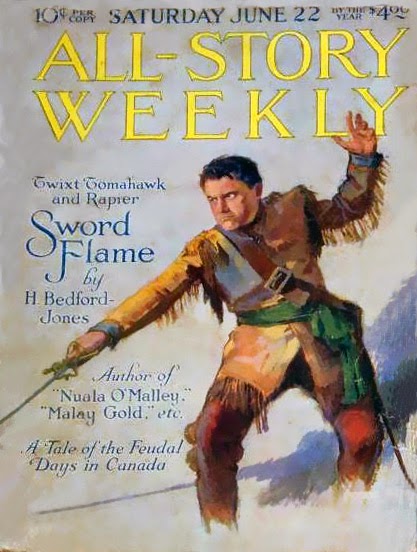
"Three Lines of Old French" is another of A. Merritt's fantasies about crossing over or passing through boundaries. It is an unusual story in that it is set in France during the Great War, which had ended not even a year before the story was published. I don't know of very many tales of fantasy, science fiction, or weird fiction that are set during the war and on the front lines. Maybe the war was too horrible to treat it in what many would consider non-serious genres of fiction. The cover story is "The Curse of Capistrano" by Johnson McCully. The cover art is unsigned and the artist is unknown.

"Three Lines of Old French" is too short for publication as a novel. Nonetheless, it took up all of one volume in a short-lived series called Bizarre. This is the cover of Bizarre #1 from 1937. 

The story was reprinted again in Famous Fantastic Mysteries for May-June 1940. The artist was Frank R. Paul.

The interior art was by Virgil Finlay. You might remember this image from my article called "Weird Tales and World War I" dated November 11, 2011, here.

In Observance of Memorial Day.

Captions copyright 2015, 2023 Terence E. Hanley

Sunday, May 24, 2015

A. Merritt Art Gallery-The Complete Moon Pool

"The Moon Pool" (1918) and its sequel, "The Conquest of the Moon Pool" (1919), were extraordinarily popular. It was only a matter of time before they were reprinted in book form, and it was a pretty brief time at that. I don't know the exact date of publication, but The Moon Pool, combining the two magazine stories, came out in 1919. The author, A. Merritt, revised and updated his stories for the book. For example, in keeping up with the times, the nefarious German from the original version became a nefarious Russian. I believe this is the original dust jacket. The artist was Joseph Clement Coll (1881-1921). 

It's hard to follow the publication history of "The Moon Pool" and "The Conquest of the Moon Pool." The two were first published separately, then revised and combined into a novel-length story, also called The Moon Pool. I believe all the editions you see here are of the combined version. This was the second, from 1929, published by Horace Liveright with a jacket illustration by Lee Conrey (1883-1976), who also did illustrations for The American Weekly, the same Sunday supplement on which A. Merritt worked for many years. 

Here is what must have been the first softbound edition, a digest-sized book and number 18 in the Avon Murder Mystery Monthly series, from 1944. The art is unsigned and the artist is unknown.

The 1951 edition, an Avon mass-market paperback, has that classic 1940s/1950s science fiction look to it. Unfortunately, the artist is unknown.

The 1956 edition, also from Avon, is a step down in my opinion. Not that Art Sussman (1927-2008) created a bad cover, it's just that something was lost when science fiction tried to become serious or relevant in the 1950s.

The 1962 edition from Collier Books is far more subdued. It almost looks like a book in the social sciences. The cover design was by Ben Feder, Inc., a firm run by none other than Ben Feder (1923-2009), an artist, real estate developer, and winemaker.

In 1968, Collier Books issued an edition with a more science-fiction-like cover by Don Ivan Punschatz (1936-2009). I would buy a book like this, even if I had never heard of the story or the author.

You didn't have to tell me that the cover artist on Avon's 1978 edition is British. It just has that look. His name is Rodney Matthews, he was born in 1945 in North Somerset, and he is still at work. 

Everybody likes A. Merritt, including the French. In 1957, the publisher Hachette came out with Le Gouffre de la Lune, number 48 in its series Le Rayon Fantastique. The cover artist is unknown.

The artist on the 1975 edition from J'ai Lu was Philippe Caza (b. 1941).

Rowena Morrill (b. 1944) was on hand for the 1986 edition. 

Here's a German edition from 1981 entitled Der Mondsee. I don't know the name of the cover artist.

Finally, an Italian-language version, Il Pozzo della Luna, from 1998, again by an unknown cover artist.

I would like to acknowledge The Internet Speculative Fiction Database in the writing of this series.
Captions copyright 2015, 2023 Terence E. Hanley

Friday, May 22, 2015

A. Merritt Art Gallery-The Conquest of the Moon Pool

"The Conquest of the Moon Pool" by A. Merritt in
All-Story Weekly, February 15, 1919

Eight months after publishing "The Moon Pool," All-Story Weekly came out with "The Conquest of the Moon Pool," described on the cover as "An Amazing Sequel to an Unparalleled Adventure." It was Merritt's fourth published story and his first to be serialized. For the next six weeks, readers thrilled to the adventures of Merritt's heroes in a world found underground and beyond the ken of ordinary existence. "The reaction that followed the last of the six weekly installments," wrote Sam Moskowitz, "verged on hysteria." (1) Before the year was out, G.P. Putnam's Sons issued a hardbound edition of the saga, combining "The Moon Pool" with "The Conquest of the Moon Pool." In the ninety-five years since, the two stories have more often been reprinted in their combined form than individually.

"The Moon Pool"--I believe in the combined version--was serialized for the first time in Amazing Stories from May to July 1927. Merritt's name landed on the cover below that of H.G. Wells, but the illustration seems to be unrelated to his or their stories. The artist was Hugo Gernsback's mainstay, Frank R. Paul. Gernsback was of course a pioneer in radio. It's no surprise that radio equipment would figure so prominently on the cover. I'm not sure what the narrative is here. It could be that the woman is saying, "Help me, Obi Wan Kenobi, you're my only hope." Or this could be the male fantasy projected by Gernsback or by science fiction in general, namely: Through science, you will get a woman. It's as true now as it was then, only now the woman is--though still miniature--two-dimensional and digital vs. three-dimensional and presumably real.

The original story "The Moon Pool" appeared in the first issue of Famous Fantastic Mysteries in September-October 1939. "The Conquest of the Moon Pool" followed over the next six issues, from November 1939 to April 1940.

The March 1940 issue of Famous Fantastic Mysteries was the first with a pictorial cover. Virgil Finlay created the cover art. The April issue, in which the last installment of "The Conquest of the Moon Pool" appeared, had an uncharacteristic cover from Frank R. Paul. It seems to me that the publishers of pulp magazines had noticed the vast popularity of comic books and printed this and other covers in response.

Finally, "The Conquest of the Moon Pool" was reprinted in its entirety in Fantastic Novels Magazine in September 1948. The controversy over "The Shaver Mystery" had raged over the previous few years among readers of science fiction. It's likely that Raymond A. Palmer, in formulating the Shaver Mystery, drew some of his ideas from the scientific romances of the early 1900s, including "The Moon Pool" saga. The companion title to Fantastic Novels Magazine was of course Famous Fantastic Mysteries. Many fantasy and science fiction stories are essentially mysteries, "The Call of Cthulhu" for example. Even early superheroes were called "mystery men." So is it any wonder that Ray Palmer would call his new mythology of subterranean races of robots a mystery? That would have been a powerful attraction to readers. Unfortunately, the Shaver Mystery didn't pan out for Palmer and his sidekick, Richard Shaver. On the other hand, Palmer latched on to an even more powerful myth in the 1947 with the coming of the flying saucers.

The Woman of the Moon Pool
There are images from science fiction that stick in the head of every fan. This one--by the artist Lawrence--sticks. To me it represents a long-ago and utterly lost era in American culture, especially in art and science fiction. The draftsmanship and technique are flawless. They are the work of a master craftsman. The foreshortening of the arm, the handling of flesh and underlying bone, the shading, the positioning and rendering of the fingers--all are perfect. That takes nothing away from the figure as a whole or its accoutrements, which are beautifully and impeccably done. In our current age when everything is becoming miniaturized, weapons in science fiction and comic books have become ridiculously huge (as have breasts and biceps). The artists and designers of today could learn a thing or two in the economy of Lawrence's little derringer-like blaster.

The woman is of course beyond glamorous. She reminds me of those sweater girls from postwar Hollywood movies--Virginia Mayo, Janet Leigh, Ava Gardner. Not that she is an object, for the woman in Lawrence's painting is strong and determined. She represented a certain ideal of her time, I'm sure. Women like her worked in factories and flew airplanes during the war. The men who fought, fought in part for her and to return to her. Together they defeated tyrants and built the most prosperous society the world has ever known.

My feeling of nostalgia goes beyond the artist's ability or the woman's looks or femininity or strength. A pulp magazine is a magazine full of stories and art, but it's also an artifact of a previous era. (I have read a quote that magazines are the closest thing to a time machine we have.) In the 1940s, the future as represented in science fiction was going to be great. Having survived the onslaught of totalitarianism (a kind of science-fictional system of belief), Americans looked with confidence (though also with some anxiety) to the future. A cover of a science fiction magazine like this one is a kind of symbol of those prevailing feelings and of the era in which it was published. A movie from that time is called The Best Years of Our Lives (1946), an ironic title to be sure, but also true and un-ironic in its way. (The line is spoken by Virginia Mayo's character.) A history of the same period is called The Best Years: 1945-1950 by Joseph C. Goulden (1976). The titles are not boastful or prideful. There's more than a sneaking suspicion that they are true.

Now we have arrived in the future--an alternate future--in which we have stopped ourselves dead in our tracks. Science fiction, being essentially optimistic, is no longer our genre of choice. Fantasy, including the darkest kinds of fantasy, has taken its place. Instead of being an expression of her own life and character, a beautiful woman--so called--is now a concoction of Botox, collagen, silicone, artificial tan, and a plastic surgeon's skill with knife and suction tube. Depictions of beautiful women today are seen as symbols of patriarchy, oppression, sexism, and injustice. Men and women both seem to prefer ugliness to beauty. I won't linger over that. The ills of our society go far deeper. Instead I wonder, did the men and women of the 1940s fight and die and build and bring children into the world so that we could give up hope and the freedom they won, so that we could collapse in on ourselves and wallow in our most miserable self-indulgent and self-absorbed misery? I wonder, too, does it make any sense to feel a sense of nostalgia for a time of hope and optimism, in other words, to look backward to a time of looking forward, to remember so fondly a previous civilization that fought for freedom and was filled with hope but that, for all practical purposes and mostly by our own actions, now lies in ruins at our feet?

Text and captions copyright 2015, 2023 Terence E. Hanley

Wednesday, May 20, 2015

A. Merritt Art Gallery-The Moon Pool

"The Moon Pool" by A. Merritt in
All-Story Weekly, June 22, 1918


"The Moon Pool" was A. Merritt's third published story and the tale that won him his fame. Like Merrit's previous stories, "The Moon Pool" is a romance of other worlds accessible from our own through some kind of extraordinary passageway. In Merritt's tale, the moon provides the passageway. His stories must have been a great influence on other writers, H.P. Lovecraft, C.L. Moore, Edmund Hamilton, and probably Nictzin Dyalhis among them. Raymond A. Palmer, who fashioned "The Shaver Mystery" from the scientific romances he read in his youth, also fell under Merritt's spell. Sam Moskowitz, in his book Explorers of the Infinite (1963), recounted how, after the publication of "The Moon Pool," "letters by the hundreds began to pour across the desk of Robert H. Davis, the Munsey editor who had discovered Merritt." Davis had paid Merritt $50 for "The Moon Pool." He offered forty times that for a sequel.

In 1939, the Frank A. Munsey Company began reprinting works from its old story magazines, Argosy and All-Story Weekly. The lead story in the first issue of Famous Fantastic Mysteries, dated September-October 1939, was none other than "The Moon Pool" by A. Merritt. Mary Gnaedinger was editor.

Editor Alden Norton made use of "The Moon Pool" in the Canadian pulp Super Science and Fantastic Stories for December 1945. The format appears to have been the same: old stories reprinted for a new generation. The cover illustration was recycled as well. It had previously appeared on the cover of the September 1945 issue of Famous Fantastic Mysteries, presumably illustrating "Phra the Phoenician" by Edwin Lester Arnold. The art was by Lawrence Sterne Stevens (1886-1960).

Mary Gnaedinger also edited Fantastic Novels Magazine, a companion to Famous Fantastic Mysteries. In the May issue of 1948, she reprinted "The Moon Pool" once again, and the cover artist was once again Stevens, who went by the mononym Lawrence.

Captions copyright 2015, 2023 Terence E. Hanley

Monday, May 18, 2015

A. Merritt Art Gallery-The People of the Pit

"The People of the Pit" by A. Merritt in
All-Story Weekly, January 5, 1918


A. Merritt's second published story, "The People of the Pit," appeared in All-Story Weekly for January 5, 1918. The cover story was the first chapter of a serial called "Trapped" by Ben Ames Williams. The cover artist is unknown. "The People of the Pit" is a tale of the Far North, written when there were still recent memories of the Yukon Gold Rush. It's also a kind of Lost Worlds story and a story of a subterranean city, like earlier stories of the Vril-Ya and later stories of the Deros. There are also similarities in H.P. Lovecraft's At the Mountains of Madness to "The People of the Pit." With his second story, A. Merritt was poised for his first great success.

Caption copyright 2015, 2023 Terence E. Hanley

Saturday, May 16, 2015

A. Merritt Art Gallery-Through the Dragon Glass

"Through the Dragon Glass" by A. Merritt in
All-Story Weekly, November 24, 1917

Abraham Merritt was a thirty-three-year-old journalist laboring away in New York City when All-Story Weekly published his first story, an Oriental fantasy called "Through the Dragon Glass." It's no surprise that his was not the cover story. Instead, a long-established author, Julian Hawthorne (1846-1934), son of Nathaniel Hawthorne, earned his place on the cover with "The Cosmic Courtship." Merritt's story was also a romance, though not "inter-planetary." Inter-dimensional might be the right word to describe it, as the "Dragon Glass," an artifact looted from the Forbidden City at the end of the Boxer Rebellion, allows its possessor to pass from one plane into another. The uncanny qualities of the Dragon Glass make me think of the green casket in "Claimed!" by Francis Stevens, from 1920. The story also mentions Iram, the many-columned city of the desert that showed up as Irem in "The Nameless City" by H.P. Lovecraft (1921). The artist is unknown. The medium looks like watercolor or gouache. The technique, especially in the handling of the female figure, reminds me of the work of Roy G. Krenkel (1918-1983) or some other American illustrator of the 1950s and '60s.

Caption copyright 2015, 2023 Terence E. Hanley

Friday, May 15, 2015

A. Merritt (1884-1943)-Part Two

So the careers of A. Merritt and Francis Stevens have some similarities and possibly some connections. The two authors may have met early in their careers, when she was working as a secretary at the University of Pennsylvania and he was a journalist at the Philadelphia Inquirer and The Sunday Supplement and/or The Sunday American Magazine, forerunner to The American Weekly. (1) Both had their first stories published in All-Story Weekly in 1917, and both wrote almost exclusively for the Munsey magazines (Argosy and All-Story) for several years. There was even a time when readers thought that "Francis Stevens" was a pseudonym of A. Merritt. They were only half right, for "Francis Stevens" was actually the pseudonym of Gertrude Barrows Bennett. One difference between Merritt and Stevens is that he became well known and very wealthy. She was neither.

It's reasonable to assume that Merritt was in contact with Gertrude Barrows Bennett. His first story in Famous Fantastic Mysteries or Fantastic Novels Magazine--two titles that reprinted stories from the old Munsey magazines--was "The Moon Pool," the lead story in the first issue of Famous Fantastic Mysteries, dated September-October 1939. Stevens' first story reprinted in those magazines was "Behind the Curtain" in Famous Fantastic Mysteries for January 1940. I have lost track of the source that says Merritt persuaded Mary Gnaedinger, the editor of Famous Fantastic Mysteries and Fantastic Novels Magazine, to reprint Francis Stevens' stories. I wonder now if he let Gertrude Barrows Bennett know about these new markets for her stories or if he secured payment for her for their reprinting. In any case, A. Merritt died of a heart attack on August 21, 1943, at his winter home in Indian Rocks Beach, Florida. Gertrude Barrows Bennett followed him to the grave in 1948. Nonetheless, Mary Gnaedinger continued reprinting their work. Six of Gertrude's thirteen stories were reprinted in Famous Fantastic Mysteries, Fantastic Novels Magazine, or Famous Fantastic Mysteries Combined with Fantastic Novels Magazine from 1940 to 1950. At least thirteen of Merritt's stories were so honored. His were also reprinted in Amazing Stories, Avon Fantasy Reader, Fantastic, Leaves, Satellite Science Fiction, Science and Invention, Science Fiction Digest, and Super Science and Fantastic Stories, as well as many collections and anthologies over the years.

Both A. Merritt and Francis Stevens had just one story published in Weird Tales, both in the 1920s. Merritt's contribution, "The Woman of the Wood" (Aug. 1926), was voted by readers the most popular story in the issue in which it appeared, for the entire year of 1926, and of all stories published from 1924 to 1940. It was reprinted in January 1934 and was again voted the most popular story in that issue. (2) Stevens' lone contribution, "Sunfire" (July-Sept. 1923) was published before readers were polled for their favorite stories. With it, her writing career came to an end, while Merritt's continued to the end of his life, although his last story published in his lifetime was in 1936, shortly before he became editor of The American Weekly in 1937 (3).

As further evidence of Merritt's popularity, in 1938, Argosy polled its readers for their favorite story in the fifty-eight-year history of the magazine. The winner was "The Ship of Ishtar" from 1924. Argosy proceeded to reprint Merritt's story and confessed that it had paid him the highest word-rate of any its authors.  The editor wrote: "This only proves he was worth it!" (4) More than a decade later, in December 1949, Merritt had a magazine published with his name in the title, A. Merritt's Fantasy Magazine. Mary Gnaedinger was the editor for five issues dated December 1949 to October 1950, when the magazine came to an end. Vargo Statten Science Fiction Magazine (1954) and Isaac Asimov's Science Fiction Magazine (1977-present) later fell into the category of magazines named for authors.

A. Merritt was and is a very popular writer, and his stories have seldom if ever been out of print. According to Sam Moskowitz, Avon Publications estimated that its re-printings of Merritt's stories had sold four million copies as of 1959. (5) Merritt's stories have been reprinted many times in many languages, including English, of course, as well as French, Italian, and German. They have also been adapted to the movies in Seven Footprints to Satan (1929) and two adaptations of "Burn, Witch, Burn!", The Devil Doll (1936) and Muñecos infernales (1961). He is supposed to have been an influence on Francis Stevens and H.P. Lovecraft, or they were an influence on him, or each other, or some combination of influences, one upon another, for which no one seems to have offered very much evidence. (6) Suffice it to say, Merritt's stories "are among the most famous titles in the canon of fantastic literature." (7) A. Merritt was inducted into the Science Fiction Hall of Fame in 1999.

A. Merritt's Story, Essay, & Letters in Weird Tales
"The Moon Pool" (Aug. 1926; reprinted Jan. 1934)
Letter to "The Eyrie" (Oct. 1929)
Letter to "The Eyrie" (Oct. 1934)
Letter to "The Eyrie" (Nov. 1935)
"How We Found Circe" (Winter 1973; originally in The Story Behind the Story, 1942)

Further Reading
There is much to read about A. Merritt on the Internet and in those ancient artifacts known as books, including:
  • "The Marvelous A. Merritt" in Explorers of the Infinite by Sam Moskowitz (Cleveland: The World Publishing Company, 1963), pp. 189-207.
  • Introduction by Sam Moskowitz to "The Moon Pool" by A. Merritt in Under the Moons of Mars: A History and Anthology of "The Scientific Romance " in the Munsey Magazines, 1912-1920 (New York: Holt, Rinehart and Winston, 1970), pp. 137-138.
  • A. Merritt: Reflections in the Moon Pool by Sam Moskowitz (1985)
Notes
(1) Gertrude Barrows Bennett had arrived in Philadelphia in 1909 or 1910, either newly married or newly widowed. A. Merritt left Philadelphia in 1912 for New York City, but I can't say that he cut ties to his former city. It's worth noting that one of the characters in Stevens' story "Sunfire" (1923) is a "war-correspondent and a writer of magazine tales." Named Alcot Waring, he is described as a "vast mountain of flesh . . . obese, freckle-faced, with small, round, very bright and clear gray eyes" (The Nightmare and Other Tales of Dark Fantasy, p. 348). I have seen two photographs of Merritt but have never read a description of him. He doesn't appear to have been a small man, but he may not have been Alcot Waring-sized either. Like Waring, Merritt spent some time in Latin America, at least as a visitor and maybe as an explorer.
(2) Merritt also had an essay in the magazine, "How We Found Circe," in a later incarnation, Winter 1973.
(3) At the time, The American Weekly, the Sunday magazine of the Hearst newspaper chain, claimed "the largest circulation of any periodical in the world" according to Sam Moskowitz. (Source: Moskowitz's introduction to "How We Found Circe" in Weird Tales, Winter 1973, p. 26.) Considering his new responsibilities, we can't blame Merritt for not writing in the field of fantasy after 1937.
(4) Quoted in "The Marvelous A. Merritt" by Sam Moskowitz in Explorers of the Infinite (1963), p. 190.
(5) Explorers of the Infinite, p. 206.
(6) In "The Moon Pool" by Merritt (published June 22, 1918), there is a "moon-door." In The Heads of Cerberus by Stevens (published August-October 1919), there is a "moon-gate." If these things are evidence of influence, one upon another, then Merritt would seem the influence in this case. But how far does anyone want to go with something like that?
(7) Sam Moskowitz in his introduction to "The Moon Pool" by A. Merritt in Under the Moons of Mars: A History and Anthology of "The Scientific Romance " in the Munsey Magazines, 1912-1920 (1970), p. 137.

Abraham Merritt (1884-1943)

Text and captions copyright 2015, 2023 Terence E. Hanley