Showing posts with label Weird Tales and Controversy. Show all posts

Saturday, May 9, 2026

Reactions and Reactionaries-Part Four

From December 2017, updated to 2026.
No natural science can hold its own in the struggle against the onslaught of bourgeois ideas and the restoration of the bourgeois world outlook unless it stands on solid philosophical ground. In order to hold his own in this struggle and carry it to a victorious finish, the natural scientist must be a modern materialist, a conscious adherent of the materialism represented by Marx, i.e., he must be a dialectical materialist.
--V.I. Lenin, The Significance of Militant Materialism (1922)

In 2011, Marvin Kaye and his partnership Nth Dimension Media acquired the rights or license to publish Weird Tales magazine. The editor, Ann VanderMeer, stayed on, but not for long. She left in August 2012. I don't know what her reaction was to the whole situation, but her husband, Jeff VanderMeer, was obviously upset by it. I can sympathize. On the other hand, if he had wanted Weird Tales to be a certain thing--his thing--he should have acquired the rights or the license himself. Instead, Marvin Kaye took over. Unfortunately, he and Nth Dimension Media published only four issues of their new charge from 2012 to 2019. There weren't any issues at all in the period 2015 to 2018.

Marvin Kaye's acquisition of the Weird Tales, effectively removing it from the VanderMeers' control, can be seen as a counterrevolution, as a reactionary attempt to restore the ancien régime. The Cthulhu Mythos issue, published in Fall 2012, can be seen as a shot through the heart of the attempted revolution against H.P. Lovecraft, his work, and older forms in general, what has been called "the Old Weird." It might also be seen as a move against the dissolution of what the VanderMeers and writers in their circle had seemingly judged to be a cohesive genre, governed by tradition and convention. In the pages of Weird Tales at least, there would be no more radical attempts at remaking "the Old Weird" into the genre-crossing, genre-bending, anything-goes "New Weird." We should note that Marvin Kaye was born less than a year after Lovecraft died, and so there was a kind of continuity in the life, if there is such a thing, of weird fiction.

To her great credit, Ann VanderMeer made sure that Weird Tales was published year after year, for six years anyway, from 2007 to 2012 inclusive. During her tenure, it was an award-winning magazine. The late Mr. Kaye was less successful in those two ways. Is that evidence that a more conservative approach to genre fiction was no longer viable? Was a "New Weird" approach better in commercial or artistic terms? I don't know. But in 2023, the new, new editor of Weird Tales, Jonathan Maberry, put out a Cosmic Horror Issue, and though he used stories by "New Weird"-type authors, that issue fell back on old--even old and moldy--concepts, themes, and conventions (e.g., Vril). Remember here that cosmic horror is a synonym for Lovecraftian horror, and so Lovecraft and "the Old Weird" had come back. I wonder what Ann and Jeff VanderMeer thought of that. I wonder what relationship, if any, they have with Mr. Maberry, who relied on his friends to provide him with content, like Andy Hardy putting on a show. Mr. VanderMeer is not represented in the Cosmic Horror Issue, nor is his name in Mr. Maberry's list of authors who write or wrote cosmic horror stories. I have never read any of Jeff VanderMeer's fiction, so I can't say whether he has written in that sub-genre or not.

Charles Fort's complaint against science was that scientists had set their facts--their data--as separate and discontinuous from all other data. Those other data, then, were excluded. They were damned. Before he wrote The Book of the Damned (1919), Fort wrote science fiction stories, all of which he destroyed. Maybe he became a gadfly of science because of his own struggles with the nascent genre of science fiction. In any case, if scientists and science-minded people are correct in their worldview, and science fiction is the fiction of science, then it would follow that science fiction is discontinuous with all other genres. If science is purely materialistic, then any fiction based on science must also be purely materialistic. No fantasy, ghosts, spirits, or non-material forces of any kind, including psychic powers, allowed. And if V.I. Lenin, a thoroughgoing materialist, was right and the natural sciences must be Marxist in orientation, then from the Marxist point of view, science fiction can't be anything but Marxist.

Unfortunately for the science fiction author oriented towards Marxism, that would mean the end of his genre, for Marxism is demonstrably and has repeatedly been a failure of epic and murderous proportions. What artist--not propagandist but artist--would want any part of that? If writers of "the New Weird" or any other "new" genre or sub-genre or sub-sub-genre would hope to model their beliefs on Marxism or its offshoots, or perhaps on any codified a priori or gnostic system, then they, too, will fail in artistic or intellectual terms--and almost certainly in commercial terms. Editors, publishers, distributors, and sellers of books work for corporations. The vast majority of readers are middle class, in other words, part of the Marxist's hated bourgeoisie. Why would any of them want to read about how terrible they are or why they should be torn down and cast upon the ash heap of History? On the other hand, there are those who despise themselves and everything they have come from, including their own families, the middle class, Christianity, Western civilization, and the European-style nation-state. Maybe they like reading stories of destruction. Maybe that's why so much genre fiction is dark, depressing, violent, bloody, gory, and nihilistic. Even H.P. Lovecraft, a supposed materialist, spared humanity in "The Call of Cthulhu." He didn't hate us enough to destroy us just yet. And so people keep reading Lovecraft, despite his frequent darkness and pessimism. Meanwhile, "the New Weird" has grown old and gray. Maybe at this point it has one foot in the grave and the other on a banana peel.

Anyway, I would wager that any science fiction or other genre or sub-genre based on Marxist, materialistic, or atheistic ideas will wither and die because we as human beings have an undeniable non-material and spiritual aspect. It is a lie to say that we are merely material. Although lies can live, they are mortal, whereas the truth is eternal and imperishable--the truth will out, while lies can live only in the dark, including in the dark heart of the hateful, despairing, and vengeful Marxist.

Red Menace #47, "War-Maker," from a trading card issued by Bowman in 1951. Note the ape with a scimitar, wading in blood. This is not Poe's orangutan. If you're a Marxist, Mao Tse-tung is one of your buddies. You might as well own him. In this picture he has a green face, like Frankenstein's monster or Cthulhu or an alien from space. The unknown artist could not have anticipated the current Red-Green coalition that seeks to tear down Western civilization. Or maybe I should call it a Red-Green-Green coalition.

Text copyright 2017, 2026 Terence E. Hanley

Saturday, September 27, 2025

Bertha Russell (ca. 1910-?)

Young Author
Born Circa 1910
Died ?

There is an extra story in the November 1925 issue of Weird Tales. It's not listed in the table of contents, and its author is not included with others who contributed to "The Unique Magazine." Her name was Bertha Russell and she was fifteen years old when her story was published. Editor Farnsworth Wright took the unusual step of publishing her story, entitled "Pity Me!", in its entirety not in the main body of the magazine but in "The Eyrie," the regular letters column. I have seen poetry in "The Eyrie" before, but this is the first time I have seen a short story.

"Pity Me!" is brief. Call it a short short story. It's in a necrophilic vein--pun partially intended. There were readers who liked and wanted stories of what they called necrophilia. There were others who did not. I don't think stories in this vein that appeared in Weird Tales were always sexual. I think when readers wrote about "necrophilia," they meant stories that were focused on death and corpses, maybe also stories that were especially gruesome. One of the first, if not the first, necrophilic story in Weird Tales was "The Loved Dead" by C.M. Eddy, Jr., assisted or revised by H.P. Lovecraft and published in the issue of May/June/July 1924. That story was supposed to have caused a wider controversy regarding pulp magazines. I'm not sure that that actually happened. Anyway, maybe what's needed here is some further research and a whole series devoted to stories of this type. But does anybody really want to read them?

We don't know anything about Bertha Russell except that she was fifteen years old in 1925, making her birth year about 1910 and making her yet another teen-aged author in Weird Tales. Usually "The Eyrie" included the city from which a correspondent wrote, but we don't have that for her. Suffice it to say that young Bertha Russell must have been thrilled and excited to have her story in Weird Tales.

Like I said, I have seen poetry in "The Eyrie." I have also seen it as an epigraph in various short stories. A list or discussion of poetry or lines of poetry that appeared in "The Eyrie" or stories published in Weird Tales would make for another essay or series. It would also make for an expanded list of authors whose work appeared in "The Unique Magazine."

Copyright 2025 Terence E. Hanley 

Saturday, August 23, 2025

R.G. Macready (1905-1977)-Part Two

R.G. Macready contributed to student publications at all of the schools he attended. He also contributed to the Volta Review, a publication for the deaf and hard of hearing that is still being published today. After graduating from the University of Oklahoma in 1945, he went to work as a teacher of English, history, and journalism at the Oklahoma School for the Deaf. He planned to write in his spare time.

Macready contributed just one story to Weird Tales. Entitled "The Plant Thing," it was published in July 1925 when its author was just twenty years old. "The Plant Thing" is a brief tale of a large, carnivorous plant, bred by a scientist who lives in a walled estate with his daughter and a Malay servant. The narrator of the story is a newspaper reporter. "The Plant Thing" has similarities to "Ooze" by Anthony M. Rud (Weird Tales, Mar. 1923), as well as to "The Hand" by Guy de Maupassant (1883). Stories of murderous or carnivorous plants are common in weird fiction, horror fiction, and science fiction. I have written before about plants like these that appeared on the cover of Weird Tales. Click here to find your way. And of course there is in "The Plant Thing" the scientist and his beautiful daughter, with his wife and her mother nowhere to be found. Women in popular culture should know better than to marry scientists and to give them beautiful daughters. They're likely to end up like Dr. Morbius' wife in Forbidden Planet (1956) or Dr. Medford's wife in Them! (1957).

"The Plant Thing" has been reprinted several times since its original publication, as early as 1925 in Not at Night, edited by Christine Campbell Thomson, and as late as 2022. In a newspaper article from 1946 ("Deaf Man Receives M.A. in Journalism," in The Deaf Mississippian, Feb. 1, 1946, p. 1), Macready was described as having written "two horror novels and numerous short stories and novelettes, as yet unsold." I wish that these novels and stories were still in existence, but I fear they have been lost, for Macready never married and died without issue. He was survived only by two brothers and several nieces and nephews.

Macready had two letters in "The Eyrie." Here is the text of his first, from June 1925:

You are to be commended on the determined stand you, as well as the great majority of WEIRD TALES readers, have taken against those who protest at the weird quality of the stories printed in your periodical. Why do not these people, who are trying to wipe out of existence the only magazine of its kind, turn their artillery upon the sex-exploiting magazines that are crowding the best magazines out of place on our news stands? Anyway, a mind that can go undiseased through that so-called literature should be able to survive the pleasantly exhilarating 'kick' of a good horror tale. There can be no question as to the literary status of WEIRD TALES. In it have appeared stories worthy of Kipling himself, to say nothing of Poe.

Macready worked as telegraph editor at the Galveston Daily News in 1948 and at the Big Spring Daily Herald in 1949 and after. I don't have anything on his career after 1950. Reginald G. Macready died on May 10, 1977, in Arlington, Texas, at age seventy-two and was buried at Southland Memorial Park in Grand Prairie, Texas.

R.G. Macready's Story & Letters in Weird Tales
Letter to "The Eyrie" (June 1925)
"The Plant Thing" (July 1925)
Letter to "The Eyrie" (July 1925)

Further Reading
Many interesting and detailed newspaper articles about him and his career as a student and journalist. You might start at the website of the Oklahoma Historical Society and its archive of newspapers.

 Original text copyright 2025 Terence E. Hanley

Saturday, March 29, 2025

The Weird Tales Scam

Every once in a while I look on the Internet for news of my blog. This isn't really vanity--or not mostly vanity--I just want to see what's going on out there. I don't have any connections to people in weird fiction or science fiction except for the members of our weird fiction book club. I don't know anything about current trends, developments, or controversies. I don't subscribe to any magazines and don't go looking for new fiction. The main reason I ordered Weird Tales #367, the Cosmic Horror Issue, is that it was advertised as the 100th anniversary issue. Now here it is two years later and I'm still writing about the thing.

But other people are, too.

In my most recent Internet search, I came upon an essay called "Pulp Fiction Scholar Savages Jonathan Mayberry's [sic] Weird Tales Fantasy Magazine Revival," by Richard Merritt on the website Fandom Pulse, and dated November 26, 2024. As it turns out, I'm the "pulp fiction scholar" of the title. I guess I don't mind being called a scholar. But I like John Keel's disclaimer: "Not an authority on anything." I don't have an advanced degree. I don't work in academia. I have never had anything published in a scholarly journal. I have never been a speaker or presenter at a conference. I'm not a publisher or editor. I don't know what that makes me. Maybe scholar is it.

So today I would like to write about Mr. Merritt's essay.

I'll start by saying that one of the first courtesies you can extend to another person is to get his name right. Jonathan Maberry, current editor of Weird Tales, seems to have failed in that with one of his contributors, Nicole Sixx, whose name is apparently not Nicola, as it is spelled in his table of contents. But then Mr. Merritt misspelled Mr. Maberry's last name in the very title of his essay, and then mixes correct and incorrect spellings in its main body. Does anybody work with a proofreader or editor these days?

Mr. Merritt's essay starts off well enough when he suggests that the current Weird Tales is a skinsuit. It's hard not to see things that way. Weird Tales looks like Weird Tales and has some of its trappings, but it's mostly an imitation. More accurately, I think, it's a type of exploitation. A lot of people have glommed onto something that they never created and could never have created because they're too small, all for their own purposes and their own gain. It's actually pretty cynical when you think about it. The egregious failure of the current Weird Tales to meet its business obligations is more cynical still. I'll go beyond the word skinsuit: the current Weird Tales is a scam.

I don't have Mr. Merritt's full essay. It's behind a paywall. (My blog is free. Things about my blog you have to pay for.) My friend Nate was kind enough to get it for me, but my version is cut off. I have this clause from Mr. Merritt, though: "Even legacy magazines from the heyday of the pulp era aren't safe from crusaders injecting their tired politics into them [. . .]." If he's referring to Weird Tales #367, I will say that at least Mr. Maberry and his contributors did not inject politics into their magazine (or at least I didn't detect any politics in my reading of it). We can be thankful for that. There is a political issue on the fringes of the magazine, though. I covered that last year. The editor and his authors wisely avoided these otherwise poisonous topics, poisonous and fatal to fiction-writing and the pleasures of reading.

Richard Merritt went through some of what I wrote about the magazine. "Overall," he concluded, "the revival is a mess." Those are his words. Although I wouldn't call it a mess, I would also not praise it very highly, either. Most of it is readable. Some of it is fair to good. None of it is very good or excellent. As I wrote before, probably nothing in here will ever be anthologized, which is far less than you can say about the original Weird Tales and its contemporaries in science fiction. I guess we like to mine the material and culture from the past while putting ourselves above the people who created it. This is presentism in one of its worst forms. Read on . . .

Near the end of his essay, Mr. Merritt showed something that Jonathan Maberry posted on Twitter/X in 2019. Mr. Maberry wrote: "My goal is to find exceptional stories from writers of all kinds. None of the racism, sexism, and homophobia that was once associated with this title." So the goal is not to seek out good and promising writers, regardless of their identitarian qualities, to guide and advise them in their work, or to publish good, enjoyable, memorable, and well-written stories. No, the goal is evidently something else, something less. The focus isn't on what's good but what's bad about the past. And the goal is negative rather than positive. Any adult should know (Jonathan Maberry is sixty-six years old) that negative goals don't work. You have to be for something, not against something else. Anyway, maybe that's where the reference to politics in the first paragraph of Mr. Merritt's essay comes from.

Richard Merritt also quoted from the magazine Cirsova, which wrote, I believe also on Twitter/X: "the guy who's behind the most recent woke relaunch of Weird Tales slapped the Weird Tales logo on his own book and called [it] 'The first Weird tales novel'." I don't know who wrote that and when. In addition to not having any connections to anybody, I don't use X or any other social media. In any case, that quote seems to be from someone called #stolenvalor. That's another fitting phrase, if I'm reading the reference the right way. Mr. Maberry has no claim at all to the label "the first Weird Tales novel." I think what he means actually is that his novel is the first Weird Tales-branded novel. And as we have seen, branding, the use of brandnames, product placement, and the advertising of Weird Tales merchandise seem to be the main activities in the writing and publication of Weird Tales #367. Good writing isn't it.

Skinsuit . . . scam . . . stolen valor. All seem to be accurate in reference to the current Weird Tales. I will say to the current editor and publisher: Let us have our magazine back. At the beginning, in the November issue of 1924, the new editor, Farnsworth Wright declared:

Weird Tales belongs to you, the readers, and we will be guided by your wishes.

Let us have our magazine back.

-----

Corrected on April 2, 2025. Thanks to Mike for the correction.
Thank you to Nate for a copy of Richard Merritt's essay.
Original text copyright 2025 Terence E. Hanley

Friday, December 27, 2024

The Last Picture Shown

Many years ago, author Jeff VanderMeer wrote an essay called "Moving Past Lovecraft" in which he objected to what he called the adulation, imitation, fetishizing, and commodification of H. P. Lovecraft. He wrote that soon after his wife, Ann VanderMeer, resigned as editor of Weird Tales magazine. There was a controversy and some conflict in all of that. One of the principals, Marvin Kaye, has since died. Mr. Kaye was without a doubt an admirer of Lovecraft and the old Weird Tales. He was born less than a year after Lovecraft died. You could say that he had come to contemporary weird fiction from out of its past.

The 100th-anniversary issue of Weird Tales, published in 2023, is a themed issue. The theme is cosmic horror. Wikipedia, that fount of all knowledge, lets us know that cosmic horror is a synonym of Lovecraftian horror. All three essays in the Cosmic Horror Issue mention Lovecraft. One of the essays and one of the stories begin with epigraphs from his pen. Several of the stories have Lovecraftian themes, content, props, motifs, and so on. Although Jeff VanderMeer urged us to move past Lovecraft, we never have. It looks like he failed in his effort . . .

Except that there is an illustration in Weird Tales #367 that seems to acknowledge one of his complaints against contemporary authors who continue to admire, imitate, fetishize, and most especially commodify Lovecraft, his works, his concepts, and his approach to weird fiction. The unsigned illustration is the last to appear in the Cosmic Horror Issue and occupies the last page. It has the look of a trompe-l'Å“il painting and shows an album cover resting on a woodgrain tabletop. The album cover is a takeoff of Nevermind by Nirvana. It shows a larval Cthulhu swimming after a hundred dollar bill on the end of a hook. The illustration is ironic, even cynical. It's curious that the editor and publisher of Weird Tales would print it. They seem to recognize that they and many of their authors are chasing after Cthulhu cash and Lovecraft lucre. Evidently they don't feel any shame or embarrassment in that. They would be laughing to the bank except that I don't think Weird Tales is much of a moneymaking operation. Maybe I'm wrong.

I'm not exactly on Jeff VanderMeer's side in this, but you have to admit that an awful lot of writers, artists, and other creators, not just now but for the past many decades, probably going back to the 1940s, are milking a cash cow and will no doubt continue to do so for as long as they can. It would be better, I think, if writers would put the cow away and create something new and original. But again, I don't think they're up to it. It's a lot easier to copy and imitate things created by others and to go on doing that for all of your life. And that's what our popular culture has become, a mix of imitation, adaptation, remakes, sequels, prequels, pastiches, and, worst of all, shameless copying and outright theft of other people's ideas. It's no wonder there is so much product placement in the Cosmic Horror Issue, for the fiction itself and all of its themes and content have become commercial products. Cosmic Horror, like so many other genre names, has become a brand, and the authors writing in these genres have seemingly become hucksters and exploiters.

Copyright 2024 Terence E. Hanley

Wednesday, November 20, 2024

This Worm Ouroboros

The other day I mentioned the symbolic worm ouroboros in reference to Weird Tales #367 and its authors. That symbol has meant different things to different people. My use is after Camille Paglia in her book Sexual Personae: Art and Decadence from Nefertiti to Emily Dickinson (1990; Vintage, 1991), in which she called it a serpent and spelled it uroboros. She quoted Erich Neumann in reference to uroboros: "the serpent which at once bears, begets, and devours." (p. 88) That can work for my purposes, but it's not quite what I was looking for.

Here's a longer quote:

To find one's life sensational is to be aroused by oneself. [. . .] Gwendolen [from The Importance of Being Earnest by Oscar Wilde] reading her diary is lost in autoerotic skopophilia, titillation of the eye. If books can corrupt, and we know from Dorian Gray that they can, then one can be corrupted by one's own diary. To be corrupted by oneself is sexually solipsistic [. . .]. Gwendolen is an uroboros of amorous self-study, an Art Nouveau serpent devouring itself. (p. 540)

Remember that "Night Fishing" by CaitlĂ­n R. Kiernan is told in the first person, like a diary. Remember, too, that the narrator (diarist) opens a box (book) so that the viewer (reader) might be corrupted.

In thinking about these things, the story "'All You Zombies --'" by Robert A. Heinlein has come into my head again and again. If you haven't read it, you should. It may be the most solipsistic story ever written. As Camille Paglia pointed out, circular ouroboros is solipsistic as are so many people in our world.* In his story, Heinlein foresaw something of our current situation. It's nice to see the concept of solipsism in someone else's thinking on these things. But now I find in rereading parts of Sexual Personae that solipsism and related phenomena, including the subject of today's essay, are ancient, if not prehistoric in their origins. They are also pagan and shamanistic, thus, it becomes apparent, the story "Teoquitla the Golden" by RamĂ²n de las Cuevas, also known as Mark R. Harrington, who would have encountered phenomena like these in his work as an anthropologist. His story of changing sexes was in Weird Tales in November 1924, one hundred years ago this month.

(*In Glory Road by Robert A. Heinlein [1963], the hero tricks the ogre Igli into swallowing himself, and--poof!--he's gone into nowhere. If only he were here with us, Igli could warn the worm ouroboros of the dangers of autophagy at the organismic level.)

Camille Paglia's thoughts on the character Gwendolen gets closer to my idea than the first quote above. This idea is that uroboros is turned inward upon itself and devours itself--inverted, curled like an embryo, self-centered, self-absorbed, it makes of itself its whole world. The image I have of these authors is that they are tagmata in the body of the worm, if not many of them the worm itself.

A third quote is too obscene to reproduce (no pun intended) here. You will find it on page 587. It's in reference to an episode in Moby Dick by Herman Melville. It's obscene but also obscenely funny, in its original and in Ms. Paglia's reference to it. That quote also gets to what I'm talking about in reference to the Cosmic Horror Issue of Weird Tales. I hate to say it, but that one might be closest of all.

Worm, by the way, is from the Old English wurm or wyrm, meaning "serpent, snake, dragon, reptile." The Indo-European root is the same as for the word weird or wyrd: "to bend."

* * *

In his introductory essay in "The Eyrie," editor Jonathan Maberry mentioned the names of several dozen authors, including Ramsey Campbell, Thomas LigottiCaitlĂ­n R. Kiernan, and China MiĂ©ville. Poor Jeff VanderMeer. He got left out. But we should remember that in 2012, he had a tussle with the current publisher, John Harlacher, and the previous editor, Marvin Kaye. Maybe things haven't settled down just yet, even after the death of Mr. Kaye in 2021. We should remember, too, that Mr. VanderMeer wants us to move past Lovecraft, whereas Weird Tales #367 is essentially a Lovecraft issue.

Essayist Nicholas Diak is in Weird Tales #367. Near the end of his contribution, he wrote:

In 2023 Weird Tales celebrates its centennial. The periodical has seen cycles of inactivity and resurrection (not dead, but dreaming), but also high-water marks from the stewardship of unflappable editors, including its current prosperity under Jonathan Maberry. (p. 19)

On his own website, Mr. Diak posted interviews with three other contributors to the Cosmic Horror Issue, three of the five women in fact. They are Angela Yuriko Smith, Samantha Underhill, and Carol GyzanderJonathan Maberry wrote the introduction to Samantha Underhill's poetry collection Sadness of the Siren, issued in 2022. Carol Gyzander appeared with Mr. Maberry at Philcon, held in Cherry Hill, New Jersey, on November 17-19, 2023. Angela Yuriko Smith co-edited a collection called Worlds of Light and Darkness (2021). In its pages is a story by Jonathan Maberry.

Speaking of introductions, Jeff VanderMeer, who is married to Ann VanderMeer, former editor of Weird Tales, wrote a not very interesting foreword for Songs of a Dead Dreamer and Grimscribe by Thomas Ligotti (Penguin, 2015). (Mr. Ligotti is far more interesting and erudite.) In his forward, Mr. VanderMeer mentioned Mr. Kiernan, but only in passing. The former covered the latter in depth in an interview conducted in 2012. In a response to a comment on that online interview, Jeff VanderMeer wrote: "I totally agree, Craig. She [sic] is one of my favorite, favorite writers because her [sic] work shows progression and she [sic] isn’t content to stick with just one thing." 

Sic, sic, sic.

In that same interview, CaitlĂ­n R. Kiernan appears to have expressed admiration for the work of Thomas Ligotti. I wouldn't be surprised to find that Mr. Kiernan does in fact admire Mr. Ligotti. They both appear to come from the same kind of place and to write the same kind of story, although I confess I have read only one by the former author and only four or five by the latter. Also in that interview, Mr. Kiernan called China MiĂ©ville "brilliant." Jeff VanderMeer has also interviewed Mr. MiĂ©ville. No word on what Mr. MiĂ©ville thinks of Mr. Kiernan. Can anyone find the missing tagma for this self-swallowing worm?

In 2005, CaitlĂ­n R. Kiernan published a short story collection called To Charles Fort, With Love. (We knew from just one story, "Night Fishing," that Mr. Kiernan is a reader of Charles Fort.) The author of the afterword in that book, entitled "A Certain Inexplicability," is Ramsey Campbell. Mr. Campbell also wrote an introduction to the first edition of Mr. Ligotti's Songs of a Dead Dreamer, published in 1985.

In September 2020, Ramsey Campbell attached his signature to a lie. The lie is part of a letter drawn up by British authors Kiran Millwood Hargrave and Daisy Johnson. You can read the letter and the names of its signatories by clicking here. The letter is tacitly against J.K. Rowling, a woman who has shown herself to be fearless in the face of the most hateful verbal attacks made by followers of a harmful, destructive, and oppressive belief system afoot in our world. She is a woman in the only sense of the word. They call her by a derogatory term, a slur: trans-exclusionary radical feminist, or TERF. That letter, signed by 200 small people plus Ramsey Campbell (we have to admit he has stature), was in response to a previous letter in support of Ms. Rowling, this one signed by 58 writers, actors, musicians, and artists. As usual, cowards outnumber the courageous, and liars the speakers of truth. You can read the initial letter, signed by the courageous 58, by clicking here.

J.K. Rowling writes genre fiction, including short works. I have a feeling, though, that if she were to stoop to approach Weird Tales with a submission, the people behind the magazine--and who inhabit the larger world of contemporary weird fiction--would tell her to go away. She would not be wanted, for she speaks the truth and many of them traffic in lies, one lie in particular.

In this I say thank God for China MiĂ©ville. At least his leftism and progressivism are still class-based instead of sex-and-gender-based. At least Marxism is a product of the mind.

George Orwell famously said, "In a time of deceit telling the truth is a revolutionary act." Progressives like to think of themselves as bravely ushering in new worlds. They are actually counterrevolutionaries who want to take us backward to that pagan and shamanistic fog of circling and turning years that preceded the onset of history. J.K. Rowling and people like her are the true revolutionaries, for they believe in freedom, reason, and civilization.

To paraphrase a recent presidential campaign, the current and recent Weird Tales appears to  be about they and them. You can decide for yourself who they are and to whom them refers.** You could begin with lists and names appearing in the Cosmic Horror Issue. The original Weird Tales--thirty-one years' worth, from 1923 to 1954--was about you--about us, the readers. Remember what Farnsworth Wright wrote in 1925 in "The Eyrie," the column that in its original form and for its original purpose was a readers' column:

Weird Tales belongs to the readers.

(**Robert A. Heinlein wrote another solipsistic story called "They," published in Unknown Fantasy Fiction in April 1941.)

* * *

I have been writing a lot about the meanings of words. Thank you to the Online Etymology Dictionary for so much fascinating information. I began in that because it's really interesting. After a while, though, it became something else, something really important, and I'll tell you why. If we as writers, readers, speakers, and listeners are to understand each other and communicate with each other, we must agree on the meanings of words. If those meanings break down, then understanding and communication break down, too.

Words and language do not belong to any one person or group of people. They are our common property. No one shall claim ownership of them, and no one shall forbid others from using any word in its proper sense. Nor shall anyone alter the meanings or uses of words, unilaterally or for his own purposes. Each of us has rights, but no one's rights extend into the lives of others. There are rules in every language. Call them law. To misuse words, damage them, vandalize them, do violence to them is to break the law we all must respect if we are to go on. These things are an offense against us all.

There has been a lot of lawbreaking, damage, vandalism, and violence done to our language. This is especially true of a single word: woman. Woman means just one thing. It doesn't mean more than one thing, nor does it mean whatever you want it to mean. One thing, one fixed meaning, one kind of person--woman--to the exclusion of all who are not women. Those who seek to change the meaning of the word seek to silence women, erase women, cancel women, take from women; to deprive them of their rights, their privacy, their safety, their security, their prerogatives and their exclusive privileges as women; to deprive them also of their being and experience as women; to invade the country of womanhood, take it over, subdue it, punish, enslave, or imprison all of its inhabitants, and steal or wipe away everything that was theirs and theirs alone. These invaders and usurpers should be ashamed of themselves, but they know no shame. They will go on hurting people and destroying things by their lies and beliefs and by their system. I think and I hope that the election just past in America has broken the wave of this hateful and destructive belief system. But systems without any built-in limits will never relent. We will always have to remain vigilant.

Next: An Alien Abduction.

Original text copyright 2024 Terence E. Hanley

Friday, November 17, 2023

Edgar Allan Poe in the First Year of Weird Tales

This is a very long essay, but as it is about Edgar Allan Poe, I think I should offer it to you all in one piece so that, if you're able, you can read it in one sitting.

* * *

In early 1809, two men were born who would change the nation, though in different realms and at different scales. The first-born of them came into the world in a great eastern city. The second was born on the American frontier. The first was born in the North but grew up in the South. The other made the opposite kind of journey. Both were orphaned in their childhood. Both were frequent failures and had great tragedy in their lives. Both men served in the military, though only for a short time. Both were known for their writing, their words, and their sense of humor.

Both of these men of 1809 died too young, the second-born by violence, the first perhaps also by violence. They died within forty miles of each other, though their deaths were separated by sixteen years and more. The second died in spring, when lilacs bloomed in the dooryard. His death was mourned by millions, and millions witnessed the passing of his funeral train to the final resting place of his earthly body. The second died in autumn. His body was placed in a simple coffin and only a few attended his funeral. The service lasted all of three minutes on a "dark and gloomy [. . . a] raw and threatening day," according to one of the attendees. The headstone of the departed lacked even his name. Only decades after his death did his grave receive proper attention. Now both men are renowned all over the world and both graves are well visited.

The first-born was conservative. In his work, he explored, among other things, the afflicted psyche of the modern man. The other was liberal. He warred against the ancient institution of slavery. The first was one of our greatest writers. There is a professional football team named after one of his poems. The second was one of our greatest presidents. You will see his visage on pennies, five-dollar bills, and the face of Mount Rushmore. It's strange to think that Abraham Lincoln and Edgar Allan Poe were born just twenty-four days apart.

Abraham Lincoln (1809-1865) was and is justly revered in America. There have probably been more books written about him than anyone else in our history. From the moment of his death, the Rail-Splitter, our Great Emancipator, has never been forgotten and is always close in our thoughts as we contemplate the history and meaning of our country. Edgar Allan Poe (1809-1849) on the other hand was slandered at his death, and though his works were still in print for many years afterwards, there were long periods during which he seems to have been almost forgotten, or at least relegated to a minor place in American letters.

That changed as the nineteenth century went on. If you look at the list of collections by Poe in the Internet Speculative Fiction Database, you will see big gaps--1856 to 1869, 1871 to 1878--begin to narrow as the turn of the century approached. And every year or almost every year from about 1888 to today, there has been a collection of Poe's works published somewhere in the world. One of those collections, a fairly early one in fact, was entitled Weird Tales (1895).

Jacob Clark Henneberger (1890-1969), cofounder of Weird Tales magazine, is a curious case. He helped bring Weird Tales to life in 1923 and helped keep it alive in 1924 and after. He seems to have been devoted to the magazine and to weird fiction in general, and yet we have almost nothing from his own hand on any subject at all. He seems to have been almost an invisible partner in the whole affair and to have essentially disappeared after the 1920s. But in a letter dated April 14, 1969, exactly seven months before his death, he wrote to Joel Frieman about his adolescent encounter with Poe:

As a lad of 16 I attended a military academy in Virginia. The English department was headed by one Capt. Stevens, a hunchback who was a rather chauvinistic chap in that he favored Southern writers. One entire semester was devoted to Poe! You can imagine how immersed I became in him. . . . (Ellipses in the original source, WT 50: A Tribute to Weird Tales, edited by Robert A. Weinberg, 1974, page 6.)

The school of which Henneberger wrote was Staunton Military Academy in Staunton, Virginia. Capt. Stevens was Captain Luke Leary Stevens (1878-1944), who, in addition to being a teacher, was a farmer, a school superintendent, and a state representative of his home county.

Note that Henneberger wrote that he became "immersed" in Poe. There is a suggestion but not quite an affirmation that he was in fact a fan of Poe. There is a general lack of information--a lack of being entirely forthcoming--in Henneberger's letter that I find frustrating. Why not tell us the name of the school? Why do we have to "imagine how immersed" in Poe he became? And how exactly did he feel about Poe? Why doesn't he say? But then Henneberger founded and stuck with a magazine based on Poe--or at least I believe that it was based on Poe--and so we should assume, I guess, that he was a fan not only of the author but also of weird, mysterious, and fantastic fiction in general.

H.P. Lovecraft (1890-1937) was much more direct. In his first letter printed in "The Eyrie" (Sept. 1923), he wrote:

"My models are invariably the older writers, especially Poe, who has been my favorite literary figure since early childhood."

This is how you do it, J.C.!

Henneberger and Lovecraft were contemporaries. They were born a little more than six months apart, Lovecraft in an old, Waspish New England city, Henneberger in rural and small-town Pennsylvania Dutch country. Both grew up in the 1890s. Both would presumably have been exposed to Poe's stories and poems by way of collections published during that mauve decade. Both, too, would have turned the golden age of twelve years old in 1902, when several collections, including a 787-page edition of Tales of the Grotesque and Arabesque, were published, all in one year. As I've written before, I think that the most likely source of the title Weird Tales is in the Poe collection Weird Tales, published in 1895 by Henry Altemus Company of Philadelphia. Henneberger was "immersed" in Poe at age sixteen. Poe was Lovecraft's "favorite literary figure since early childhood." Many of Lovecraft's early stories, including "The Outsider" (Weird Tales, Apr. 1926), are very Poesque. Weird Tales itself would seem to have been a revival of and a venue for Poesque tales of mystery and imagination. Maybe its companion title, Detective Tales, was intended to follow in the footsteps of the man who wrote the first detective story in our literature.

Other early contributors to Weird Tales were also Poe fans and Poe admirers. Poe's name was mentioned frequently in early letters to "The Eyrie," including in the very first one, submitted by Anthony M. Rud (1893-1942), author of the very first cover story as well and published in that same first issue, March 1923. Rud, then, was the first reader of Weird Tales to mention Poe in its pages. Many others followed in their letters to "The Eyrie," including:

Walter F. McCanless (1876-1965) was a Southern author. Like Captain Stevens, he hailed from North Carolina, and, like Stevens, who was two years his senior, he was a teacher. Maybe the two men knew each other. In any case, McCanless had a long letter in Weird Tales in March 1924. Part of his letter is a complaint about the short story "The Autobiography of a Blue Ghost" by Don Mark Lemon (1877-1961), which had appeared in Weird Tales in September 1923. In his letter, McCanless also urged the editor, Edwin Baird, not to print "The Transparent Ghost" by Isa-belle Manzer (1872-1944), and for about the same reason that he objected to Lemon's tale, namely, that it would make a farce of Weird Tales. (He was too late: the serialized story "The Transparent Ghost" was already in its second part by then.) McCanless moved on to his main point:

"We, of the South, believe in Edgar Allan Poe. To have it said of one that 'He writes like Poe' is, to our minds, the highest compliment that can be paid one. (By the way, 'The Crawling Death' by P.A. Connelly [sic; Weird Tales, Nov. 1923] is, in my opinion, equal, for thrills, to anything Poe ever wrote.) We, therefore, should hate to see a publication parody his best known style of writing. Poe, however, attempted humor of a sort (example, 'Why the Frenchman Wears His Arm in a Sling'), but with no very great degree of success, since he is best known for horror and mystery stories. To see these parodied by a publication would result in making such a publication taboo in the South. We turn to joke books that do not hurt our pride."

Poe may have been born in Boston, but Southerners, including Luke Leary Stevens and Walter F. McCanless, claimed him as one of their own, and I think rightly so. They were and are protective of Poe. Manly Wade Wellman, an adopted North Carolinian, wrote a story called "The Devil Is Not Mocked" (Unknown Worlds, June 1943). Well, McCanless wanted us to know that people of his region would not stand for Poe or the Poe-like story to be mocked either. By the way, we have probably all noticed that fans of fantasy, including comic book fantasy, take their subject seriously. They don't want it to be made fun of or mistreated in any way. That desire for seriousness goes back at least as far as 1924 and McCanless' letter.

The first editorial mention of Edgar Allan Poe in Weird Tales is in the blurb for "The Sequel" by Walter Scott Story (1879-1955), in the first issue of March 1923. That blurb reads:

Walter Scott Story offers a new conclusion to Edgar Allen [sic] Poe's "Cask of Amontillado"

(You'd think that a magazine based on Poe would spell his name right.)

I'll tell you right off that I think "The Sequel" was a needless effort, one that completely alters the meaning and undoes the intent of Poe's original. Story should have left well enough alone. An overly sensitive reader might even think of his tale as insulting towards Poe or even towards the art of literature in general. That's probably beside the point, which is that early tellers of weird tales were fully conscious of Poe. Some, like Walter Scott Story, wrote imitations, homages, or pastiches. Poe's influence upon certain other authors was more subtle.

Walter McCanless was getting at something when he wrote that Poe "is best known for horror and mystery stories,and it seems to me that very many of the early stories in Weird Tales were one of those two types. Both horror and mystery are broad terms. In a narrower sense, in the case of some of Poe's stories, horror can be taken as psychological horror, an account of the workings of one man's diseased mind, sometimes told from within that mind. "The Tell-Tale Heart" (1843) is an example. As for mystery, we now think of that term in a narrow sense and as the name of a literary genre. There are other kinds of mysteries to be sure. But, again, Poe is credited with having invented the mystery genre, also called the detective story, with his first tale of C. Auguste Dupin, "The Murders in the Rue Morgue" (1841). Both of these examples were reprinted in Weird Tales as "Masterpieces of Weird Fiction."

The Poesque horror story and the Poesque detective tale come at things from two opposite ends. One is a tale of passion, feeling, irrationality. The other is dispassionate, reasoning, scientific. Remember that Poe called his detective stories "tales of ratiocination." He collected several stories of certain other types in Tales of the Grotesque and Arabesque (1840), the title perhaps inspired by Sir Walter Scott's essay, On the Supernatural in Fictitious Composition (1827). I take grotesque and arabesque not as opposites but as two kinds of more or less the same thing. "William Wilson" (1840) and "The Fall of the House of Usher" (1839), two stories of what I think you can call psychological horror, are included in Poe's contents.

The protagonist of the horror story is flawed--physically, mentally, or morally weak or deficient, if not insane. Maybe he is in a long line descended from Jack Williamson's Egyptian-Hebraic hero and a progenitor of the weird-fictional hero of the twentieth century. The Poesque detective, on the other hand, possesses a level and piercing intellect. Later American detectives, being flawed antiheroes, have more in common with the weird-fictional hero. British detectives, perhaps their French counterparts, too, also some prissy Americans, are at a higher level of society. In any event, the tale of ratiocination can be seen as the beginning not only of the detective story but also as a beginning of the science fiction story with its strong, able, and triumphant hero, a man who applies science and reason to all problems, thereby solving them. The bad part about all of that is that there may be very little of the human in the problem and especially in the problem-solving. Otis Adelbert Kline's Dr. Dorp, for example, is basically nonhuman. It's worth noting here that in an essay entitled "Edgar Allan Poe," D.H. Lawrence wrote:

     But Poe is rather a scientist than and artist. He is reducing his own self as a scientist reduces a salt in a crucible. It is an almost chemical analysis of the soul and consciousness. (p. 111)

That essay was published in 1923 of all years. (It was reprinted in The Recognition of Poe, edited by Eric W. Carlson and published in 1966, which is my source for the quote above.) If you read Poe, you might be struck by a lack of moral sense. Maybe he was more a scientist than artist after all. On the other hand, if his subject was himself, then he was both the rational scientist and the tormented and passionate individual placed on the examination table or under the microscope, in other words, a human being and perhaps an artist after all.

So Poe had his horror stories or weird tales and his detective stories or tales of ratiocination. Under J.C. Henneberger and his business partner John M. Lansinger (1892-1963), Detective Tales came first, on October 1, 1922, to be precise. Weird Tales followed of course in March 1923. There was and is crossover between weird fiction and mystery or detective fiction. Batman for example is both a detective and a weird-fictional hero. And as I've written before, "The Call of Cthulhu," doubtless a piece of weird fiction, can also be considered a detective story. (As in "Ooze," see below, the murderer in Lovecraft's story is not human, or at least some of the murders are committed by the nonhuman Cthulhu.) If, in 1923 and after, you had wanted straight science and no horror or weirdness in your literature of choice, you could have read Hugo Gernsback's radio magazines. Or you could have waited until Amazing Stories came along in April 1926, the same month, by the way, in which Weird Tales printed one of Lovecraft's most Poesque stories, "The Outsider." Shortly after that, Lovecraft began writing "The Call of Cthulhu" (Weird Tales, Feb. 1928), a mostly Lovecraftian story of some length, although it now occurs to me that it bears some similarity to "The Narrative of Arthur Gordon Pym of Nantucket" (1838) by Poe.

The first story in the first issue of Weird Tales is "The Dead Man's Tale" by Willard E. Hawkins, a decidedly Poesque story of psychological horror, even if Hawkins was inspired by The Strange Case of Dr. Jekyll and Mr. Hyde by Robert Louis Stevenson (1886). The story is told in the first person by a man deranged by his love for a woman. The first detective story is "The Chain" by Hamilton Craigie, which is ten stories into that inaugural issue. Although there is a somewhat weird element in Craigie's story, it's essentially a tale of ratiocination, and its hero is very nearly without flaw or weakness.

In between those two stories is "Ooze" by Anthony M. Rud, a proto-science-fictional tale of the South but also one involving some detective work, carried out by an urban-dwelling Northerner. (In "Ooze," the Southerners are generally low characters, the Northerners high, or at least medium-high.) In this case, the murderer is a giant amoeba rather than an orangutan, as in "The Murders in the Rue Morgue." As for the first ape in Weird Tales, see "The Extraordinary Experiment of Dr. Calgroni" by Joseph Faus and James Bennett Wooding, also from March 1923 and also a story of super-science. And maybe at this point we should consider that all ape and gorilla stories are descended from "The Murders in the Rue Morgue" and that that was the real gorilla connection in Weird Tales. By the way, Poe paired "The Murders in the Rue Morgue" with another of his stories in a one-bit pamphlet published in 1843. The other is a story called "The Man That Was Used Up" (1839). If you substitute one relative pronoun for another, you get "The Man Who Was Used Up," and so maybe we have another first for Edgar Allan Poe: he wrote the first story with the title construction "The Man Who . . .". The irony is that the pronoun who is used in reference to people, while that is used in reference either to people or things. So who--or what--is the title subject of Poe's story? Is he a man or is he something else?

I'm not sure that Poe was the first literary figure to treat a narrative from the viewpoint of a diseased, depraved, insane, or dysfunctional narrator, in other words, to turn a story upside down by making the villain his protagonist and to try, at least, to make him appear sympathetic, though in a perverse way. There may have been precedent for that in Shakespeare, for example in Othello. I think Poe took a lot from Shakespeare, and I would like to read about parallels in their work. Remember that the word and concept weird may have come to us through ShakespeareThomas De Quincey (1785-1859) and his confessions were a more immediate precedent perhaps. The hero or antihero of Gothic fiction and weird fiction, Nelson Algren's man with a golden arm, the Angry Young Men of postwar British literature--on and on they go--all may very well be descended from Poe's defective protagonists. So just remember the next time you're watching a movie or TV show and find yourself rooting for the thief, the murderer, or the drug addict: you may just be the latest consumer of a Poesque brand of fiction.

The narrator of "The Cask of Amontillado" is named Montresor. Like Iago, he has a complaint against his hapless victim, poor Fortunato. (Or Unfortunato.) You could call him a killer, but killing isn't exactly his aim. Instead, it's a perverse and depraved kind of revenge--or worse. Walter Scott Story's "Sequel" picks up where Poe left off. Story's story is overtly Poesque, a kind of pastiche in fact. Other Poesque tales are more subtle. However, the discerning reader can tell one when he or she sees it. For example, in the July/August 1923 installment of "The Eyrie," H. M. of New York, New York, remarked upon the similarity of "The Devil Plant" by Lyle Wilson Holden (Weird Tales, May 1923) to "The Cask of Amontillado." I have a feeling that if you were to study the first few years of Weird Tales contents, you would find many more parallels--which might be a polite word for ripoffs. We have seen the same thing during the past century regarding Lovecraft and Robert E. Howard. (Not that I've been around for the past century.) That doesn't seem to be the case with Clark Ashton Smith, but how would you ever rip off CAS? With his language, imagery, and vast vocabulary, he seems to have made his work ripoff-proof.

The first mention of Poe in a nonfiction item in Weird Tales is in the first installment of "Weird Crimes"--its subject "Bluebeard"--by Seabury Quinn. That was in October 1923. The first mention in a story is in the March 1924 issue, in "The Fine Art of Suicide" by Howard Rockey (p. 19). Poe is also mentioned and even quoted in "Draconda" by John Martin Leahy. (p. 65; p. 70).

Rockey wrote:

"Some day," he would muse in his lighter moments, "an inspired genius will actually live or die a real story for me--with all the trimmings that even a Poe could desire--and I won"t have to fake a single detail!"

Leahy followed Rockey in his invocation of Poe, but at greater length:

     "You know," I said, "things come crowding into my mind--visions, memories, words spoken or written, some long forgotten. Among the words penned, induced no doubt by what has just been said, this haunting sentence of Poe's:

     "'No thinking being lives who, at some luminous point of his life of thought, has not felt himself lost amid the surges of futile efforts at understanding or believing, that any thing exists greater than his own soul'."

     "So you waded through Eureka. What did you get out of it?"

     "Not much; that and a few others. This, for instance:

     "'We walk about, amid the destinies of our world-existence, encompassed by dim and ever present Memories of a Destiny more vast'." (p. 65)

Then:

     Her figure was tall and slender and willowy. In her depthless eyes, and on and about her full lips, was a look the like of which I had never seen in all my life. It reminded one of sadness, and yet it was not an expression of sadness. If I were to say that it was one of deep experience, there would come, I believe, an idea of harshness or even cruelty perhaps; but there was neither harshness nor cruelty in the eyes of Draconda. It was, I fancy, an expression very like that in the orbs of Poe’s Ligeia: "I have felt it in the ocean--in the falling of a meteor." (p. 70)

I'm not sure that it really means anything, but Eureka (1848) is supposed to have been a work of ratiocination, while "Ligeia" (1838) is a horror story or weird tale.

May/June/July 1924 was past the one-year anniversary of Weird Tales. Nonetheless, I'll point out that Poe's name is mentioned ten times in Otis Adelbert Kline's manifesto-of-sorts "Why Weird Tales." Poe is the first author and "The Murders in the Rue Morgue" the first story mentioned therein. Kline called "The Murders in the Rue Morgue" "[t]he greatest weird story and one of the greatest short stories ever written."

Edgar Allan Poe had fourteen stories and four poems in Weird Tales. Five of the stories were reprinted in the first year of the magazine in the series "Masterpieces of Weird Fiction." They were:

  • "The Murders in the Rue Morgue" (the cover story of the June 1923 issue)
  • "The Pit and the Pendulum" (Oct. 1923)
  • "The Tell-Tale Heart" (Nov. 1923)
  • "The Black Cat" (Jan. 1924)
  • "Never Bet the Devil Your Head"(Mar. 1924)

Poe's next story reprinted in Weird Tales was "The Mask [sic] of the Red Death," in March 1926. The last was "The Fall of the House of Usher" in August 1939. Farnsworth Wright was editor during those years. Dorothy McIlwraith took over his post in 1940. I believe she emphasized new stories, but even she eventually turned to reprinting previously published works. But no more of Edgar Allan Poe.

One last thing regarding Poe and Weird Tales. In his lecture "House of Poe" (1959), poet Richard Wilbur remarked on Poe's repeated use of spirals and vortices in his work. These are in "MS. Found in a Bottle," "Descent into the Maelstrom," "The Fall of the House of Usher," "Metzengerstein," and "King Pest." Wilbur's speculation was that spirals and vortices "had some symbolic value for Poe." His conclusion: "What the spiral inevitably represents in any tale of Poe's is the loss of consciousness, and the descent of the mind into sleep." (The Recognition of Edgar Allan Poe, p. 257). There were circles and spirals on the cover of Weird Tales, but I think these went beyond the symbolism of Poe's stories and sleep was not at their end.
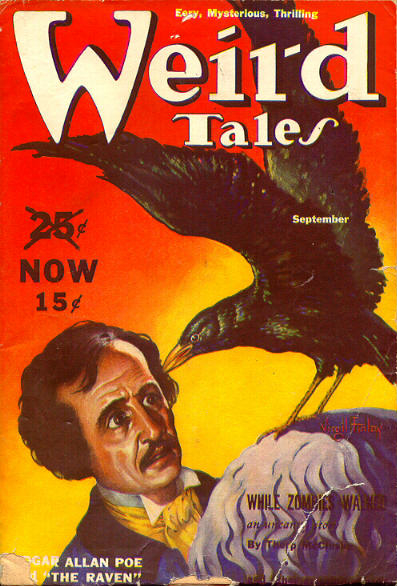
Edgar Allan Poe on the cover of Weird Tales, September 1939, with cover art by Virgil Finlay.

This will have to do until later in the month or maybe into December when I will wrap up this series on the 100-year anniversary of Weird Tales. Until then:

Happy Thanksgiving!

Original text copyright 2023 Terence E. Hanley

Tuesday, November 7, 2023

"The Eyrie," November 1923

There are nineteen letters in Weird Tales for November 1923. It looks like the magazine was gaining pretty rapidly in popularity as 1923 went on. Beyond that, there were some very enthusiastic readers and fans aborning, people who praised and admired Weird Tales, passed issues around to their friends, looked for it on the newsstand every month, and began collecting and keeping issues instead of discarding them. (How many popular magazines went into the trash bin or incinerator in those days!)

One of the first Weird Tales controversies began in November 1924 when the editor, Edwin Baird, printed a letter by Mrs. D.M. Manzer, also known as Isa-belle Manzer, of Amarillo, Texas. The letter is practically illiterate. I can't imagine what the original manuscript would have looked like. Baird asked readers if he should publish the story based on Mrs. Manzer's letter and his brief description of her story. Evidently they said yes, for "The Transparent Ghost" was published as a three-part serial in February, March, and April 1924.

The writers of letters to "The Eyrie," November 1923:
  • Eighteen-year-old Homer O(ldham) Peterson (b. June 12, 1905, Valparaiso, Indiana; d. Dec. 18, 1978, New Castle, Indiana) of Delaware, Ohio, who commented on several stories in previous issues. Peterson went on to become a high school teacher in Ohio and Indiana. He taught English, French, and journalism and was also a champion chess player.
  • Twenty-year-old Cecil John Eustace (b. June 5, 1903, Walton-on-Thames, England; d. 1992) of the Bank of Montreal, St. Catherines, Ontario, who remarked that the August issue of Weird Tales was the first that he had seen in Canada. He was a recent arrival in Canada, having immigrated in August 1922 from his native England. Eustace was a writer of short stories and novels for popular and pulp magazines, including "Ten Days to Live" in Amazing Stories Quarterly, Summer 1928. Later he was an editor at J.M. Dent and Sons in Canada, retiring in 1967. He wrote a dozen books, some of which are novels, others non-fiction. He also collaborated with his daughter, (Elizabeth) Mary Eustace, on a musical. Cecil John Eustace was a Catholic author by the way.
  • Charles G(ilbert) Kidney (1892-1945) of Cleveland, Ohio, who greatly admired Hall's story. Born in Chicago and having died in Ohio, Kidney was buried in the in-between state of Indiana.
  • Sidney E. Johnson of Joplin, Missouri, who predicted that "the fiction center of the United States is going to shift from New York to Chicago." Presumably this was Sidney Evans Johnson (1882-1963). Johnson was like Johnny Appleseed: in his letter he wrote that he scattered copies of the magazine in an effort to grow more readers. Johnson had a second letter in Weird Tales in March 1925.
  • Mrs. Elizabeth Purington (dates uncertain--believe it or not, there were and are several Elizabeth Puringtons in America) of Santa Ana, California, who wrote about a dream she had had.
  • World War I veteran Ralph S. Happel (1892-1963) of Albany, New York.
  • Thomas J. Harris (dates unknown) of Brooklyn, New York.
  • Walter F. McCanless (1876-1965) of Wadesboro, North Carolina. He had a story, "The Phantom Violinist," in the same issue and would have two more letters in "The Eyrie" in 1924.
  • Godfrey Lampert (1898-1968) of Jasper, Indiana, who wrote a letter full of questions. Lampert was an artist, druggist, and city councilman in Jasper, a city known as a maker of office furniture.
  • Lee Andrews (1902-1977) of Indianapolis, Indiana.
  • Mrs. F. Wickman (1885-1942) of Duluth, Minnesota. Mrs. Wickman, aka Rosella (Cole) Wickman, really liked "The Gorilla" by Horatio V. Ellis, as well she should have, for the author, Horatio Vernon Ellis (1895-1945), was her son. And so we have an answer to the question of "Who was  . . ?" so commonly encountered when it comes to tellers of weird tales. 
  • Thirteen-year-old Ralph Fingle (dates unknown; his name may have been misspelled in print) of Long Beach, California, who took a quarter from "a very nearly empty bank" so that he could buy a copy of Weird Tales and read "The People of the Comet."
  • Mrs. Thomas Earl Davison (dates unknown) of Chicago, Illinois, who commented on stories from way back in the first issue. She thought of "The Basket" by Herbert J. Mangham (1896-1967) as "rotten." Believing she could do better, she submitted a story with her letter. I assume that her story is lost forever.
  • Edith Lyle Ragsdale (ca. 1878-?) of Centralia, Illinois, who liked weird stories and went on to write three of her own published in Weird Tales in 1924-1926.
  • E. B. (dates unknown) of West Point, Maine.
  • Gertrude (Carey) Strauss (1866-1929) of Puyallup, Washington, an artist and poet.
Writers of letters were real people who lived real lives. They were not just ghosts with addresses. Maybe we forget that. Isa-belle Manzer notwithstanding, many of the readers of Weird Tales read and wrote at a high level, evidence that pulp magazines were not necessarily trash. And of course many of those readers knew what is weird fiction or a weird tale, and they sought out that genre. Many also liked what they called "the scientific story," or what we would call science fiction, or at least science fantasy. There wasn't yet a name for that type a story--science fiction as a term did not appear in print until 1929--but they sought out that type of story, too, and asked for more.

I have read only a few of the stories published in Weird Tales in 1923, but I sense that in a brief eight months, from March to November of that first year, their average quality improved, while authors were reaching towards just what makes weird fiction, science fiction, and science fantasy. And of course in that first year, H.P. Lovecraft, Clark Ashton Smith, Seabury Quinn, Otis Adelbert Kline, Frank Owen, Anthony M. Rud, and other returning authors made their debut in the magazine. Weird Tales could have died in its first year or two. But there were enough people who believed in it and wanted it to go on--readers included--that it was able to survive. And again, here we are one hundred years later and able to hold in our hands a newly printed issue of "The Unique Magazine," the magazine that never dies.

Homer O. Peterson (1905-1978), far right, in a photograph from the Indianapolis Star Magazine, November 9, 1958, whole page number 153.

Cecil John Eustace (1903-1992), from an article called "New Novel Written as Short Stories" in the Toronto Star, March 9, 1929, page 32.

Forty-five years later, Cecil Eustace with his daughter Mary in the same newspaper, the Toronto Star, November 23, 1974, whole page number 119. Photograph by Dick Darrell.

Godfrey Lampert (1898-1968), third from the left (in the dark suit), from the Jasper, Indiana, Herald, December 31, 1955, page 1.

Original text copyright 2023 Terence E. Hanley