Showing posts with label Jacob Clark Henneberger. Show all posts

Thursday, July 25, 2024

Who Was the Editor of the First-Anniversary Number of Weird Tales?

In the previous entry, I went back in time to January 30 of this year. Now I'm going even further back to almost the beginning of 2024, to an entry of January 6. That entry is entitled "Weird Tales in the First Year (and More)." A question came up in that entry, namely: Who was the editor of the first-anniversary number of Weird Tales? Some comments went back and forth. I can't say that we have a definitive answer. I'm not sure there will ever be a definitive answer. But I would like to summarize what we know.

First: Edwin Baird edited Weird Tales from its inception until, presumably, April 1924 (or maybe only March). There isn't any editor credited in that issue, nor in the issues preceding or following it. Baird was also the editor of Detective Tales, a companion title to Weird Tales and one that preceded it in print, beginning with a first issue on October 1, 1922.

In the spring of 1924, The Rural Publishing Corporation, publisher of both Weird Tales and Detective Tales, was in financial trouble. Co-founded by Jacob C. Henneberger and John M. Lansinger, The Rural Publishing Corporation came to an end with the first-anniversary number of Weird Tales of May/June/July 1924. Baird went with Lansinger and Detective Tales. That left Henneberger with Weird Tales--and no editor.

In my entry of January 6, I called the anniversary number "jumbo-sized" and a "triple issue." It was actually neither. That number, or issue as we say now, had the same number of pages as the first two issues of the magazine, 196 in each. So it wasn't jumbo-sized exactly, although that's still a lot of pages. Also, it wasn't a triple issue, even if it covered a three-month period. In fact, the May/June/July issue of 1924 was a stated quarterly issue, the first and as far as I know only quarterly issue during the first run of the magazine, i.e., from 1923 to 1954. By the way, Edwin Baird died in September 1954, which was when the last issue of Weird Tales came out. I might call that weird, or an instance of the workings of Weird.

So who was the editor of the first-anniversary number of Weird Tales?

Well, in The Weird Tales Story (1977), author Robert Weinberg wrote, without citation: "Otis Adelbert Kline and Farnsworth Wright put together one gigantic issue," i.e., the first-year anniversary issue. (p. 4)

In The Thing's Incredible! The Secret Origins of Weird Tales (2018), author John Locke went into more detail, quoting, first, Kline, who claimed editorship of the issue in a letter to Robert E. Howard's father, dated 1941; and, second, quoting Henneberger, who wrote in 1924 that Baird was the editor until the last issue, i.e., the first-anniversary issue. According to Mr. Locke, Wright had also served as an uncredited editor since April 1924. He wrote: "Wright was the actual editor of the issue in its early stages of preparation [. . .]." Wright quit the company in anger, though, at which point, "Kline was recruited as temporary editor [. . .]." (p. 168) John Locke's conclusion: "all three individuals [Baird, Wright, and Kline] edited the issue!" (p. 168)

Biographer, essayist, book reviewer, and encyclopedist Phil Stephenson-Payne left comments under my entry of January 6, 2024. He had credited Edwin Baird as editor of the first-anniversary number in his online source, The FictionMags Index. (Forget what I have done in this blog. Mr. Stephenson-Payne has done far more in his career.) He quoted an article written by Robert Weinberg and published in Science Fiction, Fantasy, and Weird Fiction Magazines (Greenwood Press, 1985) as follows: that the first-anniversary number was "assembled by Jacob Henneberger and Otis A. Kline from dummies assembled by Baird." After consulting with Mike Ashley and John (presumably) Locke, he left a comment quoting John, as follows:
The short version is that Baird initiated work on the Ann[iversary] Issue in the midst of the "reorganization," which was editorial until the financial axe fell. Mid-course, Baird was pulled off of W[eird] T[ales] to devote his exclusive time to Detective Tales. Wright came in as a part-time interim editor for WT (while J[acob] C[lark] H[enneberger] unsuccessfully tried to recruit [H.P.] Lovecraft). Wright found out about the many debts to contributors, couldn't get any resolution from JCH, and stormed out in protest with the Ann[iversary] Issue unfinished. JCH got Kline to get it out the door. It's fair to say that the issue was edited by Baird, Wright, and Kline, in that order. I don't think it follows that any two of them worked together as co-editors. (Italics and boldface added.)

That sounds like a good and reasonable answer to the question: first Baird, then Wright, and finally Kline had a hand in editing the first-anniversary number, all or some with an assist from Henneberger. Lovecraft famously declined the editorship of the magazine at around that time. What a different world it would have been if he hadn't! In any case, the May/June/July 1924 issue of Weird Tales was the last for several months. Like a revenant, though, it came back in November 1924, then and for the next fifteen and a half years edited by Farnsworth Wright.

Thank you to Phil Stephenson-Payne, Mike Ashley, and John Locke for their information and clarifications. Thanks also to the late Robert Weinberg.

Original text copyright 2024 Terence E. Hanley. Text and comments by John Locke and Phil Stephenson-Payne are their own property.

Friday, March 22, 2024

Weird Tales & George Washington's Axe

Weird Tales was in trouble one hundred years ago this month. Although by March 1924, "The Unique Magazine" had been in print for a full year, and although it seemed to be prospering, Weird Tales was also only two months away from faltering. After the quarterly anniversary number of May/June/July 1924, Weird Tales went into hiding, and things fell apart for its publishers, Jacob C. Henneberger, John M. Lansinger, and their Rural Publishing Corporation of Indianapolis and Chicago. In actuality, things fell apart for Henneberger, for in the spring of 1924, he sold his interest in Detective Tales and College Humor to his business partner and college friend, who took editor Edwin Baird with him. Henneberger was left holding the bag that was Weird Tales.

That's when disinterested businessmen rode in to save the day. I say "disinterested" because they were not fans. Or at least they were not obviously fans. The real saviors were George M. Cornelius (1866-1946) and his son George H. Cornelius (1897-1973) of Cornelius Printing Company of Indianapolis. Other owners and stockholders in the new Popular Fiction Publishing Company, listed in the December 1924 issue of Weird Tales (page 190), were William R. Sprenger (1902-1972), Farnsworth Wright (1888-1940), and J.C. Henneberger (1890-1969). All but Henneberger gave their addresses as 325 North Capitol Avenue, Indianapolis. That was in fact the address of Cornelius Printing Company. I think it safe to say that without Cornelius Printing Company, there would no longer have been a Weird Tales magazine.

As it so happens, Cornelius Printing Company opened its new facility at 2501 East Washington Street in Indianapolis on November 1, 1924, and in December of that year, the staff of The American Legion Weekly moved from New York to the Circle City to assume its activities in Cornelius' new building. If you have kept up on the many biographies I have published on this blog, you will notice that there were many World War I veterans who contributed to Weird Tales, some of whom were also associated with the American Legion.

Now an aside. As I understand it, the Cornelius Printing Company building is still standing just off of East Washington Street, at Tacoma Avenue, in Indianapolis. I remember seeing it on our drives downtown when we were kids. Of course I never knew that it was once the place where Weird Tales originated. I also didn't know that George M. Cornelius and his family once lived in the neighborhood where we lived, they on Layman Avenue, we on Johnson Avenue. C.L. Moore (1911-1987) and her family also lived in Irvington, as did actor and singer Bill Shirley (1921-1989), actress Marjorie Main (1890-1975), cartoonist--or caricaturist as he preferred it--Kin Hubbard (1868-1930), and painter William Forsyth (1854-1935). Cornelius was buried out of Shirley Brothers Mortuary Irving Hill Chapel, a firm founded by Bill Shirley's family and an establishment not far from our childhood home.

* * *

I have had my own disappearance: I haven't written since February 20. I have been busy with my regular work and caught up as always in crisis, loss, grief, and other sad and distressing events. I want to get back to my writing here and to the topic at hand, which is Weird Tales in the spring of 1924 and its three Houdini issues. At least we're still in the centennial season of those events.

* * *

When I last wrote, I let everybody know that I had ordered two copies of Weird Tales #367 but had received only one. That situation hasn't changed. Weird Tales still owes me a copy of issue #367. I have never worked for a magazine, so I don't know who is the responsible party. I guess ultimately it's the publisher's responsibility to meet the obligations of his own company and operations. That includes filling orders I would think. The current publisher of Weird Tales, according to my one copy of issue #367 (out of the two that I ordered) is Weird Tales, Inc., in the person of John Harlacher, who has as his titles Publisher and Creative Director on the title page. Mr. Harlacher is an actor, stage director, and filmmaker. He seems to have an interest in what you might call the pulp genres of horror, fantasy, and science fiction. I don't think it would be very much of a stretch to call him a fan. It looks like he's also a businessman. Weird Tales, Inc., is a business. It's still running. Nevertheless, it still doesn't meet its obligations. This is a really simple thing, Mr. Harlacher, if you're reading: Just send me my magazine. Please. Be a responsible businessman, meet your obligations, and just send me my magazine.

* * *

I'll close with two comments. First, a reply I made to a comment by John of World of Monsters. From March 6, 2024:

As I see it, there are two issues here:

First is the issue of simply running a business. I think if you're going to run a business, you need business people. Good business people know how to run things, keep things going, meet the obligations of the business. Fans usually don't make good business people. They're too close to their subject. Weird Tales has failed before because of a lack of business acumen. One hundred years ago, businessmen--the men who ran Cornelius Printing of Indianapolis--saved Weird Tales. It is because of them that we have it today. The magazine would have otherwise been just a footnote in the history of pulps.

Second is the issue of content, editorial policy, and so on. I'm planning to write about that issue in a series of entries on Weird Tales #367.

Second, Weird Tales as it is today bears a resemblance to the original of a century ago, but is it really the same thing? In one way or another, Weird Tales ended in 1924, 1938, 1940, and 1954, but at least there was continuity in its staff, authors, editorial policies, and so on until that final year. It ended again in 1974, 1983, 1985, 1994, 2012, 2014, and 2020. But even by 1974, it was too late. Weird Tales and the whole universe of pulp magazines and pulp fiction had already come to an end. There was no bringing it back. Yes, there's a magazine now called Weird Tales. And, yes, it has the same main title logo that it had more than ninety years ago, also the same editorial column, "The Eyrie," that it has had from the beginning. But isn't Weird Tales at this point really just a franchise operation, trading on a name and a cachet not its own? It's like Paul Revere and the Raiders or The Guess Who, of which there was or is little or nothing left at the end of what they were at the beginning. Or, to put it another way, Weird Tales today is like George Washington's axe. The handle has been replaced five times and the axehead has been replaced three times, but this is still George Washington's axe. That's the claim that has been made all along anyway. I don't mind that anyone would continue to trade on a long-ended franchise. I like the title, the main title logo, "The Eyrie," and all of the other trappings of Weird Tales. I like that there is tradition in all of these things and more (except for the tradition of not meeting obligations). After all, weird fiction is a traditional and conservative genre. It ought to be based in the past and to draw from the past. But we should all know these things for what they are, and we should all know that they have come to us from out of a time that is gone forever and can never be brought back. Let Weird Tales be an exercise in nostalgia while still updating weird fiction for today. After all, weird is in our lives and we live in a weird world. All of that is fine, as long as we recognize that the Weird Tales of today is not the Weird Tales of one hundred years ago or even seventy years ago or even  . . .

The Cornelius Printing Company building when it was still new, 1924-1925. The building front, located at the end of South Tacoma Avenue in Indianapolis, with its triple windows and double doors, is still recognizable. From the Indianapolis Star, February 4, 1925, page 9. 

Text copyright 2024 Terence E. Hanley

Friday, November 17, 2023

Edgar Allan Poe in the First Year of Weird Tales

This is a very long essay, but as it is about Edgar Allan Poe, I think I should offer it to you all in one piece so that, if you're able, you can read it in one sitting.

* * *

In early 1809, two men were born who would change the nation, though in different realms and at different scales. The first-born of them came into the world in a great eastern city. The second was born on the American frontier. The first was born in the North but grew up in the South. The other made the opposite kind of journey. Both were orphaned in their childhood. Both were frequent failures and had great tragedy in their lives. Both men served in the military, though only for a short time. Both were known for their writing, their words, and their sense of humor.

Both of these men of 1809 died too young, the second-born by violence, the first perhaps also by violence. They died within forty miles of each other, though their deaths were separated by sixteen years and more. The second died in spring, when lilacs bloomed in the dooryard. His death was mourned by millions, and millions witnessed the passing of his funeral train to the final resting place of his earthly body. The second died in autumn. His body was placed in a simple coffin and only a few attended his funeral. The service lasted all of three minutes on a "dark and gloomy [. . . a] raw and threatening day," according to one of the attendees. The headstone of the departed lacked even his name. Only decades after his death did his grave receive proper attention. Now both men are renowned all over the world and both graves are well visited.

The first-born was conservative. In his work, he explored, among other things, the afflicted psyche of the modern man. The other was liberal. He warred against the ancient institution of slavery. The first was one of our greatest writers. There is a professional football team named after one of his poems. The second was one of our greatest presidents. You will see his visage on pennies, five-dollar bills, and the face of Mount Rushmore. It's strange to think that Abraham Lincoln and Edgar Allan Poe were born just twenty-four days apart.

Abraham Lincoln (1809-1865) was and is justly revered in America. There have probably been more books written about him than anyone else in our history. From the moment of his death, the Rail-Splitter, our Great Emancipator, has never been forgotten and is always close in our thoughts as we contemplate the history and meaning of our country. Edgar Allan Poe (1809-1849) on the other hand was slandered at his death, and though his works were still in print for many years afterwards, there were long periods during which he seems to have been almost forgotten, or at least relegated to a minor place in American letters.

That changed as the nineteenth century went on. If you look at the list of collections by Poe in the Internet Speculative Fiction Database, you will see big gaps--1856 to 1869, 1871 to 1878--begin to narrow as the turn of the century approached. And every year or almost every year from about 1888 to today, there has been a collection of Poe's works published somewhere in the world. One of those collections, a fairly early one in fact, was entitled Weird Tales (1895).

Jacob Clark Henneberger (1890-1969), cofounder of Weird Tales magazine, is a curious case. He helped bring Weird Tales to life in 1923 and helped keep it alive in 1924 and after. He seems to have been devoted to the magazine and to weird fiction in general, and yet we have almost nothing from his own hand on any subject at all. He seems to have been almost an invisible partner in the whole affair and to have essentially disappeared after the 1920s. But in a letter dated April 14, 1969, exactly seven months before his death, he wrote to Joel Frieman about his adolescent encounter with Poe:

As a lad of 16 I attended a military academy in Virginia. The English department was headed by one Capt. Stevens, a hunchback who was a rather chauvinistic chap in that he favored Southern writers. One entire semester was devoted to Poe! You can imagine how immersed I became in him. . . . (Ellipses in the original source, WT 50: A Tribute to Weird Tales, edited by Robert A. Weinberg, 1974, page 6.)

The school of which Henneberger wrote was Staunton Military Academy in Staunton, Virginia. Capt. Stevens was Captain Luke Leary Stevens (1878-1944), who, in addition to being a teacher, was a farmer, a school superintendent, and a state representative of his home county.

Note that Henneberger wrote that he became "immersed" in Poe. There is a suggestion but not quite an affirmation that he was in fact a fan of Poe. There is a general lack of information--a lack of being entirely forthcoming--in Henneberger's letter that I find frustrating. Why not tell us the name of the school? Why do we have to "imagine how immersed" in Poe he became? And how exactly did he feel about Poe? Why doesn't he say? But then Henneberger founded and stuck with a magazine based on Poe--or at least I believe that it was based on Poe--and so we should assume, I guess, that he was a fan not only of the author but also of weird, mysterious, and fantastic fiction in general.

H.P. Lovecraft (1890-1937) was much more direct. In his first letter printed in "The Eyrie" (Sept. 1923), he wrote:

"My models are invariably the older writers, especially Poe, who has been my favorite literary figure since early childhood."

This is how you do it, J.C.!

Henneberger and Lovecraft were contemporaries. They were born a little more than six months apart, Lovecraft in an old, Waspish New England city, Henneberger in rural and small-town Pennsylvania Dutch country. Both grew up in the 1890s. Both would presumably have been exposed to Poe's stories and poems by way of collections published during that mauve decade. Both, too, would have turned the golden age of twelve years old in 1902, when several collections, including a 787-page edition of Tales of the Grotesque and Arabesque, were published, all in one year. As I've written before, I think that the most likely source of the title Weird Tales is in the Poe collection Weird Tales, published in 1895 by Henry Altemus Company of Philadelphia. Henneberger was "immersed" in Poe at age sixteen. Poe was Lovecraft's "favorite literary figure since early childhood." Many of Lovecraft's early stories, including "The Outsider" (Weird Tales, Apr. 1926), are very Poesque. Weird Tales itself would seem to have been a revival of and a venue for Poesque tales of mystery and imagination. Maybe its companion title, Detective Tales, was intended to follow in the footsteps of the man who wrote the first detective story in our literature.

Other early contributors to Weird Tales were also Poe fans and Poe admirers. Poe's name was mentioned frequently in early letters to "The Eyrie," including in the very first one, submitted by Anthony M. Rud (1893-1942), author of the very first cover story as well and published in that same first issue, March 1923. Rud, then, was the first reader of Weird Tales to mention Poe in its pages. Many others followed in their letters to "The Eyrie," including:

Walter F. McCanless (1876-1965) was a Southern author. Like Captain Stevens, he hailed from North Carolina, and, like Stevens, who was two years his senior, he was a teacher. Maybe the two men knew each other. In any case, McCanless had a long letter in Weird Tales in March 1924. Part of his letter is a complaint about the short story "The Autobiography of a Blue Ghost" by Don Mark Lemon (1877-1961), which had appeared in Weird Tales in September 1923. In his letter, McCanless also urged the editor, Edwin Baird, not to print "The Transparent Ghost" by Isa-belle Manzer (1872-1944), and for about the same reason that he objected to Lemon's tale, namely, that it would make a farce of Weird Tales. (He was too late: the serialized story "The Transparent Ghost" was already in its second part by then.) McCanless moved on to his main point:

"We, of the South, believe in Edgar Allan Poe. To have it said of one that 'He writes like Poe' is, to our minds, the highest compliment that can be paid one. (By the way, 'The Crawling Death' by P.A. Connelly [sic; Weird Tales, Nov. 1923] is, in my opinion, equal, for thrills, to anything Poe ever wrote.) We, therefore, should hate to see a publication parody his best known style of writing. Poe, however, attempted humor of a sort (example, 'Why the Frenchman Wears His Arm in a Sling'), but with no very great degree of success, since he is best known for horror and mystery stories. To see these parodied by a publication would result in making such a publication taboo in the South. We turn to joke books that do not hurt our pride."

Poe may have been born in Boston, but Southerners, including Luke Leary Stevens and Walter F. McCanless, claimed him as one of their own, and I think rightly so. They were and are protective of Poe. Manly Wade Wellman, an adopted North Carolinian, wrote a story called "The Devil Is Not Mocked" (Unknown Worlds, June 1943). Well, McCanless wanted us to know that people of his region would not stand for Poe or the Poe-like story to be mocked either. By the way, we have probably all noticed that fans of fantasy, including comic book fantasy, take their subject seriously. They don't want it to be made fun of or mistreated in any way. That desire for seriousness goes back at least as far as 1924 and McCanless' letter.

The first editorial mention of Edgar Allan Poe in Weird Tales is in the blurb for "The Sequel" by Walter Scott Story (1879-1955), in the first issue of March 1923. That blurb reads:

Walter Scott Story offers a new conclusion to Edgar Allen [sic] Poe's "Cask of Amontillado"

(You'd think that a magazine based on Poe would spell his name right.)

I'll tell you right off that I think "The Sequel" was a needless effort, one that completely alters the meaning and undoes the intent of Poe's original. Story should have left well enough alone. An overly sensitive reader might even think of his tale as insulting towards Poe or even towards the art of literature in general. That's probably beside the point, which is that early tellers of weird tales were fully conscious of Poe. Some, like Walter Scott Story, wrote imitations, homages, or pastiches. Poe's influence upon certain other authors was more subtle.

Walter McCanless was getting at something when he wrote that Poe "is best known for horror and mystery stories,and it seems to me that very many of the early stories in Weird Tales were one of those two types. Both horror and mystery are broad terms. In a narrower sense, in the case of some of Poe's stories, horror can be taken as psychological horror, an account of the workings of one man's diseased mind, sometimes told from within that mind. "The Tell-Tale Heart" (1843) is an example. As for mystery, we now think of that term in a narrow sense and as the name of a literary genre. There are other kinds of mysteries to be sure. But, again, Poe is credited with having invented the mystery genre, also called the detective story, with his first tale of C. Auguste Dupin, "The Murders in the Rue Morgue" (1841). Both of these examples were reprinted in Weird Tales as "Masterpieces of Weird Fiction."

The Poesque horror story and the Poesque detective tale come at things from two opposite ends. One is a tale of passion, feeling, irrationality. The other is dispassionate, reasoning, scientific. Remember that Poe called his detective stories "tales of ratiocination." He collected several stories of certain other types in Tales of the Grotesque and Arabesque (1840), the title perhaps inspired by Sir Walter Scott's essay, On the Supernatural in Fictitious Composition (1827). I take grotesque and arabesque not as opposites but as two kinds of more or less the same thing. "William Wilson" (1840) and "The Fall of the House of Usher" (1839), two stories of what I think you can call psychological horror, are included in Poe's contents.

The protagonist of the horror story is flawed--physically, mentally, or morally weak or deficient, if not insane. Maybe he is in a long line descended from Jack Williamson's Egyptian-Hebraic hero and a progenitor of the weird-fictional hero of the twentieth century. The Poesque detective, on the other hand, possesses a level and piercing intellect. Later American detectives, being flawed antiheroes, have more in common with the weird-fictional hero. British detectives, perhaps their French counterparts, too, also some prissy Americans, are at a higher level of society. In any event, the tale of ratiocination can be seen as the beginning not only of the detective story but also as a beginning of the science fiction story with its strong, able, and triumphant hero, a man who applies science and reason to all problems, thereby solving them. The bad part about all of that is that there may be very little of the human in the problem and especially in the problem-solving. Otis Adelbert Kline's Dr. Dorp, for example, is basically nonhuman. It's worth noting here that in an essay entitled "Edgar Allan Poe," D.H. Lawrence wrote:

     But Poe is rather a scientist than and artist. He is reducing his own self as a scientist reduces a salt in a crucible. It is an almost chemical analysis of the soul and consciousness. (p. 111)

That essay was published in 1923 of all years. (It was reprinted in The Recognition of Poe, edited by Eric W. Carlson and published in 1966, which is my source for the quote above.) If you read Poe, you might be struck by a lack of moral sense. Maybe he was more a scientist than artist after all. On the other hand, if his subject was himself, then he was both the rational scientist and the tormented and passionate individual placed on the examination table or under the microscope, in other words, a human being and perhaps an artist after all.

So Poe had his horror stories or weird tales and his detective stories or tales of ratiocination. Under J.C. Henneberger and his business partner John M. Lansinger (1892-1963), Detective Tales came first, on October 1, 1922, to be precise. Weird Tales followed of course in March 1923. There was and is crossover between weird fiction and mystery or detective fiction. Batman for example is both a detective and a weird-fictional hero. And as I've written before, "The Call of Cthulhu," doubtless a piece of weird fiction, can also be considered a detective story. (As in "Ooze," see below, the murderer in Lovecraft's story is not human, or at least some of the murders are committed by the nonhuman Cthulhu.) If, in 1923 and after, you had wanted straight science and no horror or weirdness in your literature of choice, you could have read Hugo Gernsback's radio magazines. Or you could have waited until Amazing Stories came along in April 1926, the same month, by the way, in which Weird Tales printed one of Lovecraft's most Poesque stories, "The Outsider." Shortly after that, Lovecraft began writing "The Call of Cthulhu" (Weird Tales, Feb. 1928), a mostly Lovecraftian story of some length, although it now occurs to me that it bears some similarity to "The Narrative of Arthur Gordon Pym of Nantucket" (1838) by Poe.

The first story in the first issue of Weird Tales is "The Dead Man's Tale" by Willard E. Hawkins, a decidedly Poesque story of psychological horror, even if Hawkins was inspired by The Strange Case of Dr. Jekyll and Mr. Hyde by Robert Louis Stevenson (1886). The story is told in the first person by a man deranged by his love for a woman. The first detective story is "The Chain" by Hamilton Craigie, which is ten stories into that inaugural issue. Although there is a somewhat weird element in Craigie's story, it's essentially a tale of ratiocination, and its hero is very nearly without flaw or weakness.

In between those two stories is "Ooze" by Anthony M. Rud, a proto-science-fictional tale of the South but also one involving some detective work, carried out by an urban-dwelling Northerner. (In "Ooze," the Southerners are generally low characters, the Northerners high, or at least medium-high.) In this case, the murderer is a giant amoeba rather than an orangutan, as in "The Murders in the Rue Morgue." As for the first ape in Weird Tales, see "The Extraordinary Experiment of Dr. Calgroni" by Joseph Faus and James Bennett Wooding, also from March 1923 and also a story of super-science. And maybe at this point we should consider that all ape and gorilla stories are descended from "The Murders in the Rue Morgue" and that that was the real gorilla connection in Weird Tales. By the way, Poe paired "The Murders in the Rue Morgue" with another of his stories in a one-bit pamphlet published in 1843. The other is a story called "The Man That Was Used Up" (1839). If you substitute one relative pronoun for another, you get "The Man Who Was Used Up," and so maybe we have another first for Edgar Allan Poe: he wrote the first story with the title construction "The Man Who . . .". The irony is that the pronoun who is used in reference to people, while that is used in reference either to people or things. So who--or what--is the title subject of Poe's story? Is he a man or is he something else?

I'm not sure that Poe was the first literary figure to treat a narrative from the viewpoint of a diseased, depraved, insane, or dysfunctional narrator, in other words, to turn a story upside down by making the villain his protagonist and to try, at least, to make him appear sympathetic, though in a perverse way. There may have been precedent for that in Shakespeare, for example in Othello. I think Poe took a lot from Shakespeare, and I would like to read about parallels in their work. Remember that the word and concept weird may have come to us through ShakespeareThomas De Quincey (1785-1859) and his confessions were a more immediate precedent perhaps. The hero or antihero of Gothic fiction and weird fiction, Nelson Algren's man with a golden arm, the Angry Young Men of postwar British literature--on and on they go--all may very well be descended from Poe's defective protagonists. So just remember the next time you're watching a movie or TV show and find yourself rooting for the thief, the murderer, or the drug addict: you may just be the latest consumer of a Poesque brand of fiction.

The narrator of "The Cask of Amontillado" is named Montresor. Like Iago, he has a complaint against his hapless victim, poor Fortunato. (Or Unfortunato.) You could call him a killer, but killing isn't exactly his aim. Instead, it's a perverse and depraved kind of revenge--or worse. Walter Scott Story's "Sequel" picks up where Poe left off. Story's story is overtly Poesque, a kind of pastiche in fact. Other Poesque tales are more subtle. However, the discerning reader can tell one when he or she sees it. For example, in the July/August 1923 installment of "The Eyrie," H. M. of New York, New York, remarked upon the similarity of "The Devil Plant" by Lyle Wilson Holden (Weird Tales, May 1923) to "The Cask of Amontillado." I have a feeling that if you were to study the first few years of Weird Tales contents, you would find many more parallels--which might be a polite word for ripoffs. We have seen the same thing during the past century regarding Lovecraft and Robert E. Howard. (Not that I've been around for the past century.) That doesn't seem to be the case with Clark Ashton Smith, but how would you ever rip off CAS? With his language, imagery, and vast vocabulary, he seems to have made his work ripoff-proof.

The first mention of Poe in a nonfiction item in Weird Tales is in the first installment of "Weird Crimes"--its subject "Bluebeard"--by Seabury Quinn. That was in October 1923. The first mention in a story is in the March 1924 issue, in "The Fine Art of Suicide" by Howard Rockey (p. 19). Poe is also mentioned and even quoted in "Draconda" by John Martin Leahy. (p. 65; p. 70).

Rockey wrote:

"Some day," he would muse in his lighter moments, "an inspired genius will actually live or die a real story for me--with all the trimmings that even a Poe could desire--and I won"t have to fake a single detail!"

Leahy followed Rockey in his invocation of Poe, but at greater length:

     "You know," I said, "things come crowding into my mind--visions, memories, words spoken or written, some long forgotten. Among the words penned, induced no doubt by what has just been said, this haunting sentence of Poe's:

     "'No thinking being lives who, at some luminous point of his life of thought, has not felt himself lost amid the surges of futile efforts at understanding or believing, that any thing exists greater than his own soul'."

     "So you waded through Eureka. What did you get out of it?"

     "Not much; that and a few others. This, for instance:

     "'We walk about, amid the destinies of our world-existence, encompassed by dim and ever present Memories of a Destiny more vast'." (p. 65)

Then:

     Her figure was tall and slender and willowy. In her depthless eyes, and on and about her full lips, was a look the like of which I had never seen in all my life. It reminded one of sadness, and yet it was not an expression of sadness. If I were to say that it was one of deep experience, there would come, I believe, an idea of harshness or even cruelty perhaps; but there was neither harshness nor cruelty in the eyes of Draconda. It was, I fancy, an expression very like that in the orbs of Poe’s Ligeia: "I have felt it in the ocean--in the falling of a meteor." (p. 70)

I'm not sure that it really means anything, but Eureka (1848) is supposed to have been a work of ratiocination, while "Ligeia" (1838) is a horror story or weird tale.

May/June/July 1924 was past the one-year anniversary of Weird Tales. Nonetheless, I'll point out that Poe's name is mentioned ten times in Otis Adelbert Kline's manifesto-of-sorts "Why Weird Tales." Poe is the first author and "The Murders in the Rue Morgue" the first story mentioned therein. Kline called "The Murders in the Rue Morgue" "[t]he greatest weird story and one of the greatest short stories ever written."

Edgar Allan Poe had fourteen stories and four poems in Weird Tales. Five of the stories were reprinted in the first year of the magazine in the series "Masterpieces of Weird Fiction." They were:

  • "The Murders in the Rue Morgue" (the cover story of the June 1923 issue)
  • "The Pit and the Pendulum" (Oct. 1923)
  • "The Tell-Tale Heart" (Nov. 1923)
  • "The Black Cat" (Jan. 1924)
  • "Never Bet the Devil Your Head"(Mar. 1924)

Poe's next story reprinted in Weird Tales was "The Mask [sic] of the Red Death," in March 1926. The last was "The Fall of the House of Usher" in August 1939. Farnsworth Wright was editor during those years. Dorothy McIlwraith took over his post in 1940. I believe she emphasized new stories, but even she eventually turned to reprinting previously published works. But no more of Edgar Allan Poe.

One last thing regarding Poe and Weird Tales. In his lecture "House of Poe" (1959), poet Richard Wilbur remarked on Poe's repeated use of spirals and vortices in his work. These are in "MS. Found in a Bottle," "Descent into the Maelstrom," "The Fall of the House of Usher," "Metzengerstein," and "King Pest." Wilbur's speculation was that spirals and vortices "had some symbolic value for Poe." His conclusion: "What the spiral inevitably represents in any tale of Poe's is the loss of consciousness, and the descent of the mind into sleep." (The Recognition of Edgar Allan Poe, p. 257). There were circles and spirals on the cover of Weird Tales, but I think these went beyond the symbolism of Poe's stories and sleep was not at their end.
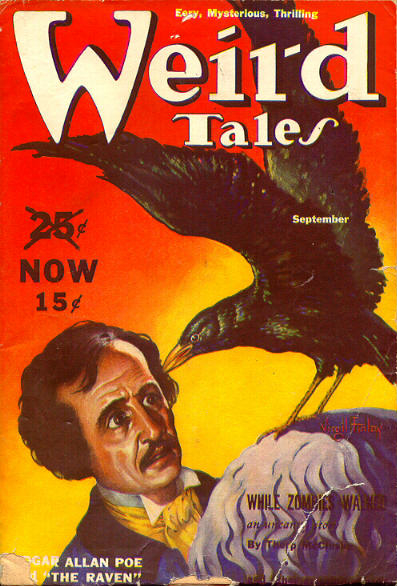
Edgar Allan Poe on the cover of Weird Tales, September 1939, with cover art by Virgil Finlay.

This will have to do until later in the month or maybe into December when I will wrap up this series on the 100-year anniversary of Weird Tales. Until then:

Happy Thanksgiving!

Original text copyright 2023 Terence E. Hanley

Sunday, January 8, 2023

What's in a Title?-Part One

Weird Tales

Weird Tales was the brainchild of Jacob Clark Henneberger (1890-1969), a native Pennsylvanian who arrived in Indianapolis, Indiana, in 1919 after having served in the U.S. Navy during the Great War. Alternating between there and Chicago over the next few years--no one now can be sure of his movements--Henneberger founded, with his business partner John  M. Lansinger (1892-1963), the Rural Publishing Corporation in 1922. Detective Tales came first. Fans of Weird Tales often forget that. The first issue of that very early detective magazine was dated October 1, 1922. Weird Tales came along a few months later, in March 1923.

J.C. Henneberger was long a fan of what we now call weird fiction. As a young student at Staunton Military Academy in Staunton, Virginia, Henneberger encountered Captain Luke Leary Stevens (1878-1944), an instructor in English who favored Southern authors and devoted an entire semester each year to Edgar Allan Poe. I believe it is through Poe and probably Captain Stevens that we have the title Weird Tales.

Like H. P. Lovecraft (1890-1937), Henneberger was born in 1890 and came of age at a time when a mass and popular culture in America was reaching towards full development. Poe's reputation suffered after his death in 1849. But in about 1895-1896, the Henry Altemus Company of Philadelphia began reprinting some of Poe's weird fiction, collected in a number of editions over the following years, all with the title Weird TalesThere were other collections of weird tales, written by other authors, published in the late 1800s and early 1900s, but I don't know of any more likely inspiration for the title of the later magazine than the Henry Altemus editions of Poe's Weird Tales. The last may have been published in 1901. A year later, Hennberger--and Lovecraft--reached that Golden Age of twelve.

The Altemus editions were meant for a mass and popular readership. It's hard to imagine that either of those future writers, Henneberger and Lovecraft, would not have encountered them. Again, I think that the works of Poe were not only the primary source of weird fiction in America but also the source of the title and the term Weird Tales.

To be continued . . .

I am indebted here to a website called Henry Altemus Company, accessible at henryaltemus.com. Everything I have on the Henry Altemus editions of Edgar Allan Poe's Weird Tales, published from about 1895 to about 1901, is from that website. The edition shown above is from 1899. I have altered an image I found on the Internet to get it. We could use straight-on scans of the covers of the Altemus editions rather than oblique photographs if we're going to have a complete study of the origins of Weird Tales magazine.

There were various editions of Poe's Weird Tales, each from a different series published by Altemus. These included the Beauxarts series, the Marqueterie series, the Petit Trianon series, and the Vademecum series. The cover designs across all titles were standardized within these various series. The main differences within each series seem to have been: 1) variations in the color of the covers; and 2) of course the titles and the names of authors, which appear to have been stamped on, again, standardized cover designs. The books in some or all of these series were enclosed within small boxes--something like a slipcase, though not so fine, I guess. Perhaps they were meant as gift books, possibly as inexpensive gift books for a growing popular readership. They may also have been intended for young people and students. Don't take my word for any of this, though. You should puzzle it all out for yourself by visiting the website of the Henry Altemus Company.

The contents of Weird Tales by Edgar Allan Poe (Henry Altemus, ca. 1895-1901 or after) are as follows, from the Internet Speculative Fiction Database:

  • "The Fall of the House of Usher" (1839)
  • "The Tell-Tale Heart" (1843)
  • "Berenice" (1850) (variant of "Berenice--A Tale," 1835)
  • "The Assignation" (1845) (variant of "The Visionary," 1834)
  • "The Pit and the Pendulum" (1842)
  • "The Black Cat" (1843)
  • "The Murders in the Rue Morgue" (1841)
  • "Ligeia" (1838) 
  • "The Gold-Bug" (1843)
  • "The Oval Portrait" (1845)
  • "'Thou Art the Man'" (1844)
  • "Shadow--A Parable" (1850) (variant of "Shadow: A Fable," 1835)
  • "Silence--a Fable" (1850) (variant of "Siope--A Fable," 1838)
  • "Eleonora" (1841)

Of these fourteen works, seven were reprinted in Weird Tales, beginning with "Murders in the Rue Morgue," the cover story of the June 1923 issue. We should note that "The Black Cat" may have been the inspiration for the title of another magazine of popular fiction, The Black Cat, published in Boston beginning in October 1895. The Black Cat influenced, in turn, Weird Tales. One author who had at least one story in both magazines was Clark Ashton Smith.

Text copyright 2023 Terence E. Hanley

Sunday, March 31, 2019

The Thing's Incredible! The Secret Origins of Weird Tales by John Locke (2018)

This month, March 2019, marks the 96th anniversary of the publication of the very first issue of "The Unique Magazine," Weird Tales. That first issue was big: 196 pages and twenty-six stories all together, plus the first installment of a letters column called "The Eyrie." The history of Weird Tales, especially in those early days, is shrouded in mystery. I have written before that if something in biography or history seems not quite right, it's for good reason. There seems to be something not quite right about the early history of Weird Tales, and author John Locke has delved into that not-quite-rightness in his book The Thing's Incredible! The Secret Origins of Weird Tales, 1923-1924, published last year (July 2018) by Off-Trail Publications of Elkhorn, California. Mr. Locke has done his homework, and his book shows it. In reading it, you're likely to come across things you have never seen or heard of before. The main body of text is 229 pages, and its facts are well documented and supported by extensive notes, seven appendices, and two pages of bibliography. Thank God and John Locke that there is also an index, a feature too often lacking in books about popular culture.

A lot of the information on Weird Tales and its founders, Jacob Clark Henninger and John M. Lansinger, is just plain missing and will probably never be recovered, but Mr. Locke makes the best of a bad situation by fleshing in around the missing parts. The result is a series of holes or gaps in a certain shape, and that shape is one of a bitter, final, and irreconcilable break between the two founders of the magazine. It's a wonder that Weird Tales ever got off the ground or survived its first year or year and a half in print. Somebody believed in it, though, and fought for it, and that somebody seems to have been J.C. Henneberger. In my mind, Henneberger was an unlikely hero of weird fiction. There seems to be something not quite right about his story and the early history of his creation. But we have only the evidence, and the evidence is a magazine that should never made it past its infancy--but did. Weird Tales lived for thirty-one years in fact, and since 1954 it has come back again and again--although the current holders of the license or owners of the rights have still not put out an issue since 2014. But that's a story for another day. The point here is to let everyone know that John Locke's book of the early history of Weird Tales is available. You can find it by following this link to the website of Off-Trail Publications:


Text copyright 2019, 2023 Terence E. Hanley

Thursday, December 27, 2018

Orville R. Emerson (1894-1945)-Part Two

I sense two possible connections between Orville R. Emerson and Weird Tales, connections other than his authorship of a story for the first issue of the magazine.

First, Emerson's father, Reverend Frank W. Emerson, was affiliated with the Prohibition Party prior to World War I. Emerson himself was a member of the American Legion, which was established in 1919. In the year of its founding, the American Legion moved its headquarters to Indianapolis, Indiana. That same year, a young man of Pennsylvania, recently out of the U.S. Navy, also relocated to Indianapolis to work on an organ of the Prohibition Party. The young man's name was Jacob Clark Henneberger. In 1922, he formed, with his friend John M. Lansinger, Rural Publishing Corporation. Although the firm was based in Chicago, the editorial offices for its new magazine of 1923, Weird Tales, were in Indianapolis. I think it possible that Orville R. Emerson learned of Weird Tales through his father's connections to the Prohibition Party, more likely through his own connections to the American Legion. Both connections eventually led to Indianapolis, home also of the magazine in which his first and only story was published. By coincidence, the Cornelius Printing Company, which effectively gained control of Weird Tales in 1924, were also the printers of The American Legion Magazine beginning that same year.

Second, Orville R. Emerson was married to Lila Strait, daughter of Mr. and Mrs. J.H. Strait of Redlands, California. J.H. Strait was president of Mutual Orange Distributors of Redlands, which was in business for many years inclusive of the 1920s. Well, in 1920, a future teller of weird tales was working as an orange packer in Redlands, and it wasn't Orville Emerson. Rather, it was F. Georgia Stroup (1882-1952), who had her story "The House of Death" in Weird Tales, by strange coincidence the same month in which Emerson's story "The Grave" appeared. So did F. Georgia Stroup work at Mutual Orange Distributors? And did she know Orville R. Emerson? Could they have talked to each other about their stories and about this new magazine Weird Tales? The possibility is fascinating to consider.


Text copyright 2018, 2023 Terence E. Hanley

Sunday, December 11, 2016

Weird Tales in Indiana

Today, December 11, 2016, is the two-hundredth birthday of the State of Indiana. I would like to say Happy Birthday to my home state and to point out that Weird Tales was born here, in Indianapolis in fact. The founder of the magazine, Jacob Clark Henneberger (1890-1969), arrived in Indianapolis in 1919 to work for a weekly newspaper. He alternated between that city and Chicago for a number of years. For example, he was married in Chicago on June 18, 1919. (His bride was Alma K. Schneidewind.) The city directory of Indianapolis, on the other hand, had him living downtown, at 320 North Meridian Street, in 1920. Henneberger published his first magazine, Collegiate World, in Indianapolis beginning in 1920. In 1922, Henneberger and John M. Lansinger founded Rural Publishing Corporation and went about publishing two genre magazines. The first issue of Detective Tales had a cover date of October 1, 1922. The first issue of Weird Tales followed in March 1923.

Henneberger and Lansinger's joint venture went aground in 1924. In an effort to save Weird Tales, Henneberger gave up Detective Tales and more or less ceded financial ownership of his preferred title to Cornelius Printing Company of Indianapolis. Weird Tales returned to print in November 1924 with Farnsworth Wright at the helm. Like Henneberger before him, Wright lived in Indianapolis and had his offices at the old Baldwin Building (not to be confused with the old Baldwin Piano Building on the Circle). In 1926, Weird Tales moved its offices to Chicago. The Indianapolis era presumably did not end until Weird Tales was purchased by Short Stories, Inc., in 1938, at which point the magazine presumably ceased being printed by Cornelius Printing Company.

Weird Tales relied heavily on artists from Indiana in its first couple of years, especially William F. Heitman (1878-1945), a German-born sketch artist for the Indianapolis Star. Heitman created covers for two issues of "The Unique Magazine" in its first year. Known for his speed with a pen, Heitman illustrated whole issues by himself until the triple, first-anniversary issue of May-June-July 1924. Harry Harrison Kroll (1886-1967) and George Olinick were among the other Hoosier artists to contribute to Weird Tales.

Much is made of "The Big Three"--H.P. Lovecraft, Robert E. Howard, and Clark Ashton Smith--in Weird Tales. If we were to create a category of "The Big Six" or "The Big Ten," we might include at least one Hoosier on that list, C.L. Moore (1911-1987) of Indianapolis. (She grew up only a few blocks from our childhood home.) H. Bedford-Jones (1887-1949) and E. Hoffmann Price (1898-1988), though not native to Indiana, lived there for a time as well. Another prominent Hoosier contributor to Weird Tales was writer Wallace West (1900-1980). There were of course others, but for now I'll let this brief list stand on its own.

The Coke bottle and Clabber Girl Baking Powder were created in Indiana. So, too, was Weird Tales. With that, I would like to say Happy Birthday to my home state, the Hoosier State of Indiana!

Weird Tales, born in Indianapolis in 1923, a little more than one hundred years after the state (1816) and the city (1821) came into being.

Text copyright 2016, 2023 Terence E. Hanley

Saturday, January 2, 2016

Black Holes and the Mushroom Planet

Not long ago, I wrote about Dr. Timothy S. Miller's Botanical Fiction Database. It's a great piece of work. I wish I had compiled it myself. These past few days, I have read a couple of books missing from Dr. Miller's list. Those books might be missing from a lot of lists, for they seem to have been overlooked by science fiction fans. I would like to put that right if I can.

When I was a kid, I read The Wonderful Flight to the Mushroom Planet by Eleanor Cameron (1954). I remember liking the book. I especially remember the beginning, in which a boy reads a newspaper advertisement asking for a spaceship "built by a boy, or by two boys, between the ages of eight and eleven. . . . An adventure and a chance to do a good deed await the boys who build the best space ship." That's a great way to begin a story, and I believe more than one science fiction writer of the 1940s or '50s began his story in a like manner. I also remember the boy's searching for a house on a forgotten backstreet in his town. (The forgotten backstreet is like something from H.P. Lovecraft.) Soon the boy finds the street, a strange mushroom-shaped house located there, and the even stranger inhabitant of that house, Mr. Tyco Bass. I have searched for The Wonderful Flight to the Mushroom Planet since I first read it. Finally, a few weeks ago, I found an old library edition at the local second-hand store. The book is well worn, but it's an original hardbound edition with illustrations by Robert Henneberger. (1) Reading it again after so many years was no disappointment at all.

In December 1954, Collier's ran a three-part serial called "The Body Snatchers" by Jack Finney. The book ends with the defeat of the pods. The narrator describes their departure from earth:
. . . the great pods lifted and rose, climbing up through the faint mist, on and out toward the space they had come from, leaving a fiercely inhospitable planet behind, to move aimlessly on once again, forever, or . . . it didn't matter. (Dell, 1967, p. 189; ellipses in the original) (2)
The Wonderful Flight to the Mushroom Planet was first published in 1954, almost certainly before "The Body Snatchers" appeared in print. It, too, ends with a lifting and rising, when Mr. Bass, a Mushroom person, simply blows away:
I looked out my window when the wind was really getting strong [a boy recounts] and I saw Mr. Bass go up in the air like a leaf in the sky . . . and that was the last of him. . . . He blew away all right. (Little, Brown, and Company, 1954, 1955, p. 195)
Eleanor Cameron and Jack Finney were probably writing their books at about the same time. I doubt that one was influenced or inspired by the other. The coincidence is probably just another example of two minds arriving at the same idea independently and at the same time.

Whether the idea of spores or plant people blown from one planet to another was original with Eleanor Cameron, she may have come up with an innovation in her sequel, Stowaway to the Mushroom Planet, published in 1956. In that book, her two boy heroes, David and Chuck, return to the Mushroom Planet, this time with Mr. Bass' cousin, Mr. Theodosius M. Bass, and an insufferable scientist, Horatio Quimby Peabody. Peabody is a menace of a kind, a type familiar to anyone who has ever known the pretentious, self-absorbed graduate student, hungry with avarice and ambition. He is easily taken care of by the wise people of the Mushroom Planet, Basidium. There is another danger, however, what the author calls a "hole in space," located between earth and Basidium. On their return to earth, the boys witness its power when "a swarm of meteors . . . . as though caught in some giant whirlpool, in some fearsome, invisible maelstrom" sweeps downward and vanishes from sight into the hole (Scholastic, n.d., p. 143). (3) Peabody doesn't witness the marvel himself and doesn't believe the boys. Too bad for him, for in trying to return to the Mushroom Planet on board a stolen spaceship, he is caught by the hole in space. David and Chuck ponder what has happened to him and come to understand that he will stay "just exactly the same as he was the second he plunged in" (p. 173; emphasis in the original). They envision the young scientist
alert, erect, beaming with eager anticipation, speeding through infinities of time, caught in one moment forever--and forever tilted on the invisible edge of attaining what he longed for most--the return to Basidium. (p. 174)
For Peabody, they realize, "there's no time . . . . It's all just one big long NOW" (p. 177). After escaping from the hole, the young scientist remembers his experience as a "horrible dream" of "being wrenched bone from bone" and of "saying over and over . . . without stopping, the words, 'This is forever--' " (p. 183).

So Horatio Quimby Peabody fell into a "hole in space," becoming caught in a never-ending instant, on an "invisible edge" in proximity to, within, or through the hole. Those things should sound familiar to us, for Eleanor Cameron seems to have been describing a black hole, gravitational time dilation, and possibly the event horizon around a black hole.

In 1956.

Prior to what is now called "the Golden Age of Black Holes."

Other science fiction authors had written about time dilation at speeds approaching that of light. In a quick Internet search, I came up with the Viagens series by L. Sprague de Camp (1948-1958), "To the Stars" by L. Ron Hubbard (Feb.-Mar. 1950), Childhood's End by Arthur C. Clarke (1953), "Common Time" by James Blish (Aug. 1953), "One Love Have I" by William F. Nolan (Apr. 1955), "The Long Way Home" by Poul Anderson (Apr.-July 1955), and Time for Stars by Robert A. Heinlein (1956). Others followed, of course. I thought of the movies Interstellar from 2014 and The Black Hole from 1979 (which, like Stowaway to the Mushroom Planet, has a passage through a black hole rather than an orbit around it or a spiraling into it). I also thought of Gateway by Frederik Pohl (1977), which seems to come closest to Eleanor Cameron's original image of being "caught in one moment forever." Strangely enough, I also thought of "Ode on a Grecian Urn" by John Keats (1819) and its lines:

Bold Lover, never, never canst thou kiss,
Though winning near the goal--yet, do not grieve;
She cannot fade, though thou hast not thy bliss,
For ever wilt thou love, and she be fair!

But did any author of fiction before Eleanor Cameron write about time dilation around a black hole or about an event horizon? It doesn't seem very likely, and for that, I think she deserves some credit. (4)

Notes
(1) Robert Henneberger (1921-1999) was a prolific illustrator, yet I am astonished to find that there is nothing about him on the Internet as an artist. I looked through my books on children's literature and still found nothing until I looked in Illustrators of Books for Young People by Martha E. Ward and Dorothy A. Marquardt (1970) and Illustrators of Children's Books, 1946-1956 compiled by Bertha Mahoney Miller, et al. (1958). Born in Baltimore, Maryland, on March 8, 1921, Robert Gow Henneberger was the son of Harry Cole Henneberger (1888-1983) and Anna Esther Bailey (1896-1985). Despite living in the city as a child, Henneberger loved animals and the outdoors. His menagerie included eighty spiders kept in jars in the basement. Henneberger served in the U.S. Navy during World War II, first as an illustrator at Bethesda Naval Hospital, then as a boxer in the South Pacific. His boxing career effectively ended when he was knocked out by the eventual champion, Regis O'Brien of Pittsburgh, Pennsylvania (who also went on to a professional career of 3 wins and 2 losses). After the war, Henneberger attended the Rhode Island School of Design. In 1950, he married Kathryn Lorraine Dalton (1917-2000) in York, Maine. The couple had two children and apparently divided their time between Maine and their home in East Providence, Rhode Island. Mrs. Henneberger, a reporter, feature writer, and editor, worked for newspapers in New York and spent twenty years with the Providence Journal. Her husband illustrated many books over the years, including the first two books of Eleanor Cameron's Mushroom Planet series. He died on January 31, 1999, in York, Maine. In case you're wondering, he and Jacob Clark Henneberger, co-founder of Weird Tales, were fourth cousins, once removed.
(2) That lifting and rising comes at the beginning of the 1978 version of Invasion of the Body Snatchers, a movie that ends in a different kind of defeat.
(3) For more on spirals, see my posting from the other day, "Circles and Spirals on the Cover of Weird Tales."
(4) The time dilation effect in Stowaway to the Mushroom Planet seems to be attributed more to travel at the speed of light and to interdimensional travel than to gravitation. However, Eleanor Cameron seems to have had an intuitive grasp of relativity and its relationships among time, gravity, and the speed of light. I am not the first to recognize the "hole in space" in Stowaway as a black hole. An anonymous contributor to Wikipedia got there before me. You can read a little about Eleanor Cameron and her book on that website in what you might call the "Black Hole Fiction Database" by clicking here
Incidentally, I thought as I was reading her two books that Eleanor Cameron (1912-1996) was British. As it turns out, she was Canadian. Close enough. There is a vague Britishness about her writing. She even has one of the boys exclaim "Crikey!" No American boy has ever said "Crikey!" That Britishness--and a faint too-wholesomeness and sentimentality--only very slightly mars an otherwise fine series.


Original text copyright 2016, 2023 Terence E. Hanley

Friday, September 25, 2015

Jacob Clark Henneberger on Campus

I received a request from a reader in France for a photograph of Jacob Clark Henneberger (1890-1969), co-founder and publisher of Weird Tales magazine. Here is his senior picture from the yearbook of Franklin and Marshall College in Lancaster, Pennsylvania, from 1913. Henneberger was then twenty-three years old. A decade later he published the first issue of Weird Tales, the magazine that--like the past--never dies.

The day before yesterday I had the three hundred thousandth visit to my blog. I figure about half of those are Russian hackers and Chinese spammers, but I want to say thank you to everyone else for reading.

Text and captions copyright 2015, 2023 Terence E. Hanley