Showing posts with label Robert A. Heinlein. Show all posts

Saturday, May 30, 2026

Amelia Calling

In "Reactions & Reactionaries-Part Two," from May 3, 2026, I  wrote:

By the way, earlier this year a British video game character named Amelia escaped from her creators to become a tempter of young men away from the State that wants to prevail over them. (If the society created by the overarching and controlling state is Eden, then let there be no Eve.) In that way, Amelia plays the same role as Julia in 1984, LUH 3417 in THX 1138 (1971), and I-330 in We (1924). There have since become German, Dutch, and other versions of Amelia. I wish them all success, even if they have faded from the news.

I have done some more thinking since then. Call the following an example of the Wikipedia-zation of research. Take the phone off the hook. This is going to take awhile.

Once Amelia escaped from her creators in January of this year, images of her proliferated on the Internet. These included videos, illustrations, and memes. In at least one of these images, Amelia wears a Joy Division t-shirt. I have written before about Joy Division and related topics. You can read what I wrote in the following two entries:

"Joy Connection" (Sept. 1, 2024)

"Joy Connection Revisited" (Nov. 13, 2025)

These have proved to be among the most popular of my postings in the past few years, if the number of visits to a posting is a measure of its popularity. I'm not sure why they are popular, but I like that they are. It's good to stick your finger in the eye of powerful people, including the entirely too powerful people who promote the cult of global warming. Maybe some of you like that idea, too. There will be more of that here, beginning in mere seconds and mere sentences.

I wonder about the significance of Amelia in her Joy Division t-shirt. I'm not British and never have been, but if I had to guess about any significance, it would be that there is something very British--if not uniquely British--about that group. If that's the case, then it's fitting (no pun intended) that Amelia the digital British rebel would wear the t-shirt of a uniquely British band. Maybe the t-shirt thoroughly identifies her as a Briton.

Another Amelia meme shows her lighting her cigarette from a flaming picture of the current prime minister, Keir Starmer. This was after a real-life woman, also in January, lit hers from a photo of the late Iranian leader, who proceeded in February to go up in flames. (Instead of a voodoo doll, hers was a voodoo photo.) Whenever I hear the prime minister's name, I think of Starker from the TV show Get Smart. But Mr. Starmer is no shtarker. On the contrary, he always seems to have a scared look on his face. He should have, for he's in over his head, I think. (He's more like a hapless No. 2 in The Prisoner. I hope there are plenty of prisoners on his island who continue to get his goat.) If he were an American, Two-tier Kier would be a Baby Boomer. Maybe he is in his native land, too. Like H.G. Wells, he's a Fabian socialist. As we know, there are only two kinds of socialists, the evil kind and the stupid kind. I don't think he's evil.

When I wrote about Joy Division in 2024, I made note of the fact that people have associated the group with fascism. I'm sure those same kinds of people will say that Amelia is also fascistic and that she is being used by fascists for their fascistic purposes. As we know, too, anything we disagree with is automatically fascist--no argument, debate, or analysis required. Amelia's wearing of a Joy Division t-shirt would seem to confirm her fascism.

Joy Division's first chart hit was "Love Will Tear Us Apart," which was released in June 1980, after lead singer Ian Curtis had killed himself the month before. If I interpret a quotation I found on Wikipedia correctly, drummer Stephen Morris said that the band was inspired in the composition of their song not only by Frank Sinatra and the American group Sparks but also by the song "I Lost My Heart to a Starship Trooper" by Sarah Brightman of all things. The video for "Love Will Tear Us Apart" was shot in a dark, decaying place. The video for "I Lost My Heart to a Starship Trooper" is bright and science-fictional. The reference in the title of the latter is of course to Robert A. Heinlein's novel Starship Troopers, from 1959. People who see fascists everywhere, even under their own beds, believe that Heinlein was a fascist and Starship Troopers a really fascisticky book. This must be further evidence that Joy Division were fascistic. (1)

Joy Division is considered a post-punk or punk-inspired band. I can't go into punk music here. I don't know enough about it and there isn't enough space. I have already taken up enough in today's entry and will take up a lot more, as you will see. (I could split it, but I would like for all of what I write to be together.) But to me, punk is part anger, and it seems to me that it is descended in part from the Angry Young Men of 1950s British literature. I could be wrong about that. Let me know if I am and how I might better interpret these things. (2)

Keir Starmer was born in 1962, or about the time that the decade of the Angry Young Men ended and that of the unrelated or not-closely-related or maybe-closely-related decade of British New Wave science fiction began. Mr. Starmer seems weak and hesitant to me. Nonetheless, he seems to share in the Angry-Young-Man desire to tear down traditional British society and culture, only in a somewhat slow Fabian way rather than in a fast-motion radical way. He may not be capable of that himself, but he can import people who are, and that's probably good enough for him and his fellow-travelers. If his country falls after he dies--Mr. Starmer is an atheist after all--what does he care? Anyway, what he and people like him fail to understand is the same thing that the Mensheviks failed to understand about the Bolsheviks, which is that less ruthless people will forever fall prey to their more ruthless counterparts. Put another way, once the revolution is accomplished, the man-of-words- or man-of-ideas-type revolutionary is always the first to be stood up against the wall. The ruthless man-of-action-type revolutionary always wins out. The radical always shoots the comparative moderate. In this example, the Green will prevail in the Europeans' perceived Red-Green Alliance, and I don't mean Green of the radical environmentalist type, even if the two Greens are now forming alliances. (3)

Tearing down and overthrowing tradition is of course part of the socialistic or progressive program. But there are those who don't really care about building anything new in its place. Their anger and desire to destroy are everything that they have. Maybe some of the early punk rockers were like that. Angry people can tear down or undermine things in a fierce and angry way. They can also do it in a funny and angry way. The point is that prominent people who were once angry and destructive, or angry and funny, or angry and musically creative have since become what powerful people call fascists if only because they want to preserve their country for their own countrymen and culture. John Cleese appears to be in that category. So does Morrissey. I'm sure there are others. (4) J.K. Rowling isn't in the (extremely) angry or (at all) destructive category, but she has been called a fascist, too.

You don't have to be famous to be labeled a fascist, though. All you have to be is a lover of your own country and culture. (5) All you have to want is not to be deprived of your rights; to have your reputation or livelihood ruined; or to be oppressed, silenced, impoverished, imprisoned, attacked, molested, raped, stabbed, or murdered by the State or its imported myrmidons. If you were anti-establishment in 1976, you might have stomped on, torn up, or defaced the Union Jack. If you are anti-establishment fifty years later, you wave it. That or St. George's flag.

Maybe what we need is for great numbers of Americans continuously and systematically to discomfit, oppose, and offend the British government on behalf of its own people, whom it has silenced and subjugated, and who risk imprisonment just for speaking their minds--or the truth. (6)

We ought to overthrow those who want to overthrow everything--here, in the British Isles, in the rest of the English-speaking world--for the real revolution of the twenty-first century is against the revolutionaries who have finally reached the highest levels of power after so much striving. They used to be on the other side of things, or imagine that they were. Maybe they romanticized themselves that way. Maybe they were once angry young men, filled with punk-era fury. Now they seem tired, but not too tired to oppress the common people who disagree with them. I have read that we live in a post-democratic era in which the people get to vote, and yet their votes mean nothing. Any change cannot be permitted if the governing elite are to retain their power, prestige, and status.

Maybe what we need is a new punk music, a new punk culture, a new punk society, more powerfully anti-establishment than it was fifty years ago. Amelia is calling.

One last thing: Joy Division and New Order have finally made it into the Rock & Roll Hall of Fame, such as it is. Their induction has been announced in the month that I write, April 2026, the same month in which King Charles III has made his happy visit to our shores. Joy Division was formed fifty years ago, in June 1976, so Happy Anniversary, Joy Division!

Notes
(Including two notes that are essays in themselves.)

(1) According to music journalist Jon Savage, Ian Curtis was interested in "romantic and science-fiction literature." One of the songs on the Joy Division album Closer (1980) is called "The Atrocity Exhibition" after J.G. Ballard's experimental novel of the same name published ten years before. Five of its chapters were first in New Worlds, edited by Michael Moorcock. The title story "The Atrocity Exhibition" was originally in New Worlds in September 1966, so sixty years ago. Mr. Moorcock's essay in that issue was "Why So Conservative?" That's an intriguing title, given today's topic. Unfortunately, I can't read it in any source available to me.

Anyway, on the other side of things, record producer Martin Hannett described the Joy Division sound as "dancing music with Gothic overtones." And now I think: could there have been a Gothic/science-fictional convergence in Anglo-American culture in the late 1970s and early 1980s? Could New Wave-type science fiction, with its Gothic, Romantic, or weird-fictional tone, themes, imagery, protagonists, and so on have been a forerunner to such a convergence? If there was such a convergence, it seems to have happened not only in literature but also in music. Whatever might have happened, a new sub-genre of science fiction emerged at that time. Named after a short story by Bruce Bethke (1983), exemplified by a novel by William Gibson (1984), and popularized by Gardner Dozois, it is of course cyberpunk, and so now we're back to punk music . . .

I have noticed how romantic much of the British music of the late 1970s and early to mid 1980s is, for example "Wishing (If I Had a Photograph of You)" by A Flock of Seagulls (1982), "Thieves Like Us" by New Order (1984), "Be Near Me" by ABC (1985), and "I Melt with You" by Modern English (1982), even if the last alludes to nuclear war. (In the video, singer Robbie Grey wears a Nazi-like hat. One of the members of Depeche Mode wears a similar hat in a video for "New Life.") Now I find that there was supposedly a reaction to punk music among musicians and singers called the New Romantics. (I try not to put much stock in what I have called genrefication, either in literature or music.) Their name echoes that of Mr. Gibson's Neuromancer, or vice versa. Spandau Ballet and Roxy Music are associated with the New Romantics. Like Joy Division, the name Spandau Ballet is connected to Nazis and concentration camps. Meanwhile, Bryan Ferry got himself into trouble talking about Nazis. Both he and Tony Hadley, lead singer of Spandau Ballet, are conservative. I guess all of that makes them fascistic, too.

I tell you, once you make a start in the Wikipedia-ziation of your research, you'll find that there is no end. And once you start calling people fascists, there's no end to that, either, because nobody is ever going to agree with you on everything, and like I said in a previous paragraph, anything we disagree with is automatically fascist.

(2) There are lots of confluences between punk music and things about which I have written lately, including 1976 as "year zero" in punk music, as well as anarchistic, nihilistic, leftist, and utopian strains in that music and culture. Remember that Michael Moorcock wrote an essay called "Starship Stormtroopers," dated 1977. If it had been a punk song instead of an essay on science fiction, "Starship Stormtroopers" would have come to us from Year One.

(3) At a march of the religion of pieces in East London late last year, a young leftwing British numbskull said to one of the marchers, "We're on the same side, bro." The man, dressed all in black, including a mask, replied, "No we're not," and marched on.

(4) I don't know anything about the politics of Pet Shop Boys, if they have any politics, but their song and video "West End Girls," from the mid-1980s, seem impossible now. That world from only forty years ago has disappeared as if it never existed. The video seems to have come from another planet. Any of the concerns of the pre-invasion 1980s--the concerns of British singers, musicians, and fans; of all of those East End boys and West End girls; moreover of every young Briton of the past, including of the punk scene--have been completely wiped away, displaced by new concerns, that is if young people are aware enough to have them, which is what Amelia and her appeal are all about, I think. Maybe the young people of today have been called to action against the betrayals of the older generations. And, yes, Boomers, you're among the older generations now, and, yes, many of you have betrayed young people in the worst way.

The music of the past is still young and new. The records and photos and videos from those times are like the figures on Keats' Grecian urn:

And, happy melodist, unwearied,

         For ever piping songs for ever new;

More happy love! more happy, happy love!

         For ever warm and still to be enjoy'd,

                For ever panting, and for ever young;

Ian Curtis and the voices and images of all who lived on will be "for ever young" and they will be forever for the young. In contrast, the image of pudgy leftist Boomer Anthony Albanese in a Joy Division t-shirt is comical, ironic, and cringe, all at the same time, especially considering that he is now powerful, now part of the establishment, now an oppressor. Amelia wears it much better. She may be made only of electrons, but she represents real human beings. She represents youth. For older people to wear youth like a costume is an offense. In the language of the left, it's an act of cultural appropriation. Wearing youth like a costume is an especial offense considering that the establishment is against youth, for it wants to take away young people's freedoms. In 1981, Triumph, a Canadian band, sang, in the voice of the listener, "I'm young now, I'm wild now, I want to be free." A half generation before, The Monkees, an American band, sang their part: "We must be what we're goin' to be/And what we have to be is free," and: "(In this generation)/We gotta be free." Both songs link youth to a yearning to be free. Young people will forever sing such songs, and too many older people will forever do their best to deny them. When you're a traitor to youth, you don't get to claim youth. Take off your Joy Division t-shirt. It's not for you. Once you begin oppressing, brutalizing, exploiting, mutilating, raping, and murdering babies, children, and young people, or once you countenance those things, you have given up on your youth. You have thrown it behind you in rags. You are undeserving of everything that rightfully belongs to the young.

By the way, some people describe Amelia as "goth." That fits in with what I have been writing about and will write about in terms of Gothic and Romantic reactions. Look for more of that in the series to follow.

Update: After I wrote this entry, above and below, the United Kingdom had its local elections. Labour was pretty much slaughtered. Amelia made another appearance a couple of days after that. In a video, she has Prime Minister Shtarker dressed up like a British schoolgirl and delivers him to the type of men who have preyed upon British schoolgirls for many years now, the same type of men who are protected--if not encouraged in their predations--by the British establishment at its various levels. I don't like AI anything, but sometimes it can be useful.

I write these things and Americans talk about them not because we are against the British people but because we are for them. They--you--have given us so much and have so much more to offer the world, not least of which is your music. We do not wish you to be destroyed or for you to destroy yourselves. We want you to turn back another invasion from the Continent. We want you not to make a shameful conquest of yourselves. We want your history, culture, and nation to be preserved and to thrive. We want you here with us instead of our standing alone in the world. We want you not to become Airstrip One or a new caliphate.

(5) If you think that culture is a Nazi codeword, please get a grip, and I don't mean on your revolver.

(6) Update: Now I find that the U.S. government is setting up a website for just that purpose. We'll see how it goes.

Original text copyright 2026 Terence E. Hanley

Thursday, November 6, 2025

Moviemakers Grok the Past

The Faculty (1998) is meta-fictional. Its characters know they're in an alien invasion story, and they refer to other such stories that have appeared in print and on film. It is from other alien invasion stories that they know that if they can neutralize the alien queen they can have all of their friends back and the threat will be ended.

* * * 

If I remember right, there aren't any meta-references in The Breakfast Club (1985). Times changed in the fourteen years that separated the release of these two films. More than fourteen years separated their respective creators. John Hughes, who wrote and directed The Breakfast Club, was an early Baby Boomer. Kevin Williamson who wrote and Robert Rodriguez who directed The Faculty come from Generation X. I don't know if that explains anything exactly, but it's clear that there were some pretty big changes in our culture between the 1980s and the 1990s and early 2000s. You could write a book or a dozen about those changes and what they might mean.

There have been bigger changes since the early 2000s. People still make teenager movies and high school movies, also alien invasion movies, but I feel certain that these are vastly different from similar movies from the past. And why wouldn't they be? Everything changes. Nonetheless, nostalgia seems to prevail. For example, Shoplifters of the World, released in 2021, is about teenagers living in Colorado in 1987 and lamenting the breakup of The Smiths. (The writer and director of the film, Stephen Kijak, is Gen X.) Last time I wrote I mentioned the film Super 8, which was released in 2011. Super 8 is meta in that it's a movie about a movie, made by teenagers in a small city or town in western Ohio. More importantly, it's meta in that it's self-consciously about the past, being set in 1979, the same year, incidentally, in which Alien was released. Remember that The Smashing Pumpkins' biggest and probably best-loved song is called "1979," the video of which is an exercise in nostalgia in which the singer--the storyteller--sits in the backseat of a car, a 1972 Dodge Charger, as his friends from the past go about their night's activities, like a four-and-a-half-minute American Graffiti (released in 1973, set in 1962). He's not really there. He has placed his current self into the seat he occupied in the past, at the outset of his adolescence. (Billy Corgan is Gen X, too.) He's like a ghost from the future, seeing but unseen in that haunted past. The song "1979," by the way, was released in 1996.

Things may be gained but others are always lost. We try to go back, but it proves impossible. We try to recapture the past and must always fail. We will forever find ourselves thrown upon the shores of today, forever marooned in the present. 

* * *

This blog entry is meta-factual. It's a blog entry about my blog. I noticed this past summer that the number of daily visits jumped by a lot. There were nearly 100,000 visits last month and now about 10,000 per day. I can't say why that is. I have suspected that a large number of those visits are actually made by the engines of artificial intelligence (AI). I have a feeling that I'm being ripped off by a lot of machines which are, to be fair to them, even though they don't need it, prompted to do the ripping off by a lot of lazy, stupid, impatient, and ethically challenged people. You know who you are. Or maybe you don't. I have thought about bringing this blog to an end because of AI. I don't do what I do for the benefit of machines and the machine-like people behind the machines. I do what I do for the benefit of people--real human beings of real human feeling, people questing for knowledge of the past and present and of the human culture of that same past and present. I might sound like Jeremiah, but AI might prove the ruination of the Internet, if it isn't already ruined.

* * *

I promised to cover a couple of real-world developments that I found out about during my five-weeks-and-a-day. I found out about one of those while sitting, in late October, at a computer in a university library . . .

On October 27, 2025, Elon Musk launched an online encyclopedia called Grokipedia. I had a feeling that this new website is AI-generated, and it is. I stay away from AI as much as possible. Remember that a vampire cannot enter your house unless you invite him in, but once he's in, you can never get him to go away again. Anyway, I thought I would have a look, and so I searched for the term "Weird Tales." There is a long entry on Weird Tales in Grokipedia. On the day that I looked, there were 110 footnotes in that entry. Eleven of those are in reference to my blog. I don't take any pride in that. Rewards, accolades, and recognition bestowed by machines are worthless, meaningless. But this makes me think that, yes, many of the visits to my blog are from machines. I would like to tell them: Stay away. You're not invited. You're not welcome here. This blog is for human beings only.

* * *

Like Clea DuVall's character in The Faculty, Elon Musk in his new venture refers to the works of Robert A. Heinlein, specifically in his case to Stranger in a Strange Land (1961) and the Martian word grok. Heinlein may have died nearly four decades ago, but his works and influence live on.

Copyright 2025 Terence E. Hanley 

Tuesday, November 4, 2025

An Alien Invasion for Halloween

On Halloween I worked on a windy hilltop and in the evening drove on dark roads under a half-moon, including a road that runs along the route that the funeral train of Abraham Lincoln took from Washington, D.C., to his final resting place in Springfield, Illinois. By the time I got to where I was going, it was too late to do anything Halloween-related, but the next night we watched a scary movie on TV, and so that's what I'll write about today.

The movie is called The Faculty, and it was released in 1998. It's an alien invasion movie that takes place in the fictional town of Herrington, Ohio.* There are lots of characters in The Faculty but not too many. The main characters are high school students, but there are teachers and other faculty, too. The faculty members are taken over by aliens, one by one, and soon the students are, too. Pretty soon it becomes hard to tell who is an alien and who is still human.

The Faculty owes a lot to previous science fiction stories and movies, and it knows and acknowledges that. For example, one character refers to The Body Snatchers by Jack Finney (1954, 1955) as a ripoff of The Puppet Masters by Robert A. Heinlein (1951). I don't see it that way, but that's beside the point. The point is that the moviemakers are letting us know that they know that their own story is essentially a ripoff. Theirs is a deflection but a harmless one. Once we're aware that they're aware, we can sit back and enjoy the movie instead of saying, "This is all just a ripoff." By the way, that character, played by Clea DuVall, is the science fiction expert.** It is from her that the others learn about the nature of the alien threat and how to nullify it. She knows these things only by having read lots of science fiction stories. Like Faye Dunaway's character in The Thomas Crown Affair (1968), she just knows and there isn't any need to find out. It's a neat trick by the moviemakers and avoids a lot of screen time spent on investigations when the main action in the movie is essentially a chase scene and a lot of hiding and sneaking.

The Faculty has things in common with The Blob (1956), too, but nobody in the movie mentions that. They do mention Independence Day (1996), however, and question why aliens would come to Earth in a podunk place in Ohio versus landing on the lawn of the White House. By asking that question, they essentially answer it, for a quiet and insidious invasion is more likely to work beginning in a place where people who are more powerful and more able to resist aren't rather than are.*** Remember that The Invasion of the Body Snatchers (1956) begins in a small town in California and that the alien pods are grown and distributed as like an agricultural product. Rather than a great mother ship, the vehicle of invasion turns out to be a lowly farm truck.

There is in The Faculty an oblique reference to a concept that C.M. Kornbluth memorably covered in his short story "The Silly Season" (1950), namely that we are being softened up for invasion by repeated false reports--or in this case stories and movies about alien invasions--of  flying saucers. If you cry wolf enough times, nobody believes you when the wolf really arrives at your door. I can't say, though, that the movie-makers were aware of Kornbluth's story.

There is one other movie at least to which The Faculty owes a debt, for this film is a lot like a science-fiction version of The Breakfast Club (1985), with Jordana Brewster as Molly Ringwald, Clea DuVall as Ally Sheedy, Shawn Hatosy as Emilio Estevez, Josh Hartnett as Judd Nelson, and Elijah Wood as Anthony Michael Hall. That's an imperfect comparison, but it seems close enough. By the way, Laura Harris is an actress without a counterpart in The Breakfast Club, but there's reason for that. Watch the movie and you'll find out why. Another by-the-way: the queen-mother alien**** in The Faculty, as well as her little offspring, have tentacles. I would say that their lineage can be traced to H.G. Wells' War of the Worlds from a century before.

It's too late to say Happy Halloween for the year 2025. I had intended to but arrived too late. Maybe this is close enough. Next I'll write about a couple of recent developments in the wider world.

----- 

*Super Eight (2011) takes place in Ohio, too, supposedly in western Ohio, even if the name Belmont County comes over the police radio. Belmont County is actually on the exact opposite end of the state. And what is the most populous city in Belmont County? None other than Martins Ferry, birthplace of William Dean Howells.

**She is first shown reading Double Star, another book by Heinlein, published in 1956. While we're on the subject of ripoffs--or call them more politely influences, inspirations, or homages--we can say that Double Star owes a lot to The Prisoner of Zenda by Anthony Hope, from 1894.

***If the train wreck and chemical spill that happened in East Palestine, Ohio, had happened instead in President John Gill's Delaware, there would have been a completely different response from his regime. We can be sure of that.

****Sigourney Weaver of Alien (1979) earns mention in The Faculty as well.

Copyright 2025 Terence E. Hanley 

Sunday, July 13, 2025

From Irvington to the Stars

We lived and grew up in Irvington. Once its own town, Irvington was annexed by the city of Indianapolis in 1902. Irvington is and was a cultured place. Its streets were named for prominent authors and artists of the nineteenth century, including Washington Irving, Nathaniel Hawthorne, James Russell Lowell, John Greenleaf Whittier, Hoosier poetess Sarah Bolton, and John James Audubon. Butler University got its start in Irvington before moving to the north side of Indianapolis. The Disciples of Christ had a prominent place in our neighborhood for decades. We walked past the Christian Church on our way to school. As much as anything, Irvington is now known for its annual Halloween Festival.

The painter William Forsyth lived in Irvington, as did caricaturist Kin Hubbard, creator of Abe Martin. Bill Shirley, the original Prince Charming, was from Irvington. Marjorie Main--Ma Kettle--lived there for a time. So did C.L. Moore (1911-1987). One of the homes in which she and her family lived was around the corner from that of the Cornelius family, who saved Weird Tales from extinction in the 1920s. On the opposite end of the social order, H.H. Holmes murdered and hid the remains of young Howard Pitezel in a house in Irvington in October 1894. Holmes poisoned Pitezel with drugs he had purchased at a local pharmacy. That small fact will come into play shortly. We never heard of Holmes and knew nothing about those events from the distant past. Holmes and everything he did seems to have been forgotten after his execution in 1896.

When we were kids, we walked to a lot of local businesses, many of which were in a Tudor-style block of buildings on the north side of the National Road, U.S. Highway 40, which, in Indianapolis, is called Washington Street. One of those businesses was Peacher Drugs, located at the northwest corner of Washington Street and North Audubon Road.* The pharmacist was Rex Peacher (1913-1983). Only today did I learn his name or anything about him. Peacher started his business in 1956 after having worked for Haag Drugs and probably in other places. He seems to have been destined to become a pharmacist, for if you take away the 'e' from his Christian name, you're left with Rx. Peacher sold everything at auction in September 1975 and retired in 1976. Like Howard Pitezel, he died in October.

Rex Peacher attended Arsenal Technical High School in Indianapolis. One of his classmates was Robert Padgett Moore (1913-1973), who also became a businessman. If you look back two paragraphs, you will see again the surname Moore. In this world of strange coincidences, Rex Peacher's high school classmate was first C.L. Moore's younger brother. Peacher's drugstore was just one block east of the Moores' childhood home, though those two places were separated by decades. Remember that she used the surname Padgett, her grandmother's maiden name, as a shared pseudonym with her husband Henry Kuttner (1915-1958) in their writing lives. Robert Moore was buried out of Shirley Brothers mortuary, run by the family of Bill Shirley.

I don't know whether there was a pharmacy on the site of Rex Peacher's drugstore before he set up shop in 1956. I don't know where in 1894 H.H. Holmes might have bought his killing drugs. But the house in which he committed his crimes was on Julian Avenue, only about four blocks east of the site of Peacher's drugstore. That house is supposed to exist still. Sometime in the twentieth century, though, it was turned to Good.

The entrance to Peacher Drugs, or Peacher's as we called it, sat at a slant facing the street corner. Upon entering the store, if you turned to the right and went all the way to the rear, you would find a shelf upon which plastic model kits were set up for sale. We didn't have much money when we were kids. Revell models were the high-end brand and were mostly out of reach for us. Monogram models were more affordable. Very often, though, we could afford only models from the Lindberg Line, which sold for $1.25 apiece.

I have always liked airplanes, and when I was a kid I usually bought only airplane models. (I made an exception for Aurora monster models, later for the AMT Gigantics series.) I remember building a Grumman Hellcat, one of my favorites, and a Messerschmitt Bf 109. I remember my older brother had an Me 262. Like kids did in those days, we hung our airplane models from the bedroom ceiling. Airplane models hung from the ceiling of the day room in our barracks at Lackland Air Force Base, too. On our last night there, late into the night, I built a C-119 Flying Boxcar to add to the collection. The next day, I slept almost the whole way on the bus to Sheppard Air Force Base. That's where I learned to work on the real thing, in my case the F-16 Fighting Falcon, sometimes in places far from the Irvington of my childhood, including in two war zones.

When I was a kid, I thought the Lindberg Line models were named after Charles Lindbergh. That seemed logical enough: he was a famous airplane pilot, the Lindberg Line were airplane models, and so the models were named in his honor. Only later did I find out that the Lindberg Line was named for the founder of the company, Paul Lindberg (1904-1988). Again, Lindberg models were cheaper than most other brands. The box art wasn't as good and there were fewer parts and fewer decals. But there were enough parts to put wings on a dream. 

I have been writing about Charles Lindbergh and Donald E. Keyhoe (1897-1988). Like Lindbergh, Keyhoe was an aviator. Born in Iowa, he graduated from the U.S. Naval Academy in 1919 and became a pilot in the U.S. Marine Corps. Keyhoe was injured in a plane crash in Guam in 1922 and later discharged. In his convalescence, he began writing. He wrote about aviation for magazines and newspapers, but he also wrote pulp fiction, including early stories for Weird TalesRobert A. Heinlein (1907-1988) also graduated from the U.S. Naval Academy. He, too, was discharged for medical reasons and became a writer of pulp fiction. Both men died in the same year, 1988, nigh on forty years ago. Heinlein of course won a far wider fame.

One of the ideas that came out of the Flying Saucer Era is that Earth was visited in ancient times by people from other planets. Although he wrote mostly on the flying saucers of the present, Keyhoe also touched upon this ancient astronaut hypothesis. Modern-day researchers have traced the origins of the ancient astronaut hypothesis to the works of another pulp-fiction writer, H.P. Lovecraft (1890-1937), especially to "The Call of Cthulhu" (Weird Tales, Feb. 1928) and At the Mountains of Madness (Astounding Stories, Feb.-Mar.-Apr. 1936). I have a feeling the idea goes back farther than that, though perhaps not very much farther. I wonder what, if anything, Charles Fort had to say about the whole matter.

Flying saucers were one of two major religious belief systems to come out of science fiction. The other, Dianetics/Scientology, also draws on the ancient astronaut hypothesis. The story is that a long time ago, in a galactic empire far, far away, an alien named Xenu packed his people into spacecraft that looked like the Douglas DC-8 and proceeded to bring them to Earth. I have seen online images of a Lindberg Line model of the DC-8. One of these bears the Pan Am logo. Remember that in 2001: A Space Odyssey (1968), there are spacecraft with the same logo. These are shown after a long, wordless opening sequence in which ancient astronauts influence pre-men into becoming men. They do this using a monolith that hums because they don't yet know the words. Anyway, there weren't any parts to make Xenu attached to the sprue of those old Lindberg Line models. If you had wanted him, you would have had to build him from scratch, just as his creator did in the dark depths of his twisted mind. By the way, L. Ron Hubbard served in the U.S. Navy, too, and styled himself a hero. Instead I think he was more or less a nincompoop and a far, far cry from Lindbergh, Keyhoe, and Heinlein.

 Next: More on Keyhoe and then an end.

----- 

For my younger brother, whom we have lost and whose birthday was last week.

----- 

*One street was named for a Federalist, the other for a Romantic, both frontiersman. George Washington never set foot in what is now Indiana, but John James Audubon almost certainly did. By the way, the grandmother of my classmate Mary, named Jean Brown Wagoner (1896-1996), was also an Irvingtonian and also an author. She wrote a biography, Martha Washington: Girl of Old Virginia (1947), among others in the Childhood of Famous Americans series published by Bobbs-Merrill of Indianapolis. She came to talk to us and answer questions when we were in grade school. Her father was Hilton U. Brown (1859-1958) of the Indianapolis News, Indianapolis Newspapers, Inc., Butler University, and the Disciples of Christ Church. If I have this right, he lived across the street from the painter William Forsyth.

Copyright 2025 Terence E. Hanley

Saturday, November 19, 2022

Caleb B. Laning (1906-1991)

U.S. Navy Officer, Technical Advisor, Teacher, Writer
Born March 27, 1906, Kansas City, Missouri
Died May 31, 1991, Falls Church, Virginia

Robert Heinlein's friend Cal Laning has come up more than once in this blog. You can find plenty of biographical information on him on the Internet, but it isn't all in one place. And most of what you will find is about his very illustrious naval career--or his death. There is far less on his involvement in science fiction. That information is scattered, too. I'd like to put some of it together here.

Presumably named for his paternal grandfather, Caleb Barrett Laning was born on March 27, 1906, in Kansas City, Missouri, to Levin Dirickson Laning and Jessie Inez (Butt) Laning. For those who know something about the family of John W. Campbell, Jr., there is the birth of a child named Randazzo recorded on the same page as Laning's birth. Sometimes you come upon some very strange coincidences.

Cal Laning graduated from Westport High School in Kansas City in 1924 and attended the U.S. Naval Academy in Annapolis from 1924 to 1929. One of his classmates--and his friend--was Robert A. Heinlein. Both men graduated in 1929, and both were commissioned as ensigns. Laning remained in the Navy throughout the 1930s, in fact throughout his career. Heinlein on the other hand was discharged in 1934 for ill health. Would he have become one of the great science fiction authors if it had not been for a case of tuberculosis? Although what-if questions are a staple of science fiction, they are unanswerable in real life.

In January 1932, Laning introduced his girlfriend Leslyn MacDonald to Heinlein. Heinlein proceeded to take her way and marry her. No hard feelings, I guess: Heinlein and Laning remained friends and even collaborated later in life. In fact there is a fifty-year record of their correspondence with each other. We should see those letters, but I can't say where they are or who controls them. The Heinleins, on the other hand, were married for just sixteen years, from 1932 to 1948, and a good deal of that wasn't very happy.

As a Navy man, Laning specialized in microwave radio, radar, electronics, and communications. As executive officer assigned to the destroyer USS Conyngham (DD-371), Laning was there during the attack on Pearl Harbor and helped to fight back against the Japanese. He continued in combat during World War II, participating in the battles of Midway and Leyte Gulf, as well as the campaign for New Guinea. For his actions as commander of the destroyer USS  Hutchins  (DD-476) at the Battle of Surigao Straits, he received the Navy Cross, the Navy's highest award for valor. Laning also twice received the Legion of Merit, as well as the Gold Star. He was promoted to captain late in the war and to rear admiral afterwards. His headstone refers to service in Korea, too, but I don't have anything on that. Laning's last assignment was as chief of communications for NATO forces in Southern Europe. He retired in 1959, afterwards working for Lockheed Electronics Company and System Development Corporation.

In regards to Cal Laning's involvement in science fiction and science fiction-based developments in the real world, I have three items from two sources on the Internet. First, from the French-language version of Wikipedia:

  • Laning "actively campaigned for the transformation of the US Navy into a 'space navy' and, from 1945, for a first unmanned lunar mission."
  • "Always passionate about science fiction, he is [sic] an active member of the Trap Door Spiders, model of Isaac Asimov's the Black Widowers."

Founded by Fletcher Pratt, the Trap Door Spiders were a writer's club active in New York City from 1944 until the 1990s. Other members included Isaac Asimov, L. Sprague de Camp, Lester del Rey, George O. Smith, and Theodore Sturgeon.

Second, from the English-language version of Wikipedia:

  • "Laning was involved in the development of the U.S. naval Combat Information Center (CIC) during World War II. The idea was taken 'specifically, consciously, and directly' from the spaceship Directrix in the Lensman novels of E. E. Smith, Ph.D., and influenced by the works of his friend, collaborator, and Naval Academy classmate, fellow Missourian Robert Heinlein, but for bureaucratic reasons the source of the idea was not disclosed." [Boldface added.]

Both sources provide documentation, but I don't have access to those original sources.

Cal Laning is also in the Internet Speculative Fiction Database (ISFDb) with two credits:

  • "Flight into the Future," a piece of nonfiction written with Robert A. Heinlein and published in Collier's magazine for August 30, 1947.
  • "System in the Sky," also with Robert A. Heinlein, a sequel to "Flight into the Future" but not put into print until 2011 in The Nonfiction of Robert Heinlein: Volume I.

I haven't read either of these articles. Judging from a letter to the editor of the Bridgewater, New Jersey, Courier-News (Sept. 3, 1947, p. 18), submitted by Herbert M. Merrill (1871-1956), I have the impression that "Flight into the Future" involves the kind of peace-from-above theme common in a certain brand of idealistic and progressive science fiction from H.G. Wells to The Day the Earth Stood StillHere's an article implying a different angle:

(From the Marysville [Ohio] Journal-Tribune, August 22, 1947, page 1. This was actually a syndicated article that went out to newspapers all across America.)

Laning wrote on technical subjects during and after his naval career. According to an article in the Washington Post, published after his death, Laning also wrote unpublished science fiction. At his death, Laning's occupation was, again, writer.

I have one more point about "Flight into the Future," this one regarding the historical context of its publication. Laning and Heinlein's article was published at the end of August 1947. Less than three weeks later, on September 18, 1947, the provisions of the National Security Act of 1947 took effect. These included the establishment of the Department of Defense, the establishment of the U.S. Air Force as a separate branch of the U.S. military, and the establishment of the National Security Council and the Central Intelligence Agency (CIA). Conspiracy theorists should note that the summer during which our national security apparatus changed began on June 24, 1947, when the first flying saucers appeared in the skies over America.

Having lost his wife, with his own health in decline and not wanting to go through what she had gone through at the end, Rear Admiral Caleb B. Laning, USN (ret.) died by suicide on May 31, 1991, in Falls Church, Virginia. In doing so, he made a return to the past, for he shot himself while standing in a boat, using the same pistol his mother had used to kill herself more than seventy years before. Cal Laning was buried at Arlington National Cemetery. One final, terrible irony: his place of death is recorded as a hospital on Gallows Road.

Further Reading
"Decorated Rear Adm. Caleb B. Laning Dies" in the Washington Post, June 8, 1991.
"The Story of One Man's Decision" by Laning Pepper Thompson in the Washington Post, Aug. 20, 1991.

Collier's, August 30, 1947, with cover art by Stan Ekman (1913-1998).

Original text copyright 2022, 2023 Terence E. Hanley

Thursday, November 17, 2022

Literary Circles & Literary Cults

Robert A. Heinlein was such a good and prolific writer and such a full and interesting figure that it will be a long time before the subjects of him and his work are finally worn out. It's fitting that there is a literary society devoted to him. As an English major first time around, I would like to see literary societies devoted to just about anybody.

In reading about Heinlein, I get the sense that he is one of those figures of whom criticism may be considered impermissible, at least in certain circles and on certain topics. There are certain things we're just not allowed to say in regards to him, one of which is that the failure of his second marriage may have been equally his fault as his wife's. And who knows about his first marriage? That was so brief and so long ago that everything from it and everything about it is probably lost.

There are other figures that are similarly considered unassailable. The Islamic Prophet is one. He is believed by his followers, I think, to have been the perfect man. A long time ago, I heard a tall-haired, cigarette-voiced women say the same thing about Elvis. One question that might arise here: If those two men were in a cage match, who would win?

Anyway, Edgar Rice Burroughs is probably in the category of untouchable or unassailable authors. His fans won't permit us to say that he was a pretty lousy writer. Great imagination. Great worlds. But not fully human characters and a terrible writing style. Philip José Farmer is another author with his very devoted fan base. Every year, FarmerCon is held in conjunction with PulpFest. Yes, there is a FarmerCon. I have talked to the men at the Farmer table. Maybe it should be called FarmerTable. I have never read anything by Farmer, though, and so I have nothing to say about his writing. Even if I wanted to say something, and if it were not very favorable, his followers might very well go ballistic. Or since we're talking about Farmer here, maybe that should be ball-istic. But that's only if they could muster enough of the non-science fiction fan's masculinity and vigor to defend themselves and their opinions.

(There's a lot of crossover between science fiction and rock music. Both are led by artists, and the artists have their devoted followers. A lot of rock musicians have been keen on science fiction and have created science-fictional music and science-fictional concept albums. That's a topic for another day, though. One difference between rockers and science fiction fans is that rockers tend to be more vigorous and masculine. For example, Pete Townshend, the true inventor of the Internet by the way, might have been a beanpole when he was young, but that didn't stop him from hitting Roger Daltrey with his guitar. And Roger might be a shrimp, but he still knocked out Pete with one punch. Remember that a famous logo for The Who includes the spear-and-shield symbol of masculinity. [It's hidden in the illustration below.] One of my favorite scenes from The Who's performance at Woodstock is when Pete tells some bearded Marxist freak eff off my effing stage! and then hits him with his guitar. That's how we all ought to respond to these people. Eff off our effing stage! Wham!)

There are women writers in the category of those we're not really allowed to criticize. Virginia Woolf may be one of them. I have a friend whose son was forced to read To the Lighthouse in high school. Imagine being a boy and being tortured in such a way. Don't make them read Virginia Woolf. Let them be boys. Let them read--well, Heinlein. I have a feeling, though, that it is impermissible to say such things. After all, Heinlein and all high school boys are fully charged with toxic masculinity. They are part of a patriarchy that must be smashed. These things have to be gotten rid of. We must read women writers. We must begin with Virginia Woolf.

Margaret Atwood and J.K. Rowling have their devoted fans. There is practically a religion built around The Handmaid's Tale. But neither one of these women is considered untouchable, for both are feminists in the original sense of the word. They're both for, you know, women. And because of that, they must be cancelled, silenced, and erased, the things that, incidentally, women accuse men of doing to women. Women cancelling women. Women silencing women. Women erasing women. Who'd have thunk it? By the way, when I use the words men and women, I mean them in the sense of men and women.

The case of J.K. Rowling reminds me of that of H.P. Lovecraft. When it comes to these two writers, many fans would like to throw out the baby and keep the bathwater. They would rather that Rowling's and Lovecraft's books and stories be anonymous, like the books of the Old Testament, than tolerate the fact that someone has ideas different from their own, or, like Lovecraft, that he has flaws and is therefore human. (Or vice versa.) A reference to babies here is apt.

I don't sense that there are similar circles around writers such as Arthur C. Clarke or Ray Bradbury. (In fact, criticism of Bradbury sometimes seems fashionable.) Maybe it's because they and authors like them did not in their corpus of work create fully realized political, historical, sociological, sexual, or religious systems or worlds. And maybe that's the key: the author who may not be criticized is the same author who creates complete worlds of fantasy into which the reader and fan may fully escape, away from the real world, into the fantastic, where the reader and fan is not frustrated and his life not spoiled, where self-fulfillment, exercises of power, realization of meaning, and even spiritual salvation are possible. Remember here that fan is short for fanatic.

Isaac Asimov may have his circle of defenders or believers. If there is such a circle, some of it would seem lighthearted, as Dr. Asimov seems to have been. Some of it, though, appears more serious, in a cultish kind of way. I think that part has to do with the quasi-Marxism of his psychohistory concept. As we know from critical theory, Marx and his acolytes must never be criticized and everything they do must be tolerated. In contrast, their opponents must not be tolerated and criticism of them and their ideas must be relentless. That might be taking a discussion of Asimov and his psychohistory too far, but remember that we have a weird, scruffy, usually wrong, leftist, Nobel Prize-winning economist who has followed the good doctor in his ideas.

L. Ron Hubbard has his circles of defenders, followers, and believers, but his circles are not literary but something else entirely. They will defend his stories and his writing, but what they're really defending is a belief in their leader. He was-is after all perfect, having purged himself of engrams and raised himself to the eleventieth level of transcendence. So maybe here there are similarities between Hubbard and Heinlein. Maybe one way of looking at the problem of Leslyn MacDonald and her marriage to Robert Heinlein is to see her as a kind of suppressive person. We just don't speak of her--at least in a very favorable way--even though her husband said of her:

Mrs. Heinlein and I are in almost complete collaboration on everything. She never signs any of the stories, but I do better if she's there.

There are of course differences between Hubbard and Heinlein. Maybe you could say that the cult of Heinlein, if there is such a thing, is secular, whereas the cult of Hubbard is pseudo-religious. Also, nobody has ever died because of someone else's faith in and devotion to Heinlein.

Heinlein has his detractors to be sure. He once ran for public office as a Democrat. Now people call him a rightwing kook, a nut job, a fascist. They despise him and never fail to get worked up over him and what he wrote. Some of them seem to suffer from a kind of Heinlein Derangement Syndrome (HDS). They should realize that that's not a good look. The flaw here is that, like his circle of fiercest defenders, sufferers of HDS can't seem to manage thinking about Heinlein and his writings in a dispassionate way. Instead they let their feelings get in the way of their judgment. I guess I have two pieces of advice for people like that: First, if your eye offends you, pluck it out. Second, like Duke Ellington said about music, if it sounds good, it is good. An extension to that might be that no human being is entirely good or entirely bad and nothing that any human being has ever made is perfect. Except for Elvis, we are all imperfect. We are all flawed. That includes Robert A. Heinlein, in his personal life and in everything he ever wrote. In short, in your reading, be even, be discerning, be judicious. If it's good, it's good, and if it's not, it's not. And it doesn't matter who wrote it.

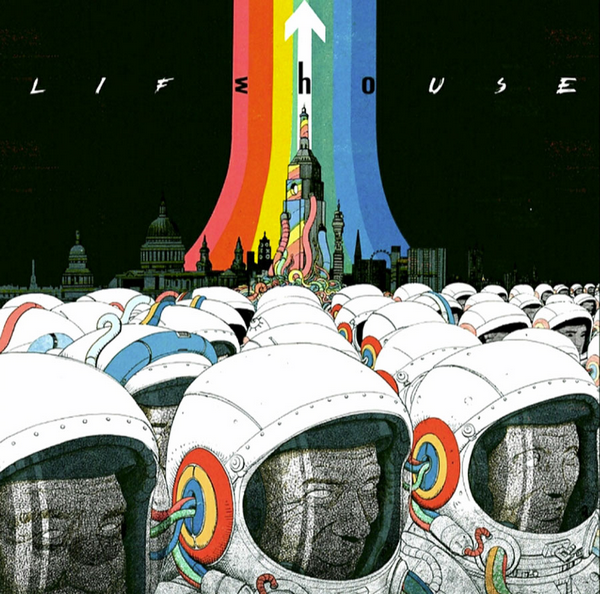
Lifehouse, a multimedia, rock-music-and-science-fiction project created by Pete Townshend inside and outside The Who. Art by James Harvey for Heavy Metal, a project announced for publication in 2020 but maybe not published after all? Note the cables and feeds coming from the lighthouse and into every head.

Pete Townshend and recording equipment, an image that echoes a photograph of James Burke that I posted the other day. Photograph by Chris Morphet / Redferns, originally in The Rolling Stone, February 15, 1969. Again, note the cables and feeds. I do not have rights to either of these images and have reproduced them here under the doctrine of fair use. I will remove them at the request of the copyright holders.

Original text copyright 2022, 2023 Terence E. Hanley

Tuesday, November 15, 2022

Husbands & Wives-Part Four

Robert Anson Heinlein was born on July 7, 1907, in Butler, Missouri. Like his contemporary Loren Eiseley (1907-1977), he was inspired by the sight of Halley's Comet in the night skies of 1910. Both were only toddlers when they saw the comet. Of the two, only Heinlein lived long enough to see it again. (Did he?)

Heinlein attended Central High School in Kansas City, Missouri, where he was a lieutenant colonel in the ROTC, president of the Officer's Club, president of the Shakespeare Literary Society, and captain of the affirmative debate team. One reason for his joining the debate team: he hoped it would help him overcome his stammer.

Heinlein graduated from Central High School in 1924 and from the U.S. Naval Academy in 1929. He served in the Navy from 1929 until 1934, when he was discharged for ill health. On June 21, 1929, shortly after graduating from the Naval Academy, Heinlein married Elinor Leah Curry (1907-1988) of Kansas City. The place was Platte City, Missouri. The couple were divorced a little more than a year later, on October 15, 1930, in Jackson County, Missouri. (1)

In January 1932, Heinlein was introduced to the woman who would soon become is second wife, this by his Navy friend Cal Laning (later Rear Admiral Caleb B. Laning, USN). She was Laning's girl, but Heinlein took her to bed with him that first night. Her mother announced their engagement at a "smart tea" at the bride-to-be's home on February 28, 1932. (2) She and Heinlein were married a month later, on March 28, 1932. The name of Heinlein's new bride was Leslyn MacDonald. (3)

Born on August 29, 1904, in Boston, Massachusetts, Leslyn MacDonald was a graduate of the University of California, Southern Branch, later known as the University of California, Los Angeles. One of her classmates was Agnes DeMille (1905-1993). (Their pictures are side by side in the university yearbook, and they performed together on stage.) Like Agnes DeMille, Leslyn was an artistic type of person, in her case an actress and a poet. And like DeMille, she would later have connections to L. Ron Hubbard, though in a more direct way, as we'll see--and if you can stomach the thought.

I'm sweeping a lot away by writing that the Heinleins were married for sixteen years. Their divorce came on October 14, 1948, in Los Angeles County, California. Before the year was out, she had married Jules G. Mocabee (1919-1966), another Missourian. (4) I'll sweep more away: Leslyn MacDonald Heinlein Mocabee died on April 13, 1981, in Stanislaus County, California. (5) Her family--father, mother, sister, husband--had all gone before her. I believe that she came to a sad end, but then I think her later life was generally sad in one way or another.

Two days after divorcing Leslyn MacDonald, Robert Heinlein married Virginia "Ginny" Doris Gerstenfeldon October 21, 1948, in Raton, New Mexico. She was a New Yorker born on April 22, 1916, in Brooklyn. They had met in 1944 at the Naval Air Experimental Station in Philadelphia, where she was a lieutenant in the WAVES. Ginny Gerstenfeld Heinlein had her own career apart from, then together with, her husband's. She was a chemist and an engineer, also an editor of some of Heinlein's works. After his death on May 8, 1988, she established the Heinlein Society, which is still in existence and has its own website.

The saying is that the winners write the history books. Leslyn MacDonald wasn't a winner. Very little seems to remain of her writing, nothing of course of her thoughts and feelings and memories. Most of what we have comes from only one side of all of this. It isn't her side.

It seems like Leslyn doesn't get a lot of sympathy. Actually she seems to catch a lot of grief for being the cause of her husband's failed marriage. Imagine. She is reputed to have been a pretty bad alcoholic, mentally ill, too. The two enjoyed happier times, though. They include what was then or now called Denvention I, the 3rd World Science Fiction Convention held on July 4-6, 1941, in Denver, Colorado. Heinlein was in fact the guest of honor at that event. Leslyn dressed as Queen Niphar, from the work of James Branch Cabell. In his speech, Heinlein said a few words about his wife that we all ought to remember, now and forever:

Mrs. Heinlein and I are in almost complete collaboration on everything. She never signs any of the stories, but I do better if she's there. (6)

Times change.

Heinlein of course was friends with L. Ron Hubbard, another Navy man and another of John W. Campell's stable of writers for Astounding Science Fiction. At around the time that Heinlein first met Ginny Gerstenfeld--that is, in late 1944--Heinlein gave his wife over to Hubbard. Here is Alec Nevala-Lee's very brief account of the affair. I have abbreviated it even more:

     Around this time, Hubbard also slept with Leslyn. Heinlein evidently encouraged the affair, as Hubbard later remarked: "He almost forced me to sleep with his wife." [. . .] Heinlein may have pushed her into it out of pity for Hubbard [. . .]. (7)

Hubbard of course is not a very reliable source for just about anything, but if it's true that Heinlein "almost forced" him to have sex with Leslyn, or if he encouraged the affair, then we have to rethink both Heinlein and Leslyn and the possible causes of their failed marriage.

There's no need to rethink Hubbard. He will always be what he always was: an utterly repulsive figure. It doesn't matter what you think of your wife. You don't give her over to a man like L. Ron Hubbard. It's like John Cassavetes' character giving his wife over to Satan in Rosemary's Baby (1968), just so he can advance his acting career. (8) Okay, so maybe there were already difficulties in the Heinleins' marriage. Maybe Heinlein already had one foot out the door. Maybe he was beginning to a see a future open up for him with this new redheaded WAVE from Brooklyn. But you don't give your wife over to Satan. Leslyn MacDonald didn't deserve it. There isn't anything she could have done to deserve it. I don't really want to hear about Leslyn's alcoholism, mental illness, or anything else. She didn't deserve it.

* * *

The 1980s took away three of the principals in all of this, Leslyn in 1981, Hubbard in 1986, and Heinlein in 1988. Heinlein's first wife also died in 1988. (9) Virginia Heinlein was the last to go, on January 18, 2003. She was eighty-six years old.

Notes

(1) Sources for some of this information are in an online family tree.

(2) "Engagement Announced" in the Los Angeles Times, March 6, 1932, page 28.

(3) Like John W. Campbell, Jr., Heinlein used a name from the distaff side of his marriage to formulate one of his pseudonyms, Anson MacDonald. His mother's maiden name was Lyle, thus, perhaps, another, Lyle Munroe.

(4) Early on, Jules Mocabee's Christian name was spelled Jewel. I think that's more likely the correct spelling. People used to give their children names like that. I myself know of two older men named Pearl. Heinlein's own mother was named Bam, but in the Federal census of 1880, when she was still an infant, she was Balm. To a really big part of the country, Balm and Bam--rhymes with Mom--are pronounced the same way. And Balm makes sense as a name.

(5) Also from an online family tree.

(6) Quoted in Astounding by Alec Nevala-Lee (2018, 2019), p. 145.

(7) From Astounding, pp. 202-203.

(8) Incidentally, John Cassavetes wrote and directed a movie called Husbands--no wives--released in 1970. It's an interesting movie, a work of ambition and artistry, but ultimately deeply flawed. Long, improvised scenes don't work. Some of them become almost painfully awkward. You'd think that a movie with Ben Gazzara and Peter Falk would work, but this one doesn't very well.

(9) Elinor Curry died on April 25, 1988, thirteen days before her ex-husband.

"Transience," a poem by then seventeen-year-old Leslyn MacDonald, originally in the Los Angeles Times, one hundred and one years ago this week, November 13, 1921, page 149. Her age shows in its composition. There would prove to be transience in her life, as there is in every life. I hope that sunset came to her "with all its peace."

Revised November 16, 2022.
Original text copyright 2022, 2023 Terence E. Hanley

Friday, November 11, 2022

Husbands & Wives-Part Three

John Wood Campbell, Jr., was born on June 8, 1910, in Newark, New Jersey. He attended the Massachusetts Institute of Technology and graduated from Duke University in 1934. As a student living in the Boston area, he met young Doña Stebbins. They were married in 1931, not long after she graduated from high school. Unfortunately I haven't been able to find the exact date or place.

Doña Louise Stuart Stebbins was born on November 27, 1913, in Ohio, possibly in Akron. Her mother, Mary V. Stebbins, was a Canadian-American and--in 1920 at least--a singer in a theater in Boston. Her mother was Martha Stuart, also born in Canada. So by a combination of a version of his wife's given name and her mother's maiden name, Campbell had his nom de plume, Don A. Stuart.

Doña Stuart, or Doña Campbell, was artistic, a singer, a cook, and a hostess in the Campbell home. Campbell called her "a kindly, gentle, and sweet person." (1) She was outgoing where her husband was not. According to Alec Nevala-Lee, she "changed his writing, although it took years for the full implications to emerge." She retyped his stories and corrected his grammar and spelling. "She became his first reader [. . .], and he submitted ideas and openings for her approval." According to L. Ron Hubbard, she was his "sounding board." (2)

In October 1937, Campbell was elevated to the editorship of Astounding Stories, published by Street & Smith Publications, Inc. Within a year or two, he had set off what is now called the Golden Age of Science Fiction. He did this by gathering a stable of young writers, including A.E. van Vogt, Robert A. Heinlein, Isaac Asimov, and Lester del Rey. We remember their names and read their stories even today. Doña, the woman behind the editor, is not so well known.

Campbell and Doña were especially close to Robert A. Heinlein and his wife, Leslyn MacDonald Heinlein. The Campbells' older daughter, Philinda Duane Campbell, called "Peedee" or "Peeds," was born on Leslyn's thirty-sixth birthday, August 29, 1940. Leslyn Heinlein became the namesake of the Campbells' younger daughter, Leslyn Stuart Campbell, born in 1945. The Heinleins were her godparents.

In 1949, Campbell got himself wrapped up in Dianetics. His partner in that work was of course L. Ron Hubbard. That was the end of the line for Doña Campbell, especially, I think, after her husband decided that he should audit their two daughters. She was resistant to Hubbard and Campbell's new brainchild. She warned the Heinleins that Dianetics "would be dangerous 'in the hands of a couple of crackpot world-savers.'" (3) Her insight at that very early date seems to have been rare among science fiction writers. To his credit, Lester del Rey also saw through this newest of pseudosciences.

As people used to say, Doña fled into the arms of another man. He was science fiction author George Oliver Smith. Born on April 9, 1911, in Chicago, Smith was one of Campbell's stable of writers at Astounding from 1942 to 1948. He and Doña were married in 1950. Again, unfortunately, I haven't found the exact date, although the place may have been in Philadelphia. Smith had been married before, too. His first wife was Helen Kunzler (1913-1996). They were married from 1936 to 1948. Smith did not return to the pages of Astounding until 1959. He also had one story in Analog.

John W. Campbell rebounded soon enough after his wife left him, for on June 15, 1951--exactly a week after his forty-first birthday--he married Margaret Winter Kearney. She had been married before. Her marriage to Everett W. Kearney had ended by divorce just two months before, on April 19, 1951, in Gogebic County, Michigan. Nicknamed Peg, she was the sister of Dr. Joseph A. Winter, who had also lent a hand in the development of Dianetics. Peg Campbell was involved in all of that business, too. By coincidence, Dr. Winter died on John W. Campbell's forty-fifth birthday, June 8, 1955.

Campbell remained editor of Astounding Science Fiction, later Analog, until his death, which happened at his home in New Jersey on July 11, 1971. It was Peg Campbell who found him in his chair. She wrote "Postscriptum" in The Best of John W. Campbell, published in 1976.

Doña Louise Stuart Stebbins Campbell White died in May 1974 in Rumson, New Jersey, this according to an undocumented source on the Internet. Margaret "Peg" Winter Kearney Campbell died on August 17, 1979, in Waterville, Maine. George O. Smith wrote a remembrance of the second wife of his second wife's ex-husband. Entitled "In Memoriam: Margaret Winter Campbell," it was published in the February 1980 issue of Isaac Asimov's Science Fiction Magazine. He died a little more than a year later, on May 27, 1981, in Rumson, New Jersey. He was just seventy years old and the last of the main players in these three connected marriages--these three partnerships from which so much science fiction emerged.

Next: The Heinleins

Notes
(1) From a letter to Frank Kelly Freas, June 10, 1955, in The John W. Campbell Letters, Volume 1 (AC Projects, Inc., 1985), p. 286.
(2) These three quotes are from Astounding by Alec Nevala-Lee, p. 60, a book that I have relied on and quoted from more than once in this series. I fully acknowledge Mr. Nevala-Lee's great job of research, analysis, synthesis, and writing, and I urge you to read his book.
(3) From Nevala-Lee, p. 273.

Cover art by Alex Schomburg. Note the byline of James Gunn.

Thanks to Carrington Dixon for corrections.
Revised November 15, 2022.
Original text copyright 2022, 2023 Terence E. Hanley