Showing posts with label German and Austrian Authors. Show all posts

Saturday, January 16, 2016

Edith Ogutsch (1929-1990)

Poet, Author
Born January 30, 1929, Essen, Nordrhein-Westfalen, Germany
Died February 25, 1990, Los Angeles, California

Edith Ogutsch was born in Essen, Germany, on January 30, 1929. Her father, Wilhelm Ogutsch (1893-1944), was a cantor and a teacher of religion. Despite having served his country during World War I, he was Jewish, and so, under the Nazis, considered undesirable or an enemy of the State. On July 20, 1942, he and his wife were deported to Theresienstadt, a concentration camp in what is now the Czech Republic. At Theresienstadt, he taught and held religious services at a children’s home until his death from malnutrition and illness in 1944His wife and Edith's mother, Erna Katz Ogutsch (1893-1971), survived the war and in 1947 immigrated to the United States. She died in New York in December 1971.

When she was ten years old, Edith Ogutsch was sent by her parents by Kindertransport to London.  Eventually she was adopted by a British family named Acker in Manchester. Edith helped her adoptive family by working in their several hotels. In July 1947, she immigrated to the United States, where she was reunited with her mother and her aunt, Emmy Katz (1896-1977). Edith became a naturalized citizen in 1953.

Edith Ogutsch's poems were published in EnsignFiddleheadGood Housekeeping, Negro Digest, the Los Angeles Times, The New YorkerReader’s Digest, Riverside Quarterly, The Saturday Evening PostWormwood Review, and other publications. She was active in science fiction fandom and contributed to several science fiction and fantasy magazines. Following is a list of her genre poems from the Internet Speculative Fiction Database (except for the first item):
  • A poem in Challenge #4 (Spring 1951)
  • "Reflections of an Egyptian Princess While Being Interred" in Weird Tales (Jan. 1954; reprinted in The Diversifier #20, May 1977)
  • "Musings of an Insomniac" in Fire and Sleet and Candlelight (Arkham House, 1961)
  • "Premonition" in Fire and Sleet and Candlelight (Arkham House, 1961)
  • "A Recluse Answers" in Omniumgathum: An Anthology of Verse by Top Authors in the Field of Fantasy (Stygian Isle Press, 1976)
  • "Immortality" in Omniumgathum (1976)
  • "Listen! The Grass is Dying" in Omniumgathum (1976)
  • "Nightmare Number Ten" in Omniumgathum (1976)
  • "Me" in Fantasy Crosswinds #2 (Jan. 1977)
  • "The Parade" in Fantasy Crosswinds #2 (Jan. 1977)
  • "Lethal Lure" in Escape #1 (Fall 1977)
  • "The Vampire" in Escape #1 (Fall 1977)
  • "A Wish Come True" in The Diversifier #23 (Nov. 1977)
  • "To a Meteor in a Planetarium" in Fantasy Crossroads #13 (June 1978)
  • "Midnight Wine" in The Anthology of Speculative Poetry #4 (1980)
In addition, Edith co-authored a short story, "The Ideas," with Ross Rocklynne, published in Witchcraft & Sorcery #5 (Jan./Feb. 1971). And she wrote two published essays on Hannes Bok, "A Memorial for Hannes Bok" in and flight of angels: The Life and Legend of Hannes Bok (1968), and "The Rambunctious Bok" in Escape #1 (Fall 1977), the latter with Bok.

Like Bok before her, Edith Ogutsch was found dead in her home, in her case, in Los Angeles on February 25, 1990. She was buried at Home of Peace Cemetery in San Diego.

Here is a science fiction limerick by Edith Ogutsch:

The alkaloid natives of Pollux
Engage in the strangest of frollux--
They each get their kicks
Chewing alkali sticks
Which makes them, of course, alkihollux.

Edith Ogutsch's Poem in Weird Tales
"Reflections of an Egyptian Princess While Being Interred" (Jan. 1954)

Further Reading
Guide to the Papers of the Ogutsch and Katz Family, 1893-1988, at the Leo Baeck Institute Center for Jewish History, New York, New York.
You can see photographs of Edith Ogutsch and others at Fun-Con 1, from July 1968, at the following URL:

http://www.lasfsinc.info/index.php?option=com_content&task=view&id=287&Itemid=514

Here is a poem from The Children's Newspaper, a British newspaper, from March 17, 1945. It shows, I think, a young poet learning her craft. We should remember that when this poem of the joy of spring was published, the poet's mother was imprisoned within the Nazi Reich, her father had already died, and the continent of Europe lay in ruins.
Edith Ogutsch's first published genre work may have been in this publication, Challenge: The Poetry of the Atomic Age #1.4 (Spring 1951). Lilith Lorraine was editor. Also represented in its pages were Clark Ashton Smith, Stanton A. Coblentz, Evelyn Thorne, Vera L. Eckert, Orma McMormick, Isabelle E. Dinwiddie, Emili A. Thompson, Michael Wolf, Clive Jackson, Alan Donovan, Dariell Dunay, and others. 

Text and captions copyright 2016, 2023 Terence E. Hanley

Wednesday, December 16, 2015

Curtis W. Casewit (1922-2002)

Soldier, Author, Outdoorsman
Born March 21, 1922, Mannheim, Germany
Died March 2, 2002, Denver, Colorado

Curtis Werner Casewit was born on March 21, 1922, in Mannheim, a city in southwestern Germany, not far from the French border. During World War II, he served in the French army and as a translator for the British army. After the war, in 1948, he immigrated to the United States and settled in Colorado, where he set about a career as a writer. Casewit wrote four stories for Weird Tales in 1952-1954. He also had stories in Amazing Stories, Fantastic Universe, and Super-Science Fiction. His genre credits make a short enough list to show here in its entirety:
  • "The Mask" in Weird Tales (Mar. 1952)
  • "Table Number 16" in Weird Tales (Sept. 1952)
  • "Fermentation" in Weird Tales (Nov. 1952)
  • "Transfusion" in Amazing Stories (June 1953)
  • "The French Way" in Fantastic Universe (Oct. 1953)
  • "Prediction" in Weird Tales (May 1954)
  • "The Advantages Are Tremendous" in Fantastic Universe (Aug. 1955)
  • "Bright Flowers of Mars" in Super-Science Fiction (Apr. 1957)
  • "The Martian Wine" in Super-Science Fiction (Aug. 1958)
  • The Peacemakers (science fiction novel, 1960)
  • Adventure in Deepmore Cave (adventure novel [?], 1965)
Casewit also wrote nonfiction, especially on skiing, mountaineering, and careers. His books include:
  • Ski Racing: Advice by the Experts (1963)
  • The Adventures of Snowshoe Thompson (1970)
  • Mountain Troopers: The Story of the Tenth Mountain Division (1972)
  • Overseas Jobs: The Ten Best Countries (1972)
  • Adventure Guide to Colorado (1973, with Steve Cohen)
  • Freelance Photography: Advice from the Pros (1974)
  • America's Tennis Book (1975)
  • Colorado, Off the Beaten Path
  • The Hiking-Climbing Handbook
  • How to Make Money from Travel Writing
  • The Complete Book of Mountain Sports (1978)
  • The Stop Smoking Book for Teens (1980)
  • Graphology Handbook (1980)
  • Making a Living in The Fine Arts: Advice from the Pros (1981)
  • The Saga of the Mountain Soldiers: The Story of the Tenth Mountain Division (1981)
  • The Diary: A Complete Guide to Journal Writing (1982)
  • Quit Smoking (1983)
  • The Skier’s Companion (1984)
  • How to Get a Job Overseas
  • Handwriting Never Lies . . .
  • Tennis Resorts
  • The Mountain World
  • The Mountaineering Handbook: An Invitation To Climbing
  • Foreign Jobs: The Most Popular Countries
  • Freelance Writing: Advice from the Pros (1985)
  • Skier's Guide to Colorado (1993)
Curtis Casewit died on March 2, 2002, in Denver. He was seventy-nine years old.

Curtis W. Casewit's Stories in Weird Tales
See the list above.

Further Reading
Casewit's papers are at the University of Southern Mississippi de Grummond Children's Literature Collection. There is an article on him in the Dutch-language Wikipedia.

The Peacemakers, a British edition from 1963.
And an American paperback edition from 1968. The cover artists are unknown.

Text copyright 2015, 2023 Terence E. Hanley

Saturday, May 2, 2015

Franz Nabl and the Austrian P.E.N. Club

I would like to take a break from my series on Francis Stevens and write a little on Franz Nabl and the Austrian P.E.N. Club. There are actually two tellers of weird tales in this story, one at the beginning and one near the end. Franz Nabl comes at the beginning.

I have written about Franz Nabl before, on October 24, 2013. You can read that article by clicking here. Lars Dangel provided the information that linked Franz Habl, the name listed in Jaffery and Cook's index to the writers and artists in Weird Tales, to Franz Nabl, the real Austrian author. Once you know his real name, it's easy to find information on him.

According to Herbert Herzmann in Major Figures of Austrian Literature: The Interwar Years 1918-1938 (1995), Franz Nabl was born on July 16, 1883, in Litschau, Bohemia, now in Austria. (In my earlier article, I had his birthplace as Lautschin, Austria-Hungary, now Loučeň, a city in the Czech Republic. That information came from the German version of Wikipedia.) Nabl's father, also named Franz, was the manager of an estate owned by the German Princely House of Thurn und Taxis. The elder Franz retired early and acquired his own estate, Gstettenhof, in Lower Austria. That's where Franz Nabl the son spent most of his childhood.

Franz Nabl studied law at Vienna University but left before attaining his degree. In 1905 (according to Mr. Hertzmann), he married Hermengild Lampa and about that time became a freelance writer. Nabl suffered from poor health, thus avoiding military service during the Great War. He was editor of Grazer Tagblatt from 1924 to 1927, but the success of a play freed him from the need for regular work and he returned to freelance writing. Mr. Herzmann describes the main theme and thrust of Nabl's work:
Most of his narratives tell of the attempt of an individual to free himself or herself from the restrictions of the environment in order to achieve something like autonomy, autarky, self-sufficiency, or freedom . . . . The notion of "Wiedergeburt" (rebirth) plays a decisive role in [his work]. [One of his characters explains that] each one of us . . . is sooner or later faced with the decision of whether to undergo rebirth. If we decide for it, we must annihilate ("vernichten") all remains of our former self. (1)
Franz Nabl wrote nineteen plays and books published from 1905 to 1990. He died on January 19, 1974, in Graz, at age ninety.

I am revisiting the biography of Franz Nabl, whose main body of work was published before World War II, because of a controversy of today, in fact, of this week. Nabl was a member of the Austrian P.E.N. Club, a branch of the international organization of poets, essayists, and novelists. In May 1933--eighty-two years ago this month--the International P.E.N. Club held its 11th annual congress in Ragusa, Italy, now Dubrovnik, Croatia. Earlier that month, the German Student Union had burned thousands of books in Berlin.
When the Austrian PEN delegation introduced a resolution condemning the students' action [wrote Donald G. Daviau], the German representatives walked out of the meeting in protest, accompanied by the Austrians Grete von Urbanitzky, head of the Austrian group, Felix Salten, the publisher Paul Zsolnay, Egon Caesar Corti[,] who even at this early juncture was a convinced National Socialist, and others. (2)
The split became permanent the following month when a number of pro-Austrian members of the Austrian P.E.N. Club passed a resolution "defending intellectual freedom and condemning the abolition of human rights and the persecution of writers in Nazi Germany." (3) A dozen and a half (or more) writers resigned from the club in protest. Franz Nabl was among them. Although Nabl never joined the Nazi party,
there is no doubt that he allowed the new regime [after the Anschluss in 1938] to support and use him, at least partly because of the views he held at the time. (4)
Mr. Herzmann described those views as "increasingly authoritarian and even reactionary" as the 1930s progressed. Although Nabl's reputation was restored somewhat after the war, it will probably always exist under the shadow of Nazism.

This week, on May 5, 2015, at the PEN Literary Gala in New York City, PEN America will bestow upon the French satirical newspaper Charlie Hebdo the PEN/Toni and James C. Goodale Freedom of Expression Courage Award. You would think that would not be a controversial award, but we now live in an age in which all things are politicized. One hundred forty-five members of PEN have signed a letter objecting to the award, believing, I suppose, that continuing to exercise one's freedom of expression under very serious threats of violence that prove to be more than mere threats does not constitute sufficient courage. Novelist Peter Carey specifically objects to "PEN’s seeming blindness to the cultural arrogance of the French nation, which does not recognize its moral obligation to a large and disempowered segment of their population." (5) Just as the pro-German writers of the Austrian P.E.N. Club decided in favor of the suppression of free thought and free expression in 1933, so, too, do 145 members of PEN International today. Incredibly, Joyce Carol Oates is among them.

Joyce Carol Oates was born on June 16, 1937, in Lockport, New York, and received her bachelor's degree from Syracuse University (1960) and her master's degree from the University of Wisconsin-Madison (1961). Her first book was a collection of short stories entitled By the North Gate, published in 1963. Ms. Oates is considered a mainstream writer, but like innumerable writers in the American mainstream, she has delved into the Gothic tradition. (I'm not sure that American literature is separable from Gothicism.) The Internet Speculative Fiction Database lists her stories and essays in the fields of horror, fantasy, and science fiction. They go back to her first published work. In 1997, Ecco Press published Tales of H.P. Lovecraft, selected and introduced by Ms. Oates. Her connections to Weird Tales go deeper than that, with works of fiction and non-fiction appearing in the newer incarnations of the magazine.

Peter Carey it seems has succumbed to politically correct idiocy. Joyce Carol Oates' comments on the PEN controversy are pretty mild in comparison, but I think they also represent a misunderstanding that people have about cartoonists and humorists in general. (6) I won't go into any great length. I will just say that it's obvious to me that Charlie Hebdo is not racist (the leftist's favorite cry), that in fact it is an equal-opportunity offender, and that everybody ought to just calm down and get a sense of humor. The next thing you know, people will start calling Blazing Saddles racist and want to shoot holes into Mel Brooks, one of our great national treasures. But then there have always been people who have wanted to shoot holes into people like Mel Brooks (and Felix Salten and Paul Zsolnay and Joyce Carol Oates' grandmother). In 1933, they were called Nazis. Today they go by a different name. Then and now, they had supporters, defenders, and apologists. It's just too bad that writers--supposedly thoughtful, well-educated, intelligent people--are among them.

Notes
(1) "Franz Nabl" by Herbert Herzmann in Major Figures of Austrian Literature: The Interwar Years 1918-1938, edited by Donald G. Daviau (Ariadne Press, 1995), p. 299.
(2) From "Introduction" by Donald G. Daviau in Major Figures of Austrian Literature: The Interwar Years 1918-1938 (Ariadne Press, 1995), p. 62.
(3) Ditto, p. 63.
(4) Herzmann, p. 318.
(5) From "Six PEN Members Decline Gala After Award for Charlie Hebdo" by Jennifer Schuessler on the website of PEN America, here.
(6) You can read her little tweets about the whole PEN/Charlie Hebdo affair in an article called "Joyce Carol Oates, Francine Prose, and Salman Rushdie Speak Out about Charlie Hebdo PEN Award" by Isabella Biedenharn on the website of Entertainment (Apr. 30, 2015), here.

You can read more about the controversy on my blog, Indiana Illustrators and Hoosier Cartoonists, here.


Franz Nabl (1883-1974)

Copyright 2015, 2o23 Terence E. Hanley

Friday, December 19, 2014

A.J. Mordtmann (1839-1912)

August Justus Mordtmann
Aka Dr. Eisenhart, R.A. Guthmann, N.N. Guthmann, R. von A. Duroy-Warnatz (1)
Civil Servant, Journalist, Editor, Author, Classical Scholar
Born February 27, 1839, Hamburg, Germany
Died April 30, 1912, Darmstadt, Germany

August Justus Mordtmann was a German author, editor, and journalist born in Hamburg on February 27, 1839. He was the son of Andreas David Mordtmann (1811-1879), a teacher, diplomat, and Orientalist, and the brother of Andreas David Mordtmann II (1837-?), an author and historian, and Johann Heinrich Mordtmann (1852-1932), who, like his father, was a diplomat and Orientalist.

August J. Mordtmann received his education in Anklam and at the famed Johanneum school in Hamburg. (2) He then went to work in the customs and tax office (Zoll- und Akziſe-Deputation), then in the post office, all in his native city. Mordtmann served during the Franco-Prussian War of 1870-1871 and did not begin his career as a writer and editor until 1881.

Mordtmann was a friend of the German teacher, writer, and journalist Ernst Otto Hopp (1841-1910). Hopp edited Deutschen (Schorerschen) Familienblatt (translated as Family Blade or Family Paper) beginning in 1881 and founded the weekly Echo in 1882. Mordtmann was an editor with the Familienblatt in 1882-1883 and worked on Echo with Hopp. Mordtmann also edited Görlitzer Nachrichten (Görlitzer News) from 1883 to 1888 and was editor-in-chief of Münchner Neuesten Nachrichten (Münchner Latest News), in Munich, until 1902.

August Justus Mordtmann is little known today, but he was a prolific author. His works include the following: Aus zwei Welten (From Two Worlds, 1882), Das Goldene Vliess (The Golden Fleece, 1883), Märchenprinzessin (Fairy Princess, 1890), Der Untergang der Hibernia (The Sinking of the Hibernia, 1891), Kronjuwelen (Crown Jewels, 1892), Belladonna (1893), Max Ingram (1894), Der Vagabund (The VagabondThe Rover, or The Tramp, 1895), Sneewittchen (Snow White1896), Schlangenring (Snake Ring, 1898), Familienschmuck (Family Jewels, 1899), Die Insel Zipangu (The Island Cipangu, 1899, illustrated by Hugo L. Braune), Albumblatt (Album Leaf, Sheet, or Page, 1900), Die Abrechnung mit England (The Settlement with England, 1900), Sonnige Tage (Sunny Day, 1901), Perlen der Adhermiducht (Pearls of Adhermiducht, 1902 and 1905), Leukothea (1903), Konigin von Golkonda (Queen of Golconda, 1906), Jasillü-Tasch, Zacharula: Zwei Geschichten vom "Golden Horn" (Jasillü-Tasch, Zacharula: Two Tales from "Golden Horn", 1908), Pfingsten (Pentecost, 1909), Violanta (1911), Aus tiefer Not (From Great Distress, 1922), Eine halbe Stunde (Half an Hour), and Pater Unselm (3). Mordtmann also wrote the libretto for the operetta Der Fürst von Sevilla (The Prince of Seville, 1889) and may also have written works of history or geography.

Mordtmann wrote one story in Weird Tales. It is called "The Ship That Committed Suicide," and it appeared in the issue for March 1936. I am fairly certain that the translator was Roy Temple House, who had written a brief review of a German-language collection of ghost stories some years before and who was a regular translator of European stories for Weird Tales. The collection of German ghost stories about which he wrote is called Der Untergang der Carnatic: Spukgeschichten (The Sinking of the Carnatic: Ghost Stories), and it was published in 1927 by Deutsche-Dichter-Gedächtnis-Stiftung of Hamburg. The title story, "Der Untergang der Carnatic," is the work of A.J. Mordtmann and was almost certainly the basis for Roy Temple House's translation for Weird Tales. In his review, published in Books Abroad in January 1929, House called Mordtmann's tale the most realistic of all to appear in the collection. "There are also shudderers by the Grimms, Wilhelm Hauff, Friedrich Gerstäcker, Paul Heyse, and Heinrich Zschokke," wrote House. The illustrations were by A. Paul Weber, and I believe Benno Diederich also contributed to the collection, perhaps as editor or the author of an introduction.

The story "Der Untergang der Carnatic" is an episode in a longer work by A.J. Mordtmann, Die Perlen der Adhermiducht, which was originally published in the magazine Deutschen Romanbibliothek (German Novel Library) in 1902, then published in hardback in 1905. I will quote from Axel Weiss:
Die Perlen der Adhermiducht is an epistolary novel consisting mainly of letters one Lydia Thompson receives from several admirers. A central part of the story is the adventurous hunt for the pearl necklace of the Adhermiducht. (In the book "Adhermiducht" is the name of a princess of the Sassanids). In the end it is revealed that most of these adventures are simply made up to impress the lady--so is the tale of the sinking of the Carnatic.
In his study of ghost stories, Von Gespenstergeschichten, ihrer Technik und ihrer Literatur (On Ghost Stories, Their Art and Their Literature, Leipzig: Schmidt & Spring, 1903), Dr. Benno Diederich described Deutschen Romanbibliothek as having an inclination for telling stories with a spooky atmosphere, and German adventure stories as being less grotesque than their English counterparts. Dr. Diederich gave "Der Untergang der Carnatic" as an example. The title by the way translates as "The Sinking of the Carnatic." Axel Weiss describes it as "a ghostship-story taking place in the Antarctic region." The SS Carnatic was a real ship that foundered in the mouth of the Gulf of Suez in 1869. In addition to Mordtmann's story, the ship is mentioned in Around the World in Eighty Days by Jules Verne (1872).

August Justus Mordtmann died on April 30, 1912, at age seventy-three. I have found out about him only recently after hearing from Axel Weiss, the editor and layout designer for the German magazine Cthulhu Libria and the co-host of a podcast called Arkham Insiders. (Click on the titles for links.) Mr. Weiss wrote to me regarding A.J. Mordtmann because he would like to read the English translation of "The Ship That Committed Suicide" from Weird Tales. I don't have a collection of Weird Tales myself, so I ask:
Can anyone provide Axel Weiss with a copy or scan of "The Ship That Committed Suicide" by A.J. Mordtmann, from Weird Tales, March 1936?
If so, please contact me and I will put you in touch with him, or I will forward your reply to him.

Now, on to two issues that have come up in this article.

First, "Der Untergang der Carnatic" is an episode from Die Perlen der Adhermiducht, a story originally published in the magazine Deutschen Romanbibliothek in 1902. According to Dr. Benno Diederich, Deutschen Romanbibliothek had an inclination for telling stories with a spooky atmosphere. I don't know what kind of magazine it was. I have found only five references to that title on the Internet, and all are in German--and in Fraktur script! Der Orchideengarten: Phantastische Blätter (The Orchid Garden: Fantastic Leaves, 1919), a German title, is supposed to have been the first magazine in the world devoted to literature of the fantastic. Could Deutschen Romanbibliothek have been a forerunner? Or was Deutschen Romanbibliothek itself the first magazine of that type? Axel Weiss provides an answer:
Deutsche Romanbibliothek was a weekly magazine comparable to Charles DickensAll the Year Round (1859-1895). Die Perlen der Adhermiducht was printed throughout the thirtieth volume (1902). The magazine was not exactly specialized in uncanny tales but hosted a broad range of romantic, adventurous, and humorous novels and poems. Most of its authors are now forgotten (so is the magazine itself); among those who won a little bit of fame was Eva von Baudissin (1869-1943).
So if Der Orchideengarten: Phantastische Blätter is comparable to Weird Tales, perhaps Deutsche Romanbibliothek was like The Black Cat or The Argosy, which printed a variety of genres, including adventure and fantasy.

Second, "Der Untergang der Carnatic" was reprinted in the book Der Untergang der Carnatic: Spukgeschichten (Hamburg, 1927). The other authors in that book are the Brothers Grimm, Wilhelm Hauff, Friedrich Gerstäcker, Paul Heyse, and Heinrich Zschokke. A. Paul Weber was the illustrator. Farnsworth Wright, editor of Weird Tales, had previously used the book Modern Ghosts (1890) as a source of stories from the Old World. It's nice to think that he could have used Der Untergang der Carnatic: Spukgeschichten for yet more stories, translated of course by Roy Temple House. Instead, Weird Tales reprinted Mordtmann's tale and just one story by Wilhelm Hauff, "The Severed Hand," from October 1925. ("The Severed Hand" is not from Der Untergang der Carnatic: Spukgeschichten--see the list of contents below.) So who were those other authors, the illustrator, A. Paul Weber, and the contributor, Dr. Benno Diederich? First a list of their stories, then a few facts about each.

Der Untergang der Carnatic: Spukgeschichten (Hamburg, 1927)
Illustrated by A. Paul Weber
Contents
"Märchen von einem, der auszog, das Fürchten zu lernen" ("The Story of a Youth Who Went Forth to Learn about Fear") by Brüder Grimm
"Die Höhle von Steenfoll" ("The Cave of Steenfoll") by Wilhelm Hauff
"Das rote Haus" ("The Red House") by Friedrich Gerstäcker
"Germelshausen" by Friedrich Gerstäcker
"Die schöne Abigail" ("The Beautiful Abigail") by Paul Heyse
"Der Untergang der Carnatic" ("The Sinking of the Carnatic") by A.J. Mordtmann
"Die Nacht in Brezwewmeisl" ("Night in Brezwewmeisl") by Heinrich Zschokke

Contributors
The Brothers Grimm--Jacob Grimm (1785-1863) and Wilhelm Grimm (1786-1859), together the Brothers Grimm, are among the most famous storytellers of all time. You can read more about them on your own.
Wilhelm Hauff (1802-1827)--You can read more about Wilhelm Hauff in my posting "Weird Tales from Germany and Austria," here.
Friedrich Gerstäcker (1816-1872)--A traveler, adventurer, travel writer, novelist, and oddly enough honorary citizen of Arkansas, Friedrich Gerstäcker wrote the story "Germelshausen," upon which the Broadway musical Brigadoon (1947) may or may not have been based.  
Paul Heyse (1830-1914)--Paul Heyse wrote novels, short stories, poems, and plays and for his work was awarded the Nobel Prize in literature in 1910.
August Justus Mordtmann (1839-1912)--His biography is here in front of you.
Heinrich Zschokke (1771-1848)--Heinrich Zschokke was a novelist, playwright, historian, journalist, teacher, and civil servant. He spent most of his life in Switzerland.
A. Paul Weber (1893-1980)--Commercial artist, illustrator, lithographer, and painter Andreas Paul Weber was an artist whose work can be called weird without hesitation, but it also has a political dimension. There is information on him all over the Internet, including on the website of the A. Paul Weber Museum, here.
Dr. Benno Diederich (1870-1947)--Benno Diederich was a teacher, scholar, philologist, author, and biographer. Among his works is the aforementioned Von Gespenstergeschichten, ihrer Technik und ihrer Literatur (1903) and a biography of Alphonse Daudet. Diederich's daughter was the painter, illustrator, writer, and stage designer Ursula Schuh (1908-1993). I will quote Axel Weiss once again:
Benno Diederich is indeed the man who saved Mordtmann's ghost ship tale from ruin. [H]e featured it in Von Gespenstergeschichten, ihrer Technik und ihrer Literatur in 1903 and once again in Der Untergang der Carnatic: Spukgeschichten (1927). But there is one more title to mention where it has been collected: Das Buch der seltsamen Geschichten (The Book of Strange Tales), an anthology published by Norbert Falk in 1914. Since 1945 "Der Untergang der Carnatic" has been reprinted seven times in Germany; finally it appeared as a recording on the audiobook CD Das Geisterschiff (The Ghost Ship) in 2004.
Of all the authors listed here, only August Justus Mordtmann is unrepresented on the Internet by an original work of biography. I hope I have done my part in correcting that oversight. I would like to acknowledge the great contribution of Axel Weiss and to thank him for giving me a start on August Justus Mordtmann.

This is probably my last entry on Tellers of Weird Tales for 2014. I hope everyone has a Merry Christmas and a Happy New Year.

A.J. Mordtmann's Story in Weird Tales
"The Ship That Committed Suicide" (Mar. 1936)

Further Reading
Gespenstergeschichten, ihrer Technik und ihrer Literatur by Dr. Benno Diederich (Leipzig: Schmidt & Spring, 1903), p. 176+.
Deutschlands, Österreich-Ungarns und der Schweiz Gelehrte, Künstler und Schriftsteller in Wort und Bild (Leipzig, 1908), p. 321.
Lexikon der deutschen Dichter und Prosaisten vom Beginn des 19. Jahrhunderts bis zur Gegenwart, Volumes 5 and 6 (?), by Franz Brümmer (Leipzig, 1913), p. 27.
Deutsche Biographische Enzyklopädie, [Volume] 7: Menghin-Potel, by Walter de Gruyter (Munchen: K.G. Saur, 2007), p. 189.

Notes
(1) Mordtmann apparently also wrote under a pseudonym which is some variation of the name for a traditional Turkish storyteller, Hodscha Nasreddin.
(2) The character Otto Lidenbrock from Journey to the Center of the Earth by Jules Verne (1864) is a professor at the Johanneum, the first of two references to Verne's work you will find in this article.
(3) I have transcribed this list from sources printed in German Fraktur script. I'm not sure that I have translated them or certain other words or phrases correctly from Fraktur to a modern typeface. My task is complicated by the fact that I know only a few words in German and nothing at all about German grammar. The list is from Deutschlands, Österreich-Ungarns und der Schweiz Gelehrte, Künstler und Schriftsteller in Wort und Bild (Leipzig, 1908), found on the Internet by clicking here, and from Lexikon der deutschen Dichter und Prosaisten vom Beginn des 19. Jahrhunderts bis zur Gegenwart by Franz Brümmer (Leipzig, 1913), found by clicking here. I invite corrections, comments, and additions.

Die Perlen der Adhermiducht by A.J. Mordtmann, serialized in Deutsche Romanbibliothek in 1902. The script is Fraktur, not easy for our American eyes. Translating it takes two translations: from Fraktur to a modern typeface, then from German into English. In my original article (from Dec. 19), I made a few mistakes. Axel Weiss has offered corrections, and I have included them in my revision of today, December 20.
Das Buch der seltsamen Geschichten (The Book of Strange Tales, Berlin: Ullstein and Company, 1914), in which "Der Untergang der Carnatic" appeared. The editor was Norbert Falk.
Mordtmann's story appeared once again as the title story in Der Untergang der Carnatic: Spukgeschichten (Hamburg, 1927).
Die Insel Zipangu (The Island Cipangu, 1899) by A.J. Mordtmann, illustrated by Hugo L. Braune.
Aus tiefer Not (From Great Distress, 1922) by A.J. Mordtmann, published posthumously. Axel Weiss provided this image, as well as the first and second images shown above.

A postage stamp showing the work of A. Paul Weber, illustrator of Der Untergang der Carnatic: Spukgeschichten.

Revised December 20 & 21, 2014.
Many thanks to Axel Weiss.
Text and captions copyright 2014, 2023 Terence E. Hanley
Axel Weiss' comments are copyright 2014, 2021 Axel Weiss.

Saturday, October 25, 2014

Kurt Barle-A Speculation

Kurt Barle wrote one story for Weird Tales. Published in the February 1935 issue, "Anything Could Happen" was his only story in the field of fantasy and science fiction. If it had been translated from the German, I might have a little more confidence in this speculation. Anyway, here it goes.

Curt (or Kurt) Schwabe-Barlewin was born on May 19, 1892, in Varel, near Oldenburg, Germany. On September 27, 1938, he and his family--wife Frieda and sons Arthur and Paul--sailed from Hamburg, Germany, on board the S.S. President Roosevelt. He gave his occupation as merchant and his race or people as Hebrew. The family arrived in New York on October 9, 1938. While the Schwabe family was en route to the United States, Nazi Germany began its occupation of the Sudetenland. Only a month later, on November 9-10, 1938, came Kristallnacht, the Night of Broken Glass. Curt Schwabe had made previous trips to America in March 1926, September 1930, and June 1937. He had also previously traveled to Argentina and Canada. In 1938, he apparently came to stay.

In the 1940 census, the Schwabe family was enumerated in Watsonville, California. Curt was then the proprietor of a lunchroom. When he filled out his draft card during World War II, he was unemployed and gave an address in Santa Cruz. That city would remain his place of residence for the next couple of decades. Curt Schwabe died on August 13, 1971, in Los Angeles city or county.

The 1940 census is useful for giving, for those enumerated, their place of residence in 1935. Curt Schwabe gave his place of residence in 1935 as Varel, the city of his birth. (In 1934, he was listed in a local directory as a milliner.) In February 1935, "Anything Can Happen" by Kurt Barle was published in Weird Tales. Presumably Curt (or Kurt) Schwabe-Barlewin was then in Germany. If he was the author, perhaps the story was translated. But if he was a well-traveled merchant who had made trips to South and North American, perhaps he knew English well enough to write a story. In any case, that is my speculation and the best that I can do considering there isn't any Kurt Barle in the United States census.

Copyright 2014, 2023 Terence E. Hanley

Saturday, December 7, 2013

Anton M. Oliver (1888-1977?)

Writer, Mechanical Engineer, Violinist, Actor, Salesman, Advertising Agent
Born May 20, 1888, Budapest, Austria-Hungary
Died 1977?

Anton Mareček Oliver was born on May 20, 1888, in Budapest to Johann Oliver and Paulina Pavlik. He served for a year as a lieutenant in the Austrian infantry and graduated from Vienna University in 1909. Oliver arrived in the United States before World War I and lived in Akron, Ohio, beginning in 1912. He worked as a mechanical engineer there, according to a contemporary advertisement doing "steam tests, shop drawings, special machinery, and [the] working out of patents." In about 1929, he moved to Hagerstown, Maryland. By 1940 he was in Pelham, New York.

Oliver was a violinist and played with the Cleveland Symphony Orchestra. On February 4, 1912, he married Beatrice Stowers, a singer, in Summit County, Ohio, presumably in Akron. He later married Ruth Frances Fiske, also a singer, as well as the former social editor and a columnist for the Mount Vernon (New York) Daily Argus, originally of Wilkinsburg, Pennsylvania, and of New York, New York, on November 15, 1953.

In 1917, when he filled out his draft card, Oliver was in Spokane, Washington, and employed by the Goodyear Tire Company. Oliver also worked for the Campbell-Ewald Company, Rickard and Company, and the Pangborn Corporation. He spent eight years with the McGraw-Hill Publishing Company, the last three as executive assistant to the president. In 1947, he formed Beatty and Oliver advertising agency with Robert S. BeattyAnton Oliver was also a writer for The Coal Industry, India Rubber Review, The Kindergarten-Primary Magazine, and Power Plant Engineering. His lone story for Weird Tales was "The Living Nightmare" from the second issue, April 1923.

Anton M. Oliver may have married a woman named Erika Kloz. That Anton M. Oliver died in 1977 and was buried at Muddy Brook Cemetery in Great Barrington, Massachusetts.

Anton M. Oliver's Story in Weird Tales
"The Living Nightmare" (Apr. 1923)

Further Reading
None that I can find.

Anton M. Oliver's short story "The Living Nightmare" was in the April 1923 issue of Weird Tales. The cover was by R.M. Mally.

Thanks to Donna Brown of the Mason Library, Great Barrington, Massachusetts, for further research.
Updated on November 14, 2018. Revised and corrected on April 23, 2023.
Text and captions copyright 2013, 2023 Terence E. Hanley

Tuesday, November 12, 2013

Laurence R. D'Orsay (1887-1947)

Pseudonym of Leopold Alexander Thalmayer
Aka Laurence Thalmore
Author, Critic, Literary Agent
Born November 8, 1887, Vienna, Austria
Died November 21, 1947, Los Angeles City or County

Laurence Rex D'Orsay was the pseudonym of a man named Leopold Alexander Thalmayer, also known as Laurence Thalmore. (1) He was born on November 8, 1887 (or 1893), in Vienna, Austria. In 1911 he was living in London, England. Five years later (on March 14, 1916), he arrived in New York with a woman who was ostensibly his British-born wife, Renette. She seems to have vanished from the public record after that.

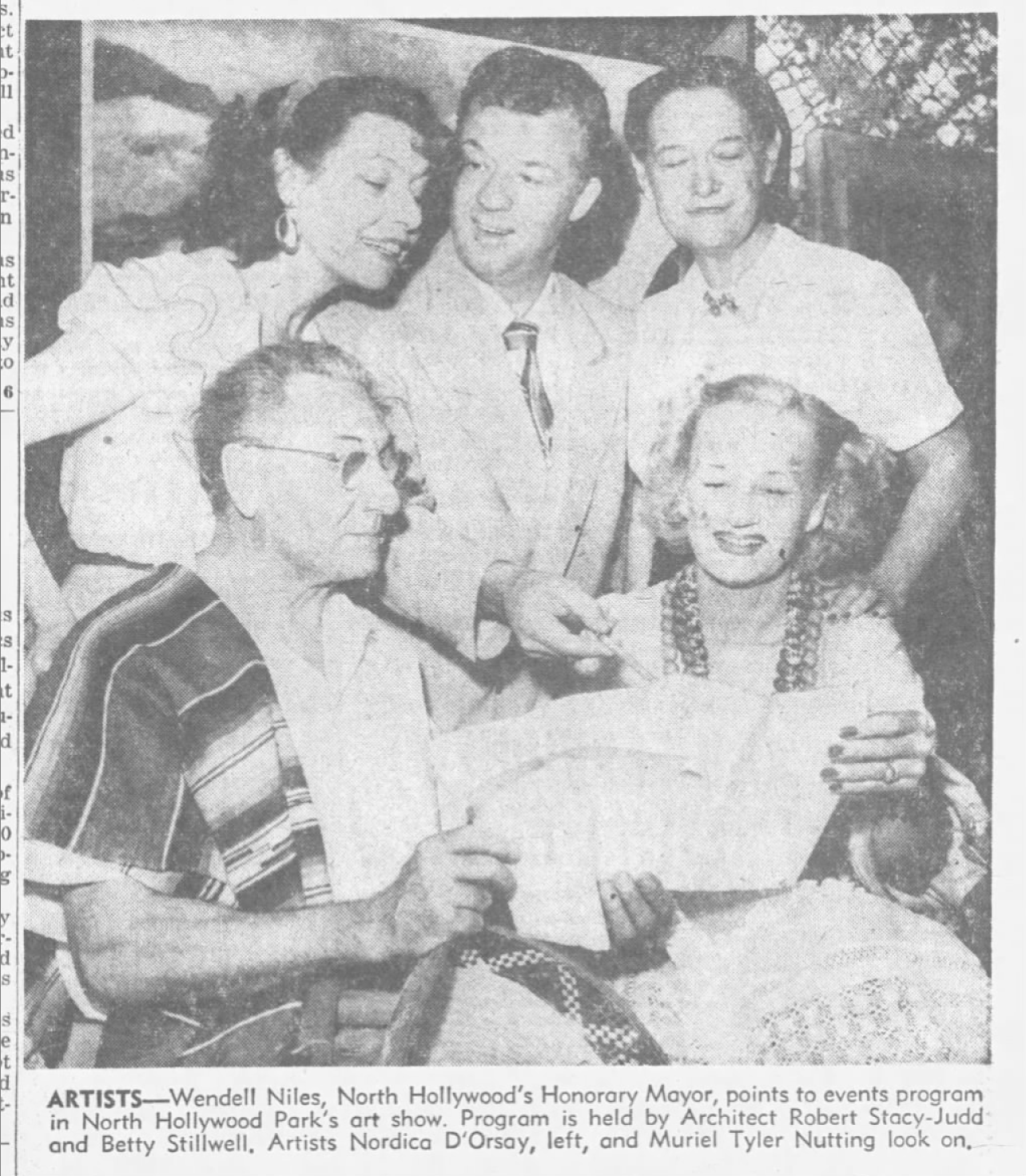
The 1920 census found Laurence A. Thalmayer living in Kearny, New Jersey, and employed with a trading company. By 1925, he was already working as a literary agent. (He wrote to Kansas columnist Jay E. House [1872-1936] that year offering to place House's writings for him.) By 1930 Laurence Thalmore was in Beverly Hills with a relatively new wife and son. She was Nordica Abbott (1902-1969), a dancer and artist named for the American opera singer Lillian Nordica, also called Madame Nordica. (2) The son was named Kenneth Thalmayer, eventually Kenneth Edward D'Orsay (1923-1972). (3) Kenneth D'Orsay would one day have a daughter named Nordica Theodora D'Orsay, or Teddy for short. In the 1970s, Teddy was or was not part of some kind of intrigue involving the CIA, the Mafia, drugs, the Shah of Iran, and other fodder for conspiracy theorists. You can try to untangle all that yourself if you'd like.

In the meantime, Laurence R. D'Orsay busied himself as a writer and a literary agent. His stories included:
  • "Phantoms," Weird Tales (Jan. 1925)
  • "The Spirit of It," Short Stories (Jan. 25, 1925)
  • "Marble," Weird Tales (June, 1925)
  • "The Stamp of Courtesy," Clues (Oct. 1926)
  • "Jewels for Two," (with F. L. Grant) Clues (Dec. 1926)
  • "The Price of Empire," Soldiers of Fortune (May, 1932)
D'Orsay also wrote a novel, Mistress of Spears: A Tale of Amazulu (Kansas City, Missouri: Burton, 1930), plus non-fiction on writing and marketing for writers. He ran Laurence D'Orsay Literary Agency in Los Angeles in the 1930s. Henry Kuttner worked for D'Orsay before making a name for himself as an author of science fiction, fantasy, and horror stories. In his work for D'Orsay, Kuttner also helped Leigh Brackett get her career started. I suspect a number of science fiction fans from southern California and their friends from the hinterlands passed through the doors of the D'Orsay agency.

Laurence D'Orsay became a naturalized citizen in 1940. He died after the war, on November 21, 1947, in Los Angeles City or County and was buried at Forest Lawn Memorial Park, in Glendale, California.

Notes
(1) Laurence D'Orsay should not be confused with the British actor of the same name.
(2) Laurence Thalmore and Nordica Abbott were married on September 15, 1922, in San Francisco. She was born on March 21, 1902, in Fresno, California.
(3) Kenneth Thalmayer was born on October 3, 1923, in San Francisco.

Laurence R. D'Orsay's Stories in Weird Tales
"Phantoms" (Jan. 1925)
"Marble" (June 1925)

Further Reading
I don't know of any further sources on Laurence D'Orsay except for his own works.

Mistress of Spears, Laurence D'Orsay's 1930 novel with a cover design by an unknown artist.
And a work by his wife, Nordica Abbott D'Orsay.

A photograph of Nordica Abbott D'Orsay (with others) from the Los Angeles Times, Ocotber 14, 1950, page 15. (Photo added Feb. 22, 2021.)

Update (June 6, 2014): I found out today that Michael C. Ruppert, the man who made the allegations about Teddy D'Orsay, killed himself on April 13, 2014. Born on February 3, 1951, in Washington, D.C., Ruppert was a police officer with the Los Angeles Police Department, an author, a conspiracy theorist, and a radio host. 

Updated: June 6, 2014; February 22, 2021.
Text and captions copyright 2013, 2023 Terence E. Hanley