Showing posts with label Edgar Rice Burroughs. Show all posts

Saturday, August 26, 2023

Weird Tales, June 1923

Like the first pair of issues of Weird Tales, the second pair--the issues of May and June--go together. Both have the same main title logo and each has 120 interior pages. William F. Heitman was the cover artist on both, and he drew all of the interior art in both. There are twenty-one stories in the May issue of 1923 but only seventeen in the one for June. The staff of the magazine made up for that with thirteen non-fiction fillers (all by an uncredited author or authors), plus a non-fiction article, plus two features, "The Eyrie" and a new feature called "The Cauldron: True Adventures of Terror," conducted by Preston Langley Hickey (1900-1962).

Firsts in Weird Tales for June 1923 include:

  • The first story with a series character, Dr. Dorp in Otis Adelbert Kline's short story "The Phantom Wolfhound."
  • The first reprint of a story by Edgar Allan Poe, "The Murders in the Rue Morgue," from 1841.
  • The first photograph, a picture of an electric chair, taken by Harry Hirschfield and used as an illustration for "The Chair," a non-fiction article by Dr. Harry E. Meerness.
  • The first regular feature other than "The Eyrie," the aforementioned "The Cauldron: True Adventures of Terror," conducted by Preston Langley Hickey.

I haven't read most of the stories in that fourth issue. There may be other firsts hiding inside.

I have written before about eleven of the eighteen authors listed below. Click on their names for links.

  • Edwin MacLaren (dates unknown)
  • Adam Hull Shirk (1881-1931)
  • Julian Kilman (1878-1954)--His story "The Well" was reprinted in The Best of Weird Tales: 1923, edited by John Gregory Betancourt and Marvin Kaye.
  • Walter Noble Burns (1866-1932)--The title of his story "The Man the Law Forgot" is a variation of "The Man Who . . .".
  • Loual B. Sugarman (1894-1965)--His story "The Gray Death" was reprinted in The Eighth Green Man and Other Strange Folk, edited by Robert Weinberg (Starmont House, 1989).
  • Henry Leverage (1885-1931)
  • Hugh Thomason (dates unknown)--This may have been Captain Hugh Thomason, a friend of and correspondent with Edgar Rice Burroughs. Captain Thomason also used the pen names Jack MacLeod and Captain John Graham. Hugh Thomason the author, if he was a different person, also used the pen name Rjinn Van Veldt.
  • Herbert Hipwell (dates unknown)
  • Dr. Harry E. Mereness (dates unknown; possibly a pseudonym)

Next: "The Cauldron: True Adventures of Terror."

Weird Tales, June 1923, with cover art by William F. Heitman illustrating Edgar Allan Poe's story "The Murders in the Rue Morgue." This is the first gorilla or ape cover in Weird Tales. Unfortunately, it's terribly inept. Heitman was a better artist than this. I wonder what happened.

Text copyright 2023 Terence E. Hanley

Tuesday, August 8, 2023

A.G. Birch (1883-1972)

Albert George "Al" Birch
Newspaper Reporter, Photographer, Editor, Publicity Manager, Press Agent, Advertising Man, Traveler & Explorer, Cattle Rancher
Born July 15, 1883, Washington, D.C.
Died May 11, 1972, Denver, Colorado

Albert George "Al" Birch was born on July 15, 1883, in Washington, D.C., to George Albert Birch (1846-1899), an undertaker by trade, and Fannie (Balman) Birch (1856-1905). It looks as though Albert was an only child. After his parents were gone, maybe there was nothing to hold him in the city of his birth. He traveled extensively in his young life, in Canada, California, and Colorado, among other places. He found a place to stay in Estes Park and Denver, Colorado.

Birch was the president of his senior class at Business High School in the nation's capital. Graduating in 1901, he set of on his travels. Birch worked as a newspaperman in his native city, but he began working for the Denver Post soon after his high school graduation, perhaps as early as 1902. In 1905, with three partners, he leased the Estes Park property, known, I believe, as "the English Ranch," owned by Windham Thomas Wyndham-Quin, 4th Earl of Dunraven (1841-1946). It looks as though cattle ranching was one of Birch's early endeavors.

A.G. Birch was not only a newspaper reporter but also a photographer, editor, and publicity manager. He participated in automobile tours, explored the Yampa River with his friends, organized a rodeo, ran the annual Denver Post Opera from 1934 to 1969, and pulled off publicity stunts, including one in which a barefoot young woman, nicknamed "the Eve of Estes" and dressed in a leopard-spot suit, was supposed to have lived as a cavewoman in the newly created Rocky Mountain National Park in 1917. It's worth noting that "The Cave Girl" and its sequel "The Cave Man" by Edgar Rice Burroughs had been published in The All-Story and All-Story Weekly in 1913 and 1917. Birch also built two houses in Estes Park, the first of which burned and the second of which is on the Colorado State Register of Historic Properties. Birch also worked in publicity in Hollywood and for the Orpheum Circuit vaudeville theater in Denver. Albert G. Birch was with the Denver Post for fifty-nine years and died on May 11, 1972, in Denver. He was eighty-nine years old.

A.G. Birch had just one story in Weird Tales. It's called "The Moon Terror," and it was the lead story in the May issue of 1923, with a conclusion in the issue of the following month. "The Moon Terror" wasn't the first serial in Weird Tales, but depending on how you define these things, it was the first novel. Reprinted in The Moon Terror by A.G. Birch (and others), it runs to 130 pages in all. Issued in 1927, The Moon Terror, published by The Popular Fiction Publishing Company, almost certainly with Farnsworth Wright as the uncredited editor, was the first Weird Tales book. And so Birch had to his credit the first novel and the first illustrated story in Weird Tales, the lead story in the third issue of the magazine, and the lead story in the first Weird Tales book. Not bad for an author of just one published genre story in his whole career.

"The Moon Terror" is like a Burroughs novel in its way, but it's also a yellow peril-type story with a Fu Manchu-like mastermind named Kwo at its center. Kwo is an aspiring totalitarian ruler of Earth who uses a kind of super-science indistinguishable from magic in his plot against its peoples and nations. In Birch's story, there are elements of H.G. Wells' War of the Worlds (which preceded it), as well as of The Day the Earth Stood Still, "The Call of Cthulhu," Worlds in Collision, and Indiana Jones and the Temple of Doom (which followed).* Like many early science fiction stories, including stories by John W. Campbell, Jr., "The Moon Terror" is more plot than real human story. Thousands of people--whole cities and regions--are swept away and destroyed in the space of a paragraph or two. You could say that it's like a disaster movie except that in a disaster movie, things happen to characters instead of to abstractions or categories. In fact, the story in a disaster movie is about human characters, who have lives and pains and relationships and speak in dialogue with each other. I had never thought about this before, but only in fiction is it possible to tell a story without characters, without people. Movies are about people.

"The Moon Terror" becomes more specific in its later chapters. There are characters after all, and they actually do things and speak to each other. Unfortunately, they're like the characters of Edgar Rice Burroughs, meaning, not recognizably human and devoid of any genuine human feeling or emotion. (Burroughs must have been a cold and unlikable person if his work is any indication.) They're more like robots--plot-robots programmed by their author to carry out his wishes. I'll point out that the period or cycle of vibrations that Kwo has figured out can be used to destroy Earth is eleven minutes and six seconds long, in other words, 666 seconds. Whether that symbolism was intentional on Birch's part, I can't say. By the way, Kwo is a homophone of the Latin word quo, meaning, "where." And it is the question, "Where is Kwo?", that takes up a good part of "The Moon Terror."

A.G. Birch's Story in Weird Tales
"The Moon Terror" (two-part serial, May and June 1923)

Further Reading

  • An entry on A.G. Birch and The Moon Terror on the website Internet Archive at the following URL: https://archive.org/details/BirchA.G.TheMoonTerrorAndOtherStories1927
  • An article behind a paywall, "For 59 Years, No Stunt Was too Elaborate to Draw in Readers for This Publicity Manager" by Dave Kreck in the Denver Post, October 15, 2017.
  • Other items linked within the text of my entry on Albert G. Birch above.

*In The Day the Earth Stood Still: a meeting of the world's scientists and a demonstration of power made by the outsider. In "The Call of Cthulhu": the upheaval of the seabed. From Worlds in Collision: a new moon torn from the earth. And from Indiana Jones and the Temple of Doom: the human sacrifice with the heart torn from the breast of the sacrificed.

Next: The Moon Terror book.

A photograph of "Eve of Estes," subject of a publicity stunt by Albert G. Birch of the Denver Post in 1917.

Text copyright 2023 Terence E. Hanley

Monday, July 3, 2023

The Last of Colloids & Tentacles

A colloid is a suspension of one or more substances in another. Two thirds of the ingredients of a peanut butter and jelly sandwich are colloids. A long time ago, I knew a guy who liked banana and mayonnaise sandwiches. (They smelled like house paint.) Only one third of his ingredients--mayonnaise--is colloidal. Protoplasm is a colloid, too, so when John Corliss Cranmer's giant amoeba gulped down first his daughter-in-law, then his son, people were the meal and the colloid was the eater of the meal. But then the people were made of cells brimming with protoplasm, too, and so it was a case of one big colloidal mass eating lots of little ones--if you're a reductionist, that is.

The word colloid is from the French, originally from the Greek. It means "a substance in a gelatinous or gluey state," originally, simply, "glue." Colloid as a word and a scientific concept is from the mid-nineteenth century, as so many things in our daily lives and so many of the ideas in our busy little brains are. There are other gluey concepts in science, collagen, for example, also the subatomic particles called gluons. There are also gluey crafts and gluey art forms. The collage is the most obvious example of these.

People have made collages for a long, long time, but the collage as a work of art dates from the modern period, maybe from the eighteenth century, certainly no later than the nineteenth or early twentieth century. Georges Braque and Pablo Picasso made collages and coined the term papier collé. Those two artists, along with Juan Gris, were originators first of analytical cubism, then of synthetic cubism. In analytical cubism, the artist looks at his or her subject from many different points if view. That's why, in a work by Picasso for example, you can see both eyes in a portrait seemingly done in profile. So, no, Picasso's people are not part flounder. In synthetic cubism--I think a more playful and not so mathematically exacting variation--a work of cubistic art is synthesized by gluing together scraps and cuttings of paper, thus the collage or papier collé. I guess making collages would have been hard to do before there was a mass and popular press as a source of material.

In moving towards synthesis, or what we might call literary collage, modern authors followed modern artists, I think. The art seems to have come first--synthetic cubism was in flower, if you can call it that, in 1912-1914. Then came the literary works, "The Waste Land" by T.S. Eliot, for example, in 1922, Show Girl by J.P. McEvoy in 1928, John Dos Passos' U.S.A. trilogy in 1930-1936. I think we can include "The Call of Cthulhu" by H.P. Lovecraft (Weird Tales, Feb. 1928) in that list, too. Several stories in the first issue of Weird Tales (Mar. 1923) include notes, clippings, diary entries, and so forth, as if the story were a scrapbook or a collage. That kind of thing would continue in future issues.

"The Call of Cthulhu" also has an analytical approach, as do other works of weird fiction that refer or allude to weird geometries, outré mathematics, and multiple dimensions. Maybe pulp fiction wasn't very far behind mainstream literature in the 1910s-1930s in its move towards modernism. But maybe the pulp fiction genres--especially science fiction--were a little bit ahead because they were in such close contact with the scientific developments of their time. Mainstream authors of the early twentieth century could disregard science. F. Scott Fitzgerald, William Faulkner, Ernest Hemingway, and John Steinbeck didn't write science fiction. But then science and the future barged into the room and Walker Percy, Cormac McCarthy, and Margaret Atwood did and have. How times change.

There will be more on Ms. Atwood in a minute.

Dr. Frankenstein made a kind of collage using parts from different bodies, plus an Abby Normal brain. His goal was the synthesis of life from non-life. "I had worked hard for nearly two years," he wrote, "for the sole purpose of infusing life into an inanimate body." Lightning was the literal spark of life by which he would do it. And so his monster lived. A long line of proto-scientists, semi-scientists, pseudoscientists, and maybe the rarest kind, real scientists, has proposed that early in the earth's history lightning infused life in what they have called the primordial soup or primordial ooze, ooze being a species of colloid. Anthony M. Rud seems to have alluded to the primordial ooze--or jelly in H.G. Wells' formulation--in his story "Ooze" (Weird Tales, March 1923). Since the early nineteenth century, real-life scientists seem to have followed the example of Victor Frankenstein. We, the world over, recently had a deadly encounter with their Frankensteinian brand of science in the form of a lowly virus raised to the top of a Chinese/U.S. government-built Tower of Babel. They'll do it again. We can be sure of that. Next time it's likely to be worse, but that will be good for them because they can take more of what is ours in the process.

Life arising from non-life, called spontaneous generation, was debunked a long time ago. But I guess debunked things don't always stay that way. For example, there are yet again people who believe that a person can change his or her bodily form by some magical process of mind or by a series of practices they call "care," practices that the rest of us can only consider criminal, immoral, and unethical mutilations of the human body, a kind of witch-doctory or pseudo-medical falling-back on superstition, ultimately a literal diabolism. People who can supposedly transform themselves used to be called shape-shifters or skin-walkers, and they did what they did by supernatural processes. Now they go by a different name and we're supposed to believe that there is science behind it.

From the moment we ate from the tree of the knowledge of good and evil, we have believed ourselves to be as gods and to hold in our hands godlike power, godlike authority, and godlike wisdom. Our punishment was expulsion from the Garden and a realization of death. The difference is that we once knew shame and walked in shame, out of the gates and into exile. Now there isn't any shame, only pride, or Pride as it is now capitalized. Now we walk in history every day, as the worst among us might say. Anyway, I guess if we're gods, we can create and mold bodies and parts of bodies, just as Dr. Frankenstein did. In creating our modern-day monster, we will fashion his/her whole body--his veins, his feet, his hands, his organs--everything, including a Frankenstein's schwanzstucker made from the flesh of her forearm--according to our own whims. It won't be real, but we will be required to call it real and her a man. It will in fact be grotesque, a monstrous simulacrum, at once a symbol and a manifestation of our reaching into hell in our efforts to reach into heaven, where we believe we are or shall be enthroned. And, no, she's not gonna be very popular because of it.

Margaret Atwood, who has been called a TERF because she knows what everybody in the whole history of the world knew until ten minutes ago, famously said, "Science fiction is rockets, chemicals and talking squids in outer space." As we know, squids are cephalopods and the bearers of tentacles. So Ms. Atwood has offended not only people who don't know what a woman is, but she has probably also offended a lot of science fiction fans with her opinions on these things. If you're an offended Star Wars fan, though, you might want to just slink away, the reason being that in the Star Wars universe, there is a literal talking squid. His title is Admiral and his name is Ackbar, and though his tentacles are small (they're more like the barbels of a catfish), he is a member of a race called the Mon Calamari, meaning, in una bella lingua of a faraway planet spinning on its axis a long, long time in the future, squid. (The noun is Italian, the possessive pronoun French.)

There are other tentacled aliens in the Star Wars universe. Oola is one. Ahsoka is another. They have tentacles coming out of their heads. The Thermians in Galaxy Quest (1999) are, in their true form, tentacled. They are one form but take another. Call them trans, I guess. Cthulhu of course has tentacles. In Frank Frazetta's interior illustration for The Chessmen of Mars by Edgar Rice Burroughs (1922), there are tentacled heads, called Kaldanes in the story, that frighten and horrify Tara of Helium. In Gino d'Achille's  cover version, the Kaldanes are more spider-like. I believe the Kaldanes have both kinds of members, though, both tentacles and jointed legs. Maybe a Burroughs fan can let us know for sure. That reaching down through the neck to control a host body is also in The Puppet Masters by Robert A. Heinlein (1951), the Star Trek Episode "Operation -- Annihilate!" (1967), and, if I remember right, a skit on SCTV in which cabbage leaves attach themselves to the backs of people's heads. In the Star Trek episode at least, the controlling aliens are colloidal, made by the prop master from bags of fake vomit. By the way, the ninth book in Burroughs' Mars series is The Synthetic Men of Mars, originally published in 1939, and so we have another example of Frankensteinian synthesis in genre fiction.

Colloids are sometimes fun. Give a child a bottle of Elmer's Glue-All along with some construction paper and glitter and see how she entertains herself. But in science fiction, fantasy, and weird fiction, colloids are more often gross, nasty, disgusting, and revolting--when they are not creeping, crawling, encroaching, and deadly in the way shoggoths or the Blob is. We have a different reaction to tentacled creatures, owing, I think, to our hundred-thousand-year experience with them. They are real, discrete, recognizable, nameable, alive. They look back at us with the biggest eyes in nature. And the smartest of them are very smart. More than any of that, though, they seem alien in their star-shaped or radially symmetrical bodies. It's no wonder tentacled creatures became the aliens of science fiction, or more accurately, why science fiction authors, beginning with H.G. Wells, would have fashioned the tentacled creatures of earth into aliens from outer space. Maybe we have atavistic memories of when octopuses first came to our planet, raining down on us in their iron spaceships.

We were made in the image of our Creator, and so we wish to create, thus our art and literature, among so many other great and wonderful things, including most of all love, which allows us an escape into eternity. Where we make our mistake is in believing we can create or re-create the things that he first created. And so Frankensteinian scientists, engineers, and technicians are busy. They believe they can create life (or that life was created) from non-life. They believe they can alter unalterable facts about human nature, human anatomy, and human biology. They believe they can make of us something beyond human, better than human, other than human, transhuman. They're working on synthesizing new forms from fragments of previously existing ones. The coronavirus and a million dead are one result of that. The supposedly counteractive "vaccine" and a million more dead are another. They also believe they can transfer the human mind into a machine, thus surviving their own deaths.* In fact, they appear to see little difference between the ghost and the machine. One can be the other. One is the other. And so we will soon have machines taking the place of human beings. Soon after that, our machines will probably enslave or kill us. If you have never read "I Have No Mouth, and I Must Scream" by Harlan Ellison (1967), you probably should, like right now. It may give you a glimpse into our caliginous--not collagenous but caliginous--future. Anyway, thanks, scientists, but ultimately, thanks, all of us, for we have all done this. Scientists--others, too--are only at the vanguard of our limitless depravity in our fallen state. We fall. The asymptotic curve of our pursuit of perfection--of a perfect and limitless depravity--moves forever upwards.

-----

*Having eaten the forbidden fruit, they believe that the knowledge they have thereby gained will reopen the gates and allow them back into the Garden.

"To Tara's horror, the headless body moved, took the hideous head in its hands and set it on its shoulders." Illustration by Frank Frazetta from The Chessmen of Mars by Edgar Rice Burroughs.

Text copyright 2023 Terence E. Hanley

Wednesday, May 17, 2023

R.T.M. Scott (1882-1966)-The First Tale of the Prehistoric Past

Reginald Thomas Maitland Scott, Sr.
Aka Maj. R.T.M. Scott

Author, Poet, Military Officer, Lecturer
Born August 14, 1882, Woodstock, Ontario, Canada
Died February 5, 1966, New York, New York

Reginald Thomas Maitland Scott, better known as R.T.M. Scott, was born on August 14, 1882, in Woodstock, Ontario, to Alfred Maitland Scott and Elizabeth Bolby Willson Scott. He matriculated at the Royal Military College at Kingston, Ontario, in 1901 and served as an engineer in India, Ceylon, and Malaysia. During the Great War, he was with the Canadian Expeditionary Force on the Western Front and attained the rank of major.

Scott began his writing career after the war. His first story listed in The FictionMags Index is "Such Bluff as Dreams Are Made Of," in Adventure, April 1, 1920. The leading character in that and more than two dozen more stories is Aurelius "Secret Service" Smith. One unusual aspect of this series is that its various entries were published in many different magazines, including Action Stories, Adventure, The American Magazine, The Black Mask, Collier's, Detective Book Magazine, The Illustrated Detective Magazine, Real Detective Tales and Mystery Stories, and others. There was one "Secret Service" Smith story in Detective Tales, in the issue of April/May 1923. Smith also appeared in hardback. Scott also wrote the first two stories in The Spider series, published in the pulp magazine The Spider in October and November 1933.

R.T.M. Scott arrived in the United States on July 28, 1919, five years to the day after the war had begun. He lived in New York City, also in Pasadena, after the war. In 1919-1921, he lectured in those two places on Theosophy and reincarnation. We can speculate that he encountered Theosophy in either India or Ceylon. Southern California was a hotbed, too, for Theosophy and other pseudo-religious, cult-like, and gnostic beliefs. In the 1930s, Scott wrote articles for Mystic Magazine and True Mystic Science with such titles as "In Search of My Own Ghost" and "Astounding True Seances." Scott claimed that his 1931 book The Mad Monk was written under the influence of Rasputin, with whom Scott had established contact through spiritualistic means. The book was dramatized in an episode of the Strange As It Seems radio program in March 1940. (Strange As It Seems was based on the syndicated cartoon panel of the same name, created by John Hix.) In other media, Scott wrote "special material" for the movie You'll Find Out (1940), starring Kay Kyser, Peter Lorre, Boris Karloff, and Bela Lugosi. The film is a comedy about Spiritualism. Maybe Scott acted as a kind of technical advisor.

Scott's son, also named Reginald Thomas Maitland Scott but nicknamed Robert, followed in his father's footsteps by authoring articles and short stories for Western, detective, and weird menace magazines, from 1930 to 1938. He was also an associate editor at Popular Publications in New York City. Born in Columbo, Ceylon in 1909, Robert Scott served in the Canadian Army during World War II and was killed in an accident after the war, in August 1945. His widow, Susan Ashley Scott, followed him to the grave in 1948. R.T.M. Scott's mother died in the in-between time, in January 1946. It all seems like too much for the survivors to take.

Scott resumed his writing career after the war, but his success was pretty limited. He published several hardbound novels during his career, the last of which seem to have been The Agony Column Murders, from 1946, and The Nameless Ones, from 1947. Both are "Secret Service" Smith stories. R.T.M. Scott died on February 5, 1966, in New York City. He was eighty-three years old.

R.T.M. Scott's Stories in Weird Tales and Detective Tales

Weird Tales

  • "Nimba, the Cave Girl" (Mar. 1923)

Detective Tales

  • "The Emerald Coffin" (Apr./May 1923)
Further Reading
"Scott, R T M" in The Encyclopedia of Science Fiction, at the following URL:

R.T.M. Scott's Story:

"Nimba, the Cave Girl" is short story of just three pages and is the first in Weird Tales set in prehistoric times. The place is "a beautiful lake lying between steep-sloping, wood-covered hills," south of what we call James Bay, in Scott's native country of Canada. That's an odd and seemingly irrelevant detail for a story of the distant past. Scott seems to have been attempting to make a concrete connection between the past and the present. I guess that's not surprising considering his interests in Theosophy, reincarnation, and spiritualism. He was pretty specific in his description of the setting for "Nimba, the Cave Girl." I wonder if he knew of exactly such a place in his native province.

Scott's story is violent and gory. You don't want to be the man who wrongs Nimba. I'm sure of that. What she does to Oomba gives new meaning to the word pulp fiction. But if she likes you, you'll be in like Flynn, even if you knock her down and eat all of her food. There are people writing on the Internet about how distasteful it all is, meaning the relationship between Nimba and her newfound man. Let's remember we're talking about cave people here. They don't act like we do. They might even be happy because they don't act like we do.

None of this is to say that "Nimba, the Cave Girl" is without its flaws or even that it's a very good story. Like I said, the setup is odd. Knowing that Scott was into Theosophy and spiritualism makes me wonder whether he considered his story to be simply fiction, or whether he thought of it as a work that exists for the rest of us in that misty territory between fiction and nonfiction or pseudo-nonfiction. Could he have believed that he was channeling Nimba?

There is also in "Nimba, the Cave Girl" a weird fetishism. Not weird as in weird tales but weird as in kinda pervy. Here's the main evidence of that:

    She stood long, viewing the new magnificence of the eastern horizon, her coppery-tanned skin glistening in the sun and her firm young breasts rising and falling as if they, too, saw and wondered in dreamy contemplation. Lithe were her legs and arms, and slender her waist, with hips full big but boy-like in their taper. Her hair was bound with little tendrils into a cue that reached below her waist and then was doubled to keep it off the ground. Sun-burned, its hue was a golden glory. A deep scar marked her face, but this only added to its barbaric beauty.

So her firm, young breasts could almost see and wonder in dreamy contemplation. Okay. Got it.

* * *

I don't know where Scott got the inspiration for his story, but it was preceded by two works written by Edgar Rice Burroughs, "The Cave Girl," which was serialized in The All-Story in 1913, and "The Cave Man," also in All-Story and serialized in 1917. These two stories were collected in a hardbound book called The Cave Girl in 1925. I'm not sure that Scott could have avoided the Burroughs effect once he sat down to write. There was a lot of that in the pulp fiction of the 1910s and for many decades after that.

* * *

There has already been a caveman in the first issue of Weird Tales. He was frozen in a block of ice and revived in "The Ghoul and the Corpse" by G.A. Wells. In "The Ghoul and the Corpse," it is the caveman who travels through time, from his to ours. And it is he who is frightened and horrified by what he finds. In "Nimba, the Cave Girl," there is the opposite situation. We, the readers, are the time travelers. We go from our time to hers, and this time it is we who are horrified, perhaps less by the violence and gore (readers and viewers today love their violence and gore) than by the sexual deal-making between woman and man.

* * *

"Nimba, the Cave Girl" is unique in the first issue of Weird Tales, at least among the eighteen stories I have considered so far. Sixteen of those eighteen are set in the 1800s or 1900s. "The Sequel" by Walter Scott Story, is an exception. I think we can call it a work of historical fiction, taking place as it does, in Italy, in the 1700s or before. However, "The Sequel" is not really an original work. Call it an outlier. Maybe we can pretty well discard it. If we discard it, then only "Nimba, the Cave Girl" remains as a work of historical fiction, except that it's not really historical. It's actually prehistorical. As such, it's the first story in Weird Tales to take place in a fantastical setting. In terms of the cosmos in which we find ourselves (or in which we have lost ourselves), only R.T.M. Scott's tale tells of real, physical things separated from us by great gulfs of time or space.

Except for "The Sequel," all of the other stories so far are set in the United States, Canada, or Alaska, or they are set in Europe during World War I, mostly with Americans as their main characters. (The unnamed German soldier in "The Grave" is an exception.) Even "Nimba, the Cave Girl" is set in what is now Canada. Again, discarding "The Sequel," sixteen of seventeen stories take place in our everyday world. ("The Ghoul And the Corpse" and "The Mystery of Black Jean" by Julian Kilman are admittedly set on its frontiers, especially "The Ghoul and the Corpse.") Not counting stories set outside of the United States, most take place either in the rural South or in or near big cities, including New York, Chicago, and San Francisco. In short, there's very little variety in their setting.

There's also not much variety in the characters depicted or their situations. Most of the characters are not very well developed or very memorable or even very lifelike. They are also mostly normal, everyday, middle-class or working-class Americans. Even the detectives are middle class. For an example of that, read Hamilton Craigie's introductory description of his detective, named Quarrier, in "The Chain." Anyway, there's a kind of sameness to all of it. Edwin Baird, the editor of Weird Tales, remarked on that sameness in "The Eyrie," two months after the debut issue:

     These manuscripts come from all parts of the civilized world, and they come from all sorts of people--lawyers, truck drivers, doctors, farmers' wives, university professors, carpenters, high school girls, convicts, society women, drug fiends, ministers, policemen, novelists, hotel clerks and professional tramps--and one, therefore, would naturally expect their stories to possess a corresponding diversity. But not so. With rare exceptions, all these stories, written by all these different kinds of people, are almost exactly alike.
     Not only do they contain the same general plots and themes--one might understand that--but practically all are written in the same style; all have the same grammatical blunders, the same misspelled words, the same errors in punctuation, the same eccentric quirks of phraseology. After plowing through fifty or so of these stories (and we often read that many in an evening), a man acquires the dazed impression that all are written by the same person. It’s baffling! Why do the minds of these various types of people, living in different parts of the world and moving in dissimilar walks of life, slide comfortably into the same well-worn groove whenever they put their thoughts on paper? We give it up.

So it looks like the authors who contributed to those first few issues of Weird Tales worked almost exclusively with what they had close at hand. They didn't seem ready to make great leaps of the imagination, leaps into greater realms of either time or space. R.T.M. Scott made the leap, though, even if his jumping-off point was his belief in Theosophical, psychic, or occult phenomena, or, more accurately, pseudo-phenomena. Remember this passage from H.P. Lovecraft's preamble to "The Call of Cthulhu" (1926; 1928):

    Theosophists have guessed at the awesome grandeur of the cosmic cycle wherein our world and human race form transient incidents.

So maybe R.T.M. Scott opened a door in Weird Tales. If he did, then others would soon enough walk through it, including Lovecraft.

Lacking an image for R.T.M Scott and his "Nimba, the Cave Girl," I offer this one instead, for Edgar Rice Burroughs' story "The Cave Girl" in The All-Story, July 1913, with cover art by Clinton Pettee.

Text copyright 2023 Terence E. Hanley

Tuesday, January 31, 2023

What Is Weird Fiction?

Beowulf was composed in pre-Christian times but written down only after Christianity had moved into northern Europe. The result is syncretic, that is, a cross between pre-Christian and Christian beliefs. Syncretism was and is a very successful strategy in the growth and spread of Christianity. Rather than wipe out beliefs that came before it, the Church absorbed and modified them. It's why we celebrate Christmas at midwinter.

In his last words, Beowulf mentions both Weird (Wyrd) and "the Creator." The implication is that Weird works on earth, perhaps independently of the Creator. Or is she one of his agents or angels? I can't say. Beowulf seems to have lived and died in an in-between time. But what if the inclusion of Weird in Beowulf is not fully syncretic? What if Weird and God lived side by side for some time in Europe before Weird became what people now call "God's will" or "God's plan for the world"? What if only later did God subsume Weird?

For nigh on a thousand years after Beowulf, Weird was the workings of God--"God moves in mysterious ways" is the saying--and there was a syncretism, with God on top and Weird hidden away. Weird, or Fate, and her seeming random and often cruel ways retreated behind God's will, God's plan, God's mercy, God's love. God took her place; he is loving and caring, even if mysterious. He does things for his own reasons, which may be inscrutable and incomprehensible to us in our smallness, yet are ultimately wise and unassailable. Maybe the weird fiction of the nineteenth century and after chronicles a renewed schism of Weird from God, significantly beginning with the Romantic Period and the rise of the natural sciences.

We think of the Romantic Period as a reaction to the Age of Reason. But there was no simple conservatism in Romanticism. In fact, it may be seen as a search for a third way, for a middle ground between a cleaving to tradition and a radical overthrow of the past. So maybe Weird came back only after we had begun the process of dethroning God, which seems to have been part of the program of Western thought during the nineteenth century. Then, in 1883, Nietzsche wrote that God is dead. A couple of years later, publishers began putting out books with the word weird in their titles. These were no doubt the inspiration for the title, themes, and subject matter of the later magazine Weird Tales, which began one hundred years ago this spring.

So maybe the authors of weird fiction from the 1880s to the 1920s and '30s were simply returning to the Weird of the past. Except that Weird was now embodied or manifested in dark, malign, and alien beings, entities, and forces. Weird may be cruel. She may seem arbitrary. She carries us away. But more than anything, she may actually be indifferent to what we want for ourselves on this earth. Her ways may just be matters of course. These things must be done for no reason we may know. Cthulhu, on the other hand, wishes to crush us and rule over us. He has his designs upon us. He has come into this world to stay. He is bodily, though also in control of nonmaterial forces. But I sense in him an indifference, a malign indifference to be sure, but an indifference nonetheless. In the eyes of Cthulhu, we are nothing. Beyond that, in the greater Lovecraftian universe, we as human beings are insignificant, mere specks. I don't think Weird sees us that way. Weird may carry us away, but we are not nothing to her.

Based as it is on genuine human experience in a seemingly harsh, often cruel, and largely unforgiving world, the pre-Christian concept of Weird is actually profound in its grasp of our condition. It is not the simple or savage or barbaric belief of a pre-civilized people. It may actually be a kind of stoicism, a well-developed philosophy from ancient, civilized, and pre-Christian Greece and Rome. But I sense more in the concept of Weird than simply a kind of stoicism. Weird is at work in the world. No one knows her workings. Whereas Fate may be seen as acting out some kind of moral judgment or dealing some kind of punishment against transgression, Weird is or may be simply neutral. And because of that, we have acceptance. There can be no bitterness or lashing out at her. Our fists would simply fly through thin air. We are urged not to tempt Fate. But Weird is not tempted. Nor can she be avoided. She has her way no matter what we do. As Beowulf says, "Goes Weird as she must go!"

Weird is not a force. I feel certain of that. Weird is embodied in the person of an unseen and unknowable woman or goddess. And yet there is no discrete body or physical manifestation of her. And she is not a she but something else. Weird is at work everywhere at once. Weird is also not necessarily supernatural. Again, Weird may be simply part of our existence. She is in the way we live and ultimately die.

Weird fiction involves things that are weird, uncanny, eerie--all Scottish words--also, strange, fantastic, and possibly, though not necessarily, supernatural. I'll tell you the truth: I don't know what weird fiction is. But I think I know a couple of things that it is not:

First, weird fiction is not science fiction. If there are elements of weirdness in a scientific story (or pseudoscientific story, a term that predated science fiction), then it might best be described as science fantasy rather than as science fiction. To illustrate, I think it more accurate to say that H.P. Lovecraft and C.L. Moore composed stories of science fantasy rather than of science fiction. Both wrote in the weird-fiction tradition, which seems to have come from the Old World as far back as what Jack Williamson referred to as the Hebraic-Egyptian tradition. Edgar Rice Burroughs also wrote science fantasy. Although he was not a science fiction author proper, his stories may be seen as a kind of proto-science fiction. I don't think his stories are essentially weird, though, nor do they contain very many--if any--truly weird elements. I don't think Burroughs had that kind of imagination. Likewise, John Carter is not a weird-fictional hero. He is more nearly a science-fictional hero and a proximate forerunner to the Superior Man-type hero of the 1930s and after. Lovecraft's heroes, if you can call them that, and C.L. Moore's Northwest Smith in particular are clearly not science-fictional heroes in that they are not triumphant. They are in fact weak and in the end often defeated. The difference may come from differences in personality and biography. Remember that Burroughs was a man of action and vigor, whereas Lovecraft and Moore were sickly, at least in their formative years. Anyway, science fiction can have its weird elements, but, ultimately, if it's science-based rather than weird-based, then I think it has to remain within the realm of science fiction.

Likewise, weird fiction is not fantasy, or at least it's not high fantasy. The Hobbit and The Lord of the Rings Trilogy may have their weird elements, but they are fantasy. Like Robert E. Howard's stories of Conan, they also have elements of heroic fantasy. It seems to me, though, that the Conan stories lie within the realm of weird fiction because of their pervasive weird atmosphere. And let's remember that Howard saw himself as a Celt. Glenn Lord in fact assembled a book about him called The Last Celt: A Bio-Bibliography of Robert Ervin Howard (1976). We should also note that Conan is a Celtic name, and there are similarities between Conan and his countrymen with pre-Christian Celtic cultures and society. Although Weird is in Beowulf, she survived in the real-world realms of Celt-ism. Maybe that's another syncretism: Celts adapted Weird from Beowulf and his pre-Christian culture into their own and there it survived, only to be rediscovered in the nineteenth century, perhaps when it was needed again, perhaps when the Christian-pre-Christian syncretism began to break down and Weird was once again loosed from God.

I have written more than once that weird fiction involves Fate or Destiny as a limiting, corrective, or punitive force--maybe not force so much as outcome. We are permitted only certain things and no more. If we attempt more, we are put back in our place. The Greek notions of hubris and agon may come into play here. When we began our weird fiction book club several years ago, the leader of our group, my friend Nathaniel Wallace, asked us what we think makes weird fiction. My answer was and is that weird fiction involves a crossing over: either we cross over into other realms, or they cross over into or touch ours. Usually, there is a return or a retreat, but there need not be. The crossing over is the key. This, too, can be neutral: moral dimensions may be removed from weird fiction and it can still go about its business.

In reading about weird fiction, I have encountered two or three or four ideas again and again. One is that weird fiction crosses genres. I think that's true, but I think it has been true since the beginning. The claim of "the New Weird" to genre-crossing may very well be inconsequential. It's like inventing a new genre called "the New Western" and then setting all of its stories in the American West. Genre-crossing may very well be built into the definition of weird fiction. There's no need to keep commenting on it. And can we quit calling it "the New Weird"? If a thing is near two decades old, it ain't new anymore.

Second is that weird fiction subverts our expectations, or, as Wikipedia puts it, it "radically reinterprets" its subject matter. Again, I'll label that idea as puerile or sophomoric. Only the childish imagination--including the Marxist imagination--that exists within supposed adults believes in subversion or subversiveness, or in the idea that anything at this late date can be truly radical. What we should all know by now is that everything has already been tried. There is nothing new under the sun. The only reason that all of these things that have been tried don't still exist is that we found out they don't work and discarded them. It is the things that have been tried and found true that stick. You might call that the fundamental realization behind conservatism. Or if you want something truly radical, try Christianity and the idea that human beings are and by rights free and that we are made this way by our Creator. What he has done, no man may undo. Christianity and human freedom are the truly radical ideas and the real revolutions in our history. Marxism and all of its offshoots are merely reactionary, and in a pretty lunkheaded way, too.

Third is that weird fiction treats what is called the numinous. The numinous seems a philosophical or theological concept. I'm not a philosopher, nor am I a theologian, so I'll return to that fount of all knowledge, Wikipedia, which paraphrases Rudolf Otto (from 1923, the same year in which Weird Tales began) in stating that the numinous is "a mystery (Latin: mysterium) that is at once terrifying (tremendum) and fascinating (fascinans)." That works pretty well for me: weird fiction is about mysterious things that are at once terrifying and fascinating.

C.S. Lewis also commented on the numinous. In The Problem of Pain (1940), he wrote:

Suppose you were told there was a tiger in the next room: you would know that you were in danger and would probably feel fear. But if you were told "There is a ghost in the next room," and believed it, you would feel, indeed, what is often called fear, but of a different kind. It would not be based on the knowledge of danger, for no one is primarily afraid of what a ghost may do to him, but of the mere fact that it is a ghost. It is "uncanny" rather than dangerous, and the special kind of fear it excites may be called Dread. With the Uncanny one has reached the fringes of the Numinous. Now suppose that you were told simply "There is a mighty spirit in the room," and believed it. Your feelings would then be even less like the mere fear of danger: but the disturbance would be profound. You would feel wonder and a certain shrinking--a sense of inadequacy to cope with such a visitant and of prostration before it--an emotion which might be expressed in Shakespeare's words "Under it my genius is rebuked." This feeling may be described as awe, and the object which excites it as the Numinous. [Emphasis added.]

If terrifying equals dread and fascinating equals awe, then we have two prominent people in agreement as to what makes the numinous. I might add that Fate--but perhaps not Weird--acts as a rebuke. We believe ourselves to be so, so fine--We are geniuses! And we are forever rebuked.

Lovecraft had his say when it came to weird fiction. In "Supernatural Horror in Literature" (1927), he wrote:

The true weird tale has something more than secret murder, bloody bones, or a sheeted form clanking chains according to rule. A certain atmosphere of breathless and unexplainable dread of outer, unknown forces must be present; and there must be a hint, expressed with a seriousness and portentousness becoming its subject, of that most terrible conception of the human brain--a malign and particular suspension or defeat of those fixed laws of Nature which are our only safeguard against the assaults of chaos and the daemons of unplumbed space. [Emphasis added.]

I think you can read awe into Lovecraft's formulation of the weird tale. But his definition doesn't quite work for me. The chief reason might be that he wrote it in his typical overwrought and very pulpish prose ("our only safeguard against the assaults of chaos and the daemons of unplumbed space."). Another, though, is that he saw these unknown forces as being against us. I'm not sure that that's necessary. I don't think that Weird is against us. There may be cruelty in her workings, but that's only what we see on our end. She may carry us away, but for what purpose? We are merely human. We are not to know. In short, I believe the weird tale can be about weird forces, weird atmospheres, and weird events, but these need not be malign.

Again, maybe personality and biography must make their entrance. Lovecraft was not properly loved by his parents. I imagine that he extended that feeling of not being loved or cared for into the universe as a whole. In addition, he may have had a personal sense of insignificance and extended that to all of us. Lovecraft was also a materialist and an amateur astronomer. I suppose that, as such, he liked Cosmos (order) and feared Chaos (disorder). He did not believe in God. He probably resisted God, who sweeps into the heart and disorders it so that it might be put right again. God rebukes our genius. Without God, there is also Chaos, though of a different kind than exists in the physical universe. We see that in our world today, which is overfull with moral and intellectual chaos. There is also fear: we live in a world of fear. And, as we are finding now, there is also insanity. Without God and a belief in God, we--all of humanity--go utterly insane. Anyway, remember that Lovecraft fancied himself a figure from the Enlightenment and greatly admired two exemplars of that period, Joseph Addison and Richard Steele. Gothicism and Romanticism, which are in Lovecraft as well, were reactions to Reason. How do we make all of these things work with him? Maybe Lovecraft wasn't quite what he made himself out to be. In any case, fearing Chaos is not the same as discounting it. Lovecraft knew fear, terror, awe, and madness. He wrote very effectively on weird subjects and in a weird atmosphere. In fact, building atmospheres of awe and terror was one of his special talents. A writer--and a believer--like C.S. Lewis probably had less of a problem with these kinds of things, but notice that he used--and capitalized--the word Uncanny. Remember, too, that Lewis came from a Celtic culture, whereas Lovecraft was from an old Anglo-Saxon one. They all lived on the same islands, but maybe there has always been a divide between them, like Hadrian's Wall.

The quotes, again, are from Wikipedia.

Finally, there is the idea that weird fiction is about tentacles. Weird, I know. But there may be something to it. Except that I don't think a fascination with tentacles originated in weird fiction. In fact, I think it came from science fiction. And I'll have more about that when I write about the first issue of Weird Tales and its first cover story, "Ooze."

* * *

I was reading and writing about Weird earlier this month when Weird--call it Death instead--visited us again: last year at this time, we lost a sister. Now, a year and four days after losing her, we lost a brother. I do not invoke Weird lightly. I write this in all seriousness. Like I said, I don't believe Weird to be a force, nor a body, nor a spirit. Weird may not be the proper word for it. But there are workings in this world about which we may not know, and no one can explain to me that these things have happened.

My brother had a paper route when we were kids. Sometimes I helped him deliver the Indianapolis News to the people of our neighborhood. This was in Irvington, on the east side of Indianapolis. Named for Washington Irving, it's the same neighborhood in which C.L. Moore grew up fifty years before us and the same in which the Cornelius family, the printers/publishers of Weird Tales from 1924 to 1938, also lived. With his pay, my brother bought comic books, Conan the Barbarian and Kull the Conquerer among them. We read them and enjoyed them very much. We even drew our own Conan-inspired comic book called Barbarian Magazine. Later in life, my brother sought out and assembled a very good collection of Howard's works in paperback. They are still on his bookshelf.

I remember and hold on to my brother and my sister and my parents and all of the other family members and friends we have lost. Again, here are Beowulf's last words:

"Weird hath offcarried
All of my kinsmen to the Creator's glory,
Earls in their vigor: I shall after them fare."

But not now. Later. I hope later for all of us who are left. Let Death go away from our door. Let it no more carry any of us away.

* * *

Tentacles on the Cover of
Conan the Barbarian
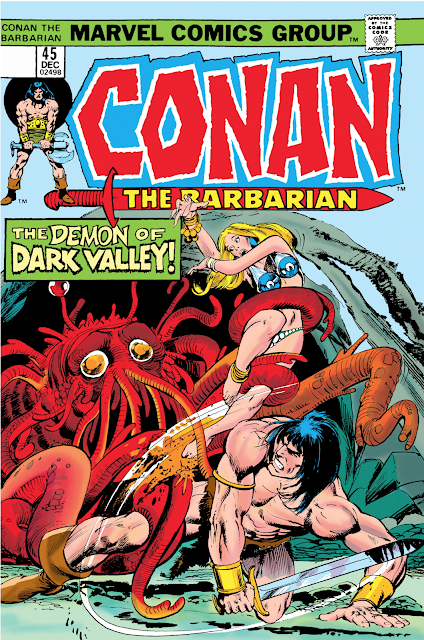

There were lots of tentacles on the cover of Conan the Barbarian. Here are just two tentacled covers. Top: Conan the Barbarian #32 (Nov. 1973), with cover art by Gil Kane and Ernie Chua. Bottom: Conan the Barbarian #45 (Dec. 1974), with cover art by Gil Kane, Neal Adams, and Crusty Bunkers. Others from the first one hundred issues include #25, #72, and #86. The images here are from Marvel Database, hence the lack of price tags and the cleaned-up images.

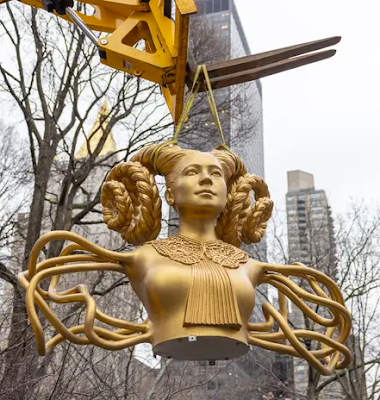
Tentacles are in the current art world as well. Here is a photograph by Rashmi Gill showing the raising of a sculpture called "Witness," created by Shahzia Sikander, in New York City. It's meant to honor a late Supreme Court justice. That's why she's wearing a lace collar. The hair is similar to a Hopi maiden's, but it's more like a pair of goat horns. Some people have called the statue demonic or satanic. It doesn't help that her arms look like the tentacles of the Octopus Woman who is attacking Conan on the cover above. If a male sculptor had done something like this, he would have been excoriated for mutilating the female form. Instead, I guess, this is an expression of grrl power.

Notice that the tentacles are connected to her body on both ends. They look like tubes or conduits or spark plug wires. Is she actually a machine? A cyborg? An AI? A transhuman? Is she feeding into herself, reaching into herself? Is she a multi-limbed female version of the worm Ouroboros? On November 17, 2022, I wrote a little about Pete Townshend's Lifehouse project. In James Harvey's illustration, there are tubes or feeds going into the heads of dehumanized masses of people. They look something like the image above. Or maybe these are manifold Fallopian tubes. Could she be fertilizing and impregnating herself? 

"Witness" is a well-made work. The face, head, and neck are good. But it's also bizarre and antihuman. I guess this is the state of public art in America. We must tear down images of Abraham Lincoln and put up monstrosities like this one as replacements. There will be no end to this of course. Or maybe Weird will end it.

Original text copyright 2023 Terence E. Hanley

Sunday, October 16, 2022

After Utopia by Mack Reynolds

Mack Reynolds (1917-1983) was a very prolific author of science fiction novels and short stories published between 1950 and 1983. He was something of a red-diaper baby and though he went by a kind of tough-guy moniker and lived an active life, he was a socialist. (1) That may have changed in 1958 when he resigned from the Socialist Labor Party in America. I know very little about that whole matter, but his transgression seems to have been, essentially, success. As Ambrose Bierce observed, success is the one unpardonable sin against our fellows. Socialism, being about envy, despises it.

As I was reading late last year or early this year about Utopia and Dystopia, I learned that Mack Reynolds wrote utopian fiction. "I have to read those stories," I thought. Soon after, I found his book After Utopia (Ace Books, 1977) at a local secondhand store. As the saying goes, ask and you shall receive. I read After Utopia this spring and drew more than a little from it.

Reynolds was well aware of the conventions of the utopian novel and he observed those conventions in his own book. First, the author of stories of this type must get his hero quickly, even precipitously, into Utopia. The author mustn't bother very much with a setup when telling about his ideal society is really the object. By this convention, maybe the John Carter novels are actually utopian. After just twelve pages, Carter, lickety-split, wakes up on Mars, having flown there by a kind of astral projection. In "The Sapphire Goddess" by Nictzin Dyalhis (Weird Tales, Feb. 1934), the narrator simply wills himself into a new world--Click!--after just four very brief introductory paragraphs.

Sometimes the hero must sleep his way into Utopia, and that's what happens in After Utopia. Other examples of Sleeping into Utopia (or Dystopia) include:

There are without a doubt other examples. They show that in order to reach into the dream of Utopia, a man must first sleep. (1)

In utopian and dystopian fiction, there is very often no action and no plot. Or words and ideas become the plot and the action. Utopia/Dystopia is the goal and the intellectual playground for what Eric Hoffer categorized as the man of words or man of ideas. Words and ideas are the excitement of such a man. To him, they are the action, including in any utopian story. (How often in our world is the revolutionary--the man who seeks to overthrow everything--essentially logorrheic? Karl Marx is a perfect example. Adolf Hitler is another.) In After Utopia, there is very little action. Most of what there is, is initiated by the man of the twentieth century awake in the twenty-first. Otherwise, it is mostly talk and more talk.

In the utopian story, the protagonist has to learn the culture of Utopia, including its language, and there is usually a sped-up process for teaching it. Very often the teacher is female. Sola in A Princess of Mars by Edgar Rice Burroughs (1912) fills that role. There is a female teacher--a Moon woman--in The "Lomokome" Papers by Herman Wouk (1968). The teacher in After Utopia, named Betty, is also female. I should add that the teacher in Dystopia is also often female, but she leads the hero away from or out of Dystopia instead of into it. And she uses love, sex, and human feeling to teach him and not anything out of a book.

When it isn't satirical or ironic, Utopia is a liberal or progressive genre. The dream and purpose of this creed seems very often to be sexual freedom, license, libertinism, or hedonism. Alternatively, liberalism, despite any higher or finer goals it might have, eventually reduces itself to being about sex and sexual matters, or in our time, what people call gender. Much of human society, culture, religion, and government seems to be about controlling sex (which I think is made so powerful in part so as to defy human ambitions towards godhood). The Liberal or Progressive chafes under traditional controls and wants to do away with them. But supposed conservatives sometimes do, too. Edgar Rice Burroughs is an example of that, I think. He is supposed to have been an atheist or agnostic. Beyond that, despite his very Victorian squeamishness and sentimentality, he inserted (no pun intended) sex into his books, including in the overt nudity of John Carter and the people of Mars. (3) It seems to me that Burroughs yearned for a kind of freedom in writing his Mars novels. That freedom included bodily freedom, unclothed of the constraints of his life and times. One of the things that attracted me when I was young about Frank Frazetta's illustrations of Burroughs' Mars novels is their sexuality and extraordinary vigor. Frazetta saw what Burroughs had put into his stories but was unable to depict fully given the times in which he wrote. Frazetta was free from those things. We should remember that he did his best work during the 1960s and '70s, in other words the Golden Age of Heterosexuality. As I've written before, I think that Frazetta's vision was superior to Burroughs'. I would rather go adventuring on Frazetta's Barsoom than on Burroughs' version of that Red Planet. In any case, After Utopia by Mack Reynolds is as much a sex fantasy as it is a Utopia, but then Utopia is very often just an excuse or a way to escape from constraints and into license. Call it Utopia as a letter printed in Penthouse Forum.

After Utopia is built on the model of Looking Backward by Edward Bellamy. That much is clear. As I have pointed out, the protagonists in both sleep their way into the dream of Utopia. The problem in Reynolds' novel is that his future Utopia is not a desirable kind of place. His hero, Tracy Cogswell (a man), keeps asking his hosts, why is he here? Why have they brought him from the past into the year 2045? And they keep putting him off. Finally he gets his answer. "The human race is turning to mush," they say. And they need his help.

"For more than half a century [Academician Stein tells him] we've had what every Utopian throughout history has dreamed of. Democracy in its most ultimate form. Abundance for all. The end of strife between nations, races, and, for all practical purposes, between individuals. And, as a species, we're heading for dissolution." [Emphasis added.] (pp. 54-55)

Setting aside the idea that history can end and that we can have stasis, dissolution would seem the logical endpoint of Utopia. That or a new revolution, or, as Stein (not Goldstein, as in 1984) puts it: "To overthrow the present socioeconomic system and form a new society." (p. 55) Utopia/Dystopia resists revolution of course. That is part of its nature and its strategy for survival. In his conceit, the utopian theorizer believes that there can be no further revolution after his own is accomplished.

Cogswell's three hosts have sent for him--have brought him from the past into the present--because he, as a man of the twentieth century, is still a man. He has the qualities that are lacking among men of the twenty-first by which a society--even a society of weak, stupid, shallow, and dissolute people--can be overthrown. The film Idiocracy has more than a little in common with After Utopia, but I'm also reminded of the movie Star Trek Into Darkness (2013), in which, again, people from the past have the strength and the grit to do the things that need doing in this still perilous future. We could easily say the same thing about our own time in which there is so much stupidity, weakness, and incompetence--especially in government--enough of those things and more to get us all killed if we're not careful. People of today are not up to the task. What we need are people of yesterday. (4)

Mack Reynolds was good at scientific extrapolations, better than almost any science fiction author I know of from that time and probably just as good as Robert Heinlein. In After Utopia, there is addictive programmed dreaming, equivalent to our virtual reality, computer gaming, Internet porn, and so-called Metaverse. There are also print-on-demand books. Late in his book, Reynolds described a gem of an extrapolation, what he called a transceiver, what we would recognize as a smartphone: a combination communications device, a device for accessing libraries of information, an "identification device," and a tracker or GPS unit (p. 176) Reynolds also predicted the current idea (around on the Internet since 2016) that "you will own nothing and you will be happy," for his people of the future own nothing and are happy that way. Whether they are happy in general is another story.

Anyway, eventually, towards the very, very end of the book, Tracy Cogswell, the man with a woman's name (one of his hosts, named Jo, is also a man, or "man"), figures out how to help his hosts and overthrow their society, and finally, finally, he takes action. And it works. It's not very convincing, but it's also an idea not without precedent in science fiction and in the ideas of real-world people. It's a surprise ending, so I won't give it away. I will say, though, that the ending is similar in a way to that of Things to Come, another story of a future Utopia.

Notes

(1) In our time, socialism is not a manly or vigorous pursuit. The most prominent socialists in America today are a superannuated hippie layabout and his callow sidekick, a dingbat ex-bartender from the Bronx. Their followers are stupid and weak in the extreme, the women harridans and the men feminized or infantilized beyond reach. Lenin, Trotsky, and Stalin are probably turning over in their graves, or on his bier, I guess, if you're talking about Lenin.

(2) There is no doubt a relationship between waking up or awakening and being woke. Wokeness was originally a black take on the old and very human idea of waking up--of opening one's eyes--to what's really going on in one's life or in the world. A non-genre novel with that idea in its very title is Hanger Stout, Awake! by Jack Matthews (1967).

(3) The Lady in C.S. Lewis' Perelandra (1943) is also naked, but her nakedness is innocent: like Adam and Eve, she is clothed in innocence. The people of Burroughs' Mars may live before the apple, but I don't sense that innocence in them. Instead, they seem to be just another expression of Burroughs' fantasy of freedom or what you might call a conservative Utopia.

(4) As I was watching last night (Saturday, October 15, 2022), I realized: there is at least one area of our culture--and our educational system--in which there is still excellence, and that is in college football.

After Utopia by Mack Reynolds, cover art by Vincent Di Fate.

Original text copyright 2022 Terence E. Hanley