Saturday, November 5, 2011

George Armin Shaftel (1903-1999)

Aka George S. Rosenberg
Author, Playwright, Educator
Born December 24, 1903, St. Louis, Missouri
Died December 7, 1999, Portola Valley, California

George Armin Shaftel was born in St. Louis, Missouri, on Christmas Eve, 1903. Son of Russian immigrants (his father was an itinerant watchmaker), Shaftel grew up in Du Quoin in "the soft coal country" of southern Illinois and matriculated at the University of Illinois. When the Shaftel family moved to southern California, George Shaftel transferred to the University of California at Berkeley. He wrote for the university magazine, The Occident, and plays for the University of California Little Theatre. Two of his plays won prizes.

After graduating with a masters degree in English, Shaftel returned to Champaign, Illinois, where he got in touch with a former teacher, William Byron Mowery. A professional author, Mowery offered guidance to Shaftel and other young writers on how to break into magazines. As George S. Rosenberg, Shaftel wrote stories for Western pulps for about a decade (1927-1937). He also wrote under his own name, including for detective magazines. Argosy, Blue Book, Collier's, Country Gentleman, Holland's, Liberty, Short Stories, and This Week were among the other titles to publish his work. Shaftel sold one story to Weird Tales, "The Giant in a Test Tube," from May 1942.

Living in Pasadena in the mid-1940s, Shaftel was part of what the Los Angeles Times called a "pulp mill," a group of authors who together cranked out two million words every year for pulp magazines. In addition to Shaftel, the group included John A. Saxson, Robert Leslie Bellem (1902-1968), and Frank Bonham (1914-1988), all housed in an office building on Arroyo Parkway. After World War II--as pulp magazines faded from the scene--George Shaftel switched gears and began writing more educational and non-fictional works, some with his wife, Stanford University education professor Dr. Fannie R. Shaftel. Also after the war, the Shaftels became involved in the creation of a housing cooperative in San Mateo County, California, close to Stanford University. Named Ladera, the community's members included writer Wallace Stegner and inventor Sigurd Varian, two interesting characters in their own right.

The Shaftels' marriage and professional collaboration lasted sixty-five years and ended only with the death of Fannie R. Shaftel on March 21, 1999. Her husband, George Armin Shaftel, died on December 7, 1999, in Portola Valley, California, just short of his ninety-sixth birthday.

George Armin Shaftel's Story in Weird Tales
"The Giant in a Test Tube" (May 1942)

Further Reading
Some of George Shaftel's pulp fiction stories are available as electronic books on the Internet.
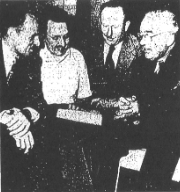
The Pasadena "pulp mill" of the 1940s (left to right): Frank Bonham, R.L. Bellem, G.A. Shaftel, and J.A. Saxson. (Photo from the Los Angeles Times.)
George Armin Shaftel (1903-1999). (Photo from the New York Times.)


Thanks to Randal A. Everts for additional information on George Armin Shaftel.
Text and captions copyright 2011, 2023 Terence E. Hanley

Friday, November 4, 2011

Maud E. Uschold (1896-1982)

Poet, Playwright, Local Historian
Born February 19, 1896, Illinois
Died April 26, 1982, Illinois

Maud Elfrid Uschold wrote a single poem for Weird Tales and many more for other publications. Her work was reprinted as recently as 2010 in the anthology One Big Rain: Poems for a Rainy Day, compiled by Rita Gray. Maud was born on February 19, 1896, in Illinois, a state in which she spent all or most of her life. She graduated from Lacon High School in 1913. From the 1920s through the 1950s, she wrote verse published in American Boy, Commonweal, Davis' Anthology of Newspaper Verse, The Double Dealer, The Improvement Era, Jack and Jill, Kaleidograph, Poetry, and Prairie Schooner. Her poem for Weird Tales was "Old Ghosts," from January 1929.

Maud Uschold enjoyed a second career as a local historian. Her works in that field included Always the Prologue (1967), This Is the Place (1968), The Blue Book of Old Settlers: A Retreat into Memory (1970), Deep Are the Roots (1976), and Marshall County Sketches (1976). She also authored a short play with a long title, The Redemption of a Free State: A Comedy-Drama of Pioneer Days in One Act, Two Scenes. Over the course of her long life, Maud lived in Richland and Lacon, Illinois, her last place of residence. She died on April 26, 1982, at age eighty-six and was buried at Lacon Cemetery.

Maud E. Uschold's Poem in Weird Tales
"Old Ghosts" (Jan. 1929)

Further Reading
Maud Uschold's poetry and non-fiction, though mostly out of print, are still generally available. 

American Boy for July 1935 with a poem by Maud Uschold and a cover by Edgar Franklin Wittmack, who created two covers for Weird Tales in 1943.


Thanks to Randal A. Everts for Maud Uschold's middle name.
Thanks to Anonymous (comment below) for finding her death date and place of burial.
Text and captions copyright 2011, 2023 Terence E. Hanley

Monday, October 31, 2011

Weird Tales at Halloween

Happy Halloween from Tellers of Weird Tales!
Feliz Día de los Muertos!

Cover by Boris Dolgov (March 1947)
Cover by Matt Fox (November 1949)
Cover by Harold DeLay (January 1944)
Cover by Matt Fox (May 1947)
Cover by Lee Coye Brown for the 25th Anniversary Issue (March 1948)
Cover by Joseph Eberle (March 1952)
Cover by A.R. Tilburne (July 1944)
Cover by Matt Fox (May 1948)

Sunday, October 30, 2011

More Weird Tales from the Victorian Age

Frederick Marryat
Born July 10, 1792, Westminster, London
Died August 9, 1848, Langham, Norfolk, England

For Weird Tales
"The Werewolf" (story, May 1926)

Frederick Marryat served well in the British navy and wrote prolifically about the sea. He also wrote horror stories, including "The Story of the Greek Slave" and "The Legend of Bell Rock." Marryat's weird novels included The Phantom Ship (1839) and Snarleyyow, or The Dog Fiend (1837). Weird Tales reprinted his story "The Werewolf," in its May 1926 issue. I believe the story was retitled after the original, "The White Wolf of the Hartz Mountains," drawn from the novel The Phantom Ship, and originally published in The New Monthly Magazine in 1839.

Elizabeth Cleghorn Gaskell
Née Elizabeth Stevenson
Aka Mrs. Gaskell
Born September 29, 1810, Chelsea, London
Died November 12, 1865, Holybourne, Hampshire, England

For Weird Tales
"The Old Nurse's Story" (story, Oct. 1927)

Elizabeth Gaskell, friend and associate of Charles Dickens, Charlotte Brontë, Charles Eliot Norton, and other prominent people of her age, was a successful and well-loved author despite her short life. With Dickens, Wilkie Collins (see below), and three others, she wrote "The Haunted House," a collection of interconnected stories set in a haunted house. "Conducted by" Dickens (who also wrote the first and last installments and one in between), the story was published in All the Year Round in 1859. Mrs. Gaskell's contribution to Weird Tales was "The Old Nurse's Story," from October 1927.

(William) Wilkie Collins
Born January 8, 1824, London
Died September 23, 1889

For Weird Tales
"The Dream Woman" (story, Jan. 1927)

Author of more than three dozen volumes of drama, fiction, and non-fiction, Wilkie Collins is remembered now for his mystery and detective novels, especially The Woman in White (1860) and The Moonstone (1868). Collins contributed to Dickens' collection of ghost stories, "The Haunted House." (See Elizabeth Gaskell above.) "The Dream Woman," from The Frozen Deep and Other Stories (1874) appeared in Weird Tales in January 1927. 

William Ernest Henley
Born August 23, 1849, Gloucester, England
Died July 11, 1903, Woking, England

For Weird Tales
"A King in Babylon" (poem, Dec. 1929)

Poet William Ernest Henley was a friend of Robert Louis Stevenson and the model for Long John Silver, right down to his wooden leg. His poem "Invictus" (1875) is the popular source of the phrase "bloody but unbowed" and an empowering and inspiring couplet:

I am the master of my fate:
   I am the captain of my soul.

Weird Tales reprinted his poem "A King in Babylon" in its December 1929 issue.

Ernest Dowson
Born August 2, 1867, Lee, London
Died February 23, 1900, Catford, London

For Weird Tales
"A Requiem" (poem, Mar. 1927)
"The Three Witches" (poem, Feb. 1928)

Playwright, novelist, poet, reviewer, and translator Ernest Dowson lived a short life of tragedy and dissipation, yet through his work, his name will live on, for his poetry gave us the phrases "Gone with the Wind" and "Days of Wine and Roses." Weird Tales did its part to remember him with two poems reprinted, "A Requiem" (March 1927) and "The Three Witches" (February 1928).

A Requiem
by Ernest Dowson

Neobule, being tired,
Far too tired to laugh or weep,
From the hours, rosy and gray,
Hid her golden face away.
Neobule, fain of sleep,
Slept at last as she desired!

Neobule! is it well,
That you haunt the hollow lands,
Where the poor, dead people stray,
Ghostly, pitiful and gray,
Plucking, with their spectral hands,
Scentless blooms of asphodel?

Neobule, tired to death
Of the flowers that I threw
On her flower-like, fair feet,
Sighed for blossoms not so sweet,
Lunar roses pale and blue,
Lilies of the world beneath.

Neobule! ah, too tired
Of the dreams and days above!
Where the poor, dead people stray,
Ghostly, pitiful and gray,
Out of life and out of love,
Sleeps the sleep which she desired.

An illustration of a werewolf by Henry Anelay, probably from the 19th century.
And an illustration for The Woman in White by Wilkie Collins. The artist was Frederick Walker (1840-1875). Revision (Feb. 28, 2021): Now I find that this illustration is actually the work of William Harcourt Hooper (1834-1912).

Text copyright 2011, 2023 Terence E. Hanley

Thursday, October 27, 2011

Weird Tales from the Victorian Age

Edward Bulwer-Lytton
Born May 25, 1803, London
Died January 18, 1873, Torquay, England

For Weird Tales
"The Haunted and the Haunters, or The House and the Brain" (story, May 1923)

Bulwer-Lytton was a prolific author known more today for the opening line of one of his novels than for any other work. The line is Snoopy's favorite opening line as well:

It was a dark and stormy night . . . 

Bulwer-Lytton worked in a number of forms and genres, including the horror story and the science fiction novel. Weird Tales reprinted "The Haunted and the Haunters, or The House and the Brain" (1859) in a very early issue of the magazine, May 1923. Equally interesting is his authorship of The Coming Race, or Vril: The Power of the Coming Race (1871), a science fiction novel concerning a subterranean race and its designs on the surface upon which we live. Theories of a hollow earth preceded the publication of Bulwer-Lytton's book. Edgar Rice Burroughs was among later popularizers of the idea. In the 1940s, Richard S. Shaver and science fiction editor Raymond A. Palmer advanced the idea that Deros, or detrimental robots, inhabit the inner earth and are forever scheming against humanity. Briefly popular, "The Shaver Mystery" faded from the public eye to be replaced by the first of two great science fiction-based belief systems, flying saucers. Raymond Palmer was instrumental in keeping flying saucers before the public for years after the first sighting in 1947. Occultists now weave the hollow earth theory, subterranean races, flying saucers, ancient astronauts, interdimensional travel, and cryptozoological creatures into a unified field theory of the paranormal.

Alfred, Lord Tennyson
Born August 6, 1809, Somersby, Lincolnshire, England
Died October 6, 1892, Haslemere, Surrey, England

For Weird Tales
"The Splendor Falls on Castle Walls" (poem, Oct. 1938)

Tennyson was and is one of the most admired and accomplished poets in the English language. He served as Poet Laureate of the United Kingdom from 1850 until his death in 1892, the longest tenure of any poet to hold the post. Frequently quoted, Tennyson's verse dealt with classical, historical, and contemporary subjects. Tennyson's short poem, "The Eagle: A Fragment" (1851), brings to mind Andrew Brosnatch's drawing for "The Eyrie," the letters column of Weird Tales from 1924 to 1954.

The Eagle: A Fragment
by Tennyson

He clasps the crag with crooked hands;
Close to the sun in lonely lands,
Ring'd with the azure world, he stands.

The wrinkled sea beneath him crawls;
He watches from his mountain walls,
And like a thunderbolt he falls.

Edward FitzGerald
Born March 31, 1809, Bredfield, Suffolk, England
Died June 14, 1883, Merton, Norfolk, England

For Weird Tales
Three stanzas translated from "The Rubaiyat of Omar Khayyam" (Mar. 1934; June/July 1939; Jan. 1940)

Edward FitzGerald was vastly wealthy and towards the end of his life a skeptic, yet he lived here and there and was buried in a churchyard. A dilettante, a gardener, an idler, and a writer of letters, he produced a translation of 700-year-old Persian poetry that is still read today. Weird Tales reprinted three stanzas from that work, "The Rubaiyat of Omar Khayyam," in 1934 (No. 24), 1939 (No. 68), and 1940 (No. 31).

Charles Dickens
Born February 7, 1812, Landport, Portsmouth, England
Died June 9, 1870, Gad's Hill Place, Higham, Kent, England

For Weird Tales
"The Bagman's Story" (Oct. 1926)
"The Signal-Man" (Apr. 1930)
"A Child's Dream of a Star" (July 1930)

In his lifetime, Charles Dickens was probably the most famous and popular writer in the English language. In addition to his many well-read and often-filmed novels A Tale of Two Cities (1859), Great Expectations (1861), David Copperfield (1849-1850), and The Adventures of Oliver Twist (1837-1839), Dickens wrote the most famous ghost story in the English language, A Christmas Carol (1843). Weird Tales reprinted three of his short pieces, "The Bagman's Story" (Oct. 1926), "The Signal-Man" (Apr. 1930), and "A Child's Dream of a Star" (July 1930). Dickens would not have been a stranger to magazines: during his lifetime, he serialized many of his novels in monthly and weekly publications, his installments often ending in a cliffhanger.

Charles Kingsley
Born June 12, 1819, Holne, Devon, England
Died January 23, 1875, Eversley, Hampshire, England

For Weird Tales
"The Sands of Dee" (poem, Jan. 1926)

Charles Kingsley was a minister and son of a minister, and a writer and both brother and father of writers. He authored more than thirty-five books of non-fiction, sermons, verse, and fiction, most famously The Water-Babies, A Fairy Tale for a Land Baby (1863) and Westward, Ho! (1855), which lent its title to the only town in England with an exclamation point in its name. His work reprinted in Weird Tales consisted of a single poem, "The Sands of Dee," from January 1926. 

Dante Gabriel Rossetti
Born May 12, 1828, London
Died April 9, 1882, Birchington-on-Sea, Kent, England

For Weird Tales
"The Blessed Damozel" (poem, Dec. 1938)

Dante Gabriel Rossetti championed FitzGerald's "Rubaiyat" and helped the older poet earn later printings of his work. Rossetti was the son of Italian immigrants and only one of a talented and accomplished family that included the poet Christina Rossetti. A medievalist, artist, poet, and translator, Dante Gabriel Rossetti co-founded the Pre-Raphaelite Brotherhood. Among his associates were William Holman Hunt, John Everett Millais, and William Morris, a multitalented author, artist, designer, and--as a fantasist--an influence upon writers of the twentieth century, especially J.R.R. Tolkein.

Robert Louis Stevenson
Born November 13, 1850, Edinburgh, Scotland
Died December 3, 1894, Vailima, Spain

For Weird Tales
"Markheim" (story, Apr. 1927)

Robert Louis Stevenson wrote what you might call genre fiction, or what in the 1920s and '30s could have been called pulp fiction, including pirate stories (Treasure Island), historical adventure (The Black Arrow, Kidnapped, The Master of Ballantrae), Ruritanian romance (Prince Otto), and of course horror (The Strange Case of Doctor Jekyll and Mister Hyde). Weird Tales reprinted his story "Markheim" (1887) in its April 1927 issue.

Weird Tales reprinted the work of other writers from the Victorian Age, but I'll write about them in future postings, either because they lived into subsequent ages (Bram Stoker, H.G. Wells), or because they were Irish rather than British (Oscar Wilde, Fitz-James O'Brien).

"The Blessed Damozel" by Dante Gabriel Rossetti, poet, artist, and co-founder of the Pre-Raphaelite Brotherhood.
"La Belle Dame Sans Merci," another work by Rossetti and subject of Keats' poem, listed in yesterday's posting.
An illustration for Charles Kingsley's Water Babies by the American illustrator Jessie Willcox Smith (1863-1935). Other artists have tried their hands at Kingsley's book, but none is as closely identified with the book as she.

Text and captions copyright 2011, 2023 Terence E. Hanley

Tuesday, October 25, 2011

Weird Tales from the Romantic Era

William Blake
Born November 28, 1757, London
Died August 12, 1827, London

For Weird Tales
"The Tiger" [sic] (poem, Apr. 1926)

Samuel Taylor Coleridge
Born October 21, 1772, Ottery Saint Mary, Devon, England
Died July 25, 1834, Highgate, England

For Weird Tales
"Song" (poem, Jan. 1927)
"The Knight's Tomb" (poem, Sept. 1927)

John Keats
Born October 31, 1795, London
Died February 23, 1821, Rome

For Weird Tales
"La Belle Dame Sans Merci" (poem, Apr. 1938)

Percy Bysshe Shelley
Born August 4, 1792, Field Place, Horsham, England
Died July 8, 1822, Viareggio, Grand Duchy of Tuscany

For Weird Tales
"Ozymandias" (poem, Sept. 1926)

Mary W. Shelley
Née Mary Wollstonecraft Godwin
Born August 30, 1797, Somers Town, London
Died February 1, 1851, Chester Square, London

For Weird Tales
"Frankenstein" (serialized novel, eight parts, May-Dec. 1932)

Thomas Lovell Beddoes
Born June 30, 1803, Clifton, Bristol, England
Died January 26, 1849, Basel, Switzerland

For Weird Tales
"The Old Crow of Cairo" (originally "Song", July 1927)

Robert Burns
Born January 25, 1759, Alloway, Ayrshire, Scotland
Died July 21, 1796, Dumfries, Scotland

For Weird Tales
"Tam O' Shanter" (poem, May 1938)

Sir Walter Scott
Born August 15, 1771, Edinburgh, Scotland
Died September 21, 1832, Melrose, Scotland

For Weird Tales
"Wandering Willie's Tale" (story, Jan. 1926)
"The Tapestried Chamber" (story, Sept. 1926)

Despite many differences among them, Wordsworth, Coleridge, Blake, Byron, Shelley, Keats, and their contemporaries were long ago lumped into a Romantic movement said to have begun in 1798 with the publication of Lyrical Ballads. The authors of that book were an anonymous Wordsworth and Coleridge. According to the Norton Anthology of English Literature, the Romantic movement was characterized by: 1) an emphasis on poetry and the poet; 2) poetic freedom and spontaneity; 3) treatments of nature; 4) "the glorification of the commonplace"; and 5) for readers of weird tales, an interest in the supernatural and "'strangeness in beauty'." Many Romantics also seemed preoccupied with death, none so much as Thomas Lovell Beddoes, who could almost have been a living Dr. Frankenstein. Beddoes, along with Keats and Shelley, also met a tragic death when quite young and when living on the Continent. As forerunners to American literature of the nineteenth century, the writers of the British Romantic era, especially Mary Wollstonecraft Shelley with her Frankenstein (1818), might even be said to have fathered (or mothered) the weird tale.  

Of the major British Romantic poets, all but Wordsworth and Byron were represented in the pages of Weird Tales. If you would like something weird or supernatural from Wordsworth, you might try "Lucy Gray, or Solitude" (1799), which ends with the suggestion of a haunting. Byron authored a more powerful and dreadful poem, "Darkness" (1816), which begins with these lines:

          I had a dream, which was not all a dream.
          The bright sun was extinguished, and the stars
          Did wander darkling in the eternal space,
          Rayless, and pathless, and the icy earth
          Swung blind and blackening in the moonless air. . . .

William Hope Hodgson may have drawn inspiration from Byron's "Darkness" while writing his novel from a century later, The Night Land. On the other hand, a world that ends in darkness is likely a shared vision among humanity.

Miscellany: Blake's short poem "The Tyger" (1790-1792) is a work not forgotten by those who read it. Alfred Bester borrowed the first two words of the poem--Tiger! Tiger!--for the title of the British edition of his science fictional and typographic tour de force, The Stars My Destination (1956), an equally unforgettable work. 

Shelley's "Ozymandias" was reprinted in Weird Tales in its September 1926 issue, about the time H.P. Lovecraft was working on "The Call of Cthulhu." As I wrote in a previous posting, in Watchmen, Alan Moore named his Übermensch character Ozymandias. What's the connection? Moore's Ozymandias uses a Cthulhu-like creature to destroy New York City.

There were of course other British writers of the the Romantic era. Charles Lamb (1775-1834) wrote an essay, "Witches and Other Night Fears" (1821), that might be of interest to readers of weird tales.

William Blake was not only a poet but also an artist. Here is a watercolor illustration, "The Great Red Dragon and the Woman Clothed in Sun," one of a series depicting scenes from Revelation. The musculature and the staves of the dragon's wings are horrifying in Blake's carefully wrought and naturalistic treatment. What model did he use to draw such a thing? What is the source for such "fearful symmetry"?
An etching by Piranesi (1720-1778), another fantasist of the 18th century.
And a painting by Fuseli (1741-1825), an associate of Mary Wollstonecraft (mother of Mary W. Shelley) and an influence on William Blake. Weird tales and fantasy art go back millennia, but they began to look more modern during the eighteenth century.

Text and captions copyright 2011, 2023 Terence E. Hanley

Monday, October 24, 2011

Weird Tales from the Revolution, Restoration, and Union

John Milton
Born December 9, 1608, Cheapside, London, England
Died November 8, 1674, Bunhill, London, England

Daniel Defoe
Né Daniel Foe
Aka Daniel De Foe and at least 198 different pen names (according to Wikipedia)
Born ca. 1659-1661, London?, England
Died April 24, 1731, In hiding?, England

Weird Tales published many works from authors well known but long dead. It doesn't really matter that the practice might look to us like an attempt to lend an air of high culture to the magazine or an avoidance of paying authors for their work. I'm more inclined to think that if it qualified as a weird tale, it was fitting for the magazine. In any case, from that apparently unnamed period in English history between the end of the Renaissance and the beginning of the Age of Reason (or the Industrial Revolution) comes the work of Milton and Defoe.

Defoe's story is either a journalistic account or a well-disguised work of fiction detailing the apparition of a departed Mrs. Veal before one of her friends. The full title of the work is "A Relation of the Apparition of Mrs. Veal," and it was perhaps drawn from The Novels and Miscellaneous Works of Daniel De Foe, volume 5, edited by Sir Walter Scott (Oxford, 1840). I don't know the date of the original composition or publication of the story, but the apparition is said to have taken place on September 8, 1705. Mrs. Veal made another apparition in Weird Tales in December 1926. The magazine would have been on the newsstand at about the time H.P. Lovecraft was working on "The Call of Cthulhu." Although the story may not have influenced Lovecraft in his work, it may have given him some affirmation that the journalistic approach he had taken was the right one.

Milton's work was a poem, "L'Allegro," and part of Virgil Finlay's poetry series. I haven't seen the full text of what appeared in Weird Tales, but I suspect that it was less than Milton's whole poem, which runs to 152 lines. Here are the first ten, sure to appeal to readers of "The Unique Magazine":

Hence loathed Melancholy
Of Cerberus, and blackest midnight born,
In Stygian Cave forlorn
'Mongst horrid shapes, and shreiks, and sights unholy,
Find out som uncouth cell,
Wher brooding darknes spreads his jealous wings,
And the night-Raven sings;
There under Ebon shades, and low-brow'd Rocks,
As ragged as thy Locks,
In dark Cimmerian desert ever dwell.

(From Milton's Poems [1645]).

Reading Milton and other poets from the 17th and 18th centuries makes it easy to see where Lovecraft got his inspiration. Lovecraft may even have imagined himself as the poem's personified "loathed Melancholy."

That's not Robert E. Howard's Cimmeria by the way, but Homer's.

John Milton's Poem in Weird Tales
"L'Allegro" (Jan. 1939)

Daniel Defoe's Story in Weird Tales
"The Apparition of Mrs. Veal" (Dec. 1926)

"De Foe in the Pillory," an engraving by J.C. Armytage. How could I pass up a beautifully made work like this one, showing an author from Weird Tales being pilloried?
Defoe wasn't the only one. Milton was clapped into prison late in life for his support of the Revolution. Here is the  frontispiece and title page of his Poems.

Text and captions copyright 2011, 2023 Terence E. Hanley