Thursday, February 6, 2014

John Giunta (1920-1970)-Part 3

According to the book The T.H.U.N.D.E.R. Agents Companion (2005), John Giunta began working in comic books in 1939, when, as a beginning artist, he did lettering and coloring for the Harry "A" Chesler comic book shop. He also reviewed science fiction fanzines in Amazing Mystery Funnies #12 (Dec. 1939). According to the online Comic Book Database, Giunta's earliest credited work as a comic book artist appeared in Spitfire Comics #1, from August 1941. He continued working in comic books for the rest of his life and is credited with published work in all but four years between 1941 and 1970, the year of his death. In addition to Spitfire Comics, he worked on Joker Comics, Suspense Comics, Treasure Comics, Spook Comics, The Mad Hatter, All-Star Comics, All-American Western, Boy Commandoes, Badmen of Tombstone, Strange Worlds, Man Comics, Chamber of Chills, Weird Thrillers, Big Town, Strange Adventures, Mystery in Space, Lost Worlds, Phantom Stranger, Tomb of Terror, Thrills of Tomorrow, Superboy, Journey into Mystery, Two Gun Western, World of Suspense, Strange Tales, World of Fantasy, Eerie, The Fly, Adventures of the Fly, Tales of the Unexpected, Laugh, Pep, House of Mystery, Tales to Astonish, T.H.U.N.D.E.R. Agents, Undersea Agents, Noman, Batman, and Detective Comics. That means that in his lifetime, John Giunta worked for Harvey, Timely, Continental Magazines, Prize Publications, Baily Publishing, O.W. Comics, DC, Avon, Ziff-Davis, Standard/Nedor, Atlas, I.W. Enterprises, Archie Comics, Marvel, and Tower Comics. His work has also been reprinted since his death.

According to the Internet Speculative Fiction Database, John Giunta's first published work in a professional science fiction magazine was an illustration for "Bratton's Idea" by Manly Wade Wellman in the December 1940 issue of Comet, edited by F. Orlin Tremaine. Giunta's second credited illustration was for "The Hound" by Fritz Leiber, Jr., published in Weird Tales in November 1942. For the next eight years, his illustrations in the genres of science fiction and fantasy appeared only in Weird Tales. That changed in December 1950 with his illustrations for Out of This World Adventures. From the early 1950s to the late 1960s, Giunta contributed to Fantastic Adventures, Avon Science Fiction and Fantasy Reader, Fantastic, Infinity Science Fiction, Amazing Stories, Science Fiction Adventures, Venture Science Fiction Magazine, Saturn, Fantastic Universe, If, Galaxy Magazine, and Worlds of Tomorrow. He was also art director for Original Science Fiction Stories and Saturn. And again, his work has been reprinted since his death in 1970.

Those are some long lists for a blog posting, but I have compiled them for a reason. John Giunta was both a comic book artist and a science fiction illustrator. You would hardly know that to look at sources in print or on the Internet. The science fiction sources pretty well ignore his work in comic books, and the comic book sources tell very little about his work as an illustrator. Why is that? Why should there be this unbridged gap between a genre (science fiction) and a form (comic books) that so naturally go together?

To be concluded . . . 

"The Magician from Mars," a comic book character and series created by John Giunta, Malcolm Kildale, and Michael Mirando in Amazing Man Comics (Centaur, 1940-1941). Giunta's interest in science fiction shows through pretty clearly here. If you remember my posting from the other day, Malcolm Kildale was the artist from whom Frank Frazetta seems to have borrowed an image or two.
Roly-Poly Comics #10 (Green Publishing Company, Jan. 1946). "Jay Gee," the artist, was John Giunta. 
Fantasy, a fanzine dated November 15, 1948, with cover art by John Giunta, evidence that he was involved in fandom even after having become a professional artist. 
A somewhat muddy interior illustration for "The Moonrakers," Giunta's own story from If (Jan. 1966). 
The cover of Fantasy-Times: The Science-Fiction Newspaper (Sept. 1956), with a small photograph of John Giunta in the upper right. Bill Blackbeard is in the lower center. Giunta illustrated his story (co-written with James O. Causey) "Hammer of Cain" for Weird Tales in November 1943.

Text and captions copyright 2014, 2023 Terence E. Hanley

John Giunta (1920-1970)-Part 2

Science fiction fandom of the 1930s culminated in the First World Science Fiction Convention, held July 2 to July 4, 1939, at Caravan Hall, in New York City. Science fiction fans, artists, and writers from all over the country flocked to the convention. Forrest J Ackerman and Ray Bradbury came in from Los Angeles, Jack Williamson from New Mexico. Ray Cummings, Manly Wade Wellman, Edmond Hamilton, L. Sprague de Camp, Isaac Asimov, and the esteemed Frank R. Paul also showed up. The convention also boasted the attendance of magazine editors John W. Campbell, Jr., Leo Margulies, Mort Weisinger, Charles D. Hornig, and Farnsworth Wright. Wright was of course the editor of Weird Tales. John Giunta and Wright may have met. Who at this point can say. But by the time Giunta's first illustration appeared in Weird Tales in November 1942, Wright was gone from his post as editor. He was in fact in his grave.

John Giunta was a part of the crowd and in front of the crowd at the First World Science Fiction Convention. Giunta, James V. Taurasi, and Sam Moskowitz auctioned off, among other gems, original art by Virgil Finlay that went for as little as two dollars apiece. (1) In a softball game between the Queens Science Fiction League Cometeers and the Philadelphia Science Fantasy Society Panthers, Giunta replaced the Queens pitcher, A. Langley Searles, in the fourth inning and finished the game despite being pounded by the Panthers. The final score was Queens 23, Philadelphia 11. (2)

Science fiction conventions continue today, but that First World Science Fiction Convention came at the beginning of a fateful summer, for two months later, war began again in Europe. American involvement was still two years off, but science fiction fandom of the 1930s was reaching not only a chronological end but also a sort of spiritual end. As Isaac Asimov wrote:
Beginning with the third decade [of life], after [age] twenty, life becomes filled with adult responsibility and turns to lead. But that second decade, from ten to twenty, is gold; it is in those years that we remember bliss. (3)
Asimov turned twenty in 1940. John Giunta entered his own age of lead that year. Nevertheless, Taurasi and Moskowitz organized a new science fiction fan club, The Cometeers, on October 14, 1940, at Giunta's home. Other members included Ray Van Houten, John Peterson, Elliott Dold, and F. Orlin Tremaine. According to Harry Warner, Jr.:
Membership was by invitation only, and eventually the group either became so exclusive that it lost all contact with civilization, or it disintegrated; the last positive evidence of its survival is at the start of 1944. (4)
I don't know whether Giunta was still a member in 1944, but by then he was well on his way as a comic book artist and magazine illustrator, the career that would carry him through to the end of his brief life.

To be continued . . . 

Notes
(1) The Immortal Storm: A History of Science Fiction Fandom by Sam Moskowitz (1954), p. 221.
(2) Moskowitz, p. 222.
(3) From "Introduction" by Isaac Asimov in Before the Golden Age: A Science Fiction Anthology of the 1930s (1974), p. xiii.
(4) All Our Yesterdays by Harry Warner, Jr. (1969), p. 220.

Updated on February 1, 2022.
Original text copyright 2014, 2023 Terence E. Hanley

Wednesday, February 5, 2014

John Giunta (1920-1970)-Part 1

Aka Jay Gee
Illustrator, Comic Book Artist, Science Fiction Fan, Author, Editor, Publisher, Art Director, Reviewer
Born June 5, 1920, New York, New York
Died November 6, 1970, New York, New York

John Giunta was born on June 5, 1920, in New York City, probably in Brooklyn or Queens. His parents were Italian immigrants. (The surname Giunta is the Italian equivalent of the Spanish word junta.) Giunta's mother was named Jenny, a nickname for Giovanna. According to David Saunders on his website Field Guide to Wild American Pulp Artists, Giunta's father was Francesco Antonio Giunta. His father may have been Thomas G. Giunta. I think both worked in the garment industry. In 1940, John Giunta was at home in Brooklyn with his mother. He was just nineteen years old but already working as a commercial artist. If Thomas G. Giunta was indeed the father of John Giunta, then there were other Giunta children: Anna, Antonio, and Marie E. Giunta. I haven't found John Giunta in any other census except 1940, nor in any other public records. I don't even know his date of birth.

If John Giunta has any measure of fame today, it's mostly for his collaboration with Frank Frazetta on Frazetta's first published comic book story, "Snowman," from Tally Ho #1 (Dec. 1944). Frazetta was of course a teenaged prodigy and would go on to great fame in the 1960s and beyond. Giunta, who in 1944 was in his mid-twenties, was already a comic book veteran, having started in the business in the late 1930s. However, if you look for biographical information on him in any of the histories of comic books, you will come up empty. On the other hand, if you begin with two sources on science fiction fandom, you will find some interesting tidbits on Giunta's early career as an artist, editor, and publisher.

Science fiction fandom began in the late 1920s with the letters column of Hugo Gernsback's Amazing Stories. During the next decade or so, fans began corresponding with each other, organizing clubs, and issuing their own hectographed and mimeographed magazines. New York City was an epicenter of fandom, Brooklyn and Queens in particular. Much of what we know of early fandom comes from the men who were there and who in later years recounted their experiences. The Immortal Storm: A History of Science Fiction Fandom by Sam Moskowitz (1954) and All Our Yesterdays by Harry Warner, Jr. (1969) are two invaluable sources about a kind of golden age that slipped away, just as youth slips away.

Like other artists and writers in his field, John Giunta gained entry into comic books because of his interest in science fiction and fantasy and because of his activity in fandom. (1) According to Sam Moskowitz, Cosmic Tales, issued by New York fans James V. Taurasi, Jack Gillespie, and Robert G. Thompson beginning in 1937, "was the magazine which introduced artists John Giunta and Jack Agnew to the field." (2) Giunta would have been just sixteen or seventeen years old at the time. Taurasi passed editorship to the sister-and-brother team of Gertrude and Louis Kuslan with the September 1938 issue of Cosmic Tales. John Giunta took over for one issue, dated 1940 (Vol. 1, No. 2). By then Giunta had already published his own fanzine, Amazing Wonder Tales, the one and only issue of which was dated August 1938. Giunta subsequently changed the title to Scienti-Tales (Mar./Apr. 1939). He also issued an amateur press magazine called Scientitale Publication. (3)

Earlier that summer--on June 5, 1938, his eighteenth birthday--Giunta had attended the first meeting of the newly reorganized Greater New York Chapter of the Science Fiction League. Sixteen fans were present, including, in the words of Sam Moskowitz, "two amateur artists, John Giunta and Daniel C. Burford." (4) Jack Rubinson and William Sykora were also there. The next event in a chronicle of Giunta's fan activity was the publication of the first mimeographed edition of Fantascience Digest, edited by Robert A. Madle, in January 1939. Staff writers on the magazine included the two aforementioned historians of fandom, Harry Warner, Jr., and Sam Moskowitz. The list of contributors to Fantascience Digest is nothing to sniff at: Henry Kuttner, Ray Bradbury, Ralph Milne Farley, Donald A. Wollheim, and the young John Giunta. (5) That same month, Giunta had his first published credit in a professional science fiction magazine (or prozine), a letter in Startling Stories.

To be continued . . .

Notes
(1) Jerry Siegel and Joe Shuster for example, were keen fans of science fiction and published their own fanzines, Cosmic Stories (1929) and Science Fiction (1933). They also created Superman, a character that had originated in pulp-fictional form. Other science fiction fan artists included Ronald Clyne and Hannes Bok, both of whom contributed to Weird Tales. See All Our Yesterdays by Harry Warner, Jr. (1969), p. 91
(2) The Immortal Storm: A History of Science Fiction Fandom by Sam Moskowitz (1954), p. 135.
(3) "Death of an Artist: John Giunta--A Personalized Obituary" by Sam Moskowitz, Luna Monthly No. 20 (Jan. 1971), pp. 1-2.
(4) Moskowitz, p. 171.
(5) Moskowitz, p. 200.

Amazing Wonder Tales #1, August 1938, a science fiction fanzine with cover art by John Giunta.
Cosmic Tales, July 1941 (Vol. 1, No. 4), with cover art by Giunta. 

Thanks to Christopher M. O'Brien for providing Sam Moskowitz's obituary of John Giunta.
I acknowledge David Saunders in his research on John Giunta. Click here to read what Mr. Saunders wrote.
Updated on February 1, 2021.
Text and captions copyright 2014, 2023 Terence E. Hanley

Tuesday, February 4, 2014

C.C. Senf (1873-1949)-Part 3

C.C. Senf created his first cover for Weird Tales in March 1927 and his last in September 1932. In that five-and-a-half-year period, Senf (forty-five covers), Hugh Rankin (fifteen covers), and C. Barker Petrie, Jr., (one cover) were the sole cover artists for "The Unique Magazine." By my count, Senf also contributed interior illustrations to thirty-four issues of Weird Tales from April 1927 to June 1932.

C.C. Senf turned fifty-nine in 1932. That seems too young for retirement, yet his cover for the September issue of Weird Tales was evidently his last credit in the field of science fiction and fantasy. (The Internet Speculative Fiction Database lists only his illustrations for Weird Tales and no other.) I don't know of any other credits for him, and I have not found anything in the Chicago Tribune. That seems a shame to me. In any case, Senf lived another seventeen years. His death came on April 24, 1949, in Chicago. Curtis C. Senf was buried in Memorial Park in Skokie, Illinois, with his wife.

C.C. Senf's Cover Illustrations for Weird Tales
Mar. 1927, "The City of Glass" by Joel Martin Nichols, Jr.
Apr. 1927, "Explorers Into Infinity" by Ray Cummings
May 1927, "The Master of Doom" by Donald Keyhoe
June 1927, "A Suitor from the Shades" by Greye La Spins
July 1927, "The Return of the Master" by H. Warner Munn
Sept. 1927, "The Wolf-Woman" by Bassett Morgan
Oct. 1927, "The Dark Lore" by Nictzin Dyalhis
Nov. 1927, "The Invading Horde" by Arthur J. Burks
Jan. 1928, "The Gods of East and West" by Seabury Quinn
Feb. 1928, "The Ghost Table" by Elliot O'Donnell
Mar. 1928, "The Strange People" by Murray Leinster
Apr. 1928, "The Jewel of the Seven Stones" by Seabury Quinn
May 1928, "The Bat-Men of Thorium" by Bertram Russell
June 1928, "The Devil's Martyr" by Signe Toksvig
July 1928, "The Witches' Sabbath" by Stephen Bagby
Aug. 1928, "Red Shadows" by Robert E. Howard
Sept. 1928, "The Devil-Plant" by John Murray Reynolds
Oct. 1928, "The Werewolfs Daughter" by H. Warner Munn
Nov. 1928, "The Mystery in Acatlan" by Rachael Marshall and Maverick Terrill
Jan. 1929, "The Black Master" by Seabury Quinn
Mar. 1929, "The People of Pan" by Henry S. Whitehead
May 1929, "The Scourge of B'Moth" by Bertram Russell
July 1929, "The Corpse-Master" by Seabury Quinn
Sept. 1929, "The White Wizard" by Sophie Wenzel Ellis
Nov. 1929, "The Gray Killer" by Everil Worrell
Jan. 1930, "The Curse of the House of Phipps" by Seabury Quinn
Mar. 1930, "The Drums of Dumballah" by Seabury Quinn
May 1930, "The Brain-Thief' by Seabury Quinn
July 1930, "The Bride of Dewer" by Seabury Quinn
Sept. 1930, "The Invisible Bond" by Arlton Eadie
Nov. 1930, "A Million Years After" by Katherine Metcalf Roof
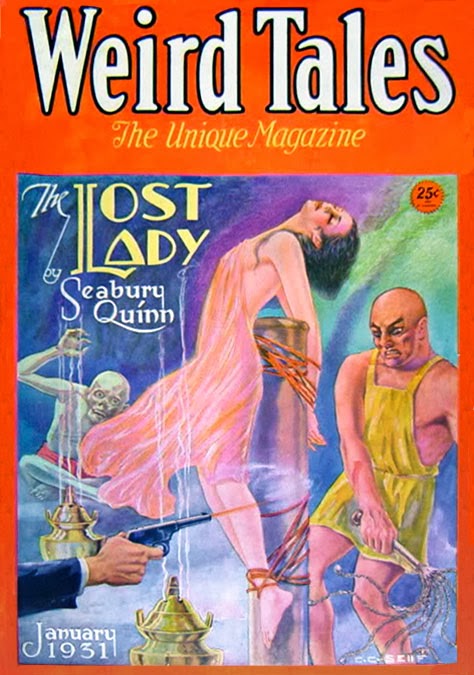
Jan. 1931, "The Lost Lady" by Seabury Quinn
Apr.-May 1931, "The Dust of Death" by Hugh Jeffries
June-July 1931, "Tam, Son of the Tiger" by Otis Adelbert Kline
Aug. 1931, "Tam, Son of the Tiger" by Otis Adelbert Kline
Sept. 1931, "Tam, Son of the Tiger" by Otis Adelbert Kline
Oct. 1931, "Tam, Son of the Tiger" by Otis Adelbert Kline
Nov. 1931, "Placide's Wife" by Kirk Mashburn
Dec. 1931, "The Dark Man" by Robert E. Howard
Jan. 1932, "The Monster of the Prophecy" by Clark Ashton Smith
Feb. 1932, "The Devil's Bride" by Seabury Quinn
Mar. 1932, "The Vengeance of Ixmal" by Kirk Mashburn
Apr. 1932, "The Red Witch" by Nictzin Dyalhis
May 1932, "The Brotherhood of Blood" by Hugh B. Cave
Sept. 1932, "The Phantom Hand" by Victor Rousseau
(Source: The Collector's Index to Weird Tales by Sheldon R. Jaffery and Fred Cook, 1985)

Interior Illustrations
Apr. 1927, "Explorers Into Infinity" part 1 by Ray Cummings
May 1927
June 1927
July 1927
Mar. 1929
Apr. 1929
May 1929
July 1929
Aug. 1929
Sept. 1929
Oct. 1929
Nov. 1929
Jan. 1930
Mar. 1930
Apr. 1930
May 1930
July 1930
Aug. 1930
Sept. 1930
Oct. 1930
Nov. 1930
Jan. 1931
Feb.-Mar. 1931
Apr.-May 1931
June-July 1931
Aug. 1931
Sept. 1931
Oct. 1931
Nov. 1931
Dec. 1931
Jan. 1932
Mar. 1932
Apr. 1932
June 1932, "Birch Trees" (poem) by Marvin Luter Hill

Further Reading
Field Guide To Wild American Pulp Artists by David Saunders.

C.C. Senf's first cover for Weird Tales, March 1927.
And his last, September 1932. Note the difference in style, from a somewhat antiquated style, like a nineteenth-century fairy tale, to a more contemporary style, like a 1930s movie magazine or love pulp.
A few days ago I wrote about swipes. Well sometimes an artist swipes from himself. The top image is from January 1932. Just five months later, Weird Tales treated its readers to an almost identical composition.
I have been harping on Senf's old-fashioned style. This cover (May 1928) is old-fashioned in its way, but it's still effective. The woman is a little stiff, considering what is being done to her, but the monsters are good, that is to say, bad. They remind me of Ray Harryhausen's animated creatures. 
Believe it or not, this picture was drawn by a fifty-seven-year-old and probably a respected man in his neighborhood, yet it has a primitive power and a certain unseemliness that doesn't quite fit the artist. This cover came along at about the beginning of the weird-menace craze. It has all that and more: bondage, torture, a scantily clad woman, a reaching hand, a pistol shot ringing out, a green ghoul, and a bald-headed guy with mean eyes and a meaner whip. Snoopy could write a novel about a picture like this one. In any case, Senf's technique had changed in the four years he had been creating covers for Weird Tales. There is less fussiness and more pulpishness. The hero's hand looks good, and the figure of the woman is beautifully done. I have begun to see that Senf was good with female form, face, and hair.
Here is an odd composition by C.C. Senf. It reminds me of a Biblical epic from the early days of Hollywood. Intolerance (1916) might be the movie I'm thinking of. I call it odd, but I have to say it works.
In comparison, here's an illustration by Hugh Rankin from December 1927. Another odd composition, but still a workable picture. C.C. Senf (1873-1949) and Hugh Rankin (1878-1956) were close to the same age, yet they could hardly have been different as artists. Senf was of course born in Germany and worked in a European or nineteenth-century style and technique. Rankin on the other hand was American and very modern. He first worked as a cartoonist and newspaper artist. In that capacity, he would have been forced to reduce things to their essences. As an illustrator, he seems to have been influenced by the art nouveau and art deco styles. The lettering on the cover looks like his own hand lettering. Rankin was the son of an artist. His mother was Ellen Rankin Copp, a sculptress and a student of Lorado Taft at the Art Institute of Chicago in 1888-1890. It seems pretty likely to me that Senf and Rankin would have been acquainted before they worked for Weird Tales. But there are certain things we will probably never know.

Text and captions copyright 2014, 2023 Terence E. Hanley

Monday, February 3, 2014

C.C. Senf (1873-1949)-Part 2

Weird Tales, the first American magazine devoted exclusively to fantasy fiction, made its debut in March 1923. Subtitled "The Unique Magazine," it was indeed unique, but only for a time. In April 1926, Amazing Stories, the first American science fiction magazine, crowded onto the newsstand with Weird Tales. Although science fiction and fantasy titles proliferated in the 1930s and '40s, Weird Tales and Amazing Stories continued to hold a place of prominence. Both are still in existence in an electronic format if not always in print.

The first cover of Amazing Stories was the work of Frank R. Paul (1884-1963), one of the most well-known and influential of science fiction artists. Paul was born in the old imperial city of Vienna on April 18, 1884. Unlike C.C. Senf, he studied art and reached adulthood in Europe, arriving in the United States in 1906. While in London, Paul studied mechanical and architectural drafting. That training showed in his work, for he had a flare for buildings, machinery, vehicles, and equipment. (1) In 1914, Paul met Hugo Gernsback (1884-1967), an entrepreneur and publisher, and--like Paul and Senf--a European immigrant. (2) Only four months younger than Paul, Gernsback came to the United States before him, in 1904. Gernsback was an enthusiast of electronics and radio (then called wireless) and founded two magazines on his favorite subjects, Modern Electrics in 1908 and The Electrical Experimenter in 1913. Both published catalogues of parts, instructional and informational articles, and scientific romances, what Gernsback later called scientifiction. One of the earliest of these was "Ralph 124C 41+," Gernsback's own work, which was serialized in Modern Electrics beginning in April 1911. (3) Frank R. Paul, who did illustrations for Gernsback's electronics magazines, also provided the cover art for the hardbound version of Ralph 124C 41+, published in 1925. With the debut of Amazing Stories in 1926, Paul became a regular cover artist for Gernsback's science fiction magazines as well, including Amazing Stories Annual, Amazing Stories Quarterly, Air Wonder Stories, Science Wonder Stories, and Science Wonder Quarterly. 

Although Frank R. Paul excelled at drawing the architecture and gadgetry of science fiction, his work, like that of C.C. Senf, has a decidedly old-fashioned look. That is especially true of his human faces and figures. There is a certain stiffness and formality in Paul's people. Moreover, their hair, dress, and facial features are not especially modern in appearance. Both men were of course fully capable of drawing people, but an air of the Victorian Age pervades their work. Frank R. Paul was younger than C.C. Senf by eleven years. That difference seems not to have mattered much in their art. Like Senf, Paul fussed over details, although to be fair to him, a certain fussiness is necessary when you're drawing objects of such mechanical precision. In that way Paul's work is often a wonder to behold. His perspective and his sense of how a purely imaginary machine is put together are flawless. You can actually count bolts and rivets, and they are in precisely the place necessary to hold the thing together. Also, a certain amount of precision may be unavoidable for an artist of German origin or training. (4, 5, 6) In any case, there is a strong contrast between the early Germanic pulp artists Senf and Paul, and later artists--mostly American-born--who dashed off loose, impressionistic, action-packed magazine covers. As examples, I offer Rudolph Belarski (1900-1983), Walter Baumhofer (1904-1987), and Norman Saunders (1907-1989), all men of a younger generation, each of whom probably cut his teeth on golden age illustration and early newspaper comics.

To be concluded . . .

Amazing Stories Annual #1, 1927, with cover art by Frank R. Paul. Note the attention to detail in the clothing and equipment. Note also the nineteenth-century appearance, especially the look of a lithograph and the stiffness of the male figure. This scene, from "Master Mind of Mars" by Edgar Rice Burroughs, is one of the most iconic in all of science fiction. Generation after generation of artists has depicted it or variations thereof.
Weird Tales, November 1929, with cover art by C.C. Senf. Here for example is a version by Senf.  His scientist is a villain rather than a savior. Again, note the old-fashioned look. 
Amazing Stories, April 1927, with cover art by Frank R. Paul. A scene that looks even more Victorian than the first two. The man on the lower left looks like a depiction of Sherlock Holmes, right down to his Victorian- or Edwardian-era suit and collar. Again, Paul's work looks like a lithograph. 
Weird Tales, May 1927, with cover art by C.C. Senf. It looks like Senf was more comfortable with the human figure than was Paul, but there is still a certain posed stiffness to much of his work. Or maybe staged is a better word. I have called Senf and Paul old-fashioned, but Hollywood movie stills from the same period looked a lot like this. It may have been that moviemakers were still thinking in terms of the stage and had not yet gotten it into their heads that they were working in an entirely new medium. Maybe pulp artists were in the same boat. Pulp magazines were a new form, but artists were still looking to the past for inspiration. For example:
Amazing Stories, August 1927, with cover art by Frank R. Paul, illustrating War of the Worlds, a story by H.G. Wells from the Victorian Age. It's an exciting image and has a certain pulp garishness, with flat and very bright colors. Note the artist's fascination with and mastery of mechanical objects. 
Frank Reade Weekly Magazine #10, January 3, 1903. That fascination with mechanical objects may have been simply a personal preference with Paul. On the other hand, it may been a throwback to so-called "Edisonades," or stories of invention from the Victorian and Edwardian Ages. (7) Note the similarities between the work of Senf and Paul, and the much earlier work of the anonymous artists who illustrated dime novels: the formalized composition and treatment of figures; the attention to detail, especially in textures, foliage, and machinery; and the use of the medium of lithography.
Frank Reade Weekly Magazine #46, September 11, 1903. Another example of a dime-novel "Edisonade." So, a quarter century separated the dime novels I have shown here from the pulp covers drawn by C.C. Senf and Frank R. Paul. To be sure, there were changes in those twenty-five years, but none as dramatic as those that took place in the next decade:
Argosy, January 8, 1938, with cover art by Rudolph Belarski. Note the more dramatic composition and the ease with the human figure. Note also that most of the detail has dropped out. There is a machine in the picture, but the artist has refrained from showing every rivet and joint on its surface. Note a certain slickness and glamour in the presentation. The three main characters could be movie stars (maybe Alan Ladd, Dorothy Lamour, and Anthony Quinn). It's a story from the past, but it looks like the future with all its perfect people and clean, streamlined surfaces. There is even an evocation of the perisphere and trylon from the 1939 World's Fair in the planet and the wing of the aircraft.
Startling Stories, May 1941, with cover art by Rudolph Belarski. Another Belarski cover, more action-packed than the previous. Note the impressionistic brushwork, especially in the creatures in the foreground. Moreover, note the composition: you are not just looking at a tableau; you are actually right beyond the bounds of the picture.
Doc Savage Magazine, November 1933, with cover art by Walter Baumhofer. Only four years separated this cover from Senf's November 1929 cover shown above, yet the difference is remarkable. Was Baumhofer a better artist than Senf? Maybe so and maybe not. That's beside the point. What matters here is the gulf separating the artist working in a nineteenth-century European tradition from the artist working in a new, twentieth-century American style. 
Secret Agent X Detective Mysteries, June 1938, with cover art by Norm Saunders. So what happened in the ten years or less between Senf and Saunders? I can't say for sure. I can speculate that the torch was passed from one generation of artists to the next. Each of the three previous artists was born after 1900. They would not have had any memory of dime novels, Currier and Ives, or any other trappings of nineteenth-century America, nor would they have been trained in a European tradition. Despite his Polish name, Belarski was born in Pennsylvania and attended the Pratt Institute, as did Baumhofer. Norm Saunders came from the sticks, too. He studied with Harvey Dunn, a student in turn of Howard Pyle, the father of illustration in America. They and artists like them grew up looking at books and magazines illustrated by giants--Howard Pyle and N.C. Wyeth--and by artists of glamour and sophistication--Charles Dana Gibson, Howard Chandler Christie, and James Montgomery Flagg. They would also have read newspaper comics with all their verve and vitality. And they would have witnessed the transition of movies from simply filmed plays to a new kind of art. Maybe that was the difference: from the mid or late '20s and into the 1930s, pulp magazines became something new--not a dime novel or penny dreadful, not a magazine from the golden age, but a new form and something uniquely American.

Notes
(1) Frank R. Paul was also very good with designing alien life forms. I can't help but think that Stanley G. Weinbaum was inspired to create his Martian Tweel by looking at pictures by Paul.
(2) Hugo Gernsback was born in Luxembourg.
(3) The title "Ralph 124C 41+" is a pun--"Ralph, one to foresee for one"--and lets us know that Gernsback's story is one of prophecy and prediction.
(4) Before you get upset about supposed ethnic stereotypes, you should know that I'm about half German, and I'm from Indiana, a state with a lot of German-Americans. I recognize the German sense of precision and order in myself and in many of the Hoosiers I have met over the years. I would guess that Germans recognize these qualities in themselves as well.
(5) In the late nineteenth century, there was a certain tension between artists working in the French manner and those working in the German manner. In an example from the world of music, the French composer Erik Satie stated in a lecture:
At that time [presumably circa 1890-1892] I was writing music for Le Fils des Etoiles . . . and I explained to Debussy the necessity for a Frenchman to free himself from the Wagnerian adventure which in no way corresponded to our national aspirations. And I told him that I was not anti-Wagner in any way but that we ought to have our own music—if possible without choucroute [sauerkraut]. Why shouldn't we make use of the methods employed by Claude Monet, Cezanne, Toulouse-Lautrec, etc.?
Using sauerkraut as a shorthand expression for German or Germanic music may have originated with Debussy. I believe Ravel also used the expression. A further example from the world of art: Indiana artists John W. Love and James F. Gookins established the first Indiana School of Art in 1877. The school lasted just two years and was dissolved in part because the two men differed in their approaches to art. Love studied in France and worked in an Impressionistic manner. Gookins on the other hand studied in Germany and labored over his paintings in the German manner. We should remember that France and Germany fought a war in 1870-1871. A German victory secured Alsace-Lorraine, the birthplace of C.C. Senf, for the German Empire. We should also remember that France and Germany have had a couple of tussles since then, one of which began one hundred years ago this year. If you read The Guns of August by Barbara Tuchman, you'll find that there were certain feelings of cultural inferiority among the Germans who went to war against France in 1914.
(6) Senf's and Paul's artwork is decidedly Old World in appearance, but their heritage need not have locked them in a box. After all, William F. Heitman (1878-1945), one of the first artists for Weird Tales and a near contemporary of C.C. Senf, was also born in Germany and also came to the United States as a young boy. In contrast to Senf, Heitman possessed a loose, rapid-fire, journalistic technique. He may not have been the draftsman that Senf was, but Heitman got the work done in a hurry, and he produced--a lot. The interior art in some early issues of Weird Tales was entirely his work.
(7) The term Edisonade is relatively new, but the idea is old. The Tom Swift books were another brand of Edisonade. For boys who were more interested in building machines rather than just reading about them, there were toy trains, Erector sets, model airplanes, and model rockets. By the way, I think early science fiction too often lavished attention on technology while skimping on characterization. I recently read some early stories by John W. Campbell, Jr., in which there is an almost pornographic description of science and technology at the expense of other elements of storytelling. These "stories" often amount to little more than plots.

Text and captions copyright 2014, 2023 Terence E. Hanley

Sunday, February 2, 2014

C.C. Senf (1873-1949)-Part 1

Curtis Charles Senf
Commercial Artist, Lithographer, Illustrator
Born July 30, 1873, Alsace-Lorraine, German Empire
Died April 24, 1949, Chicago, Illinois

I have been writing lately about cover illustrations for Weird Tales but only a little about the artists who created them. I would like to take some time out from the one to write about the other. The life and work of C.C. Senf are a good place to start.

Curtis Charles Senf, better known to readers of Weird Tales as C.C. Senf, was born on July 30, 1873, in Alsace-Lorraine, then a relatively new addition to the German Empire. (1) Senf's parents, Constantin Ernst Senf and Rosette "Rosa" Senf, set out for the United States in June 1881 with their four children in tow. Curt was then just seven years old. His younger siblings, Gertrud, Robert, and baby Elise, ranged in age from six years to seven months. The Senf family made Chicago their new home. By 1900, Constantin Senf was gone, and Rosa was then living in St. Louis with her family. Curtis, her oldest, was married and had by then started a career of his own in Chicago. (2)

You can read the biography of C.C. Senf on a website called Field Guide to Wild American Pulp Artists by David Saunders, here. I don't want to rehash too much of what Mr. Saunders has already written. According to him, Senf studied at the Art Institute of Chicago and in 1896 joined the then new Palette and Chisel Club. Lorado Taft (1860-1936), a renowned sculptor and a teacher at the Art Institute of Chicago, was a leader of the club. We'll hear more of Taft later. On June 29, 1898, seventeen years and one day after the ship delivering him from Germany landed in New York, Curtis C. Senf married Harriet L. Loesch at St. Paul's Church in Chicago. Nicknamed Hattie, Senf's wife was also a German immigrant. Together, the Senfs would have two daughters, Ruth and Evelyn.

I don't know Senf's course of study, but a listing in the Chicago Association of Commerce and Industry from 1914 described him as a commercial artist and lithographer. That listing leads to some speculation on Senf's lineage as an artist.

C.C. Senf turned fifty in the year that Weird Tales made its debut and was fifty-three when he created his first cover for the magazine in March 1927. (3) Age should not of course be a limitation for an artist, even in a new field of endeavor. Fletcher Hanks for instance was fifty-one when he began working in comic books in 1939. But it's hard to deny that Senf's work has an old-fashioned look to it, even for the 1920s. To be fair, Weird Tales was an old-fashioned magazine in many ways. After all, weird fiction is essentially about the past and about decadence. (4) Senf's artwork may have suited the mood and the editorial slant of the magazine pretty well. In any case, he created forty-five covers for Weird Tales between March 1927 and September 1932, or about three-quarters of the covers for that period. Senf's tenure as cover artist at Weird Tales nearly coincided with that of another Old World artist who worked for the competition. And thereby hangs a tale.

To be continued . . . 

Notes
(1) The Internet Speculative Fiction Database give's Senf's birthplace as Roßlau, Duchy of Anhalt, German Empire, in central Germany. I have based my information on public records, but I'm not going to argue with anybody on this. Public records are often wrong.
(2) Isabella Senf was the youngest child enumerated in the home of Rosa Senf. Presumably she was the last of the Senf children. Curtis C. Senf's younger brother, Robert Senf, was enumerated with him in Chicago in 1900. Robert was then an artist. Later he became an engraver in New York City. Born on December 3, 1875, Robert Gunther Senf died in Manhattan on November 29, 1924, a few days short of his forty-ninth birthday.
(3) Prior to that, Farnsworth Wright, the editor of Weird Tales, had relied on a number of artists for his cover designs. There were eight in the four years before Senf arrived on the scene in March 1927. Together, Senf and another newcomer, Hugh Rankin, did the cover illustrations for all but one issue of Weird Tales for the next five years, until May 1932. The exception was by C. Barker Petrie, Jr., in the issue of February/March 1931. Senf created forty-five covers between March 1927 and September 1932. Rankin created fifteen covers between August 1927 and December 1930. They were succeeded by J. Allen St. John and Margaret Brundage, who dominated the 1930s at Weird Tales.
(4) In contrast, science fiction is about the future, even when it is set in the present or the past.

Weird Tales, April 1927, the first issue with cover art by C.C. Senf. I believe this is a watercolor drawing, yet the technique in the textures of fur, skin, foliage, and grass gives it the look of a lithograph. By the 1920s, lithography had been replaced by photoengraving in the popular press. The artist, who was fifty-three years old when this cover was printed, had studied art in the 1890s, but even then lithography as a commercial process was nearing the end of its days. (Currier and Ives, a leading seller of lithographs, went out of business in 1907.) Like wood engraving before it, lithography would soon fall into the domain of the fine artist rather than the commercial artist. Nevertheless, C.C. Senf seems to have held on to the look if not the use of lithography even into the 1920s.

So the technique is somewhat old-fashioned. The subject matter and the depiction of the figures are also old-fashioned, and to my eye distinctly Old World in appearance. European culture casts its gaze into the past; the European monster comes from folklore. He is a giant, a troll, a vampire, a werewolf. American culture, being young and without a past, looks to the frontier or to the future for its monsters. American monsters may come from tall tales, like the Hodag, but most are cryptozoological (Sasquatch) or in some way scientific or technological (the space alien or the android). The psychopath, which in Europe is called a werewolf or a vampire, is another type of scientific--hence American--monster. He is explained by the soft science of psychology. In any case, this cover for Weird Tales looks European to me. It's no surprise to learn that its creator was born in Europe and worked in a tradition more European than American.
Here is an example of a chromolithograph--a color lithograph--from the late nineteenth century. (The Internet source for this image says 1884. The book Popular Prints of the Americas [1973] dates it to the 1890s.) Note the attention to detail in the grass and the foliage in the background. You may not see it very well, but the man's jacket is also highly textured.
Here is a later chromolithograph, a label for Mephisto Cigars from 1897. The figure is fantastic, but note the stiffness and formality in how it is depicted. Victorian might be the best word to describe that look. Pulp magazine illustration would help bring all of that to an end. 
Weird Tales, October 1927. Again, an example of Senf's nineteenth-century sensibilities, though less so in terms of technique. Here, the old-fashioned look is more in the subject matter and the treatment of the figures. It reminds me of a historical film, which would at that time have been silent. Moreover, it reminds me of nineteenth-century academic art, the kind that Modernists wanted to tear down and replace with their own work.  
Here's an example: "From an Absent One" by the Dutch-British artist Lawrence Alma-Tadema (1836-1912), who was famed for his historical paintings of Egypt, Greece, and Rome. By the early twentieth century, Alma-Tadema and artists like him had fallen far out of favor. Taking their place were parades of Cubists, Futurists, Dadaists, Surrealists, and Fauves, the last not insignificantly called "the wild beasts."
Weird Tales, June 1928. Few covers for Weird Tales were as European as this one, and probably no other artist would have been as comfortable with it as C.C. Senf. (Even the author of the cover story, Signe Toksvig, was European, though transplanted to America.) Senf seems to have handled this illustration with complete confidence. The figures, the dress, and the horse's outfit ring with authenticity.

So C.C. Senf was old-fashioned in his technique, in his subject matter, in his treatment of the human figure, and in his work in the European tradition. That's not to say that he was a bad artist or ill-suited to Weird Tales. After all, he proved to be a workhorse in his five years creating covers for the magazine. I'll write more about his artistic lineage next time.

Text and captions copyright 2014, 2023 Terence E. Hanley