Monday, August 15, 2011

Stella Wynne (1885-1966)

Née Estella Francis Wynne
Aka Stella Wynne Herron
Poet, Playwright, Short Story Writer
Born April 5, 1885 (or 1886), San Francisco, California
Died March 1, 1966, San Francisco, California

Estella Frances Wynne was born on April 5, 1885 (or 1886), in San Francisco, California, daughter of Irish immigrants. As a student at Stanford University, she participated in theater and was associate editor of The Stanford Sequoia. She was also a published author, with stories in McClure's Magazine and The Overland Monthly. Stella, as she was known, graduated from Stanford in January 1907 and married a classmate, William Francis Herron, before the year was out. By 1920 she was divorced and supporting herself and her son as a magazine writer. Her stories appeared in Collier's, Harper's, Life, Woman's Home Companion, and other magazines. Her only work for Weird Tales was called "Ebony Magic," published in the March 1928 issue. Two of her works were adapted to the silver screen, Shoes (1916) and The Double Room Mystery (1917). She also wrote a book of poetry, Bowery Parade and Other Poems of Protest (1936), illustrated by the Mexican painter and muralist José Clemente Orozco (1883-1949); a play, Hearndon House, A Drama in Three Acts; and a piece that was included in Among the Humorists and After Dinner Speakers, Part Two (1909). Stella Wynne Herron died in the city of her birth on March 1, 1966.

Stella Wynne's Story in Weird Tales
"Ebony Magic" (Mar. 1928)

Further Reading
Several of Stella Wynne's stories are available on the Internet, on Google books and other sources.

A snippet from the Stanford University yearbook for 1908 showing the staff of The Stanford Sequoia. Just who is who in the photo isn't exactly clear. Presumably one of the women is associate editor Stella Wynne. The ghostly photo of the man on the far left has been pasted in, the twentieth century equivalent to "Photoshopping." Peeking out of the bottom of this snippet is the name William F. Herron, Stella's future husband. Presumably he is in the photo as well.

Thanks to Randal A. Everts for clarifications.
Text and captions copyright 2011, 2023 Terence E. Hanley

Sunday, August 14, 2011

Harold Freeman Miners at College

Harold Freeman Miners, later a teller of weird tales, attended Michigan Agricultural College, the forerunner of Michigan State University, and graduated in 1913 with a Bachelor of Science degree in Agriculture. During his years on campus, he was a member of the Phi Delta Literary Society, Horticulture Club, Poultry Club, Class Track, and Class Football. He was also in the Corps of Cadets, serving during the 1911-1912 school year as 1st Lieutenant in Company D and during the 1912-1913 school year as Major in the 3rd Battalion. His promising young career stumbled when he contracted influenza while serving in the U.S. Navy during World War I. As a result of his ill health, he was forced to a more hospitable climate in the West in 1921.  His life came to an end in a Denver sanitarium before the decade was out.

Harold Freeman Miners (far left) in his halcyon days as a student at Michigan Agricultural College, 1912.

Thanks to Ed Busch, Archivist, University Archives and Historical Collections, Michigan State University, and Randal A. Everts for passing on information on Miners at college.
Text and captions copyright 2011, 2023 Terence E. Hanley

Saturday, August 13, 2011

Joel Martin Nichols, Jr. (1895-1991)

Author, Adman
Born December 18, 1895, Manchester, Connecticut
Died December 13, 1991, Camp Verde, Arizona

Joel Martin Nichols, Jr., was born on December 18, 1895, in Manchester, Connecticut. His father before him served in the U.S. Army during the Spanish-American War. Joel, Jr., also served, also in the Army, during World War I. He graduated from the Brown University School of Journalism in 1921 and went to work as a reporter for the Hartford Courant. In 1923, he moved to the New York Herald and began writing pulp fiction stories for Action Stories, Triple-X Magazine, Illustrated Novelets, All-Adventure Action Novels, and of course Weird Tales. He wrote five stories for "The Unique Magazine" beginning with "The Lure of Atlantis" (Apr. 1925) and ending with a three-part serial, "The Isle of Lost Souls" (Dec. 1928-Feb. 1929). Nichols' story "The City of Glass" (Mar. 1927) was voted most popular by readers for that issue and was tied for fourteenth most popular (with "The Dunwich Horror" by H.P. Lovecraft no less) among all stories published between November 1924 and January 1940.

Nichols also traveled to Europe in the 1920s and had the good fortune to run into the American painter Ruth Graves (1884-1964). Locked out of her Latin Quarter studio one morning, Ruth was in the process of giving a boost to a janitor, through the window, when Nichols happened on the scene. He opened the door for the young artist and agreed to sit for a portrait in exchange for "a cup of real American coffee." Ruth Graves' portrait of Joel Martin Nichols, Jr., was one of three paintings by her that were hung in the 1926 exhibition at the Societé Nationale des Beaux-Arts, otherwise known as the Salon or Salon de Paris. (That was the same exhibition in which the fictional fantastic painter Ardois-Bonnot had hung his "blasphemous Dream Landscape" the previous year, an event mentioned in H.P. Lovecraft's "Call of Cthulhu.")

In 1931, Nichols joined the Federal Advertising Agency, eventually becoming vice-president and director. According to the Brown Alumni Monthly (Feb. 1935), the iconic Sinclair dinosaur was Nichols' idea. (That may be the only source of that claim.) In later years, Nichols was employed by Hixson-O'Donnell Advertising, Inc., Maxon, Inc., and Arthur Kudner, Inc. Hixson-O'Donnell handled accounts for radio, including the radio show "Calling All Cars." In 1947, Nichols moved to Tucson, Arizona, because of his wife's ill health. He continued to write short stories while living in Arizona and was even working on a novel in the years prior to his death. Joel Martin Nichols, Jr., died in Camp Verde, Arizona, on December 13, 1991, at age ninety-six.

Joel Martin Nichols, Jr.'s Stories in Weird Tales
"The Lure of Atlantis" (Apr. 1925)
"The Hooded Death" (Apr. 1926)
"The Devil Ray" (serial, May-July, 1926)
"The City of Glass" (Mar. 1927)
"The Isle of Lost Souls" (serial, Dec. 1928-Feb. 1929)

Further Reading
You can find Joel Martin Nichols, Jr.'s obituary online at the website of the Arizona Obituary Directory, here.

The American artist Ruth Graves (1884-1964), who lived in Paris for many years and painted a portrait of Joel Martin Nichols, Jr., during one of his trips there in the 1920s.
The Sinclair dinosaur dates from the early 1930s, about the time Nichols went to work for the Federal Advertising Company. Was he responsible, at least in part, for that iconic image? His college's alumni magazine seemed to think so.
More Not at Night, a British anthology edited by Christine Campbell Thompson (1926), included Nichols' story from Weird Tales, "The Hooded Death."
Joel Martin Nichols (1895-1991), an undated photograph from the collection of Randal A. Everts.

Text and captions copyright 2011, 2023 Terence E. Hanley

Thursday, August 11, 2011

Andrew Brosnatch (1896-1965)

né André Brosnatch or Brosnac, Jr.
Aka Andrew Brosnac
Illustrator and Commercial Artist
Born October 24, 1896, Fayette County, Pennsylvania
Died December 26, 1965, Los Angeles, California

The first year in print for Weird Tales was a rough one. Poor sales along with changes in size, format, editors, and even publishers almost sank the magazine. After the giant-sized, triple-issue, first-anniversary number, dated May/June/July 1924, "The Unique Magazine" went on hiatus. Weird Tales returned to the newsstand with its November 1924 issue and a new editor, Farnsworth Wright. Among its improvements, the magazine offered more illustrations, almost all of which for the next year and a half were drawn by an artist named Andrew Brosnatch.

Despite the fact that Andrew Brosnatch created illustrations for one of the most treasured and sought-after of pulp magazines, little is known of his life. He was born André Brosnatch, Jr., son of an Austrian immigrant, on October 24, 1896, in Fayette County, Pennsylvania. At the time he filled out his World War I draft card in 1917, Brosnatch was living in Louisville, Kentucky, and working for the Tinsley-Mayer Engraving Company, a hardworking firm that created every kind of commercial art, including letterhead, covers, catalogs, and calendars. By 1922, he was living in Chicago and studying art, the perfect time and place as it turned out, for Weird Tales was to come along only a year later.

Brosnatch got his big break as an artist in mid-1924 with the reorganization of Weird Tales. Although every issue up to the point had included an illustration on the cover, interior art was relatively scarce. (In fact, the first two issues of the magazine lacked interior art entirely.) Farnsworth Wright changed that. Beginning with the November 1924 issue, at least half the stories in each issue of Weird Tales were illustrated. The magazine also stuck to a monthly production schedule, requiring twelve cover designs per year. And, the letters column, known as "The Eyrie," came into focus. Like a workhorse, Andrew Brosnatch illustrated every part of the magazine--covers, interiors, and "The Eyrie" alike--for the next year and more, sometimes singlehandedly.

Brosnatch was the first illustrator to put together a long run as cover artist on Weird Tales. He created fifteen covers in all, including every cover between November 1924 and November 1925. He was also busy every month with interior illustrations, often illustrating the entire issue by himself. (He was the only illustrator credited for the April, July, September, October, and November 1925 issues.) "The Eyrie" had appeared in Weird Tales before Farnsworth Wright took over the magazine, but only after November 1924 did it become a favorite feature. Long after Brosnatch had left Weird Tales, his decoration for "The Eyrie" remained, even to the last issue, September 1954.

By the May 1926 issue of "The Unique Magazine," Andrew Brosnatch had given out. New artists--Ed Witham, E.M. Stevenson, George Olinick, C. Barker Petrie, Jr.--came on to take his place. Brosnatch's last cover for Weird Tales appeared in March 1926, his last interior illustration (except for his heading for "The Eyrie") the following month. That is his last known credit as an artist as far as I have found.

The 1930 census found Brosnatch still living in Chicago and working as a commercial artist. His housemates and neighbors included artists Lavergne Louisburg, Neil Slocum, David A. Koves, Philip Viviano, George D. Anderson, and William G. Connelly. Neil Slocum was also a pulp artist, having recently illustrated stories for Real Detective Tales, a magazine originally published as a companion title to Weird Tales. He went on to illustrate a couple of children's books, Billy the Kid's Pledge by Robert Marshall (1940) and Vic Sands of the U.S. Flying Fortress Bomber Squadron by Roy Snell (1944). William Connelly was an instructor at an art school, the Croydon Institute of Chicago. Brosnatch's trail goes cold again until 1942 when he filled out his World War II draft card. By then he was living in New York City and employed in an unknown capacity by Charles A. Nixon.

Brosnatch was only forty-six years old in 1942, yet nothing more is known of his life until a record of his death on December 26, 1965, in Los Angeles, California. His last published work may have been a cover illustration for The Brain in the Jar and Others: Collected Stories and Poems by Richard F. Searight (1992). Although I haven't seen the illustration, I suspect it is simply a reprint of Brosnatch's art from that first issue, November 1924. Despite his obscurity and only mild praise by aficionados of Weird Tales, Andrew Brosnatch, with his monsters, fiends, demons, and oversized arthropods, deserves some credit for having helped saved the magazine during its early and perilous days in print.

Andrew Brosnatch's Illustrations for Weird Tales
Covers
Nov. 1924 ("Teoquitla the Golden" by Ramon de las Cuevas)
Dec. 1924 ("Death Waters" by Frank Belknap Long)
Jan. 1925 ("Invaders from Outside" by J. Schlossel)
Feb. 1925 ("Whispering Tunnels" by Stephen Bagby)
Mar. 1925 ("The Last of the Teeheemen" by Arthur Thatcher)
Apr. 1925 ("When the Green Star Waned" by Nictzin Dyalhis)
May 1925 ("Under the N-Ray" by Will Smith and R.J. Robbins)
June 1925 ("Monsters of the Pit" by Paul S. Powers)
July 1925 ("The Werewolf of Ponkert" by H. Warner Munn)
Aug. 1925 ("Black Medicine" by Arthur J. Burks)
Sept. 1925 ("The Gargoyle" by Greye La Spina)
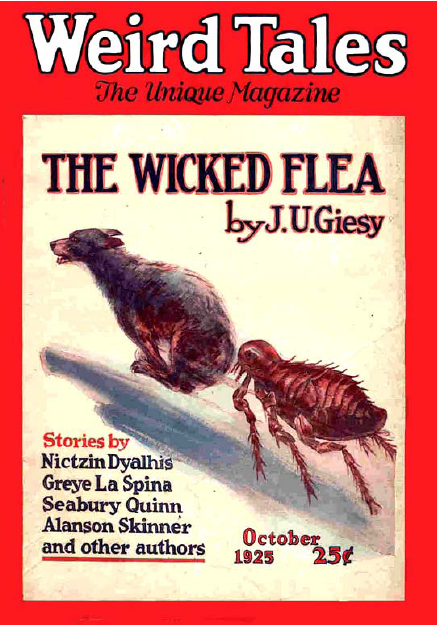
Oct. 1925 ("The Wicked Flea" by J.U. Giesy)
Nov. 1925 ("The Stolen Body" by H.G. Wells)
Jan. 1926 ("Stealer of Souls" by Charles Hilan Craig)
Mar. 1926 ("Lochinvar Lodge" by Clyde Burt Clason)
Interiors
Nov. 1924 through Apr. 1926, plus the decoration for "The Eyrie" (Nov. 1924-Sept. 1954) 

Further Reading
Many of the artists for Weird Tales have gotten short shrift, as artists so often do. There is little that I know of available on Brosnatch and many others like him, but at least we have their art, which may be as much as they ever wanted.

Here is a three-color cover from about halfway through Andrew Brosnatch's year-long run as cover artist for Weird Tales. It's supposed to illustrate a werewolf story, but it looks more like a Russian folktale.
Another three-color cover with a strong composition and not much narrative.
The ever-popular giant spider, which has done battle with Conan, The Incredible Shrinking Man, and a pair of Hobbits, among countless other protagonists.
Poor Andrew Brosnatch. Only months before he got to draw a giant spider. Now, in October 1925, he's forced to show a giant flea chasing a terrified dog. This may be the most ridiculous of all Weird Tales covers. Was the content of that month's magazine really so poor that J.U. Giesy's story made the cover?
Speaking of Hobbits, here is Andrew Brosnatch's early version, before there was such a thing.
Another three-color cover with a nicely drawn demon.
Andrew Brosnatch created not only cover art but also black-and-white interior illustrations. Here is his heading for "The Eyrie," the long-running letters column of Weird Tales.
And here, his illustration for H.P. Lovecraft's story, "The Music of Eric Zann" (May 1925).
Before moving to Chicago, Andrew Brosnatch worked for the Tinsley-Mayer Engraving Company of Louisville, Kentucky. Here's an advertisement from 1912 showing just how hard its artists worked.
Finally, what collection of pulp art would be complete without the robed fiend who threatens the helpless woman while the masked hero rushes in to save her? Brosnatch's cover for the September 1925 issue of Weird Tales is something of a cross between the terror pulps and the hero pulps.
Postscript: A scanned version of a digital printout of a digital scan of a microfilm photograph of a reproduction on newsprint of a photograph taken of Andrew Brosnatch. Is there any wonder why the image is so poor? But is there any other image of the artist anywhere in existence? From the Chicago Tribune and its feature, "The Inquiring Reporter" (Jan. 5, 1922), in answer to the electrifying question: "Does your barber talk to you while you are being shaved?"

Text and captions copyright 2011, 2023 Terence E. Hanley

Thursday, August 4, 2011

Durbin Lee Horner (1906-1979)

Aka Jack Horner
Author, Editor, Radio Scriptwriter, Actor
Born March 19, 1906, Pennsylvania
Died May 3, 1979, Pennsylvania

World War II carried away whole generations of men and women. Some never returned. Others, like Durbin Lee Horner, were fortunate enough to continue the work they did in civilian life even while wearing the uniform of an American serviceman. Horner's wartime service may actually have boosted his career as a writer and editor. It sure didn't hurt.

Horner was born on March 19, 1906, in Pennsylvania. By his mid-twenties, he was living in Manhattan, working as an actor, and sharing lodgings with another actor, Robert Allen. By the mid-1930s, he had found work as an editor of Mystery magazine. He also edited a hardbound collection, Murder by the Dozen: The Cream of the Mystery Crop, published in 1935. (Vincent Starrett, a teller of weird tales, was among the authors represented in the book.) Horner also wrote radio scripts during the 1930s. His only story for Weird Tales dates from that decade as well. "The House on Fifth Avenue" was published in the January 1937 issue of "The Unique Magazine." 

The facts on Horner's career as an actor aren't clear. An actor by the name of Jack Horner appeared on the Broadway stage in a play called The Stairs in November 1927. There was also a voice actor by the name of Jack Horner in Walt Disney's Bambi (1941). The whole question is complicated by the fact that an actress, Adele Horner, also went by the name Jack Horner. Maybe that's research for another day.

Durbin Lee Horner, civilian, became Private Horner, U.S. Army, in August 1942. As an author and editor with four years of college under his belt, he eventually landed a plum assignment as London editor of Yank. Horner also wrote for the magazine and rose to the rank of technical sergeant before separating in November 1945. Back in New York, he went right to work, helping to launch Salute, a journal for ex-GIs, in March 1946 (first issue dated April 1946). Horner served as editorial director. His contributing editors included Irwin Shaw, Marion Hargrove, and Jimmy Cannon. Horner drew on his experience in show business in his work as editor of several movie magazines during the 1950s and '60s. His titles included Modern Screen, Screen Hits Annual, and Screen Stories. After a long and varied career, Durbin Lee Horner died on May 3, 1979.

Durbin Lee Horner's Story in Weird Tales
"The House on Fifth Avenue" (Jan. 1937)

Further Reading
Horner's work is scattered in old magazines, some of which can still be found at reasonable prices. I don't know of anything in print on his life or work.

Durbin Lee Horner palled around with authors, editors, actors, and--yes--cartoonists. Here he is (far right) with Charles Raab, Milton Caniff (Terry and the Pirates and Steve Canyon), Phyllis Raab, and Noel Sickles (Scorchy Smith), date unknown, but probably from the 1930s. As you can see from the digital watermarks, this and the following image are from the collection of the Billy Ireland Cartoon Library and Museum.
Durbin Lee "Jack" Horner as Napoleon, one of several portraits and caricatures drawn by Noel Sickles of the author, actor, and editor.
Salute, "Produced by Former Editors and Writers of Yank and Stars & Stripes," made its debut in 1946. After three years in the Army, editorial director Durbin Lee Horner had a sense of what ex-GIs wanted. The cover of the fourth issue (Aug. 1946), featuring a young, brunette Marilyn Monroe in nothing but terry cloth, is evidence of that.
Horner was also editor of Screen Stories magazine. Different title, same principle: a picture of a pretty woman on the cover helps move magazines.

Text and captions copyright 2011, 2023 Terence E. Hanley

Wednesday, August 3, 2011

Call for Requests

I have been writing this blog for over three months and in that time I have had more than 2,000 page views not only from the English-speaking world but also from Germany, France, Italy, Spain, Russia, Japan, Brazil, and Singapore. Despite the fact that the first incarnation of Weird Tales met its end almost sixty years ago, people all over the globe are still interested in the magazine, its writers, its artists, and its history. I enjoy researching and writing Tellers of Weird Tales. I hope I have given you, the readers, what you want. Now I'm offering you a chance to tell me what you want. If you would like me to write about a particular author, artist, issue, or other bit of history of "The Unique Magazine," let me know. I will do my best to find the information you want. Feel free to leave your requests in the form of a comment, or you can email me at:

info@hoosiercartoonists.com (No longer active as of March 21, 2023.)

Thanks for reading. I look forward to hearing from you.


Text copyright 2011, 2023 Terence E. Hanley

Monday, August 1, 2011

Talbert Josselyn (1886-1961)

Journalist, Short Story Writer, Novelist
Born January 9, 1886, Worcester, Massachusetts
Died April 2, 1961, Carmel, California

If you dig deeply enough, you're likely to find connections between Weird Tales and the unlikeliest of people, places, and things. Who would have guessed that a teller of weird tales also wrote the story upon which one of the Bowery Boys movies was based? It's the truth, though. Talbert Josselyn spent a career as a writer, mostly for magazines of the slick and pulp variety. His story, "Smuggler's Cove," serialized in Blue Book magazine in 1933, was adapted to the silver screen in 1948 under the same title. It was the eleventh in the Bowery Boy series. Josselyn also wrote the story for the film Navy Bound (1951), starring Tom Neal and Wendy Waldron. Hollywood bought at least two other Josselyn stories. John Garfield was to play the lead in "Second Wind," from The Saturday Evening Post (Jan. 27, 1940). "Kunming Cargo," coauthored by L.G. Heston, must have died in the making. I'm not sure if either was ever put on film.

Arthur Talbert Josselyn came from an old New England family. His ancestor, Private Charles Josselyn, a Revolutionary War soldier, "marched on April 20th, 1775, in response to the alarm of April 19th, 1775," in other words, at the outset of the war. Talbert Josselyn, as he came to call himself, was born on January 9, 1886, in Worcester, Massachusetts. The family may have alternated between east and west coasts, for Josselyn's younger brother Winsor Josselyn, also a writer, was born in San Diego, California, in 1895. The Josselyns moved up the coast, living in Los Angeles and Pasadena before Talbert Josselyn settled in Carmel-by-the-Sea in 1914. In 1919, he built a house (still standing) and there he stayed.

Josselyn attended Stanford University and the University of California at Berkeley. He started writing stories at an early age and was published in pulp magazines before World War I. Known primarily for his sports stories, Josselyn had works published in The American Magazine, Argosy, Blue Book, Collier's, Country Gentleman, Everybody's Magazine, Fight Stories, Liberty, Red Book, and Short Stories, among others. His lone story for Weird Tales was called "The Bracelet," published in the September 1926 issue. Josselyn also wrote a novel, Golden City. His brother, Winsor Josselyn (1895-1973), was also a short-story writer, and the brothers even collaborated on at least one tale. Older brother Lewis Josselyn (1883-1964) was a renowned photographer. One of his subjects worth special mention was the artist, illustrator, and cartoonist Jo Mora, creator of inimitable and invaluable works of the early twentieth century.

During World War II, Josselyn served with the Office of War Information in San Francisco. One result was an article, "Courage Beyond Duty," concerning Navy pilots and published in This Week magazine in 1942. Josselyn was involved in the local Forest Theater (where his brother Lewis was official photographer). He was also co-founder (in 1921) of the Abalone League, a softball league made up of Carmel residents and which played under some peculiar rules. For example, balks were allowed at all times, bunting was forbidden, the first baseman must be a woman, and the center fielder must be a grade school boy. Josselyn lived in the artists' colony of Carmel-by-the-Sea for almost half a century. He died on April 2, 1961.

Talbert Josselyn's Story in Weird Tales
"The Bracelet" (Sept. 1926)

Further Reading
Josselyn was a prolific writer. His work is probably not hard to find. You might also want to read something about his brother, the photographer Lewis Josselyn, through a simple web search.

Talbert Josselyn's house in Carmel, California.
Weird Tales for September 1926. Talbert Josselyn's name made the cover. The cover art is by E.M Stevenson.
Smuggler's Cove, starring Leo Gorcey, Huntz Hall, and Gabriel Dell, was based on a story by Talbert Josselyn, written when the Bowery Boys were still boys.
Talbert "Tal" Josselyn (1886-1961)

Thanks to Randal A. Everts for the photograph and obituary of Talbert Josselyn.
Text and captions copyright 2011, 2023 Terence E. Hanley