Tuesday, March 10, 2015

Francis Stevens (1883-1948)

Pseudonym of Gertrude Barrows Bennett
Author, Office Worker
Born September 18, 1883, Minneapolis, Minnesota
Died 1948, California

Francis Stevens has been called "the woman who invented dark fantasy." (1) That would seem a significant accomplishment for a pseudonymous author who wrote in isolation and who was largely forgotten in the decades after her last story was published. Stevens is also supposed to have been an influence upon A. Merritt and H.P. Lovecraft. Again, if that were true, it would seem of some importance. Yet no one seems to have made a convincing case in her favor, either as an innovator or as an influence upon her peers. But then no one seems to have defined "dark fantasy" in any satisfactory way either. It's as if we were to claim that Thomas Edison invented the light bulb, but we haven't decided yet just what is a light bulb.

Those are only two of the many problems in the case of Francis Stevens. The problem of her biography precedes them. Thankfully, some of the questions about who she was, where she came from, and how she lived have been answered. We can thank Randal A. Everts for a good deal of that information. Even so, erroneous information survives, in print and on line, even in so-called scholarly works. For example, was her middle name Mabel or Myrtle? If she was a writer of significance, why should there be any confusion? Do we wonder whether Lovecraft's middle name was Phillips or Poe's was Allan? For another example, on what date and in what place did she die? If we're talking about an important writer of the twentieth century, we should know these things. A second problem--the unsolvable problem of the disorderly human mind--is that no one on line seems to have provided a simple, complete, chronological list of her works with their original titles and their original dates of publication. I hope to have corrected that in the list provided below. If I have made any errors or omissions, I hope someone will let me know.

Francis Stevens was the pseudonym of Gertrude Barrows Bennett, a native Minnesotan who worked in an office during the day to support herself, her orphaned daughter, and her invalid mother, and in her spare time composed tales of fantasy. She wrote thirteen stories published from 1904 to 1923. The first, "The Curious Experience of Thomas Dunbar," is an outlier in two ways. First, it was separated from the others by thirteen years. Second, it was published under a semblance of her real name, that is, as by G.M. Barrows. Francis Stevens' reputation rests instead on a dozen stories and serials published from April 1917 to September 1923, a mere six and a half years. All appeared in All-Story Weekly, Argosy, The Thrill Book, People's Favorite Magazine, and Weird Tales. After the publication of "Sunfire" in Weird Tales in the summer of 1923, Francis Stevens fell silent.

The stories of Francis Stevens were rediscovered in the early 1940s and have been reprinted many times since. Eight appeared in The Nightmare and Other Tales of Dark Fantasy, published in 2004. The introduction, by Gary Hoppenstand, is entitled "Francis Stevens: The Woman Who Invented Dark Fantasy," but it opens with a discussion of A. Merritt (1884-1943), H.P. Lovecraft (1890-1937), and other subjects. Stevens herself doesn't make an appearance until the middle of the second page, and then only in these three sentences:
The person who may stake the best claim at creating the new genre of dark fantasy is Francis Stevens (1883-1948). It is readily apparent to those who survey Steven's pulp magazine novels and short stories that her fiction was greatly admired by Merritt and Lovecraft. Both authors expanded and reworked in their own fiction the dark fantasy narrative elements that Stevens first developed and employed in her writings . . . . (p. x)
Each one of those sentences makes an extraordinary claim in need of supporting evidence, evidence that is not always forthcoming. But there is a more subtle problem at work here, one that is central to the case of Francis Stevens. That problem has nothing to do with her. Instead, it has to do with how she is seen and interpreted. Why for example, in a book of her stories, is she in third place after two male authors and not even mentioned until page two of the introduction? Here is another example:
Francis Stevens was the most gifted woman writer of science fiction and science-fantasy between Mary Wollstonecraft Shelley and C.L. Moore. She possessed, in addition to a natural storytelling sense, a flair for creating images of sheer imagination that come to life from the printed word, a facility second only to that of A. Merritt, who had so greatly admired her. (2)
Again, instead of being taken on its own merits, the work of Francis Stevens is considered in comparison to that of a man, A. Merritt. (3)

Francis Stevens worked alone. She had no known contacts with any other writers of fantasy. Unlike H.P. Lovecraft, of whom she was a rough contemporary, she did not have a circle of friends, associates, and correspondents. Nor did she have a champion, as August Derleth was for Lovecraft, unless it was A. Merritt. She was a female writer, but she is also considered one of the originators of that ill-defined sub-sub-genre, dark fantasy. That would seem to me a significant accomplishment. Yet the emphasis seems to be placed more on her femaleness than on her innovation. The question is this: can the work of Francis Stevens stand alone, or is it propped up only in comparison to or in relationship with that of her male counterparts? More often than not, Stevens has been compared to men, the significance of her work has been defined in relationship with men, and those who have written about her life in greatest detail--Lloyd Arthur Eshbach, Sam Moskowitz, Gary Hoppenstand--have been men. If Francis Stevens was one of the originators of so-called dark fantasy, then someone should make that case. If she was a significant influence upon other authors, someone should make that case as well. Instead, what we have is a strained argument that seems to say that because she was a woman, Francis Stevens needs our help, that her work can't stand on its own but needs a crutch. Gertrude Barrows Bennett's pen name was that of a man and an artifact of her time. But just how far have we come in the nine decades since her career as a published author came to an end?

Stories & Serials by Gertrude Barrows Bennett aka Francis Stevens
With reprints from the pulp-fiction era:
  • "The Labyrinth" (three-part serial, All-Story Weekly, July 27, 1918-August 10, 1918)
  • "Friend Island" (All-Story Weekly, September 7, 1918; reprinted in Fantastic Novels Magazine, September 1950)
  •  "The Citadel of Fear" (seven-part serial, The Argosy, September 14, 1918-October 26, 1918; reprinted in Famous Fantastic Mysteries Combined with Fantastic Novels Magazine, February 1942)
  • "Behind the Curtain" (All-Story Weekly, September 21, 1918; reprinted in Famous Fantastic Mysteries, Jan. 1940)
  • "The Elf-Trap" (The Argosy, July 5, 1919; reprinted in Fantastic Novels Magazine, November 1949)
  • "Avalon" (four-part serial, The Argosy, August 16, 1919-September 6, 1919)
  • "Claimed" (three-part serial, The Argosy, March 6, 1920-March 20, 1920; reprinted in Famous Fantastic Mysteries, April 1941; Super Science Stories, October 1944)
  • "Serapion" (four-part serial, The Argosy, June 19, 1920-July 10, 1920; reprinted in Famous Fantastic Mysteries Combined with Fantastic Novels Magazine, July 1942)
  • "Sunfire" (two-part serial, Weird Tales, July 1923-September 1923)

Notes
(1) From "Francis Stevens: The Woman Who Invented Dark Fantasy" by Gary Hoppenstand, his introduction to The Nightmare and Other Tales of Dark Fantasy by Francis Stevens (University of Nebraska Press, 2004).
(2) From "The Woman Who Wrote 'Citadel of Fear'" by Sam Moskowitz, his introduction to The Citadel of Fear by Francis Stevens (Paperback Library, 1970), p. 9.
(3) Whenever I read his name, I can't help but think of A. Mutt, of Mutt and Jeff fame.

Note: I had intended to write and post this article on Sunday, March 8, 2015, in observance of International Women's Day. We have had a family emergency, and so I'm late in posting it. Please bear with me. I will add images later.

Corrected on October 14, 2023.
Text and captions copyright 2015, 2023 Terence E. Hanley

Saturday, March 7, 2015

Clare Winger Harris (1891-1968)

Née Clare M. Winger
Aka Mrs. F.C. Harris
Author
Born January 18, 1891, Freeport, Illinois
Died October 1968, Pasadena, California

Clare Winger Harris is credited as being the first woman to write science fiction for an American magazine under her own name. Her output was modest, but her place in the history of her field is secure. She was born on January 18, 1891, in Freeport, Illinois, and attended Smith College in Northampton, Massachusetts. In 1912, Clare Winger married a native Kansan, Frank Clyde Harris (1885-19?). His work as an architect, engineer, and college instructor carried the couple from place to place in the American Midwest. Together they had three sons.

Clare Winger's father was Frank Stover Winger (1865-1936), son of the founder of the Stover Manufacturing Company of Freeport, Illinois, (1) and more importantly, author of The Wizard of the Island, or The Vindication of Prof. Waldinger (1917). Frank Stover Winger's novel, a Jules Vernian story of super-science set in the South Seas, was published less than a decade before his daughter's first tale of fantasy. There are those who speculate that her interest in science fiction stems from her father's, but I don't see any reason why that interest could not have been shared, or even that she inspired him. (2) Clare's husband, described as "a visionary architect and engineer," (3) is also seen as an inspiration to her.

Clare Winger Harris's first published story, "A Runaway World," appeared in Weird Tales in July 1926. Her first story for an out-and-out science fiction magazine was "The Fate of the Poseidonia," published in Amazing Stories less than a year later, in June 1927. According to the website of Amazing Tales,
"The Fate of the Poseidonia" is . . . . simultaneously, the first publication of a story by its author in an sf magazine, the first story by a woman published in such a magazine, and a co-winner in the first contest ever held by a science fiction magazine.
"The Fate of the Poseidonia" actually won third place in that contest and was supposed to have earned its author some prize money. Whether editor Hugo Gernsback--a notorious chiseler--ever came across with the dough is another matter. More important than the prize, perhaps, is that the door was opened for Clare Winger Harris, and by extension other women science fiction writers. Over the next two years, she wrote half a dozen stories published in Amazing Tales. Her collaborator on one of those was Miles J. Breuer, M.D. (1889-1945).

In all, Clare Winger Harris wrote eleven stories published in Weird Tales, Amazing Stories, and Science Wonder Quarterly from 1926 to 1930. Her career was brief to say the least. She gave it up to rear her children. In 1947, Clare's eleven stories were collected in hardback in Away from the Here and Now: Stories in Pseudo-Science. A novel, Persephone of Eleusis: A Romance of Ancient Greece (1923), had preceded the publication of that book. Clare also wrote four published letters in the science fiction and fantasy pulps. The last, in Wonder Stories (Aug. 1931), was an attempt at classification of science fiction themes. That letter, one of the first documents of its kind, was also, apparently, the last of her original published works of or about science fiction. Clare's stories have been anthologized many times in the years since her death. She is a favorite among those interested in feminism and science fiction.

Clare Winger Harris died in October 1968 in Pasadena, California, at age seventy-seven.

Stories of Clare Winger Harris
(Stories in Weird Tales are in bold.)
"A Runaway World" (Weird Tales, July 1926)
"The Fate of the Poseidonia" (Amazing Stories, June 1927)
"A Certain Soldier" (Weird Tales, November 1927)
"The Miracle of the Lily" (Amazing Stories, April 1928)
"The Menace From Mars" (Amazing Stories, October 1928)
"The Fifth Dimension" (Amazing Stories, December 1928)
"The Diabolical Drug" (Amazing Stories, May 1929)
"The Artificial Man" (Science Wonder Quarterly, Fall 1929)
"A Baby on Neptune" (with Miles J. Breuer, M.D., Amazing Stories, December 1929)
"The Evolutionary Monstrosity" (Amazing Stories Quarterly, Winter 1929)
"The Ape Cycle" (Science Wonder Quarterly, Spring 1930)

Letters of Clare Winger Harris
(Her letter in Weird Tales is in bold.)
Letter (Amazing Stories, May 1929)
Letter (Air Wonder Stories, September 1929)
Letter to "The Eyrie" (Weird Tales, Mar. 1930)
Letter (Wonder Stories, August 1931)

Further Reading
There is a fair amount of information on Clare Winger Harris on the Internet, but not all of it is very good or very reliable. The Wikipedia entry is inadequate. The article on the website of Amazing Stories is much better. You can also read some of her works on line.

Notes
(1) Smokey Stover of the newspaper comics page may have been named after the Stover business. See my article, "Foo! Bill Holman and Smokey Stover" in Traces of Indiana and Midwestern History, Summer 2012.
It is almost certain that Harris herself was inspired to begin writing science fiction because her father, Frank Stover Winger, had written the lively, and clearly Jules Verne influenced early science fiction novel, Wizard of the Island (1917).
(3) Also from the website of Amazing Stories

On the cover of Amazing Stories, December 1926, the editor, Hugo Gernsback, announced a contest: "$500.00 for the Most Amazing Story Written Around This Picture." Somewhere out on this vast continent, Clare Winger Harris was watching.
Six months later, her entry in the contest, "The Fate of the Poseidonia," appeared in Amazing Tales, and for it, she won third place. However, her byline did not make the cover.
That would have to wait until October 1928, when "Menace from Mars" was published. So was this the first time that the name of a woman author appeared on the cover of a science fiction magazine? Whether it was or not, Weird Tales had been showing the bylines of its female contributors on the cover for years.
A gallery of covers with Clare Winger Harris' byline. From top to bottom: December 1928, May 1929, December 1929, and Winter 1929. The artist on all of the covers shown here was Frank R. Paul except for the December 1929 issue, which was done by H.W. Wesso.

In 1917, Clare Winger Harris' father, F.S. Winger, published his own story of super-science, The Wizard of the Island. I had hoped this book had been illustrated, but I haven't found any evidence of that. If it ever had a dust jacket, it's probably gone with the wind.
In 1926, with her first story in Weird Tales, Winger's daughter, Clare Winger Harris, followed her father into the realm of fantasy and science fiction. Thirty years after his book was published, hers was as well. Here and Now: Stories in Pseudo-Science, from 1947, collected Clare's eleven published stories in hardback. Note the flying saucer-like spaceship. This was 1947 after all. The artist was the otherwise uncredited J.M.

This is the second of three articles on women writers in observance of International Women's Day, Sunday, March 8, 2015. Thanks to La Contessa.
Text and captions copyright 2015, 2023 Terence E. Hanley

Friday, March 6, 2015

Amelia Reynolds Long (1904-1978)

Aka A.R. Long, Peter Reynolds, Patrick Laing, Adrian Reynolds, Kathleen Buddington Coxe (with Edna McHugh), Mordred Weir
Author, Poet, Editor, Museum Curator
Born November 25, 1904, Columbia, Pennsylvania
Died March 26, 1978, Harrisburg, Pennsylvania

Amelia Reynolds Long had a long and very fine career as an author of science fiction, fantasy, mystery, and detective stories. She was one of few female science fiction authors before the Golden Age and very likely one of few in that category to be published in both Weird Tales and Astounding Science-Fiction. Her stories for "The Unique Magazine" were six in number. One was made into a movie. Many of her stories have been reprinted again and again.

Amelia Reynolds Long was born on November 25, 1904, in Columbia, Pennsylvania, and moved at age six with her family to Harrisburg. She graduated from Harrisburg Central High School in 1922. By the time she had graduated from the University of Pennsylvania in 1931, Amelia was already a published author with stories in Weird Tales and Amazing Detective Tales to her credit. (She received her bachelor's degree in 1931 and a master's degree the following year.) Stories for Amazing Stories, Astounding Stories, Strange Stories, and other publications rolled out of her typewriter during the 1930s, but by the end of the decade, Amelia was ready for a change. Late in life, she explained:
I stopped writing science fiction and the weird story right around that time, because science fiction had hit the comic strips and I felt it was sort of degrading to compete with a comic strip. (1, 2)
Her first mystery novel, Behind the Evidence, was published in 1936. In all, Amelia Reynolds Long wrote nearly three dozen novels in that genre, twenty-five of which were translated into other languages. Her short stories numbered about one hundred. "The Thought Monster," from Weird Tales (1930), was made into a movie called Fiend Without a Face in 1958.

Amelia also wrote poetry and had two collections, Shreds and Patches (1974) and Counterpoint (1975), published in her lifetime. Her first poem, "Lucifer's Reply," had appeared in Kaleidograph in the early 1930s. From 1951 to 1958, Amelia was an editor of textbooks at The Stackpole Company in her hometown. Outdoor Reference Guide, from 1959, carries her byline on the cover. She was also a member of the Harrisburg Poetry Workshop of the Pennsylvania Poetry Society, and a curator at the William Penn Museum.

Amelia Reynolds Long died on March 26, 1978, in Harrisburg. She was seventy-three years old.

Stories, Article, & Letters of Amelia Reynolds Long
(Stories and one letter in the weird fiction magazines are in bold.)
"The Twin Soul" (Weird Tales, Mar. 1928)
"The Mechanical Man" (Stellar Science Fiction Series #7, 1930)
"The Thought-Monster" (Weird Tales, Mar. 1930) 
"The Magic-Maker" (Weird Tales, June 1930)
"The Mystery of the Phantom Shot" (Amazing Detective Tales, July 1930)
"The Undead" (Weird Tales, Aug. 1931)
Letter to "The Eyrie" (Weird Tales, Nov. 1931)
"Omega" (Amazing Stories, July 1932)
"Scandal in the 4th Dimension" (Astounding Stories, Feb. 1934)
"Masters of Matter" (Marvel Tales of Science and Fantasy, Mar.-Apr. 1935)
"Flapping Wings of Death" (Weird Tales, June 1935)
"A Leak in the Fountain of Youth" (Astounding Stories, Aug. 1936)
"The Album" (Weird Tales, Dec. 1936)
"Cosmic Fever" (Astounding Stories, Feb. 1937)
"Reverse Phylogeny" (Astounding Stories, June 1937)
"The Mind Master" (Astounding Stories, Dec. 1937)
"The Dimension Drug" (serial, Spaceways #1-2, 1939)
"Death by Fire" (Science Fiction, Mar. 1939)
"Time-Traveling" (letter, Startling Stories, Mar. 1939) 
"The Box from the Stars" (Strange Stories, Apr. 1939)
"Bride of the Antarctic" (as Mordred Weir, Strange Stories, June 1939)
"When the Half Gods Go--" (Astounding Science-Fiction, July 1939)
"Justice in Time" (Stardust, May 1940)
"Castaways in Space" (Science Fiction, June 1940)
"Machines That Think" (article, Spaceways, Dec, 1940)
"The Man Who Vanished" (The Phantom Detective, Summer 1950)
"The Man They Couldn’t Kill" (The Phantom Detective, Fall 1950)
"Spirit Voice" (5 Detective Novels Magazine, Fall 1950)
"Hot Money!" (G-Men Detective, Winter 1951)
"Handmade Alibi" (The Phantom Detective, Spring 1951)
"Reverse Alibi" (Smashing Detective Stories, June 1951)
"Dames Ain’t Neat" (Famous Detective Stories, Aug 1951)
"The Mountain Comes to Mohammed" (Smashing Detective Stories, Sept. 1951)
"Fatal Footsteps" (Famous Detective Stories, Nov. 1951)
"Death Looks Down" (Triple Detective, Winter 1951)
"Case of the Frightened Child" (as Patrick Laing, Famous Detective Stories, Feb. 1952)
"Breathe Deep of Death" (as Patrick Laing, Smashing Detective Stories, Sept. 1952)

Further Reading
There are several sources of information on Amelia Reynolds Long on the Internet. The most comprehensive is called "A Tribute to Amelia Reynolds Long" at this URL:


The author, Richard Simms, has included a long list of links and has posted numerous images, including images of Amelia's rarest books.

You can also read about her in Etchings & Odysseys #10, from 1987.

Notes
(1) Quoted in "Etchings & Odysseys Profile: A Visit with Amelia Reynolds Long" by Chet Williamson in Etchings & Odysseys #10 (1987), p. 61.
(2) I'm not sure what comic strips Amelia Reynolds Long was talking about. The big three--Buck Rogers in the 25th Century A.D. (1929), Brick Bradford (1933), and Flash Gordon (1934)--were between six and ten years old when the 1930s ended. Perhaps she was talking about science fiction comic books rather than comic strips. In any case, her remarks are sound proof that even science fiction authors--who were themselves very often on the receiving end of cultural snobbery--could also be horrible snobs. I've said it before and I'll say it again: Science fiction is a genre. Comics are a form. You cannot compare one to the other. More to the point: There is an old quote from Duke Ellington: "If it sounds good, it is good." That judgement can be applied to all things. If a science fiction story is good, it's good. It doesn't matter what form it takes. I have read science fiction comic book stories that are much better than certain science fiction prose stories. Just because a science fiction story takes the form of a comic strip or comic book doesn't mean that it's some low form of expression. We should all remember that of all the vaunted writers of Golden Age science fiction, none foresaw that ordinary people would watch the first moon landing on their television sets. V.T. Hamlin, author of the comic strip Alley Oop, did however, and drew such a sequence in 1947. At that time and for many years after, science fiction writers were busy with the Shaver Mystery, flying saucers, Dianetics, and other nonsense.

A poster for Fiend Without a Face (1958), based on a story by Amelia Reynolds Long.

This is first in a series of three articles in observance of International Women's Day, which takes place this weekend, on Sunday, March 8, 2015.

Text and captions copyright 2015, 2023 Terence E. Hanley

Thursday, March 5, 2015

Witches, Wizards, and Warlocks on the Cover of Weird Tales

I promised six weeks ago to write about witches. Finally, here they are.

I count eleven covers of Weird Tales showing witches, wizards, and warlocks and all their magical ways. I'm surprised that there are so few. It seems like I have missed some somehow. (I'll add more if I discover more.) Even the covers shown here are a little fuzzy: If the word "witch" or "witchcraft" weren't there to clue you in, you might not know these are pictures of witches. Only Matt Fox (May 1947) depicted the classic or stereotypical witch. William Heitman's cover (May 1923) seems to me second in its witchiness.

So is there an explanation? Maybe. For one, it's not easy to depict conjuring or the casting of spells. For another, witches are not very scary, not like vampires, werewolves, or other monsters. (I always liked the Salem Witch in the Aurora monster model series, but she hardly qualifies as a monster.) Also, a witch is not a person of great or dramatic action. She works behind the scenes, puttering around her house with her herbs and her eyes of newt. Lastly, the witch may present a problem to artists and writers who don't handle female characters very well. In any case, here are the witches, wizards, and warlocks, the original www.

Weird Tales, May 1923. Cover story: "The Moon Terror" by A.G. Birch (?). Cover art by William F. Heitman. This is one of two covers by Heitman. The other (June 1923) seems to have been a rush job and came off badly. This one is far more successful.

Weird Tales, August 1925. Cover story: "Black Medicine" by Arthur J. Burks. Cover art by Andrew Brosnatch. Not having read the story, I assume here that "black medicine" refers to witchcraft. Update (Mar. 7, 2015): "Black Medicine" is a voodoo story. Presumably, the larger man is a zombie.

Weird Tales, December 1937. Cover story: "The Sea-Witch" by Nictzin Dyalhis. Cover art by Virgil FinlayAs an artist, Virgil Finlay had many great virtues. One of them was that he could draw women. Another is that he always showed good taste and never, as far as I know, depicted women in a cruel or misogynistic way.

Dyalhis probably didn't mean it, but his title invokes the character of Sea Hag from Thimble Theatre, better known as Popeye, by Elzie Segar.

Weird Tales, January 1938. Cover story: "The Witch's Mark" by Dorothy Quick. Cover art by Margaret Brundage. The January 1938 cover is very similar to the immediately preceding December 1937 cover. Was that poor planning, or did the editor just not see the similarity?

Weird Tales called itself "The Unique Magazine." That subtitle was true in more ways than one. Here, the cover story is by a woman and about women, and the cover artist was a woman who specialized in drawing women. Pulp magazines tended to be cruel, misogynistic, and even hateful towards women. In general, Weird Tales was not.

Weird Tales, December 1948. Cover story: "The Sin-Eater" by G.G. Pendarves. Cover art by Ray Quigley. Looks like a wizard to me. In fact, he looks a little like Dr. Strange.

Weird Tales, October 1939. Cover story: "In the Walls of Eryx" by Kenneth Sterling and H.P. Lovecraft [?]. Cover art by Harold S. De Lay. I'm not sure that "In the Walls of Eryx" was the cover story for this issue. The title "The Witch's Cat" is also prominent on the cover, but I don't see a witch or a cat. Jaffery and Cook don't give a cover story in their index of Weird Tales. In any case, the man looks like a wizard or sorcerer, so I have put him in this category.

Weird Tales, May 1941. Cover story: "There Are Such Things" by Seabury Quinn [?]. Cover art by Hannes Bok. Voodoo dolls are witchcraft, so here goes this cover.

Weird Tales, October 1939. Cover story: "Kurban" by Seabury Quinn [?]. Cover art by A.R. Tilburne. Here are the trappings of wizardry: book, skull, candle, and animal companion or familiar.

Weird Tales, May 1947. Cover story: None. Cover art by Matt Fox. Matt Fox could always be counted on to create unconventional images of totally conventional characters. Here the witch and her little demon friends get the inimitable Matt Fox treatment.

Weird Tales, July 1951. Cover story: "Flame Birds of Angala" by E. Everett Evans. Cover art by Charles A. Kennedy

Weird Tales, July 1952. Cover story: "Hell's Bells" by Duncan H. Munro (Eric Frank Russell). Cover art by Jon Arfstrom. Again, I haven't read the story, so I can't be sure. The blurb reads, "It was magic," so I assume the story involves magic, but the man is not obviously a wizard or warlock, although that doodad he's holding in his right hand looks like some kind of magical object. 

Thanks to Lemuel Nash for corrections.
Text and captions copyright 2015, 2023 Terence E. Hanley

Tuesday, March 3, 2015

Scarecrows

In sweeping up the scraps of my research, I came across one more connection to make among Lee Brown Coye, "Sticks," and The Blair Witch Project. Then it will be time to move on.

A quote from "Sticks" (1974):
When he [Colin Leverett, the Coye character in the story] came across a scrap of board nailed to several sticks set into a stone wall, his darkest thought was that it might read "No Trespassing."
A quote from Planet of the Apes (1968):
Landon: Scarecrows?
Taylor: Let's see.
Is there a connection? You decide.


Text copyright 2015, 2023 Terence E. Hanley

Monday, March 2, 2015

Robert Bloch and The Blair Witch Project-Part Two

Like "Sticks" by Karl Edward Wagner, Robert Bloch's "Notebook Found in an Deserted House" is a story of the Cthulhu Mythos. I don't see much connection between Bloch's story and The Blair Witch Project, but there are similarities to stories by H.P. Lovecraft. That shouldn't come as any surprise, as Bloch was a member of Lovecraft's circle. In Bloch's story, there are deep wells as in "Pickman's Model," an altar or sacrificial slab of stone as in "The Dunwich Horror," and of course the menace of unknown creatures pressing in from the outside. (1) Some of those creatures are Shoggoths, and they are described in Bloch's story in horrifying verisimilitude.

* * *

I came to "Notebook Found in a Deserted House" by way of The Blair Witch Project. As I wrote yesterday, both are "found footage" stories. Bloch's story takes the form of a notebook, as the title explains outright, so it isn't really "footage." (2) A more inclusive term might be a "found artifact" story. (3) That brings me to a more interesting connection among "Notebook Found in a Deserted House," The Blair Witch Project, and the work of H.P. Lovecraft.

The "found artifact" story is old. The "found footage" story is new. What's new about it? The technology used to record the story. And when did that new technology come about? In the nineteenth century of course, in still photography (1820s), sound recording (1870s), the telephone (1876), motion picture photography (1890s), and radio (1890s). Here were true innovations. It could only have been a matter of time before they made their way into nascent science fiction. So what were the first "found artifact" stories involving those five technological developments? I don't know. That would make an interesting research project. (4) But in writing about The Blair Witch Project and "Notebook Found in a Deserted House," I thought of "The Statement of Randolph Carter" by H.P. Lovecraft (1920). Lovecraft's story is documentary, a transcript of a statement made by the title character, presumably to the police, perhaps even as a voice recording. (5) But the story turns on a piece of technology, a portable telephone used by the investigators in their exploration of a tomb. Without that piece of technology, the story could not have been told, and in that, I can see a connection, however tenuous, to The Blair Witch Project, made eight decades later. (6)

Notes
(1) Cap, the mailman, reminds me of the grandfather in The Lost Boys, who knows what's going on.
(2) "Notebook Found in a Deserted House" is a great title, guaranteed to pull in the curious reader. The title also serves as a framing device in the most economical way. I can think of one other title with multiple functions. There Will Be Blood is, at one and the same time: 1) A title; 2) A synopsis of the story; and 3) A movie review.
(3) A story told in the form of letters back and forth between correspondents is called an epistolary story. What is a story told in the form of a notebook called? A notatory story?
(4) Orson Welles' radio play "The War of the Worlds" from 1938 is a kind of "found artifact" story except there is no artifact: the story is broadcast live as it is happening. And it wasn't found, unless you found it on your dial. Maybe a more inclusive term is needed. The "documentary" story? That doesn't quite work, for a story can be documentary but not include any found artifact. The found aspect adds an irreplaceable dimension of mystery to a story. So found artifacts can be used in building a documentary story, as in "The Call of Cthulhu," thus making the story more mysterious and suspenseful. 
(5) Note the similarity of the title--as a kind of framing device or setup--to that of Bloch's story.
(6) Some added points: 1) We now have a new technology: computers and the Internet. So if new kinds of "found" stories originate in new kinds of technology, then there should be "found" Internet stories. I'm not sure it fits, but the closest I can come to that is the Slender Man phenomenon. 2) "Found" artifacts are a staple of pseudoscience: the image of a person, ghostly figure, alien, flying saucer, or cryptozoological creature in an otherwise ordinary photograph. So-called "rods" are a good example. 3) I don't know what connection there might be, but there is art, or so-called art, that consists of found objects assembled or labeled as something else. It should come as no surprise that the found object as art comes from the time of the Great War, in other words, from a time of decadence.


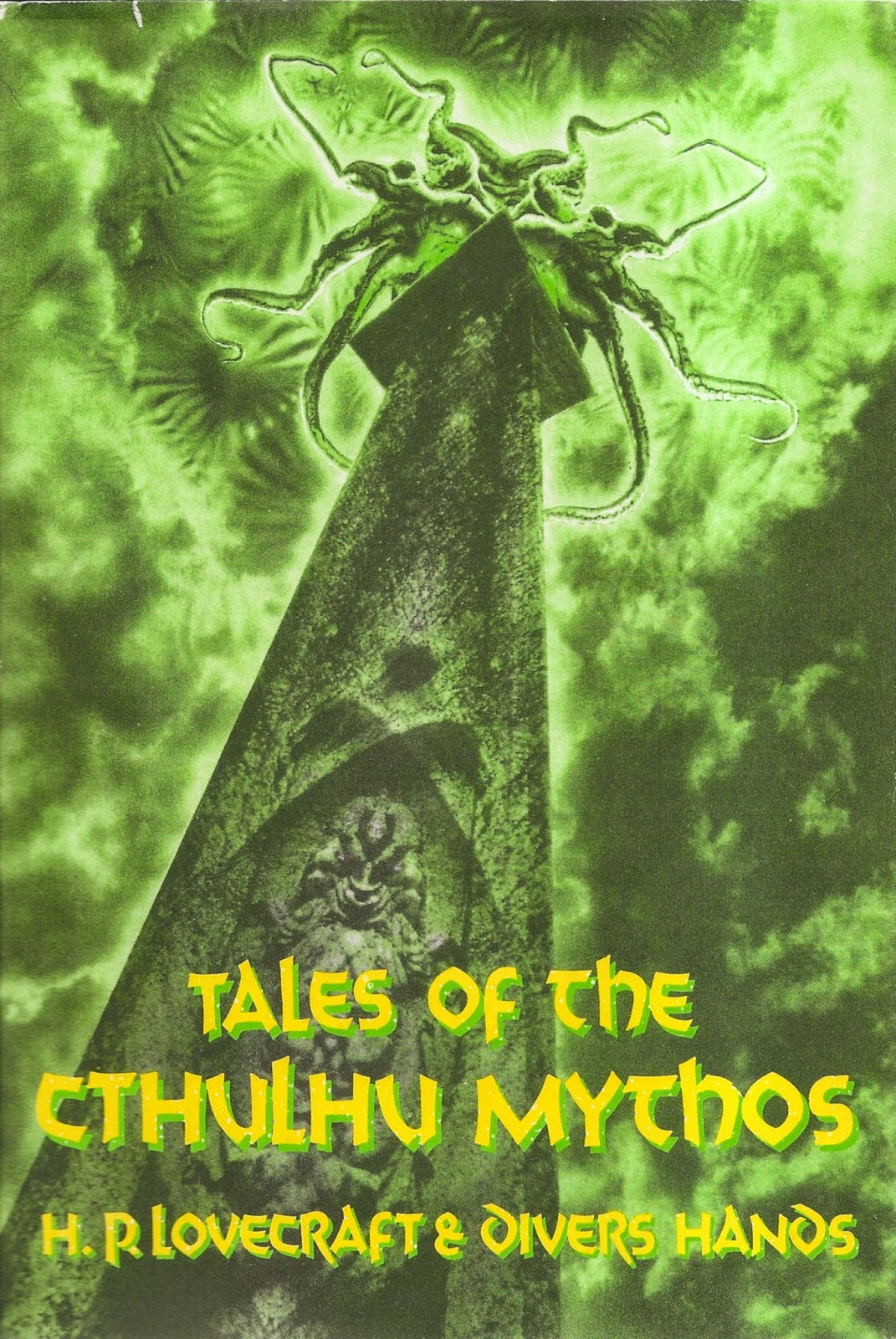
"Notebook Found in a Deserted House" was reprinted in Tales of the Cthulhu Mythos. Here is the cover of the 1990 edition, created by Jeffrey K. Potter.

Copyright 2015, 2023 Terence E. Hanley

Sunday, March 1, 2015

Robert Bloch and The Blair Witch Project-Part One

The Blair Witch Project (1999) was based on "Sticks" by Karl Edward Wagner (1974). Of that there can be little doubt. But were there other sources for the movie? Here's what Wikipedia has to say about Robert Bloch's short story "Notebook Found in a Deserted House":

"Many consider it to be a predecessor to the film The Blair Witch Project."

Many.

There's scholarship for you.

Presumably the people who write articles for Wikipedia have access to the Internet. You would think they could replace that many with a few names by doing a simple Internet search. So I did a simple Internet search and quickly came up with two names. That's a start. One is Michael D. Winkle, who wrote an article called "Tales of the Blair Witch Mythos," posted on a sketchy website in 2001, back when computer servers were made of stone and iron. Mr. Winkle's article is interesting. You might want to have a look.

Another of the many is Michael J. Tresca, who wrote a customer review of the anthology Tales of the Cthulhu Mythos in 2006. I could go on down the line, but I'm not sure I would find the originator of the idea that The Blair Witch Project was based on or inspired by "Notebook Found in a Deserted House." The thing to do is to just see how they stack up against each other.

"Notebook Found in a Deserted House" is a short story by Robert Bloch. First published as the cover story in the May 1951 issue of Weird Tales, it has been reprinted many times since, including in the aforementioned anthology Tales of the Cthulhu Mythos. Coincidence or no, Lee Brown Coye was the cover artist for both magazine and book. I have read the story in a later edition of Tales of the Cthulhu Mythos (1990), very generously provided by my friend Gandelyn.

As the name suggests, "Notebook Found in a Deserted House" takes the form of a notebook and is told in the voice of its author, a twelve-year-old boy named Willie Osborne. Willie lives with his aunt and uncle in the backwoods of New England, presumably in Massachusetts. (Arkham and Kingsport are both mentioned in the story.) Bad things start to happen and the boy is left alone in the house. There seems to be no escape for him and there the story ends. I won't give anything more away.

Bloch's story and The Blair Witch Project utilize a framing device. In "Notebook Found in a Deserted House," the title is the device, but there isn't any frame on the other end. Maybe it's only a half-framing device. In The Blair Witch Project, the narration inserted at the beginning and end of the film are the device. So there is the first similarity. But there are hundreds if not thousands of stories with framing devices. I read one the other day, "The Horror of the Heights" by Arthur Conan Doyle (1913), a story that also takes the form of a notebook kept by the protagonist. So maybe not much of a similarity.

Story and movie are also both told in documentary fashion, and in general the action takes place as the story is being told. (Both begin with scary stories of what happened in the woods back in the old days.) Both take place in the backwoods, and in both, the woods--inhabited by unknown and terrifying forces--represent a menace. That idea--that evil lurks in the deep, dark forest--goes back at least to first settlement and probably to the beginning of time. Witness "Hansel and Gretel" and "Young Goodman Brown."

In both tales, the narrators circle back to their place of beginning, but that's common in people who are lost, disoriented, frightened, or on the run. You might take that as a metaphor for life itself, for we all return or wish to return to the place where we began. Both stories end within the walls of a house, in the story, a deserted house, in the movie, a decrepit house. However, the deserted house is the last safe place, while the decrepit house is the place where horror still lives.

Finally, both "Notebook Found in an Deserted House" and The Blair Witch Project are "found footage" stories. In the case of the first, the "footage" is actually, of course, a notebook. I'll have more to say about "found footage" in the second and last part of this series.

That's it. That's as much as I can see. I think the similarities between Bloch's story and the film from half a century later are superficial and consist mostly of conventions of storytelling. That's not to say the moviemakers had not read "Notebook Found in a Deserted House," or that they were not inspired by it, but I don't see any hard evidence that they had or were.

To be concluded . . .

Weird Tales, May 1951, with a cover story, "Notebook Found in a Deserted House," by Robert Bloch, and cover art by Lee Brown Coye. Stories told by Bloch and Coye are supposed to have influenced the making of The Blair Witch Project. But could Coye have been influenced by Bloch's story in his tale of the Mann Brook house?
"Notebook Found in a Deserted House" was reprinted in Tales of the Cthulhu Mythos in 1969.  Once again, Coye was the cover artist.

Text and captions copyright 2015, 2023 Terence E. Hanley