Monday, February 20, 2023

Weird Tales, March 1923: Tentacles-Part One

The first cover story in Weird Tales is called "Ooze." It was written by Anthony M. Rud. The monster in the story is a giant amoeba. In Richard R. Epperly's cover drawing, it looks more like an octopus with long, reaching tentacles. I don't know why Epperly drew his monster that way. Maybe he or the editor or publisher thought that people would know at a glance what an octopus is. An amorphous blob of protoplasm isn't so easy to recognize.

There are lots of tentacles in weird fiction. I have read a reference to tentacles as being in fact representative of the genre. Unfortunately, I don't have access to the original source, China Miéville's article "Weird Fiction" in The Routledge Companion to Science Fiction, edited by Mark Bould, et al. (2009). I can offer two examples of tentacles and tentacled creatures as a subject of weird fiction. One is a critical or analytical work, "'Comrades in Tentacles': H. P. Lovecraft and China Miéville" by Martyn Colebrook in New Critical Essays on H.P. Lovecraft (2013). The other is Mr. Miéville's own novel Kraken, from 2010. In case you didn't know it, things from 2010 are considered new, as in the phrase "the New Weird."

The idea that tentacles are representative of weird fiction may be mostly China Miéville's. There appears to be some theorizing behind it and the theorizing appears to be his. I haven't read Mr. Miéville's writing on the subject, but I believe he's correct in tracing tentacles in fiction to the late nineteenth century. However, my own research leads me to believe that tentacles didn't come from weird fiction so much as from science, pseudoscience--especially cryptozoology--science fiction, and the precursors of science fiction, including pseudo-scientific fiction, science fantasy, and scientific romances.

Cryptozoologists trace the beginning of their field (I won't call it a discipline--it takes discipline to be a discipline) to the late nineteenth century, but the study of unknown animals actually goes back centuries. In order for any pursuit to become a science, though, there first has to be science. Science didn't have a start date, although it seems to have recently developed an expiration date, which was yesterday or the day before. I guess we should just say that science evolved from the seventeenth to the early nineteenth centuries. And that's when Pierre Dénys de Montfort (1766-1820) lived, that is, at the end of that period. Montfort studied mollusks, a group of animals that seem almost alien to us, one that includes octopuses, squids, nautiluses, and cuttlefish. You know Montfort's work, even if only by one image, that of the kraken, a legendary creature he believed to be a giant octopus. Montfort's theorizing began after he had read about the discovery of a great tentacle in the mouth of a whale. In other words, Weird Tales began with tentacles and so did cryptozoology. Anyway, Montfort believed in the giant octopus, so much so that he attributed the loss of a British flotilla to the kraken's depredations. He was wrong and died in poverty and shame. In other words, there was a time when people who were wrong about things were punished rather than rewarded. Now it's the other way around.

Alfred, Lord Tennyson immortalized the kraken in his poem of the same name, from 1830:

The Kraken
by Alfred, Lord Tennyson

Below the thunders of the upper deep,
Far, far beneath the abysmal sea,
His ancient, dreamless, uninvaded sleep
The Kraken sleepeth: faintest sunlights flee
About his shadowy sides; above him swell
Huge sponges of millennial growth and height;
And far away into the sickly light,
From many a wondrous grot and secret cell
Unnumbered and enormous polypi
Winnow with giant arms the slumbering green.
There hath he lain for ages, and will lie
Battening upon huge sea worms in his sleep,
Until the latter fire shall heat the deep;
Then once by man and angels to be seen,
In roaring he shall rise and on the surface die. 

It's a strange and vivid, a frightening and apocalyptic poem. There is a faint or not so faint awareness of the natural sciences in its lines, most detectable in Tennyson's use of the Greek word polypi. Polypi is plural, of course, and refers to an archaic word for octopus or cuttlefish, polypus, meaning, more or less "many-footed." The French word for octopus is poulpe. Despite the similarity, there is apparently no relationship between the words poulpe and pulp. So, no, pulp fiction is not poulpe fiction and not the literature of octopuses, or of the tentacle. But wouldn't it have been a nice way to draw a circle?

Anyway, it seems clear that the Kraken in Tennyson's poem is a greater creature than the "[u]nnumbered and enormous polypi" that seem to attend it. But we don't have a description: the Kraken remains a mysterious creature, a great natural or perhaps supernatural force. If you detect Cthulhu in Tennyson's versifying, you're probably on to something. Author Robert Price was apparently the first to draw a connection between "The Kraken" and H.P. Lovecraft's story "The Call of Cthulhu" from nigh on a hundred years later. I think the similarities of the latter to the former are unavoidable. Good work, Mr. Price.

(Update, Feb. 22, 2023): In Moby Dick (1851), there is a sighting of but no battle with a giant squid. The author Herman Melville described the creature in Chapter 59, called "Squid":

A vast pulpy mass, furlongs in length and breadth, of a glancing cream-colour, lay floating on the water, innumerable long arms radiating from its centre, and curling and twisting like a nest of anacondas, as if blindly to clutch at any hapless object within reach. No perceptible face or front did it have; no conceivable token of either sensation or instinct; but undulated there on the billows, an unearthly, formless, chance-like apparition of life. 

Note the references to the squid as a "vast pulpy mass" and as "unearthly" and "formless." There will be more descriptions like these in the next part of this series.

There's a battle with an octopus in The Toilers of the Sea by Victor Hugo (1866). Three years later, a giant squid appeared in Twenty Thousand Leagues Under the Sea by Jules Verne (published 1869-1870). Verne wrote before there was such a named thing as science fiction. His works were something new or almost new in the world, though, and so there had to be some kind of name for stories of their type. In a discussion of literary items published on November 28, 1884 (p. 6), the Boston Evening Transcript referred to "Jules Verne's stories, with their magic machinery of pseudo-science." That's the earliest example I have found of Verne's name coupled with the term "pseudo-science." "[M]agic machinery" refers to what some people might call super-science or superscience, like in the James Bond movies or Marvel Comics. There was also a pulp magazine called Super Science Stories. You can see one of its tentacle covers below.

My purpose isn't to trace the history of the terms "pseudo-science" or "pseudo-scientific," but now that I'm on it, I might as well keep going for a while. And--holy cow!--I found the phrases "weird tale" and "pseudo-scientific stories" in the same article--and it's from 1896, the decade during which pop culture began in America!

     The leading story of the Argonaut of July 6 is "The Mines of Mars." It was written by Maria Roberts, who, some time ago, had a very striking story in the Argonaut entitled "The Mystery of Asenath."

     The present story is a weird tale of a clairvoyant's two trip [sic] through space to the distant planet that many now suppose to be inhabited, and is one of those pseudo-scientific stories for which the Argonaut has long been celebrated. (Los Gatos Mail, July 7, 1896, p. 5).

(The phrase "pseudoscientific tale" didn't come until later, in the Pittsburgh Daily Post, December 5, 1908, page 5, in regards to Campbell MacCullough's story "The Fourth Dimension.")

Maria Roberts' story, in the San Francisco Argonaut, from January 11, 1892, was actually entitled "The Sorcery of Asenath." It's about Voodoo and it's set in the American South. A brief newspaper review called it "weird and uncanny in the extreme," so there are those two words again. "The Sorcery of Asenath" was reprinted in Argonaut Stories, edited by Jerome Hart and published in 1906. It was also reprinted in the New Orleans Crescent. You will remember that I wrote recently about another story in the Crescent, this one called "A Christmas Reminiscence," from Christmastime, 1868. It was written by a pseudonymous author calling herself Hagar. Her subject was also Voodoo or Voudou.

By the way, no one knows anything about Maria Roberts. She may have been a teacher in California. She is in the Internet Speculative Fiction Database only by name and for her authorship of "The Sorcery of Asenath." We should add "The Mines of Mars: A Weird Tale of a Clairvoyant's Two Trips Through Space" to her credits. That story was in The Argonaut for July 6, 1896. The Argonaut should not be confused with Argosy, the American magazine that ushered in the pulp era in its issue of December 1896. It won't, of course, be confused with the short story "The Chronic Argonauts" (1888) by an author whose name is going to come up really, really soon, like if you were traveling in a time machine to the end of this article.

Proto-science fiction or science fantasy stories were sometimes called "pseudo-scientific." The term "pseudoscience" was and is also used to describe fields of endeavor that make out like they're scientific but really aren't. Phrenology is a good example. The Hollow Earth theory is another. Cryptozoology is kind of split. Looking for, discovering, and describing previously unknown animals is a legitimate scientific endeavor. The okapi, finally described by Europeans in 1901, is kind of the spirit animal of cryptozoologists. On the other side of the coin are people who go out on weekends looking for Bigfoot at the local state park. Cryptozoology as a quasi-scientific, semi-scientific, or pseudoscientific field got its start in 1892--when else?--and the publication of crypto- and just plain zoologist Antoon Cornelis Oudemans' book The Great Sea Serpent, and so we're back to monsters of the sea, except that Oudemans theorized that sea serpents are actually some unknown species of giant seal. So no tentacles.

The point of all this is that tentacles in weird fiction are probably not from folklore, myths, legends, fairy tales, weird tales, or any other old or traditional form but instead from science, pseudoscience, and pseudo-scientific fiction from the nineteenth century. That's what the evidence seems to show. In order to make the leap--or crawl the creep, I guess--into science fiction, tentacles needed treatment from a biologically trained author. Anthony M. Rud, whose parents were medical doctors and who studied to be a doctor, too, was one of them. But he was preceded by another and far more well-known author with a background in biology. His name was H.G. Wells.

To be continued . . .

First and Last Tentacles
The first issue of Weird Tales has tentacles on the cover. So does the most recent issue, Number 366, the Sword & Sorcery Issue, from 2023. Number 366 also has a side-by-side kind of cover: On the left is a Cthulhoid monster--you might as well call him Cthulhu--while on the right is the swordsman of heroic fantasy. On the left: A Lovecraftian monster. On the right: A Howardian hero.

Pierre Dénys de Montfort's "Le Poulpe Colossal 1801," the Giant Octopus or Kraken of cryptozoology.

Classics Illustrated #56, illustrating The Toilers of the Sea by Victor Hugo, from February 1949. Cover artist unknown. 

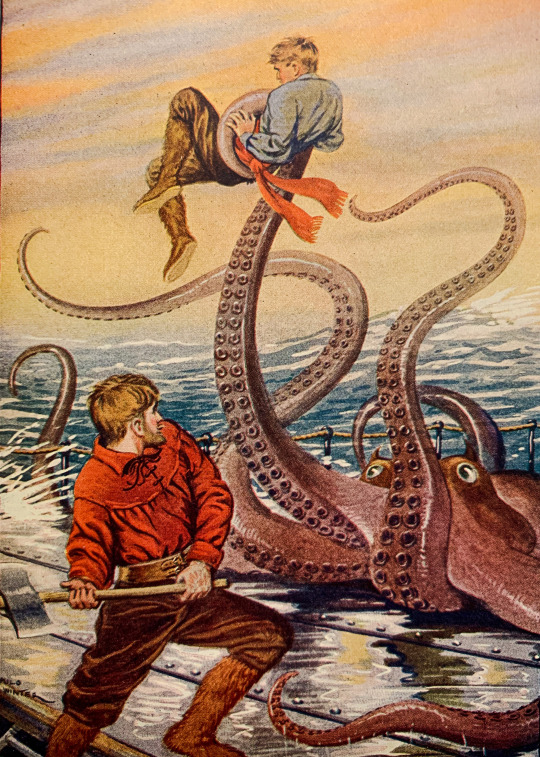
An illustration for Twenty Thousand Leagues Under the Sea by Jules Verne, from a 1922 edition, illustrated by Milo Winter (1888-1956). That's a nice picture.

A record cover for Jonny Quest in 20,000 Leagues Under the Sea, presented by Hanna-Barbera Records in 1965. Even under water, Race Bannon's hair stays in place.

The works of Jules Verne and many writers after him were characterized by super-science, what a reviewer from 1884 called "[m]agic machinery." Super-science isn't usually real science but a magical kind of science or technology that requires a suspension of disbelief in order for it to work. In 1940, Popular Publications (not to be confused with the Popular Fiction Company that published Weird Tales) began publishing Super Science Stories. Here is the cover for the second issue, May 1940, with art by Gabriel Mayorga (1911-1988). That looks like airbrushed art. Maybe Mayorga knew Alex Schomburg, who was a master of that tool.

Here's a bonus, the cover of Peril, The All Man's Magazine, from October 1956: another first issue, another tentacled creature on the attack.

Original text copyright 2023 Terence E. Hanley

Wednesday, February 15, 2023

Weird Tales, March 1923: Main Title Logo

The first issue of Weird Tales was dated March 1923. What many fans forget is that "The Unique Magazine" had a companion title that had begun in print nearly six months before. It was called Detective Tales, and the first issue had a cover date of October 1, 1922. Edwin Baird was the editor of both magazines, which were published by Rural Publishing Corp., a then-new company started by J.C. Henneberger and John M. Lansinger.

There were five issues of Detective Tales leading up to March 1923. Their numbers and dates:

  • Volume 1, Number 1--October 1, 1922
  • Volume 1, Number 2--October 16, 1922
  • Volume 1, Number 3--November 1, 1922
  • Volume 1, Number 4--Nov. 16/Dec. 15, 1922
  • Volume 2, Number 1--February 1923

Detective Tales started out in its first issue with eleven stories, plus eight nonfiction pieces, plus two editorial pages. I believe the first four issues (i.e., all of the issues comprising Volume 1) had forty-eight pages each. By February, the magazine had expanded to 192 pages and had begun calling itself "America's Biggest All-Fiction Magazine." The issue of March 1923 was Volume 2, Number 2. It, too, contained 192 pages. There were twenty-two stories in that issue, plus an editor's page called "A Chat with the Chief."*

Richard R. Epperly created the cover illustration for the first issue of Weird Tales. He also created the cover illustration for the March 1923 issue of Detective Tales. These two covers appear below, side by side. As you can see, both covers were printed using a two-color process, and the color scheme on both is the same, orange and black. However, Epperly's illustration for Detective Tales is a line drawing, whereas his illustration for Weird Tales is done in half tones. I'm not sure of the medium, but it looks like watercolor.

The designs are similar. Both have, on the left, a plaque-like design (or cartouche) containing cover blurbs. These were no doubt typeset. Above are the main title logos and subtitles for each of the two magazines. The main title logos appear to have been hand lettered, while the subtitles and other information (date, place of printing, price) were all typeset.

Richard Epperly was a commercial artist. I haven't yet read very much about his career, but I assume he took a course of study in cartooning, illustration, lettering, commercial art, and/or advertising art. His hand-lettered main title logos for Detective Tales and Weird Tales are essentially the same in terms of their design and technique.

I have a book called Speedball Text Book, prepared by Ross F. George. Mine is the 16th edition, which is dated 1952, but I doubt there were many changes from earlier editions. I think the first edition is from the early 1930s, or not long after Epperly created the cover designs you see below.  In any case, Epperly's lettering is similar to what George called Round Gothic with an F-B-1 Speedball pen point (p. 13) or Condensed Poster Gothic using an A-1 point (p. 41). Maybe Epperly modeled his lettering after one of these or a similar display face, or maybe he created his own style of lettering based on his art training.

Again, we should probably consider Detective Tales a companion magazine to Weird Tales. That's how I'm going to look at it. As such, it's deserving of study. I'll look into Detective Tales soon. But first, I have more on the first cover and the first issue of Weird Tales.

*Thanks to The FictionMags Index for its list of issues and contents of Detective Tales magazine.

Text copyright 2023 Terence E. Hanley

Monday, February 13, 2023

Weird Tales, March 1923: Cover Variants

The first issue of Weird Tales has a cover date of March 1923. The price was twenty-five cents. That was a lot for a pulp magazine, but inside were twenty-six stories, including twenty-two short stories, three novelettes, and the first of a two-part serial, 192 pages in all. The cover art was by Richard R. Epperly, a young commercial artist in Chicago. His was the only illustration in that first issue.

The cover story in the first issue of "The Unique Magazine"--it was called that from the beginning--was "Ooze" by Anthony M. Rud. Epperly's illustration shows the eternal triangle of man, woman, and monster, the man playing his role as hero and rescuer, the woman as damsel in distress, and the monster as monster. Was this the first depiction of a science-fictional monster (versus a folkloric monster) on the cover of an American pulp magazine? I can't say.

The cover of Weird Tales, Volume 1, Number 1, may have been a first of another kind: it was probably the first American magazine with cover variants. That wasn't intentional. Somebody at the printing plant messed things up by switching either the printing plates or the ink so that orange printed in black and vice versa. I'm not sure how many surviving issues there are of Weird Tales #1, but both variants are still in existence. And I can't say how many of each variant were printed. Suffice it to say that Rural Publishing Corp. was almost certainly not in a financial position to destroy the issues printed in error. The cover with the switched colors is a little odd--it looks kind of like a negative image--but it's not a complete disaster. Sometimes you just have to go with what you've got.

The explanation behind the mistake is that the printer switched the printing plates or the colors of ink. That suggests that this was a two-color process rather than a three-color process. The color orange, then, would have been printed from one plate (orange) rather than two (yellow plus red or magenta to make orange). The other plate would have been black of course. A two-color process would have been cheaper than a three- or four-color process but would still have allowed some color on the cover. A black-and-white cover--i.e., a one-color cover--would probably have been bad for sales, even if Weird Tales was the first magazine of its kind and practically guaranteed to find an eager and waiting readership.

That explanation doesn't go all the way, though, for the main title logo is the same in both versions: in both, the lettering is black and the lines above and below are orange. So could the cover have actually been printed twice, first with the logo, then with the illustration (or vice versa)? That doesn't make much sense. If you're trying to keep down costs, you don't send your stuff through the printing press twice. Maybe someone who knows about these things can propose an explanation.

Anyway, the first issue of Weird Tales was also the first issue of an American magazine devoted to fantasy fiction. Maybe (though I doubt it) it had the first science-fictional monster on the cover of an American pulp magazine. And it was possibly or probably the first American magazine with cover variants, even if those were unintentional. There are more firsts on their way and more about the first cover and the first issue of Weird Tales.


Revised February 13-14, 2023.
Text copyright 2023 Terence E. Hanley

Friday, February 10, 2023

Bacharach, Blob, & Brennan

Today I write about a circle. The circle begins with Burt Bacharach, who died two days ago, on February 8, 2023, at age ninety-four. Everyone who grew up in the 1960s through the 1980s remembers his songs. There are so many that are so good and come so quickly to mind that as soon as you hear his name, one of them is bound to start playing in your head.

Burt Bacharach and Mack David collaborated on the theme song for the 1958 film The Blob. If you grew up during the 1950s through the 1970s, you probably saw The Blob either at the theater or on late-night television. Maybe a horror host presented it for your consideration.

The star of The Blob was Steve McQueen, about whom I wrote recently. We think of The Blob as a science-fiction monster movie or an alien invasion movie, but it's also a car movie and a teenager movie (even though Steve McQueen was already twenty-seven when it was released). Teenagers drive around in their cars and save the day in The Blob. The plot is like a cross between the first encounter with Mothman in 1966 and the movie American Graffiti.*

The plot is also like Joseph Payne Brennan's novelette "Slime," from Weird Tales, March 1953. Brennan gets short shrift when it comes to The Blob. You might think that the similarity between the two stories is just a coincidence. Maybe it's a case of convergent evolution. But if you consult the description of the Joseph Payne Brennan Papers at Brown University Library, you will find that there appears to have been legal action involving The Blob and "Slime." The word plagiarism comes up in fact. Unfortunately, we have only a description of the papers available to us on line. It would take a trip to the library, I guess, to find out what it was all about.

Click on the words below for a link:

Joseph Payne Brennan papers (Ms. 2009.011), Brown University Library, Box A, Brown University, Providence, RI 02912

"Slime" was the cover story for the March 1953 issue of Weird Tales. As it so happens, that was the thirtieth-anniversary issue of "The Unique Magazine," an anniversary that seems to have been observed only in "The Eyrie," in a letter by Irving Glassman of Brooklyn, New York, on page 70. That was the last chance for anyone to observe a nice, round-numbered anniversary issue in the original run of Weird Tales. The magazine came to an end exactly a year and a half later, in September 1954. Virgil Finlay did the cover art for both, March 1953 and September 1954.

Thirty years before "Slime," there appeared another slime-blob-jelly-ooze cover, the first in fact for Weird Tales. This was of course in the first issue of Weird Tales, March 1923. The cover story was "Ooze" by Anthony M. Rud. The monster on the cover looks more like an octopus. If you read the story, you will find that it's actually a giant amoeba. Whereas Rud told his story from the point of view of an after-the-fact human investigator, "Slime" begins with the monster.

And that leads into the next few parts of this series.

Two slime-blob-jelly-ooze covers of Weird Tales. On the left is the cover for March 1953, illustrating "Ooze" by Anthony M. Rud. The cover artist was Richard R. Epperly. On the right is the cover for March 1953, illustrating "Slime" by Joseph Payne Brennan. The cover artist was Virgil Finlay. Note that, although thirty years separated these two issues, the cover price was the same. Of course the first issue had a lot more content. As for the cover art, well, Virgil Finlay simply outshone most pulp artists. This is no exception.

*Terrence Steven McQueen (1930-1980) and I share a first name, though his has one more "r" in it. That gave him extra Vrr-oom. He was born in Beech Grove, Indiana, a town that has been swallowed like the Blob by my native city of Indianapolis. James Dean (1931-1955) was also from Indiana. I think Steve McQueen is way cooler. He was also a better driver.

Text copyright 2023 Terence E. Hanley

Thursday, February 2, 2023

Weird vs. "The Weird"

When I wrote the first draft of my entry on Weird in Beowulf (Jan. 28, 2023), I used a little different title and a little different expression: I referred to weird as "the weird." I have to admit that I was influenced in that by the expressions in common use now, namely, "the weird" and "the New Weird." After reading and thinking about it more, I decided to remove the "the" and leave it at just "weird."

The definite article may seem like a small thing, but it isn't really. You might have heard that the Associated Press has instructed that we are not to use it when referring to groups of people. I take it that the AP is not like Soylent Green in that it's not made of people. Maybe it has been taken over by an AI, and so it can go on using a word--the Associated Press--that it has forbidden the rest of us from using. (What's the band The The supposed to do? Go nameless?) Maybe it should change its name to the Artificial Intelligence Press, AIP for short. You might have heard, too, that there are AIs in existence or in development that threaten to take over the jobs of journalists. I'm pretty wary of AI, but I have a feeling that it can do a better job at these things than can human journalists. Maybe they can learn to code.

Anyway, the definite article is no small thing, even if it is only three letters long. Here are my thoughts: to call weird or Weird "the weird" is to make it into a definite thing, an object, a category, a theoretical concept, a force, possibly a material force. (One of the leading theorists of "the weird" is a Marxist.) If we call it "the weird," then it seems to me that we have mastered it. We have turned it into something that can be understood, that can be held in the mind, examined and manipulated, turned this way and that. If we call it "the weird," we have turned it into something it is not. I think we have misinterpreted it, for we are not the masters of weird. Weird is not for us to understand. Weird does what it wants with us, not the other way around.

Like I've written, I don't think that weird is a force. I think of it more as a condition, perhaps a condition of our existence in this world. We don't say "the life" or "the love." We say "life" and "love." It's not "the faith" or "the madness" or "the despair" or "the joy" or "the death." You get my meaning. There's another offense in calling it "the weird," too. It seems a pretentious thing, the act of the intellectual too full of himself and his own ideas, too prissy and insistent on establishing and maintaining a name for himself by formalizing and theorizing on a literary genre that may be mostly his own invention, or at least mostly his own discovery. (We shouldn't leave out commercial considerations here, either: even Marxist authors like to sell their books in a free and open marketplace, although they might like it better if their god, the State, could compel people to buy their books.) But weird exists outside of literature. We write about it because it does, and literature is supposed to reflect life. Weird predates writing. An awareness of it does, too. We might call Beowulf and his Geatmen primitive or savage, but they knew a few things we don't. In our post-civilized state, we seem to have lost touch with the world, with nature, including our own nature, and with reality itself. It's no wonder weird was almost lost and that we don't really know what "weird" means anymore.

Weird is not a genre, nor is it a literary theory. It's not an intellectual system. It's not the sum total of the words or the very pulpish prose used to write our way around it. (Sorry, Lovecraft. Sorry, current Weird Tales website.) It's not a body of works. It's not in the names of authors thrown around in any essay, introduction, anthology, or website, even if they are from special places that are not the United States or the United Kingdom. (Namedropping is a favorite habit of another of the theorists of "the weird.") Again, we are not the masters of weird. It acts upon us. We write about it because we have become aware of it and witnessed or experienced its workings. But we may not understand it. In its essence, weird is beyond our ken, another Scottish word by the way.

So these are my thoughts, and they are why I won't reduce weird or Weird by calling it "the weird." It's also not "the New Weird," as something that is more than a decade old can't really be considered new. Anyone who doubts that should go get one of these new gadgets called a smartphone--you may have heard of them--and ask it how old it is.

So, no "the."

No "new."

Just weird.

Grendel, by Lynd Ward.

Text copyright 2023 Terence E. Hanley

Tuesday, January 31, 2023

What Is Weird Fiction?

Beowulf was composed in pre-Christian times but written down only after Christianity had moved into northern Europe. The result is syncretic, that is, a cross between pre-Christian and Christian beliefs. Syncretism was and is a very successful strategy in the growth and spread of Christianity. Rather than wipe out beliefs that came before it, the Church absorbed and modified them. It's why we celebrate Christmas at midwinter.

In his last words, Beowulf mentions both Weird (Wyrd) and "the Creator." The implication is that Weird works on earth, perhaps independently of the Creator. Or is she one of his agents or angels? I can't say. Beowulf seems to have lived and died in an in-between time. But what if the inclusion of Weird in Beowulf is not fully syncretic? What if Weird and God lived side by side for some time in Europe before Weird became what people now call "God's will" or "God's plan for the world"? What if only later did God subsume Weird?

For nigh on a thousand years after Beowulf, Weird was the workings of God--"God moves in mysterious ways" is the saying--and there was a syncretism, with God on top and Weird hidden away. Weird, or Fate, and her seeming random and often cruel ways retreated behind God's will, God's plan, God's mercy, God's love. God took her place; he is loving and caring, even if mysterious. He does things for his own reasons, which may be inscrutable and incomprehensible to us in our smallness, yet are ultimately wise and unassailable. Maybe the weird fiction of the nineteenth century and after chronicles a renewed schism of Weird from God, significantly beginning with the Romantic Period and the rise of the natural sciences.

We think of the Romantic Period as a reaction to the Age of Reason. But there was no simple conservatism in Romanticism. In fact, it may be seen as a search for a third way, for a middle ground between a cleaving to tradition and a radical overthrow of the past. So maybe Weird came back only after we had begun the process of dethroning God, which seems to have been part of the program of Western thought during the nineteenth century. Then, in 1883, Nietzsche wrote that God is dead. A couple of years later, publishers began putting out books with the word weird in their titles. These were no doubt the inspiration for the title, themes, and subject matter of the later magazine Weird Tales, which began one hundred years ago this spring.

So maybe the authors of weird fiction from the 1880s to the 1920s and '30s were simply returning to the Weird of the past. Except that Weird was now embodied or manifested in dark, malign, and alien beings, entities, and forces. Weird may be cruel. She may seem arbitrary. She carries us away. But more than anything, she may actually be indifferent to what we want for ourselves on this earth. Her ways may just be matters of course. These things must be done for no reason we may know. Cthulhu, on the other hand, wishes to crush us and rule over us. He has his designs upon us. He has come into this world to stay. He is bodily, though also in control of nonmaterial forces. But I sense in him an indifference, a malign indifference to be sure, but an indifference nonetheless. In the eyes of Cthulhu, we are nothing. Beyond that, in the greater Lovecraftian universe, we as human beings are insignificant, mere specks. I don't think Weird sees us that way. Weird may carry us away, but we are not nothing to her.

Based as it is on genuine human experience in a seemingly harsh, often cruel, and largely unforgiving world, the pre-Christian concept of Weird is actually profound in its grasp of our condition. It is not the simple or savage or barbaric belief of a pre-civilized people. It may actually be a kind of stoicism, a well-developed philosophy from ancient, civilized, and pre-Christian Greece and Rome. But I sense more in the concept of Weird than simply a kind of stoicism. Weird is at work in the world. No one knows her workings. Whereas Fate may be seen as acting out some kind of moral judgment or dealing some kind of punishment against transgression, Weird is or may be simply neutral. And because of that, we have acceptance. There can be no bitterness or lashing out at her. Our fists would simply fly through thin air. We are urged not to tempt Fate. But Weird is not tempted. Nor can she be avoided. She has her way no matter what we do. As Beowulf says, "Goes Weird as she must go!"

Weird is not a force. I feel certain of that. Weird is embodied in the person of an unseen and unknowable woman or goddess. And yet there is no discrete body or physical manifestation of her. And she is not a she but something else. Weird is at work everywhere at once. Weird is also not necessarily supernatural. Again, Weird may be simply part of our existence. She is in the way we live and ultimately die.

Weird fiction involves things that are weird, uncanny, eerie--all Scottish words--also, strange, fantastic, and possibly, though not necessarily, supernatural. I'll tell you the truth: I don't know what weird fiction is. But I think I know a couple of things that it is not:

First, weird fiction is not science fiction. If there are elements of weirdness in a scientific story (or pseudoscientific story, a term that predated science fiction), then it might best be described as science fantasy rather than as science fiction. To illustrate, I think it more accurate to say that H.P. Lovecraft and C.L. Moore composed stories of science fantasy rather than of science fiction. Both wrote in the weird-fiction tradition, which seems to have come from the Old World as far back as what Jack Williamson referred to as the Hebraic-Egyptian tradition. Edgar Rice Burroughs also wrote science fantasy. Although he was not a science fiction author proper, his stories may be seen as a kind of proto-science fiction. I don't think his stories are essentially weird, though, nor do they contain very many--if any--truly weird elements. I don't think Burroughs had that kind of imagination. Likewise, John Carter is not a weird-fictional hero. He is more nearly a science-fictional hero and a proximate forerunner to the Superior Man-type hero of the 1930s and after. Lovecraft's heroes, if you can call them that, and C.L. Moore's Northwest Smith in particular are clearly not science-fictional heroes in that they are not triumphant. They are in fact weak and in the end often defeated. The difference may come from differences in personality and biography. Remember that Burroughs was a man of action and vigor, whereas Lovecraft and Moore were sickly, at least in their formative years. Anyway, science fiction can have its weird elements, but, ultimately, if it's science-based rather than weird-based, then I think it has to remain within the realm of science fiction.

Likewise, weird fiction is not fantasy, or at least it's not high fantasy. The Hobbit and The Lord of the Rings Trilogy may have their weird elements, but they are fantasy. Like Robert E. Howard's stories of Conan, they also have elements of heroic fantasy. It seems to me, though, that the Conan stories lie within the realm of weird fiction because of their pervasive weird atmosphere. And let's remember that Howard saw himself as a Celt. Glenn Lord in fact assembled a book about him called The Last Celt: A Bio-Bibliography of Robert Ervin Howard (1976). We should also note that Conan is a Celtic name, and there are similarities between Conan and his countrymen with pre-Christian Celtic cultures and society. Although Weird is in Beowulf, she survived in the real-world realms of Celt-ism. Maybe that's another syncretism: Celts adapted Weird from Beowulf and his pre-Christian culture into their own and there it survived, only to be rediscovered in the nineteenth century, perhaps when it was needed again, perhaps when the Christian-pre-Christian syncretism began to break down and Weird was once again loosed from God.

I have written more than once that weird fiction involves Fate or Destiny as a limiting, corrective, or punitive force--maybe not force so much as outcome. We are permitted only certain things and no more. If we attempt more, we are put back in our place. The Greek notions of hubris and agon may come into play here. When we began our weird fiction book club several years ago, the leader of our group, my friend Nathaniel Wallace, asked us what we think makes weird fiction. My answer was and is that weird fiction involves a crossing over: either we cross over into other realms, or they cross over into or touch ours. Usually, there is a return or a retreat, but there need not be. The crossing over is the key. This, too, can be neutral: moral dimensions may be removed from weird fiction and it can still go about its business.

In reading about weird fiction, I have encountered two or three or four ideas again and again. One is that weird fiction crosses genres. I think that's true, but I think it has been true since the beginning. The claim of "the New Weird" to genre-crossing may very well be inconsequential. It's like inventing a new genre called "the New Western" and then setting all of its stories in the American West. Genre-crossing may very well be built into the definition of weird fiction. There's no need to keep commenting on it. And can we quit calling it "the New Weird"? If a thing is near two decades old, it ain't new anymore.

Second is that weird fiction subverts our expectations, or, as Wikipedia puts it, it "radically reinterprets" its subject matter. Again, I'll label that idea as puerile or sophomoric. Only the childish imagination--including the Marxist imagination--that exists within supposed adults believes in subversion or subversiveness, or in the idea that anything at this late date can be truly radical. What we should all know by now is that everything has already been tried. There is nothing new under the sun. The only reason that all of these things that have been tried don't still exist is that we found out they don't work and discarded them. It is the things that have been tried and found true that stick. You might call that the fundamental realization behind conservatism. Or if you want something truly radical, try Christianity and the idea that human beings are and by rights free and that we are made this way by our Creator. What he has done, no man may undo. Christianity and human freedom are the truly radical ideas and the real revolutions in our history. Marxism and all of its offshoots are merely reactionary, and in a pretty lunkheaded way, too.

Third is that weird fiction treats what is called the numinous. The numinous seems a philosophical or theological concept. I'm not a philosopher, nor am I a theologian, so I'll return to that fount of all knowledge, Wikipedia, which paraphrases Rudolf Otto (from 1923, the same year in which Weird Tales began) in stating that the numinous is "a mystery (Latin: mysterium) that is at once terrifying (tremendum) and fascinating (fascinans)." That works pretty well for me: weird fiction is about mysterious things that are at once terrifying and fascinating.

C.S. Lewis also commented on the numinous. In The Problem of Pain (1940), he wrote:

Suppose you were told there was a tiger in the next room: you would know that you were in danger and would probably feel fear. But if you were told "There is a ghost in the next room," and believed it, you would feel, indeed, what is often called fear, but of a different kind. It would not be based on the knowledge of danger, for no one is primarily afraid of what a ghost may do to him, but of the mere fact that it is a ghost. It is "uncanny" rather than dangerous, and the special kind of fear it excites may be called Dread. With the Uncanny one has reached the fringes of the Numinous. Now suppose that you were told simply "There is a mighty spirit in the room," and believed it. Your feelings would then be even less like the mere fear of danger: but the disturbance would be profound. You would feel wonder and a certain shrinking--a sense of inadequacy to cope with such a visitant and of prostration before it--an emotion which might be expressed in Shakespeare's words "Under it my genius is rebuked." This feeling may be described as awe, and the object which excites it as the Numinous. [Emphasis added.]

If terrifying equals dread and fascinating equals awe, then we have two prominent people in agreement as to what makes the numinous. I might add that Fate--but perhaps not Weird--acts as a rebuke. We believe ourselves to be so, so fine--We are geniuses! And we are forever rebuked.

Lovecraft had his say when it came to weird fiction. In "Supernatural Horror in Literature" (1927), he wrote:

The true weird tale has something more than secret murder, bloody bones, or a sheeted form clanking chains according to rule. A certain atmosphere of breathless and unexplainable dread of outer, unknown forces must be present; and there must be a hint, expressed with a seriousness and portentousness becoming its subject, of that most terrible conception of the human brain--a malign and particular suspension or defeat of those fixed laws of Nature which are our only safeguard against the assaults of chaos and the daemons of unplumbed space. [Emphasis added.]

I think you can read awe into Lovecraft's formulation of the weird tale. But his definition doesn't quite work for me. The chief reason might be that he wrote it in his typical overwrought and very pulpish prose ("our only safeguard against the assaults of chaos and the daemons of unplumbed space."). Another, though, is that he saw these unknown forces as being against us. I'm not sure that that's necessary. I don't think that Weird is against us. There may be cruelty in her workings, but that's only what we see on our end. She may carry us away, but for what purpose? We are merely human. We are not to know. In short, I believe the weird tale can be about weird forces, weird atmospheres, and weird events, but these need not be malign.

Again, maybe personality and biography must make their entrance. Lovecraft was not properly loved by his parents. I imagine that he extended that feeling of not being loved or cared for into the universe as a whole. In addition, he may have had a personal sense of insignificance and extended that to all of us. Lovecraft was also a materialist and an amateur astronomer. I suppose that, as such, he liked Cosmos (order) and feared Chaos (disorder). He did not believe in God. He probably resisted God, who sweeps into the heart and disorders it so that it might be put right again. God rebukes our genius. Without God, there is also Chaos, though of a different kind than exists in the physical universe. We see that in our world today, which is overfull with moral and intellectual chaos. There is also fear: we live in a world of fear. And, as we are finding now, there is also insanity. Without God and a belief in God, we--all of humanity--go utterly insane. Anyway, remember that Lovecraft fancied himself a figure from the Enlightenment and greatly admired two exemplars of that period, Joseph Addison and Richard Steele. Gothicism and Romanticism, which are in Lovecraft as well, were reactions to Reason. How do we make all of these things work with him? Maybe Lovecraft wasn't quite what he made himself out to be. In any case, fearing Chaos is not the same as discounting it. Lovecraft knew fear, terror, awe, and madness. He wrote very effectively on weird subjects and in a weird atmosphere. In fact, building atmospheres of awe and terror was one of his special talents. A writer--and a believer--like C.S. Lewis probably had less of a problem with these kinds of things, but notice that he used--and capitalized--the word Uncanny. Remember, too, that Lewis came from a Celtic culture, whereas Lovecraft was from an old Anglo-Saxon one. They all lived on the same islands, but maybe there has always been a divide between them, like Hadrian's Wall.

The quotes, again, are from Wikipedia.

Finally, there is the idea that weird fiction is about tentacles. Weird, I know. But there may be something to it. Except that I don't think a fascination with tentacles originated in weird fiction. In fact, I think it came from science fiction. And I'll have more about that when I write about the first issue of Weird Tales and its first cover story, "Ooze."

* * *

I was reading and writing about Weird earlier this month when Weird--call it Death instead--visited us again: last year at this time, we lost a sister. Now, a year and four days after losing her, we lost a brother. I do not invoke Weird lightly. I write this in all seriousness. Like I said, I don't believe Weird to be a force, nor a body, nor a spirit. Weird may not be the proper word for it. But there are workings in this world about which we may not know, and no one can explain to me that these things have happened.

My brother had a paper route when we were kids. Sometimes I helped him deliver the Indianapolis News to the people of our neighborhood. This was in Irvington, on the east side of Indianapolis. Named for Washington Irving, it's the same neighborhood in which C.L. Moore grew up fifty years before us and the same in which the Cornelius family, the printers/publishers of Weird Tales from 1924 to 1938, also lived. With his pay, my brother bought comic books, Conan the Barbarian and Kull the Conquerer among them. We read them and enjoyed them very much. We even drew our own Conan-inspired comic book called Barbarian Magazine. Later in life, my brother sought out and assembled a very good collection of Howard's works in paperback. They are still on his bookshelf.

I remember and hold on to my brother and my sister and my parents and all of the other family members and friends we have lost. Again, here are Beowulf's last words:

"Weird hath offcarried
All of my kinsmen to the Creator's glory,
Earls in their vigor: I shall after them fare."

But not now. Later. I hope later for all of us who are left. Let Death go away from our door. Let it no more carry any of us away.

* * *

Tentacles on the Cover of
Conan the Barbarian


There were lots of tentacles on the cover of Conan the Barbarian. Here are just two tentacled covers. Top: Conan the Barbarian #32 (Nov. 1973), with cover art by Gil Kane and Ernie Chua. Bottom: Conan the Barbarian #45 (Dec. 1974), with cover art by Gil Kane, Neal Adams, and Crusty Bunkers. Others from the first one hundred issues include #25, #72, and #86. The images here are from Marvel Database, hence the lack of price tags and the cleaned-up images.

Tentacles are in the current art world as well. Here is a photograph by Rashmi Gill showing the raising of a sculpture called "Witness," created by Shahzia Sikander, in New York City. It's meant to honor a late Supreme Court justice. That's why she's wearing a lace collar. The hair is similar to a Hopi maiden's, but it's more like a pair of goat horns. Some people have called the statue demonic or satanic. It doesn't help that her arms look like the tentacles of the Octopus Woman who is attacking Conan on the cover above. If a male sculptor had done something like this, he would have been excoriated for mutilating the female form. Instead, I guess, this is an expression of grrl power.

Notice that the tentacles are connected to her body on both ends. They look like tubes or conduits or spark plug wires. Is she actually a machine? A cyborg? An AI? A transhuman? Is she feeding into herself, reaching into herself? Is she a multi-limbed female version of the worm Ouroboros? On November 17, 2022, I wrote a little about Pete Townshend's Lifehouse project. In James Harvey's illustration, there are tubes or feeds going into the heads of dehumanized masses of people. They look something like the image above. Or maybe these are manifold Fallopian tubes. Could she be fertilizing and impregnating herself? 

"Witness" is a well-made work. The face, head, and neck are good. But it's also bizarre and antihuman. I guess this is the state of public art in America. We must tear down images of Abraham Lincoln and put up monstrosities like this one as replacements. There will be no end to this of course. Or maybe Weird will end it.

Original text copyright 2023 Terence E. Hanley

Saturday, January 28, 2023

Weird in Beowulf

Weird is a very old concept, possibly--or very probably--a pre-Christian concept. If we're going to talk about weird we must first understand it. I'm not sure that we can at this late date. Weird has come to us from a culture long departed from this earth. It is from a sensibility that may be alien to us, separated as we are from it, first by the intervention of the Christian era, afterwards by modernity and our embrace of science and reason. Or maybe it's not so alien, if an awareness of weird is in our eternal human nature.

In trying to understand the meaning of weird, not so much as a word as a concept, we might best go back to beginnings. For that, we have Beowulf, which dates from the early Middle Ages, was first spoken, then written, in Old English, and was finally committed to an extant manuscript at around the turn of the first millennium. If you're going to search for a word in a text, it's best to use a digital version of that text. In my search for weird in Beowulf, I have consulted a translation of the Heyne-Socin Text by Dr. John Lesslie Hall, Professor of English and History at the College of William and Mary in Virginia. Dr. Hall's work was published in 1892 by D.C. Heath & Company of Boston, New York, and Chicago. You will find his translation at the following URL:

https://www.gutenberg.org/files/16328/16328-h/16328-h.htm

* * *

In Dr. Hall's translation, the word weird occurs seven times, plus once in the glossary, where it is defined as: "Fate, Providence."

Here are the seven occurrences:

1. Beowulf speaks of what might happen to him in battle, even that he might die. In Part VII, Line 83, he acknowledges:

"Goes Weird as she must go!"

In other words, in Hall's annotations, "Weird is supreme."

And, in other words, Weird is personified--as a woman! She must be Urðr (Wyrd), one of the Norns.

2. In Part VIII, Line 22, Weird once again acts:

Weird hath offcast them to the clutches of Grendel.

3. In Part X, Lines 14-15:

[. . . .] Weird often saveth 
The undoomed hero if doughty his valor!

Doughty means "brave and persistent." The implication here is that weird as fate is not always negative. Providence seems to be a better meaning of the word in cases like this one.

4. In Part XIV, Line 42:

Weird they knew not, destiny cruel,

meaning that the men knew not what cruel fate would befall them. Here a connection is made between cruelty, as in the much later conte cruel, and weird.

5. In Part XXXIV, Lines 27-33, are these remarkable words and images:

Then the battle-brave atheling sat on the naze-edge,
While the gold-friend of Geatmen gracious saluted
His fireside-companions: woe was his spirit,
Death-boding, wav'ring; Weird very near him,
Who must seize the old hero, his soul-treasure look for,
Dragging aloof his life from his body:
Not flesh-hidden long was the folk-leader’s spirit.

6. In Part XXXVIII, Lines 61-63, come Beowulf's last words:

"Weird hath offcarried
All of my kinsmen to the Creator's glory,
Earls in their vigor: I shall after them fare."

7. In Part XLI, Lines 84-86:

So the high-minded hero was rehearsing these stories
Loathsome to hear; he lied as to few of
Weirds and of words. [. . .]

I'm not sure of the meaning here, but it may be that in recounting the events of the feuds between the Swedes and the Geats, the messenger left some things out--in so doing, he "lied"--there being so much more to tell, that is, there were more weirds and more words, a longer and fuller story left untold.

* * *

The Anglo-Saxon language often catches some grief, especially from snobbish native speakers and those of more florid Latin languages. But it has great power, witness, for example, "his soul-treasure look for." It seems to me that, for maximum effectiveness, weird fiction must reach towards Anglo-Saxon power, force, vigor, and vividness of imagery. By weaving such words of power, maybe we can revive original spirits and bring back the real meaning of weird, or more properly: Weird.

An illustration for Beowulf by Lynd Ward (1905-1985).

Original text copyright 2023 Terence E. Hanley