Tuesday, June 23, 2015

The Iron Heel and 1984-Part Four

Quotes and predictions from The Iron Heel continue as Ernest Everhard speaks:
"The ownership of the world . . . lies between the trusts and labor. That is the battle alignment . . . . The middle class is a pygmy between two giants. Don't you see, you poor perishing middle class, you are caught between the upper and nether millstones, and even now has the grinding begun." (p. 101) (1)
This quote is preceded and followed by illiterate Marxist claptrap, but the quote itself is illuminating, for it shines a light on the desire of the Leftist or Socialist to destroy what he hates the most, namely, the middle class, the people who by their success in life have taken away the power of the élite, of which he considers himself a part by virtue of his superior intellectual ability. And why does he hate the middle class so much? It probably goes beyond a mere gospel of envy (Churchill's phrase) and into the pathology of self-loathing diagnosed by Eric Hoffer in The True Believer: Thoughts On The Nature Of Mass Movements (1951). We should note that Marx, Engels, Lenin, Trotsky, and countless others of their kind emanated from the middle class they so wished to destroy. A point for Jack London.

In The Iron Heel, Bishop Morehouse is
led away to a private sanitarium for mental disease . . . . a sane, normal, saintly man . . . crushed by the brutal will of society. (p. 126)
The bishop's crime? Giving voice to unpopular ideas. In the parlance of 1984, he has committed a thoughtcrime, and like Winston Smith, he is classed as a lunatic. So where in the United States today are the laws against thoughtcrime enforced? In the hotbeds of leftism and statism, that is, in academia, government, media, and entertainment, and probably few other places, although the Thought Police have now extended their reach into the private sector and soon into our private lives. Jack London: right in general, wrong in the specifics.

Science fiction may not be about prediction, but try this on for size: in the winter of 1912, war with Germany threatens, that is, between the United States and Germany--a year and a half early for the war that really came about, five years early for war between the two nations. There's more: on December 4, 1912, a German fleet launches an attack on Honolulu, sinking four ships. Jack London got the month right and was pretty close on the day. He was also right about the place and about an attack on naval vessels. He was just twenty-nine years off on the actual date and marginally off on the attacker. In any case, you've got to give London points for those two predictions, even if they're not really pertinent to this essay.
And through it all . . . continued to rise the form of that monster of the ages, the Oligarchy. (p. 157)
Jack London recognized the monstrousness of the totalitarian state, even at that early date. Score a point for him.

A plot to explode a bomb in Congress is hatched among the oligarchs, who will blame the socialists for the attack. (pp. 171-172) Twenty years later, the Nazis hatched a similar plot with the firing of the Reichstag. London was right in predicting the ruthless machinations of statism.

Avis Everhard travels undercover as a wealthy woman, complete with a maid to attend to her lapdog. The author of the footnotes opines:
This ridiculous picture well illustrates the heartless conduct of the masters. While people starved, lap-dogs were waited upon by maids. (p. 177)
One of the hallmarks of a socialist or statist society is the destruction of the family, for the State cannot tolerate anything that separates the individual from itself. George Orwell foresaw it 1984, Aldous Huxley in Brave New World, and William F. Nolan and George Clayton Johnson in Logan's Run. Did any authors of the past foresee, however, that dogs would one day--meaning now--take the place of children? (2) I'm not sure that they did, just as no one seems to have predicted that the highest sexual license of the future would involve something other than heterosexuality. In any case, the wealthy woman's dog in The Iron Heel is probably not an expression of the Statist desire to destroy the family. More likely, it's an expression of the fact that when people are powerful, they are easily corrupted, a corruption that includes elevating animals to the level of human beings and/or demoting human beings to the level of animals or even of inanimate objects.

To be continued . . .

Notes
(1) The image of the upper and lower grindstones may have come from Henry George (1839-1897), who wrote:
Private ownership of land is the nether mill-stone. Material progress is the upper mill-stone. Between them, with an increasing pressure, the working classes are being ground.
Somehow or other, that quote became transmogrified into a supposed quote from Lenin:
The way to crush the bourgeoisie is to grind them down between the millstones of taxation and inflation.
That's a good quote, and I wish it were attributable to the demonic, mummified Bolshevik himself, but alas, no. A blogger called "The Skeptical Libertarian" has puzzled it all out here.
(2) It occurs to me that the craze for purebred and designer dogs may represent a kind of eugenics practiced by people who own dogs and view them as their surrogate children. Their message seems to be: better dog = better child = better parent = better dog owner. Instead of a bumper sticker that reads, "My child is an honor student at Springfield Middle School," the contemporary dog owner should have one that reads, "My dog is genetically superior to your dog (or child)." He might as well add, "My self-esteem is so fragile that my status as I perceive it is dependent upon my choice in designer dogs."

Original text copyright 2015, 2023 Terence E. Hanley

Sunday, June 21, 2015

The Iron Heel and 1984-Part Three

The Iron Heel was published more than a century ago. By the timeline of the book, we should be about one third of the way through the reign of the Oligarchy or Plutocracy that it described. There are people today who would argue that our country has indeed become an oligarchy. I think the evidence of that is pretty weak. After all, we have a president who is, with his talk of "Wall Street fatcats" and "you didn't build that," decidedly leftist in orientation. More to the point, in the one hundred and seven years since Jack London published his novel of an oligarchical dystopia, leftists and socialists have committed atrocities that are horrifying in the extreme. Any crimes committed by capitalists pale in comparison to the tens of millions of deaths brought about by the Nazis, Fascists, Marxist-Leninists, Maoists, and other socialists of the last century.

As I've said before, science fiction is not meant to be predictive, although it is capable of foretelling future developments by extrapolation. Jack London may have been blinded somewhat by ideology, but he had some understanding of power, and he understood the nature of the socialist as a True Believer burning with holy fire. I'll let him speak (in the voice of his main character):
The socialists were revolutionists . . . struggling to overthrow the irrational society of the present and out of the material to build the rational society of the future. (The Iron Heel, Signet, 1971, p. 53)
The theme: socialism as "rational" vs. freedom as "irrational." Witness the mission of the spaceship Integral from We by Yevgeny Zamyatin (1921, 1924): "You will subjugate the unknown beings on other planets, who may still be living in the primitive condition of freedom, to the beneficent yoke of reason." Since Marx or before, socialism is said to be "scientific" or "rational." Even today, those who oppose socialism are tarred with the accusation that they are anti-science. Mark one up for Jack London.

Mr. Wickson, a capitalist, stands up to the saintly socialist Ernest Everhard:
"We will grind you revolutionists down under our heel, and we shall walk upon your faces." (p. 65)
Later, Everhard repeats Wickson's words:
". . . the Iron Heel will walk upon our faces . . . ." (p. 117)
London placed those words in the mouth of a capitalist, yet has Mr. Wickson's kind perpetrated crimes that are in any way equal to those of the Socialist or Statist in the last hundred years? George Orwell, in 1984 (1949), echoed Jack London's words, but he placed them at their true source: in the mouth of the Statist, in his case, the monstrous torturer O'Brien: "If you want a picture of the future, imagine a boot stamping on a human face--forever." (Signet, 1981, p. 220) Jack London: half right.

Mr. Wickson continues:
"There is the word. It is the king of words--Power. Not God, not Mammon, but Power. Pour it over your tongue till it tingles with it. Power." (p. 65)
Orwell, through O'Brien, paraphrases: "The Party seeks power entirely for its own sake. We are not interested in the good of others; we are interested solely in power. Not wealth or luxury or long life or happiness; only power, pure power." (p. 217) Here is Saul Alinsky, one of our president's surrogate daddies, on the same subject: "In this book we are concerned with how to create mass organizations to seize power and give it to the people . . . ." (Rules for Radicals, Vintage, 1971, p. 4) Translation: We, the Statists, will seize power, ostensibly for "the people," in the same way that the Bolsheviks seized power, and in the name of "the people," proceed to commit atrocities. Again, London was half right.

Here is a footnote in The Iron Heel, written hundreds of years in the future:
[John Cunningham's book Economics and Education] dealt, in elaborate detail, with . . . the capitalistic bias of the universities and common schools. It was a logical and crushing indictment of the whole system of education that developed in the minds of the students only such ideas as were favorable to the capitalistic régime, to the exclusion of all ideas that were inimical and subversive. (p. 71)
Substitute leftist, statist, or totalitarian for capitalistic and you have a pretty accurate picture of what's going on in American education today. London: again half right.

To be continued . . .

Original text copyright 2015, 2023 Terence E. Hanley

Friday, June 19, 2015

The Iron Heel and 1984-Part Two

Typically, a dystopian novel describes a perfectly ordered society of the future. The Iron Heel (1908) is considered dystopian, but its author, Jack London, seems to have been concerned more than anything with the problems of his time. In the book, the true dystopia--complete control by the oligarchical Iron Heel--is still a thing of the future. Instead, The Iron Heel is mostly about the then-present, the recent past, and the very near future. (1) More nearly a political tract with some muckraking journalism thrown in, London's novel does not in fact fall easily into the category of dystopia. There is still opposition and violent resistance to the prevailing power. Rather than perfect order, there is still a distinctly un-dystopian disorder. The reader is left to wonder: just what would an oligarchical dystopia look like? Is such a thing possible?

When The Iron Heel by Jack London was published, a future society in which wealthy capitalists band together to form an overarching Oligarchy or Plutocracy may have seemed plausible. Although the Progressive Era had begun, many of its reforms still lay in the future. Holdovers from the Gilded Age must have seemed at the time to have the upper hand. Time has shown, however, that the dystopian threat issues not from the capitalist boogeyman but from the ideological Statist or Leftist. In fact, many so-called Progressive ideals or programs--efficiency and scientific management; standardization and centralization; technocracy or reign by experts; the conversion of history, sociology, psychology, etc., to so-called social sciences; an emphasis on equality and democracy (in other words an emphasis on the masses vs. the individual); eugenics and forced sterilization; the intrusion of moralism, for example Prohibition, into politics--help form the foundation of the dystopian or totalitarian society. I am reminded here of a quote from C.S. Lewis:
Of all tyrannies, a tyranny sincerely exercised for the good of its victims may be the most oppressive. It would be better to live under robber barons than under omnipotent moral busybodies. The robber baron's cruelty may sometimes sleep, his cupidity may at some point be satiated; but those who torment us for our own good will torment us without end for they do so with the approval of their own conscience. (2)
I have seen this quote in a book called What Liberals Believe: Thousands of Quotes on Why America Needs to be Rescued from Greedy Corporations, Homophobes, Racists, Imperialists, Xenophobes, and Religious Extremists edited by William Martin (2008). People who call themselves liberal--today's heirs to the Progressive Era--would like to think Lewis' quote to be one of their own. It clearly isn't. The irony is lost on them.

To be continued . . .

Notes
(1) Most of the action in the book takes place in the years 1912 to 1917 or so. The fictional footnotes are appended in the far future, after the Iron Heel has been overthrown and replaced with a socialist utopia. In short, we see the Iron Heel at its beginnings and look back upon it after its end, but we don't see it very well at the height of its power.
(2) From God in the Dock, a reprinting of essays originally published, I believe, in 1948. The title and publication history of the essays or book are not clear to me.

Original text copyright 2015, 2023 Terence E. Hanley
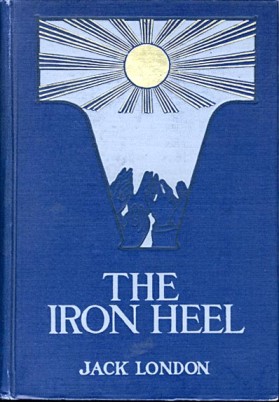
Monday, June 15, 2015

The Iron Heel and 1984-Part One

This is a story of two families, two writers, and two books.

John Griffith Chaney was born on January 12, 1876, in San Francisco, California. The man who is believed to have been his father, William Chaney, was an attorney and a journalist. Chaney was also an astrologer. For some time in the 1870s William Chaney lived with a woman named Flora Wellman. Whether the two were married or not is a question that may never be answered. Like the supposed father of her child, Flora Wellman had skills both practical and whack-tical. In addition to teaching music, she conducted seances during which she is supposed to have channeled the spirit of Black Hawk.

Chaney the astrologer and Wellman the spiritualist were a pair, but not for long. She became pregnant and announced publicly that Chaney had demanded that she have an abortion. He disclaimed parentage. She shot herself. Temporarily deranged at around the time of her son's birth, she gave him into the care of a former slave named Virginia Prentiss. Late in 1876, Flora Wellman married John London, a disabled Civil War veteran. Having earlier gained a new surname, Flora Wellman's son, the adolescent John London, began calling himself Jack. Jack London went on to become an extraordinarily prolific, active, and successful author of short stories, novels, and non-fiction. Like a fast-burning candle, he soon exhausted himself and died on November 22, 1916, at his ranch near Glen Ellen, California. He was just forty years old.

Like an apple, Jack London didn't fall far from his parents' tree. Son of an astrologer who repudiated him and a once-deranged spiritualist who was unable to give him everything that a fatherless boy might need, Jack London became an atheist and a socialist. In other words, he subscribed, like them, to beliefs with little purchase on reality. That's a simplistic assessment to be sure. I prefer what Clarice Stasz wrote in her online biography: "[The] contradictory themes in his life and writing make him a difficult figure to reduce to simple terms." I am reminded of our current president, who was also repudiated by his father and more or less rejected by his mother, both of whom also subscribed to whacky beliefs. Like London, he was a drug-user and is more or less leftist in orientation. Moreover, his beliefs have seemingly arrived on the fringes of reality. My belief is that he will never be able to forgive the world for what his parents did to him and that he will forever wish to punish us all for their inadequacies. One difference between these two orphans is that Jack London was a man of action and accomplishment. (1)

Jack London moved in socialist circles, an apt image for a belief system that--like the worm Ouroboros--has aspects of inversion, solipsism, and infantilism. American socialists of his time included Victor L. Berger (1860-1929), Eugene V. Debs (1855-1926), William James Ghent (1866-1942), George D. Herron (1862-1925), Morris Hillquit (1869-1933), and London's fellow author Edward Bellamy (1850-1898). As a Hoosier, I find it interesting that Debs, Ghent, and Herron were all from Indiana. Ghent was also a member of a Bellamy Club, also called Nationalist Clubs for their desire to nationalize industry. The Bellamy Clubs were named for the author of Looking Backward: 2000-1887, published in early 1888. On December 1, 1888, the Boston Nationalist Club met for the first time. According to a source on Wikipedia,
Boston club members were overwhelmingly of the middle class and included no small number of Theosophists. . . . Indeed, fully half of the members of the first Nationalist Club were members of the Theosophical Society, including key leaders [Cyrus Field] Willard and [Sylvester] Baxter. (2)
I have included the reference to the middle class to point out that revolutionaries are often, if not exclusively, drawn from the middle class. And I have included the reference to Theosophy because of its place, along with socialism and countless other related beliefs, in the ever-expanding web of crackpot ideas spun from the nineteenth century. I am reminded once again of the quote from "The Miracle of Moon Crescent" by G.K. Chesterton (1924):
You hard-shelled materialists were all balanced on the very edge of belief--of belief in almost anything.
Put another way, once people stop believing in God, they are likely to believe in anything, no matter how preposterous. Or, as John Cougar Mellencamp sang, you've got to stand for something, or you'll fall for anything.

Those early American Socialists and Bellamyites tended to come from religious backgrounds. Their number included George D. Herron, a Congregationalist minister and a teacher at Ripon College in Wisconsin and Grinnell College in Iowa, two schools with ties to Congregationalism and/or Presbyterianism. Herron was married three times. His first wife was Mary Vennette Everhard (1861-1935), daughter of Dr. Aaron Everhard (1824-1892) and granddaughter of John Jacob Everhard (1792-1867), a founder of Emmanuel Church in Wayne County, Ohio, and described as "rigid and uncompromising in his religious belief." (3) Mary Vennette Everhard's mother was Ann Vennette Marsh Everhard (1834-1922). The name Vennette cropped up in at least three generations of Everhard women. The youngest to bear that name was Ann's granddaughter, Margaret Vennette Herron (1885-1973), daughter of George D. Herron and Mary Vennette Everhard. Margaret, better known by her pen name Vennette Herron, wrote a couple of collections of stories. She also contributed to Weird Tales magazine.

In 1908 Macmillan published The Iron Heel, Jack London's supposedly dystopian novel involving early twentieth-century American socialists and the opposing Oligarchy or Plutocracy of wealthy capitalists, The Iron Heel of the title. I say "supposedly" because the book is actually a combination dystopia/utopia, with two narratives running simultaneously. The main narrative, told in the first person by the wife of a revolutionary, is dystopian and describes The Iron Heel in its formative years, 1912-1932. The sub-narrative, if you want to call it that, is indirect and takes the form of footnotes to the main narrative, which has been discovered many centuries later, after the establishment of a socialist utopia. The Iron Heel is an overtly political novel, a combination of fiction, journalistic exposé, and Jeremiad. It's also something of a hagiography of the narrator's husband, a Christ-like figure who knows all and foresees all. The socialist William James Ghent is mentioned in the book (Bantam, 1971, p. 146), as are many other real people, places, and events. They include the author's own Wake Robin Lodge near Glen Ellen, California, and probably also the author himself, who romantically prophesied his own death:
Once a writer friend of mine had owned the ranch [a hiding place for revolutionaries]; but he, too, had become a revolutionist, though more disastrously than I, for he was already dead and gone, and none knew where or how. (p. 179)
The narrator by the way is named Avis Cunningham Everhard. Her husband, the subject of The Iron Heel, is Ernest Everhard. The temptation is to interpret that name as having some psychosexual meaning. (4) I have a better explanation. Avis' father, like Vennette Herron's father, is a college professor. Ernest Everhard also has something in common with Vennette Herron, for her mother and he share the surname Everhard. I don't think that's any coincidence at all.

To be continued . . .

Notes
(1) My reason for bringing up the president isn't just as a critique. I'll have more to say later in this series.
(2) The source is Authoritarian Socialism in America: Edward Bellamy and the Nationalist Movement by Arthur Lipow (Berkeley, CA: University of California Press, 1982), p. 226. Cyrus Field Willard (1858-1942) was an American socialist, Bellamyite, Theosophist, and--incongruously--inventor. Sylvester Baxter (1850-1927) was also an American, an urban planner, Bellamyite, Theosophist, and newspaperman.
(3) From History of the Eberharts in Germany and the United States from A. D 1265 to A. D. 1890--625 Years by Uriah Eberhart (Donohue and Henneberry, 1891), p. 70.
(4) Rather than being sexual in its overtones, the name Everhard could just be symbolic of Ernest Everhard's great strength: what better man to resist the relentless Iron Heel than a man who is ever-hard. Likewise, the given name Ernest is obviously an evocation of the adjective earnest, from my dictionary, "serious in intention, purpose, or effort; sincerely zealous."


The Iron Heel in the Bantam paperback edition of 1971, with an introduction by the socialist, anarchist, and propagandist Howard Zinn (1922-2010).

Text copyright 2015, 2023 Terence E. Hanley

Wednesday, June 10, 2015

Gertrude Macaulay Sutton (1887-1979)

Gertrude Forster Macaulay Sutton
Author, Poet
Born October 16, 1887, Québec, Canada
Died September 19, 1979, presumably in Montréal, Québec, Canada

Update (Dec. 5, 2021): I first wrote on Gertrude Macaulay Sutton in 2015 when there was less information about her on line. The picture is a lot clearer now, but I will leave what I wrote before but with some updated information.

[From 2015:] Links in a broken chain:

A Miss Gertrude Macaulay, possessor of a "full and well-trained contralto," received coverage in The Sketch, March 16, 1898, page 322, including a photograph showing her as a full-grown woman, perhaps in her twenties.

Almost certainly the same Gertrude Macaulay, a contralto, having returned from Canada, advertised for singing engagements and to receive and visit students, giving her address as Park Court Mansions, Clapham Park, S.W., [London] in The Musical Times (Vol. 49, 1908).

On July 21, 1908, a Miss Gertrude Macaulay performed at St. Nicholas Cole Abbey, 112a Queen Victoria Street, E.C., [London].

[New information shows that this Gertrude was not our Gertrude. So, more from 2015, with a few pieces of updated information:]

A Gertrude F. Macaulay, age 28 years, 5 months, arrived in New York aboard the Orduna on March 20, 1916, from Liverpool. Given her age and the apparent age of the previously mentioned Gertrude Macaulay, I assume that these were two different women and that the second, the passenger on the Orduna, was the writer for Weird Tales.

A Gertrude Macaulay, daughter of President T.B. Macaulay of the Sun Life Assurance Company of Canada, contributed to the war effort during World War I by preparing 700 puddings per week for wounded British soldiers in the Mary Lady Gerhardt Hospital in London. "Broken in health," she retreated to New York, arriving on April 6, 1916. The soldiers had awarded her "the Cuisine Cross de Pudding, the highest military honor conferred on civilians by wounded British soldiers." (From The Insurance Field--Life Edition, Apr. 14, 1916, p. 12.)

T.B. Macaulay--Thomas Bassett Macaulay (June 6, 1860-1942)--was a Canadian actuary, philanthropist, and farmer. According to Wikipedia, "It has been estimated that most of the world's Holstein cattle descend from Macaulay's herd." Macaulay married Henrietta Maria Louisiana Bragg (1857-1910) in 1881. She was a native of Louisiana. Henrietta died in 1910 and was buried in Montréal. The following year, her widowed husband pushed to have Canada annex the Bahamas.

A Gertrude F. Macaulay wrote a piece called "Only a 'Case'" for the journal Nurse (Vol. 5, 1916), in which she seems to have had some familiarity with nursing and hospitals in England during the war.

A Gertrude F. Macaulay of Montreal was listed as a member in Journal of the American Society for Psychical Research (Vol. 12, 1918).

A Gertrude F. Macaulay, presumably the same woman, wrote an article called "The Source of Inspiration" in The Editor (May 25, 1918, pp. 345+), quoting from F.H.W. Myers' Human Personality and Its Survival after Bodily Death (1903). Frederick William Henry Myers (1843-1901) was the founder of the Society for Psychical Research in 1882.

June 23, 1923: A wedding announcement from the Vancouver Daily World (June 23, 1923, p. 9): "Sutton-Macaulay--Relatives of Miss Gertrude F. Macaulay here and in New Westminster have received the news of her marriage in Montreal to Mr. Cecil Arthur Sutton, of London, England. The bride, given in marriage by her father, Mr. T.B. Macaulay, wore a French robe of ivory tinted ninon stamped with a design in velvet, enriched by a court train of net embroidered in silver, the draperies, like the veil, caught with knots of orange blossom. Lilies of the valley and Ophelia roses composed the bouquet she carried. There were three attendants: the bride's cousin, Miss Edith Cushing, and her niece, Nancy Hale, and Kathryn Owen, of Detroit. All were dressed alike in almond green crepe sashed with black velvet and wore fillets of tulle. Mr. W. E. MacFarlane was best man. After a honeymoon in the Catskills, Mr. and Mrs. Sutton will live at 4002 Montrose Avenue, Montreal."

In an article from the Winnipeg Tribune (Jan. 31, 1930), Gertrude MacAulay [sic] Sutton was described as "a brilliant, vivid, young Canadian writer, who has in the past two years achieved literary distinction." If she was the passenger on the Orduna, she would have been, in 1930, about forty-two years old.

The FictionMags Index lists the following works by Gertrude F. Macaulay:
  • "And the Devil Laughed" in The Smart Set (short story, Jan. 1912)
  • "Sated" in The Cavalier (poem, Feb. 3, 1912)
  • "A Splash of Scarlet" in The Smart Set (short story, May 1915)
  • "The Girl in the Mirror" in The Parisienne (miscellaneous, July 1915)
  • "The Sale of a Face" in The Smart Set (short story, July 1915)
  • "The Artist" in The Smart Set (poem, Aug. 1916)
  • "Her Typical Experience" in The Smart Set (short story, Aug. 1916)
  • "Sweet as First Love" in The Smart Set (miscellaneous, Jan. 1918)
  • "Her Men" in The Smart Set (short story, Nov. 1918)
and the following by Gertrude Macaulay Sutton:
  • "Theft from the Devil" in The Delineator (short story, July 1928)
  • "Indifference Is Filthy" in Maclean's (short story, Jan. 1, 1930)
  • "Private Angel" in Woman's Home Companion (short story, Feb. 1930)
  • "Gesture" in Weird Tales (short story, Sept. 1930)
  • "Mrs. Falconer’s Private Conscience" in The Canadian Magazine (short story, Nov. 1930)
  • "Beauty Parade" in The Delineator (short story, Sept. 1931)
  • "In the House of My Friends" in The Canadian Magazine (short story, Nov. 1932)
  • "Husbands Can Be Managed" in Canadian Home Journal (short story, Apr. 1933)
  • "No Clue Left" in This Week (short story, July 28, 1935)
"Gesture" was her lone story for Weird Tales. "Theft from the Devil" won her a first prize in a competition for short stories by the Montreal Branch of the Canadian Authors' Association in 1927.

Old St. Andrews Parish Church of Charleston, South Carolina, an Anglican church, had among its parishioners Cecil Arthur Sutton (Oct. 25, 1884-Feb. 25, 1960), "Son of William Francis and Margaret Little Sutton [and] Beloved Husband of Gertrude Macaulay." Sutton was buried in the church cemetery.

And that's all I have found.

Update (Dec. 5, 2021): And now I have more:

Gertrude Forster Macaulay or MacAulay was born on October 16, 1887, in Québec, Canada, to Thomas Bassett Macaulay (June 6, 1860-1942) and Henrietta Maria Louisiana Bragg (1857-1910). Her father was Canadian, her mother American. She attended McGill University, presumably graduating in 1907. In her yearbook, she was described as an "[e]fficient hockey captain" and a "clever reporter." Her home at the time was Westmount, an enclave of wealthy English-speaking people located on the Island of Montreal. She wrote a number of stories, listed above, published in both Canadian and American magazines from 1912 to 1935. She married Cecil Arthur Sutton (Oct. 25, 1884-Feb. 25, 1960) in 1923, and although her writing career continued for at least a dozen years after being married, I have nothing for her after 1935.

Gertrude lived a very long life. I finally have her death date from Randal A. Everts and the Bibliothèque et Archives nationales du Québec. The latter informed the former that death notices for Gertrude Macauley Sutton appeared in the Montreal Star (p. B5) and The Gazette (p. 41) on September 20, 1979. She had died the previous day, September 19, 1979, at age ninety-two.

Gertrude Macaulay Sutton's Story in Weird Tales
"Gesture" (Sept. 1930)

Further Reading
There is a good deal on the Internet about Gertrude's father, Thomas Bassett Sutton, but only a little about her.

Gertrude Macaulay and friend, 1910, Mount Victoria Farm, Hudson, Quebec. I believe Gertrude is on the left. She was five feet, six or seven inches tall; the woman on the left appears to be the taller of the two.

Update (Dec. 5, 2021): Here is her yearbook picture, from Old McGill, the yearbook of McGill University, 1907. Dorothy McIlwraith (1891-1976), later editor of Weird Tales, also attended McGill University but graduated in 1914, well after Gertrude. I wouldn't rule out that they knew each other, though.

Thanks to Randal A. Everts and the Bibliothèque et Archives nationales du Québec for more information on the death of Gertude Macauley Sutton.
Thanks also to Brian Busby (see his comment below) for more information on the young Gertrude.
Text copyright 2015, 2023 Terence E. Hanley

Tuesday, June 9, 2015

Louis B. Capron (1891-1971)

Author, Poet, Merchant, Photographer, Anthropologist
Born July 26, 1891, Menands, Colonie, New York
Died December 16, 1971, West Palm Beach, Florida

Louis Bishop Capron was born on July 26, 1891, in the village of Menands within the town of Colonie, adjacent to Albany, New York. Capron moved to Oneonta, New York, at an early age and became interested in the history of American Indians. At Yale University he studied chemistry, anthropology, and archaeology and participated in the Yale-Andover Archaeological Survey of the Connecticut River Valley. Graduating in 1913, Capron--like his father before him--became a merchant. In 1925, he moved to West Palm Beach, Florida, where he worked for the Palm Beach Mercantile Company until his retirement in 1952.

From 1915 to 1920, Louis B. Capron contributed poems, stories, and vignettes to The Argosy, Breezy Stories, Munsey's, The Saturday Evening Post, The Smart Set, and St. Nicholas. His lone contribution to Weird Tales was the short story "The Soul That Waited" from June 1925.

Louis B. Capron was considered an expert on the Seminole Indians and was a member of historic and anthropological societies, including the American Anthropological Association. Once in Florida, he acquainted himself with the Seminole people and wrote the text of a pamphlet, "The Medicine Bundle of the Florida Seminole and the Green Corn Dance," for the Smithsonian Institution Bureau of American Ethnography, published in 1953. His article "Florida's 'Wild' Indians: The Seminole" appeared in National Geographic in December 1956. 

In addition to being an author of verse, short fiction, and non-fiction, Louis Capron wrote children's novels, including Golden Arrowhead (1948), White Moccasins (1955), The Blue Witch (1957), and The Red War Pole (1963). The color-coded titles remind me of those of another Florida author, John D. MacDonald.

Capron died at home in West Palm Beach, Florida, on December 16, 1971, at age eighty.

Louis B. Capron's Story in Weird Tales
"The Soul That Waited" (July 1925)

Further Reading
Louis Bishop Capron's papers are at the George A. Smathers Libraries at the University of Florida.


Text copyright 2015, 2023 Terence E. Hanley

Monday, June 8, 2015

Frank Owen's Books

US author and editor, husband of Ethel Owen. He wrote 10 mildly salacious novels in the 1930s as Roswell Williams, sometimes listed erroneously as his real name. FO is best-know for mannered tales of the Orient. (p. 739)
According to that source, his works fall into the category of fantasy and fable, some with supernatural elements. The Encyclopedia is right in saying that Owen's real name was not Roswell Williams but wrong in saying Ethel Owen was his wife. She was in fact his older sister. Following is an incomplete list of Frank Owen's books:
  • Coat Tales from the Pockets of the Happy Giant (with Ethel Owen, collection, New York: The Abingdon Press, 1927)
  • The Dream Hills of Happy Country (with Ethel Owen, collection, New York: The Abingdon Press, 1928)
  • Games in Rhyme (with Ethel Owen, illustrated by M. Farini, New York: C.R. Gibson and Company, 1929)
  • The House Mother (New York: Lantern Press, 1929)
  • Pale Pink Porcelain (1929)
  • The Wind that Tramps the World: Splashes of Chinese Color (collection, New York: Lantern Press, 1929)
  • The Purple Sea: More Splashes of Chinese Color (collection, New York: Lantern Press, 1930)
  • Wind Blown Stories (with Ethel Owen, collection, illustrated by George T. Tobin, New York: The Abingdon Press, 1930)
  • Della Wu, Chinese Courtezan and Other Oriental Love Tales (collection, New York: Lantern Press, 1931)
  • Rare Earth (New York: The Lantern Press, 1931)
  • The Blue Highway (with Ethel Owen, collection, illustrated by George T. Tobin, The Abingdon Press, 1932)
  • Madonna of the Damned (as by Roswell Williams, 1935)
  • Lovers of Lo Fab (as by Roswell Williams, 1935 or 1936)
  • Between the Covers (New York: The Macaulay Company, 1938)*
  • A Husband for Kutani (collection, New York: Lee Furman, 1938)
  • The Scarlet Hill (New York: Carlyle House, 1941)
  • Morris the Midget Moose (children's book, G.P. Putnam's Sons, 1945)*
  • The Porcelain Magician: A Collection of Oriental Fantasies (collection, illustrated by Frances E. Dunn, New York: Gnome Press, 1948)
*I can't be sure that these books were by our Frank Owen, who should not be confused with the Welsh military officer, author, and newspaperman, nor with the American cartoonist (1907-1971) of the same name.

In addition to writing books, Frank Owen was an editor. Many of these books are from the Teen-Age Library series published by Lantern Press and/or Grosset and Dunlap. The following list may or may not be complete:
  • The Bedside Bonanza (New York: Frederick Fell Company, 1944)
  • Murder for Millions: A Harvest of Horror and Homicide (New York: Frederick Fell Company, 1946)
  • Teen-Age Companion (illustrated by Carl Cobbledick, 1946)
  • Fireside Mystery Book (New York: Lantern Press, 1947)
  • Teen-Age Baseball Stories (1947)
  • Teen-Age Outdoor Stories (1947)
  • Teen-Age Sports Stories (1947)
  • Teen-Age Basketball Stories (1948)
  • Teen-Age Football Stories (1948)
  • Teen-Age Mystery Stories (illustrated by Carl Cobbledick, New York: Lantern Press, 1948)
  • Teen-Age Stories of Action (1948)
  • Teen-Age Winter Sports Stories (1949)
  • Teen-Age Victory Parade (1950)
  • Teen-Age Winter Sports Stories (Grosset Dunlap, 1950)
  • Baseball Stories (paperback, Lantern Press, 1964)
Ethel Owen, Frank Owen's sister and sometime co-author, was born in August 1890 in New York, probably in Brooklyn. In addition to writing books with her younger brother, Ethel also wrote books on her own, many about parties for young people, some about more adult topics. Here is a partial list:
  • A Book of Original Parties (1925)
  • Parties That Are Different (1926)
  • The Pumpkin People (1927)
  • Hallowe'en Tales and Games (illustrated by Eleanore Mineah Hubbard, Chicago: A. Whitman and Company, 1928)
  • Wish for Tomorrow (New York: Robert Speller Publishing Corp, 1936)
  • The Abingdon Party Book (1937)
  • Romance in the Rain (New York: Green Circle Books, 1937)
  • Some One Shall Love Me (New York: Lee Furman, 1939)
  • Unwilling Bride (Astro Books #9, 1948)
  • Confessions of a Good-Time Girl (Astro Books #10, 1948)
  • A Year of Recreation
Ethel Owen died on November 17, 1946, at age fifty-six. Her obituary--an incomplete obituary taken from the online archive of the New York Times--from November 18, 1946:
OWEN, Ethel, on Sunday, Nov. 17, 1946, devoted sister of Frank Owen, Mrs. Andrew Rankine and Mrs. Paul F. Pinkham. Service at her residence, 204 Weirfield St., Brooklyn . . . .
Here are some other sources from the Times on the Owen family. The transcriptions may not be entirely accurate:
Deaths
OWEN, Friday, March 25, 1938, Agnes A., beloved daughter of Henrietta and the late Henry Owen, sister of Margaret, Ethel, Ralph H., and Frank Owen, Mrs. Andrew Rankine and Mrs. Paul F. Pinkham. Services at her residence, 204 Weirfield Ave., Brooklyn. (Mar. 27, 1938)
Wills for Probate
OWEN, AGNES A. (March 25). Estate $4,800 personal. To mother, Henrietta Owen, 204 Weirfield St. Frank Owen, 204 Weirfield St., executor. (Apr. 6, 1938)
And Frank Owen's own obituary:
Frank Owen, Author, 75; Editor of Mystery Books
Frank Owen, an author who also wrote under the pen names Roswell Williams and Richard Kent, died Sunday after a long illness at his home, 21 Adler Place, Brooklyn. He . . . . (Oct. 15, 1968)
So what are we to make of the oeuvre of Frank Owen? He was a very prolific and seemingly reliable author for Weird Tales, yet his stories have very seldom been reprinted during the intervening years. It's true that they appeared in hardbound editions in the 1920s and '30s, even as most of his contemporaries were still hacking their way through the pulp jungle. But most were reprinted for the first and last time more than seventy years ago. Even if your library is well stocked, you might have a hard time coming up with even one of them. According to my recent email correspondent, E. Hoffman Price (another Orientalist) considered Owen "a fine writer," but how are we to know? If nothing else, "The Wind That Tramps the World," Owen's most popular story for Weird Tales, should be generally available. Instead, it has been reprinted only in Weird Tales #3, edited by Lin Carter, from 1981, a book that is hard to come by. (1) Ten authors are ahead of Frank Owen in the number of stories they wrote for Weird Tales. All but Allison V. Harding have had their stories reprinted again and again. (2) Most have their own large following of diehard fans. So what of Frank Owen? Is he a neglected author? Or is there something else going on? These are no mere rhetorical questions. We should know their answer.

Notes
(1) The title by the way is from the poem "Sestina of the Tramp-Royal" by Rudyard Kipling (1896).
(2) Allison V. Harding is a special case. There is reason to believe that stories by that pseudonymous author received special treatment in being published in Weird Tales.


You don't have to take my word for it. Here is an inscription from Ethel Owen:

July 23, 1936
To Frank Owen
My Brother
My Collaborator
My Fellow-Novelist
My Artist
and
A pretty good guy
Ethel Owen


Note: The illustration on the dust jacket of The Purple Sea is initialed "HR." I assume that to have been Hugh Rankin, an illustrator for Weird Tales.

Text copyright 2015, 2023 Terence E. Hanley