Friday, June 16, 2023

The Eyrie in the First Issue

"The Eyrie" was the letters column in Weird Tales and was there from the first issue. The first installment opens with a kind of fanfare. The author of it called himself merely "The Editor." We can assume that Edwin Baird wrote it. I wouldn't rule out, though, that Otis Adelbert Kline or even Farnsworth Wright lent a hand.

The first letter in the first issue of Weird Tales was by Anthony M. Rud. He wrote before the magazine had gone to press. That makes me think that Rud was involved with the magazine at the outset. At the very least, he acted as a kind of talent scout or agent or maybe just a messenger to other writers, especially writers in the South. In the run-up to the publication of the first issue, Rud was in Alabama. Of his intentions on behalf of the new magazine, he wrote:

     It's a corking title, and it will get all the boosting I can give. Herewith a clipping of my last platform appearance. I told 'em of the coming magazine, and that it offered a field of reading unique. At Atlanta and Montgomery, where I speak later in the winter, I'll give the sheet a hand. I have two more dates in Mobile, and I’ll mention your project.

There was a lot of chummy kind of writing in those days, writing that may not be exactly to our tastes, but at least we have something from the men who were there.

The second letter was from Willard E. Hawkins, who wrote the first story to appear in Weird Tales, "The Dead Man's Tale." In his letter, he explained how he had written his story. The letters column closes with a request for comments by readers. Those would surely follow.

In his introduction to "The Eyrie," the editor wrote:

If the letters we have already received, and are still receiving (weeks before the magazine goes to press), are an augury of success, then WEIRD TALES is on the threshold of a tremendously prosperous career. Some of these letters are accompanied by subscriptions, others request advertising rates and specimen copies; all predict great things for us and express enthusiastic anticipation of "something different" in magazine fiction.

We're now at the end of the first one hundred years of Weird Tales. Although "The Unique Magazine" came close to perishing at the end of its first year, it ran for thirty-one years in its first incarnation, was revived several times in the 1970s and '80s, and has now been revived again. Marvin Kaye called it "The Magazine That Never Dies." Lots of other magazines have in the past 100 years, but Weird Tales lives on.

The first heading of "The Eyrie," March 1923.

Original text copyright 2023 Terence E. Hanley

Wednesday, June 14, 2023

Cormac McCarthy (1933-2023)

Cormac McCarthy has died. He was eighty-nine years old. It would not be exactly true to call him a mainstream novelist, but he was more nearly mainstream than an author of genre fiction or of one of the pulp genres. However, like Walker Percy (1916-1990), he wrote a post-apocalyptic novel, his called The Road, from 2006.

Like Percy and so many well-known and well-admired American authors of the twentieth century, the late Mr. McCarthy was a Southerner. However, he was not so by birth, for Cormac McCarthy, whose real name was the same as a ventriloquist's dummy, was born in Providence, Rhode Island, on July 20, 1933. Imagine: for a time, he shared a city with H.P. Lovecraft.

Like Lovecraft, Cormac McCarthy, as a writer, lived in poverty. He did not come from poverty, though. His father was a successful and well-off attorney. Named Charles Joseph McCarthy (1907-1995), he was born in Providence, too. In 1934, the elder McCarthy began work for the Tennessee Valley Authority (TVA). The McCarthy family moved to Knoxville, Tennessee, in 1937. I imagine they lived somewhere else in the South before that. If so, maybe Cormac McCarthy was a Yankee only for a year.

In 1962, when the childhood home of Knoxville author James Agee (1909-1955) was being demolished, Cormac McCarthy salvaged some of the bricks to build fireplaces in his writer's shack. Like Mr. McCarthy, James Agee was not an especially prolific author. Unlike him, Agee died young. Agee is known for his work from the Great Depression, Let Us Now Praise Famous Men (1941), a collaboration with another Walker, Walker Evans.* Agee also wrote the screenplay for The Night of the Hunter (1955), an unforgettable film directed by Charles Laughton and starring Robert Mitchum, Shelley Winters, and Lillian Gish. Agee's screenplay was based on the novel of the same name by West Virginia author Davis Grubb (1919-1980). Writing as Dave Grubb, he had one story in Weird Tales, "One Foot in the Grave," from May 1948. His story "The Horsehair Trunk" (Collier's, May 25, 1946) was adapted to an episode of Rod Serling's Night Gallery in 1971.

I said that Cormac McCarthy was not exactly a mainstream author. That's probably not exactly true, either, for he wrote about violence, death, menace, and terror. He also wrote mostly of men. And if there is a setting for the American novel, it might be the road. Cormac McCarthy wrote, of course, the aforementioned novel, The Road. I think that he and his works would have fit easily into Leslie Fiedler's thesis concerning American literature, which Dr. Fiedler explicated in Love and Death in the American Novel (1960, 1966). Not love and hate, as printed on Robert Mitchum's knuckles, but love and death.**

Cormac McCarthy did a lot of wandering in his life. He lived in a lot of places and must surely have spent a lot of time on the road. The wonder is that he lived so long, was married three times, and had two children, one of whom, a then-young son, is one of the subjects of The Road. Mr. McCarthy came from an Irish-Catholic family. We have our ways. I see echoes in my own family of him and his.

He was interested in science and hung out with physicists, biologists, and other scientists. One of these was whale biologist Roger Payne (1935-2023), who died three days before Cormac McCarthy, on June 10, 2023. Dr. Payne's recordings of whale-song are on their way to the stars aboard the Voyager spacecraft. They are also in Star Trek IV: The Voyage Home (1986), one of the better entries, I think, in that series. We begin our voyages by setting off on the road.

Another way in which Cormac McCarthy is in the mainstream of American literature is that he is essentially an enigma and a kind of solitary voice emanating from his place on the fringes, in the wilderness, from foreign shores, from beyond frontiers. In that way, he is like Edgar Allan Poe, Henry David Thoreau, Herman Melville, his fellow Southerners William Faulkner, Carson McCullers, and Flannery O'Connor, and countless others.*** I wish we had more of him. But at least we have what we have. At least we shared with him this life and this earth, at least for a while.

-----

*Like The Road, The Walking Dead is post-apocalyptic. In the former, the cannibals are living. In the latter, they are the walking dead, and they are called walkers.

**Cormac McCarthy's first novel, The Orchard Keeper, was published in 1965, probably too late for consideration in Leslie Fiedler's book. I once had a copy of The Orchard Keeper. I regret having given it up. I started it but never finished it. Like trying to read Loren Eiseley's book The Invisible Pyramid while I was still a high-schooler, I knew that this was something important and a book that would hold something for me, but I knew also that it was something above me at the time. Instead, since then, I have read Mr. McCarthy's Border Trilogy and The Road, plus No Country for Old Men (2005). I have Suttree and Blood Meridian on my bookshelf. Maybe it's time to read those, too. And, yes, I did go back and read The Invisible Pyramid. Loren Eiseley, a friend of Ray Bradbury, is one of my favorite authors.

***Another on that list might be Charles Brockden Brown (1771-1810). Charles Joseph McCarthy, Jr., known as Cormac McCarthy, and Charles Brockden Brown shared a first name. Unfortunately, Mr. McCarthy also shared his first and last names with a ventriloquist's dummy, thus the powerful and evocative assumed name, Cormac. Brown's last novel is entitled Memoirs of Carwin the Biloquist (1803-1805). A biloquist is a ventriloquist.

Finally, Cormac MacCarthy and Cormac Mac Art were both men in Irish history. Robert E. Howard wrote stories about Cormac Mac Art. Finally, finally, my friend Sarah had a short-tailed cat that she called Cormy, short for Cormac McCarthy. Hello to Sarah wherever you are on this great road and I miss you.

Copyright 2023 Terence E. Hanley

Tuesday, June 13, 2023

J.B.M. Clarke, Jr. (1883-1959)-The First British Author and a Second Canadian

James Blyth Macalester Clark, Jr.
Journalist, Author
Born August 26, 1883, Liverpool, England
Died February 5, 1959, Rainhill Hospital, Liverpool, England

James Blyth Macalester Clark, Jr., was born on August 26, 1883, in Liverpool, England. His parents were James Blyth Macalester Clark (1847-1935), a Scottish-born optician and a man in business, and Esther Allan Nichol (1848-1885). Clark, Senior, was married twice, first to Esther Allan Nichol, on May 12, 1879, in Dumfermline, Fife, Scotland; next to Eliza Jane Dobbie (1850-1900), on June 2, 1889, in Toxteth, St. Philemon, Lancashire, England. In 1881, the Clark family were in Toxteth Park in Lancashire. In 1891, they were in Cathcart, Renfrewshire, Scotland.

A James Blyth Macalester Clark was admitted to Gartnavel Royal Asylum, an insane asylum, in 1909. Whether that was the father or the son, I can't say. But in 1911, Clark, Junior, crossed over to Quebec, Canada. His father followed in 1915 and lived in Montreal until the summer of 1935, when he returned to England. James B.M. Clark, Sr., died on July 26, 1935, in Leigh-on-Sea, Essex. His children were Esther Marie (Clark) Mitchell, Elizabeth Grieg (Clark) Sawer, J.B.M. Clark, Jr., and Alexander D. Clark.

J.B.M. Clark, Jr., of Montreal visited in Burlington, Vermont, in 1918. His story "The Ape Man" is set in Burlington and in neighboring Winooski. (By looking for Clark in Vermont, I discovered his full name and the facts needed for this biographical sketch.) In 1921, Clark moved to Los Angeles, California. I don't know how long he stayed there. In 1935 when his father died, he was back in Montreal. Like his father before him, he returned to England. Clark died on February 5, 1959, at Rainhill Hospital, Liverpool, England. He was seventy-five years old. His wife may have been A.D. Clark (?-1964).

James B.M. Clark, Jr., wrote nonfiction and fiction. "The Ape-Man," from Weird Tales, March 1923, was his first story listed in The FictionMags Index. That list includes stories from 1923 to 1932. Clark also had brief stories syndicated in American newspapers during the 1920s and '30s. Clark's stories were in Cabaret Stories, Clues, Detective Fiction Weekly, Real Detective Tales and Mystery Stories, and a number of boys' magazines. His nonfiction seems to have been exclusively in British magazines.

J.B.M. Clarke, Jr.'s Stories in Weird Tales
"The Ape-Man" (Mar. 1923)
"Windows of Destiny" (Apr. 1927)

Further Reading
None known except for his stories.

J.B.M. Clarke, Jr.'s Story:

"The Ape-Man" is a long short story in six chapters. It takes place in Burlington and Winooski, Vermont, an unusual setting for a story in the first issue of Weird Tales. The author Clark is known to have visited in Burlington. I didn't realize until looking at a map just how close Burlington is to Clark's hometown of Montreal.

There are three main characters in "The Ape-Man," human characters, that is. There are also two simian characters. One of the men, Needham, seems to be halfway between one and the other. Another of the men, Norton, calls him "a throwback--an atavistic specimen." Needham lives a slovenly existence in a closed-up house in Burlington. His companion is a little monkey named Fifi, who wears clothing like a person. Needham has been to Africa and has observed baboons in the wild. From his observations, he has learned something about how baboons communicate. He seems to have formed a bond with one of them, a dominant male.

One night, Norton has a frightening experience while walking through Ethan Allen Park, which is close to Needham's house on North Avenue. He sees Needham gamboling in the park, more like an ape than a man. Needham follows him. He's in a tree and reaches down to grasp Norton by the throat, chuckling, "Aha! You would give me away, would you!" Fortunately Norton escapes.

There is a circus in town. Norton and his friend Meldrum go there. Naturally there are baboons among the circus animals. Needham shows up and gives his curious cry. The smaller baboons are cowed by it. The dominant one is not. Could this be the same animal with whom Needham communicated in Africa?

Norton agrees to go to Needham's house the next day. Call it an idiot-plot device. Meldrum goes later. Instinct tells him to take his pistol. From outside the door, he witnesses a strange tableau: Needham and the baboon are sitting at a table and drinking whiskey. Norton is already unconscious. It looks as though Needham commands the baboon to kill Norton. Meldrum intervenes. Shots are fired. The lights go out. (That little Fifi!) Help comes along, and Norton is saved.

"The Ape-Man" is unusual in its setting. It's also unusual in its diction. It's no surprise to learn that the author was born in England and lived in Canada. Clark's story is well developed. However, the ending isn't very satisfying. It may be that Clark didn't quite know how to bring his story to a close after having set it up pretty well. In any case, we have the last story and the last author in the first issue of Weird Tales.

Ethan Allen Park Tower, a feature mentioned in "The Ape-Man" by J.B.M Clark, Jr.

Text copyright 2023 Terence E. Hanley

Saturday, June 10, 2023

Harold Ward (1879-1950)-The First Tale of the South Seas

Aka H.W. Starr, Ward Sterling, Zorro
Songwriter, Press Agent/Publicist, Postmaster, City Clerk, National Guardsman, Newspaper Reporter & Editor, Author
Born January 5, 1879, Coleta, Illinois
Died March 1, 1950, Sterling, Illinois

Harold Emmons Ward was born on January 5, 1879, in Coleta, Illinois, a small town located west of Chicago. His parents were Milton and Sarah Ward. The Ward family moved to Mitchell, South Dakota, when Ward was a child. They returned to Sterling, Illinois, which is close to Coleta. Both places are in Whiteside County. Fantasy author Terry Brooks (b. 1944) is also from Sterling.

In his schooling, Harold Ward went only so far as the eighth grade, but he accomplished much and was active all of his adult life. He teamed up with Arthur Gillespie (1860-1914) in writing songs, sketches, and plays. He also traveled as a press agent for theatrical producers Sam (1878-1905) and Lee Shubert (1871-1953). Ward worked for William A. Brady (1863-1950) as a publicist for boxer, actor, and performer James J. "Gentleman Jim" Corbett (1866-1933). He spent much of his career, however, in the newspaper business.

In 1900, Ward was working as a newspaper reporter in Sterling. He was with the Sterling Standard until 1904, when he took a job with Rural Life, a weekly farm paper published in Sterling. In 1906 he was city editor of the Dixon Sun, and at some point editor of the Freeport Standard, both in Illinois. At the time of the 1910 census, Ward was living in Chicago and working as a theatrical press agent. By 1918, he was back in Sterling and employed as that city's first city clerk.

Not many authors in Weird Tales were involved in their hometowns the way Harold Ward was. In addition to being city clerk, he served as postmaster from 1924 to 1930 or after, and he served two terms as president of the Sterling chamber of commerce. Ward spent twenty years with the Illinois National Guard and retired as a major.

Ward returned to the newspaper business in 1934, when he began working for the Sterling Daily Gazette. He was an editor and writer for that paper. On March 1, 1950, he died at his desk, probably from a heart ailment. He had been in poor health for some time. Ward was married twice and had children. Here's an interesting detail for those of us with redheads in the family: Harold Ward had red hair.

Harold Ward had stories in pulp magazines and story magazines beginning with "Ethics" in Snappy Stories, September 2, 1917, and ending with "Bride of the Ape" in Mystery Novels and Short Stories, September 1939. Coincidentally or not, his career as a pulp writer was bracketed by war. He had nearly four dozen stories in The Black Mask from the first issue in April 1920 to April 15, 1923, writing sometimes as himself and sometimes under his pseudonyms Ward Sterling and H.W. Starr. Among other magazines that published his stories were The Argosy, Breezy Stories, Double-Action Gang Magazine, The Dragnet Magazine, Mystery Adventure Magazine, Saucy Stories, Snappy Stories, Spy Stories, Telling Tales, and 10 Story Book. There were more than one hundred in all.

Ward wrote most of his stories on his own, but he also collaborated with John Irving Pearce, Jr. (1860-1941), Ralph Milne Farley (1887-1963), and Otis Adelbert Kline (1891-1946). (Pearce also collaborated with Joseph Faus, about whom I wrote earlier in this series.) Ward's story with Kline was "The Yellow Killer" in The Detective Magazine #47, August 29, 1924.

Although Otis Adelbert Kline was born in Chicago, he grew up on a farm in Whiteside County, Illinois, the same county in which Coleta and Sterling are located. Like Ward, Kline was a songwriter early in his career. He was also a newspaperman. I don't know when or for how long, but he worked as an advertising man with the Sterling Standard. Kline was twelve years younger than Ward, but they knew each other, possibly well before they worked together on their story "The Yellow Killer." Then or later, Kline worked as Ward's literary agent.

In February 1935, Dell Magazines put out a magazine called Doctor Death, a continuation under a new title of All Detective Magazine. The title character is a villain. His goal, to quote from Wikipedia, is to "restore the earth 'to its original state. Man will dwell upon it again in primitive simplicity. And I [. . .] will be hailed as the savior of mankind'." In other words, a return to Utopia. Doctor Death ran for just three issues, from February to April 1935. Each issue had a full-length novel from a pseudonymous author who called himself Zorro. The illustrator for those three novels was Jay McCardle (1899-1960). To fill out each issue, there were stories by other authors, including one by Arthur J. Burks (1898-1974), who also contributed to Weird Tales. Zorro by the way was Harold Ward. His Doctor Death stories:

  • "12 Must Die" in Doctor Death (Feb. 1935)
  • "The Gray Creatures" in Doctor Death (Mar. 1935)
  • "The Shriveling Murders" in Doctor Death (Apr. 1935)
  • "Waves of Madness," which was not published until 2009
  • "The Red Mist of Death" in Pulp Vault #5 (1989)

Ward wrote fifteen stories for Weird Tales, beginning with "The Skull" in the first issue, March 1923, and ending with "The Life-Eater" in June 1937. In fact, he and Julian Kilman (1878-1954) were the only writers to have stories in the first issues of both The Black Mask and Weird Tales. There were three stories in a row with the word "house" in their titles. I wonder if they could be in a series. Ward also had four stories in Detective Tales, including one with a variant of "The Man Who . . ." type title, "The Detective Who Never Failed" in July/August 1923.

Harold Ward's Stories in Weird Tales and Detective Tales

Weird Tales

  • "The Skull" (Mar. 1923)
  • "The Bodymaster" (Apr. 1923)
  • "The Killer" (Feb. 1924)
  • "The House in the Forest" (Mar. 1924)
  • "The House of the Living Dead" (Mar. 1932)
  • "House of the Lizard" (July 1932)
  • "The Ravening Monster" (Sept. 1932)
  • "Germs of Death" (Mar. 1933)
  • "The Thing from the Grave" (July 1933)
  • "Dead Men Walk" (Aug. 1933)
  • "The Closed Door" (Dec. 1933)
  • "The Master of Souls" (July 1934)
  • "Clutching Hands of Death" (Mar. 1935)
  • "The Man with the Blue Beard" (Dec. 1935)
  • "The Life-Eater" (June 1937)

Detective Tales

  • "Who Killed 'Spot' Bohnett?" (Oct. 16, 1922)
  • "Fragments of the Sun" (May/June 1923)
  • "The Detective Who Never Failed" (July/Aug. 1923)
  • "Secret Service" (Mar. 1924)

I don't think there can be any doubt that H.W., who wrote a letter printed in the second issue of Weird Tales (Apr. 1923), was Harold Ward.

Harold Ward's Story:

"The Skull" is a short story in four parts. It is set on an unnamed island in an unnamed chain of islands. Indications are that this is in the South Seas, and so we have the first South Sea adventure in Weird Tales. As with other stories in the first issue, this one deals with murder and with vengeance delivered from beyond the grave. As in "The Return of Paul Slavsky," there is a case of decapitation.

"The Skull" is a pretty harsh and unpleasant story. It's the second to have the n-word in it. Two white characters speak it, but it's also in the narration, though perhaps in the thoughts of one of those men, thoughts which are of course known to an omniscient narrator. Like I said, "The Skull" is a pretty unpleasant story, but it is probably accurate in its description of relationships between the races in some remote places of the world in the 1920s. (The story is set on a plantation of some kind.) Those wishing to cancel Ward's story will find all of the reason they need in his use of the n-word and the following sentence: "For the supremacy of the white man must be maintained for the common good of all." On the other hand, they should know that the white men, one more horrible than the other, both die by poison in a weird case of murder-accidental suicide. In other words, they both get their comeuppance.

The term beche-de-mer, referring to a type of pidgin English, comes up in the story. That would seem to place it in the area of New Guinea and nearby islands. Bêche-de-mer more commonly refers to the sea cucumber, which figures in a far more well-known story, The Narrative of Arthur Gordon Pym of Nantucket by Edgar Allan Poe (1838).

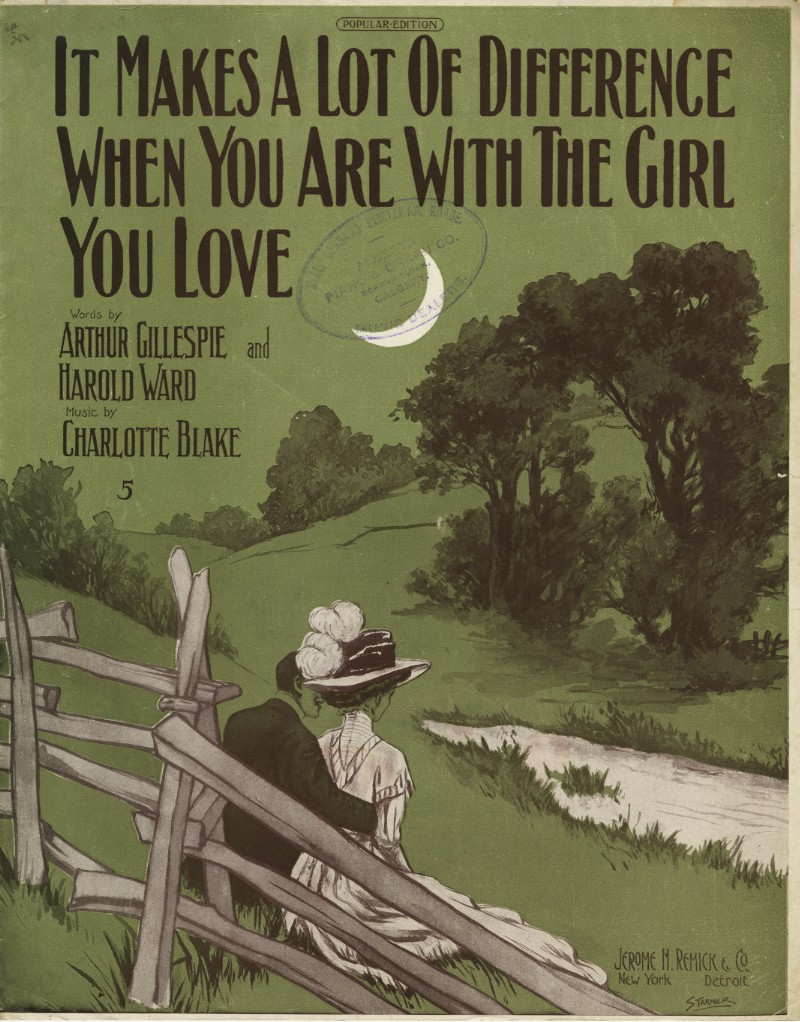
Harold Ward worked with Arthur Gillespie. Here is the sheet music for their song "It Makes a Lot of Difference When You Are with the Girl You Love" (1909). Charlotte Blake (1885-1979) wrote the music.


Writing as Zorro, Arthur Ward penned five novels of the pulp character Doctor Death. Three of these appeared in the pulp magazine Doctor Death in 1935. They were reprinted by Corinth Publications in 1966 with cover art by Robert Bonfils (1922-2018).

An article from the Sterling Daily Gazette, September 7, 1929, page 5, regarding two men who at one time or other called both Chicago and Whiteside County, Illinois, home.

Text copyright 2023 Terence E. Hanley

Wednesday, June 7, 2023

I.W.D. Peters (1870s?-1931)-The Second Woman Author

Née Idella W. Donnally
Aka Ida Donnally Peters, Ida D. Peters

Author, Telephone & Telegraph Operator
Born November 27, 1870s?, Callaghan, Alleghany County, Virginia
Died March 14, 1931, at home, Chastleton Hotel, Washington, D.C.

If you're going to write a biographical sketch of Idella W. Donnally Peters, you'll have to gather and assemble scattered bits of information and not rely on her obituary ("Mrs. Ida D. Peters, Writer, Is Buried" in the Washington, D.C., Evening Star, March 16, 1931, page 7). She was not born on a plantation near Monticello or Oak Hill in Virginia. Instead, she came into the world at Callaghan, a humble place situated in a narrow valley in western Virginia, in the shadows of mountains. Her father was not a doctor. Instead, he was a glovemaker. She is supposed to have attended Powell School in Richmond, Virginia, as well as Women's College of Richmond and what is now called Columbia University in New York City. Some of that can be squared with her work as a telephone and telegraph operator in Richmond. Then again, maybe it can't quite. She was born on November 27. Of that we can be sure. Her obituary doesn't give her age or the year of her birth, but her headstone does, as do census records. She was almost certainly not born in the 1880s, however. More likely, she was born in the early 1870s, possibly in the period 1871 to 1873.

Her father was Allan Donnally (1831-ca. 1905), who, on May 31, 1861, at age thirty, enlisted as a private in Company K, 14th Virginia Cavalry, in service of the Confederate States of America. He served for six months and was discharged on November 22, 1861. Donnally was a farmhand, a glovemaker, and a store clerk. In 1868, he married Margaret E. Dickson. In 1870, they were living in Covington Township, Alleghany County, Virginia. Callaghan, the place of Idella's birth, is in Alleghany County. I suspect she was born in about 1873, possibly a little earlier, possibly in about 1871. I base that on her later employment, in 1889 and after, as a telephone and telegraph operator, a job she could hardly have held at age six. She had an older brother, Charles E. Donnally. He may have been the same Elwood Donnally who died in November 1877 in Alleghany County at age eight.

I haven't found the Donnally family in the 1880 census. In 1888, Allan Donnally was working as a clerk in Richmond. He entered the Old Soldiers Home in Richmond in the 1890s or in 1900. He left that place in April 1900. The last record I have found for Allan Donnally is a census record: in June 1900, he was living in the county poorhouse at Boiling Spring in Alleghany County. He was a widower. An unsupported source on the Internet says that he died in about 1905.

So it may have been that Idella W. Donnally Peters was an only child and that she lost both of her parents when she was still young. There is so much we don't know about her or her family, including something as simple as her middle name. She lost a foot in a childhood accident and walked with a crutch. In 1889, 1891, 1892, and 1900, she was listed in the Richmond city directory as Ida W. Donnally, a telephone operator, with an address at Union Passenger Depot, 320 East Franklin Street. On February 16, 1902, she married (Emmett) Eugene Peters (1880-1933), a druggist, in Baltimore, Maryland. She was employed at the time by Western Union Telegraph Company in the same drugstore where her new husband worked.

In 1912, the Peters moved to Washington, D.C. In the census of 1920, they were enumerated in that city. Ida was employed as a writer for magazines. In 1930, they were in the same city, and she called herself an author of books. Ida D. Peters' obituary says that her early stories were "humorous Chinese sketches." I have no idea what that means. I have found mention of two of her books, Colonial Children and Girls of Long Ago (1930), the latter illustrated by Mabel Pugh (pictured below). She also wrote nonfiction, as well as short stories for children, and her "Sketches of Historic Personages" were broadcast on the radio. She was a member and district auditor of the District of Columbia League of American Pen Women. She died on March 14, 1931, at home in the Chastleton Hotel in Washington, D.C., and was buried at Rock Creek Cemetery, also in the nation's capital. Her husband died exactly two years later, on March 14, 1933, after having fallen out of a barn loft and fracturing his skull. They are at rest now, side by side, as their shared headstone reads, "Until the Glorious Resurrection."

* * *

I discovered the identity of I.D.W. Peters by looking at The FictionMags Index. There is a story--a single story--listed there by Ida Donnally Peters, "A Lover of Freedom," which appeared in Detective Story Magazine in the issue of June 29, 1920. Just two entries above that is the lone story by I.W.D. Peters, "The Gallows," which was in the inaugural issue of Weird Tales, March 1923. That was the connection, and it led after a little research to an answer to the question of "Who Was I.W.D. Peters?" Now we know. Thanks to The FictionMags Index.

* * *

I have a few more credits for her:

  • "The Girl of His Dreams" (short story) in the Boston Herald, Aug. 6, 1911, magazine section, p. 9.
  • "Woman: The Same Yesterday, Today and Forever" (Bible story) in The Woman's Magazine, St. Louis Star and Times, Jan. 16, 1912, p. 13.
  • "The Chinese Language" (nonfiction) in the Belleville (Illinois) News-Democrat, Sept. 7, 1912, p. 22.
  • "All on a Summer Night" (short story) in the Nashville Banner, Dec. 9, 1916, p. 17.

These works were probably all syndicated.

* * *

I.W.D. Peters' Story in Weird Tales
"The Gallows" (Mar. 1923)

Further Reading
"Mrs. Ida D. Peters, Writer, Is Buried" in the Washington, D.C., Evening Star, March 16, 1931, page 7.

I.W.D. Peters' Story:

"The Gallows" is yet another prison story, another story of marital infidelity, and another story of murder. It's told in the first person by a man named Traylor, who has killed a man with whom his wife was having an affair. Traylor is waiting to be hanged for his crime, and he wants to die.  He hopes that his wife's efforts to save him will fail. The story closes with a statement made by the prison warden, another example of an introduction or closing to a story that helps to illuminate or explain it.

"The Gallows" is brief, a mere three pages long and the first of what Weird Tales called a "five-minute story." It's a crime story, a love story (love gone wrong), and a confessional. There aren't any weird elements in it at all. The first issue of Weird Tales has several nonfiction fillers. We might as well say that it has several fictional fillers, too, "The Gallows" being one of them. A magazine made leaner would have left them all out.

Text copyright 2023 Terence E. Hanley

Sunday, June 4, 2023

F. Georgia Stroup (1882-1952)-The First Woman Author

Fannie Georgia Stroup was the first woman writer in Weird Tales, or I should say the first writer known to have been a woman. After all, two in that first issue used only their initials, while a third remained anonymous. She was born in Missouri in 1882 and lived in her youth in Kansas, where she worked as a schoolteacher. In 1909, at age twenty-seven, she married and moved to California with her new husband. Neither her marriage nor her sojourn in California lasted especially long. By 1930, she was back in the Midwest and living in Chicago. (I suspect she was in Chicago as early as 1922 or 1923, thus in the right spot to submit her story to Weird Tales.) In 1950, she was at the Wyndon Hotel in that city. F. Georgia Stroup died in 1952 at age seventy, presumably at East Moline State Hospital, in East Moline, Illinois, for that is where she lies buried. "The House of Death" was her only story for Weird Tales. In fact, it is her only known work of fiction. I have written about her before. Click here to read what I wrote.

F. Georgia Stroup's Story:

"The House of Death" is a sad story about a terrible event. It isn't a fantasy or a weird tale at all, though it isn't exactly mainstream, either. The story is set in a Kansas farmhouse. Its characters are three women who talk among themselves as they work in a house where a tragic death has occurred. One theme in the story is how hard life is for a farm wife. Another is of a kind of family curse, a common theme in weird fiction. The narrative is interrupted when the women find a letter that had been secreted away in a horsehair trunk in an upstairs room. The letter explains things in a way that the women could only have speculated about before they had read it. It decides them on what to do next.

"The House of Death" by F. Georgia Stroup is a sad and tragic story. I would rather show a happy picture and one of my favorites. Georgia wrote her story about farm life in Kansas. The photograph above is from a book about that same kind of life and that same place. The book is Farm Town: A Memoir of the 1930s, with photographs by J.W. McGanigal and text by Grant Heilman (Brattleboro, VT: The Stephen Greene Press, 1974). Georgia lived and worked in Miami and Linn counties, south of Kansas City. McGanigal lived and worked in Horton, in Brown County (the same county in which George Warburton Lewis was born), west of Atchison. This is a beautifully and perfectly made picture, taken at just the right instant. This man and this woman will forever be young and beautiful and in love. He will forever be her protector and provider, she forever his helpmate.

Text copyright 2023 Terence E. Hanley

Thursday, June 1, 2023

Capt. George Warburton Lewis (1878-1963)-The First Femme Fatale

Carpenter, Typesetter, Soldier, Author, Poet
Born February 20, 1878, near Old Fairview, Kansas
Died November 1, 1963, U.S. Veterans Hospital, The Bronx, New York

George Warburton Lewis was born on February 20, 1878, in prairie country, southeast of Old Fairview, Kansas. He was the son of Robert Lewis (ca. 1831-1893) and Rhoda E. Massey Lewis (1838-1890), both of whom died when he was still in his adolescence. Lewis attended school at Old Fairview and Fairview and worked as a typesetter at the Powhattan Bee. On April 30, 1898, he enlisted in the Kansas National Guard, beginning as a private with the 20th Kansas Infantry Regiment. Shortly after his enlistment, Lewis' unit was activated in the U.S. Army. He served under General Frederick Funston in the Philippines during and/or after the Spanish-American War. He was also in China during the Boxer Rebellion (1899-1901).

George W. Lewis seems to have been in and out and then back in the Army. By the time his first story for Weird Tales was published in March 1923, he had attained the rank of captain. Although he was nicknamed "General" by friends and acquaintances, Lewis rose no higher in rank than major or colonel. His headstone calls him captain. Impressively tall and slender, he was a drum major in the U.S. Infantry Band. He served in the military police in the Panama Canal Zone under George W. Goethals and in Haiti in about 1914. He was director general of revenue and acting treasurer of the Dominican Republic. In Puerto Rico, he was police chief and inspector general of the Puerto Rican Insular Police. Lewis also served in Liberia for two years and wrote a manual of instruction for the Liberian Army. By 1938, he had retreated to Arkansas for the sake of his health, also to write. During World War II, he was with the U.S. Department of War in the censorship division in New York City.

On December 22, 1930, Lewis married Zoraida Matus (1903-1984), a native of Puntarenas, Costa Rica, in Monrovia, Liberia. She was the daughter of Nicaraguan general and undersecretary of state Juan de Dios Matus. Zoraida studied at Columbia University and taught Spanish in Arizona and in New York City. Her husband spoke Spanish and several other languages. The Lewises lived in New York City. George W. Lewis died on November 1, 1963, at U.S. Veterans Hospital, in the Bronx, New York, and was buried at Arlington National Cemetery. His wife survived him by more than two decades and now lies by his side.

George Warburton Lewis had stories and articles published in magazines from 1909 to 1949, including three in Weird Tales and three in Detective Tales, all in 1923. He also had stories, articles, and poems in Action Stories, Adventure, The Cavalier, Ghost Stories, Homicide, The Kansas Magazine, Top-Notch Magazine, and other titles. He wrote a book about his life, Fifty Most Thrilling Experiences of My Life, plus at least three volumes of verse, including Poems of Panama (1916) and Songs of Tropic Trails (1928).

Capt. George Warburton Lewis' Stories in Weird Tales and Detective Tales

Weird Tales
  • "The Return of Paul Slavsky" (Mar. 1923)
  • "The Blade of Vengeance" (June 1923)
  • "The Outcasts" (July-Aug. 1923)

Detective Tales

  • "Doctor Dunraven's Discovery" (Mar. 1923)
  • "The Pink Mirador" (Apr./May 1923)
  • "The Snitchers" (July/Aug. 1923)
Further Reading
"Col. George W. Lewis" (obituary) in the Fairview Enterprise, November 21, 1963, page 2, plus several brief newspaper articles about his service in the U.S Army.

Capt. George Warburton Lewis' Story:

"The Return of Paul Slavsky" is a short story about crime and murder. There are six characters in Lewis' story, three detectives and three terrorists recently arrived in the United States from Russia. The terrorists are Paul Slavsky, his sister Olga, and an unnamed brother who looks like Paul. You can tell they're Russians because their name is Slavsky. Like the Germans in The Big Lebowski (1998), they are Nihilists.

"The Return of Paul Slavsky" is told cleanly and efficiently and without any of the purple prose so common in pulp magazines. Paul Slavksy is dispatched in less than a page. One and a half pages later, two of the detectives have Olga in custody. But then there is the ride on the train. Olga tells them that her dead brother is coming back to deliver vengeance on his killer. Then they see a man who looks a lot like him riding with them on the train. One of the detectives leaves the car to smoke. When he comes back, his partner is sleeping with his hat pulled down over his face. The third detective nabs the third Slavsky and brings him into their car. He isn't Paul after all. But why won't the sleeping detective wake up? And why does Olga have that look on her face? Why has she bitten into and drawn blood from her carmine lips? A final sentence, printed in italics, provides an explanation as to just what has happened here.

Captain Lewis was a police detective in Panama and Puerto Rico. His experience shows through in "The Return of Paul Slavsky," not only in his depiction of his three detectives but also in the efficiency and conciseness of his story, as if he were writing a police report. There are no writer's tricks, self-indulgences, or extravagances. "The Return of Paul Slavksy" is out of the ordinary for the first issue of Weird Tales. Yes, it's set in the United States and is a story of crime and detection, but there is an international element and an element of suspense in the story, and in Olga there is the first of her type in the magazine, the femme fatale. She might be the best and fullest of the female characters so far in the magazine. And of course there is the first example of the final, italicized sentence, printed that way for effect.

George Warburton Lewis (1878-1963).

Text copyright 2023 Terence E. Hanley